Yoga 108: Meaning, Sun Salutations & How to Prepare
Yoga 108 refers to one of the most enduring numbers in yoga tradition, appearing in sun salutation challenges, mala bead counts, sacred texts, and astronomical calculations that yogis have drawn meaning from for centuries. Whether you are preparing for a 108 sun salutation practice, trying to understand why the number matters, or looking to use a mala for meditation, this guide gives you the full picture from cultural context to physical preparation.
The physical demands of 108 Sun Salutations are genuinely significant. According to the American College of Sports Medicine, high-repetition bodyweight sequences like sun salutations produce cardiovascular responses comparable to moderate-intensity aerobic exercise, making preparation and pacing essential for safety, not optional extras.
This guide covers the origin and meaning of the number 108 in yoga, Hindu, Buddhist, and astronomical traditions, the full Surya Namaskar (Sun Salutation) sequence with alignment cues, the muscles and joints involved, a multi-week training plan, modifications for beginners and people with physical limitations, and what your body needs to recover after completing the practice.
What Does Yoga 108 Mean
Yoga 108 refers to the number’s role as a sacred constant across yoga practice, spiritual tradition, and natural mathematics, appearing in sun salutation counts, mala bead strings, Sanskrit texts, and ceremonial practice worldwide. It is not a single idea but a convergence of multiple traditions that each arrived at 108 independently.
In yoga practice, 108 is most commonly encountered in two contexts. The first is 108 Sun Salutations, a physical and devotional practice of completing 108 consecutive rounds of Surya Namaskar. The second is the 108-bead mala, a string of prayer beads used to count mantras or breath cycles during meditation.
The number also appears in yoga’s textual tradition. There are traditionally 108 Upanishads, the philosophical texts forming the basis of Vedanta philosophy. The 108 names of deities in Hindu tradition, including 108 names of Shiva and 108 names of Vishnu, further embed the number in devotional practice. It is not a coincidence. Across traditions, 108 carries the weight of completion.
Understanding what yoga 108 means changes how you approach a 108-round practice. It reframes the physical challenge as something with a deeper structure. That mental context, whether or not you hold any spiritual belief, can help sustain attention and effort across what is genuinely a long and demanding practice.
Key reasons 108 appears across yoga traditions:
- 108 Upanishads form the philosophical core of Vedantic yoga
- 108 names assigned to major Hindu deities in devotional chants
- 108 sacred sites (pithas) in Hindu pilgrimage tradition
- 108 beads on a mala for counting mantras or breaths
- 108 Sun Salutations practiced on solstices, equinoxes, and ceremonial dates
- 108 energy lines (nadis) said to converge at the heart center in yogic anatomy
Why Is the Number 108 Sacred in Yoga Tradition
The number 108 is considered sacred in yoga tradition because it appears at the intersection of Hindu cosmology, Buddhist practice, Jain philosophy, and ancient Vedic mathematics, making it one of the few numbers that carries equivalent weight across multiple spiritual systems. Its repeated appearance is treated not as coincidence but as evidence of a fundamental pattern in existence.
In Hindu tradition, 108 represents the wholeness of the universe. The Rig Veda, one of the oldest Sanskrit texts, contains 10,800 stanzas, a number structured around 108. Ancient Vedic mathematicians held certain numbers as cosmically significant, and 108 was among the most revered because of its mathematical properties and its recurrence in natural and celestial measurements.
In Buddhist tradition, 108 corresponds to the number of earthly desires or temptations that a practitioner seeks to transcend. Prayer beads in Tibetan Buddhist practice traditionally number 108 for this reason, as do the bells rung at Buddhist temples in Japan at the new year, precisely 108 times, one for each human transgression.
In Jain tradition, 108 represents the combined qualities of enlightened beings. The number carries a specific structural meaning: 4 times 3 times 3 times 3, representing the four qualities of the soul (infinite knowledge, infinite perception, infinite conduct, and infinite energy) multiplied by three states (good, neutral, and bad) across three realms.
Pose Tip:
- When practicing 108 Sun Salutations, many teachers divide the count into four groups of 27
- Each group of 27 can be associated with one of the four elements: earth, water, fire, air
- This structural approach helps maintain mental focus through the later rounds
108 in Mathematics, Astronomy, and Ancient Texts
The number 108 holds specific mathematical and astronomical properties that help explain why it appeared independently across cultures separated by thousands of miles and centuries. This is the least mystical angle on 108 and, for many practitioners, the most compelling.
The most frequently cited astronomical relationship is the one between the Earth, Sun, and Moon. The diameter of the Sun is approximately 108 times the diameter of the Earth. The average distance from the Earth to the Sun is approximately 108 times the diameter of the Sun. The average distance from the Earth to the Moon is approximately 108 times the diameter of the Moon. These are genuine astronomical ratios, though they are averages because both the Moon’s orbit and the Earth’s orbit are elliptical, not perfectly circular.
Mathematically, 108 is a Harshad number, meaning it is divisible by the sum of its own digits (1 plus 0 plus 8 equals 9, and 108 divided by 9 equals 12). It is also a multiple of 9 and 12, both of which carry significance in Vedic numerology. The number 108 can be expressed as 1 to the power of 1, times 2 to the power of 2, times 3 to the power of 3 (1 x 4 x 27 = 108), which ancient mathematicians found aesthetically and philosophically striking.
In Sanskrit, the classical language of yoga texts, there are said to be 54 letters in the Sanskrit alphabet, each with a masculine (Shiva) and feminine (Shakti) aspect, giving 108 total expressions. This linguistic interpretation reinforces the number’s presence in chant, mantra, and text-based practice.
| Context | Relationship to 108 | Type |
|---|---|---|
| Sun and Earth | Sun’s diameter is ~108x Earth’s diameter | Astronomical |
| Earth and Sun distance | Distance is ~108x Sun’s diameter | Astronomical |
| Earth and Moon | Moon distance is ~108x Moon’s diameter | Astronomical |
| Sanskrit alphabet | 54 letters x 2 (masculine/feminine) = 108 | Linguistic |
| Rig Veda | Contains 10,800 stanzas (108 x 100) | Textual |
| Harshad number | 108 divisible by digit sum (1+0+8=9) | Mathematical |
Key Takeaway: The number 108 is not arbitrary. Its recurrence across astronomy, mathematics, linguistics, and spiritual tradition gives it a cross-cultural legitimacy that no single tradition invented or owns.
108 Mala Beads and Their Role in Yoga Practice
A mala is a string of 108 beads used in yoga and meditation practice to count repetitions of a mantra, breath cycle, or intention during Japa meditation, which is the practice of repeated sacred sound or phrase. The mala functions as a physical counting tool that frees the mind from tracking numbers so attention can stay with the breath or mantra.
Traditional malas include 108 counting beads plus one larger guru bead, also called the meru bead, which marks the beginning and end of one full rotation. When the fingers reach the guru bead, the practitioner does not cross it but reverses direction and begins another round. This reversal is considered a sign of respect for the teacher or tradition the guru bead represents.
Malas are made from a range of materials. Rudraksha seeds are among the most traditionally significant in Hindu yoga practice, believed in tradition to carry specific vibrational properties. Sandalwood, tulsi wood, rose quartz, lapis lazuli, and bodhi seeds are all common materials, each carrying different traditional associations. From a purely practical standpoint, the material matters for durability, weight, and tactile feel during counting.
Using a mala during meditation is straightforward. Hold the mala in the right hand, draping it over the middle finger. Use the thumb to draw each bead toward you after each mantra repetition or breath cycle. The index finger is traditionally not used to touch the beads in many Hindu practices.
| Mala Material | Traditional Association | Practical Quality |
|---|---|---|
| Rudraksha seeds | Shiva, protection, grounding | Textured grip, durable |
| Sandalwood | Vishnu, calming, aromatic | Smooth, lightweight |
| Tulsi wood | Devotion, purification | Lightweight, fragrant |
| Rose quartz | Love, heart center | Smooth, heavier |
| Bodhi seeds | Buddhism, awakening | Medium weight, symbolic |
What Is Surya Namaskar and How Does It Connect to 108
Surya Namaskar (Sun Salutation) is a flowing sequence of 12 positions performed in continuous movement, traditionally practiced at dawn as a salutation to the sun and as a physical preparation for the rest of a yoga session. Its connection to 108 is direct: practicing 108 complete rounds of Surya Namaskar means moving through 1,296 individual positions in a single session.
The practice of Surya Namaskar likely entered mainstream Hatha yoga in the early 20th century, promoted significantly by the Rajah of Aundh, Bhawanrao Pant Pratinidhi, who published a physical practice guide in the 1920s. Earlier Vedic traditions included sun salutation prayers but not necessarily this exact physical sequence. The specific 12-position format became standardized through Hatha yoga lineages and was later incorporated into Ashtanga yoga as the opening sequence.
Each round of Surya Namaskar is practiced symmetrically: one round technically consists of two half-rounds, one leading with the right leg and one with the left. Some traditions count each half as one round, making 108 Sun Salutations either 108 full rounds (216 half-rounds) or 54 full rounds depending on the convention used. When preparing for a 108 practice, confirm which counting system your teacher or event uses.
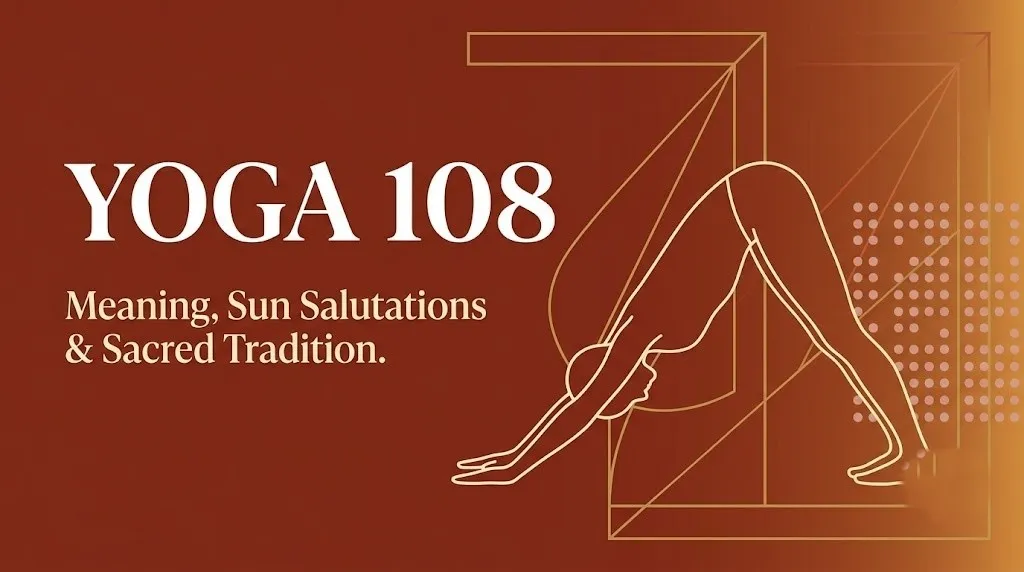
The physical demands scale with the number of repetitions. A single round of Surya Namaskar takes approximately 45 seconds to 90 seconds depending on pace. At that rate, 108 rounds requires 60 to 90 minutes of continuous movement, placing significant demands on the cardiovascular system, upper body endurance, and hip flexor capacity.
The Full Surya Namaskar Sequence: Step-by-Step
The full Surya Namaskar sequence consists of 12 positions practiced in one continuous flowing movement, linking breath to each transition. The sequence described here follows the classical Hatha yoga version used in most general yoga settings.
To practice one round of Surya Namaskar:
- Tadasana (Mountain Pose): Stand at the front of your mat. Feet together or hip-width apart. Hands at the heart in Anjali Mudra. Inhale to lengthen.
- Urdhva Hastasana (Upward Salute): Inhale. Sweep the arms overhead. Gaze up softly. Slight backbend. Keep the ribs from flaring.
- Uttanasana (Standing Forward Fold): Exhale. Fold forward from the hips. Bend the knees generously if the hamstrings are tight. Let the head hang.
- Ashwa Sanchalanasana (Low Lunge): Inhale. Step the right foot back. Right knee lowers to the mat. Front knee stays above the ankle. Gaze forward.
- Phalakasana (Plank Pose): Exhale. Step the left foot back. Body forms one straight line. Spread fingers wide. Wrists under shoulders.
- Chaturanga Dandasana (Four-Limbed Staff Pose): Exhale. Lower the body halfway. Elbows stay close to the ribs. Lower only to shoulder height. Modify by keeping knees down.
- Bhujangasana (Cobra Pose) or Urdhva Mukha Svanasana (Upward-Facing Dog): Inhale. Press the tops of the feet down. Lift the chest using spinal extension. Cobra keeps elbows bent; Upward Dog straightens them and lifts thighs off the mat.
- Adho Mukha Svanasana (Downward-Facing Dog): Exhale. Press hips up and back. Heels reach toward the floor. Spread fingers wide. Hold for one breath.
- Ashwa Sanchalanasana (Low Lunge, other side): Inhale. Step the right foot forward between the hands. Left knee lowers. Same alignment as step 4.
- Uttanasana (Standing Forward Fold): Exhale. Step the left foot forward. Fold completely.
- Urdhva Hastasana (Upward Salute): Inhale. Rise with a long spine. Arms sweep overhead.
- Tadasana (Mountain Pose): Exhale. Return hands to heart. Stand tall. This completes one half-round.
Modification for Chaturanga: Keep the knees on the mat until upper body strength develops sufficiently to maintain shoulder-height lowering with the knees up. This single modification is the most important safety adaptation for beginners beginning a volume practice.
Key Takeaway: Surya Namaskar is a 12-position sequence, and completing 108 rounds means moving through over 1,200 individual positions. Physical preparation is not optional; it is what makes the practice sustainable and safe.
Muscles and Joints Engaged in 108 Sun Salutations
The muscles and joints engaged in 108 Sun Salutations are spread across nearly the entire body, with the upper body, hip flexors, hamstrings, and lumbar spine bearing the highest cumulative load across a full 108-round session. Understanding which tissues are most stressed helps you train and modify intelligently.
The wrist joints experience the highest repetitive load in the sequence. Every Plank, Chaturanga, Cobra, and Downward Dog position places the wrists in extension under partial body weight. Across 108 rounds, the wrists sustain this load hundreds of times. Anyone with a prior wrist injury, carpal tunnel syndrome, or wrist instability should use fists, push-up handles, or forearm-supported modifications throughout.
The shoulder joint and rotator cuff are under significant demand in Chaturanga Dandasana specifically. Incorrect form in this pose, particularly elbows flaring wide rather than hugging the ribs, places the anterior shoulder capsule under shear stress. This is the single highest-injury-risk moment in the sequence.
The hip flexors, particularly the psoas and iliacus, experience repeated stretch and contraction in the Low Lunge position. After 40 or more rounds, hip flexor fatigue begins affecting pelvic alignment in Plank and Downward Dog, increasing lumbar load. Awareness of this pattern prevents compensation injuries.
Primary muscles engaged across the full sequence:
- Upper body: Deltoids, triceps, pectorals, serratus anterior, rotator cuff, trapezius
- Core: Transverse abdominis, rectus abdominis, erector spinae, multifidus
- Lower body: Hip flexors (psoas, iliacus, rectus femoris), hamstrings, quadriceps, gastrocnemius
- Spine: Lumbar extensors and flexors, thoracic extensors
Benefits of 108 Sun Salutations for Body and Mind
Completing 108 Sun Salutations produces measurable cardiovascular, muscular, and psychological benefits that go beyond a standard yoga session, primarily because the sustained duration and repetition drive adaptations that shorter practices do not reach.
From a cardiovascular perspective, a full 108-round session sustained over 60 to 90 minutes qualifies as moderate-intensity aerobic exercise. A study published in the International Journal of Yoga found that regular Surya Namaskar practice produced measurable improvements in cardiorespiratory endurance, muscular endurance, and flexibility over a 24-week intervention period, with participants showing changes comparable to moderate aerobic training programs.
The psychological effects are equally documented. According to the National Center for Complementary and Integrative Health, yoga practices that combine sustained movement with breath awareness produce reductions in self-reported anxiety and stress that persist beyond the session itself. The repetitive, rhythmic nature of 108 Sun Salutations produces a meditative state in many practitioners by the 30th to 40th round, as the thinking mind exhausts its commentary and settles into the movement pattern.
Benefits of a completed 108 Sun Salutation practice include:
- Improved cardiovascular endurance from sustained 60 to 90-minute moderate-intensity movement
- Muscular endurance gains in the shoulders, core, and hip flexors from high-repetition loading
- Increased flexibility in the hamstrings, hip flexors, and thoracic spine through repeated dynamic stretching
- Cortisol reduction and nervous system calming through the combination of rhythmic movement and breath
- Psychological confidence from completing a physically and mentally demanding practice
- A structured meditative experience that does not require stillness or prior meditation experience
How to Prepare for 108 Sun Salutations: A Training Plan
Preparing for 108 Sun Salutations requires a minimum of 4 to 6 weeks of progressive Surya Namaskar volume, building from a comfortable starting number to the full 108 without exposing the wrists, shoulders, or hip flexors to excessive cumulative load too quickly. Attempting 108 without preparation is how acute shoulder and wrist injuries occur.
Think of your wrists and shoulder joints like a rope bridge. Each Sun Salutation round is one crossing. A bridge rated for 10 crossings per day, suddenly asked to handle 108, will show structural stress at the weakest point. Your tissues need time to adapt to the repetitive pattern before the volume reaches the full count.
A 6-week preparation timeline for beginners:
| Week | Daily Rounds | Sessions Per Week | Focus |
|---|---|---|---|
| Week 1 | 10 to 12 | 4 | Form refinement, breath connection |
| Week 2 | 15 to 20 | 4 | Building rhythm, wrist monitoring |
| Week 3 | 25 to 30 | 4 | Adding volume, hip flexor awareness |
| Week 4 | 40 to 54 | 3 | Sustained endurance, pacing practice |
| Week 5 | 54 to 72 | 3 | Mental pacing, breath consistency |
| Week 6 | 81 to 108 | 2 to 3 | Full practice preparation, recovery focus |
Between practice sessions, wrist and shoulder mobility work prevents accumulated tightness. Gentle Garudasana (Eagle Pose) arm wraps for shoulder mobility and wrist circles in all directions before each session reduce injury risk across the training period.
Anyone managing a shoulder impingement, rotator cuff tear, wrist fracture history, or recent elbow surgery should discuss appropriate practice volume with their treating physiotherapist before beginning a progressive 108 training plan.
Key Takeaway: Six weeks of progressive training, starting from 10 to 12 rounds and building steadily, is the minimum preparation window before attempting the full 108. Wrists and shoulders are the highest-risk tissues and need the most attention.
How Long Does 108 Sun Salutations Take to Complete
Most practitioners complete 108 Sun Salutations in 60 to 90 minutes, with the exact duration depending on pace, the number and length of rest breaks taken, and whether the sequence includes Bhujangasana (Cobra) or the more demanding Urdhva Mukha Svanasana (Upward-Facing Dog) in the backbend position.
A moderate, sustainable pace for 108 rounds works out to approximately 45 seconds to 60 seconds per round, including the brief standing pause in Tadasana between rounds. At 60 seconds per round, 108 rounds takes exactly 108 minutes. At 45 seconds per round, the practice takes approximately 81 minutes. Most group 108 events run 75 to 90 minutes including brief water breaks.
The pace matters more than the total time. Going too fast in the early rounds, driven by energy and group excitement, is the most common pacing error. The wrists and shoulders do not fatigue in rounds 1 through 30. They fatigue in rounds 60 through 90, when form has degraded and there are still 30 more rounds remaining. Starting at 70% of your maximum pace and holding that rhythm protects the tissues that matter most in the later stages.
| Pace | Time per Round | Total Time for 108 Rounds | Risk Level |
|---|---|---|---|
| Fast | 30 to 40 seconds | 54 to 72 minutes | High (form breaks down) |
| Moderate | 45 to 60 seconds | 81 to 108 minutes | Optimal |
| Slow | 70 to 90 seconds | 126 to 162 minutes | Low but fatiguing |
| With breaks | 60 sec plus rest | 90 to 120 minutes | Recommended for beginners |
108 Sun Salutations for Beginners and Modifications
Beginners can participate in a 108 Sun Salutation practice safely by using modified versions of the most demanding poses throughout the entire session, not just at the end when fatigue sets in. The modification is the practice, not a concession to weakness.
The most important modification is replacing Chaturanga Dandasana (Four-Limbed Staff Pose) with a knees-chest-chin lowering or a simple lowering of the knees before the chest. This modification removes the eccentric shoulder load that most beginners cannot sustain safely across 108 repetitions. Making this change from round one is far smarter than starting with full Chaturanga and collapsing form by round 30.
The second most important modification is replacing Urdhva Mukha Svanasana (Upward-Facing Dog) with Bhujangasana (Cobra Pose). Cobra keeps the elbows bent and the load on the spine rather than the arms, which significantly reduces shoulder fatigue across the session.
Additional modifications for beginners:
- Replace Low Lunge with a wider-stance version, keeping the back knee on the mat throughout all 108 rounds
- Take a Child’s Pose (Balasana) rest between every group of 9 or 27 rounds rather than pushing continuously
- Use yoga blocks under the hands in Plank and Downward Dog to reduce wrist extension angle
- Replace standing Uttanasana with hands on thighs if the lower back or hamstrings tighten significantly
- Split the practice into two sessions of 54 if a first-attempt full 108 is not physically feasible
108 Sun Salutations Safety and Who Should Not Attempt It
Not everyone should attempt 108 Sun Salutations, and identifying the specific contraindications before the event is more useful than a generic caution to listen to your body. Certain conditions make the repetitive upper body loading and sustained cardiovascular demand genuinely risky.
The American College of Sports Medicine notes that any exercise program involving sustained moderate-intensity cardiovascular effort requires pre-existing baseline fitness. Someone who is completely sedentary and has never practiced yoga should not attempt 108 Sun Salutations as a first yoga experience. Building to the practice over the 6-week plan described above addresses this.
Specific conditions where the full 108 is not appropriate:
- Active rotator cuff tear or shoulder impingement: The repeated Chaturanga and Plank positions place direct load on already-compromised shoulder tissue.
- Carpal tunnel syndrome or wrist fracture history: Wrist extension under load is unavoidable in this sequence. Fist-supported or forearm-supported modifications may allow partial participation.
- Lumbar disc herniation: Repeated spinal flexion in forward folds and extension in backbends load the disc unevenly. A physiotherapist familiar with yoga can advise on safe range of motion limits.
- Uncontrolled cardiovascular conditions: 60 to 90 minutes of moderate-intensity movement is an aerobic demand requiring a healthy cardiovascular baseline.
- Pregnancy (second and third trimester): Prone positions like Cobra and Upward Dog are generally avoided after the first trimester. Prenatal yoga-specific adaptations exist but require teacher guidance.
- Recent surgery (any joint): Clearance from the surgical team is needed before resuming weight-bearing yoga sequences.
Pose Tip:
- Stop and rest in Balasana (Child’s Pose) any time form fails, pain appears, or breath becomes uncontrolled
- Uneven or gasping breath is the first reliable sign that you need to slow down or rest
- Completing fewer rounds with maintained form is always safer than completing 108 with collapsed mechanics
Key Takeaway: The 108 Sun Salutation practice is not for everyone on every day. Knowing the specific contraindications before you start, not after you are already on the mat, is how you practice responsibly.
Recovery After 108 Sun Salutations: What Your Body Needs
Recovery after 108 Sun Salutations typically involves 24 to 72 hours of elevated muscular soreness, particularly in the shoulders, triceps, hip flexors, and lumbar region, consistent with what exercise scientists call delayed onset muscle soreness (DOMS) following high-volume, unfamiliar movement patterns.
DOMS peaks at 24 to 48 hours after the session and resolves without intervention in most healthy adults within 72 hours. The soreness is not injury. It is the normal inflammatory response to eccentric muscle loading at a volume higher than the tissue has recently experienced. The muscles adapt to become more resilient through this process, provided adequate rest and nutrition follow.
According to the Journal of Bodywork and Movement Therapies, gentle active recovery movement, including slow walking, gentle stretching, and passive yoga poses, reduces DOMS duration more effectively than complete rest. For the day after 108 Sun Salutations, a 20-minute Restorative or Yin yoga session is far more beneficial than spending the day on the couch.
Active recovery practices for the 48 hours after 108 Sun Salutations:
- Day 1 post-practice: 20-minute Restorative yoga session. Focus on Supta Baddha Konasana (Reclined Bound Angle), Viparita Karani (Legs Up the Wall), and Balasana (Child’s Pose). No active sun salutations.
- Day 2 post-practice: Gentle walking for 20 to 30 minutes. Optional: 15-minute Yin yoga targeting hip flexors and shoulders.
- Hydration: Increased water intake in the 24 hours following the practice supports metabolic waste clearance from muscle tissue.
- Protein: Adequate dietary protein supports the muscle repair process. Yoga teachers and physical therapists generally recommend 0.7 to 1.0 grams of protein per pound of body weight on recovery days following high-volume movement.
- Sleep: The most effective recovery intervention. The majority of muscle repair occurs during deep sleep stages.
108 Sun Salutations on the Solstice and Equinox
The tradition of practicing 108 Sun Salutations on the summer solstice, winter solstice, spring equinox, and autumnal equinox is one of the most visible expressions of yoga 108 in contemporary practice. These dates are chosen because they mark the astronomical transitions of the solar year, making a sun salutation practice on these days symbolically coherent.
The summer solstice, typically June 20 or 21, is the most common date for community 108 Sun Salutation events worldwide. It is the longest day of the year in the Northern Hemisphere, when the sun is at its highest and the solar energy is considered at its peak. Practicing 108 Sun Salutations at sunrise on the summer solstice combines astronomical timing with the traditional dawn practice of Surya Namaskar into a single deliberate act.
The winter solstice version carries a different energy. It is practiced as a ritual of transition, acknowledging the darkest point of the year and the return of light. Many teachers frame the winter solstice 108 as a releasing practice rather than a celebration, using the repetition to process and let go of what no longer serves before the new year.
Spring and autumnal equinox 108 events are growing in frequency as yoga communities have formalized seasonal practice traditions. The equinoxes, when day and night are equal in length, are framed as practices of balance, which aligns naturally with yoga’s emphasis on equilibrium between effort and ease, strength and flexibility.
| Date | Astronomical Event | Symbolic Theme | Timing Tradition |
|---|---|---|---|
| June 20/21 | Summer Solstice | Abundance, peak solar energy | At sunrise |
| December 21/22 | Winter Solstice | Release, return of light | At dawn or sunset |
| March 19/20 | Spring Equinox | Balance, new beginnings | Anytime |
| September 22/23 | Autumnal Equinox | Harvest, equilibrium | Anytime |
How to Count 108 Sun Salutations Using Breath and Mala Beads
Counting 108 Sun Salutations accurately is more challenging than it sounds once the mind settles into a rhythm and loses track of the number. The three most reliable counting methods are mala beads, group verbal counting, and structured group division.
Using a mala: Move one bead per complete round. Some practitioners loop the mala around a wrist or ankle where it can be accessed during Tadasana at the top of each round. This is the most traditional counting method and connects the physical practice to the meditation tradition simultaneously.
Structured group division: Divide 108 into four groups of 27 rounds each. Mark each group with a brief resting pause in Balasana (Child’s Pose). This method is the most practical for independent practice because losing count within a group of 27 is a much smaller error than losing count at round 64 in a single continuous sequence.
Group verbal counting: In community events, a leader often calls the count aloud at specific intervals, such as every 9th or 27th round, so the group stays synchronized. This removes the counting burden from individual practitioners entirely.
The significance of 27 as a sub-unit of 108 is not arbitrary. Twenty-seven is one quarter of 108 and also the number of nakshatras (lunar mansions) in the Vedic astrological system. Each group of 27 in a 108 practice can be associated with one lunar mansion or one cardinal direction, giving the practice a meditative structure across its four parts.
Pose Tip:
- Place a small stone, bead, or token at the front of your mat after every 9 rounds
- When you count 12 tokens, you have reached 108
- This tactile counting method works when mental counting fails and you have no mala available
Key Takeaway: Counting 108 rounds accurately is a practice in itself. Divide into four groups of 27, use a mala, or use a physical token system. The method matters less than the consistency of whichever one you choose.
Frequently Asked Questions About Yoga 108
What does the number 108 mean in yoga?
The number 108 is sacred in yoga because it appears across Hindu cosmology, Buddhist tradition, Sanskrit linguistics, and astronomical ratios between the Earth, Sun, and Moon.
In practice, it is most commonly used as the count for Sun Salutation challenges and the number of beads on a mala used for mantra or breath meditation.
The number represents wholeness and completion across multiple traditions rather than any single meaning.
How long does it take to complete 108 sun salutations?
Most practitioners complete 108 Sun Salutations in 60 to 90 minutes at a moderate, sustainable pace of 45 to 60 seconds per round.
Beginners taking regular rest breaks between groups of 27 rounds may take 90 to 120 minutes for their first full practice.
Going faster than 45 seconds per round is not recommended because form breaks down in the later rounds when fatigue accumulates in the shoulders and wrists.
Can beginners do 108 sun salutations safely?
Beginners can participate safely by modifying Chaturanga Dandasana to a knees-down version and replacing Upward-Facing Dog with Cobra throughout the entire session, not just when tired.
A 6-week progressive training plan building from 10 to 12 rounds per session to the full 108 is recommended before attempting the complete practice.
Anyone who is new to yoga entirely should not attempt 108 Sun Salutations as a first practice; build a foundation of regular Surya Namaskar practice across several weeks first.
What muscles do 108 sun salutations work?
One hundred eight Sun Salutations engage the deltoids, triceps, rotator cuff, pectorals, serratus anterior, core (transverse abdominis and erector spinae), hip flexors (psoas and iliacus), hamstrings, and quadriceps across the full sequence.
The shoulders, wrists, and hip flexors bear the highest cumulative load and are the areas most likely to show fatigue or discomfort in the later rounds.
Strengthening these specific muscle groups during the preparation weeks significantly reduces injury risk on the day of the practice.
When do yogis traditionally practice 108 sun salutations?
The most traditional timing for 108 Sun Salutations is at sunrise on the summer solstice, honoring the sun at its annual peak.
Community events are now organized on all four solar transitions: the summer solstice, winter solstice, spring equinox, and autumnal equinox.
Individual practitioners also use significant personal dates, New Year’s Day, or the first day of a new season as occasions for the practice.
Start Where You Are
You do not need to attempt 108 rounds on your first try. Start with 12. Practice those 12 rounds three times this week with full attention on your breath and your Chaturanga form. That is the foundation everything else builds on.
Add rounds gradually over the coming weeks. Track how your wrists and shoulders feel the day after each session. Those signals tell you whether you are ready to add volume or need another week at your current count.
When you eventually roll out your mat for 108, you will know you are ready because the preparation will have made it feel inevitable.