Garland Pose Yoga: Benefits, How to Do It in 2026
Garland pose yoga, known in Sanskrit as Malasana, is a deep squat posture that opens the hips, stretches the ankles and groin, and engages the pelvic floor in ways that few other standing poses can match. It is one of the most functional yoga shapes a human body can make, and also one of the most misunderstood poses in terms of who can actually do it and why.
Research supports yoga’s role in improving hip mobility, pelvic floor function, and lower back health. According to the National Center for Complementary and Integrative Health (NCCIH), regular yoga practice is associated with measurable reductions in musculoskeletal pain, including chronic low back pain, a condition affecting an estimated 80 percent of adults at some point in their lives.
This guide covers everything from correct alignment and breath cues to honest modifications, population-specific adaptations, and the anatomical reasons some bodies genuinely cannot access a full squat. You’ll also find out where Malasana fits into a sequence, what the research says about its benefits, and when to skip it entirely.
What Is Garland Pose Yoga
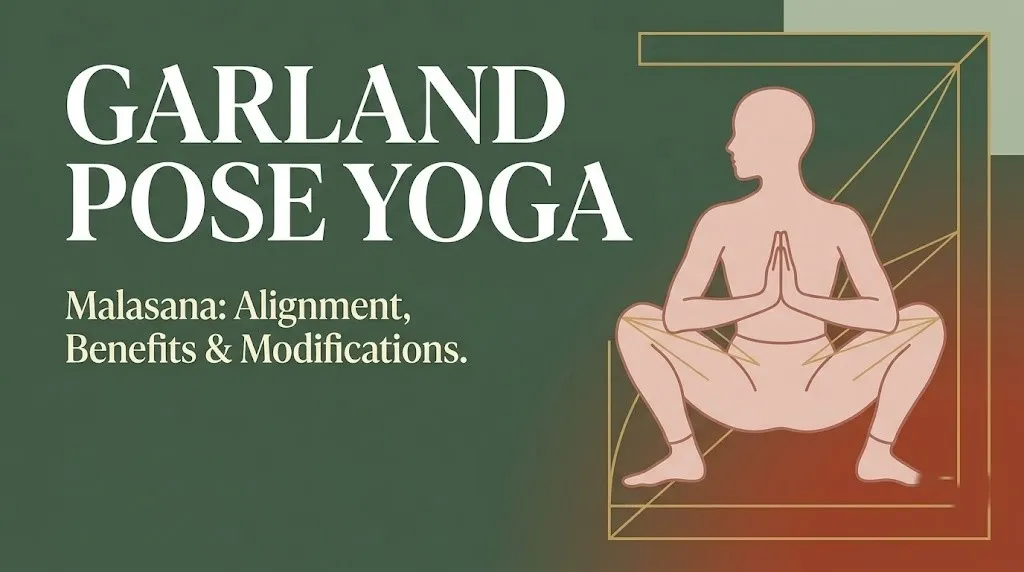
Garland pose yoga, or Malasana, is a seated deep-squat yoga posture in which the feet are flat or nearly flat on the floor, the knees are wide, and the torso descends between the thighs with the hands pressing together at the chest or reaching to the floor.
The Sanskrit word “mala” refers to a garland or rosary, and the pose is said to resemble the shape of a draped necklace. It appears across multiple yoga traditions, including Hatha, Vinyasa, and Ashtanga yoga, where it functions as both a hip opener and a transitional pose between standing and floor sequences.
Malasana is not simply a flexibility exercise. It is a functional movement pattern. The squat is one of the most primal human postures, and many physical therapists and movement researchers note that the ability to perform a comfortable, flat-footed squat is a reliable indicator of ankle dorsiflexion, hip mobility, and lower limb coordination working together.
That said, Malasana is one of the poses where individual anatomy matters enormously. Not every body can achieve the full expression of the pose regardless of how consistently they practice. The shape of the hip socket, leg length ratios, and ankle bone structure all play a role in determining what “full Malasana” looks like on any given body.
Pose Tip:
- The goal of Malasana is not a perfectly flat-heeled, deep squat at all costs
- The goal is a comfortable, supported squat with an upright torso and open hips
- Props are not a beginner shortcut; they are a permanent tool for practicing safely and effectively
Malasana Muscles Worked
Malasana (Garland Pose) engages a wide range of lower body and core muscles simultaneously, making it one of the most functionally complete postures in a basic yoga repertoire.
The primary muscles working in this pose include:
- Hip adductors (inner thigh muscles): lengthened and stretched as the knees push wide
- Hip external rotators (deep gluteal group, piriformis): activated to maintain knee-over-toe alignment
- Gluteus maximus: working eccentrically to control the depth of the squat
- Pelvic floor muscles (levator ani complex): gently activated and lengthened depending on squat depth
- Erector spinae: working to maintain spinal extension against gravity
- Gastrocnemius and soleus (calf muscles): strongly stretched as the heel attempts to stay grounded
- Achilles tendon: under consistent tensile load throughout the hold
- Transverse abdominis: engaged as a stabilizing core layer throughout
The ankle joint is central to the challenge of this pose. Adequate ankle dorsiflexion (the ability to flex the ankle so the shin moves toward the shin) is required to keep the heels flat. Research from the Journal of Bodywork and Movement Therapies consistently identifies restricted ankle dorsiflexion as the primary limiting factor in squat depth for adults who do not have structural hip restrictions.
The sacroiliac joint and lumbar spine also experience compressive forces in a deep squat. People with sacroiliac joint instability or disc-related lower back conditions should practice a supported or elevated version of the pose.
Garland Pose Benefits
The benefits of Malasana (Garland Pose) extend across mobility, pelvic health, digestion, and joint longevity, with the strongest evidence base applying to its effects on hip mobility and functional lower body range of motion.
Key documented and practitioner-supported benefits include:
- Hip mobility improvement: Regular practice of deep squat positions increases active and passive hip range of motion, particularly in external rotation and deep flexion, over time.
- Ankle dorsiflexion development: Holding the pose with heels grounded progressively lengthens the posterior ankle chain, including the Achilles tendon and calf complex.
- Pelvic floor engagement and release: Depending on squat depth and breath pattern, Malasana can both activate and gently lengthen the pelvic floor muscles.
- Lower back decompression: The spinal flexion available in a supported squat creates mild traction through the lumbar vertebrae, which many people experience as immediate relief from lower back tension.
- Digestive function support: Abdominal compression in the deep squat position is thought by yoga teachers and some gastroenterologists to stimulate peristalsis and support elimination.
- Core stability development: Maintaining an upright torso against gravity in the pose recruits the transverse abdominis and erector spinae together.
- Functional movement preservation: The deep squat pattern is a fundamental human movement. Maintaining access to it through Malasana practice supports long-term lower limb and hip joint health.
According to a 2019 review published in the International Journal of Yoga, yoga-based hip mobility interventions demonstrated measurable improvements in hip range of motion across multiple adult age groups after eight weeks of consistent practice.
Key Takeaway: Malasana is not just a hip stretch. It trains ankle mobility, pelvic floor awareness, spinal decompression, and functional squat mechanics all at once. That makes it one of the most efficient poses in a home practice.
How to Do Garland Pose Step by Step
Learning to enter Malasana (Garland Pose) correctly from the start prevents the most common injury patterns and establishes the alignment habits that make the pose accessible over time.
To practice Malasana:
- Begin in Tadasana (Mountain Pose) at the center of your mat, feet slightly wider than hip-width apart.
- Turn your toes out at roughly a 45-degree angle, adjusting slightly based on your hip anatomy.
- Bend your knees and begin to lower your hips toward the floor, moving slowly and with control.
- Descend until your hips are below your knee line, or as far as your heel contact and knee comfort allow.
- Press your upper arms against the inner thighs and bring your palms together at the chest in Anjali Mudra (prayer position).
- Use your elbows to gently press your knees wider while your knees simultaneously press back into your elbows. This is the key stabilizing action of the pose.
- Lengthen your spine upward. Resist the urge to round the upper back or tuck the tailbone aggressively.
- Breathe slowly and fully, allowing the belly to expand on each inhale.
- Hold for 5 to 10 breath cycles (approximately 30 to 60 seconds) to start.
- To exit, press through the feet, engage the thighs, and rise slowly back to Tadasana (Mountain Pose).
Modification for beginners: If the heels lift, place a folded blanket or yoga wedge under both heels before lowering into the squat. This immediately makes the pose accessible to most bodies.
Modification for knee sensitivity: Do not descend past the point where you feel any sharp or pinching sensation in the knee joint. A partially lowered squat, closer to Utkatasana (Chair Pose) depth, is a valid and productive practice position.
Garland Pose Alignment Cues
Correct alignment in Malasana (Garland Pose) is what separates a productive hip opener from a strain waiting to happen. The single most common alignment error is allowing the knees to cave inward toward each other, a pattern called knee valgus collapse.
The knees must track directly over the second and third toes throughout the pose. If your knees pull inward despite your effort to press them wide, the hip external rotators are not engaging adequately. Practicing Setu Bandha Sarvangasana (Bridge Pose) with a block between the thighs before your squat practice helps train these muscles to work correctly.
The spine deserves equal attention. Think of the crown of your head lifting straight toward the ceiling while your sitting bones reach toward the floor. These two directions create length rather than collapse. Many practitioners round the upper back in Malasana because the hip flexors and hamstrings pull the pelvis into a posterior tilt. Countering this requires active engagement of the erector spinae.
Garland Pose Alignment Checklist:
- Feet: toes turned out, heels as wide as or slightly wider than the hips
- Knees: tracking over the middle toes, pressing outward into the arms
- Hips: descending below knee line where possible, not forced
- Spine: lengthened upward, not collapsed or aggressively tucked
- Shoulders: relaxed away from the ears
- Gaze: forward or slightly downward, chin level
- Breath: diaphragmatic, expanding the belly on each inhale
According to the American College of Sports Medicine, maintaining neutral spinal alignment during loaded squat positions reduces compressive forces on the lumbar vertebrae and supports safe hip joint loading patterns.
Garland Pose Modifications for Beginners
Malasana (Garland Pose) is accessible to most beginners with the right modifications. The idea that you need to “earn” the pose through months of stretching is a yoga myth worth dropping immediately.
The most common barrier for beginners is not hip tightness. It is ankle dorsiflexion restriction. When the ankles cannot flex adequately, the heels lift, the body tips forward, and the knees strain to compensate. Addressing ankle restriction with a simple heel prop changes everything about the pose’s accessibility.
| Modification | Who It Helps | How to Apply |
|---|---|---|
| Folded blanket under heels | Tight ankles, beginners, older adults | Fold a firm blanket 2 to 3 inches thick; place under both heels before squatting |
| Block under sitting bones | Cannot reach squat depth, knee discomfort | Place a block at its lowest height under the sitting bones for a supported squat |
| Wall support behind back | Balance difficulties, lower back instability | Stand with back 6 inches from the wall; use wall contact to guide descent |
| Reduced depth squat | Knee pain, hip impingement | Stop descent at a comfortable point, even if hips are level with knees |
| Chair-seated version | Very limited mobility, post-surgical | Sit at the edge of a chair, feet wide, lean forward from hips to simulate squat position |
Starting with the folded-blanket-under-heels version is the recommendation for at least the first four to six weeks of practice. As ankle mobility improves gradually, the blanket thickness can be reduced incrementally. There is no timeline pressure. The body adapts to new ranges of motion slowly, and that is normal.
Garland Pose with Block and Props
Props in Malasana (Garland Pose) are not training wheels. They are precision tools that let you practice the correct muscle engagement, breath pattern, and spinal alignment without fighting your body’s current structural limits.
A yoga block placed under the sitting bones is one of the most effective prop uses in yoga practice. It elevates the hips just enough to allow the spine to remain upright, the knees to track correctly, and the pelvic floor to engage without strain. Think of it like adjusting the seat height in a car: the right position lets you operate the controls without tension, not because you are weak but because the geometry is correct.
How to use props in Malasana:
- Place a yoga block at its lowest height directly under the sitting bones, centered on the mat.
- Stand in front of the block with feet wider than hip-width, toes turned out.
- Lower the sitting bones onto the block, allowing the block to catch your weight.
- Press the upper arms against the inner thighs, hands in prayer position.
- Adjust the block height upward if the spine still collapses or the knees strain.
- Use a second block at medium height if the lowest height still feels too deep.
- For ankle support, layer a folded blanket under both heels simultaneously.
- Hold for 5 to 8 breaths, focusing on spinal length and knee tracking.
An eye pillow or bolster is sometimes used in restorative versions of Malasana to support the chest when folding forward. This is not a common version of the pose but is used in Restorative yoga sequences focused on pelvic floor release.
Key Takeaway: A block under the sitting bones and a folded blanket under the heels are the two most effective prop adjustments for Malasana. Use both until you no longer need them, which might take weeks or months, and that timeline is completely fine.
Garland Pose for Tight Hips and Ankles
Tight hips and restricted ankles are the two most common physical barriers to Malasana (Garland Pose), and they require different approaches. Conflating them leads to practitioners stretching the wrong tissue and wondering why nothing changes.
Ankle dorsiflexion restriction is often structural or fascial. The Achilles tendon and posterior ankle capsule may limit how far the shin can travel forward over the foot. This is not a hip problem. Calf stretches, ankle mobility drills, and heel elevation in Malasana all address this specifically. A simple test: if squatting with your heels on a 2-inch book makes the pose dramatically easier, ankle restriction is your primary limiter.
Hip restriction can come from muscular tightness in the adductors, external rotators, or hip flexors, or from structural features of the hip socket itself. The depth and angle of the acetabulum (the hip socket) varies significantly between individuals. Some people have naturally shallow sockets with wide range of motion. Others have deep sockets or high femoral anteversion angles that physically prevent a full squat regardless of flexibility work.
Poses that prepare tight hips and ankles for Malasana:
- Prasarita Padottanasana (Wide-Legged Standing Forward Bend): opens the inner groin and hamstrings
- Baddha Konasana (Bound Angle Pose): releases the hip adductors and external rotators in a supported position
- Utkatasana (Chair Pose): builds the quad strength and ankle engagement needed for a stable squat
- Downward-facing calf stretches at the wall: specifically target Achilles and gastrocnemius length
- Ankle circles (10 repetitions each direction): prepare the ankle joint capsule for dorsiflexion load
Physical therapists generally recommend addressing ankle dorsiflexion with at least four weeks of targeted mobility work before expecting significant change in squat depth.
Garland Pose Pelvic Floor Benefits
Malasana (Garland Pose) has a specific and documented relationship with the pelvic floor, the hammock-like group of muscles that spans the base of the pelvis and supports the bladder, bowel, and uterus in people who have a uterus.
In a deep squat, the pelvic floor muscles experience a combination of gentle lengthening (eccentric load) and mild activation, depending on squat depth and how the breath is managed. For people with a hypertonic (overly tight) pelvic floor, a supported Malasana practiced with a slow, full exhale can provide the release that targeted pelvic floor stretching often cannot.
For people with a hypotonic (weakened) pelvic floor, Malasana is used differently. Physical therapists specializing in pelvic health often use squatting positions to train the pelvic floor’s eccentric control, its ability to lengthen under load without losing activation. This is distinct from simply squeezing the pelvic floor in a neutral position.
According to research published in the Journal of Bodywork and Movement Therapies, squat-based exercises demonstrated statistically measurable effects on pelvic floor muscle activation patterns and were associated with reduced pelvic floor dysfunction symptoms in adult women across multiple trial groups.
Pelvic floor safety note: People with pelvic organ prolapse (grades 2 and above) should practice Malasana only under the guidance of a pelvic floor physical therapist. The deep squat position increases intra-abdominal pressure, which may not be appropriate for prolapse management without professional assessment of the individual’s specific condition and stage.
Garland Pose for Digestion and Lower Back
Malasana (Garland Pose) supports digestive function and lower back comfort through two distinct physical mechanisms that operate simultaneously in the pose.
For digestion, the primary mechanism is abdominal compression combined with the position of the colon. In a deep squat, the thighs press against the lower abdomen, and the change in intra-abdominal pressure is thought to stimulate peristalsis (the wave-like contractions of the intestinal wall that move contents forward). This is the same basic principle behind why a squat position on a squatting toilet platform is associated with more complete bowel elimination. Gastroenterologists and colorectal surgeons have noted the biomechanical efficiency of the squatted position for elimination, and yoga practitioners have applied this observation to Malasana for decades.
For lower back relief, the mechanism is spinal decompression through mild flexion. When the lumbar spine flexes slightly in a supported squat, the intervertebral spaces on the posterior side open marginally, which many people experience as immediate tension relief. This is why many people instinctively squat down when their lower back aches.
Digestion and lower back benefits at a glance:
- Abdominal compression gently stimulates intestinal motility
- Squatted position supports more complete muscle relaxation around the sigmoid colon
- Mild lumbar flexion creates posterior intervertebral space opening
- Hip flexor stretching reduces the anterior pelvic tilt that compresses lumbar discs
- Breath expansion into the belly in the pose gently massages the abdominal organs
Safety note for lower back: People with acute disc herniation or sciatica should not practice deep Malasana. The combination of lumbar flexion and hip loading may increase intradiscal pressure and worsen nerve compression. A standing, semi-squat version is a safer alternative until cleared by a spine-specialist physical therapist.
Key Takeaway: Malasana works on the digestive system and lower back through physical compression and mild spinal decompression. The two benefits are linked, and both improve with consistent, prop-supported practice rather than forced depth.
Garland Pose for Pregnancy
Malasana (Garland Pose) is widely used in prenatal yoga because the squatting position supports the natural descent of the baby’s head toward the pelvis in the third trimester, stretches the pelvic floor gently, and relieves common pregnancy-related lower back discomfort.
Prenatal yoga instructors and midwives often recommend supported squatting as part of birth preparation. The squat position allows the pelvis to open at its widest diameter, and consistent practice is thought to familiarize the pelvic floor muscles with the lengthening they will experience during delivery. Research on this specific outcome is limited in scale but consistently reported as positive in practitioner and midwifery literature.
Prenatal modifications for Malasana:
- Always use a block under the sitting bones from the second trimester onward.
- Keep the torso more upright than in a standard Malasana to avoid compressing the abdomen.
- Widen the feet further than the standard position to allow room for the belly.
- Use a wall or chair back for balance support as the center of gravity shifts.
- Limit hold time to 3 to 5 breath cycles and rest between repetitions.
- Stop immediately if pelvic girdle pain, pubic symphysis discomfort, or pressure in the pelvis increases.
Pregnancy safety note: Malasana in the first trimester is generally considered safe for women with uncomplicated pregnancies and prior yoga experience. Women new to yoga during pregnancy should begin prenatal yoga under the guidance of a certified prenatal yoga instructor rather than from written instructions alone. Anyone experiencing pregnancy complications, including placenta previa or cervical incompetence, should discuss all physical yoga practice with their obstetric care provider before continuing.
Garland Pose for Seniors
Malasana (Garland Pose) can be practiced safely by most older adults when adapted appropriately, and it offers specific benefits that are particularly relevant to aging bodies: hip joint mobility preservation, ankle dorsiflexion maintenance, and pelvic floor function support.
Loss of deep squat range of motion is common after age 60 and accelerates with sedentary patterns. When the ability to squat is lost, so is a meaningful portion of hip and ankle functional mobility. Maintaining even a partial squat position through consistent practice helps preserve the neuromuscular pathways that make lower-body movements like rising from a chair, climbing stairs, and stepping over obstacles more manageable.
According to the American College of Sports Medicine, yoga-based flexibility and mobility programs for adults over 65 demonstrate meaningful improvements in lower body range of motion, balance, and functional independence after 8 to 12 weeks of regular practice.
Senior-adapted Malasana options:
| Adaptation | Description | Who Benefits |
|---|---|---|
| Chair-seated forward fold | Sit at chair edge, feet wide, fold forward from hips | Very limited mobility, post-hip replacement |
| Wall-supported squat | Squat with back 6 inches from wall for support | Balance difficulties, vertigo concerns |
| Block-under-hips version | Block under sitting bones, elevated position | Early squat work, knee sensitivity |
| Partial squat (Utkatasana depth) | Stop descent well above full squat | Acute knee conditions, osteoporosis |
| Heel-elevated squat | Blanket under heels, full descent attempted | Ankle restriction, general senior practice |
Safety note for seniors with osteoporosis: Deep spinal flexion under compressive load can increase vertebral fracture risk in people with significant bone density loss. Seniors with diagnosed osteoporosis should use the chair-seated adaptation or wall-supported partial squat only, and should discuss yoga participation with their rheumatologist or physical therapist as part of their overall bone health management.
Garland Pose in a Yoga Sequence
Malasana (Garland Pose) works best when the joints and muscles it demands have been warmed up gradually, and when it is followed by poses that continue the hip opening or transition smoothly to the floor.
Placing a cold body directly into Malasana is one of the most reliable ways to strain the inner knee or strain the posterior ankle chain. Think of the hip adductors and ankle structures in this pose like cold rubber bands. They stretch without resistance when warm. They resist and snap when cold. Warming up properly is not optional.
Recommended Malasana sequence (35 to 40 minutes):
Warm-up (10 minutes):
- Tadasana (Mountain Pose), 1 minute: grounding and breath awareness
- Utkatasana (Chair Pose), 5 to 8 breaths: builds quad and ankle engagement
- Prasarita Padottanasana (Wide-Legged Standing Forward Bend), 5 to 8 breaths: opens inner groin
- Baddha Konasana (Bound Angle Pose) seated, 1 minute: releases hip external rotators
Main practice:
- Malasana (Garland Pose), 5 to 10 breaths: primary pose with block if needed
Cool-down (10 minutes):
- Uttanasana (Standing Forward Bend), 1 minute: releases hamstrings and lower back after squat load
- Setu Bandha Sarvangasana (Bridge Pose), 1 to 2 minutes: reestablishes hip extension after deep flexion
- Supta Baddha Konasana (Reclining Bound Angle Pose), 3 to 5 minutes: passive hip adductor release
- Savasana (Corpse Pose), 5 minutes: full rest and integration
This sequence works in both Hatha yoga and Vinyasa yoga contexts, with Vinyasa practitioners linking the warm-up poses with breath-movement synchronization and Hatha practitioners holding each shape longer.
Garland Pose Contraindications and Knee Safety
Malasana (Garland Pose) should be avoided or significantly modified by people with specific knee, hip, and spinal conditions, and understanding why matters more than simply knowing the list.
The knee joint in full flexion (as required in a deep squat) experiences compressive forces on the posterior joint capsule, the menisci, and the posterior cruciate ligament. For a healthy knee with intact structures, these forces are well within normal tolerance. For a knee with an acute or unresolved injury, they can aggravate the damaged tissue significantly.
Conditions that warrant modification or avoidance:
- Acute meniscus tear or recent meniscus surgery: full knee flexion compresses the menisci directly; avoid until cleared by a physical therapist
- ACL or PCL injury (acute phase): joint instability makes the rotational demands of a wide squat higher-risk; consult a sports medicine professional before attempting
- Severe knee osteoarthritis: cartilage degradation increases sensitivity to compressive load; a chair-based or partial-depth version is appropriate
- Sacroiliac joint instability: the wide-leg squat position can stress the SI joint; a narrower stance and reduced depth may be needed
- Acute lumbar disc herniation: lumbar flexion under load may increase intradiscal pressure; avoid until symptoms have stabilized
- Uncontrolled hypertension: deep forward fold positions (head below heart) may briefly increase intracranial pressure; a more upright squat position is safer
Key safety principle: Any sharp, pinching, or electric pain in any joint during Malasana is a signal to come out of the pose immediately. A sensation of mild muscular stretch is normal and expected. Pain is not.
Key Takeaway: The knee is the most vulnerable joint in Malasana. If you feel anything sharper than a deep muscular stretch in or around the knee at any depth, stop, add a prop, reduce depth, or skip the pose entirely until a physical therapist can assess what is happening.
Garland Pose vs Deep Squat
Malasana (Garland Pose) and a standard deep squat share the same fundamental movement pattern but differ in intention, alignment focus, and what the practitioner is trying to achieve. Understanding the difference helps you get more from each.
A conventional deep squat, as used in strength training, prioritizes mechanical loading of the quads, glutes, and posterior chain. The goal is muscular development and force production. Bar position, load management, and progressive overload are the relevant variables.
Malasana prioritizes joint opening, breath integration, spinal alignment, and sustained positional awareness. Load is the practitioner’s own bodyweight. Time under position (hold duration) matters more than repetitions. The hands pressing together at the chest create a closed-chain upper body engagement that deepens the chest opening and helps maintain spinal length.
| Feature | Malasana (Garland Pose) | Deep Squat (Strength Training) |
|---|---|---|
| Primary goal | Hip opening, breath, pelvic floor | Muscular strength, force production |
| Load | Bodyweight only | Bodyweight plus external load |
| Hold duration | 30 seconds to 2 minutes | 1 to 3 seconds (dynamic) |
| Upper body position | Hands at chest, elbows pressing knees | Varies by squat type (barbell, goblet, etc.) |
| Breath pattern | Deliberate, diaphragmatic | Braced (Valsalva maneuver for heavy loads) |
| Focus | Internal awareness, alignment | External output, performance |
| Yoga tradition | Hatha, Vinyasa, Ashtanga | Strength and conditioning |
Both the yoga squat and the strength squat require healthy ankle dorsiflexion, hip mobility, and knee stability. Practicing Malasana consistently can improve the mobility prerequisites that make loaded squatting safer and more effective. Yoga teachers and strength coaches increasingly recommend cross-training between the two approaches for this reason.
Frequently Asked Questions About Garland Pose Yoga
What is garland pose yoga good for?
Garland pose yoga (Malasana) is good for improving hip mobility, stretching the inner groin and ankles, supporting pelvic floor health, relieving lower back tension, and maintaining functional squat mobility.
It also stimulates digestive function through abdominal compression and supports the parasympathetic nervous system response when practiced with slow, deliberate breathing.
Most yoga teachers and physical therapists consider it one of the most functionally valuable hip-opening poses available to a home practitioner.
Why can’t I do garland pose even though I stretch regularly?
The most common reason is restricted ankle dorsiflexion, not hip tightness, which means the Achilles tendon and posterior ankle capsule are limiting how far the shin can travel forward.
Hip socket morphology (the actual shape of the bone) is another factor: some people have deeper or differently angled hip sockets that physically limit squat depth regardless of how flexible they are.
Placing a folded blanket under the heels immediately resolves ankle restriction for most people and is a valid long-term modification, not just a beginner fix.
How long should I hold garland pose?
Most yoga teachers recommend holding Malasana for 5 to 10 breath cycles for beginners, which equals roughly 30 to 60 seconds.
More experienced practitioners can extend to 1 to 3 minutes, particularly in Yin or Hatha yoga contexts focused on deep tissue release.
Start at the shorter end and increase hold time only after your body has adapted to the joint position and your alignment feels stable throughout.
Is garland pose safe during pregnancy?
Malasana is widely used in prenatal yoga and is considered safe for most women with uncomplicated pregnancies, particularly when practiced with a block under the sitting bones and feet wider than usual.
The deep squat position supports pelvic opening and is thought to help prepare the pelvic floor for delivery, which is why many midwives and prenatal yoga instructors recommend it in the third trimester.
Women with pregnancy complications, pelvic girdle pain, or placenta previa should discuss all physical yoga practice with their obstetric care provider before continuing or starting.
What props do I need for garland pose if I have tight ankles?
A folded blanket or yoga wedge placed under both heels is the single most effective prop for tight ankles in Malasana, immediately making the pose accessible by compensating for limited ankle dorsiflexion.
A yoga block under the sitting bones is the second most useful prop, preventing the hips from dropping past a comfortable depth and keeping the spine upright.
Together, these two props transform Malasana from an inaccessible shape into a comfortable, productive practice position for the vast majority of bodies.
Your Next Step on the Mat
Malasana is one of those poses that rewards patience more than effort. The practitioners who benefit most are the ones who show up consistently with a block under their hips and a blanket under their heels, not the ones who force their way into a deeper squat.
Start today with the beginner sequence: five minutes of calf stretches and ankle circles, then three rounds of Malasana with full prop support, held for six breaths each. Do that three times this week.
After four weeks, you’ll know exactly what your body needs next.