The Joy of Yoga: A Complete 2026 Practice Guide
The joy of yoga is real, it is accessible to nearly every body, and it does not require flexibility, experience, or a gym membership to find. Whether you are stepping onto a mat for the first time at 55 or returning after years away, yoga meets you exactly where you are.
The research backing this is substantial. According to the National Center for Complementary and Integrative Health (NCCIH), yoga is one of the most widely used mind-body practices in the United States, with an estimated 36 million Americans practicing regularly as of recent survey data. Studies published in the International Journal of Yoga consistently link regular practice to measurable reductions in stress hormones, improvements in sleep quality, and increased feelings of well-being.
This guide covers everything from the science of why yoga feels good to specific pose instructions, breathing techniques, prop guidance, and routines built for seniors, beginners, and people managing pain. You will walk away knowing exactly how to start, what to expect, and how to make yoga something you genuinely look forward to.
Joy of Yoga
The joy of yoga comes from its rare combination of physical release, mental quiet, and community belonging, all available in a single practice. It is not a fitness trend. It is an approximately 5,000-year-old system that has been adapted, studied, and refined across cultures and decades.
What makes yoga different from a conventional workout is that it asks you to pay attention. Every pose invites you to notice how your body feels, where tension lives, and where ease is possible. That awareness itself is part of the practice.
Yoga also has an unusually low barrier to entry. You do not need a baseline level of fitness to begin. A 2022 review in Complementary Therapies in Medicine found that beginners across age groups reported physical and psychological benefits within four to eight weeks of starting a twice-weekly practice.
The social dimension matters too. Many practitioners describe their yoga community as one of the most meaningful parts of their practice, whether that happens in a studio, a living room, or an online class.
Pose Tip:
- You do not need to touch your toes to practice yoga. Stiffness is a starting point, not a disqualifier.
- Every pose has a modification. Feeling challenged is fine; feeling sharp pain is not.
- The “goal” in yoga is not the advanced pose. It is the awareness you build on the way there.
Why Yoga Makes You Feel Good
Yoga makes you feel good because it activates the parasympathetic nervous system, reduces circulating cortisol, and increases levels of GABA, a calming neurotransmitter in the brain. These are not vague wellness claims. They are measurable physiological changes documented in peer-reviewed research.
Think of your nervous system as a toggle switch. Most modern lifestyles keep it stuck on “go,” which is the sympathetic (fight-or-flight) state. Yoga, particularly through its combination of movement, breath, and stillness, flips it toward “rest,” which is the parasympathetic state.
A study published in the Journal of Alternative and Complementary Medicine found that a single yoga session increased plasma GABA levels by 27% compared to a walking session of equal duration. GABA is the brain’s primary inhibitory neurotransmitter. Higher GABA is associated with lower anxiety and better mood regulation.
The physical component adds another layer. Moving through poses releases myofascial tension, improves circulation, and stimulates proprioception (your body’s internal sense of position and balance). That combination of mental and physical reset is a large part of why people leave yoga class feeling distinctly different from how they arrived.
| What Happens in Your Body During Yoga | What You Feel |
|---|---|
| Cortisol levels decrease | Less mental noise, reduced urgency |
| GABA levels increase | Calmer mood, reduced anxiety |
| Heart rate variability improves | Greater sense of ease and recovery |
| Myofascial tension releases | Physical lightness, less stiffness |
| Interoceptive awareness increases | Stronger mind-body connection |
Benefits of Yoga for Mental Health
Yoga offers documented mental health benefits, including reductions in anxiety, depressive symptoms, and perceived stress, across multiple population groups and yoga styles. According to the NCCIH, yoga is one of the most studied complementary approaches for mental health management.
A 2023 analysis published in Frontiers in Psychiatry reviewed 27 randomized controlled trials and found that yoga produced statistically meaningful reductions in anxiety and depression symptoms across adults, with the largest effects seen in people practicing at least twice weekly for eight weeks or longer.
Yoga is not a replacement for clinical mental health treatment. For someone managing a diagnosed anxiety disorder or major depression, yoga works best as an adjunct to professional care, not a standalone intervention. That said, physical therapists and mental health practitioners increasingly recommend yoga as a regulated, low-cost complement to therapy and medication.
The mindfulness component of yoga deserves specific attention. Yoga trains what researchers call interoceptive awareness: your ability to notice and interpret internal body signals. People with stronger interoceptive awareness tend to regulate their emotions more effectively.
Key mental health benefits supported by research include:
- Reduced perceived stress and burnout
- Decreased anxiety symptoms in generalized anxiety populations
- Improved mood and emotional regulation
- Better sleep quality, particularly in people with insomnia
- Reduced depressive symptoms, especially in populations with mild to moderate depression
Key Takeaway: Yoga’s mental health benefits are not placebo. They are linked to measurable changes in cortisol, GABA, and nervous system activation. Twice weekly is the research-supported minimum to begin seeing these effects.
Best Yoga Style for Beginners
Hatha yoga is generally the most accessible starting point for beginners because it moves at a slower pace, holds poses longer, and prioritizes alignment over flow. It is the traditional umbrella from which most modern yoga styles have developed.
Here is where many beginners get confused: “Hatha” is sometimes used as a catch-all for any physical yoga, and sometimes as a specific slow-paced class designation. When you see “Hatha” on a class schedule, expect a measured, alignment-focused session rather than a fast-moving sequence.
Vinyasa yoga links breath to movement in a continuous flow. It is more cardiovascular than Hatha, more dynamic, and generally more physically demanding. Beginners with an athletic background often find Vinyasa accessible, but it can be overwhelming if you are still learning pose names and form.
Yin yoga is not the same as “slow Hatha,” a common mischaracterization. Yin specifically targets the connective tissue (fascia, ligaments, joint capsules) through long passive holds, typically two to five minutes per pose. It is excellent for people who carry a lot of muscular tension and want deeper tissue work.
Restorative yoga uses props extensively to support the body in passive positions. It asks almost nothing of your muscles and everything of your nervous system. It is a particularly good entry point for people recovering from illness, managing chronic fatigue, or returning to movement after injury.
| Yoga Style | Pace | Best For | What to Expect |
|---|---|---|---|
| Hatha | Slow to moderate | True beginners, alignment learning | Held poses, verbal cues, foundational |
| Vinyasa | Moderate to fast | Active beginners, those who like flow | Breath-linked movement, sequences |
| Yin | Very slow | Tension, stress, flexibility focus | Long passive holds, floor-based |
| Restorative | Still | Recovery, fatigue, nervous system reset | Fully supported, bolster-heavy |
| Iyengar | Slow, precise | Injury recovery, detail-oriented | Props emphasized, exact alignment |
| Kundalini | Varied | Breathwork and energy focus | Repetitive movement, chanting, pranayama |
Yoga Poses for Beginners
The most effective starting poses for beginners are Tadasana (Mountain Pose), Balasana (Child’s Pose), Adho Mukha Svanasana (Downward-Facing Dog), Setu Bandha Sarvangasana (Bridge Pose), and Savasana (Corpse Pose).
These five poses together teach the fundamentals: how to ground through your feet, how to lengthen the spine, how to weight the hands safely, how to strengthen the posterior chain, and how to consciously relax.
Tadasana (Mountain Pose) is the foundation of all standing poses. It looks simple, but it actively engages the tibialis anterior, quadriceps, and erector spinae while training postural awareness.
To practice Tadasana (Mountain Pose):
- Stand with feet hip-width apart, outer edges parallel.
- Press all four corners of each foot into the floor evenly.
- Engage your quadriceps gently without locking the knees.
- Draw your lower abdomen in slightly to support the lumbar spine.
- Roll your shoulders back and down, arms alongside your body.
- Lengthen through the crown of your head. Breathe here for 5 full breath cycles.
To practice Balasana (Child’s Pose):
- Kneel on the mat, big toes touching, knees either together or wider than hips.
- Sit your hips back toward your heels as far as comfortable.
- Extend your arms forward on the mat or rest them alongside your body.
- Let your forehead rest on the mat or on a folded blanket.
- Breathe into the back of your ribcage for 5 to 10 breath cycles.
Modification for Balasana: If your hips do not reach your heels, place a folded blanket or bolster between your thighs and calves. This removes compression from the knee joint and makes the pose sustainable for people with tight hip flexors or knee sensitivity.
Safety note: Anyone with active knee injuries should approach Balasana cautiously. If hip flexion past 90 degrees causes pain, skip it and substitute Viparita Karani (Legs Up the Wall Pose) instead.
How to Start a Home Yoga Practice
Starting a home yoga practice requires three things: a safe space, consistent timing, and a clear starting sequence you can return to every time. You do not need a dedicated yoga room or professional equipment.
The biggest mistake beginners make at home is trying to improvise their practice before they have a foundation. Watching a random YouTube sequence without understanding basic alignment leads to frustration and injury. Instead, commit to one beginner sequence for four weeks. Repetition builds both muscle memory and confidence.
Your space needs to be large enough for your mat plus about two feet on each long side. A living room, bedroom, or even a cleared garage works. The floor should be non-slip. If you have hardwood floors, use a mat with a textured base.
To start your home yoga practice:
- Clear a dedicated space. Remove clutter in your immediate area.
- Choose a consistent time. Morning or evening both work. Consistency matters more than timing.
- Pick a beginner sequence of 5 to 6 poses and practice the same sequence for at least 3 weeks.
- Set a timer for 20 minutes. Do not worry about doing more.
- End every session with at least 3 minutes in Savasana (Corpse Pose).
- Gradually add one new pose per week as the basics feel stable.
According to the American College of Sports Medicine, establishing a movement routine at home is more likely to be sustained when it is attached to an existing daily habit, such as morning coffee or evening wind-down time.
How Often Should You Do Yoga to See Results
Most yoga teachers and physical therapists recommend practicing two to four times per week to see measurable physical and mental results within four to eight weeks.
One session per week maintains what you have but rarely builds on it. Two sessions per week begins to shift your nervous system baseline, improve mobility, and build postural muscle strength. Three to four sessions per week produces more rapid flexibility gains and stronger mental health outcomes according to research published in the International Journal of Yoga.
Daily practice is beneficial but not mandatory. Many experienced practitioners take one or two rest days per week to allow connective tissue recovery, particularly after more demanding styles like Vinyasa or Ashtanga.
| Practice Frequency | Expected Outcome Timeline | Best For |
|---|---|---|
| 1x per week | Slow progress, mainly stress relief | Maintenance, very busy schedules |
| 2x per week | Noticeable changes in 6 to 8 weeks | Beginners, sustainable building |
| 3 to 4x per week | Faster flexibility and mental gains | Committed beginners, injury recovery |
| Daily | Deepest progress, requires varied intensity | Experienced practitioners |
Duration matters as well. A focused 20-minute session is more valuable than a distracted 60-minute one. For beginners, 20 to 30 minutes is a realistic and effective starting target.
Key Takeaway: Two sessions per week is the research-supported floor for seeing real mental and physical changes from yoga. Consistency over four to six weeks matters far more than session length.
Yoga for Stress and Anxiety Relief
Yoga reduces stress and anxiety by lowering cortisol, the body’s primary stress hormone, and activating the relaxation response through slow, controlled movement and breath. This is one of the most replicated findings in yoga research.
According to the Harvard T.H. Chan School of Public Health, chronic stress keeps the body in a state of prolonged sympathetic activation, which over time damages cardiovascular health, disrupts sleep, and impairs immune function. Yoga is one of the few practices that directly interrupts this cycle through a combination of physical and cognitive tools.
Specific poses are particularly well-suited for acute stress relief:
- Viparita Karani (Legs Up the Wall Pose): Inverts the legs passively, reduces heart rate, and shifts blood flow toward the core. Excellent for end-of-day stress release.
- Balasana (Child’s Pose): Forward folds activate the parasympathetic nervous system. Even two minutes in this position lowers perceived urgency.
- Setu Bandha Sarvangasana (Bridge Pose): Opens the chest, strengthens the posterior chain, and counteracts the physical posture of anxiety (collapsed chest, forward head).
- Savasana (Corpse Pose): The most underestimated pose in yoga. Three to five minutes of conscious stillness allows the nervous system to consolidate the practice’s effects.
A 2020 study in Complementary Therapies in Medicine found that an eight-week yoga intervention reduced salivary cortisol levels by a measurable margin in adults reporting high stress, with participants who practiced at home between sessions showing greater reductions than class-only participants.
Yoga and the Nervous System
Yoga influences the autonomic nervous system by increasing parasympathetic tone and reducing sympathetic dominance, which means it actively trains your body to recover from stress more efficiently over time.
The vagus nerve is the key mechanism here. It is the primary nerve of the parasympathetic system, running from the brainstem through the heart, lungs, and digestive organs. Yoga practices that involve slow exhalations, gentle inversions, and diaphragmatic breathing all stimulate vagal tone.
Higher vagal tone is associated with better heart rate variability, more stable emotional responses, and faster recovery from stressful events. Think of vagal tone like the suspension system in a car: the better it functions, the smoother the ride over rough terrain.
According to research published in the Journal of Alternative and Complementary Medicine, yoga practitioners show measurably higher heart rate variability than age-matched non-practitioners, suggesting long-term nervous system adaptation.
Key nervous system effects of regular yoga practice:
- Increased parasympathetic tone over time
- Improved heart rate variability
- Lower resting cortisol levels
- Better regulation of the stress response
- Reduced inflammatory markers in chronic stress populations
Modification note: For people with dysautonomia or postural orthostatic tachycardia syndrome (POTS), standard inversions and rapid standing sequences may not be appropriate. A yoga teacher trained in therapeutic yoga or a physiotherapist should guide modifications in these cases.
Pranayama Breathing Techniques for Beginners
Pranayama, the yogic practice of breath regulation, is one of yoga’s most accessible and research-supported tools. It does not require a mat, a class, or flexibility.
The three most beginner-friendly pranayama practices are diaphragmatic breathing, ujjayi breath, and nadi shodhana (alternate nostril breathing). Each targets the nervous system slightly differently but all promote parasympathetic activation.
Diaphragmatic breathing is the foundation. Most adults breathe shallowly into the upper chest, which keeps the sympathetic nervous system mildly activated. Breathing into the lower belly and back ribs engages the diaphragm fully and signals safety to the nervous system.
To practice diaphragmatic breathing:
- Sit or lie comfortably. Place one hand on your lower belly.
- Breathe in slowly through the nose for a count of 4. Feel your belly rise.
- Pause briefly at the top of the inhale.
- Exhale slowly through the nose for a count of 6. Feel your belly fall.
- Repeat for 5 to 10 cycles before your yoga practice or any time you feel stressed.
Ujjayi breath adds a slight constriction at the back of the throat, creating a soft ocean sound. It is used throughout Vinyasa and Ashtanga classes to maintain focus, regulate breath pace, and generate internal heat.
Nadi shodhana (alternate nostril breathing) alternates breath between the left and right nostrils. A 2013 study in the International Journal of Yoga found that regular nadi shodhana practice improved spatial memory scores and reduced anxiety scores in study participants over four weeks.
Key Takeaway: Pranayama works even on days you cannot do a full yoga session. Five minutes of diaphragmatic or alternate nostril breathing produces measurable shifts in nervous system state.
Yoga for Back Pain and Flexibility
Yoga is one of the most studied non-pharmacological approaches for chronic low back pain, with strong evidence supporting its effectiveness for reducing pain intensity and improving functional mobility. The NCCIH specifically lists yoga as a recommended complementary approach for chronic low back pain management.
The poses most beneficial for the lower back address three primary contributors to pain: tight hip flexors, weak posterior chain muscles, and poor thoracic mobility. Think of the hip flexors like a bungee cord held in a shortened position all day by sitting. They pull the lumbar spine into anterior tilt, compressing the lower back. Yoga systematically releases and counterbalances this.
Most effective poses for back pain and flexibility:
- Setu Bandha Sarvangasana (Bridge Pose): Strengthens the gluteus maximus and hamstrings while releasing the hip flexors passively on the rested side.
- Balasana (Child’s Pose): Gently tractions the lumbar spine and relaxes the erector spinae.
- Supta Matsyendrasana (Supine Spinal Twist): Releases the paraspinal muscles and piriformis. Excellent for sacroiliac joint tension.
- Adho Mukha Svanasana (Downward-Facing Dog): Decompresses the lumbar spine through axial lengthening and stretches the hamstrings and calves.
Safety note: Anyone with a herniated disc, active sciatica, or spinal stenosis should avoid deep forward folds and unsupported twists. A yoga teacher with therapeutic training or a physical therapist should screen poses before practice begins. Forward folds that flex the spine (like rounding into a seated forward bend) can aggravate disc injuries rather than relieve them.
Modification for Adho Mukha Svanasana: If hamstrings are very tight, bend the knees generously. The priority is a long spine, not straight legs.
Yoga Props for Beginners
Yoga props are not training wheels. They are precision tools that make poses more anatomically accurate and more accessible to more bodies. According to Iyengar yoga methodology, which pioneered the modern use of props, a well-placed block or strap allows a practitioner to experience the correct alignment of a pose regardless of their current flexibility or strength.
The four essential props for beginners are:
- Yoga blocks (two recommended): Used to bring the floor closer to you in standing folds, support the hips in seated poses, and modify weight-bearing in arm balances. Cork blocks are more stable; foam blocks are lighter and softer.
- Yoga strap: Extends your reach in forward folds, supported stretches, and shoulder-opening poses. A 6-foot strap works for most bodies; taller practitioners may prefer 8 feet.
- Yoga bolster: A firm, cylindrical or rectangular cushion used in Restorative yoga and Yin holds to support the body in passive positions. A folded blanket can substitute.
- Yoga blanket: Provides cushioning under knees, padding under the seat, and warmth in Savasana. A folded bath towel works as a substitute in the beginning.
| Prop | Primary Use | Budget Alternative |
|---|---|---|
| Two yoga blocks | Bring floor closer, support hips | Stacked hardcover books |
| Yoga strap | Extend reach, deepen stretches | Neckties or fabric belt |
| Bolster | Passive support in restorative poses | Firm couch cushion or folded blankets |
| Yoga blanket | Cushion, warmth, seated support | Folded bath towel |
| Non-slip mat | Safe foundation for all poses | Rubber-backed area rug (temporary) |
A quality yoga mat matters more than any other single purchase. Look for 4 to 6mm thickness for cushioning, a non-slip surface texture, and dimensions of at least 68 inches long (72 inches or longer for people over 5’8″).
Chair Yoga for Seniors
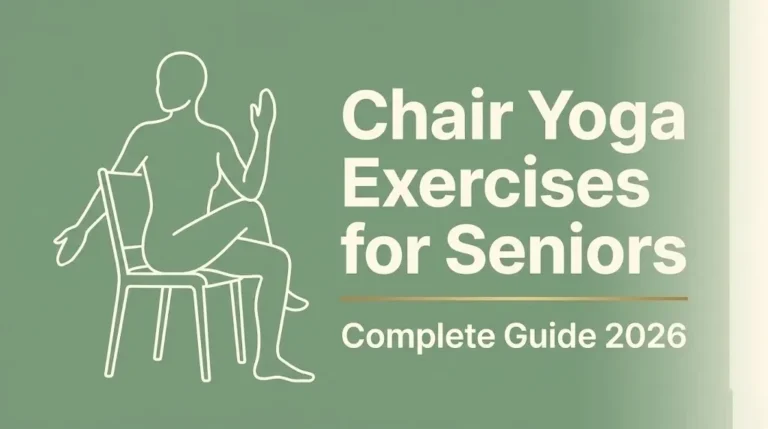
Chair yoga is a fully legitimate and research-supported yoga practice that uses a sturdy chair as the primary prop, making poses accessible to older adults, people with balance challenges, and those who cannot easily get to the floor. It is not a diminished version of yoga. It is yoga adapted intelligently for the body.
According to a study published in the Journal of Alternative and Complementary Medicine, older adults who participated in an eight-week chair yoga program showed improvements in lower body strength, flexibility, and self-reported pain levels compared to a control group. Balance improvements were also noted, which is particularly relevant given that falls are a leading cause of injury in adults over 65.
A foundational chair yoga sequence includes:
- Seated Tadasana (Seated Mountain Pose): Sit tall with feet flat on the floor, hip-width apart. Spine long, shoulders relaxed. Hold for 5 breath cycles.
- Seated Cat-Cow (Seated Marjaryasana-Bitilasana): Inhale, arch the spine gently and lift the chest (Cow). Exhale, round the spine and draw the navel in (Cat). Repeat 6 to 8 times.
- Seated Forward Fold: Exhale and hinge forward from the hips, letting your hands rest on your thighs or toward the floor. Hold for 3 to 5 breaths. Keeps the hamstrings long and decompresses the lumbar spine.
- Seated Eagle Arms (Seated Garudasana arms): Cross one arm under the other at the elbow, wrap forearms, and lift elbows. This opens the upper back and thoracic spine. Hold each side for 5 breaths.
- **Seated *Vrksasana* (Tree Pose variation):** Place the sole of one foot on the inner calf of the opposite leg. Use the chair back for balance support. Trains proprioception safely.
Anyone with severe osteoporosis should avoid spinal flexion in forward folds. A yoga teacher trained in senior or therapeutic yoga can offer individualized modifications based on bone density and joint health.
Key Takeaway: Chair yoga delivers genuine physical and mental benefits for older adults, including improved strength, flexibility, and balance. A chair does not limit the practice. It makes the practice possible.
Yoga Modifications for People with Limited Mobility
Yoga modifications are specific adjustments to pose structure that maintain the therapeutic goal of a pose while removing demands the body cannot safely meet. Every pose in yoga has at least one modification, and many have five or more.
The principle guiding modifications is simple: change the approach, not the goal. If the goal of Adho Mukha Svanasana (Downward-Facing Dog) is to decompress the spine and stretch the posterior chain, then a hands-at-the-wall version achieves the same neurological and muscular effects without weight-bearing on the wrists or requiring hamstring length.
Common modifications by condition:
| Condition | Pose to Modify | Modification Approach |
|---|---|---|
| Wrist injury or carpal tunnel | Downward-Facing Dog | Use fists, forearms, or hands-at-wall version |
| Knee sensitivity | Child’s Pose, Hero Pose | Bolster between thighs and calves; avoid if acute injury |
| Low back pain (acute) | Forward folds | Bend knees deeply; avoid spinal rounding |
| Hip replacement | Cross-legged sitting | Sit in a chair; avoid deep hip external rotation |
| Shoulder injury | Plank, Chaturanga | Drop to knees; avoid full weight-bearing on arm |
| Osteoporosis | Seated forward folds | Hinge from hip only; avoid spinal flexion |
| Balance challenges | Tree Pose, Warrior III | Use a wall or chair back for support |
The most important modification principle: if a pose causes sharp, shooting, or radiating pain, stop immediately. Yoga discomfort should feel like work or gentle stretching. It should never feel like pinching, nerve sensations, or acute joint pain.
Anyone managing a specific medical condition should speak with the treating clinician before beginning a new yoga practice, particularly if that condition involves the spine, cardiovascular system, or recent surgery.
How to Build a Morning or Evening Yoga Routine
A morning yoga routine works best when it focuses on awakening the body: warming the spine, activating the core, and building circulation. An evening routine works best when it focuses on release: calming the nervous system, releasing the day’s accumulated tension, and preparing the body for sleep.
These are not the same practice and they should not be treated as interchangeable.
Morning yoga routine (20 minutes):
- Seated diaphragmatic breathing (3 minutes): Set the breath rhythm for the session.
- Seated Cat-Cow (Marjaryasana-Bitilasana) (2 minutes): Warms the spine gently.
- Adho Mukha Svanasana (Downward-Facing Dog) (5 breath cycles): Awakens hamstrings, shoulders, and spinal length.
- Virabhadrasana I (Warrior I Pose) (5 breaths per side): Builds heat, hip flexor length, and postural strength.
- Tadasana (Mountain Pose) (5 breaths): Grounds and integrates.
- Savasana (Corpse Pose) (3 minutes): Allows the body to absorb the practice.
Evening yoga routine (20 minutes):
- Viparita Karani (Legs Up the Wall Pose) (5 minutes): Reverses the leg fatigue of the day and activates the parasympathetic system immediately.
- Supta Matsyendrasana (Supine Spinal Twist) (3 minutes per side): Releases paraspinal tension accumulated from sitting.
- Balasana (Child’s Pose) (3 to 5 minutes): Deep rest for the nervous system.
- Nadi shodhana (alternate nostril breathing) (3 minutes): Prepares the mind for sleep.
- Savasana (Corpse Pose) (5 minutes): Full nervous system reset.
According to the Harvard T.H. Chan School of Public Health, consistent sleep hygiene routines that include relaxation practices like yoga-based stretching and breathwork are associated with improved sleep onset time and sleep quality in adults with insomnia.
Modification note: For people with hypertension, avoid holding breath at the top of the inhale during morning breathwork. Continuous, smooth breath cycles are safer and equally effective.
Key Takeaway: Morning and evening yoga serve different physiological goals. Morning practice activates; evening practice releases. Matching the practice to the time of day doubles its effectiveness.
Frequently Asked Questions About Joy of Yoga
What is the joy of yoga and why do people love it so much?
The joy of yoga is the sense of physical ease, mental clarity, and present-moment awareness that builds with regular practice.
People love it because it is one of the few activities that genuinely addresses the body and the mind at the same time.
Unlike most exercise forms, yoga does not require competition, a high fitness baseline, or special conditions to feel its benefits.
How long does it take to feel the benefits of yoga?
Most people notice improved mood, reduced stress, and some physical ease within the first two to three sessions.
More measurable changes in flexibility, strength, and anxiety levels typically emerge after four to eight weeks of twice-weekly practice, according to research in the International Journal of Yoga.
Consistency matters far more than session length when you are starting out.
Can yoga really help with anxiety and depression?
Yes, yoga produces measurable reductions in anxiety and depressive symptoms, supported by multiple randomized controlled trials.
A 2023 review in Frontiers in Psychiatry found statistically meaningful improvements in both anxiety and depression across adults practicing yoga at least twice weekly for eight weeks.
Yoga is most effective as a complement to professional mental health care, not as a standalone treatment for clinical diagnoses.
What type of yoga is best if I have never done it before?
Hatha yoga is the most recommended starting point for true beginners because of its slower pace, longer pose holds, and emphasis on alignment instruction.
Restorative yoga is an excellent alternative if you are managing fatigue, stress, or recovering from illness, since it requires almost no muscular effort.
Avoid fast-paced Vinyasa or Ashtanga as your very first yoga experience if you have no background in movement or bodywork.
Do I need any equipment to start yoga at home?
You need a non-slip yoga mat to start practicing safely at home.
Two yoga blocks and a strap are worth adding early, since they improve alignment and make poses accessible before your flexibility develops.
A folded blanket or firm couch cushion can substitute for a bolster in the beginning until you decide whether yoga is a long-term practice worth investing in.
Start Where You Are
The joy of yoga does not live at the end of a perfect practice. It lives in the first breath you take that actually reaches your belly. It lives in the moment you notice your shoulders drop away from your ears. That is enough to begin.
Start with one pose today. Viparita Karani (Legs Up the Wall Pose) costs you nothing, requires no flexibility, and shifts your nervous system within three minutes. Try it tonight before bed. Notice what changes.
Come back to the mat two or three times next week. Use this guide as your reference. In four weeks, you will not recognize how your body feels compared to right now.