Immerse Yoga: Classes, Programs and What to Expect 2026
Immerse yoga refers to both a specific yoga studio brand operating in Houston and Dallas, Texas, and the broader category of immersive yoga experiences that include intensives, multi-day programs, retreats, and deep-practice formats designed to accelerate learning and physical adaptation beyond what weekly classes produce. Whether you’re searching for the Immerse Yoga studio or evaluating an immersive yoga program, this guide gives you the information that booking pages and event listings never provide.
The National Center for Complementary and Integrative Health (NCCIH) recognizes yoga as one of the most practiced complementary health approaches in the United States, with more than 21 million adult practitioners. Within that population, a growing segment is moving beyond casual weekly practice toward intensive and immersive formats that compress months of learning into days or weeks of dedicated study.
This guide covers the Immerse Yoga studio brand, the full spectrum of immersive yoga formats, the science behind why concentrated practice works, what your body needs before and after an intensive, which poses define immersive practice, and how to choose the right format for your current experience level and goals.
What Is Immerse Yoga and What Does It Mean in 2026
“Immerse yoga” refers to two distinct but related things: the Immerse Yoga studio brand in Texas, and the broader practice philosophy of deep, concentrated yoga engagement that characterizes intensives, immersion programs, and retreat formats. Both uses of the term share a common premise, that yoga produces its most durable physical and neurological effects when practiced with sustained, focused attention rather than sporadic casual attendance.
In the studio context, Immerse Yoga is a Houston and Dallas-based brand offering structured class formats including hot yoga, Vinyasa, and sculpt yoga. In the conceptual context, “immersive yoga” describes any format where a practitioner spends extended, concentrated time in study, movement, and breath practice, typically ranging from a weekend intensive to a month-long residential program.
The distinction matters for search intent. Someone searching “immerse yoga” may want to book a class at the Texas studio, or they may be evaluating a 200-hour yoga teacher training, a weekend yoga immersion workshop, or a retreat. Both paths lead to a more engaged yoga practice. The route and the investment differ considerably.
What unites both uses of the term:
- A commitment to going deeper than a single weekly class allows
- Structured guidance from experienced, often credentialed teachers
- A format that produces adaptation in both the physical body and the nervous system
- A community element that standard solo home practice cannot replicate
- A defined beginning and end point, unlike an open-ended studio membership
Immerse Yoga Houston and Dallas: The Studio Brand Explained
Immerse Yoga is a boutique yoga studio brand with locations in Houston and Dallas, Texas, known for offering heated yoga formats, power-based Vinyasa sequences, and sculpt yoga classes within a professionally designed studio environment. The brand serves the fitness-forward, professionally active Texas market that has embraced hot yoga and power yoga as primary fitness modalities.
The studio model follows the boutique yoga format common to urban wellness markets: classes run on a consistent weekly schedule, teachers are trained in specific style protocols, and students access the studio through drop-in fees, class packs, or monthly memberships. The Texas yoga market is large enough to support multiple studio brands, but Immerse Yoga has built recognition specifically through its heated format offerings and class quality.
What makes Immerse Yoga’s Texas presence relevant in 2026 is the broader expansion of premium boutique yoga in southern US cities. Houston and Dallas have both seen growth in yoga studio density, with practitioners increasingly discerning about class quality, teacher credentials, and the thermal environment of heated studios.
For anyone evaluating Immerse Yoga as a regular practice home:
- The studio’s primary offering is physically demanding heated yoga. First-timers should start with a beginner or foundational class before attending a heated power session.
- Teacher credentials vary by studio location. Ask specifically about Yoga Alliance registration (RYT-200 or above) when selecting a teacher for ongoing instruction.
- The community culture in Texas boutique yoga studios tends toward fitness-oriented and high-energy. Students who want a slower, more meditative practice may find a better match at Yin or Restorative-focused studios in the same markets.
Modification note: Any student with a cardiovascular condition, pregnancy, or heat intolerance should discuss the heated class format with their cardiologist or OB-GYN before attending, because the thermoregulatory demands of a 90 to 105-degree room are measurably different from room-temperature exercise.
Immerse Yoga Class Types: Hot Yoga, Vinyasa, and Sculpt
Immerse Yoga’s primary class formats are hot yoga, Vinyasa flow, and sculpt yoga, each of which works the body through different physiological mechanisms and suits different practitioner goals. Understanding the distinction before booking your first class prevents the common mistake of selecting a format that doesn’t match your current fitness level or practice experience.
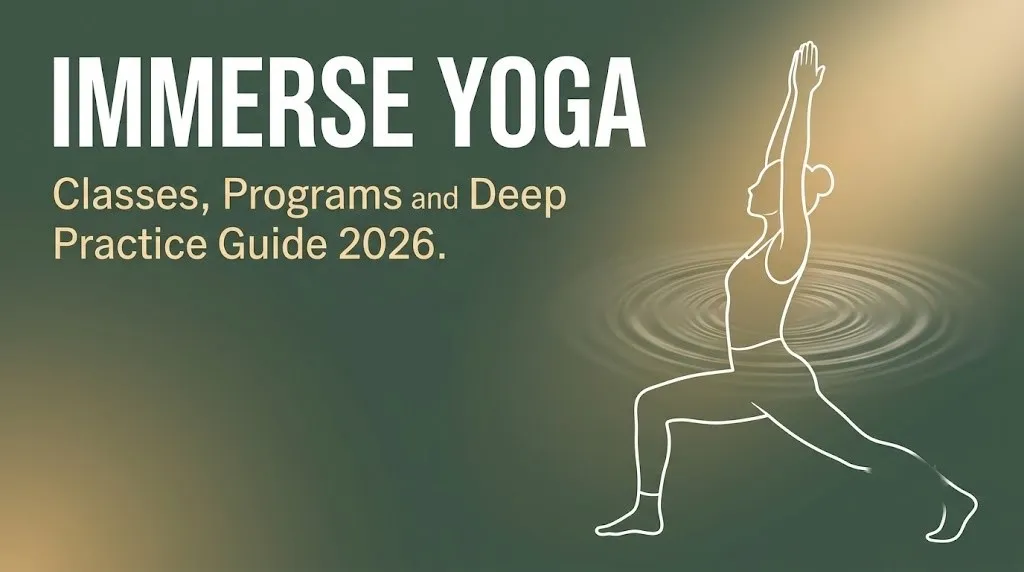
Hot yoga at Immerse Yoga is practiced in a room heated to 90 to 105 degrees Fahrenheit. The heat accelerates muscular warm-up, increases the flexibility of connective tissue, and elevates cardiovascular demand compared to the same sequence in a room-temperature environment. Expect to sweat considerably from the first five minutes.
Vinyasa yoga links breath to movement in a flowing, continuous sequence. The signature transition in Vinyasa is the Chaturanga Dandasana (Four-Limbed Staff Pose) to Urdhva Mukha Svanasana (Upward-Facing Dog) to Adho Mukha Svanasana (Downward-Facing Dog) sequence, which appears multiple times per class and demands upper body pressing strength and core stability to perform safely.
Sculpt yoga adds light hand weights (typically 3 to 5 pounds) to a Vinyasa framework, incorporating resistance-training intervals for the deltoids, biceps, triceps, and core that standard yoga movement does not fully address.
| Class Format | Heat Level | Pace | Primary Physical Demand | Best For |
|---|---|---|---|---|
| Hot yoga | 90 to 105°F | Moderate | Cardiovascular, flexibility | Range of motion, detox goals |
| Vinyasa | Room temp or lightly heated | Moderate to fast | Upper body, core, endurance | Fitness, flow, strength |
| Sculpt yoga | Room temp or lightly heated | Moderate | Full body, resistance | Toning, metabolic conditioning |
| Foundations/Basics | Room temp | Slow | Alignment, body awareness | True beginners |
Modification: First-time students in any Immerse Yoga format should attend a foundations or basics class first. The Chaturanga transition required in Vinyasa classes demands shoulder and wrist strength that most beginners have not yet developed. Use the knees-down variation in every Chaturanga until upper body pressing capacity is sufficient.
Key Takeaway: Immerse Yoga in Texas offers hot yoga, Vinyasa, and sculpt formats for fitness-focused practitioners. Beginners should start with a foundations class before any heated or power format. The Chaturanga transition requires specific strength that must be developed before it’s safe to perform repeatedly.
Immerse Yoga Schedule and Pricing: What to Know Before Booking
Immerse Yoga’s class schedule follows the standard boutique studio format: early morning (6:00 to 8:00 AM), midday (12:00 to 1:00 PM), and evening (5:30 to 7:30 PM) options on weekdays, with expanded weekend morning schedules. Specific class availability varies by location between Houston and Dallas studios.
Pricing at boutique yoga studios in the Texas market follows these general ranges in 2026:
| Pricing Option | Typical Range | Best For |
|---|---|---|
| Single drop-in class | $22 to $32 | First visit, irregular schedules |
| Class pack (5 to 10 classes) | $14 to $22 per class | 1 to 2 sessions per week |
| Monthly unlimited membership | $99 to $165 per month | Regular practitioners (3 or more per week) |
| New student intro offer | $30 to $60 (30 days unlimited) | First-month evaluation |
| ClassPass credits | Variable | Multi-studio samplers |
The introductory offer is always the most practical starting point for a new student evaluating any boutique yoga studio. It provides enough class access to try multiple formats and teachers before a monthly commitment. Most studios offer this once per student.
According to the American College of Sports Medicine, consistency of attendance is the strongest predictor of fitness outcomes in structured group exercise programs. Scheduling classes in advance, rather than deciding session-by-session, produces measurably better attendance and adaptation over a 12-week period.
Booking is typically managed through Mindbody or a studio-specific app. Arriving 10 to 15 minutes early on your first visit allows time to complete any intake paperwork, meet the teacher, and set up your mat before the room fills.
What Is a Yoga Immersion Program and How Does It Work
A yoga immersion program is a structured, multi-day or multi-week intensive course where practitioners study yoga philosophy, anatomy, alignment, and practice with concentrated depth and frequency. Unlike a regular studio membership, an immersion has a defined curriculum, a set start and end date, and a specific focus area. It is not a yoga teacher training, though it often serves as preparation for one.
Yoga immersions typically run from 3 days to 6 weeks, with daily practice sessions lasting 4 to 8 hours. The curriculum covers:
- Morning pranayama (breath practice) and meditation
- Multiple asana (physical pose) practice sessions per day
- Anatomy and alignment workshops
- Yoga philosophy and text study (the Yoga Sutras, Bhagavad Gita, or other foundational texts)
- Evening restorative or Yin practice to support recovery
What separates an immersion from a retreat is the educational structure. A yoga retreat prioritizes rest, restoration, and informal practice in a pleasant setting. A yoga immersion prioritizes systematic learning, physical skill development, and study. Some programs combine both, but the distinction matters when evaluating whether a format matches your goals.
Yoga Alliance, the primary credentialing body for yoga teachers in the United States, recognizes immersion programs as valuable preparation for teacher training, though an immersion alone does not confer teaching credentials. For practitioners considering a 200-hour Registered Yoga Teacher (RYT-200) certification, completing a yoga immersion first reduces the steep learning curve of formal training.
Modification: Yoga immersion programs are physically demanding. Any practitioner with a recurring injury, chronic joint condition, or less than 6 months of consistent practice should complete a medical evaluation with a sports medicine physician or physical therapist before enrolling in a multi-day intensive format.
Yoga Immersion vs Yoga Teacher Training: Key Differences
A yoga immersion and a yoga teacher training are not the same thing, and confusing them leads practitioners to invest in the wrong format for their actual goals. The core distinction is credentialing: teacher training leads to a formal certification recognized by Yoga Alliance. An immersion does not.
| Feature | Yoga Immersion | Yoga Teacher Training (YTT) |
|---|---|---|
| Duration | 3 days to 6 weeks | 200 to 500 hours over weeks or months |
| Yoga Alliance credential | No | Yes (RYT-200 or RYT-500) |
| Teaching practicum | Optional or absent | Required (minimum 30 hours) |
| Anatomy and physiology | Introductory to moderate depth | Detailed and assessed |
| Cost | $300 to $2,000 | $1,500 to $6,000 |
| Experience level required | 6 months to 2 years | Typically 1 to 2 years minimum |
| Primary goal | Deepen personal practice | Develop teaching skills and earn credentials |
| Physical demand | High | Very high (multiple daily sessions for weeks) |
A yoga immersion is the right choice if your goal is deepening your personal practice, exploring a specific style or philosophy with more depth than weekly classes allow, or preparing for teacher training without committing to the full credential process yet.
Teacher training is the right choice if you intend to teach yoga professionally, want a formal credential recognized by studios and employers, and are ready for the academic and physical demands of a 200-hour or longer program.
Many experienced practitioners complete an immersion first and find that the deepened body awareness and philosophical understanding they gain makes their subsequent teacher training dramatically more productive.
Yoga Immersion vs Yoga Retreat: Which Format Fits Your Goals
A yoga immersion and a yoga retreat share a residential or semi-residential structure but serve fundamentally different purposes. Understanding the difference prevents practitioners from booking a relaxing retreat when they needed rigorous training, or vice versa.
A yoga retreat prioritizes recovery, restoration, and informal practice. The schedule is generous with free time, meals are communal and nourishing, and the yoga sessions are enjoyable rather than challenging. Retreats are ideal for practitioners experiencing burnout, stress, or a need for physical and emotional restoration. Think of a retreat like a full system reset.
A yoga immersion prioritizes learning and skill development. The schedule is dense, the practice sessions are demanding, and the educational components require real cognitive engagement. Immersions are appropriate for practitioners who feel stuck in their regular practice and want accelerated development.
A 2018 study published in Frontiers in Human Neuroscience found that intensive, concentrated skill-acquisition programs (studying a single skill domain for multiple hours per day over several consecutive days) produced greater neural adaptation and skill retention than the same total hours distributed over months of weekly practice. This principle applies directly to yoga immersions: concentrated practice changes the nervous system faster than spaced practice at the same total volume.
| Format | Primary Goal | Physical Demand | Schedule Density | Cost Range |
|---|---|---|---|---|
| Yoga retreat | Restoration, rest | Low to moderate | Relaxed | $500 to $4,000 |
| Yoga immersion | Skill development, deep study | High | Dense | $300 to $2,500 |
| Yoga teacher training | Credential, teaching skills | Very high | Extremely dense | $1,500 to $6,000 |
| Yoga workshop | Single-topic depth | Moderate | Half to full day | $50 to $300 |
Modification: Practitioners recovering from physical injury, significant illness, or major life stress are better served by a retreat than an immersion. The physical demands of an immersion require a baseline level of health and resilience that injury or exhaustion compromises.
Key Takeaway: A yoga immersion and a yoga retreat are fundamentally different experiences. Immersions demand rigorous daily practice and study. Retreats prioritize restoration. Choosing the wrong one for your actual need wastes money and can set your practice back rather than moving it forward.
Benefits of Immersive Yoga Backed by Science
Immersive yoga produces documented physical and neurological benefits that standard weekly practice cannot replicate at the same rate, primarily because of the concentrated repetition’s effect on proprioception, somatic learning, and nervous system adaptation. The science here is more specific than most wellness content acknowledges.
Proprioception is the body’s ability to sense its own position in space. It’s what allows you to hold a balance pose without visual reference or adjust your spinal alignment without a mirror. Proprioceptive learning in yoga requires repetition at volume: the nervous system needs to experience a movement pattern many times before it encodes it as automatic. An immersive format provides that volume in days rather than months.
According to the NCCIH, yoga practice produces measurable changes in cortisol levels, blood pressure, and self-reported anxiety in practitioners who engage consistently over 8 weeks or more. Immersive formats compress this adaptation timeline by creating a high-frequency stimulus over a short period, which research on neuroplasticity suggests produces faster initial encoding of movement patterns.
The physical benefits of an immersive yoga program documented across research in the International Journal of Yoga include:
- Measurable increases in hamstring, hip flexor, and spinal flexibility within 7 to 10 days of intensive daily practice
- Improved postural alignment as deep spinal stabilizers respond to repeated conscious engagement
- Reduced resting cortisol and improved sleep quality during intensive programs
- Increased body awareness and proprioceptive accuracy, which transfers to everyday movement and reduces injury risk
- Stronger respiratory efficiency through concentrated pranayama practice over multiple consecutive days
The psychological benefits are equally documented. A 2020 review in Complementary Therapies in Medicine found that intensive yoga programs produced greater reductions in anxiety and depression scores than equivalent-hour weekly practice, suggesting that the immersive format itself is a therapeutic variable independent of total practice hours.
How to Prepare Physically for an Immersive Yoga Experience
Physical preparation for a yoga immersion begins 4 to 6 weeks before the program starts, not the day before. The body needs to build baseline strength, flexibility, and tissue resilience before being asked to practice for multiple hours per day over consecutive days. Walking into an immersion without preparation is like running a half-marathon without a training plan.
The most common physical failures in yoga immersions are wrist fatigue and strain (from repeated Chaturanga and Downward Dog transitions), lower back soreness (from cumulative spinal loading without adequate core activation), and hip flexor tightness (from extended seated study periods between movement sessions).
Pre-immersion physical preparation plan:
- 4 to 6 weeks out: Establish a baseline of 3 to 4 yoga sessions per week. Focus on building Chaturanga Dandasana strength safely, using the modified knees-down version until form is consistent.
- 3 weeks out: Add targeted wrist conditioning: wrist circles, forearm stretches, and gentle weight-bearing on the wrists for 5 to 10 minutes daily. This is non-negotiable for anyone attending a Vinyasa-heavy immersion.
- 2 weeks out: Introduce Yin yoga sessions twice per week to begin opening the connective tissue of the hips and thoracic spine in preparation for deeper holds.
- 1 week out: Reduce intensity. Practice gently. The goal is arriving rested, not arriving peaked.
On the nutrition side, prioritize consistent hydration, adequate protein intake (yoga immersions create real muscular demand), and sufficient sleep. Most experienced yoga teachers recommend arriving at a multi-day immersion sleeping at least 7 to 8 hours per night for the preceding week.
Modification: Practitioners with chronic wrist issues should discuss the Dolphin Pose (Ardha Pincha Mayurasana) forearm variation with their program teacher before the immersion begins. Using the forearm modification in place of standard Downward Dog and Chaturanga for the first two days allows the wrist tissue to adapt before full weight-bearing resumes.
What to Expect at a Yoga Immersion: Day-by-Day Realities
Yoga immersions follow a predictable progression across their duration that most participants don’t anticipate. Knowing what each phase typically involves prevents the confusion and self-doubt that cause practitioners to question whether they’re doing something wrong when their body and mind are simply responding normally to concentrated practice.
Days 1 to 2: The body is energized by novelty and enthusiasm. Strength and flexibility feel better than expected. Motivation is high. This phase often produces overconfidence. Practitioners push harder than they should in the first days, creating a deficit they feel on day 3.
Days 3 to 4: Physical fatigue sets in. Wrists, shoulders, and hips are sore in new ways. Emotional material often surfaces during this phase. Experienced yoga teachers refer to this as the “opening phase”: the body and nervous system are processing more than just movement. This is normal and expected.
Days 5 to 7: If the program runs a week or longer, most practitioners report a second-wind shift. The nervous system begins to adapt. Poses that felt forced in the first days begin to feel more natural. Proprioceptive learning is visibly accelerating.
According to research published in Frontiers in Human Neuroscience, the consolidation of new motor skills requires sleep during the learning period. Sleep between intensive practice days is not passive recovery. It’s the period when the nervous system encodes the day’s movement learning. Skipping sleep or reducing it during an immersion directly slows skill acquisition.
What to pack for a residential immersion:
- Two yoga mats (one for morning practice, one for evening Yin or Restorative)
- Yoga blocks (at least two), a strap, and a bolster if your program doesn’t provide them
- A foam roller for self-myofascial release between sessions
- Electrolyte supplements for sustained hydration
- A journal for study notes and self-reflection (svadhyaya)
Key Takeaway: Yoga immersions follow a predictable physical and emotional arc. Days 3 to 4 are the hardest. Expect soreness, fatigue, and emotional processing as normal parts of the process. Sleep between practice days is when the real neurological learning happens.
Yoga Immersion Poses and Practice Structure
The yoga poses that anchor immersive practice are not exotic or advanced. They are the foundational movements of Vinyasa and Hatha yoga practiced with a precision, breath awareness, and physical engagement that weekly drop-in classes rarely develop. The immersive environment makes depth possible because the teacher can address alignment repeatedly across many sessions rather than once in a crowded class.
The core poses of an immersive yoga practice structure:
| Pose | Sanskrit Name | Physical Focus | Immersion Role |
|---|---|---|---|
| Sun Salutation | Surya Namaskar | Full-body warm-up, breath-movement integration | Morning practice anchor; repeated daily |
| Downward-Facing Dog | Adho Mukha Svanasana | Hamstrings, shoulders, core | Transition and rest pose throughout practice |
| Warrior I | Virabhadrasana I | Hip flexors, quadriceps, shoulder stability | Standing sequence foundation |
| Warrior II | Virabhadrasana II | Gluteus medius, hip abductors, endurance | Extended holds for strength development |
| Extended Triangle | Trikonasana | Lateral chain, IT band, thoracic rotation | Alignment refinement focus |
| Chair Pose | Utkatasana | Quadriceps, core, ankle stability | Strength-building sequence |
| Four-Limbed Staff | Chaturanga Dandasana | Triceps, chest, core, wrist stability | Transition pose; requires careful mechanics |
| Corpse Pose | Savasana | Full nervous system integration | End of every session; minimum 10 minutes |
To practice Surya Namaskar (Sun Salutation) with immersion-quality precision:
- Begin in Tadasana (Mountain Pose). Feet together, weight even. Breathe in.
- Inhale: sweep arms overhead into Urdhva Hastasana (Upward Salute). Lengthen the spine upward.
- Exhale: fold forward into Uttanasana (Standing Forward Fold). Knees can bend if hamstrings are tight.
- Inhale: lift the chest into Ardha Uttanasana (Half Lift). Spine long, fingers on shins or blocks.
- Exhale: step or jump back to plank. Lower into Chaturanga Dandasana. Elbows track at 45 degrees.
- Inhale: press into Urdhva Mukha Svanasana (Upward-Facing Dog). Thighs off the mat, toes pressing down.
- Exhale: lift hips into Adho Mukha Svanasana (Downward-Facing Dog). Hold for 5 breaths.
- Inhale: step or jump forward. Half lift.
- Exhale: fold. Release the head.
- Inhale: rise all the way to stand. Arms overhead.
- Exhale: return to Tadasana.
Modification: Use the knees-down version for Chaturanga in every round until shoulder and tricep strength is consistent. In Downward Dog, keep generous knee bend if hamstrings limit spinal length.
Recovery Practices During and After a Yoga Immersion
Recovery during a yoga immersion is not optional and is not adequately addressed by most program guides. Practitioners who treat an immersion like a sprint, maximizing effort in every session without deliberate recovery periods, consistently perform worse by mid-program than those who manage their physical output with the same intelligence a trained athlete applies to competition weeks.
During a multi-day immersion, the two most effective recovery tools are Yin yoga and Restorative yoga sessions in the evening. Both target the fascial system and connective tissue that active practice loads repeatedly.
Yin yoga holds poses for 3 to 5 minutes, allowing the fascia, joint capsules, and ligaments to respond to sustained gentle load. After a day of active Vinyasa sessions, a Yin practice addressing the hips, thoracic spine, and shoulders accelerates tissue recovery and reduces the morning stiffness that accumulates across immersion days.
Restorative yoga uses full prop support to allow the body to release without effort, activating the parasympathetic nervous system and reducing the elevated cortisol that intensive physical training produces. A 30-minute Restorative practice before sleep during an immersion produces measurably better next-day energy and mobility than additional active practice.
Post-immersion recovery guidance:
- Reduce practice intensity for 7 to 10 days after completing a multi-day or multi-week immersion. The body needs consolidation time.
- Maintain two to three gentle yoga or Yin sessions per week during this recovery window. Complete cessation of practice allows the rapid flexibility gains of the immersion to partially reverse.
- Prioritize sleep. Research on athletic training recovery consistently identifies sleep as the highest-impact recovery variable.
- Use a foam roller on the IT band, thoracic spine, and hip flexors daily during the first week post-immersion.
Modification for practitioners with joint hypermobility: Yin yoga’s long-hold format can overstretch already lax connective tissue in hypermobile practitioners. Reduce all Yin holds to 2 minutes maximum and use props to limit the end range of every position.
Is a Yoga Immersion Good for Beginners
A yoga immersion is accessible for beginners who have at least 6 months of consistent practice before enrolling, but it is not ideal as a first yoga experience. The physical demands of multiple daily sessions, the pace of learning, and the social intensity of a group residential format require a baseline level of body awareness and physical conditioning that true beginners have not yet developed.
That said, beginners with 6 to 12 months of consistent practice and a genuine enthusiasm for depth are excellent candidates for beginner-oriented immersion programs, which exist specifically to serve this population. These programs move more slowly, offer more modification guidance, and do not assume prior knowledge of Sanskrit terminology, pranayama techniques, or yoga philosophy.
A 2021 study published in the International Journal of Yoga found that participants with less than 1 year of yoga experience who completed an 8-day intensive yoga program reported measurable improvements in flexibility, stress markers, and body awareness at the same rate as intermediate practitioners, provided the program included adequate modification guidance and individualized teacher attention.
What determines readiness for an immersion, regardless of experience level:
- Can you perform a modified Chaturanga Dandasana with consistent form? If not, the repetition volume of an immersion will produce injury.
- Can you sit comfortably on the floor for 60 to 90 minutes? Study sessions require sustained seated posture.
- Are you physically healthy enough for multiple hours of movement daily? A medical check with a physician is appropriate if you have any cardiovascular, orthopedic, or autoimmune condition.
Modification: Beginner immersion participants should use props in every pose, every session. This is not a beginner limitation. It is correct yoga practice at any level. A block under the hands in Downward Dog, a blanket under the back knee in Low Lunge, and a strap in any reclined hamstring stretch are not signs of weakness. They are signs of intelligence.
Building a Home Practice After Yoga Immersion
The weeks immediately following a yoga immersion are the most important window for consolidating what you learned into a sustainable home practice. The neural pathways laid down during concentrated practice are at their most accessible during this period. Neglecting practice in the weeks after an immersion causes faster-than-expected reversal of the flexibility, strength, and body awareness gains the program produced.
Think of the nervous system learning during an immersion like a new pathway through a forest. The path exists and you can walk it easily right after the immersion. Without repeated use, the undergrowth returns and the path becomes harder to find within weeks.
A practical post-immersion home practice structure:
- Week 1 to 2: 20 to 30-minute gentle practices, once daily. Focus on the sequences and alignment cues from the immersion. Prioritize form over duration.
- Week 3 to 4: Extend to 40 to 60-minute sessions. Begin incorporating the specific techniques refined during the immersion: pranayama, deeper Yin holds, or the alignment points the teacher emphasized.
- Month 2: Establish a 3 to 5-session-per-week rhythm with a mix of active and restorative formats.
Home practice essentials for post-immersion students:
- A dedicated practice space with enough room for a full mat plus arm extension
- Two yoga blocks, a strap, and a bolster for prop-supported work
- A consistent practice time, ideally the same time each day to build a habitual rhythm
- A notebook for recording sequences, insights, and alignment notes from the immersion
The NCCIH notes that yoga benefits are most durable in practitioners who maintain at least two sessions per week over a minimum of 3 months following an intensive program. The immersion is the accelerant. Consistent home practice is the fuel.
Key Takeaway: The weeks after a yoga immersion are when consolidation either happens or doesn’t. Practice gently and consistently for the first two weeks, then build back to your full rhythm. Skipping this window costs you a significant portion of the immersion’s physical and neurological gains.
How to Choose the Right Immersive Yoga Format in 2026
Choosing the right immersive yoga format in 2026 means matching the format’s structure, duration, physical demand, and educational focus to your specific goals, current experience level, available time, and budget. No single format is universally best. The right choice is the one that addresses your specific gap.
Start by identifying your primary goal:
- If your goal is stress relief, rest, and a reset from a demanding period, choose a yoga retreat.
- If your goal is deepening your personal practice, understanding alignment better, or preparing for teacher training, choose a yoga immersion program.
- If your goal is earning a teaching credential and developing the skills to guide others safely, choose a 200-hour or 300-hour yoga teacher training.
- If your goal is exploring a specific topic (inversions, pranayama, yoga philosophy, anatomy) with more depth than a single class allows, choose a yoga workshop or workshop series.
For the Immerse Yoga studio specifically, choosing the right class format follows the same logic:
| Goal | Right Format |
|---|---|
| First-time yoga experience | Foundations or Basics class |
| Cardiovascular fitness with yoga | Hot yoga or Vinyasa flow |
| Resistance training plus yoga | Sculpt yoga |
| Deep flexibility and recovery | Yin or Restorative (if offered) |
| Going deeper than weekly classes | Weekend immersion workshop |
Budget is a real factor and worth naming directly. A yoga retreat costs roughly $500 to $4,000 depending on location and duration. A yoga immersion costs roughly $300 to $2,500. A 200-hour teacher training costs roughly $1,500 to $6,000. For practitioners with limited budgets, a well-chosen workshop series, practiced consistently over 3 to 6 months, produces comparable learning to a single more expensive immersion format.
Yoga Alliance recommends that practitioners evaluating teacher training or immersion programs confirm the lead teacher’s credentials (RYT-200 minimum, ERYT-500 for advanced programs) before enrolling, because the quality of instruction varies substantially across programs at similar price points.
Modification note: Any practitioner evaluating a format that involves extended physical practice should review the program’s injury policy, teacher-to-student ratio, and approach to modification and accommodation before committing. A program that cannot answer these questions clearly should raise concern.
Frequently Asked Questions About Immerse Yoga
What is immerse yoga and is it different from regular yoga?
Immerse yoga refers to both a Texas yoga studio brand and the broader practice of intensive, concentrated yoga formats that go beyond regular weekly classes.
The Immerse Yoga studio in Houston and Dallas offers hot yoga, Vinyasa, and sculpt classes in a boutique studio environment.
As a concept, immersive yoga describes any multi-day intensive, retreat, or deep-practice program where yoga is practiced for multiple hours per day over several consecutive days.
How much does an immersive yoga program cost?
Yoga immersion programs typically cost between $300 and $2,500, depending on duration, location, residential vs. non-residential format, and teacher credentials.
Yoga retreats range from $500 to $4,000, and yoga teacher training programs range from $1,500 to $6,000 for a full 200-hour certification.
Drop-in classes at the Immerse Yoga studio in Texas typically run $22 to $32 per session, with monthly memberships in the $99 to $165 range.
Is a yoga immersion the same as yoga teacher training?
No, a yoga immersion and a yoga teacher training are distinct programs with different goals and outcomes.
A yoga immersion deepens personal practice and does not result in a Yoga Alliance teaching credential.
A 200-hour yoga teacher training leads to RYT-200 certification and prepares practitioners to teach yoga professionally.
How do I prepare my body for an immersive yoga experience?
Start preparing 4 to 6 weeks before your immersion by practicing yoga 3 to 4 times per week and focusing specifically on building safe Chaturanga form.
Add daily wrist conditioning exercises and two weekly Yin yoga sessions in the 3 weeks before the program begins.
Arrive rested, well-hydrated, and sleeping at least 7 to 8 hours per night during the final week before the immersion starts.
Is a yoga immersion good for beginners?
A yoga immersion is appropriate for beginners who have at least 6 months of consistent practice and enroll in a program specifically designed for newer students.
True beginners with no prior yoga experience will struggle with the physical demands and learning pace of most immersion formats.
Look for programs that explicitly list “beginner” or “all levels” as the target experience level and confirm that the teacher-to-student ratio is low enough for individualized guidance.
Immersive yoga, whether at the Immerse Yoga studio or in a multi-day intensive program, works best when you approach it with realistic preparation and clear goals. The science supports the format. The physical demands are real. And the gains are most durable when the practice continues after the intensive ends.
Start where you are. If you’re a studio newcomer, book a foundations class at Immerse Yoga this week. If you’re an intermediate practitioner ready to go deeper, begin your 4-to-6-week physical preparation for a yoga immersion now.
Show up prepared. Practice consistently after. That’s the whole plan.