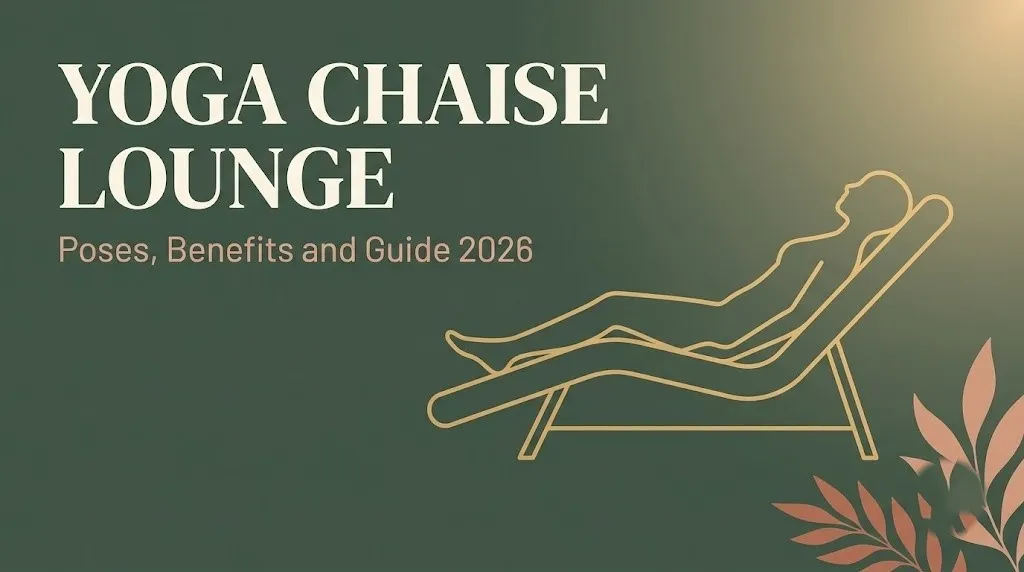
Yoga Chaise Lounge: Best Poses, Benefits, and Guide 2026
A yoga chaise lounge is a specially designed inclined support chair that allows you to practice restorative yoga, meditation, and supported breathwork without getting on the floor, making it one of the most accessible yoga tools available for people with back pain, limited mobility, or difficulty with traditional mat-based practice. It bridges the gap between a yoga bolster and a recliner, giving your body the angled, full-contact support that restorative poses need.
Supported yoga practices are not a lesser alternative to vigorous yoga. According to the National Center for Complementary and Integrative Health (NCCIH), restorative and passive yoga practices have documented effects on stress reduction, sleep quality, and self-reported pain management, outcomes that are particularly valuable for older adults and people managing chronic conditions.
This guide covers what a yoga chaise lounge actually is, how it compares to traditional props, which poses to practice on it, who benefits most, and what the research says about supported yoga as a health tool. You will also find specific guidance for back pain, neck pain, seniors, beginners, and Yin yoga practitioners.
What Is a Yoga Chaise Lounge and How Is It Used for Practice
A yoga chaise lounge is an elongated, adjustable inclined support chair designed to hold the full length of the body at a reclined angle, supporting the head, spine, hips, and legs simultaneously during yoga, meditation, and breathwork. It is distinct from a standard chaise lounge in that it is designed with yoga practice in mind, often featuring a firmer fill, a specific incline range, and dimensions that accommodate full-body supported poses.
The key design feature is the reclined angle. Most yoga chaise lounges adjust from a nearly flat position to a semi-upright angle of approximately 30 to 45 degrees. This range allows the user to transition between deep restorative positions and more supported seated postures without leaving the chair. The incline angle determines which poses are accessible and how the spine is supported.
In yoga practice, the chaise lounge functions as an oversized bolster. Like a bolster, it supports the body in passive positions where the muscles are intended to release rather than engage. Unlike a bolster, which requires floor access and specific positioning, the chaise lounge supports the entire body from head to feet in a single continuous surface.
The yoga styles that translate most naturally to a chaise lounge are Restorative yoga, Yin yoga, and yoga nidra. All three involve extended periods of stillness and passive body positioning, where full-length support genuinely changes what the practice can achieve.
Pose Tip:
- Set your chaise lounge on a firm, non-slip surface before practice; wobble during held poses disrupts the nervous system settling the practice is trying to achieve
- Use a folded blanket under the lumbar spine if the incline creates a gap between the lower back and the surface
- An eye pillow placed over the eyes during final relaxation deepens the parasympathetic response
Yoga Chaise Lounge Chair vs. Traditional Yoga Props: What Is the Difference
A yoga chaise lounge chair provides full-body length support at an adjustable reclined angle, while traditional yoga props like bolsters, blocks, and blankets provide targeted, position-specific support that the practitioner configures individually for each pose. The difference is convenience and accessibility versus precision.
Traditional yoga props are highly flexible tools. A bolster placed under the thoracic spine for Matsyasana (Fish Pose) does something different from the same bolster placed under the knees for Savasana (Corpse Pose). You move the prop to serve the pose. The limitation is that reconfiguring props requires physical ability, floor access, and knowledge of how to position them correctly.
A yoga chaise lounge inverts this relationship. The support is preset. You bring your body to it rather than building a prop configuration around each pose. For people who struggle with floor-based prop management because of joint pain, balance issues, or limited dexterity, this is a genuine practical advantage.
| Feature | Yoga Chaise Lounge | Bolster | Yoga Block | Blanket |
|---|---|---|---|---|
| Full-body support | Yes | No | No | Partial |
| Adjustable incline | Yes (most models) | No | No (fixed heights) | No |
| Floor access required | No | Yes | Yes | Yes |
| Suitable for seniors | High | Moderate | Moderate | High |
| Pose versatility | Limited to reclined | High | High | High |
| Cost | Higher ($80 to $300+) | Moderate ($25 to $80) | Low ($10 to $30) | Low ($15 to $40) |
| Best for | Restorative, Yin, nidra | All styles | All styles | All styles |
The honest view: a yoga chaise lounge does not replace a full set of yoga props for a varied practice. It excels at restorative and supported work and serves as the primary tool for people who cannot or prefer not to use the floor.
How to Choose the Best Yoga Chaise Lounge Chair in 2026
The best yoga chaise lounge chair for your practice in 2026 is one that supports your full body length, adjusts to multiple incline angles, uses a firm enough fill to prevent sinking, and is sized appropriately for your height and body weight. These four criteria matter more than brand, color, or decorative features.
Fill firmness is the single most important factor most buyers overlook. A soft, sinking fill feels comfortable initially but fails to provide the structural support that restorative yoga requires. The body needs to be held at a specific angle without collapsing into the fill material. Memory foam fills with adequate density or polyester fills compressed to firm consistency work best.
Key selection criteria for a yoga chaise lounge in 2026:
- Fill firmness: Should not compress more than one to two inches under body weight; memory foam or high-density polyester fills outperform loose pillow fills
- Adjustable incline range: Look for models offering at least three to four angle positions from near-flat to 45 degrees
- Length: Should accommodate your full body length; most adults need at least 60 inches of surface length for full recline
- Weight capacity: Confirm the stated maximum before purchase; most quality yoga chaise lounges support 250 to 300 pounds
- Cover material: Removable, washable covers are non-negotiable for a yoga prop you will sweat on and use regularly
- Stability: A wide, stable base prevents tipping during dynamic arm movements or weight shifts
For outdoor use, look specifically for weather-resistant fabric covers and UV-stable fill materials. Standard indoor yoga chaise lounges are not designed for outdoor moisture exposure.
Avana Yoga Chaise Lounge Chair: Features and Who It Suits
The Avana Yoga Chaise Lounge Chair is one of the most widely referenced yoga-specific chaise lounge products on the market, designed with an adjustable backrest, supportive fill, and contoured form that positions the body for restorative yoga, meditation, and reading. It appears consistently in yoga equipment searches and receives positive reviews from practitioners with back pain and limited mobility.
The Avana design features a contoured shape that cradles the lumbar spine at a gentle angle, which distinguishes it from a standard recliner that positions the lumbar in flexion. The adjustable backrest allows the user to move between a more upright seated position for breathwork and meditation, and a more reclined position for passive restorative poses.
Key features of the Avana Yoga Chaise Lounge Chair:
- Adjustable backrest with multiple locking positions
- High-density polyester fill for consistent firm support
- Microfiber or velour cover, typically removable for washing
- Available in multiple colors to suit home practice spaces
- Sized to accommodate most adult heights in full recline
- Designed for indoor use; not rated for outdoor or weather exposure
Who the Avana yoga chaise suits best:
| User Profile | Why It Suits Them | Key Feature Used |
|---|---|---|
| Seniors with back pain | Full-body support without floor access | Adjustable recline |
| Restorative yoga practitioners | Replaces multi-bolster setups for passive poses | Contoured lumbar support |
| Meditators seeking seated comfort | Upright angle supports long meditation sits | Backrest at 30 to 45 degrees |
| People with hip or knee issues | No floor lowering or raising required | Full chair format |
| Readers and home relaxers | Comfortable for extended daily use | Cushioned full-length surface |
Safety note: The Avana yoga chaise lounge is not a medical device. People managing specific spinal conditions should confirm with a physical therapist or spine specialist that a reclined incline position is appropriate for their specific situation before extended use.
Key Takeaway: A yoga chaise lounge is not a replacement for a complete prop set, but for restorative yoga, back pain management, and floor-free practice, it is the most accessible full-body support tool available, particularly for seniors and people managing chronic pain.
How to Set Up Your Yoga Chaise Lounge for Practice
Setting up a yoga chaise lounge for yoga practice involves adjusting the incline to match your intended pose, placing any additional support props where needed, and positioning the chair on a stable, non-slip surface in a space with enough room for arm extensions. Correct setup takes under two minutes and prevents both physical discomfort and disruption during held poses.
The incline angle is the primary setup variable. Different poses and practice styles benefit from different angles.
| Practice Type | Recommended Incline | Why |
|---|---|---|
| Restorative yoga passive recline | 15 to 20 degrees from flat | Allows full body weight surrender without head elevation straining neck |
| Supported backbend or chest opener | 20 to 30 degrees | Opens anterior chest while maintaining lumbar support |
| Seated meditation or pranayama | 35 to 45 degrees | Upright enough for diaphragmatic breathing without slouching |
| Yoga nidra or sleep-based practice | Near-flat or flat | Mirrors Savasana for deepest nervous system release |
| Supported forward rest (arms over a pillow) | 30 to 40 degrees | Provides anterior support for those who cannot lie fully flat |
To set up your yoga chaise lounge for a restorative session:
- Place the chaise on a firm floor surface, away from walls that might limit arm movement.
- Adjust the backrest to your chosen incline and lock it securely before sitting.
- Place a folded blanket at the lumbar curve if a gap exists between your lower back and the surface.
- Position a thin folded blanket or small pillow under the head if the incline angle causes the chin to drop toward the chest.
- Keep a yoga strap and additional blanket within reach for pose adjustments without leaving the chair.
- Set an eye pillow and any additional props on the chair arm or a nearby surface before beginning.
Modification for tall practitioners: If your legs extend beyond the chaise surface, place a sturdy yoga block or stacked blankets at the foot of the chair to support the calves and ankles, preventing the hanging-leg discomfort that disrupts long holds.
Yoga Poses on a Chaise Lounge: A Beginner-Friendly Guide
The most beginner-friendly yoga poses to practice on a chaise lounge are supported recline, gentle chest opener, reclined legs-elevated rest, and seated breath awareness, all of which require no prior yoga experience and are fully accessible without floor contact. These four poses create a complete introductory session on the chaise.
A chaise lounge is actually an ideal starting point for yoga beginners who feel intimidated by studio classes or mat-based practice. The body is already supported. There is no fear of falling. Alignment is partially managed by the chair’s contoured surface. The practitioner’s job is to breathe, release, and notice what the body is doing.
To practice Supported Recline on the chaise lounge:
- Adjust the chaise to approximately 20 degrees of recline.
- Sit at the base of the chaise and gently lower your back onto the inclined surface.
- Allow your arms to rest alongside your body with palms facing upward.
- Let the weight of your legs rest fully on the chaise surface.
- Close your eyes and breathe slowly for five to ten minutes.
- To exit, press into your hands and use the chair arms to return to seated.
This pose is functionally a supported Savasana (Corpse Pose), the foundational restorative position in every yoga tradition. On the floor, it requires a flat mat and often additional prop support under the knees. On the chaise, the incline and surface provide all of that support automatically.
Modification for people with acid reflux or respiratory conditions: Set the incline higher, at 35 to 40 degrees, so the head and torso are elevated above the hips. This position provides the restorative benefit without the lying-flat position that can aggravate these conditions.
According to Yoga Alliance, supported and accessible yoga formats that reduce physical barriers to practice are among the fastest-growing areas of yoga instruction globally, reflecting how effectively props and supports bring yoga to populations who previously felt excluded from mat-based classes.
Restorative Yoga Chaise Lounge: Supported Poses and Technique
A yoga chaise lounge is one of the most effective supports for restorative yoga because it provides the continuous, even body contact that restorative poses require to fully release muscular tension and activate the parasympathetic nervous system. A bolster positioned under the thoracic spine achieves a similar effect for a single area; the chaise achieves it across the entire posterior body simultaneously.
Restorative yoga uses prolonged passive poses, typically five to twenty minutes each, to allow the body to release tension it cannot release during active movement. The nervous system needs to feel fully supported before it will allow the muscles to let go. A chaise lounge provides that full-body support more immediately than a floor-based prop configuration, which is one reason practitioners with pain or tension respond to it so quickly.
To practice Supta Baddha Konasana (Reclined Bound Angle Pose) on the chaise:
- Recline the chaise to approximately 20 to 25 degrees.
- Lie back with the full spine resting on the chaise surface.
- Bring the soles of the feet together and allow the knees to open to the sides.
- Place a folded blanket under each thigh to support the knees at a comfortable height.
- Rest the arms alongside the body with palms facing up.
- Hold for five to ten minutes, breathing slowly and deeply into the belly.
- To exit, use your hands to bring the knees together before returning to seated.
This pose targets the hip adductors, hip external rotators, and the lumbar spine, and is particularly effective for people with chronic hip tension or sacroiliac joint discomfort.
Safety caution: People with sacroiliac joint dysfunction should use thick blanket support under each thigh to prevent the knees from opening too wide, which can strain the SI joint in a passive position.
Modification for limited hip range: Place the blanket support higher under each thigh so the knees are only slightly open rather than dropping toward the chaise surface.
Chaise Lounge Yoga for Back Pain and Spinal Support
A yoga chaise lounge supports back pain management by positioning the lumbar spine in a neutral or gently supported recline that reduces the compressive load of upright sitting while allowing the paraspinal muscles to release tension in a sustained passive hold. This is not the same as slouching in a recliner. The incline angle and firm fill work together to decompress rather than compress the lumbar spine.
Back pain is one of the most common reasons people seek out a yoga chaise lounge in the first place. The logic is sound: floor-based yoga with its demands for supine positioning, prone postures, and kneeling transitions can be genuinely inaccessible for people managing acute or chronic back pain. The chaise removes those transitions while preserving the restorative benefit.
Think of the lumbar spine under prolonged upright sitting like a compressed spring. The vertebral discs bear constant downward load in a fully upright chair. A gentle recline of 15 to 25 degrees distributes that load differently, reducing the compressive force on the posterior disc margins that upright sitting amplifies in people with lumbar disc issues.
Research published in the Journal of Alternative and Complementary Medicine indicates that passive yoga practices, including long-held supported reclines and restorative poses, are associated with reduced self-reported pain intensity in adults with chronic low back pain compared to control groups who received no intervention over an eight-week period.
Poses most effective for back pain on the chaise lounge:
- Supported recline (Savasana variation): lumbar decompression through gentle inclined rest
- Reclined knee-to-chest variation: gently drawing one knee toward the chest while the other leg rests on the chaise surface; targets the lumbar extensors and sacroiliac joint
- Supported lateral spinal rest: a pillow or blanket placed under one hip to create a mild spinal side-bend release
Modification for acute back pain: Keep the incline higher (35 to 45 degrees) to reduce the demands of lying more fully horizontal. Do not hold any position that reproduces or increases pain. Dull muscular release sensations are expected; sharp or radiating pain is a signal to adjust immediately.
Key Takeaway: A yoga chaise lounge works for back pain by providing firm, continuous lumbar support at a reduced compressive angle, and it offers this benefit without requiring the practitioner to navigate floor-based transitions that often aggravate back conditions.
Yoga Chaise Lounge for Neck Pain and Cervical Spine Relief
A yoga chaise lounge supports cervical spine relief by allowing the head and neck to rest in a supported neutral position during passive poses, reducing the muscular holding patterns in the upper trapezius and sternocleidomastoid that drive most desk-related and tension-based neck pain. The key is ensuring the incline angle positions the head without forcing the chin toward the chest or the chin toward the ceiling.
The most common source of neck tension that yoga addresses is the combination of chronic upper trapezius holding and levator scapulae shortening from sustained forward-head posture. Both muscles work overtime to hold the head up and forward in the position most screens and devices encourage. On a yoga chaise lounge, the head is passively supported, removing the demand from both muscles simultaneously.
To practice Matsyasana (Fish Pose) variation on the chaise lounge:
- Recline the chaise to 25 to 30 degrees.
- Lie back so the thoracic spine rests on the chaise surface.
- Allow the chest to open naturally as the back body rests into the incline.
- Rest the head on the chaise surface without dropping it back; maintain a neutral cervical curve.
- Place a thin folded blanket under the head if the incline causes any chin-jutting.
- Allow the arms to open slightly to the sides, palms up.
- Hold for five to eight minutes, breathing slowly into the upper chest and belly alternately.
This position gently opens the pectoralis major, anterior deltoid, and sternocleidomastoid while the supported weight of the head prevents the cervical extensors from working.
Safety caution: People with cervical disc herniations or cervical stenosis should keep the head fully supported and avoid any position that extends the neck beyond neutral. If neck position feels uncomfortable or produces arm tingling, raise the incline higher until the head rests in a neutral position.
Modification for sensitivity: Use a small rolled blanket under the cervical curve (the natural curve of the neck) to provide targeted cervical support rather than relying solely on the chaise surface.
Yoga Chaise Lounge for Seniors and People With Limited Mobility
A yoga chaise lounge is one of the most senior-friendly yoga tools available because it eliminates the need to lower to and rise from the floor, which is the single greatest physical barrier to yoga practice for older adults and people managing joint pain, balance issues, or chronic fatigue. All major restorative yoga benefits are accessible from the chaise without any floor contact.
According to the NCCIH, yoga practiced by adults over 60 is associated with improved balance, reduced fall risk, better sleep, and lower self-reported pain scores. These benefits do not require vigorous practice. Restorative and gentle yoga, exactly the styles a chaise lounge supports, produce these outcomes with the lowest physical demand of any yoga format.
Condition-specific guidance for seniors using a yoga chaise lounge:
| Condition | Recommended Approach | What to Avoid |
|---|---|---|
| Knee osteoarthritis | Supported recline with knees gently bent; blanket under knees | Deep knee flexion or any position requiring kneeling |
| Osteoporosis | Thoracic support at gentle incline; no forward spinal flexion | Any pose that rounds the upper back under load |
| Chronic low back pain | Firm lumbar support at 20-25 degree incline | Flat lying if it increases lumbar discomfort |
| Balance and fall risk | All practice performed in the chaise; no standing poses | Standing or weight-shifting away from supported surface |
| Chronic fatigue | Short sessions (15 to 20 minutes) of fully supported rest | Extended breath-holding or vigorous pranayama |
| Hip replacement | Confirm post-surgical restrictions with orthopedic surgeon before use | Hip positions beyond prescribed range of motion |
Seniors new to yoga chaise practice should begin with 15-minute sessions of supported recline and simple breathing before adding pose variations. Frequency matters more than duration. Three 15-minute sessions per week consistently produces better nervous system outcomes than one long session.
Yin Yoga on a Chaise Lounge: How It Works and Who Benefits
Yin yoga on a yoga chaise lounge works by providing sustained passive support during long-hold poses that target the connective tissue around the hips, spine, and shoulders, without requiring the practitioner to maintain position on a floor mat. Hold times in Yin yoga range from three to five minutes per pose, which is where the chaise lounge’s continuous support becomes genuinely valuable.
Yin yoga differs from restorative yoga in a specific way: restorative yoga aims for complete muscular release with maximum prop support. Yin yoga applies a moderate, sustained stress to connective tissue (fascia, ligaments, joint capsules) to encourage gradual remodeling. The practitioner should feel a mild but persistent stretch sensation rather than complete ease. The chaise lounge can facilitate both, depending on how the body is positioned relative to its surface.
For Yin yoga, the chaise is most useful for upper body and spinal targets. Lower body Yin poses that require the legs to be angled away from the body (like Butterfly Pose or Dragon Lunge) typically still require floor access.
Effective Yin yoga poses on a yoga chaise lounge:
- Supported backbend (Matsyasana variation): chaise incline opens the anterior chest and thoracic spine over three to five minutes; targets the thoracic extensors, pectoralis major, and anterior intercostals
- Supported lateral bend: arm raised overhead while body rests in recline creates a passive lateral stretch through the quadratus lumborum and intercostals over three to five minutes
- Reclined shoulder opener: one arm extended to the side at shoulder height while the body rests; targets the anterior deltoid and pectoralis minor over three to five minutes
Research published in Complementary Therapies in Medicine found that Yin yoga practiced consistently over six weeks produced measurable improvements in flexibility and self-reported stress reduction in adult participants, with connective tissue adaptations showing up after approximately three to four weeks of consistent practice.
Modification for Yin beginners: Start with two-minute holds rather than five. The connective tissue stress of Yin yoga is unfamiliar to most beginners, and building hold time gradually prevents the soreness that can follow an overly ambitious first Yin session.
Key Takeaway: Yin yoga on a chaise lounge delivers the connective tissue benefits of long-hold passive poses without floor access demands, making it particularly well-suited to Yin practitioners managing pain, stiffness, or limited mat-based mobility.
Yoga Nidra and Meditation on a Yoga Chaise Lounge
Yoga nidra and seated meditation are ideally suited to a yoga chaise lounge because both practices require sustained stillness, body support, and a position that allows the practitioner to remain alert without muscular holding effort. The chaise’s adjustable incline serves both practices by offering the reclined alertness of nidra and the supported upright position of sitting meditation.
Yoga nidra is a guided relaxation practice derived from Tantra and formalized in modern practice by Swami Satyananda Saraswati. It is practiced in a fully reclined position, similar to Savasana (Corpse Pose), while the practitioner follows a verbal guide through body scanning, breath awareness, and visualization. The standard instruction is to remain awake while the body falls asleep. The chaise lounge’s gentle incline helps maintain this awake-but-relaxed state better than a fully flat position, which often allows practitioners to fall asleep completely.
For seated meditation, the chaise at 35 to 45 degrees provides an alternative to floor cushions and meditation benches that is accessible for anyone who cannot maintain unsupported seated posture for 20 to 30 minutes. The chaise supports the lumbar spine and reduces the hip flexor tension that causes most people to round forward and lose spinal alignment during longer meditation sits.
According to the Harvard T.H. Chan School of Public Health, regular meditation and relaxation-based practices are associated with measurable reductions in perceived stress, improved sleep quality, and lower baseline cortisol levels across multiple study populations.
To practice yoga nidra on the chaise lounge:
- Set the incline to near-flat (5 to 10 degrees for alertness; flat for deeper release).
- Lie back fully, arms resting alongside the body with palms up.
- Cover the eyes with an eye pillow to reduce visual stimulation.
- Use a recorded yoga nidra audio guide (20 to 45 minutes) to lead the practice.
- At the end of the session, take three to five slow breaths before gently returning to seated.
Modification for people who fall asleep in flat recline: Set the incline to 20 to 25 degrees rather than flat. The mild elevation maintains enough sensory input to support the awake-but-resting state yoga nidra requires.
Yoga Chaise Lounge for Beginners: What to Expect
Beginners using a yoga chaise lounge for the first time should expect a practice that feels more like structured relaxation than conventional yoga, with poses held for several minutes in fully supported positions where the body gradually releases tension it has been holding for hours or days. This is yoga. It simply looks different from what most people picture.
The beginner’s first surprise is usually how much they feel in what appears to be a simple reclined position. When the body is fully supported and the mind is directed to notice specific sensations rather than manage movement, the accumulated tension of daily life becomes immediately apparent. Shoulders that seemed relaxed reveal holding patterns. The lower back, decompressing for the first time in hours, releases in stages.
What beginners should bring to a yoga chaise session:
- A timer set to the hold time for each pose (start with three minutes per position)
- An eye pillow or folded cloth to cover the eyes during reclined poses
- A lightweight blanket for warmth, since body temperature drops during extended passive holds
- A yoga strap for any pose that requires arm reach beyond comfortable range
- Water nearby, since passive hold practice can produce surprising thirst as the body relaxes
The most common beginner mistake on a yoga chaise lounge is holding the breath or maintaining subtle muscular tension throughout the pose. The instruction to “relax” is easier to say than to do. Directing attention to the breath specifically, counting four counts in and six counts out, gives the nervous system a task that crowds out the habitual holding patterns.
Beginners should also expect some emotional response. Restorative yoga and supported relaxation practices sometimes release stored tension that has a physical or emotional component. This is documented in yoga therapy literature and is a normal part of the practice, not a cause for concern.
Yoga Chaise Lounge Benefits: What Research Says About Supported Yoga
The documented health benefits of using a yoga chaise lounge for practice align directly with the benefits of restorative yoga and supported yoga practices, which include reduced cortisol levels, improved sleep quality, decreased chronic pain intensity, and measurable improvements in parasympathetic nervous system activity. These are not speculative claims. They reflect findings from peer-reviewed research on supported yoga practice.
The National Center for Complementary and Integrative Health (NCCIH) identifies yoga as among the most thoroughly studied complementary health approaches, with consistent evidence for its effects on stress, chronic pain, and sleep in adult populations. Restorative and supported formats, specifically those that use props to achieve passive, sustained positions, are noted as particularly appropriate for populations with pain, fatigue, or limited mobility.
A 2021 review published in Complementary Therapies in Medicine found that passive and restorative yoga practices produced greater reductions in self-reported anxiety and perceived stress scores compared to active yoga styles in populations dealing with chronic illness. The mechanism is the sustained parasympathetic activation that passive, fully supported poses achieve over time.
Key documented benefits of supported yoga practice relevant to chaise lounge use:
- Cortisol reduction: passive supported poses held for five or more minutes measurably reduce salivary cortisol in multiple study populations
- Improved sleep quality: restorative yoga practiced in the evening is associated with better sleep onset and duration, according to research in the International Journal of Yoga
- Chronic pain reduction: particularly in low back pain, where supported inclined positions reduce lumbar compressive load
- Blood pressure improvement: slow, supported breathing practices combined with passive holds show associations with modest systolic blood pressure reductions
- Improved mood: reductions in self-reported depression symptoms following consistent restorative yoga practice appear in multiple journal studies
The chaise lounge as a tool is only as effective as the practice it supports. Using it as a reading chair with no breath awareness or intentional stillness produces no yoga benefit. Used as a genuine yoga support with structured poses and breath-focused attention, it becomes a legitimate therapeutic practice tool.
Key Takeaway: The health benefits of a yoga chaise lounge come from using it as a yoga prop with intentional, breath-focused restorative practice, not simply from sitting in a reclined chair. The research on supported yoga is solid when the practice is genuine.
Frequently Asked Questions About Yoga Chaise Lounge
What is a yoga chaise lounge used for?
A yoga chaise lounge is used for restorative yoga, Yin yoga, yoga nidra, seated meditation, and breathwork practice, primarily by people who prefer or require a supported, floor-free yoga format.
It provides continuous full-body support at an adjustable incline, allowing passive yoga poses to be held for several minutes without the floor-access demands of mat-based practice.
It is also used as a meditation and reading chair, though its design specifically targets yoga and relaxation practice.
Can you do real yoga on a chaise lounge?
Yes, you can practice real yoga on a chaise lounge, specifically restorative yoga, Yin yoga, and yoga nidra, which are complete and well-researched yoga disciplines.
These styles use passive, supported positions held for extended periods to release muscular tension, reduce stress hormones, and improve nervous system regulation, all documented outcomes in peer-reviewed research.
A yoga chaise lounge is not appropriate for vigorous Vinyasa or Ashtanga practice, but for supported practice styles it is a genuinely functional yoga tool.
Is the Avana yoga chaise lounge chair worth buying?
The Avana yoga chaise lounge chair is worth buying for practitioners who specifically want a restorative yoga and meditation support that does not require floor access, particularly seniors, people with back pain, or those managing limited mobility.
It performs best for long-hold restorative poses, seated meditation, and yoga nidra, and its adjustable incline is a feature that lower-cost options often lack.
People seeking a tool for dynamic yoga or standing practice will not benefit from it, as it is designed exclusively for supported and reclined practice.
What yoga poses can I do on a chaise lounge?
The best yoga poses for a chaise lounge include supported Savasana, Supta Baddha Konasana (Reclined Bound Angle Pose), supported Matsyasana (Fish Pose), gentle chest openers, reclined lateral bends, and seated pranayama.
All of these poses involve passive holds of three to ten minutes and require the full-body support that the chaise provides.
Lower-body Yin poses like Butterfly or Dragon Lunge typically still require floor access, as the legs need to extend beyond the chaise surface.
Is a yoga chaise lounge good for back pain?
Yes, a yoga chaise lounge is well-suited for back pain management because it positions the lumbar spine in a gently reclined, supported angle that reduces the compressive load that upright sitting places on the posterior disc margins.
Research published in the Journal of Alternative and Complementary Medicine found that passive supported yoga practices reduced self-reported back pain intensity in adults with chronic low back pain over an eight-week practice period.
People with specific spinal diagnoses like herniated discs or spinal stenosis should confirm that a reclined incline position is appropriate for their condition with a physical therapist before beginning regular chaise lounge yoga practice.
Yoga on a chaise lounge is a real, legitimate practice with documented health benefits. The poses are different from what you see in studio classes, but the outcomes, reduced stress, better sleep, improved spinal support, and lower pain intensity, are supported by research on restorative yoga that spans more than a decade.
Start with ten minutes of supported recline today. Set a timer. Close your eyes. Breathe four counts in and six counts out. That is your first session.
Come back tomorrow and add Reclined Bound Angle Pose for five minutes. Build from there, one pose at a time, three times per week. The body responds to consistency far more than to intensity.