Niyamas Yoga: The 5 Observances Explained 2026
The niyamas are the five personal observances at the heart of yoga’s ethical and psychological framework. In niyamas yoga practice, these are not abstract rules; they are practical inner disciplines that shape how you relate to yourself, your habits, and your wider life.
Research published in the International Journal of Yoga consistently links yoga’s philosophical components, including its ethical guidelines, to measurable improvements in self-regulation, stress management, and overall well-being. The niyamas sit directly at that intersection of ancient wisdom and documented psychological benefit.
This guide covers every niyama in plain language: what each one means, where it comes from, how it connects to modern behavioral science, and how you can start practicing it this week. Whether you are brand new to yoga philosophy or refining a practice you have had for years, you will find specific, usable guidance here.
What Are the Niyamas in Yoga?
The niyamas are the second limb of Patanjali’s eight-limbed yoga path, consisting of five personal observances that guide how a practitioner relates to themselves through action, thought, and attitude. Where the first limb (the yamas) directs behavior toward others, the niyamas direct attention inward.
Each niyama functions as a self-directed practice rather than a rule imposed from outside. They are meant to be cultivated daily, not performed once or declared as beliefs. A practitioner who is actively working with Saucha (cleanliness) is making specific, repeated choices about their physical environment, their diet, and the quality of their thoughts.
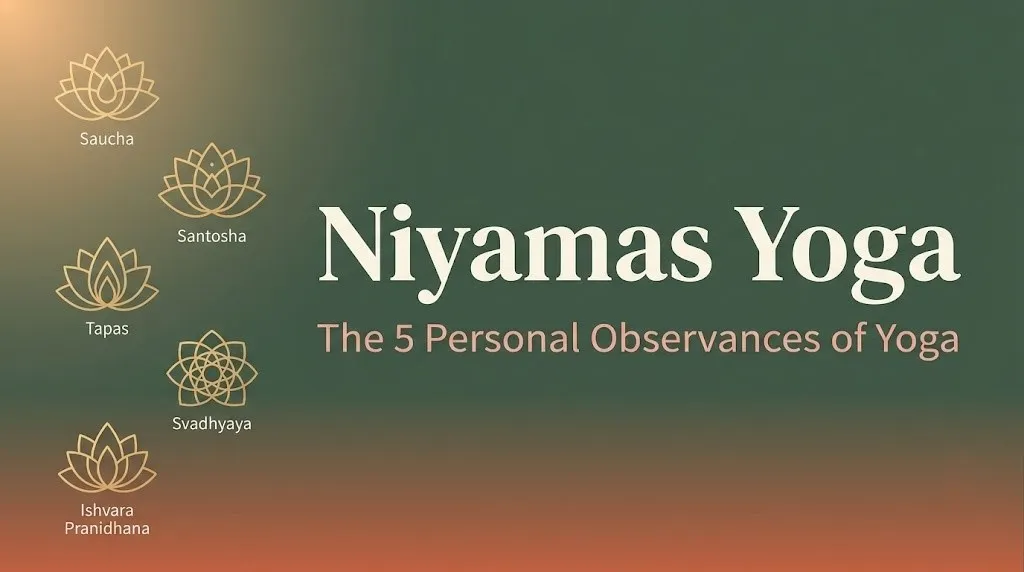
The five niyamas are Saucha (cleanliness and purity), Santosha (contentment), Tapas (discipline and self-effort), Svadhyaya (self-study), and Ishvara Pranidhana (surrender or devotion). They appear as a unified system, not a checklist. Practicing one tends to strengthen the others.
Niyamas are relevant to any yoga practitioner, regardless of which physical style they practice. You will find the niyamas referenced in Hatha yoga, Ashtanga yoga, Iyengar yoga, and Kundalini yoga traditions alike, because they precede any style. They are the foundation the physical practice is built on.
What Does Niyama Mean? The Sanskrit Definition
Niyama is a Sanskrit word that translates most directly as “observance,” “rule,” or “restraint applied to oneself.” The prefix “ni” means “toward” or “into,” and “yama” means “control” or “restraint.” Together, niyama means something close to “self-directed discipline” or “inner observance.”
The word is distinct from the first limb, Yama, even though both share the root term. Yama refers to external ethical restraints, the ways you control your behavior in relation to others and the world. Niyama turns that same disciplined attention inward.
In everyday language, a niyama is a personal practice you commit to consistently, not out of obligation, but out of the understanding that it supports your own clarity and well-being. Think of niyamas less like commandments and more like daily habits chosen with full awareness.
The plural form, niyamas, refers collectively to all five observances as a set. When a yoga teacher or text says “practice the niyamas,” they mean engaging with all five as a way of life, not selecting one and ignoring the others.
| Sanskrit Term | Literal Translation | Practical Meaning |
|---|---|---|
| Niyama | Observance, inner rule | Self-directed personal discipline |
| Yama | Restraint, external ethics | Social and ethical conduct |
| Asana | Seat, posture | Physical yoga practice |
| Pranayama | Breath extension | Breath regulation techniques |
| Saucha | Purity, cleanliness | Purification of body and mind |
The Five Niyamas of Yoga: A Complete Overview
The five niyamas form a sequential and mutually reinforcing system. Patanjali listed them in a specific order in the Yoga Sutras, and that order is not arbitrary. Cleanliness (Saucha) creates the conditions for contentment (Santosha). Contentment makes discipline (Tapas) sustainable. Discipline supports honest self-study (Svadhyaya). And self-study naturally opens the practitioner toward surrender (Ishvara Pranidhana).
Each niyama addresses a different dimension of the practitioner’s inner life. Saucha works with the physical and mental environment. Santosha works with emotional relationship to circumstance. Tapas works with will and effort. Svadhyaya works with knowledge and honest observation. Ishvara Pranidhana works with trust and release of control.
| Niyama | Sanskrit | Core Focus | Daily Practice Example |
|---|---|---|---|
| Saucha | Purity | Cleanliness of body, mind, space | Decluttering your practice space; simplifying your diet |
| Santosha | Contentment | Finding sufficiency in what is | Morning gratitude before checking your phone |
| Tapas | Discipline | Consistent self-effort and willpower | Keeping your practice schedule even on hard days |
| Svadhyaya | Self-study | Self-knowledge through reflection | Journaling after practice; reading yoga philosophy |
| Ishvara Pranidhana | Surrender | Devotion and releasing control | Ending practice with a dedication or moment of stillness |
Understanding the five niyamas as a system, rather than five separate ideas, is the key insight that most introductory yoga resources miss. Each one you work with creates more space for the next.
Niyamas vs Yamas: What Is the Difference?
The yamas and niyamas are both part of Patanjali’s eight-limbed path, but they operate in opposite directions. The yamas govern how you engage with the outer world. The niyamas govern how you engage with yourself.
Patanjali placed the yamas first and the niyamas second in his Yoga Sutras. This ordering suggests that ethical conduct toward others creates the foundation for inner discipline. You cannot genuinely practice self-purification (Saucha) while practicing deceit in your relationships. The two limbs support each other.
There are five yamas and five niyamas, making ten observances in total across these two limbs. The five yamas are Ahimsa (non-violence), Satya (truthfulness), Asteya (non-stealing), Brahmacharya (energy conservation), and Aparigraha (non-grasping). The five niyamas then apply a parallel inner discipline.
A useful way to hold the distinction: the yamas are your code of conduct with others. The niyamas are your code of conduct with yourself. Both are considered prerequisites to the physical practice of yoga postures (asana), which is the third limb.
Key points of difference:
- Yamas are social and relational in nature
- Niyamas are personal and self-directed
- Yamas deal with restraint of outward behavior
- Niyamas deal with cultivation of inner qualities
- Both limbs work together, and neither is more advanced than the other
Key Takeaway: The niyamas are not rules imposed from outside. They are five self-directed inner practices that work as a system, each one building the conditions for the next to take root.
Saucha: The Niyama of Cleanliness and Clarity
Saucha (purity or cleanliness) is the first of the five niyamas, referring to the purification of body, mind, speech, and environment. It is not about hygiene as an end in itself; it is about creating conditions where clarity becomes possible.
On the physical level, Saucha includes keeping the body clean through regular bathing, eating foods that support clear energy, and maintaining a tidy practice space. On the mental level, it refers to noticing and reducing thought patterns that cloud perception: excessive worry, resentment, or mental clutter from constant media consumption.
The connection to modern behavioral science is direct. Research from the Harvard T.H. Chan School of Public Health has linked physical and environmental order with reduced cognitive load and lower reported stress levels. A clean, uncluttered space does not just look better; it genuinely reduces the mental work your brain does to process your surroundings.
Practical ways to practice Saucha:
- Start each practice session by tidying your mat area before you begin
- Choose one meal each week that is simpler and less processed than your usual pattern
- Spend five minutes before bed clearing your mental slate, either through brief journaling or slow breathing, before looking at a screen
- Notice the quality of your inner speech during a challenging day
For beginners: Start with the physical level. Clean your practice space before every session. That single act shifts your mental state before you take one breath. The internal dimensions of Saucha develop naturally from there.
Santosha: The Niyama of Contentment
Santosha (contentment) is the second niyama, describing a stable sense of sufficiency that is not dependent on circumstances changing before you can feel at ease. It is frequently misread as passive acceptance. It is actually an active practice.
Santosha does not mean pretending everything is fine or suppressing the desire for growth. It means finding a ground of okayness that coexists with effort, aspiration, and even difficulty. A practitioner working with Santosha can want their practice to improve and simultaneously not suffer because today’s practice was not what they hoped it would be.
The distinction matters. Most people operate in a state of conditional contentment: “I’ll feel okay when I finish this project, lose this weight, or hold this pose.” Santosha inverts that relationship. The contentment comes first, as a practice, not as a reward at the end of effort.
According to the American Psychological Association, gratitude practices, which share the core mechanism of Santosha, are associated with reduced depressive symptoms, improved relationship quality, and greater reported life satisfaction across multiple study cohorts. The niyama of contentment is, in essence, what gratitude research has been studying for decades.
Practical ways to practice Santosha:
- Before checking your phone each morning, name one thing that is sufficient exactly as it is
- On days when your yoga practice falls short of your expectations, finish with a few breaths of acknowledgment rather than frustration
- Notice the difference between wanting something and suffering because you don’t have it yet
Tapas: The Niyama of Discipline
Tapas (discipline, austerity, or self-effort) is the third niyama, referring to the consistent application of will and energy toward your practice and growth. The Sanskrit root means “to heat” or “to burn,” suggesting the purifying intensity of sustained effort.
Tapas is often translated as austerity, but that word carries a connotation of deprivation that misses the point. Tapas is not about punishment or suffering. It is about showing up consistently for the practices you have chosen, even when motivation is low, even when the result is not immediately visible.
Think of Tapas like the heat required to forge metal. Without sustained temperature, metal stays soft and shapeless. The regular discipline of practice, whether physical postures, meditation, or intentional daily habits, creates a kind of internal hardening that builds character and stability over time.
Research published in Complementary Therapies in Medicine found that consistent yoga practice, maintained over an 8-week period, produced measurable improvements in self-regulatory behavior, sleep quality, and stress response in adult participants. That consistency is Tapas in action.
Practical expressions of Tapas:
- Maintaining your yoga or meditation schedule even on days when you don’t feel like it
- Choosing the slightly harder option in a pose rather than backing off habitually
- Committing to a daily practice of any length, even five minutes, rather than practicing irregularly for longer sessions
- Applying the same steady effort to habits off the mat: sleep, hydration, screen-time limits
For people managing chronic stress or fatigue: Tapas does not require intensity. A five-minute gentle practice done every day is a stronger expression of Tapas than a demanding 60-minute session done once every two weeks.
Key Takeaway: Santosha and Tapas are often mistaken for opposites, but they are partners. Contentment gives you the stability to keep practicing. Discipline gives your contentment something real to rest on.
Svadhyaya: The Niyama of Self-Study
Svadhyaya (self-study or self-inquiry) is the fourth niyama, referring to the honest, ongoing observation of your own patterns, motivations, reactions, and beliefs. It also extends to the study of yoga texts and philosophical teachings as mirrors for self-understanding.
The word breaks into “sva” (self) and “adhyaya” (study or examination). Together, Svadhyaya points toward the practice of turning awareness back on itself: not just doing yoga, but watching yourself doing yoga, noticing what arises, what you resist, what you reach for, and what you avoid.
On a practical level, Svadhyaya looks like post-practice journaling, reading the Yoga Sutras or other philosophical texts, attending classes specifically to receive feedback, or sitting with an uncomfortable emotion long enough to understand where it comes from. It is any practice that increases honest self-knowledge.
The psychological parallel is the concept of metacognition, or thinking about one’s own thinking, which the American Psychological Association identifies as a core skill in emotional self-regulation and cognitive flexibility. People who practice regular self-reflection show greater ability to respond to stress rather than react to it.
Practical ways to practice Svadhyaya:
- Keep a short practice journal. Note not just what poses you did, but how you felt during and after.
- Read one chapter of the Yoga Sutras or another yoga philosophy text each week, and reflect on one phrase that applies to your current life.
- After a difficult interaction or emotion, ask: “What pattern of mine contributed to this?”
- Seek out a teacher or mentor who will give you honest, specific feedback rather than only encouragement.
Ishvara Pranidhana: The Niyama of Surrender
Ishvara Pranidhana (surrender or devotion) is the fifth and final niyama, referring to the act of releasing attachment to outcomes and dedicating one’s practice to something larger than personal gain. The word “Ishvara” means “Supreme Being” or “highest principle,” and “pranidhana” means “to place down” or “to surrender.”
Ishvara Pranidhana does not require a specific religious belief. Patanjali used the word Ishvara as a specific technical term in the Yoga Sutras, referring to a particular consciousness or principle untouched by affliction, free from causation, and beyond time. In practice, most contemporary yoga teachers interpret Ishvara Pranidhana as the act of releasing ego-attachment to results and practicing devotion to the process itself.
The parallel in behavioral science is the concept of intrinsic motivation, where engagement is driven by the activity itself rather than by external reward. Research published in the Journal of Alternative and Complementary Medicine found that yoga practitioners who reported practicing with an attitude of non-attachment to outcomes showed significantly lower scores on anxiety measures than those practicing primarily for fitness or appearance goals.
Practical expressions of Ishvara Pranidhana:
- End each practice session by dedicating the merit of your effort to someone who needs support
- Practice one pose specifically for the experience of the practice, not for any goal related to how you look doing it
- When a plan does not go as intended, pause and ask: “What can I work with from here?”
- Notice the difference between doing a practice and performing a practice
For beginners: You do not need to define what “Ishvara” means to you right now. Start with dedicating your practice to someone you care about. That single act shifts the orientation from self-focused effort to something larger.
Key Takeaway: Ishvara Pranidhana is not passive resignation; it is the disciplined act of releasing the grip of outcome and trusting the process, a skill that behavioral science links directly to reduced anxiety and greater intrinsic motivation.
Niyamas Benefits for Mental and Physical Health
The niyamas offer measurable benefits for mental and physical health when practiced consistently, and the research connecting their core mechanisms to documented wellness outcomes is stronger than most yoga philosophy resources acknowledge.
Saucha practices, including dietary simplification and environmental order, are linked by the Harvard T.H. Chan School of Public Health to reduced cognitive fatigue and lower reported stress. Santosha, through its structural resemblance to gratitude practice, connects to findings from the American Psychological Association on reduced depressive symptoms and improved life satisfaction.
Tapas, as a model of consistent self-discipline, maps directly onto habit formation science. Research in Complementary Therapies in Medicine found that practitioners who maintained consistent yoga schedules over 8 weeks showed improved sleep quality and reduced physiological stress markers, including lower cortisol levels, compared to those who practiced irregularly.
Svadhyaya’s connection to metacognitive self-regulation has been documented by the National Center for Complementary and Integrative Health (NCCIH), which notes that mindfulness-based practices involving self-observation reduce reactivity and improve emotional regulation in adults across age groups.
Collective benefits of regular niyama practice include:
- Reduced self-reported anxiety and stress through Santosha and Ishvara Pranidhana practices
- Improved self-regulatory behavior and habit consistency through Tapas
- Greater emotional awareness and reduced reactivity through Svadhyaya
- Lower cognitive load and improved mental clarity through Saucha
- Increased sense of meaning and purpose through Ishvara Pranidhana’s orientation toward something beyond personal outcome
Niyamas and Mindfulness: What Modern Research Shows
The niyamas and mindfulness share a structural core: both direct deliberate, non-judgmental awareness toward present-moment experience. Research shows this is not a coincidence.
Mindfulness-Based Stress Reduction (MBSR), developed by Jon Kabat-Zinn at the University of Massachusetts and now among the most studied behavioral interventions in the world, draws directly on principles that mirror the niyamas. The MBSR practice of non-striving parallels Santosha. Its emphasis on beginner’s mind mirrors Svadhyaya. Its commitment to regular discipline echoes Tapas.
A study published in the International Journal of Yoga found that practitioners who engaged with both the physical and philosophical components of yoga, rather than physical practice alone, reported higher scores on measures of psychological well-being, emotional regulation, and life satisfaction. The niyamas represent exactly the philosophical layer that this research points toward.
The niyamas also parallel the mechanisms of self-determination theory, a well-established framework in behavioral psychology. Self-determination theory identifies autonomy, competence, and relatedness as the three foundations of intrinsic motivation and psychological health. Svadhyaya supports autonomy through self-knowledge. Tapas builds competence through consistent effort. Ishvara Pranidhana supports a sense of relatedness to something beyond the self.
Key insight: When a yoga student asks “is yoga philosophy actually useful or is it just spiritual decoration,” the research on mindfulness and self-determination theory provides a clear answer. The niyamas are not decorative. They are a pre-modern articulation of practices that behavioral science now validates through empirical study.
How to Practice the Niyamas in Daily Life
Practicing the niyamas in daily life means choosing one consistent action per niyama and repeating it with awareness, not performing five perfect routines simultaneously from the beginning. That is where most practitioners go wrong.
The most sustainable approach is sequential. Spend one week focusing on Saucha. Simply tidy your practice space before every session and choose one meal each day to eat more slowly and intentionally. The following week, add one Santosha practice: name three things that are sufficient before your morning coffee. Build week by week.
A daily structure that touches all five niyamas does not need to be long. A 20-minute morning routine can include:
- Tidy your space before sitting (Saucha)
- Name one moment of sufficiency before beginning (Santosha)
- Complete your planned practice even when you’d rather not (Tapas)
- Write two sentences after practice about what you noticed in your body or mind (Svadhyaya)
- Close with a brief dedication of your effort to someone or something beyond yourself (Ishvara Pranidhana)
Off-the-mat practice matters as much as on-mat application. The niyamas were not written for the yoga studio. They were written for an entire life.
For seniors: Adapt the physical dimension of each niyama to your current capacity. Saucha might mean keeping a small corner of your home specifically clean and uncluttered as a practice space. Tapas might mean a five-minute breathing practice done at the same time each day. Consistency counts far more than intensity.
Niyamas for Beginners: Where to Start
Beginners should start with Saucha and Santosha before attempting to actively practice the other three niyamas. This is the practical recommendation most yoga philosophy resources skip entirely.
Saucha is the most concrete and action-based of the five niyamas. It gives beginners something tangible to do: clean your mat area, simplify one meal, notice the quality of your inner talk after a difficult class. Concrete actions build the habit of intentional practice before more subtle inner work is possible.
Santosha comes second because it directly addresses the frustration most beginners feel when their practice does not match their expectations. Learning to find sufficiency in today’s practice, even when it is messy, is what keeps beginners coming back long enough to make real progress.
Common beginner mistakes with niyama practice:
- Treating the niyamas as a performance review where you grade yourself
- Trying to master all five simultaneously in the first month
- Confusing Tapas with intensity and burning out early
- Reading about the niyamas without applying any of them to actual daily choices
- Applying niyamas only to yoga practice and not to the rest of life
The niyamas are a lifelong practice. A 30-year practitioner and a first-week beginner are both working with the same five observances. The difference is depth of familiarity, not arrival at some finished state.
For people managing anxiety or high stress: Santosha is often the most immediately useful niyama. The practice of finding one moment of sufficiency per day is a specific, low-pressure starting point that mirrors what behavioral therapists call “savoring,” a documented strategy for shifting anxious rumination toward present-moment awareness.
Key Takeaway: Beginners get the most from starting with Saucha and Santosha: one niyama that is concrete and action-based, and one that directly addresses the frustration that derails most new practitioners.
Niyamas in Yoga Philosophy and Patanjali’s Yoga Sutras
The niyamas appear in Patanjali’s Yoga Sutras, the foundational text of classical yoga philosophy, composed in Sanskrit and estimated by scholars to date to somewhere between 400 BCE and 400 CE. Patanjali did not invent yoga. He systematized a body of existing practice into a coherent eight-limbed framework.
The Yoga Sutras consist of 196 aphorisms (short, concentrated teaching statements) organized into four chapters. The niyamas appear in the first chapter, Samadhipada, and are elaborated in Sadhanapad, the chapter on practice. Patanjali’s treatment of the niyamas is characteristically terse; each is stated in a few words. The elaboration has been the work of centuries of teachers and commentators.
The most widely referenced traditional commentaries on the Yoga Sutras include those by Vyasa (estimated 4th to 5th century CE) and in modern times by B.K.S. Iyengar in “Light on the Yoga Sutras of Patanjali” and by Swami Satchidananda. These commentaries expand each niyama from a brief aphorism into a livable teaching.
Patanjali’s specific wording for the niyamas in Sutra 2.32 is: “saucha samtosa tapah svadhyaya Isvara pranidhana niyamah.” This single sutra names all five niyamas as a single compound concept. The next several sutras elaborate the fruit of each practice, providing some of the earliest documented writing on the psychology of self-discipline, contentment, and self-knowledge in human history.
Understanding that the Yoga Sutras are a practical manual, not a religious scripture, helps beginners approach the niyamas without discomfort. Patanjali wrote about the mind and how to work with it. The niyamas are his framework for inner discipline.
Niyamas and the Eight Limbs of Yoga
The niyamas occupy the second position among Patanjali’s eight limbs, sitting between the yamas (first limb) and asana (third limb). This placement carries a specific logic that most modern yoga practice reverses.
In Patanjali’s framework, practitioners were meant to establish ethical conduct (yamas) and personal observances (niyamas) before advancing to physical postures (asana). The body was prepared for meditation through posture, and posture was prepared for by inner discipline. Many contemporary yoga classes begin and end with the physical practice, touching philosophy only briefly if at all.
The eight limbs in order:
- Yama: Ethical observances toward the outer world
- Niyama: Personal observances directed inward
- Asana: Physical postures and the practice of steadiness
- Pranayama: Breath regulation and expansion
- Pratyahara: Withdrawal of the senses from external stimuli
- Dharana: Focused concentration
- Dhyana: Sustained, uninterrupted meditation
- Samadhi: State of complete absorption and integration
The niyamas are what makes a yoga practice more than exercise. Without them, asana is physical training. With them, asana becomes a laboratory for practicing self-awareness, contentment, discipline, and release.
According to the National Center for Complementary and Integrative Health (NCCIH), yoga practices that include meditative and philosophical components, beyond physical movement alone, produce more durable improvements in psychological well-being than movement-only yoga. The niyamas are the philosophical component that most practitioners are missing.
Practicing the eight limbs in sequence is not required. Most modern practitioners work with several limbs simultaneously. But understanding where the niyamas sit in the full system explains why working with them deepens every other aspect of practice.
Frequently Asked Questions About Niyamas Yoga
What are the 5 niyamas in yoga?
The five niyamas in yoga are Saucha (purity), Santosha (contentment), Tapas (discipline), Svadhyaya (self-study), and Ishvara Pranidhana (surrender or devotion).
They come from Patanjali’s Yoga Sutras and form the second limb of the eight-limbed yoga path.
Each niyama is a self-directed inner practice, not an external rule, and all five work together as a system.
What is the difference between yamas and niyamas in yoga?
The yamas govern how you relate ethically to others and the outer world, while the niyamas govern how you relate to yourself through inner discipline.
There are five of each, and together they form the first two limbs of Patanjali’s eight-limbed path.
The yamas create the outer conditions for ethical living; the niyamas create the inner conditions for sustained practice.
How do you practice the niyamas in everyday life?
You practice the niyamas by choosing one consistent daily action for each observance and repeating it with awareness, starting with Saucha and Santosha before adding the others.
A 20-minute morning routine can touch all five: tidying your space, naming one moment of sufficiency, completing your practice, journaling one observation, and closing with a brief dedication.
Off-the-mat practice counts as much as on-mat application; the niyamas were designed for an entire life, not just a yoga class.
What does niyama mean in Sanskrit?
Niyama is a Sanskrit word that translates as “observance,” “inner rule,” or “self-directed restraint.”
The prefix “ni” means “toward” or “into,” and “yama” means “control,” making niyama something close to “control directed inward.”
In practice, a niyama is a personal discipline chosen and maintained with awareness as part of a committed yoga practice.
Which niyama should a beginner start with?
Most yoga teachers recommend beginners start with Saucha, the niyama of cleanliness and purity, because it offers the most concrete and action-based entry point.
Tidying your practice space before every session is a specific, repeatable act that immediately affects your mental state.
Santosha, the practice of contentment, is a helpful second niyama to add, particularly for beginners who feel frustrated when their practice does not meet their expectations.
The niyamas do not ask you to be perfect. They ask you to be consistent. Start with one practice this week: clean your space before every session (Saucha) or name one moment of sufficiency before your morning coffee (Santosha). That is enough.
Add one niyama each week for five weeks. Notice what changes, not in a dramatic way, but in the texture of your daily attention. That is the real work of yoga philosophy.
The mat is where you practice. Life is where the niyamas actually apply.