Yoga for Scoliosis: Poses, Benefits, and Safety 2026
Yoga for scoliosis is not only safe for most people with mild to moderate curves, it is one of the most research-supported non-surgical tools available for managing pain, improving posture, and in some cases measurably reducing spinal curvature. The key is practicing in a way that is specific to your curve pattern, not just showing up to a general yoga class and hoping for the best.
The research behind yoga and scoliosis has grown notably through 2025 and 2026. A pivotal clinical trial by Dr. Loren Fishman, published in the Global Advances in Health and Medicine, found that practicing a single yoga pose, Vasisthasana (Side Plank Pose), on the convex side of the curve reduced primary scoliotic curves by an average of 32% across all patients and 49.6% in compliant adolescents. A 2024 review published on PMC (PubMed Central) found that Hatha yoga enhances body awareness, posture, and may slow scoliosis progression while reducing back pain.
This guide covers the science honestly, explains the biomechanics that make scoliosis yoga different from general yoga, details the best and worst poses for each curve type, addresses post-surgical safety, and tells you exactly what to look for when searching for a scoliosis-informed class or instructor. Whether your curve is mild or moderate, adolescent or degenerative, this is the starting point that most articles skip.
Yoga for Scoliosis: What You Need to Know First
Yoga for scoliosis is a movement practice specifically adapted to the asymmetrical nature of a curved spine, using poses, breathwork, and props to lengthen compressed structures, strengthen the muscles on the weaker side of the curve, and improve postural awareness over time.
This is the core truth most general yoga articles miss: scoliosis is an asymmetrical condition. A standard symmetric yoga class, where both sides are stretched and strengthened equally, may feel good in the moment but can reinforce existing imbalances if it does not account for which side of the curve needs strengthening and which needs lengthening.
Think of a scoliotic spine like a bent tree. The muscles on the outer, convex side are elongated and weak. The muscles on the inner, concave side are shortened and tight. A yoga practice that stretches both sides equally is like watering only one side of a garden and wondering why the imbalance persists.
The American Academy of Orthopaedic Surgeons (AAOS) considers a spinal curve of 25 to 40 degrees sufficient to require treatment, and a curve of 45 to 50 degrees or more a reason for surgical evaluation. For people below the surgical threshold, movement-based approaches including yoga are a primary management strategy.
Before beginning any scoliosis yoga practice, understanding your specific curve pattern is not optional. It is the foundation for every decision about which poses to practice, which side to emphasize, and which movements to avoid. Your orthopedist, physical therapist, or spinal specialist can provide this information from your most recent X-ray report.
| Scoliosis Severity | Cobb Angle | Typical Management Approach | Yoga Appropriateness |
|---|---|---|---|
| Mild | Under 25 degrees | Observation, exercise | Yes, with scoliosis-specific guidance |
| Moderate | 25 to 45 degrees | Bracing, physical therapy | Yes, with specialist oversight |
| Severe | 45 to 50 degrees or more | Surgery evaluation | Modified yoga with medical clearance |
| Post-surgical | Any | Surgical recovery protocol | Yes, with specific post-fusion modifications |
Does Yoga Help with Scoliosis?
Yes, yoga helps with scoliosis when practiced with curve-specific modifications, and the research supporting this is stronger than most practitioners realize. It will not replace medical treatment for severe curves, but it offers documented benefits across pain reduction, postural awareness, respiratory function, and in some cases measurable changes to spinal curvature.
A 2024 systematic review published on PMC (National Institutes of Health PubMed Central) found that Hatha yoga as a complementary treatment for adolescent idiopathic scoliosis demonstrated potential to improve the Cobb angle of primary scoliotic curves, enhance back muscle strength, and reduce pain. The review noted that existing studies face limitations including small sample sizes and lack of large-scale randomized controlled trials, but the directional evidence is consistently positive.
The SOSORT 2025 guidelines (Society on Scoliosis Orthopaedic and Rehabilitation Treatment) highlight that personalized movement plans, including yoga-based approaches, are an emerging component of conservative scoliosis management. The emphasis is on specificity: general fitness is less effective than targeted spinal exercise programs.
A study in the European Spine Journal found that approximately 38% of adults over age 41 have some degree of scoliosis, with prevalence rising further in women over 60. This makes yoga for scoliosis relevant not just to teenagers diagnosed in school screenings, but to a very large adult population managing degenerative spinal change.
Yoga helps with scoliosis through four primary mechanisms:
- Targeted muscle strengthening: Engaging the weaker muscles on the convex side of the curve through asymmetric poses.
- Lengthening compressed structures: Releasing shortened muscles on the concave side.
- Improving spinal mobility and proprioception: Teaching the nervous system where neutral spinal alignment feels.
- Breath-based rib cage expansion: Improving respiratory function in areas where spinal rotation compresses the thoracic cage.
Can Yoga Fix Scoliosis?
Yoga cannot fully straighten a structurally curved spine in the way surgery can, but “fix” is the wrong frame for this question. Yoga can measurably reduce the degree of curvature, significantly reduce pain, improve postural alignment, and slow or arrest progression, which is a meaningful clinical outcome.
The evidence from Dr. Loren Fishman’s research at Columbia College of Physicians and Surgeons is the most specific available. A clinical trial of 25 patients with idiopathic or degenerative scoliosis found that practicing Vasisthasana (Side Plank Pose) on the convex side for an average of 90 seconds daily, six days per week, for approximately 6.8 months reduced primary scoliotic curves by an average of 32% across all participants. Among the 19 who practiced most consistently, the improvement averaged 40.9%.
Those are radiographically confirmed reductions measured by the standard Cobb angle method. That is not anecdote. That is X-ray-based clinical data.
What yoga cannot do is reverse structural changes that have fully calcified, correct curves above the surgical threshold without medical intervention, or produce results without consistent, correct daily practice. The word “fix” implies a passive outcome. Yoga for scoliosis is an active discipline that requires knowing your curve, working asymmetrically, and maintaining the practice long-term.
For adolescents still in growth spurts, the opportunity to influence curve progression is greater than in adults with stable, older curves. For adults, the realistic goal is pain reduction, postural improvement, and functional quality of life rather than dramatic Cobb angle change. Both are legitimate and achievable goals.
Key Takeaway: Yoga cannot replace surgery for severe scoliosis, but clinical research shows it can reduce spinal curvature by 32% to 49.6% in compliant practitioners when the right asymmetric poses are practiced consistently on the correct side of the curve.
Yoga for Scoliosis Benefits
Yoga delivers multiple documented benefits for people with scoliosis, spanning physical function, pain management, respiratory health, and psychological well-being. These benefits are most pronounced when the practice is tailored to the individual’s specific curve pattern rather than practiced generically.
Key benefits supported by research and clinical experience:
- Reduced Cobb angle in primary scoliotic curves: Documented in multiple clinical studies, most prominently the Fishman side plank research and the 2024 PMC review of Hatha yoga for adolescent idiopathic scoliosis.
- Back pain reduction: The National Center for Complementary and Integrative Health (NCCIH) recognizes yoga as an evidence-supported practice for chronic lower back pain, which is highly prevalent in adults with scoliosis.
- Improved core stabilization: Yoga engages the transverse abdominis, multifidus, and erector spinae, the deep stabilizing muscles of the spine that help offset the mechanical disadvantage of a curved spinal column.
- Improved postural awareness: Consistent yoga practice builds proprioceptive sensitivity, the body’s awareness of its own position, which allows practitioners to consciously correct habitual asymmetric postures throughout daily life.
- Expanded lung capacity: Spinal rotation associated with scoliosis can compress the thoracic cage and restrict breathing on the concave side. Targeted pranayama (breathwork) and rib-opening poses can improve respiratory function measurably.
- Reduced psychological distress: A 2024 PMC review noted that scoliosis affects mental health through reduced self-esteem and body image concerns, particularly in adolescents. Yoga’s mindfulness component addresses this dimension of the condition directly.
- Slowed disease progression: The 2024 Hatha yoga review found that regular yoga practice may slow scoliosis progression, particularly in adolescents during active growth phases.
Yoga for Scoliosis and Back Pain
Yoga reduces scoliosis-related back pain primarily by releasing the chronically shortened muscles on the concave side of the curve while simultaneously strengthening the overstretched, fatigued muscles on the convex side. Both sides contribute to pain, and both require attention.
Scoliosis creates a predictable pattern of muscular imbalance. The muscles on the concave (inner) side of the curve, typically including the quadratus lumborum, deeper spinal rotators, and paraspinal muscles, are shortened, tight, and constantly firing to resist the pull of gravity on a misaligned spine. The muscles on the convex (outer) side are elongated and chronically weak. This asymmetric loading is the primary driver of the muscle fatigue and pain that most people with scoliosis experience daily.
The NCCIH recognizes yoga as having the most consistent evidence base for chronic lower back pain among mind-body practices. For scoliosis specifically, the key is targeting the right side of the right muscle groups. A Marjaryasana-Bitilasana (Cat-Cow Stretch) practiced symmetrically helps spinal mobility but does not address the asymmetric pain drivers. Adding a lateral lean toward the convex side in Cat-Cow, or combining it with a side body stretch, begins to address the imbalance.
Poses that specifically target scoliosis-related back pain include:
- Marjaryasana-Bitilasana (Cat-Cow Stretch): Gentle spinal mobilization reducing stiffness in both thoracic and lumbar regions.
- Parighasana (Gate Pose): A lateral stretch that directly targets the shortened side of the lumbar region. Performed toward the concave side, it releases the tight structures that pull the spine further into its curve.
- Viparita Karani (Legs-Up-the-Wall Pose): A gentle inversion that decompresses the lumbar spine and reduces sacroiliac joint stress without requiring balance or effort.
Modification for acute pain: If pain is acute or accompanied by nerve symptoms such as radiating leg pain or numbness, avoid all active poses and work with a physical therapist and your prescribing physician to determine whether yoga is appropriate before resuming practice.
Yoga for Scoliosis and Breathing
Yoga for scoliosis improves breathing by combining lateral breathwork techniques with specific poses that open the compressed side of the rib cage, addressing one of the most functionally limiting but least discussed effects of spinal curvature.
Scoliosis rotates the vertebrae in addition to curving the spine sideways. This rotation physically tilts the ribs, creating a situation where the rib cage is more compressed on the concave side of the curve. The compressed side restricts lung expansion. Over time, reduced respiratory capacity on one side can cause measurable asymmetry in breathing depth and efficiency.
Elise Browning Miller, a senior certified Iyengar yoga teacher with a master’s degree in therapeutic recreation and decades of work with scoliosis patients, describes the first goal of scoliosis yoga as bringing breath into the compressed areas. Before alignment or strength work, the breath needs to reach the restricted spaces. This is not philosophy. It is functional respiratory training.
Lateral breathing is the primary breathing technique used in scoliosis yoga. Rather than expanding equally in all directions, lateral breathing directs the breath specifically into the compressed (concave) side of the rib cage. To practice this:
- Sit tall in Sukhasana (Easy Seated Pose) or on a folded blanket.
- Place one hand on the concave side of your rib cage, the side that feels more compressed.
- Inhale, directing the breath specifically toward that hand. Resist the urge to fill the easier side first.
- Feel the ribs expand laterally into your palm on each inhale.
- Exhale completely. Repeat for 8 to 10 breath cycles.
Modification: If seated is uncomfortable, practice lateral breathing lying on your side with the concave side up. Gravity assists the lateral expansion in this position and reduces the effort required to direct the breath.
Key Takeaway: Breathing is the first intervention in scoliosis yoga, not the last. Getting breath into the compressed side of the rib cage is both a therapeutic goal in its own right and the foundation for every physical pose that follows.
Yoga for Scoliosis: Understanding Your Curve Type
Knowing your curve type is the single most important piece of information you need before beginning yoga for scoliosis, because the side you strengthen, the direction you stretch, and the modifications you choose all depend directly on where your curve is and which way it bends.
Scoliosis curves are categorized by location (thoracic, lumbar, thoracolumbar) and by the direction of the convexity (the outward-curving side). The most common pattern in adolescent idiopathic scoliosis is a right thoracic curve, meaning the spine curves to the right in the upper back with the convex side facing right. The most common adult degenerative pattern is a left lumbar curve.
This matters because yoga for a right thoracic curve looks different from yoga for a left lumbar curve. In the Fishman side plank protocol, practitioners perform the pose on the convex side only, meaning a right thoracic curve requires Side Plank with the right side down, while a left lumbar curve requires Side Plank with the left side down. Practicing on the wrong side can potentially worsen asymmetry.
| Curve Type | Location | Convexity Direction | Side Plank Side | Concave Side (to release) |
|---|---|---|---|---|
| Right thoracic | Upper to mid back | Curves right | Right side down | Left side |
| Left lumbar | Lower back | Curves left | Left side down | Right side |
| S-curve (double) | Thoracic and lumbar | Opposite directions | Consult specialist | Both sides need work |
| Thoracolumbar | Mid-back junction | Varies | Confirm with clinician | Varies |
If you have an S-curve or double curve pattern, seeking guidance from a yoga instructor specifically trained in scoliosis is particularly important before beginning asymmetric practice. The competing curve patterns require a carefully sequenced approach that general yoga classes are not equipped to provide.
Best Yoga for Scoliosis: Iyengar and Restorative Styles
The best yoga styles for scoliosis are Iyengar yoga and Restorative yoga, because both prioritize precision, use props extensively to support the spine in appropriate alignment, and allow the level of individualization that scoliosis demands.
Iyengar yoga, developed by B.K.S. Iyengar, is built on exact anatomical alignment, sustained pose holds, and comprehensive prop use. It has the strongest documented connection to scoliosis therapy among all yoga traditions. Elise Browning Miller, a senior certified Iyengar teacher, has spent decades developing scoliosis-specific sequences that use blocks, bolsters, blankets, straps, and rope walls to support asymmetric spinal positioning. A 2007 clinical report confirmed that Iyengar yoga offers measurable benefit for scoliosis management, particularly for pain reduction and postural improvement.
Restorative yoga uses fully supported, passive poses held for extended durations (three to ten minutes) to allow the nervous system to release chronic muscular holding patterns. For scoliosis, supported side-lying poses that open the compressed rib cage and release the concave-side muscular tightness are particularly effective. The passive nature of Restorative yoga reduces the risk of inadvertently reinforcing asymmetric patterns through overly effortful, symmetrical practice.
| Yoga Style | Scoliosis Suitability | Primary Mechanism | Props Used |
|---|---|---|---|
| Iyengar yoga | Excellent | Precise alignment, asymmetric correction | Blocks, straps, bolsters, blankets, rope wall |
| Restorative yoga | Excellent | Passive release, nervous system calming | Bolster, blankets, blocks, eye pillow |
| Hatha yoga (therapeutic) | Good | Spinal mobility, breath awareness | Blocks, blankets |
| Vinyasa / Flow yoga | Use with caution | Intensity and symmetry not ideal | Limited props |
| Hot yoga / Bikram | Not recommended | Heat increases flexibility beyond safe range | None advised |
| Ashtanga yoga | Not recommended | Fixed demanding sequence not curve-specific | None advised |
For beginners with scoliosis: Start with either a therapeutic Hatha or Restorative class taught by an instructor with scoliosis-specific training. Do not begin with Vinyasa, Ashtanga, or any heated format until you have established which poses serve your curve and which aggravate it.
Yoga for Scoliosis Poses
The best yoga poses for scoliosis address three goals simultaneously: spinal decompression, asymmetric strengthening of the convex side, and release of the concave side’s shortened structures. Every pose here meets at least one of these criteria.
Tadasana (Mountain Pose): The foundational standing pose. With scoliosis, it becomes a conscious postural recalibration exercise. The goal is even weight distribution across both feet and deliberate engagement of the muscles that tend toward inhibition on the convex side. Stand with feet hip-width apart. Press evenly through all four corners of both feet. Lift through the crown of the head. Notice which shoulder or hip sits higher and consciously work toward symmetry.
Marjaryasana-Bitilasana (Cat-Cow Stretch): Mobilizes the entire spine through flexion and mild extension. Reduces thoracic and lumbar stiffness. Engages the erector spinae and transverse abdominis rhythmically. Can be modified by adding a lateral lean in Cat toward the convex side to increase the stretch on the concave muscles.
Ardha Chandrasana (Half Moon Pose): A standing balance pose that builds lateral body strength. For scoliosis, it is performed facing the concave side of the curve toward the wall for support. The extended arm reaches toward the ceiling, and the wall-facing arm holds a block. This opens the concave side body while building the hip and spinal stabilizers on the standing leg.
Balasana (Child’s Pose): A resting pose that gently decompresses the lumbar spine and broadens the sacrum. Particularly useful between more demanding poses. With scoliosis, adding a slight shift of the hips to the convex side while the arms reach forward can increase the lateral stretch on the concave side.
Setu Bandhasana (Bridge Pose): Strengthens the gluteus maximus, posterior chain, and the paraspinal muscles of the lumbar region. Supports the low back in extension without compressing the front body. For scoliosis practitioners, placing a block between the inner thighs and pressing evenly encourages pelvic symmetry.
Modification for all standing poses: Use a wall for balance in any standing pose. Scoliosis-related postural asymmetry shifts the body’s center of gravity, making balance more challenging. A wall removes the balance demand and allows full attention to the spinal cues.
Key Takeaway: Scoliosis yoga poses must work asymmetrically. Stretching the concave side and strengthening the convex side are two distinct tasks requiring distinct poses, and understanding which is which for your specific curve is the foundation of an effective practice.
Vasisthasana (Side Plank Pose) for Scoliosis
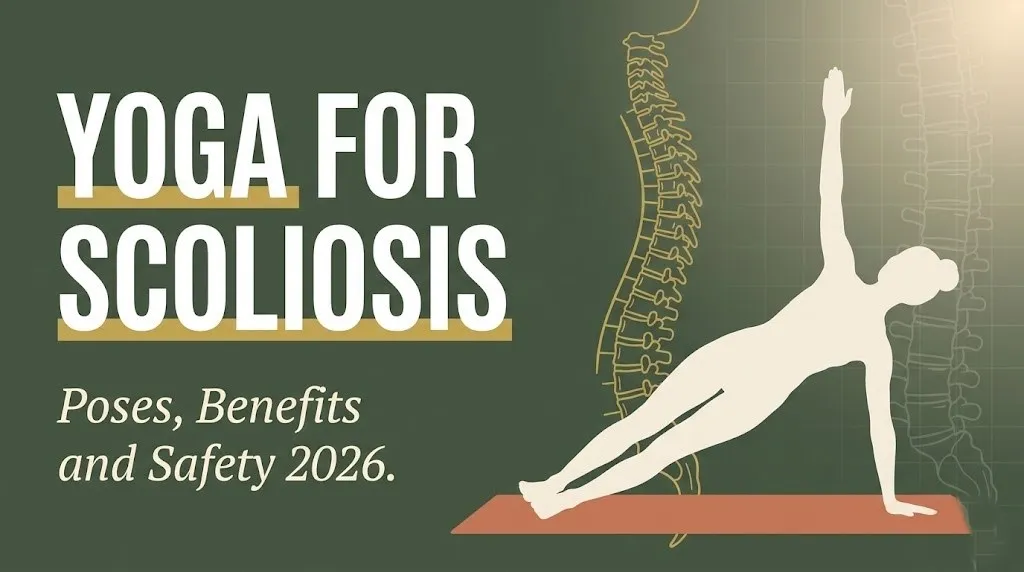
Vasisthasana (Side Plank Pose) is the most clinically studied and most directly therapeutic yoga pose for scoliosis, and it must be practiced on the correct side to produce a therapeutic rather than counterproductive effect.
The clinical evidence is specific. Dr. Loren Fishman’s research found that practicing Vasisthasana on the convex side only (the outward-curving side of the primary curve) strengthened the quadratus lumborum, obliques, and paraspinal muscles of the convex side in a way that progressively pulled the spine toward a more neutral alignment. The pose works because scoliosis is an asymmetric condition. Treating it requires an asymmetric intervention.
To practice Vasisthasana (Side Plank Pose) for scoliosis correctly:
- Begin in a full plank position, shoulders over wrists, body in one straight line.
- Rotate to the convex side: if your curve convexity is on the right, rotate to your right.
- Stack the feet, or for a modified version, stagger them with the bottom foot’s outer edge on the floor.
- Place the supporting hand (convex-side hand) directly under the shoulder.
- Lift the hips. The entire body forms one lateral line from heels to crown.
- Engage the obliques and quadratus lumborum on the supporting side actively.
- Hold for as long as possible with good form, working up to 90 seconds over time.
- Practice once daily on the convex side only. Do not mirror to the other side.
- Release gently back to plank or into Balasana (Child’s Pose).
Modification for wrist pain: Perform on the forearm rather than the palm. The forearm modification, sometimes called Forearm Side Plank or a modified version of Vasisthasana, removes wrist extension entirely and maintains the therapeutic strengthening effect on the lateral torso and spine.
Modification for beginners: Begin with bent knees stacked on top of each other rather than straight legs. Hold for 10 to 20 seconds initially and build duration progressively over weeks.
Yoga Poses to Avoid with Scoliosis
Certain yoga poses are contraindicated for scoliosis because they compress already-compressed spinal structures, force the spine into positions that worsen the curve pattern, or create loads the asymmetric spine cannot safely manage.
The category principle is more useful than a simple list: avoid poses that force symmetry on an asymmetric spine, that compress the concave side of the curve, or that place significant torsional load on already-rotated vertebral segments.
Specific poses to avoid or approach with extreme caution:
- Bhujangasana (Cobra Pose) and Urdhva Mukha Svanasana (Upward-Facing Dog): Strong lumbar extension can compress the concave side of lumbar curves. Avoid if you have significant rotation. Replace with a gentle Sphinx Pose with the elbows propped further forward to reduce lumbar compression.
- Dhanurasana (Bow Pose) and Ustrasana (Camel Pose): Deep backbends combine lumbar extension with lateral forces that can aggravate thoracic and thoracolumbar curves.
- Strong closed twists: Any twist that compresses the abdomen toward the concave side of the curve, such as Ardha Matsyendrasana (Half Lord of the Fishes Pose) toward the concave side, can increase rotational compression. Open twists toward the convex side, by contrast, may be beneficial.
- Sirsasana (Headstand) and Salamba Sarvangasana (Shoulder Stand): Inversions place the full weight of the body through a spine that may not have the structural symmetry to distribute load safely. Avoid without direct guidance from a scoliosis-trained instructor.
- Paschimottanasana (Seated Forward Fold): Deep, symmetric forward flexion with a flat back forces a shape the scoliotic spine cannot hold symmetrically. Replace with a supported, slightly lateral forward fold using a block or bolster.
Safety rule for all poses: If a pose increases pain, creates a new asymmetry, or generates radiating nerve symptoms, stop immediately. Pain is information. With scoliosis, it is particularly reliable information.
Yoga for Scoliosis: Modifications and Props
Props are not optional accessories in scoliosis yoga. They are the primary tools that make asymmetric therapeutic work possible, and the distinction between good scoliosis yoga and general yoga is often found entirely in how props are used.
Iyengar yoga‘s approach to scoliosis is built on props as corrective tools rather than supports for comfort. A folded blanket under the lower side of the pelvis corrects pelvic tilt. A block under the hand in lateral poses allows the spine to remain long while the rib cage opens. A strap around the waist can create traction feedback that teaches the muscles where neutral alignment feels.
Key props and their specific roles in scoliosis yoga:
- Yoga block: Placed under the lower hand in standing lateral poses like Trikonasana (Triangle Pose) and Ardha Chandrasana (Half Moon Pose), allowing spinal length without collapsing. Also placed between the inner thighs in Setu Bandhasana (Bridge Pose) to cue pelvic symmetry.
- Yoga bolster: Used in supported lateral poses to open the concave side of the rib cage passively. Lying over a bolster placed under the convex side of the thoracic region can gently lengthen the compressed intercostal muscles on the concave side.
- Yoga blanket: Folded and placed under the ischial tuberosity (sitting bone) on the higher side in seated poses, leveling the pelvis and creating a more neutral spinal baseline for all seated work.
- Yoga strap: Used around the lower rib cage in side-lying poses to create tactile feedback, helping practitioners feel and direct the breath into specific areas of the rib cage.
- Wall: Used as a reference plane in standing poses to check spinal deviation, as a support in balance poses, and as a tool for traction in Viparita Karani (Legs-Up-the-Wall Pose).
Modification for home practice: If you do not own a bolster, a tightly rolled blanket or a firm pillow provides a functionally similar support for side-lying rib cage opening poses. A folded towel substitutes for a thin blanket under the sitting bones.
Yoga for Scoliosis After Surgery
Yoga is possible and beneficial after spinal fusion surgery for scoliosis, but the timeline, pose selection, and instructor qualification requirements are more stringent than for non-surgical practitioners. Returning to yoga after fusion requires direct collaboration between your surgical team and your yoga instructor.
Spinal fusion for scoliosis involves connecting two or more vertebrae with metal rods and screws, eliminating movement between those segments. The fused portion of the spine cannot flex, extend, or rotate. Any pose that requires motion through the fused segment places stress on the adjacent unfused vertebrae instead, a concept called adjacent segment stress. Over time, poorly chosen poses can accelerate degeneration at the levels above and below the fusion.
General post-surgical yoga principles supported by physical therapy guidance:
- Wait a minimum of 6 to 12 months post-surgery before resuming a yoga practice, and follow your surgeon’s specific timeline precisely.
- Avoid all poses that require movement through the fused spinal segment. This varies by the extent of the fusion, which your surgical report will specify.
- Avoid deep forward folds, deep backbends, and any strong spinal twists through the fused levels.
- Focus on poses that build core stability without loading the fusion site: Tadasana (Mountain Pose), supported Setu Bandhasana (Bridge Pose) with minimal lift, and Viparita Karani (Legs-Up-the-Wall Pose).
- Work with a yoga instructor who has reviewed your surgical report and understands which vertebral levels are fused.
| Post-Surgical Phase | Yoga Recommendation |
|---|---|
| 0 to 6 months post-op | No yoga without surgical clearance |
| 6 to 12 months | Gentle restorative poses only, under PT supervision |
| 12 to 24 months | Gradual reintroduction with scoliosis-trained instructor |
| 24 months and beyond | Modified practice avoiding fusion-level movement |
Key Takeaway: Post-surgical yoga is not just a modified general practice. It requires knowledge of which vertebral levels are fused, and every pose must be evaluated against that specific structural map.
Yoga for Scoliosis: Adults vs Adolescents
The approach to yoga for scoliosis differs meaningfully between adolescents and adults, because the underlying biology, the goals of treatment, and the curve’s responsiveness to intervention are fundamentally different at different life stages.
Adolescents with idiopathic scoliosis are in an active growth phase during which the spine is most vulnerable to curve progression but also most responsive to corrective intervention. The skeletal structure has not yet fully ossified, and the muscles are still adapting to a changing body. This plasticity is why the Fishman side plank research showed adolescent curves responding at 49.6% improvement versus 38.4% in adults. For adolescents, consistency is particularly important: practicing the therapeutic pose six days per week closely matches the frequency that produced the strongest outcomes in available research.
Adults with scoliosis are generally working with a more structurally established curve. Muscle imbalances have been in place for years or decades. The goals shift from curve correction toward pain management, functional maintenance, and preventing secondary degeneration. This does not mean improvement is impossible. It means the realistic expectation is managing the condition effectively rather than dramatically reducing the Cobb angle.
For adults, Restorative yoga becomes more relevant than it is for adolescents, because chronic muscular tension accumulated over decades requires passive, sustained release rather than active strengthening alone. Supported side-lying poses held for three to five minutes allow the nervous system to release patterned muscular holding that active poses cannot access.
| Age Group | Primary Goal | Recommended Frequency | Key Yoga Approach |
|---|---|---|---|
| Adolescents (12 to 18) | Curve reduction, halt progression | 5 to 6 days per week | Therapeutic Hatha, Side Plank protocol |
| Young adults (18 to 35) | Stability, pain prevention | 3 to 5 days per week | Iyengar yoga, targeted asymmetric poses |
| Middle adults (35 to 60) | Pain management, posture | 3 to 4 days per week | Iyengar yoga, Restorative yoga |
| Older adults (60+) | Functional maintenance, pain relief | 2 to 4 days per week | Restorative yoga, chair-based modifications |
Modification for adolescents in braces: If your teenager practices yoga while wearing a corrective brace, the brace should be removed only during the yoga session with orthopedist clearance. The session should focus on the targeted therapeutic poses rather than general flow work. Reapply the brace immediately after the session ends.
Yoga for Degenerative Scoliosis
Degenerative scoliosis is a distinct condition from adolescent idiopathic scoliosis. It develops in adults, typically over age 40, as the intervertebral discs and facet joints degenerate asymmetrically, causing the spine to tilt and rotate as the structural integrity of individual segments diminishes.
A study in the European Spine Journal found that approximately 38% of adults over age 41 have some degree of scoliosis, with prevalence highest in women over 60. This is not a rare condition. It is a common aging process that most people are not told about until their curve becomes painful enough to investigate.
The yoga approach for degenerative scoliosis is more conservative than for idiopathic curves for several reasons. Degenerative discs are more vulnerable to compression and shear forces. The facet joints, which are arthritic in most degenerative scoliosis cases, do not tolerate strong twisting or extension poses well. The goal is decompression, gentle mobility, and core stabilization without placing additional load on already-compromised spinal segments.
Poses that serve degenerative scoliosis best:
- Viparita Karani (Legs-Up-the-Wall Pose): Inverts gravity’s effect on the lumbar spine and sacroiliac joint. Decompresses the lower back passively. Hold for 5 to 10 minutes with a folded blanket under the sacrum.
- Marjaryasana-Bitilasana (Cat-Cow Stretch): Maintains segmental mobility in the unfused portions of the spine. Reduces facet joint stiffness. Perform slowly with full breath coordination.
- Balasana (Child’s Pose) with lateral variation: The standard form decompresses the lumbar spine. Adding a slight walk of the hands to the concave side deepens the lateral stretch on the compressed side body.
- Supported Savasana (Corpse Pose) with props: A bolster under the knees, a folded blanket under the head, and a block or rolled blanket under the thoracic convexity can create passive traction and gentle repositioning of the curved segments over 10 to 20 minutes.
Safety note: Anyone with degenerative scoliosis who also has herniated discs, spinal stenosis, or confirmed nerve root compression should have those conditions specifically evaluated before beginning yoga. A physical therapist with spinal expertise can clarify which poses are safe given the combination of diagnoses.
Yoga for Scoliosis Near Me: What to Look for in a Class
Searching for yoga for scoliosis near you requires knowing what qualifications and class features to look for, because not every yoga class marketed as “therapeutic” or “gentle” is equipped to address scoliosis safely.
The single most important filter is instructor specialization. A yoga instructor who knows scoliosis will ask about your curve type before your first class. They will know which side your convexity is on. They will understand why the side plank is practiced asymmetrically and which direction applies to your curve. They will use props as corrective tools, not just comfort options. If an instructor does not ask about your curve pattern, treat that as information.
What to look for when searching for a scoliosis-appropriate yoga class or instructor:
- Iyengar yoga certification (CIYT): The most direct credential for scoliosis-specific training. Iyengar instructors receive extensive prop-based alignment training that directly applies to therapeutic scoliosis work.
- Advanced training in therapeutic yoga or yoga therapy: A C-IAYT (Certified Yoga Therapist) credential from the International Association of Yoga Therapists indicates graduate-level therapeutic training.
- Physical therapist who teaches yoga: A PT with yoga training offers the most direct bridge between medical scoliosis management and yoga instruction.
- Experience working with scoliosis patients specifically: Ask the instructor directly. Have they worked with people who have your curve type? Can they describe what modifications they would use?
- Small class sizes: Scoliosis yoga requires individual attention. A class of 30 students cannot provide the curve-specific cueing that scoliosis practice demands. Classes of 8 to 12 are more appropriate.
| What to Ask | Why It Matters |
|---|---|
| What is your training in scoliosis yoga? | Reveals whether they understand curve-specific practice |
| Can you describe how you modify poses for different curve types? | Tests practical knowledge, not just general awareness |
| Do you use props as corrective tools? | Distinguishes Iyengar-influenced from generic gentle yoga |
| Have you worked with patients who have spinal hardware? | Important for post-surgical practitioners |
| What yoga style do you primarily teach? | Helps match style to the practitioner’s needs |
Online options: In 2026, online platforms offer one-on-one sessions with scoliosis-specialized yoga therapists who can assess your curve via video, review your X-ray report, and build a personalized sequence. For people in areas without local scoliosis yoga specialists, this is a genuinely viable and sometimes superior option compared to attending a general yoga class without appropriate guidance.
Frequently Asked Questions About Yoga for Scoliosis
Does yoga help scoliosis or make it worse?
Yoga helps scoliosis when practiced with curve-specific modifications and can make it worse when practiced symmetrically without accounting for which side of the curve needs strengthening versus lengthening.
Research published in the Global Advances in Health and Medicine found that practicing Vasisthasana (Side Plank Pose) on the convex side reduced primary scoliotic curves by an average of 32% over approximately 6.8 months of consistent practice.
The safest approach is to begin with an instructor who specifically understands scoliosis and knows your curve type before attending any general yoga class.
Which yoga pose is best for scoliosis?
Vasisthasana (Side Plank Pose), practiced on the convex side of the primary curve, has the strongest clinical evidence of any single yoga pose for improving scoliosis.
Dr. Loren Fishman’s research at Columbia College of Physicians and Surgeons found that holding this pose for an average of 90 seconds daily, six days per week produced measurable Cobb angle reductions in both adolescents and adults.
The pose must be performed on the correct side: convex side down, and never bilaterally, as practicing on both sides negates the asymmetric therapeutic effect.
Can I do yoga after spinal fusion surgery?
Yes, yoga is generally possible after spinal fusion, but only after full surgical clearance (typically at least 6 to 12 months post-surgery) and with an instructor who knows which vertebral levels are fused.
Any pose that requires movement through the fused levels must be avoided permanently, as the fusion eliminates motion in those segments.
Focus on poses that build core stability without loading the fusion site, specifically Tadasana (Mountain Pose), supported Setu Bandhasana (Bridge Pose), and Viparita Karani (Legs-Up-the-Wall Pose).
How often should I do yoga for scoliosis?
The Fishman side plank research found the strongest results in participants who practiced 6 days per week, though broader yoga practice for scoliosis management is generally recommended at 3 to 5 sessions per week depending on age and curve severity.
Adolescents benefit from more frequent practice during active growth phases when the curve is most responsive to intervention.
Consistency matters more than session length: 20 to 30 focused minutes daily produces better outcomes than a single long session once a week.
What kind of yoga is best for scoliosis?
Iyengar yoga and Restorative yoga are the most appropriate styles for scoliosis because both prioritize precision, use props as corrective tools, and allow the individual modifications that curve-specific practice requires.
General Vinyasa or Ashtanga classes are not ideal because their fixed, fast-moving, symmetrical sequences do not accommodate the asymmetric needs of a curved spine.
Hot yoga is not appropriate for scoliosis because the heat increases flexibility beyond safe limits, raising the risk of overstretching already-compromised spinal structures.
Start with one thing: find out exactly which way your curve goes and which side is the convex side. Ask your doctor or physical therapist at your next appointment. Request a copy of your most recent X-ray report if you do not already have it.
That information is the key to practicing yoga safely and effectively. Once you know your curve type, you can begin to practice the Side Plank on the correct side, choose the lateral stretches that target your compressed structures, and find an Iyengar or restorative instructor who can build from there.
Scoliosis is an asymmetric condition. Your yoga practice should be too.