Melt Hot Yoga: What It Is, Benefits, and Safety Tips 2026
Melt hot yoga is a heated yoga practice offered at studios like Melt Hot Yoga in Edwardsville, Pennsylvania and Melt Yoga Studio in Ladera Ranch, California, combining breathwork, strength, and sustained heat to create a full-body experience unlike a standard yoga class. If you have been wondering whether the sweat, the warmth, and the community are worth it, the short answer is: for most healthy adults, yes, with the right preparation.
Hot yoga has grown steadily across the United States over the past decade. According to the National Institutes of Health, yoga broadly supports improved mental and emotional health, sleep quality, and physical balance. When practiced in a heated room, the physical demands shift in ways that both excite and intimidate new practitioners.
This article covers exactly what melt hot yoga is, how its class formats differ from Bikram and other styles, what the research actually says about the heat’s effect on your body, and how to prepare safely whether you are 28 or 68. You will walk away ready to make an informed decision about stepping onto a heated mat.
What Is Melt Hot Yoga?
Melt hot yoga is a studio-based yoga practice that pairs traditional yoga postures with a heated, humidified room to intensify the physical and mental demands of each class. The name “melt” reflects the studio philosophy: the heat encourages muscles to release tension, the breath anchors the mind, and the practice asks you to let go of what is rigid, both physically and mentally.
Studios operating under the Melt name typically heat rooms between 88 and 105 degrees Fahrenheit depending on the class type. That range is wider than many people expect. Not every Melt class is the same temperature. A beginner-oriented flow might run at 92 to 96 degrees, while a Hot Power Fusion class pushes to 100 to 105 degrees.
The format is not a single yoga style. Melt studios generally offer several distinct class types: Hot Power Fusion, Hot Vinyasa, Hot Fusion Flow, Cardio Sculpt, and Yin. Each serves a different purpose and draws from different yoga traditions. This variety is one of the features that sets Melt apart from single-style hot yoga studios.
Pose Tip:
- Walk into the room 5 to 10 minutes early to let your body begin adjusting to the temperature before class begins.
- Choose a spot near the door or a wall vent during your first few classes.
- Beginners: start with a lower-heat class (92 to 96 degrees) before attempting a 105-degree session.
What Is Hot Yoga?
Hot yoga refers to any yoga practice performed in a room heated above normal indoor temperature, typically between 88 and 105 degrees Fahrenheit with added humidity. It is not a single codified style. The term covers a range of practices, from the strict 26-posture Bikram/26&2 sequence to flowing Vinyasa classes, Yin sessions, and hybrid formats that blend strength training with yoga movement.
The heat serves a specific mechanical purpose. Warm muscles have more extensibility than cold ones, which means sustained heat can support deeper ranges of motion in poses like Trikonasana (Triangle Pose) and Adho Mukha Svanasana (Downward-Facing Dog). This is why many practitioners report feeling more open in a heated class than in a room-temperature one.
It is worth being clear about what hot yoga is not. It is not a detoxification method in the clinical sense. The liver and kidneys handle detoxification; sweat removes water, electrolytes, and trace amounts of urea, not stored toxins. Practitioners find the sweat cathartic, but the science does not support detox claims.
| Hot Yoga Type | Typical Temperature | Style | Session Length |
|---|---|---|---|
| Bikram / 26&2 | 105°F / 40% humidity | Fixed 26-posture sequence | 90 minutes |
| Hot Vinyasa | 90 to 100°F | Flowing, breath-linked movement | 60 to 75 minutes |
| Hot Power Fusion | 100 to 105°F | Power yoga with strength holds | 60 minutes |
| Yin (heated) | 85 to 95°F | Passive long-hold floor poses | 60 to 75 minutes |
| Hot Pilates | 95 to 100°F | Mat Pilates movements with heat | 45 to 60 minutes |
Melt Yoga Studio Classes: What to Expect
A Melt yoga studio class is a structured, music-driven, community-oriented session designed to work the full body through a blend of yoga styles. Classes are set to playlists curated by each instructor, which creates a rhythm that carries practitioners through demanding sequences without relying on the instructor’s voice alone.
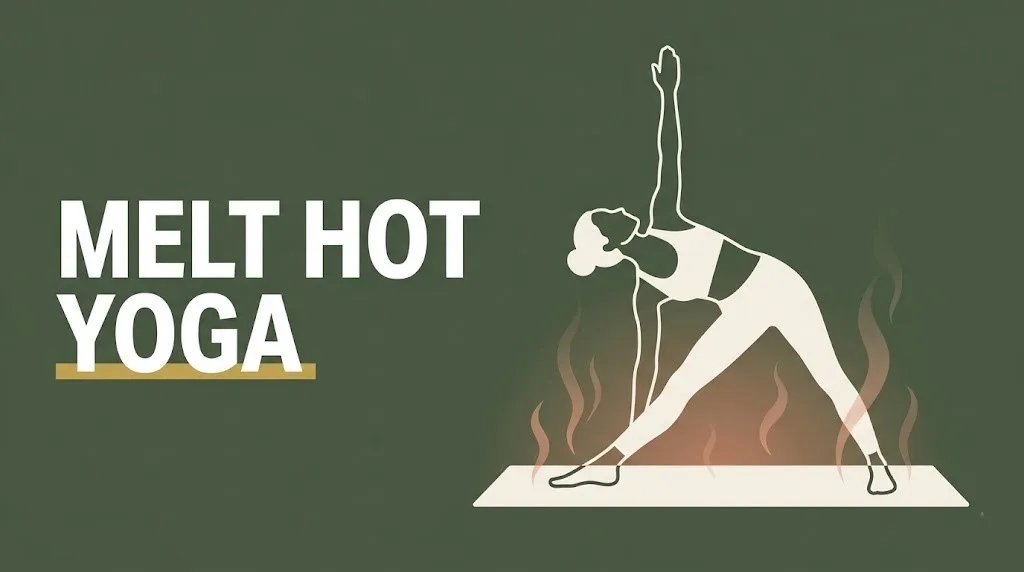
Melt Yoga Studio in Ladera Ranch offers formats including Hot Power Fusion, Hot Fusion Flow, Cardio Sculpt, Hot Vinyasa, and Yin. Hot Fusion Flow combines elements of traditional Bikram/26&2 practice with Vinyasa flow, incorporating postures, chaturangas (low push-up transitions), and energetic linking movements. Cardio Sculpt adds light hand weights to a yoga sequence, targeting calorie burn and muscular endurance simultaneously.
The studio environment matters. Melt Ladera Ranch uses premium heating and humidifying technology, mirrored walls, and waterproof flooring. These are practical features: mirrors allow self-correction of alignment, and waterproof floors handle the sweat that comes with 100-degree practice.
New students are welcomed across nearly all class levels. Instructors at Melt-style studios are generally trained to cue modifications within the flow, so beginners and experienced practitioners share the same room and simply work at different depths in each pose.
| Class Format | Heat Level | Focus | Best For |
|---|---|---|---|
| Melt 1.5 Flow | 92 to 96°F | Introduction to heat, foundational poses | Beginners |
| Hot Power Fusion | 100 to 105°F | Strength, endurance, upper body | Intermediate to advanced |
| Hot Fusion Flow | 100 to 105°F | Bikram meets Vinyasa, core and spine | All levels with heat experience |
| Cardio Sculpt | 95 to 100°F | Weighted yoga, calorie burn | Cross-trainers, weight loss focus |
| Yin (heated) | 85 to 95°F | Connective tissue, long holds | Recovery, flexibility, seniors |
Key Takeaway: Melt hot yoga is not one class. It is a range of formats across different temperatures, and choosing the right starting point matters more than most beginners realize.
Hot Yoga Temperature and Room Conditions
The temperature of a hot yoga room typically ranges from 88 to 105 degrees Fahrenheit, with humidity levels between 20 and 60 percent depending on the studio’s setup. These numbers come directly from documented practice environments reviewed in the Sports Medicine Open 2025 systematic review of hot yoga research.
Temperature and humidity work together. A dry 105-degree room feels different from a humid 95-degree one. Humidity slows the evaporation of sweat, which reduces the body’s natural cooling efficiency. That is why even a 90-degree class can feel intensely demanding when paired with 40 to 50 percent humidity.
Room temperature also affects your physiological response before you throw a single pose. As you enter the studio, your heart rate begins to climb. Your cardiovascular system starts shunting blood toward the skin to assist cooling. Your core body temperature rises above its normal baseline of 97 to 98.6 degrees Fahrenheit. This process begins within minutes of entering the room.
For beginners: Arriving 5 to 10 minutes early is not optional. It is the difference between a manageable first class and an overwhelming one. Your body needs time to begin the thermoregulation process before you add the demands of yoga postures on top of it.
Hot Yoga Benefits
Hot yoga offers documented benefits across physical, functional, and psychological categories, though the degree to which the heat itself adds those benefits beyond the yoga practice remains an active area of scientific discussion. A 2025 systematic review published in Sports Medicine Open (Springer Nature) found that hot yoga shows the potential to positively affect cardiovascular health, metabolic markers, bone mineral density, flexibility, mood, and well-being.
The same review noted that claims stating hot yoga delivers superior benefits compared to room-temperature yoga are currently unsubstantiated. The yoga practice itself drives most of the measurable benefit. Heat amplifies certain aspects of the experience, particularly perceived intensity and muscular extensibility, but the evidence for heat-specific superiority is still limited.
That honest framing matters. It means hot yoga is genuinely beneficial. It does not mean you need to find the hottest room possible to get results.
Key benefits supported by research include:
- Improved flexibility: Heat increases tissue extensibility in muscles and fascia, supporting deeper range of motion.
- Reduced stress and cortisol levels: Regular yoga practice, including hot yoga, is associated with lower perceived stress.
- Improved mood and well-being: A 6-week randomized controlled trial published in peer-reviewed literature found hot yoga practitioners reported greater well-being scores compared to controls.
- Potential bone density support: Studies indicate weight-bearing yoga postures load bone tissue, which may help maintain density.
- Caloric expenditure: Research from Colorado State University found average calorie burns of approximately 460 calories for men and 330 for women in a 90-minute heated session.
Hot Yoga and Flexibility
Hot yoga improves flexibility primarily because sustained warmth increases the extensibility of muscle tissue and fascial connective tissue. When tissue temperature rises, collagen fibers in tendons and fascia become more pliable. This allows joints like the hip joint, thoracic spine, and shoulder girdle to move through a wider range before resistance builds.
Think of a cold rubber band. Pull it hard in January and it snaps. Warm it in your hands for 30 seconds and it stretches without resistance. Your hip flexors and hamstrings respond similarly to heat. This is not magic. It is basic thermodynamic biology applied to connective tissue.
According to the National Center for Complementary and Integrative Health (NCCIH), yoga broadly improves flexibility and balance across age groups. The heat in hot yoga accelerates that effect within a single session. The question is whether those flexibility gains persist after the body cools down, and evidence suggests that consistent practice builds lasting flexibility while single-session gains are largely temperature-dependent.
Poses that benefit most from heat in a melt hot yoga class:
- Trikonasana (Triangle Pose): Targets hamstrings, hip abductors, and thoracic rotation. Heat allows more lateral spinal extension without strain.
- Utkatasana (Chair Pose): Engages quadriceps, glutes, and thoracic extensors. Heat supports deeper knee flexion with less initial stiffness.
- Adho Mukha Svanasana (Downward-Facing Dog): Stretches the hamstrings, calf muscles, and thoracic spine. Warmer tissue allows the heels to drop closer to the floor with less pull.
Modification: If hamstring tightness prevents a flat back in Downward-Facing Dog, bend both knees generously. This shifts the stretch to the thoracic spine and reduces stress on the lower back. People with sciatic nerve irritation should avoid deep hamstring stretching until symptoms are managed.
Key Takeaway: Flexibility gains from hot yoga are real, but heat makes them easier to access in the moment. Consistent practice is what makes them stick long-term.
Hot Yoga Calorie Burn and Weight Loss
Hot yoga burns more calories per session than sitting or light walking, but the numbers are often overstated in popular media. Researchers at Colorado State University studied a group of adults during a 90-minute Bikram/26&2 session and found that men burned approximately 460 calories on average and women burned approximately 330 calories. That is roughly equivalent to brisk walking at 3.5 mph for the same duration.
Those numbers are real and meaningful. They are not extraordinary compared to moderate aerobic exercise, but they are respectable for a practice that also builds flexibility, strength, and mental focus simultaneously. The heat itself raises heart rate and increases perceived effort, which may motivate practitioners to work harder within poses.
For weight management specifically, yoga teachers and physical therapists generally recommend pairing hot yoga with other movement modalities rather than treating it as a standalone weight-loss intervention. The American College of Sports Medicine recommends at least 150 minutes of moderate-intensity exercise weekly for weight management. Hot yoga can contribute meaningfully to that total.
| Activity | Approximate Calories (60 minutes) | Additional Benefit |
|---|---|---|
| Hot yoga (Bikram session, prorated) | 220 to 310 | Flexibility, strength, stress reduction |
| Brisk walking (3.5 mph) | 250 to 300 | Cardiovascular endurance |
| Moderate cycling | 400 to 500 | Cardiovascular fitness |
| Vinyasa yoga (room temperature) | 180 to 250 | Flexibility, balance, focus |
Modification for weight management focus: Adding Cardio Sculpt classes (weighted yoga in a heated room) increases muscular demand and elevates calorie burn beyond a standard flow class. This format is better suited to practitioners who have already completed 6 to 8 sessions of basic hot yoga.
Hot Yoga and Stress Relief
Hot yoga reduces perceived stress through two overlapping mechanisms: the physiological effects of yoga’s breathwork and the psychological effects of sustained focused movement. The NCCIH notes that yoga broadly promotes mindfulness and supports stress regulation by influencing the autonomic nervous system, shifting the body toward parasympathetic (rest and digest) dominance.
A 2018 study of stressed, physically inactive adults found that a 16-week program of hot yoga reduced participants’ stress levels measurably. A pilot study examining hot yoga twice weekly for 8 weeks found improvements in depressive symptoms, anxiety, and overall quality of life in participating adults.
The heat adds an interesting dimension here. Entering a 100-degree room and choosing to stay, breathe, and move through physical challenge builds a form of stress tolerance that transfers outside the studio. Yoga teachers often describe this as “practicing discomfort with equanimity,” and the science of stress inoculation supports the principle even if the specific yoga context has limited dedicated research.
Ujjayi pranayama (victorious breath), the most commonly used breathing technique in hot yoga, activates the parasympathetic nervous system through its effect on the vagus nerve. The slight constriction in the throat creates audible breath that anchors attention, reduces mental chatter, and steadies heart rate during challenging postures.
For anxious beginners: The heat can initially increase anxiety rather than reduce it. If you feel panicked in your first class, return to Balasana (Child’s Pose), place your forehead on the mat, and breathe slowly. This activates the baroreceptors in the forehead and supports a rapid shift toward calming. You do not need to push through every moment of discomfort to benefit from the class.
Hot Yoga and Bone Density
Hot yoga may support bone mineral density through weight-bearing postures that load skeletal tissue in standing and balancing poses. A 2014 study of women who practiced Bikram/26&2 yoga over a 5-year period found that premenopausal women showed increased bone density in the neck, hips, and lower back. Researchers suggested that consistent weight-bearing yoga practice may offer a protective effect against osteoporosis.
This finding matters most for premenopausal women and adults over 50, the demographic groups where bone density decline accelerates. Bone responds to mechanical loading: when you hold Vrikshasana (Tree Pose) on one leg, the tibia, femur, and hip socket all receive loading signals that stimulate osteoblast activity (bone-building cells).
According to the National Center for Complementary and Integrative Health, weight-bearing exercise is one of the most consistently supported lifestyle strategies for maintaining bone density. Hot yoga qualifies as weight-bearing exercise. The heat itself does not add bone benefit. The postures do.
Poses with documented bone-loading benefit in a melt hot yoga class:
- Vrikshasana (Tree Pose): Single-leg standing loads the hip and femur.
- Virabhadrasana I (Warrior I): Loads the front hip, knee, and ankle simultaneously.
- Setu Bandhasana (Bridge Pose): Loads the thoracic spine and posterior hip in a supported position.
- Navasana (Boat Pose): Loads the lumbar spine and hip flexors isometrically.
Modification for osteoporosis or low bone density: Avoid deep spinal flexion poses like seated forward folds, which can increase vertebral fracture risk. Focus on standing and mild extension postures. Anyone with diagnosed osteoporosis should work with a certified yoga instructor with specific training in bone health adaptations before joining a general hot yoga class.
Key Takeaway: Bone benefits from hot yoga come from the weight-bearing postures, not the heat. If bone health is your goal, prioritize standing balance poses and consistent attendance over temperature intensity.
Hot Yoga for Beginners
Hot yoga is accessible to most healthy beginners, but the first class is the hardest one. That is not a warning. It is a practical fact worth knowing so you can approach the experience with realistic expectations rather than assumptions built from someone else’s social media highlight.
The American College of Sports Medicine recommends that new exercisers introduce intensity gradually. For hot yoga, that means starting in a lower-temperature class (88 to 96 degrees) rather than immediately booking a 105-degree session. Your body needs time to adapt to thermoregulation under exertion. Research on heat adaptation indicates that physiological adjustment typically occurs across 8 to 14 sessions.
Beginners in a melt hot yoga class have one primary job: stay in the room. You do not need to do every pose. You do not need to match the person next to you. Lying in Savasana (Corpse Pose) in a heated room while breathing steadily is a legitimate practice and an intelligent choice when the heat feels overwhelming.
| Beginner Concern | Practical Answer |
|---|---|
| “I’m not flexible enough” | Flexibility develops with practice; you do not need it to begin |
| “It will be too hot for me” | Start with 92 to 96 degree classes; exit if you feel dizzy |
| “I don’t know any poses” | Melt instructors cue alignment during class; follow along visually |
| “I’ll embarrass myself” | Everyone in the room had a first class; no one is watching you |
| “What if I need to leave?” | Leave quietly. Rest in Child’s Pose first. This is always allowed. |
Modification for absolute beginners: Before attending your first hot yoga class, practice 3 to 5 room-temperature yoga sessions. Familiarity with basic poses like Tadasana (Mountain Pose), Adho Mukha Svanasana (Downward-Facing Dog), and Balasana (Child’s Pose) allows you to follow along in the heated room without spending mental energy learning new shapes while also managing the heat.
First Hot Yoga Class Tips
Your first melt hot yoga class goes better with specific preparation, not general inspiration. The physical demands of a heated practice require concrete action before, during, and after the session.
Before the class:
- Hydrate throughout the day before your class. Aim for at least 2 to 3 liters of water in the 12 hours prior.
- Eat a light meal or snack 1.5 to 2 hours before class. A full stomach in a hot room is uncomfortable.
- Wear lightweight, fitted clothing: sports bra, shorts, or fitted leggings. Avoid heavy fabrics.
- Bring a full-size yoga mat, a grip towel (to lay over the mat), a standard towel, and a large water bottle.
- Arrive 10 minutes early and enter the room to acclimate before class begins.
During the class:
- Find your breath first. If you lose the breath, you lose the practice. Return to ujjayi pranayama before adding effort.
- Choose Balasana (Child’s Pose) whenever you need a reset. This is not quitting.
- Move slowly in transitions. Heat increases cardiovascular demand. Standing up quickly can cause a drop in blood pressure and lightheadedness.
- Drink water at designated water breaks or between poses. Do not force yourself to wait until the end.
- Keep your eyes soft and focused on a single point (drishti) during balance poses to support stability.
After the class:
- Replace electrolytes, not just water. Sweat depletes sodium, potassium, and magnesium alongside fluid.
- Rest in Savasana (Corpse Pose) for the full cool-down period rather than leaving early.
- Shower if available. Staying in sweat-soaked clothes post-class can lead to skin irritation.
Key Takeaway: First-class success is almost entirely about preparation. Hydrate ahead of time, arrive early, and give yourself permission to rest. The poses become easier. The heat becomes manageable. Showing up is the skill.
Hot Yoga Modifications for Seniors
Hot yoga is appropriate for many adults over 60, with the right class selection and specific modifications in place. Research published in the Journal of Alternative and Complementary Medicine has found yoga broadly beneficial for balance, joint mobility, and mental well-being in older adults. These benefits apply in heated formats as long as the temperature is kept moderate and participants pace themselves carefully.
The key adjustment for seniors is temperature. Starting in classes at 88 to 95 degrees rather than 100 to 105 degrees reduces the cardiovascular load significantly. A senior with normal resting blood pressure and no active cardiac conditions can generally manage moderate-heat yoga safely, though anyone with cardiovascular history should confirm with their cardiologist before beginning a heated practice.
Seniors also benefit from using props consistently rather than avoiding them. A yoga block under the bottom hand in Trikonasana (Triangle Pose) allows full spinal extension without the balance demand of reaching the floor. A chair placed at the front of the mat provides stability for standing balance poses like Vrikshasana (Tree Pose).
| Pose | Standard Version | Senior Modification | Props Needed |
|---|---|---|---|
| Trikonasana (Triangle Pose) | Hand to the floor or shin | Hand to block at medium height | 1 yoga block |
| Vrikshasana (Tree Pose) | Foot at inner thigh, arms overhead | Foot at inner calf, hand on chair | Chair or wall |
| Utkatasana (Chair Pose) | Thighs parallel to floor | Partial squat, hands on thighs | None or chair |
| Setu Bandhasana (Bridge Pose) | Full bridge with hips lifted | Supported bridge with block under sacrum | 1 yoga block |
| Balasana (Child’s Pose) | Forehead to floor, arms extended | Forehead on stacked fists, knees wider | Optional blanket |
Safety note for seniors: Heat increases heart rate even at rest. If your resting heart rate is already elevated due to medication or a health condition, that baseline rises further in a hot room before you begin moving. Speak with your cardiologist or primary care physician about your target heart rate range before attending your first hot yoga session.
Hot Yoga Safety
Hot yoga is safe for most healthy adults when practiced with proper preparation, hydration, and attention to the body’s signals. The 2025 systematic review in Sports Medicine Open noted that while hot yoga demonstrates intriguing health benefits, caution is warranted given documented case reports of heat-related illness in practitioners.
The most common risks are heat exhaustion and dehydration. These are preventable. Heat exhaustion occurs when the body’s cooling system is overwhelmed, typically due to insufficient fluid intake before or during class, exercising at too high an intensity for the heat level, or skipping the acclimatization period at the start of class.
Signs that you need to stop and exit the room immediately:
- Dizziness or lightheadedness that does not resolve when you lower yourself to the floor
- Nausea or vomiting
- Cessation of sweating during a hot class (your body has run out of fluid to cool itself)
- Rapid heart rate that does not slow with rest
- Confusion or disorientation
- Fainting or near-fainting
The most important safety habit in any melt hot yoga class is permission to rest. Experienced practitioners use Balasana (Child’s Pose) or lie flat in Savasana (Corpse Pose) whenever needed. This is not a failure. It is practiced self-awareness.
Studios like Melt are designed with these realities in mind. Entering 5 to 10 minutes before class, drinking water consistently, wearing light clothing, and avoiding alcohol or heavy meals in the hours before class covers the majority of preventable risk.
Hot Yoga Contraindications
Certain health conditions and life circumstances make hot yoga inadvisable until cleared by a physician, or inadvisable altogether. The American College of Sports Medicine and the American Council on Exercise (ACE) identify the following groups as requiring specific caution or avoidance.
Hot yoga is not recommended without direct medical clearance for:
- Pregnancy: Core body temperature elevation is associated with neural tube risk in early pregnancy and increased fetal distress risk in later trimesters.
- Uncontrolled hypertension (high blood pressure): Heat and exertion both raise blood pressure. Their combined effect can be unsafe in unmanaged hypertension.
- Cardiovascular disease or recent cardiac events: The cardiovascular demand of hot yoga is higher than standard yoga. Anyone with a recent heart attack, arrhythmia, or unstable angina should not practice in a heated environment.
- Diabetes (poorly controlled): Heat affects blood glucose regulation and can mask symptoms of hypoglycemia.
- Multiple sclerosis (MS): Heat can temporarily worsen MS symptoms, including vision changes and muscle weakness, due to reduced nerve conduction velocity.
- History of heat stroke: Previous heat stroke lowers the body’s heat tolerance threshold permanently.
- Active fever or illness: Practicing in a hot room while already running a fever dramatically increases the risk of dangerous temperature elevation.
| Group | Recommendation |
|---|---|
| Healthy adults, no conditions | Cleared to begin with proper preparation |
| Pregnant adults | Avoid until after delivery and postnatal clearance |
| Uncontrolled hypertension | Avoid until blood pressure is managed |
| Controlled diabetes | Consult with endocrinologist; start with lower heat |
| Adults with MS | Avoid unless specifically cleared by neurologist |
| Seniors, no cardiac conditions | Begin with 88 to 95 degree classes with modifications |
Hot Yoga Hydration
Hydration for melt hot yoga begins the night before your class, not 20 minutes before you walk in the door. By the time you feel thirsty during a hot yoga session, you are already mildly dehydrated. Thirst is a trailing indicator of fluid status, not a leading one.
In a 90-minute hot yoga session at 105 degrees, sweat loss can reach 1 to 2 liters per person depending on body size, fitness level, and individual sweat rate. That fluid needs to be replaced before class begins, managed during class, and fully restored afterward. Water alone is not always sufficient because sweat also contains electrolytes: primarily sodium, potassium, and magnesium.
A 2022 study of Bikram yoga participants examined salt and water balance after sweat loss and found that electrolyte replacement mattered alongside fluid volume for recovery. Drinking water without replacing lost sodium can dilute electrolytes further, leading to hyponatremia (low blood sodium) in extreme cases.
Practical hydration protocol for hot yoga:
- Drink 2 to 3 liters of water in the 12 hours before class.
- Add a small amount of natural electrolytes (coconut water, an electrolyte tablet, or a pinch of sea salt in water) to your pre-class drink.
- Bring at least 20 ounces of water to drink during class. Sip at water breaks rather than gulping.
- After class, drink 16 to 24 ounces of water or electrolyte drink within 30 minutes.
- Avoid alcohol in the 12 hours before a hot yoga session.
Modification for those prone to dehydration or who sweat heavily: Keep a second water bottle in your bag for post-class. Plan your meals to include naturally high-sodium foods (olives, cheese, broth) in the hours after class to support electrolyte restoration.
Key Takeaway: Hydration for hot yoga is a 24-hour process, not a pre-class ritual. Start the day before, maintain electrolytes, and rehydrate fully after class. This single habit prevents the majority of hot yoga’s common side effects.
Hot Yoga vs Bikram Yoga
Hot yoga and Bikram yoga are related but distinct practices, and understanding the difference helps you choose the right class for your goals and body. Bikram yoga, also called 26&2 yoga, is a specific, fixed sequence of 26 postures and 2 breathing exercises practiced in a room heated to exactly 105 degrees Fahrenheit with 40 percent humidity. Every Bikram class follows the same sequence. The temperature, humidity, and order of poses do not vary.
Hot yoga is the broader category. Any yoga class practiced in a heated room qualifies as hot yoga, regardless of the posture sequence, temperature, or yoga style. A Hot Vinyasa class, a heated Yin session, and a Bikram/26&2 sequence are all technically hot yoga. They are not the same practice.
Melt hot yoga studios typically offer several formats under the hot yoga umbrella. Their Hot Fusion Flow class blends elements of Bikram sequencing with Vinyasa flow transitions. Their Hot Power Fusion combines power yoga postures with longer holds and music. These are genuine hybrids, not Bikram classes.
| Feature | Bikram / 26&2 Yoga | Melt Hot Yoga (Fusion / Vinyasa) |
|---|---|---|
| Posture Sequence | Fixed: same 26 poses every class | Variable by class type and instructor |
| Temperature | Always 105°F, 40% humidity | 88 to 105°F depending on class |
| Session Length | Always 90 minutes | 45 to 90 minutes |
| Music | Traditional: no music | Music-driven, curated playlists |
| Instruction Style | Scripted dialogue | Personalized, instructor-led |
| Modifications Offered | Limited in traditional format | Generally integrated throughout |
| Best For | Structure-seekers, heat tolerance | Variety, community, different goals |
Modification note: The fixed 26-posture Bikram sequence does not formally integrate modifications for beginners or people with injuries. If you have a specific injury or are new to hot yoga, a Melt-style Vinyasa or Fusion class is generally more accommodating than a traditional Bikram session.
Frequently Asked Questions About Melt Hot Yoga
What is melt hot yoga and how is it different from regular yoga?
Melt hot yoga is a studio-based practice that combines yoga postures with a heated, humidified room, typically between 88 and 105 degrees Fahrenheit.
Regular yoga is practiced at room temperature, which means muscle tissue does not warm up as quickly and the cardiovascular demand is lower.
The key difference is the physical environment, not the poses themselves, though Melt studios also offer unique hybrid class formats not found in standard yoga studios.
How hot is the room in a melt hot yoga class?
Room temperature in melt hot yoga classes ranges from approximately 88 to 105 degrees Fahrenheit, depending on the specific class type.
Beginner-oriented classes like Melt 1.5 Flow typically run at 92 to 96 degrees, while Hot Power Fusion and Hot Fusion Flow reach 100 to 105 degrees.
The studio should disclose the temperature for each class format so you can choose based on your heat tolerance and experience level.
Is hot yoga safe for beginners?
Hot yoga is generally safe for healthy beginners who prepare properly, start in lower-temperature classes, and listen to their body’s signals throughout.
The American College of Sports Medicine recommends introducing exercise intensity gradually, which applies directly to choosing a 92-degree introductory class rather than immediately attempting a 105-degree session.
If you feel dizzy, nauseous, or stop sweating during class, lower yourself to the floor, rest in Child’s Pose, and exit the room calmly if symptoms do not resolve within 60 seconds.
How often should you do hot yoga to see results?
Yoga teachers and physical therapists generally recommend 2 to 4 sessions per week to build consistent flexibility, strength, and stress-management benefits.
Research on heat adaptation suggests the body adapts to thermoregulation demands across 8 to 14 sessions, meaning your first 2 to 3 weeks will feel harder than your ongoing practice.
Starting with 2 sessions per week for the first month and increasing to 3 or 4 as your tolerance builds is a practical, evidence-aligned approach.
Can seniors practice melt hot yoga safely?
Many adults over 60 can practice melt hot yoga safely by choosing moderate-temperature classes (88 to 95 degrees) and using props like blocks and a chair for balance poses.
Anyone with cardiovascular history, uncontrolled blood pressure, or a neurological condition should get medical clearance from their physician before joining a heated class.
Yin yoga in a gently heated room at 85 to 95 degrees is often the most appropriate starting format for seniors new to hot yoga, as the long holds are passive and the temperature stays moderate.
Start with one class. Not five. Not a membership. One class, in the lowest-temperature format your chosen studio offers. Come hydrated, arrive early, and give yourself full permission to rest whenever you need it.
Hot yoga rewards patience far more than intensity. The practitioners who stick with a melt hot yoga practice long-term are not the ones who pushed through their first class on willpower alone. They are the ones who listened to their body, came back the second week, and kept coming back.
Bring your mat, your water, and your curiosity. Leave your expectations on the doorstep