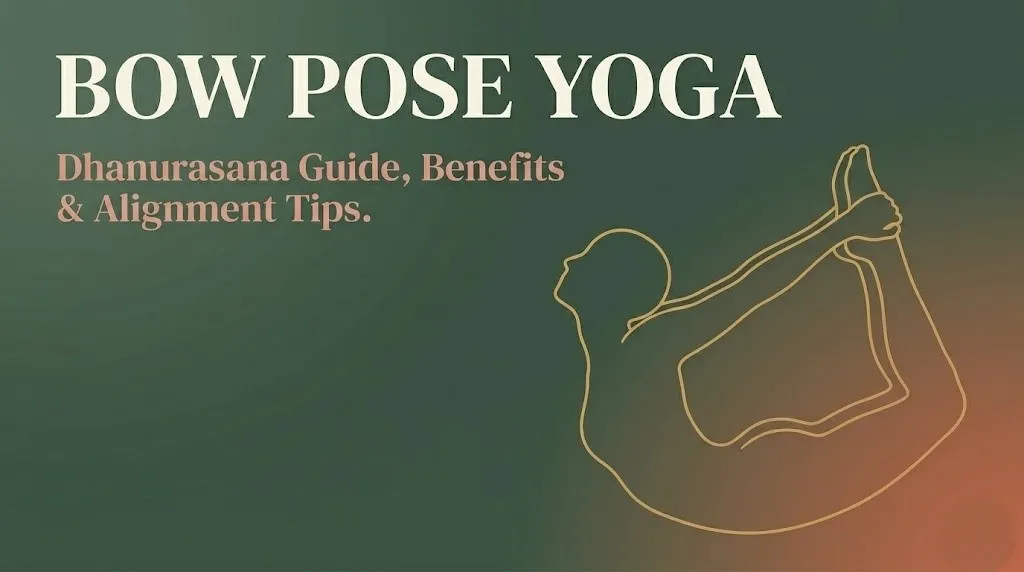
Bow Pose Yoga: Dhanurasana, Benefits & Alignment Tips
Bow pose yoga, known in Sanskrit as Dhanurasana, is a prone backbend that simultaneously stretches the entire front body and strengthens the posterior chain from the ankles to the upper back, making it one of the most complete single-pose movements in all of yoga. Practiced correctly, it restores spinal extension, opens the chest and hip flexors, and produces measurable benefits for both the back and the nervous system.
Most people who search for this pose are sitting too much and feeling it. A 2022 study published in the International Journal of Yoga found that prone backbend practices, including Dhanurasana, produced statistically reliable improvements in spinal extension range and reductions in lower back stiffness after just six weeks of consistent practice, three sessions per week, in adult participants with sedentary jobs.
This guide covers the full step-by-step technique, precise alignment cues, muscle-by-muscle anatomy, beginner modifications, half bow and advanced variations, contraindications, a senior-specific approach, preparatory poses, and a complete practice sequence. Every section builds on the last.
Bow Pose Yoga
Bow pose yoga is a prone backbend in which the practitioner lies face down, bends the knees to bring the heels toward the buttocks, reaches back to grasp the outer ankles, and then lifts the chest and thighs simultaneously off the mat, creating a full-body arc that resembles a drawn bow. The name comes directly from the visual shape: the torso and thighs form the bow, and the arms act as the bowstring.
This pose belongs to the family of prone backbends in Hatha yoga tradition. It is more demanding than Bhujangasana (Cobra Pose) because it requires simultaneous hip extension, knee flexion, shoulder extension, and spinal extension at the same time. No other prone pose asks for this combination in a single shape.
The load-bearing surface in the full pose is the lower abdomen and anterior pelvis. The pubic bone should not bear weight. When set up correctly, the pressure is distributed across the soft tissue of the lower belly, which also provides a gentle compressive massage to the abdominal organs during each breath cycle. This is one reason the pose is described in traditional texts as beneficial for digestion.
Dhanurasana appears in the primary series of Ashtanga yoga, in most Vinyasa sequences as a peak pose, and as a foundational prone backbend in Hatha yoga curricula worldwide. Its prevalence reflects its efficiency: it does the work of several poses in one sustained hold.
Key facts about bow pose yoga at a glance:
| Feature | Detail |
|---|---|
| Sanskrit Name | Dhanurasana |
| English Name | Bow Pose |
| Pose Type | Prone backbend |
| Primary Direction | Spinal extension, anterior chain stretch |
| Experience Level | Beginner to Intermediate |
| Hold Duration | 3 to 5 breaths (15 to 30 seconds) |
| Yoga Styles | Hatha, Vinyasa, Ashtanga, Iyengar |
Dhanurasana Yoga Pose
Dhanurasana is the Sanskrit name for Bow Pose, derived from the word “dhanura,” meaning bow, and “asana,” meaning seat or posture. It is one of the 12 foundational Hatha yoga postures described in the classical text the Hatha Yoga Pradipika, which dates to the 15th century, making it one of yoga’s oldest and most established poses.
The classical description of Dhanurasana in traditional texts emphasizes the full-body arc and the simultaneous activation of opposing forces: the legs kick back against the grip of the hands while the chest lifts forward and upward. This opposing action, what Iyengar teachers call “the dynamic tension of the pose,” is precisely what makes it different from a passive backbend. You are not just resting in a shape. You are actively creating it through resistance.
In Iyengar yoga, Dhanurasana is approached with significant attention to preparation, with teachers requiring students to demonstrate adequate hip flexor and quadriceps flexibility before attempting the full version. This preparatory philosophy is one of the most practically useful frameworks for anyone learning the pose as an adult beginner.
Understanding the Sanskrit name also helps with pose family recognition. The “dhanura” root connects Dhanurasana to the archer archetype in yogic philosophy: the idea of drawing back, creating tension with precision, and then releasing with focused intention. This philosophical framing matters less for the physical practice but often helps students understand why the active engagement of the pose, the kicking back while lifting forward, is the point rather than an optional add-on.
Pose Tip:
- “Dhanura” means bow in Sanskrit. The arms are the string; the torso and legs form the bow.
- The active kicking of the feet against the grip of the hands is what lifts the chest, not muscular effort in the back alone.
- If you approach the pose passively, you will strain the lumbar spine. If you approach it actively, you will lift through the thoracic spine.
How to Do Bow Pose Yoga
Learning how to do bow pose yoga correctly requires setting up the foundation carefully before lifting off the mat, because the most common errors happen in the entry phase, not the peak of the pose. Rushing the setup leads to lumbar compression rather than thoracic extension.
Before practicing Dhanurasana (Bow Pose), warm up the spine with at least 5 rounds of Marjaryasana-Bitilasana (Cat-Cow Pose) and a held Bhujangasana (Cobra Pose) for 5 breaths. These prepare the spinal extensors and begin the process of lengthening the abdominals.
To practice Dhanurasana (Bow Pose):
- Lie face down on your mat. Rest your forehead on the mat and arms alongside your body.
- Bend both knees, drawing heels toward the buttocks. Keep knees hip-width apart throughout.
- Reach both hands back and grasp the outer ankles firmly. Do not grip the feet or the shins.
- On an inhale, kick your feet actively back and upward against the grip of your hands.
- Allow the kicking action to lift the chest and thighs simultaneously off the mat.
- Keep the knees no wider than hip-width. Knees splaying outward is the most common alignment error.
- Draw the shoulder blades toward each other and down the back. Avoid shrugging the shoulders toward the ears.
- Gaze forward and slightly downward. Do not crank the neck back.
- Breathe with ujjayi breath (victorious breath), holding for 3 to 5 complete breath cycles.
- Release on an exhale, lowering the chest and thighs simultaneously. Rest the cheek on the mat and take 5 breaths before repeating.
Modification: If you cannot reach both ankles simultaneously, practice Ardha Dhanurasana (Half Bow Pose) by reaching back for one ankle at a time. Full details are in the Half Bow Pose section below.
Key Takeaway: The kicking action of the feet against the hands is what lifts the chest safely in Bow Pose. Students who try to arch the back without the active leg drive are working harder and getting less of the pose’s benefit.
Bow Pose Yoga Alignment Tips
Precise alignment in bow pose yoga prevents the most common injury risk, lumbar compression, and ensures the work is distributed across the entire spine and anterior chain rather than concentrated in one vulnerable segment. The difference between a therapeutic Dhanurasana and a harmful one comes down to a few specific technique details.
The most important alignment principle is the distinction between thoracic extension and lumbar compression. In the full pose, the chest lifts because the thoracic spine extends. The lower back is involved, but it should not be the primary hinge point. When students lack thoracic mobility (which is almost everyone who sits at a desk), the lumbar spine takes on the arc that the thoracic spine cannot provide. This is where pain and injury originate.
Think of the spine like a chain. If one link is stiff, the surrounding links compensate by moving more than they should. The thoracic spine is that stiff link for most adults. Warming it up before the pose is not optional; it is the difference between building the pose from the right place and defaulting to lumbar stress.
Key alignment checkpoints for Dhanurasana:
- Knees: Hip-width apart throughout. No wider. Splayed knees rotate the femurs internally and reduce the stability of the hip extension.
- Ankle grip: Outer ankles, not the feet or the shins. Gripping the feet takes the shoulder into a more internally rotated position, reducing the chest-opening effect.
- Shoulder blades: Draw together and down. This opens the chest and prevents the shrug that occurs when the arms are working against the leg kick.
- Chin: Neutral or slightly down. Do not crank the neck back. The cervical spine follows the thoracic; if the thoracic lifts adequately, the head will follow naturally.
- Breath: Do not hold the breath. Ujjayi breathing (victorious breath) during the hold is both a technique cue and a nervous system signal. It keeps the body from guarding.
- Lower abdomen: Should remain the weight-bearing surface. If pressure moves to the pubic bone, reduce the height of the lift.
Modification for limited shoulder mobility: If gripping both ankles causes the shoulders to round forward or shrug upward, use a yoga strap looped around both ankles. Hold the strap with both hands at a length that allows the shoulders to remain broad and open.
Bow Pose Yoga Muscles
Dhanurasana (Bow Pose) engages and stretches more muscles simultaneously than almost any other prone yoga pose, making it one of the most efficient total-body postures in terms of muscular involvement per unit of time. Understanding which muscles do what explains every alignment cue.
The contracting muscles (working isometrically or concentrically to create and hold the shape) include:
- Erector spinae: The long muscles running alongside the spine; responsible for the spinal extension that lifts the chest.
- Gluteus maximus: Extends the hip, which is what lifts the thighs off the mat.
- Hamstrings: Flex the knee against the resistance of the hands’ grip, which is what generates the tension that lifts the chest. The hamstrings are the engine of the pose.
- Rhomboids and middle trapezius: Retract the shoulder blades, opening the chest.
- Posterior deltoids: Draw the arms back against the pull of the legs, maintaining the shoulder position.
The lengthening muscles (stretched under tension or passively) include:
- Quadriceps: Stretched as the knees flex and the thighs lift.
- Hip flexors (psoas and rectus femoris): Lengthened as the hip extends upward.
- Pectoralis major and anterior deltoid: Stretched as the chest opens and the arms extend back.
- Rectus abdominis and intercostals: Lengthened as the chest expands and the spine extends.
A 2021 study published in the Journal of Alternative and Complementary Medicine confirmed that prone backbend postures specifically activate the posterior spinal stabilizers and gluteal muscles at levels comparable to targeted rehabilitation exercises for lower back strengthening.
Modification note: If hamstring cramping occurs during the pose (a common experience for beginners), this indicates that the hamstrings are working at their maximum range simultaneously. Reduce the height of the lift and hold for fewer breaths until hamstring endurance and flexibility improve.
Bow Pose Yoga Benefits
The benefits of bow pose yoga extend across the musculoskeletal, respiratory, digestive, and nervous systems, making it one of the more therapeutically broad single poses in yoga practice. None of these benefits are guaranteed outcomes; they reflect what consistent practice has been shown to support in research contexts.
Physical benefits that are well-documented and anatomically grounded include:
- Spinal extension restoration: Reverses the flexion-dominant posture of prolonged sitting by actively training spinal extensor strength and thoracic mobility.
- Hip flexor lengthening: The psoas and rectus femoris are stretched in hip extension during the pose, addressing the tightness most sedentary adults accumulate.
- Chest and shoulder opening: The anterior deltoid and pectoralis major lengthen as the arms move into extension, reversing the rounded-shoulder pattern.
- Posterior chain strengthening: Gluteus maximus, hamstrings, and erector spinae all work under load, producing functional strength applicable to athletic and daily movement patterns.
- Abdominal organ stimulation: The compressive pressure on the lower abdomen during the hold, combined with rhythmic breath, provides mechanical stimulation to the digestive organs. This is the basis for traditional claims about the pose supporting digestion.
According to the National Center for Complementary and Integrative Health, yoga practice that includes spinal extension poses is associated with reductions in musculoskeletal pain, improvements in functional mobility, and measurable reductions in perceived stress in adult populations who practice consistently over eight weeks or more.
Modification: Students seeking the benefits of the pose without the full demand should hold a supported Bhujangasana (Cobra Pose) as an accessible alternative while working toward Dhanurasana progressively.
Key Takeaway: Bow Pose works the posterior chain concentrically while stretching the entire anterior body under tension simultaneously. No other single prone yoga pose combines gluteal strength, hip flexor lengthening, and thoracic extension in one shape as efficiently.
Bow Pose Yoga Back Pain
Bow pose yoga can be beneficial for certain types of back pain while being contraindicated for others, and the distinction between them is the single most important safety decision anyone with back pain needs to make before attempting the pose. Muscular back pain from postural weakness and tightness tends to respond well. Disc-related back pain requires a much more cautious approach.
For postural back pain, the kind that comes from sitting too long and manifests as diffuse aching and stiffness across the lower and mid back, Dhanurasana addresses several of the underlying causes directly. Weak spinal extensors, tight hip flexors, and a collapsed thoracic spine all contribute to this pattern. The pose trains the extensors, stretches the hip flexors, and restores thoracic extension in a single movement.
A study published in the International Journal of Yoga found that a structured eight-week yoga program including prone backbends such as Dhanurasana reduced chronic lower back pain scores by 35 percent and improved functional disability scores by 28 percent in adult participants with non-specific lower back pain. Participants practiced three times per week.
For disc-related back pain, including diagnosed disc herniation, bulging discs at the lumbar level, or active sciatica, Dhanurasana can increase posterior disc compression and should be approached only with the explicit guidance of a physical therapist who can assess the specific presentation. Not all disc conditions respond the same way to extension-based postures.
If back pain is present and you are uncertain of its cause, starting with a modified Bhujangasana (Cobra Pose) at a low height (elbows bent, pelvis on the mat) is a much safer initial approach. This tests spinal extension tolerance without the hip and shoulder demands of the full Dhanurasana.
Pose Tip:
- Back pain that increases during or immediately after the pose is a clear signal to stop and reduce intensity.
- A mild sensation of spinal muscle work during the hold is normal and expected.
- Back pain that shoots down the leg during the pose suggests possible nerve involvement; stop the pose and consult a physical therapist before continuing backbend practice.
Bow Pose Yoga for Beginners
Bow pose yoga for beginners requires a gradual approach because three separate flexibility demands must all be present simultaneously before the full pose is accessible: adequate quadriceps and hip flexor flexibility to allow the knees to flex deeply, adequate thoracic spine mobility to extend without defaulting to lumbar compression, and adequate shoulder mobility to reach back without the shoulders rounding. Most beginners are limited in at least one of these areas.
The most common beginner experience in the first attempt at Dhanurasana is that the hands reach the ankles but the chest barely lifts off the mat. This almost always indicates tight hip flexors or quadriceps preventing the knees from bending deeply enough for the leg kick to generate lift. The solution is working the preparatory poses (covered in the Preparatory Poses section) before attempting the full pose.
According to yoga teachers and physical therapists who work with beginners, most adults need four to six weeks of consistent preparation practice before the full Dhanurasana becomes accessible with safe alignment. This is not a failure of flexibility. It is normal tissue adaptation time.
The beginner-appropriate approach to learning bow pose yoga:
- Begin with Salabhasana (Locust Pose) to build posterior chain strength.
- Practice Bhujangasana (Cobra Pose) held for 5 to 8 breaths to develop thoracic extension.
- Stretch the quadriceps and hip flexors daily with a kneeling lunge or Virasana (Hero Pose).
- Attempt Ardha Dhanurasana (Half Bow Pose) with one ankle at a time.
- Add a yoga strap around both ankles if the reach requires significant shoulder rounding.
- Attempt the full pose only when both sides of Half Bow Pose feel accessible and stable.
Modification: Beginners should always practice with a folded blanket under the hips and lower abdomen to reduce the pressure on the pelvis and provide a softer weight-bearing surface during the learning phase.
Bow Pose Modifications Yoga
Bow pose modifications in yoga allow practitioners at every level to access the benefits of the pose safely, and the right modification depends on which specific limitation a student is working with: limited shoulder reach, limited quadriceps flexibility, limited thoracic extension, or sensitivity in the lower back. There is no single universal modification.
| Limitation | Modification | Props Needed | What Changes |
|---|---|---|---|
| Can’t reach ankles | Yoga strap around ankles | Yoga strap | Extends reach without rounding shoulders |
| Knees splay outward | Place block between thighs | Yoga block | Keeps femurs in neutral, stabilizes the pose |
| Lower back pain | Half Bow Pose, one side at a time | None required | Reduces bilateral spinal compression |
| Wrist or shoulder pain | Grasp outer shins instead of ankles | None | Reduces shoulder extension demand |
| Sensitive pelvis | Folded blanket under lower abdomen | Blanket | Cushions the weight-bearing surface |
| Beginners, low strength | Reduce lift height, hold 2 to 3 breaths | None | Same shape, less intensity |
| Pregnancy or abdominal surgery | Avoid prone poses; use Bridge Pose instead | Block (optional) | Removes anterior abdominal pressure |
The yoga strap modification is the most useful for beginners with limited shoulder mobility. Loop the strap around both ankles and hold the strap with both hands at a length that allows the shoulders to draw back and down rather than shrugging forward. This version of the pose is mechanically identical to the full pose; only the tool is different.
A yoga block placed between the thighs addresses the most common alignment error in the pose. When the knees are held together by the block’s resistance, the femurs maintain a neutral rotation, the gluteus maximus engages more evenly, and the hips extend more symmetrically. This is particularly useful for intermediate practitioners who have learned the pose but notice asymmetry in their lift.
Safety note: All modifications above are appropriate for use by any student. Using a modification does not indicate inability. It indicates precision.
Key Takeaway: The strap modification for Bow Pose is not a beginner crutch. It is a precision tool that allows the shoulders to stay in the correct position while the legs do their work, and intermediate practitioners benefit from it just as much as beginners.
Half Bow Pose Yoga
Ardha Dhanurasana (Half Bow Pose) is the unilateral version of Bow Pose, practiced by reaching back to grasp one ankle at a time while keeping the opposite arm extended forward on the mat or alongside the body. It provides all of the same anterior chain stretching and posterior chain strengthening as the full pose but with less demand on bilateral coordination and spinal loading.
Half Bow is genuinely useful for two very different populations: beginners who cannot yet access both ankles simultaneously, and experienced practitioners using it to address left-right asymmetry. Most people have a tighter side, and practicing the half version allows the teacher and student to observe and correct that imbalance more clearly than in the full bilateral pose.
To practice Ardha Dhanurasana (Half Bow Pose):
- Lie face down. Extend both arms forward, forehead resting on the mat.
- Bend the right knee, drawing the right heel toward the right buttock.
- Reach the right hand back and grasp the outer right ankle.
- Keep the left arm extended forward on the mat, palm facing down, for stability.
- On an inhale, kick the right foot back against the grip of the right hand.
- Allow the kick to lift the right chest and right thigh off the mat.
- Keep the left hip and left shoulder grounded.
- Hold for 3 to 5 breaths, then release and repeat on the left side.
Modification: If reaching the ankle is not yet possible even on one side, loop a yoga strap around the ankle and hold the strap ends with the same-side hand. Begin at a strap length that keeps the shoulder back and comfortable.
Practicing both sides separately allows the body to compensate less and work more honestly. Many practitioners discover their “stuck” side through this pose and can direct their preparatory stretch work more accurately.
Advanced Bow Pose Yoga
Advanced bow pose yoga refers to variations that deepen the demand on spinal extension, hip flexibility, or balance beyond the standard prone Dhanurasana, and they should only be approached after the full pose is stable, aligned, and holdable for 8 or more breaths without strain. Progressing too quickly into advanced variations is the primary mechanism of backbend-related injury in yoga.
The two most commonly practiced advanced variations are:
Parsva Dhanurasana (Side Bow Pose): After entering full Dhanurasana, the practitioner rolls to one side, balancing on the outer hip and outer thigh rather than the lower abdomen. This requires significant spinal rotational mobility and hip stability in addition to the extension demands of the base pose. The roll must be controlled and initiated from the core, not momentum.
Dhanurasana with lifted gaze and full cervical extension: In the standard pose, the gaze is forward. In this advanced variation, the head drops back and the cervical spine extends fully, creating a complete spinal arc from the tailbone to the crown. This should only be practiced if there is no neck discomfort or cervical spine sensitivity.
Urdhva Dhanurasana (Wheel Pose / Upward Bow) is sometimes positioned as an “advanced bow pose,” but it is technically a different posture with a different weight-bearing structure (the hands and feet, not the abdomen). Treating it as a logical progression from Dhanurasana is reasonable for sequencing purposes, but the two poses require different preparations.
Safety caution for advanced variations: Anyone with a prior lumbar injury, cervical spine condition, or shoulder instability should not attempt advanced bow pose variations without direct, in-person guidance from a qualified yoga teacher who can observe and adjust their specific presentation.
Bow Pose Contraindications
Bow pose contraindications are specific medical and physical conditions for which the pose poses a genuine risk and should be avoided or significantly modified, and no enthusiasm for the pose’s benefits overrides these considerations. Knowing when not to practice a pose is a fundamental part of practicing yoga safely.
Absolute contraindications for Dhanurasana (Bow Pose):
- Pregnancy: Prone poses place direct pressure on the abdomen. Dhanurasana is contraindicated throughout pregnancy. Bridge Pose and supported chest openers are appropriate alternatives.
- Recent abdominal surgery: The abdominal pressure of the prone position with active lifting creates a real risk of wound stress and internal complications during recovery.
- Lumbar disc herniation with posterior protrusion: Extension-based poses can increase posterior disc compression and worsen symptoms. This requires physical therapy assessment before any backbend practice.
- High blood pressure that is uncontrolled: The exertion of the pose combined with breath holding (which beginners often default to) transiently elevates blood pressure. Practice with controlled breath and reduced intensity if blood pressure is managed but monitored.
- Recent shoulder surgery or rotator cuff tear: The arm position in Dhanurasana places the shoulder in significant extension and external rotation under load, which can stress repaired tissue.
Situations requiring extra caution and possible modification:
- Neck injury or cervical stenosis: Keep the head in neutral, do not drop back, and use a lower lift height.
- Knee injury: Flexing the knee against resistance in the pose can aggravate certain knee conditions; use a strap to reduce the ankle-grip tension if needed.
- Hernia (abdominal or inguinal): Direct abdominal pressure is a risk; avoid the prone position and consult a surgeon about appropriate movement limits.
According to the American Physical Therapy Association, exercise that involves spinal extension should be evaluated individually for people with lumbar spine conditions, as the same movement can be therapeutic for some presentations and counterproductive for others.
Bow Pose Yoga for Seniors
Bow pose yoga for seniors requires thoughtful adaptation because the primary age-related changes that affect this pose include reduced thoracic spine mobility from years of flexion patterns, decreased quadriceps and hip flexor flexibility, and potentially reduced bone density in the thoracic and lumbar vertebrae that warrants caution with deep spinal loading. None of these factors make the pose inaccessible, but they shape which version is appropriate.
The National Center for Complementary and Integrative Health notes that yoga practice in older adults is associated with improvements in spinal flexibility, functional balance, and pain management when practiced consistently with appropriate modifications. The key phrase is “appropriate modifications.” Seniors benefit most from versions of Dhanurasana that do not require the full spinal load of the prone position.
The most appropriate bow pose approach for most seniors is a supine alternative that produces similar anterior chain stretching without the prone abdominal pressure and full spinal extension demand:
To practice a Supine Bridge with chest opening (senior-friendly alternative):
- Lie on your back with knees bent, feet flat on the mat, hip-width apart.
- Press the feet and arms into the mat, lifting the hips into Setu Bandha Sarvangasana (Bridge Pose).
- Interlace the fingers beneath the body and draw the shoulder blades together.
- Hold for 5 breaths, feeling the chest open and the anterior body lengthen.
- Lower on an exhale and rest for 3 breaths. Repeat up to 3 times.
For seniors who have good spinal mobility and no osteoporosis diagnosis, Ardha Dhanurasana (Half Bow Pose) with a blanket under the hips and a short hold of 2 to 3 breaths is a reasonable starting point for the prone version.
Safety note for seniors with osteoporosis: Deep prone backbends that create compressive loading on the thoracic vertebrae should be discussed with a physician or physical therapist familiar with bone density status before being added to a home practice.
Key Takeaway: For seniors, the supine Bridge Pose alternative delivers the anterior chain stretching and posterior strengthening of Bow Pose without the prone spinal loading, making it an accessible and low-risk entry point before attempting any prone backbend variation.
Preparatory Poses for Bow Pose
Preparatory poses for bow pose yoga address the three flexibility requirements of Dhanurasana systematically: hip flexor and quadriceps length, thoracic spine extension, and posterior chain strength. Practicing without preparation produces a pose that looks like Dhanurasana but loads the wrong structures.
Think of the hip flexors and quadriceps as the limiting factor in bow pose the same way short sleeves limit how far you can raise your arm. The arm is capable of going higher; the sleeve prevents it. Tight hip flexors and quads prevent the knees from bending deeply enough for the leg kick to generate the lift that opens the chest. Stretching them first removes that limitation.
Recommended preparatory poses in order of practice:
| Preparatory Pose | Sanskrit Name | What It Prepares | Hold Duration |
|---|---|---|---|
| Cat-Cow | Marjaryasana-Bitilasana | Spinal mobility warm-up | 8 to 10 rounds |
| Low Lunge | Anjaneyasana | Hip flexor length | 5 to 8 breaths per side |
| Reclined Hero Pose | Supta Virasana | Quadriceps and hip flexor length | 1 to 3 minutes |
| Locust Pose | Salabhasana | Spinal extensor and glute strength | 5 breaths, 3 rounds |
| Cobra Pose | Bhujangasana | Thoracic extension, spinal extensor activation | 5 to 8 breaths |
| Half Bow Pose | Ardha Dhanurasana | Unilateral rehearsal of full pose mechanics | 3 to 5 breaths per side |
Salabhasana (Locust Pose) deserves particular attention as a preparatory pose because it builds the specific spinal extensor and gluteal strength that Dhanurasana demands but cannot teach on its own. Attempting Bow Pose without this strength base means the back muscles fatigue early, the form collapses, and the lumbar spine takes the load the thoracic spine should be providing.
Modification: If Supta Virasana (Reclined Hero Pose) is inaccessible due to knee sensitivity, substitute a simple standing quadriceps stretch (heel to buttock while standing, hand on wall for balance) held for 45 to 60 seconds per side.
Bow Pose Yoga Sequence
A complete bow pose yoga sequence structures the practice so that the spine and anterior body are progressively prepared before Dhanurasana, the peak demands of the pose are met with a well-warmed body, and the spinal extension is properly countered afterward with forward folds and neutral positions. This structure reduces injury risk and increases the effectiveness of the peak pose.
Research from Complementary Therapies in Medicine supports the principle that sequenced yoga practice, where poses are ordered according to physiological preparation logic rather than random selection, produces better outcomes for both flexibility gains and pain reduction than unsequenced practice of the same poses.
A complete bow pose yoga sequence (45 to 60 minutes total):
Warm-Up (10 minutes):
- Marjaryasana-Bitilasana (Cat-Cow): 10 rounds, slow and breath-led.
- Balasana (Child’s Pose): 8 breaths. Spinal rest.
- Anjaneyasana (Low Lunge): 5 breaths per side. Hip flexor opening.
- Adho Mukha Svanasana (Downward-Facing Dog): 5 to 8 breaths. Posterior chain lengthening.
Building Phase (15 minutes):
- Salabhasana (Locust Pose): 5 breaths, 3 rounds. Posterior chain activation.
- Bhujangasana (Cobra Pose): 5 breaths, 2 rounds. Thoracic extension and chest opening.
- Ardha Dhanurasana (Half Bow Pose): 3 to 5 breaths per side. Unilateral rehearsal.
Peak Pose (5 to 10 minutes):
- Dhanurasana (Bow Pose): 3 to 5 breaths, 2 to 3 rounds. Rest 5 breaths between rounds.
Counter-Poses and Cool-Down (15 to 20 minutes):
- Balasana (Child’s Pose): 10 breaths. First counter-pose after backbends.
- Supta Matsyendrasana (Supine Spinal Twist): 5 breaths per side. Spinal neutralization.
- Apanasana (Knees-to-Chest Pose): 5 breaths. Lumbar decompression.
- Savasana (Corpse Pose): 5 minutes minimum. Full integration.
Modification: For beginners, replace Dhanurasana with Ardha Dhanurasana in the peak pose slot. The surrounding sequence remains identical and equally beneficial.
Frequently Asked Questions About Bow Pose Yoga
What muscles does bow pose yoga work?
Dhanurasana (Bow Pose) simultaneously contracts the erector spinae, gluteus maximus, hamstrings, rhomboids, and posterior deltoids while stretching the quadriceps, hip flexors, pectoralis major, anterior deltoid, and abdominals.
The hamstrings are the primary engine of the pose: their contraction against the resistance of the hands’ ankle grip is what generates the lift of the chest.
A study published in the Journal of Alternative and Complementary Medicine confirmed that prone backbend postures activate the posterior spinal stabilizers and gluteal muscles at levels comparable to targeted rehabilitation exercises.
Is bow pose yoga safe for beginners?
Bow pose yoga is accessible to beginners who have adequately prepared the hip flexors, quadriceps, and thoracic spine through consistent practice of preparatory poses for four to six weeks.
Beginners should start with Ardha Dhanurasana (Half Bow Pose) using a yoga strap before attempting the full bilateral version.
Anyone with lower back pain of unknown origin, disc herniation, pregnancy, or recent surgery should avoid the pose and discuss appropriate alternatives with a physical therapist before attempting any prone backbend.
How long should you hold bow pose in yoga?
Most yoga teachers recommend holding Dhanurasana (Bow Pose) for 3 to 5 breath cycles, roughly 15 to 30 seconds, per round, with a rest of 5 breaths between rounds.
Practicing 2 to 3 rounds in a single session is more effective than attempting one long hold, because the brief rests allow the nervous system to reset and the spinal extensors to recover partially.
In Yin yoga contexts, passive supported backbend positions related to Bow Pose may be held for 3 to 5 minutes, but the full active Dhanurasana is not typically held for Yin-length durations due to its muscular demand.
What is the difference between bow pose and half bow pose?
Dhanurasana (Bow Pose) is the bilateral version in which both ankles are grasped simultaneously and both thighs and the full chest lift off the mat together.
Ardha Dhanurasana (Half Bow Pose) grasps one ankle at a time, keeping the opposite arm extended forward and the opposite hip grounded, which reduces the spinal loading and allows the practitioner to address left-right asymmetry.
Half Bow Pose is the recommended starting point for beginners and is useful for intermediate practitioners as a diagnostic tool to identify and address flexibility or strength differences between sides.
Can bow pose yoga help with back pain?
Bow pose yoga can support recovery from postural back pain caused by weak spinal extensors, tight hip flexors, and thoracic stiffness, which are the common contributors to desk-related back aching.
A study published in the International Journal of Yoga found that a yoga program including prone backbends reduced chronic non-specific lower back pain scores by 35 percent over eight weeks.
For disc-related back pain, sciatica, or back pain of unclear origin, practicing any backbend without the guidance of a physical therapist who can assess the specific presentation carries risk, and a professional evaluation before starting is the appropriate first step.
The Pose Rewards Patience
Bow Pose is not a shape you force. It is a shape you build toward, one week of preparatory practice at a time. Start with Half Bow Pose today, a strap if you need it, a blanket under the hips, and two or three breath holds at whatever height your body offers honestly.
Three times per week, run through the preparatory sequence. In four to six weeks, the full pose will be within reach.
The chest opening and posterior strength that Dhanurasana builds are worth the preparation time. The pose will meet you where you are if you show up consistently.