Iyengar Yoga NYC: Best Studios, Benefits & Classes Guide 2026
Iyengar yoga NYC has a genuinely exceptional teaching infrastructure, from the certified studios of Brooklyn to the long-established institutes of Manhattan. This practice, built on precision alignment and prop-supported holds, is arguably the most accessible form of yoga for people dealing with injuries, stiffness, chronic pain, or zero prior experience.
The National Center for Complementary and Integrative Health (NCCIH) at the National Institutes of Health has documented yoga’s effects on chronic low back pain, noting measurable improvements in function and pain reduction. Iyengar yoga’s emphasis on held, supported positions makes it a particularly well-studied approach within that body of research.
This guide covers everything you need to make a confident choice. You’ll learn what Iyengar yoga actually is, how it differs from every other style you may have tried, what Brooklyn and Manhattan studios each offer, and how to step into your first class without guesswork.
Iyengar Yoga NYC
New York City is one of the best cities in the world to study Iyengar yoga, with certified teachers across all five boroughs and two major dedicated institutes. The city’s Iyengar community has roots going back decades, and that depth shows in the teaching quality you’ll find even at introductory classes.
New York’s density works in your favor here. You can often find multiple certified studios within a short subway ride. Certification in this style is governed by the Iyengar Yoga National Association of the United States (IYNAUS), which means every teacher calling themselves an Iyengar instructor has passed rigorous assessment exams that other yoga styles simply don’t require.
Studios in Manhattan tend to operate longer schedules with more specialized workshops. Brooklyn studios, particularly in neighborhoods like Park Slope and Williamsburg, often have smaller class sizes and more community-oriented scheduling. Both settings offer genuine, high-quality instruction.
| Feature | Manhattan Studios | Brooklyn Studios |
|---|---|---|
| Class variety | Broader, more specialized | Fewer levels, tighter community |
| Schedule | More slots per week | Flexible, neighborhood-friendly |
| Teacher seniority | Often Senior-level certified | Mix of Junior and Intermediate |
| Class size | Typically 8 to 20 students | Often 6 to 15 students |
| Price range | $25 to $40 per drop-in | $20 to $35 per drop-in |
Whatever borough you choose, you’re entering a teaching tradition that values accuracy over speed. That is a rare thing in a city that tends to rush everything.
What Is Iyengar Yoga?
Iyengar yoga is an alignment-based yoga practice developed by B.K.S. Iyengar of Pune, India, that uses props, timed holds, and precise sequencing to teach the body correct anatomical position in each pose.
B.K.S. Iyengar, who lived from 1918 to 2014, codified over 200 asanas (poses) and 14 pranayama (breathing techniques) in his 1966 book Light on Yoga, which remains one of the most referenced yoga texts worldwide. His system is not just a fitness class. It is a structured pedagogy with a clear progression from beginner to advanced.
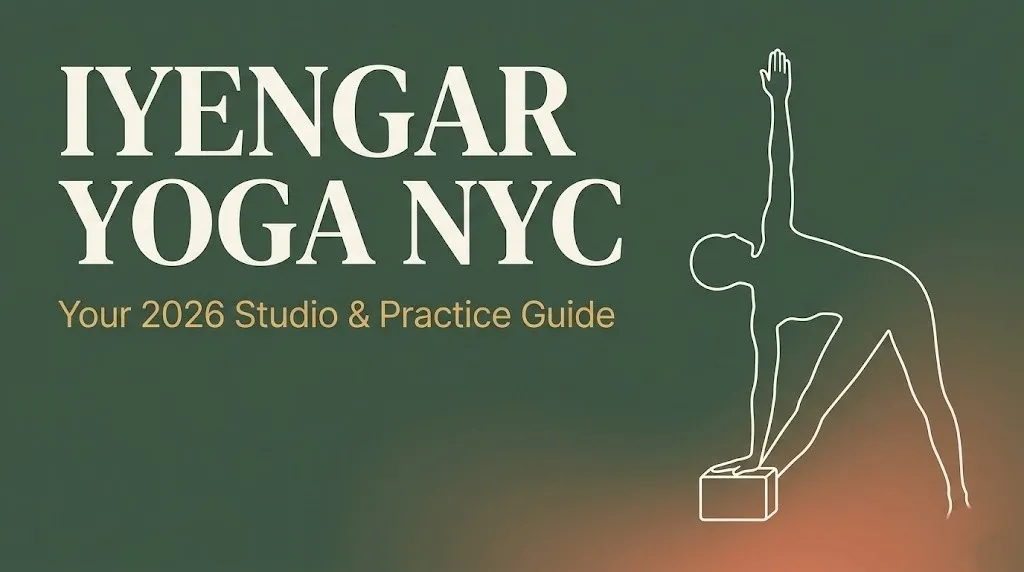
The hallmark of Iyengar yoga is the use of props as tools for learning, not as shortcuts. A block under the hand in Trikonasana (Triangle Pose) is not there because you’re weak. It’s there because it allows your thoracic spine to rotate fully without compensating through the lumbar spine.
Three things make Iyengar yoga distinct:
- Precision: Each pose has specific alignment principles tied to anatomy and physiology.
- Sequence: Poses are ordered deliberately. Standing poses before seated poses. Active poses before restorative.
- Duration: Holds are longer than in most yoga styles. This builds proprioceptive awareness and muscular endurance in stabilizing muscles rather than just primary movers.
Teachers at Iyengar studios undergo more formal training and assessment than in almost any other yoga lineage. The IYNAUS certification system spans multiple levels, from Introductory Level I and II up to Junior Intermediate and Senior designations.
How Iyengar Yoga Is Different from Other Styles
Iyengar yoga differs from other styles primarily in its emphasis on anatomical alignment, use of props, and teacher certification standards, all of which set it apart from faster or more flowing practices.
Most people come to Iyengar yoga after trying Vinyasa, Hatha, or Bikram/26&2 yoga and finding those approaches either too fast, too hot, too aerobic, or too vague on technique. Iyengar yoga is genuinely different in structure, not just in tone.
| Feature | Iyengar Yoga | Vinyasa Yoga | Hatha Yoga | Yin Yoga |
|---|---|---|---|---|
| Pace | Slow and deliberate | Flowing and continuous | Moderate | Very slow |
| Props | Central to the practice | Occasionally used | Sometimes used | Bolsters common |
| Hold duration | 30 seconds to 3 minutes | 1 to 5 breaths | 3 to 5 breaths | 3 to 7 minutes |
| Focus | Precise alignment | Movement flow | Basic poses | Connective tissue |
| Teacher standard | IYNAUS certified (rigorous) | Yoga Alliance 200hr (variable) | Varies | Varies |
| Best for | Injury, beginners, seniors | Fitness, flow preference | General practice | Flexibility, recovery |
The American College of Sports Medicine notes that yoga styles with slower hold times and deliberate alignment cueing tend to be more appropriate for clinical populations and people with musculoskeletal conditions.
Iyengar yoga does not flow. There is no music. You won’t move through a Sun Salutation twelve times. You might spend fifteen minutes in Tadasana (Mountain Pose) alone, which sounds simple until you experience how much your teacher will teach you in that single standing position.
Best Iyengar Yoga Studios in NYC
The best Iyengar yoga studios in New York City are those staffed by IYNAUS-certified teachers, which guarantees a minimum standard of training and ongoing assessment that other yoga certifications do not require.
When evaluating any studio calling itself “Iyengar-inspired” versus “Iyengar-certified,” that word choice matters. IYNAUS certification requires teachers to pass practical and theoretical assessment exams at multiple levels. “Inspired” can mean anything.
Look for these markers at any NYC studio:
- IYNAUS certification: Visible on the studio website, not just referenced vaguely.
- Dedicated prop inventory: A genuine Iyengar studio has blocks, straps, bolsters, blankets, and a rope wall (also called the wall ropes or Yoga Kurunta).
- Level-based class structure: True Iyengar studios separate Introductory, Level I, Level II, and Therapeutic classes. An all-levels flow class is a red flag.
- Small class sizes: Iyengar teaching requires hands-on adjustment. Classes larger than 20 students compromise the teaching quality.
Pose Tip:
- Visit any studio during an introductory class before committing to a membership.
- Ask the teacher what IYNAUS level they hold. Senior-level teachers have 10-plus years of assessment history.
- Therapeutic classes require a teacher’s assessment of your condition before you attend. This is a feature, not a bureaucratic obstacle.
The Iyengar Yoga Institute of New York on the Upper West Side is the city’s flagship dedicated institute, operating since the 1980s. It offers a structured curriculum from Introductory through advanced levels and hosts workshops with Senior-level teachers regularly.
Iyengar Yoga Brooklyn
Iyengar yoga Brooklyn studios offer certified instruction in a borough that has seen significant growth in its yoga community, with certified teachers now operating across Park Slope, Williamsburg, Cobble Hill, and Carroll Gardens.
Brooklyn’s Iyengar scene tends to attract practitioners who want serious study in a slightly less corporate environment than Midtown Manhattan. Class sizes run smaller on average. Teacher-student ratios are often better.
What Brooklyn studios offer that Manhattan sometimes lacks is geographic accessibility for the borough’s dense residential neighborhoods. If you live in Park Slope, Carroll Gardens, or Prospect Heights, you may find a certified studio within walking distance.
Key things to look for when choosing a Brooklyn Iyengar studio:
- IYNAUS teacher certification: Verify the level, not just the affiliation.
- Therapeutic or modified class options: Many Brooklyn Iyengar teachers have specializations in teaching people with back conditions, pregnancy, or post-surgical recovery.
- Trial class availability: Reputable studios offer an introductory session or a first-class discount.
- Prop availability: Studios should provide all props. You should never need to bring your own block or strap to an Iyengar class.
- Weekend workshops: Many Brooklyn studios host visiting Senior teachers from other cities or internationally.
The Brooklyn Iyengar community also tends to run informal study groups and peer practice sessions. If you are serious about the practice, ask the teacher whether any such groups exist. Peer practice is how intermediate students refine what they learn in class.
Iyengar Yoga Manhattan
Iyengar yoga Manhattan studios anchor the city’s most established Iyengar teaching community, with the Iyengar Yoga Institute of New York on the Upper West Side serving as the longest-running dedicated center in the borough.
Manhattan’s Iyengar studios operate with broader weekly schedules. You’ll typically find classes running six to seven days a week at major institutes, including early morning, midday, and evening slots. This density of scheduling makes it easier to build a consistent practice within a busy work week.
Manhattan also has more access to Senior-level certified teachers, who have passed the most demanding tier of IYNAUS assessment. A Senior Iyengar teacher has typically been practicing and teaching for 15 to 20-plus years and has completed multiple assessment cycles.
| Manhattan Area | What You’ll Find |
|---|---|
| Upper West Side | Flagship IYINY institute, senior teachers, full curriculum |
| Midtown East/West | Studio partnerships, introductory programs |
| Lower East Side | Smaller spaces, community-oriented scheduling |
| Greenwich Village | Mixed yoga studios with certified Iyengar teachers |
| Upper East Side | Some therapeutic-focused options |
For serious students who want to progress through the IYNAUS curriculum systematically, Manhattan institutes offer the most structured pathway. Workshops with visiting international teachers also happen most often in Manhattan.
If you are brand new and simply want to try your first class, any Manhattan studio with IYNAUS certification will serve you well. The certification standard ensures baseline consistency regardless of which certified teacher you work with.
Key Takeaway: Iyengar yoga in NYC is distinguished by its IYNAUS certification standard. Whether you practice in Brooklyn or Manhattan, that certification is the one credential worth verifying before you commit to a studio.
Iyengar Yoga for Beginners
Iyengar yoga is one of the most appropriate yoga styles for beginners because its slower pace, prop-supported instruction, and detailed alignment feedback make it safer and more educational than faster-paced alternatives.
The common misconception is that you need flexibility or prior yoga experience to start. You don’t. Iyengar studios design their introductory classes specifically for students who have never practiced. The prop system exists precisely to meet the body where it actually is, not where you imagine it should be.
Think of it this way: a yoga strap under your hands in a forward fold functions like a longer arm. It does not signal weakness. It signals that your teacher has enough anatomical literacy to prevent a hamstring strain on your first class.
What beginners specifically gain in Iyengar yoga:
- Body awareness: You learn which muscles are engaging and which are passive. This is called proprioception, and it takes weeks to develop without deliberate instruction.
- Breathing coordination: Classes integrate Ujjayi pranayama (a technique involving a slightly constricted throat breath) from early sessions. You learn to breathe deliberately, not reactively.
- Postural understanding: Many beginners discover in their first class that what they thought was a neutral spine is actually an anteriorly tilted pelvis. That correction alone changes how they sit, stand, and walk.
- Controlled progression: Iyengar studios use a level system. Beginners stay in Introductory classes until the teacher assesses readiness to move up.
Modification for very new beginners: In any standing pose, keep one hand on the wall or a chair. No certified Iyengar teacher will treat this as a failure. It is standard practice in introductory-level classes.
What to Expect at Your First Iyengar Yoga Class
At your first Iyengar yoga class, expect a slower pace than almost any other yoga style you have seen, careful verbal instruction, hands-on adjustments from the teacher, and more time in fewer poses than you might anticipate.
Arrive 15 minutes early. Most certified studios will ask new students to fill out an intake form noting any injuries, surgeries, or health conditions. This is not bureaucratic paperwork. The teacher uses this information to modify poses specifically for you during class.
The class room will have walls lined with props: stacked blocks, rolled straps, folded blankets, bolsters, and likely a rope wall, also called Yoga Kurunta, mounted at various heights. You do not need to know what any of it does. The teacher will direct you.
A typical 75-minute introductory class structure looks like this:
- Centering (5 minutes): Simple seated or lying down awareness of the breath. No instruction yet.
- Standing poses (25 to 30 minutes): Usually Tadasana (Mountain Pose), Trikonasana (Triangle Pose), and one or two other foundational standing asanas. Expect to hold each pose for 30 to 90 seconds with verbal and hands-on corrections.
- Seated and supine poses (20 to 25 minutes): Forward folds, hip openers, or supported backbends, all with props.
- Restorative or Supported Savasana (10 to 15 minutes): Savasana (Corpse Pose) with specific prop support for the lumbar spine and neck.
The teacher will correct you. This is not criticism. Hands-on adjustment is how Iyengar teachers show you what correct alignment feels like in your body, not just what it looks like on a diagram.
Iyengar Yoga Props: Blocks, Straps, and Bolsters
Iyengar yoga props are not modifications for people who can’t do poses fully. They are precision tools that allow every student to access the correct anatomical position of a pose regardless of their current flexibility or strength.
B.K.S. Iyengar is widely credited with systematizing the use of props in yoga. He introduced blocks, straps, bolsters, chairs, blankets, and rope walls as teaching tools that extend the body’s range and allow poses to be held longer and more accurately than the body could sustain unsupported.
| Prop | Purpose | Common Use |
|---|---|---|
| Yoga block (wood or foam) | Raises the floor, shortens reach distance | Under hand in Triangle Pose, under sit bones in forward folds |
| Yoga strap | Extends the arm’s reach, maintains limb position | Around feet in seated forward folds, around thighs in Shoulderstand |
| Bolster | Supports the spine and limbs passively | Under thoracic spine in backbends, under knees in Savasana |
| Folded blanket | Raises the hips, pads joints | Under sitting bones in seated poses, under head and neck |
| Chair | Supports balance and reach, used in inversions | Seated Warrior, supported backbend, inverted poses |
| Rope wall (Yoga Kurunta) | Traction and inversion support | Hanging forward folds, wall-supported Shoulderstand |
The American College of Sports Medicine notes that passive and active stretching tools that support correct joint alignment reduce injury risk significantly compared to unsupported stretching in hypermobile or inflexible populations.
Using a block under your lower hand in Trikonasana is not a concession. It is the tool that allows your top shoulder to rotate open rather than collapsing forward. Without the block, most beginners compensate at the lumbar spine. That compensation, repeated over months, causes the pain that later sends them to a physical therapist.
Key Takeaway: The prop system in Iyengar yoga is not a beginner’s shortcut. It is the mechanism by which correct alignment becomes accessible at every level of practice.
Iyengar Yoga Poses for Beginners
The foundational Iyengar yoga poses for beginners are standing poses, particularly Tadasana (Mountain Pose), Trikonasana (Triangle Pose), and Virabhadrasana II (Warrior II Pose), because these teach the principles of alignment that carry into every other pose in the system.
Iyengar methodology sequences standing poses before seated poses for beginners. Standing poses engage the larger muscle groups of the legs and hips, build strength and stability, and teach students how to work the whole body simultaneously rather than isolating a single area.
Here are the five beginner poses most commonly taught in IYNAUS introductory classes:
To practice Tadasana (Mountain Pose):
- Stand with feet together or hip-width apart, depending on your balance.
- Press all four corners of each foot into the floor: big toe mound, little toe mound, inner heel, outer heel.
- Engage the quadriceps by lifting the kneecaps gently. Do not lock the knees back.
- Lengthen the tailbone toward the floor to reduce lumbar arch.
- Roll the shoulders back and down. Arms rest alongside the body, palms facing forward.
- Hold for 60 to 90 seconds with steady Ujjayi breath.
Modification for Tadasana: Stand with your back against a wall for proprioceptive feedback. The wall tells your body exactly where vertical is.
To practice Trikonasana (Triangle Pose):
- Step feet 3.5 to 4 feet apart. Front foot points forward, back foot turns in 15 degrees.
- Extend arms to shoulder height, palms down.
- Hinge sideways over the front leg. Place the lower hand on a block positioned outside the front foot.
- Reach the top arm toward the ceiling. Look at the top thumb if your neck is comfortable.
- Keep both sides of the waist long. Don’t crunch the lower side.
- Hold for 30 to 60 seconds. Repeat on the second side.
Modification for Trikonasana: Use a higher block or place the hand on the shin rather than a block if hip tightness prevents full reach.
Viparita Karani (Legs-Up-the-Wall Pose) is a third foundational pose taught early in Iyengar classes. Sit sideways against a wall, then swing your legs up as you lower your back to the floor. Hold for 3 to 5 minutes. This is a deeply restorative inversion that requires no prior flexibility.
Safety note: People with glaucoma, retinal detachment, or uncontrolled blood pressure should avoid full inversions. Discuss any such conditions with your teacher before class, not during.
Iyengar Yoga Benefits for the Body and Mind
Iyengar yoga’s health benefits include measurable improvements in spinal flexibility, muscular endurance, balance, joint stability, pain reduction, and stress hormone regulation, all documented across multiple peer-reviewed studies.
A study published in the International Journal of Yoga found that participants in a structured Iyengar yoga program showed significant improvements in spinal range of motion and reductions in self-reported pain scores over a 12-week period. The prop-supported approach allowed participants with baseline restrictions to engage fully throughout.
The practice affects multiple body systems simultaneously:
Physical benefits:
- Increased range of motion in the hips, thoracic spine, and shoulder girdle
- Improved muscular endurance in the erector spinae, quadratus lumborum, and deep hip stabilizers
- Better proprioception and balance, especially in over-65 populations
- Reduced tension in the iliopsoas and hamstring chains, which are primary contributors to low back discomfort
Neurological and psychological benefits:
- Activation of the parasympathetic nervous system during held, supported poses
- Reduced circulating cortisol with regular practice, as noted in research published in the Journal of Alternative and Complementary Medicine
- Improved sleep quality reported across multiple practitioner surveys
The longer hold times in Iyengar yoga are not arbitrary. Holding a well-aligned pose for 45 to 90 seconds recruits slow-twitch postural muscle fibers more effectively than brief holds. These are the fibers that support the spine throughout a work day, not the fast-twitch fibers you use in a sprint.
Modification note: If any pose produces sharp, shooting, or radiating pain (rather than dull muscular sensation), release immediately and inform the teacher. Dull, warming sensation is normal. Sharp or electrical sensation is not.
Iyengar Yoga for Back Pain and Scoliosis
Iyengar yoga is among the most researched yoga styles for chronic back pain and scoliosis management, with its prop-supported alignment approach allowing people to practice safely even with significant spinal conditions.
The NCCIH, part of the National Institutes of Health, identifies yoga as one of the most commonly studied complementary approaches for chronic low back pain, with evidence supporting its use as an adjunct to standard care. Iyengar yoga’s slow, prop-supported structure makes it particularly appropriate for this population.
A study in the Spine Journal found that participants practicing Iyengar yoga for back pain showed improvements in functional disability scores and pain intensity over a 16-week program. The researchers specifically noted that the prop system allowed participants with restricted mobility to access therapeutic positions that would otherwise be unavailable to them.
For people with scoliosis (lateral curvature of the spine), Iyengar yoga offers tools that few other yoga styles provide:
- Asymmetrical positioning: Iyengar teachers are trained to observe spinal asymmetries and modify poses for the specific curvature pattern. A pose on one side may be significantly different from the same pose on the other side.
- Rib cage mobilization: Poses targeting the thoracic spine and intercostals can reduce the visible rib hump associated with some scoliosis curves when practiced consistently over time.
- Strengthening the convex side: Teachers systematically build muscular support on the weakened side of a curve, not just stretch the concave side.
Who should approach with caution: People with acute disc herniation, spinal fractures, or osteoporosis-related spinal changes should consult with a spine specialist before beginning any yoga practice. A certified Iyengar teacher with therapeutic training can work alongside medical guidance, but should not replace it.
Key Takeaway: Iyengar yoga for back pain works because the props allow every student to access therapeutic alignment, not despite the modifications, but because of them.
Iyengar Yoga for Seniors
Iyengar yoga is widely regarded by physical therapists and geriatric health specialists as one of the most appropriate yoga styles for older adults because its prop-supported approach accommodates reduced flexibility, joint changes, and balance challenges without compromising safety.
According to research published in the International Journal of Yoga, older adults who practiced alignment-based yoga showed improvements in static and dynamic balance, which is a primary factor in fall prevention. Falls are the leading cause of injury-related death in adults over 65 in the United States, according to the Centers for Disease Control and Prevention.
What makes Iyengar yoga specifically suitable for seniors:
- Chair as a prop: Many Iyengar teachers offer chair-supported versions of standing poses for students who cannot bear full weight on one leg. Virabhadrasana II (Warrior II Pose) with a chair under the front thigh is a completely legitimate variation, not a lesser version.
- Slow pace and verbal clarity: The deliberate pace reduces the risk of moving too quickly into a position that the body isn’t ready for.
- Restorative sequencing: Senior-specific Iyengar classes often include a higher proportion of Viparita Karani (Legs-Up-the-Wall Pose), supported backbends over a bolster, and supine hip openers.
- Therapeutic class options: Many certified NYC studios offer senior-specific or therapeutically oriented classes that address osteoarthritis, kyphosis, or post-surgical considerations.
Modification for students with significant hip or knee arthritis: Seated poses done on a raised surface (folded blankets under the sitting bones) reduce compression in the hip joint during forward folds. A teacher trained in therapeutic Iyengar work will know this modification instinctively.
Students over 70 or those with cardiac conditions should inform the teacher before class. Inversions, even gentle ones like Viparita Karani, require modification for some cardiovascular conditions.
Iyengar Yoga for Anxiety and Stress
Iyengar yoga reduces anxiety and stress by activating the parasympathetic nervous system through long-held, supported poses that signal physiological safety to the nervous system.
Think of your nervous system like a car idling in traffic. Most modern life keeps it in a low-grade activation state, ready to accelerate but never fully at rest. A held, supported pose in a quiet room with deliberate breath is one of the few experiences that genuinely downshifts that idle.
Research published in the Journal of Alternative and Complementary Medicine found that yoga practitioners, particularly those in alignment-based and restorative-oriented practices, showed measurable reductions in salivary cortisol compared to control groups. Cortisol is the primary stress hormone the body releases in response to perceived threat.
The specific Iyengar yoga elements that contribute to anxiety reduction:
- Viparita Karani (Legs-Up-the-Wall Pose): This semi-inversion calms the nervous system within 5 to 10 minutes. The position of the legs above the heart facilitates venous return and reduces blood pressure mildly.
- Supported Savasana (Corpse Pose): When the teacher places a folded blanket under the head and a bolster under the knees, the body truly releases postural holding. Many students fall asleep. This is considered a success, not a failure.
- Pranayama integration: Certified Iyengar teachers introduce breathing practices, including natural breath observation, Ujjayi breath, and eventually more structured techniques, as part of regular class structure.
- Single-task focus: The level of concentration Iyengar yoga demands, where is my outer heel? is my thigh rotating inward? is my breath steady? leaves very little cognitive space for anxious rumination.
Modification for students with anxiety disorders: If lying flat on the floor in a room of strangers triggers anxiety, sit in a chair in supported Tadasana (Mountain Pose) during Savasana instead. A good teacher will have seen this before and will not draw attention to the modification.
Iyengar Yoga Certification and Teacher Training in New York
Iyengar yoga certification in New York is governed by IYNAUS, which requires candidates to complete a multi-year apprenticeship, pass written and practical assessments at each level, and demonstrate knowledge of pose sequence, contraindications, and therapeutic applications.
This is meaningfully different from the standard 200-hour Yoga Alliance teacher training that most yoga styles require. A 200-hour certification can be completed in a few weeks of intensive study. An IYNAUS Introductory Level I certification typically requires two to three years of consistent study and mentorship with a Senior-level teacher before a candidate is ready to sit for assessment.
The IYNAUS certification levels, in order:
- Introductory Level I: Entry-level teaching certification. Covers approximately 40 foundational poses and basic pranayama.
- Introductory Level II: Expanded pose repertoire and more complex sequencing.
- Junior Intermediate I, II, and III: Deeper biomechanical knowledge, therapeutic applications, and more advanced poses.
- Senior I, II, and III: The highest designation. Senior teachers have extensive assessment history and often teach other teachers.
For people in New York who want to pursue teacher training:
- The Iyengar Yoga Institute of New York offers a structured mentorship and assessment preparation program aligned with IYNAUS standards.
- Students must demonstrate consistent personal practice before applying to teacher training.
- Training includes anatomy study, teaching methodology, pose practicum, and observation hours.
The cost of IYNAUS teacher training in New York varies by program structure. Monthly class fees during training years typically range from $150 to $300 per month, plus workshop fees and assessment exam fees at each level.
If you are considering teacher training, spend at least one year as a committed student first. Every Senior Iyengar teacher in New York will tell you the same thing: the personal practice shapes the teaching.
Key Takeaway: IYNAUS certification is the single most reliable quality signal in Iyengar yoga. The rigor of the assessment process protects students by ensuring every certified teacher has been evaluated, not just self-declared.
Frequently Asked Questions About Iyengar Yoga NYC
What is the difference between Iyengar yoga and regular yoga?
Iyengar yoga uses props, longer holds, and precise alignment instruction governed by a rigorous teacher certification system.
Most other yoga styles focus on flow, breath-movement coordination, or spiritual practice without the same anatomical emphasis.
The IYNAUS certification standard also distinguishes Iyengar teachers from the general 200-hour trained yoga teacher pool.
Is Iyengar yoga good for beginners with no experience?
Yes. Iyengar yoga is one of the most beginner-appropriate styles because the prop system removes the flexibility requirement.
You do not need to touch your toes, be athletic, or have any prior yoga experience.
Most certified NYC studios offer an Introductory Level I class designed specifically for students with no background.
How much does Iyengar yoga cost in NYC?
Drop-in class rates at certified Iyengar yoga NYC studios typically range from $20 to $40 per class.
Monthly memberships or class packages generally reduce the per-class cost to between $15 and $25.
Some institutes offer sliding scale pricing or new student introductory offers; call the studio directly to ask.
Can Iyengar yoga help with back pain?
Research, including a study published in the Spine Journal, supports Iyengar yoga as an effective adjunct approach for chronic low back pain.
The prop system allows people with restricted mobility to access therapeutic alignment positions that unsupported practice cannot offer.
Anyone with acute disc herniation, fractures, or recent surgery should get clearance from a spine specialist before beginning, and should inform the teacher before the first class.
What should I bring to my first Iyengar yoga class in New York?
Certified Iyengar studios provide all props, so you do not need to bring a block, strap, or bolster.
Wear comfortable, close-fitting clothes without buckles or zippers. Yoga is practiced in bare feet.
Bring the intake form the studio emailed you if they sent one, and arrive 15 minutes early to speak with the teacher about any conditions or injuries.
Your Next Step on the Mat
Iyengar yoga asks you to slow down at a time when everything else speeds up. That is not a coincidence. The practice works precisely because it teaches your body what genuine alignment feels like, and that lesson carries off the mat into the way you sit at a desk, carry your child, or recover from a long run.
Start with one introductory class at an IYNAUS-certified studio, either in Brooklyn or Manhattan, and tell the teacher one specific thing about your body before class begins. One hip is tighter. One shoulder sits higher. Low back tends to ache on long days. That single piece of information is all a good Iyengar teacher needs to make your first class genuinely useful.
The practice meets you where you are. Your job on day one is simply to show up.