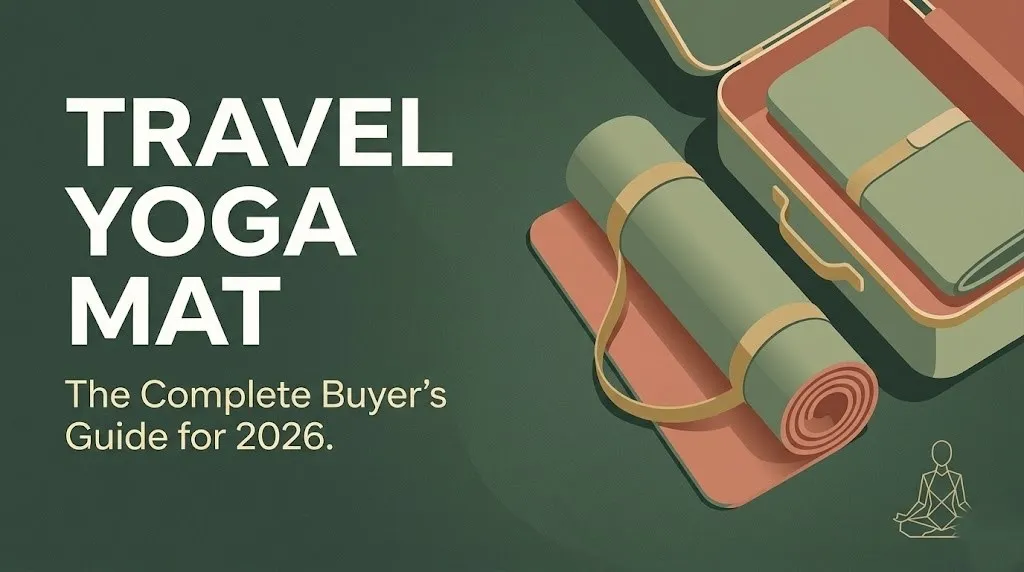
Travel Yoga Mat: The Complete Buyer’s Guide for 2026
A travel yoga mat is a thinner, lighter, more packable version of a standard yoga mat, designed to fit in a suitcase or carry-on without weighing you down or breaking your practice. Choosing the right one is genuinely more complex than most buying guides admit, because the best travel yoga mat depends on your yoga style, your body, your joints, and how you actually travel.
The National Center for Complementary and Integrative Health (NCCIH) reports that yoga practice among American adults continues to grow, with a large percentage practicing at home or away from a dedicated studio. For those practitioners, a mat that travels well is not a luxury accessory. It is the foundation of a consistent practice.
This guide covers everything that matters before you buy: thickness, weight, materials, grip, sizing, eco-certifications, and which mats work for which styles and bodies. You’ll also find a practical travel yoga sequence and step-by-step guidance on keeping your mat clean and lasting longer.
What Is a Travel Yoga Mat?
A travel yoga mat is a purpose-built yoga mat designed to be significantly lighter and thinner than a standard mat, typically weighing between 1 and 3 pounds and measuring between 1mm and 3mm thick, with the goal of fitting flat in luggage or rolling into a compact carry size. Standard yoga mats typically measure 4mm to 6mm thick and weigh 4 to 7 pounds. Travel mats trade cushioning for portability.
The category covers two main subtypes. A foldable travel yoga mat is designed to fold flat, like a large piece of fabric, and slip into a luggage pocket or bag. A rollable travel yoga mat resembles a standard mat but is thinner and lighter, rolling into a smaller, lighter cylinder.
Both serve the same purpose: keeping your practice consistent when you’re away from your home mat. The difference between them is primarily structural and affects how they feel underfoot, which matters more than most buyers initially realize.
| Feature | Standard Yoga Mat | Travel Yoga Mat |
|---|---|---|
| Thickness | 4 to 6mm | 1 to 3mm |
| Weight | 4 to 7 lbs | 1 to 3 lbs |
| Packed size | Large rolled cylinder | Folds flat or rolls compact |
| Cushioning | Good to excellent | Minimal to moderate |
| Joint protection | High | Lower; style-dependent |
| Best for | Home or studio practice | Hotels, travel, outdoor use |
Travel mats are not ideal as a permanent replacement for a standard mat for every practitioner. They are best used alongside a home mat, not instead of one, unless your practice prioritizes floor connection and balance cues over cushioning.
Travel Yoga Mat Thickness: How Thin Is Too Thin?
A travel yoga mat becomes too thin for safe, comfortable practice when it drops below 1.5mm for practitioners who perform kneeling poses, weight-bearing wrist work, or any pose that loads a bony prominence directly against the floor. Below that threshold, the mat functions more like a non-slip liner than a cushioning surface.
Most travel mats fall between 1mm and 2.5mm. The 1mm range is designed for practitioners who already practice on hard wood floors or prefer a firm, floor-connected feel. The 2 to 2.5mm range offers a modest but real cushioning buffer that most practitioners will find more forgiving on hotel carpet or tile.
Thickness matters most in specific poses. In Adho Mukha Svanasana (Downward-Facing Dog), your wrist joints bear a significant proportion of your upper body weight. On a 1mm mat over a hard floor, wrist loading increases noticeably compared to a 4mm mat. In Balasana (Child’s Pose), the knee joint contacts the floor with no muscular buffer. On a 1mm surface, this can cause genuine discomfort, especially for practitioners with any knee sensitivity.
Pose Tip:
- On mats under 2mm, fold the mat’s front edge double under your hands in Adho Mukha Svanasana (Downward-Facing Dog) for added wrist support
- In kneeling poses, place a folded hotel towel beneath the mat at knee contact points
- Practitioners with osteoporosis or a history of stress fractures should not use mats under 2mm without additional padding beneath bony prominences
Lightweight Yoga Mat Weight: What to Look For
The practical weight threshold for a travel yoga mat that will not add strain to carry-on luggage or a travel bag is 2 pounds (approximately 900 grams) or under, with the lightest options in the category weighing as little as 0.9 to 1.2 pounds. Beyond portability, weight reflects material density, which affects both durability and grip.
Think of it like this: a travel mat’s weight is like the weight of a quality paperback book. You won’t notice it. But stack three of them in your bag and you start to make choices.
The lightest travel mats are made from microfiber, thin natural rubber, or TPE (thermoplastic elastomer) and weigh under 1.5 pounds. These are genuinely ultralight and pack into a bag smaller than a rolled magazine. The trade-off is that lighter materials often sacrifice either grip or durability.
Mats in the 1.5 to 2.5 pound range offer a better balance of weight, grip, and longevity. These are appropriate for practitioners who travel regularly and want a mat that performs reliably across multiple yoga sessions per trip, not just occasional use.
| Weight Range | Best For | Trade-Off |
|---|---|---|
| Under 1.5 lbs | Ultra-minimalist travelers, occasional practice | Lower durability, thinner cushioning |
| 1.5 to 2.5 lbs | Regular travelers, 3 to 5 sessions per week | Slightly bulkier than ultralight options |
| 2.5 to 3.5 lbs | Practitioners who prioritize grip and surface feel | Heavier; similar to a thin standard mat |
Modification note: If joint protection is a priority but you want to minimize weight, carry a lightweight folded microfiber towel as a supplemental layer for kneeling sections only. This adds negligible weight and provides meaningful cushioning where it matters most.
Key Takeaway: For a travel yoga mat that genuinely works, prioritize thickness for your joint needs first, then weight second. A mat that is too thin for your practice style is not a good mat regardless of how light it is.
Foldable Yoga Mat vs. Rollable Travel Mat
The primary difference between a foldable yoga mat and a rollable travel mat is how they store and how they feel underfoot: foldable mats lie completely flat in luggage but create fold lines that some practitioners feel during practice, while rollable travel mats have no fold lines but require a cylindrical storage space. Both are legitimate travel options. The right choice depends on your storage situation and your sensitivity to surface texture.
Foldable mats are typically made from materials that resist creasing, such as microfiber combined with natural rubber, or thin polyurethane surfaces. They fold into a rectangle roughly the size of a large notebook. This makes them ideal for packing flat in a suitcase alongside clothes without using dedicated cylindrical luggage space.
The fold lines can be noticeable underfoot in standing poses, particularly under the arch of the foot or beneath the ankle joint during balance work. Most practitioners adapt within one or two sessions. Some never notice it at all.
Rollable travel mats behave more like a standard mat during practice because there are no fold lines. They roll into a compact cylinder that fits in the end pocket of most suitcases or in a dedicated mat bag. Their limitation is that they need that cylinder of space, which foldable mats do not.
| Feature | Foldable Travel Mat | Rollable Travel Mat |
|---|---|---|
| Storage shape | Flat rectangle | Compact cylinder |
| Fits in suitcase | Yes, flat with clothes | Yes, in end pocket or bag |
| Fold lines during practice | Yes; most adapt quickly | No |
| Best poses on this surface | Floor and kneeling poses | All pose types |
| Typical thickness | 1 to 2mm | 1.5 to 3mm |
| Recommended for | Frequent flyers, minimalists | Regular travelers preferring feel |
Best Material for a Travel Yoga Mat
The best material for a travel yoga mat depends on your priorities: natural rubber provides the best grip-to-weight ratio but carries latex allergy risk, TPE (thermoplastic elastomer) is the most allergy-safe and eco-friendly synthetic option, and microfiber surfaces provide the best moisture grip but require either a rubber backing or dampening before they reach peak traction. PVC, while common in budget mats, raises material safety concerns worth understanding before purchasing.
Natural rubber mats grip immediately, even when dry, and the material’s natural tackiness increases with light moisture. They are biodegradable and come from a renewable source. The critical note: natural rubber contains latex proteins. Anyone with a documented latex allergy should avoid natural rubber yoga mats and opt for TPE or cork instead.
TPE is a synthetic material that contains no latex and is generally considered free from the phthalates and heavy metals sometimes associated with PVC. It is also recyclable in many municipalities. Its grip is generally good but slightly less intuitive than natural rubber, especially on smooth hotel floors.
Microfiber surfaces are exceptionally soft and moisture-absorbent. They grip best when lightly damp, which makes them ideal for Vinyasa and hot yoga practitioners who sweat during practice. On a dry surface before warming up, microfiber can feel slippery, which is a genuine safety consideration for beginners or for opening poses in any sequence.
| Material | Grip | Eco Profile | Latex Risk | Best For |
|---|---|---|---|---|
| Natural rubber | Excellent | Biodegradable | Yes | Most yoga styles |
| TPE | Good | Recyclable, no PVC | No | Allergy-sensitive practitioners |
| Microfiber | Best when wet | Moderate | No | Hot yoga, Vinyasa |
| Cork surface | Good; improves with moisture | Sustainable | No | Eco-conscious practitioners |
| PVC | Decent | Non-biodegradable | No | Budget buyers; raises safety questions |
Eco-Friendly Travel Yoga Mat: What Certifications Mean
An eco-friendly travel yoga mat certification is only meaningful if it comes from an independent, internationally recognized body, with OEKO-TEX Standard 100 and GOTS (Global Organic Textile Standard) being the two most credible certifications to look for in 2026. Vague claims like “natural,” “non-toxic,” or “eco-conscious” printed on packaging carry no regulatory weight and require no third-party verification.
The OEKO-TEX Standard 100 is issued by the OEKO-TEX Association, a Swiss-based organization that tests textiles and materials for over 100 harmful substances, including phthalates, heavy metals, formaldehyde, and pesticide residues. A mat carrying this certification has been independently tested and found to be free from these substances at levels harmful to human health. This matters for yoga mats specifically because your skin is in direct, extended contact with the surface during every session.
PVC yoga mats have drawn attention from environmental and health researchers because of the plasticizers, specifically phthalates, used in their production. While a single session on a PVC mat is not a documented health hazard, the Journal of Alternative and Complementary Medicine has noted that long-term skin contact with materials containing phthalates warrants caution. Practitioners who practice daily or who have chemically sensitive skin may reasonably prefer certified alternatives.
Key certifications to recognize:
- OEKO-TEX Standard 100: Tests for over 100 harmful substances in the finished product
- GOTS (Global Organic Textile Standard): Covers organic fiber sourcing and processing; relevant for cotton or jute mats
- FSC (Forest Stewardship Council): Relevant for cork-surface mats; certifies responsible sourcing of the cork
- Cradle to Cradle: Evaluates material recyclability and manufacturing impact
Caution: A mat listed as “natural rubber” without any certification does not guarantee that the rubber source or manufacturing process meets any environmental standard. Look for the certification mark, not just the material claim.
Key Takeaway: Before buying, check for OEKO-TEX Standard 100 certification on any travel mat you’ll be using daily. The label requires real third-party testing. The word “natural” printed on packaging does not.
Travel Yoga Mat for Different Yoga Styles
The right travel yoga mat for your practice depends directly on your yoga style, because different styles make different demands on grip, cushioning, and surface texture throughout the session. A mat that is excellent for Yin yoga may actively undermine a Vinyasa practice, and vice versa.
Vinyasa practitioners move continuously and generate heat and perspiration. They benefit from a microfiber or natural rubber surface that improves grip as moisture increases. A dry-surface-only mat becomes a safety issue once the flow heats up.
Yin yoga and Restorative yoga practitioners spend extended time in passive, floor-based poses. Cushioning matters more for these styles than for any other. A 1mm mat under a 5-minute Balasana (Child’s Pose) will compress to nothing and leave the knee joints and ankle joints on a hard surface. Practitioners of these styles need at least 2 to 3mm of thickness, and folding a hotel towel beneath the mat is a practical workaround.
Ashtanga practitioners combine demanding sequences with precise alignment work. They need a mat with consistent grip from start to finish. Natural rubber or a dual-layer rubber-microfiber mat handles the sweat of a full Ashtanga primary series better than a TPE surface alone.
Hatha yoga at a moderate pace is the most forgiving style in terms of mat requirements. Most travel mats in the 2 to 2.5mm range with decent grip will work well for a typical Hatha class.
| Yoga Style | Minimum Thickness | Best Surface Material | Key Feature Needed |
|---|---|---|---|
| Vinyasa | 1.5mm | Microfiber or natural rubber | Wet-grip performance |
| Yin / Restorative | 2.5 to 3mm | Any; prioritize cushioning | Padding for long holds |
| Ashtanga | 1.5 to 2mm | Natural rubber or rubber-microfiber | Consistent grip throughout |
| Hatha | 2mm | TPE or natural rubber | Balanced grip and cushion |
| Hot yoga | 1.5mm | Microfiber | Maximum moisture absorption |
Travel Yoga Mat for Beginners
Beginners need a travel yoga mat with at least 2mm of cushioning, reliable non-slip grip on dry surfaces, and clear front-to-back orientation markings to support alignment learning while away from a teacher. A beginner’s primary challenges on a new mat are grip anxiety and joint discomfort. Both are solvable with the right specifications.
Grip anxiety is real for new practitioners. When a mat slips during Adho Mukha Svanasana (Downward-Facing Dog), it breaks concentration, creates fear of falling, and interrupts the learning process. Beginners benefit most from mats with natural rubber or TPE surfaces that provide immediate dry-grip, not mats that require moisture to activate.
Cushioning matters for beginners because they spend more time in foundational poses that load the wrists, knees, and hips. Many beginners are still building wrist strength and flexibility, and a 1mm mat over a hard hotel tile floor can make wrist-bearing poses discouraging or painful before the strength develops.
The NCCIH notes that consistency of practice is one of the strongest predictors of yoga’s health benefits. A beginner who stops practicing because their travel mat is uncomfortable or slippery loses that consistency. The mat specification is a wellness decision, not just a gear decision.
Practical guidance for beginners choosing a travel mat:
- Choose at least 2mm thickness for any hard-floor environment
- Prioritize dry-surface grip in the material: natural rubber or TPE over microfiber
- Look for a mat with alignment lines or printed guides if you are learning poses independently
- On a very thin mat, practice poses with a doubled towel under the wrists and knees until strength and flexibility develop
Modification: Beginners with wrist sensitivity, including those managing early-stage carpal tunnel syndrome, should speak with a physical therapist or occupational therapist about wrist loading before selecting a mat thickness. A yoga block can reduce wrist extension in many bearing poses regardless of mat thickness.
Travel Yoga Mat for Seniors and Joint Protection
For seniors, the single most important specification in a travel yoga mat is adequate cushioning at the knee, hip, and wrist contact points, which means prioritizing mats of at least 2.5 to 3mm thickness even if that adds slight weight and bulk to the travel load. Joint cartilage thins with age, and hard-floor contact through a 1mm mat during extended kneeling or seated poses is not an acceptable trade-off for packability.
The American College of Sports Medicine (ACSM) identifies balance training, flexibility maintenance, and weight-bearing activity as priority movement goals for adults over 65. Yoga directly addresses all three. A mat that causes pain during kneeling or seated poses undermines the practice before it begins.
Specific joint considerations for senior practitioners:
- Knee joints: Any kneeling pose on a mat under 2mm requires supplemental padding. A folded blanket or extra towel placed beneath the mat adds meaningful protection.
- Wrist joints: Degenerative changes in the wrist joint are common in older adults. Mats under 2mm on hard surfaces increase dorsiflexion load at the wrist in poses like Adho Mukha Svanasana (Downward-Facing Dog). Yoga blocks to reduce weight-bearing angle are a simple and highly effective modification.
- Hip joints: Sukhasana (Easy Seated Pose) and all floor-seated poses are most comfortable on a mat that has not bottomed out under the sit bones. Mats under 2mm on hard floors may require a folded blanket for seated practice.
Pose Tip:
- Seniors should always carry a small, lightweight folded blanket in travel luggage to supplement a thin travel mat at pressure points
- For poses that require kneeling, position the mat so its fullest thickness is under the knees, not distributed evenly
- Setu Bandha Sarvangasana (Bridge Pose) is an excellent senior-accessible travel pose; the heels, upper back, and arms bear load without stressing wrists or knees
Key Takeaway: For seniors and for anyone with joint-related pain, a travel mat under 2.5mm is a compromise that affects your actual practice quality. Carry a lightweight folded towel as a supplement rather than accepting a mat that is too thin for your joints.
Non-Slip Travel Yoga Mat Grip Explained
Grip on a yoga mat is determined by three interacting factors: the surface material’s coefficient of friction against skin, the mat’s behavior when moisture is introduced, and the floor surface the mat sits on. Understanding all three prevents the frustrating experience of buying a “non-slip” mat that slides around on hotel room carpet or tile.
Grip is not a single quality. It is a relationship. A natural rubber mat grips brilliantly on hardwood but can slide on low-pile hotel carpet because the mat’s underside loses friction against the carpet fibers. A microfiber surface grips excellently against sweaty skin but feels slippery when completely dry at the start of practice.
Most mat slippage on carpet comes from the mat’s underside, not the top surface. Mats with a textured or dotted rubber underside grip carpet better than smooth-backed mats. When evaluating a travel mat for use on hotel carpet specifically, the bottom surface specification matters as much as the top.
For floor-level grip when practicing on smooth tile or hardwood, these materials perform reliably in descending order:
- Natural rubber: Highest dry-surface tack; improves with light moisture
- Cork over rubber: Natural antimicrobial; good dry grip; improves with moisture
- TPE: Consistent dry grip; does not improve significantly with moisture
- Microfiber over rubber: Excellent wet grip; requires warming up before reaching peak traction
- PVC with texture: Adequate dry grip; does not improve with moisture; declines with wear
Safety note: A mat that slips during a weight-bearing pose creates real fall risk. If your mat slides on the floor surface at your travel destination, placing it over a non-slip rug pad cut to size adds grip at virtually no weight cost.
Yoga Mat Size for Travel: What Fits in a Carry-On
A travel yoga mat fits in a carry-on when it folds to under 18 inches in any dimension or rolls to under 22 inches in length with a diameter under 4 inches, which places it within the standard carry-on size limits enforced by most major airlines worldwide. Most standard-size travel mats (68 to 72 inches long, 24 inches wide) fold or roll well within these limits.
Most airlines allow yoga mats as carry-on items when properly stored, either in a mat bag or folded into a luggage bag. A foldable mat placed flat in a suitcase raises no carry-on size issues at all. A rolled mat in an external bag needs to fit within the airline’s overall carry-on dimension limit, typically 22 x 14 x 9 inches for US domestic carriers.
Standard yoga mat dimensions vs. travel mat dimensions:
| Mat Type | Length | Width | Rolled/Folded Size | Carry-On Fit |
|---|---|---|---|---|
| Standard mat | 68 to 72 in | 24 in | Large roll | No; too bulky |
| Travel rollable | 68 to 72 in | 24 in | Compact roll, 3 to 4 in diameter | Yes, with mat bag |
| Travel foldable | 68 to 72 in | 24 in | Flat folder, 12 x 24 in | Yes, flat in suitcase |
| Extra-long travel mat | 74 to 84 in | 24 to 26 in | Larger compact roll | May exceed carry-on; check airline |
Practitioners over 6 feet tall often find standard-length travel mats (68 inches) leave their feet on the floor during Savasana (Corpse Pose). A 72-inch travel mat still rolls compactly and is worth the marginal size difference for taller practitioners.
How to Clean a Travel Yoga Mat
Clean a travel yoga mat after every session by wiping both surfaces with a diluted solution of water and white vinegar or a dedicated mat spray, allowing it to air-dry completely before rolling or folding for storage. Storing a damp mat is the single fastest way to develop bacterial growth, odor, and material breakdown.
Travel environments expose your mat to hotel carpets, unfamiliar floors, outdoor surfaces, and the bacteria transferred from airport or class floors. Cleaning frequency matters more for a travel mat than a home mat because the environments vary more widely.
To clean a travel yoga mat properly:
- Unroll or unfold the mat fully on a clean, flat surface.
- Mix a cleaning solution: 1 part white vinegar to 3 parts water, or use a mat-specific enzyme-based spray. Avoid dish soap; it leaves a residue that reduces grip.
- Apply the solution to a clean microfiber cloth. Do not spray directly onto natural rubber mats; excess moisture can degrade the material over time.
- Wipe the top surface in long strokes from one end to the other.
- Flip and wipe the underside with the same cloth, rinsed and re-dampened.
- Hang the mat over a towel rack, shower rod, or chair back to air-dry fully, ideally 30 to 60 minutes minimum before storing.
- Never dry a yoga mat in direct sunlight for extended periods. UV exposure degrades both natural rubber and TPE over time.
Modification for travel: If a full spray-and-dry is not practical mid-trip, wipe the mat surface with a clean, damp hotel towel after each session and air it open overnight. A small travel spray bottle of diluted mat cleaner adds under 2 ounces to your bag and handles a week of travel sessions.
Key Takeaway: Air-drying your travel mat completely before folding or rolling it is not optional. Moisture trapped in a folded mat creates bacteria and breaks down the material faster than any amount of regular use.
Yoga Mat Bag and Carrying Options for Travel
The right carrying solution for a travel yoga mat depends on whether the mat folds or rolls, with foldable mats requiring only a sleeve or flat carry pouch and rollable mats benefiting from a cylindrical bag with a shoulder strap or a dedicated luggage attachment loop. For most travelers, placing a foldable mat flat in a suitcase is the simplest and most efficient carrying solution.
A dedicated yoga mat bag adds weight and bulk. For travel purposes, a mat bag is most useful when you need to carry the mat separately from your luggage, such as walking to a hotel studio class or carrying the mat through an airport.
Carrying options and their trade-offs:
- Suitcase flat-packing (foldable mats): Zero additional equipment. Fits with clothes. No extra weight.
- Suitcase end pocket (rollable mats): Works well if the pocket is deep enough. No external attachment needed.
- Yoga mat sling strap: A simple adjustable strap that wraps the rolled mat. Weighs under 2 ounces. Allows shoulder carry. Does not protect the mat surface.
- Tube-style mat bag: Protects the rolled mat. Adds 3 to 6 ounces. Works as a standalone carry or attaches to a backpack.
- Backpack with external mat holder: Most practical for practitioners who walk to class. Keeps hands free. Adds weight only when mat is external.
Tip: A long luggage strap or packing band can wrap a folded mat and secure it to the exterior of a checked bag if it does not fit inside. This works well for practitioners who carry full-size supplemental mats rather than ultralight travel versions.
Yoga Poses and Sequences for a Travel Mat
The best yoga sequences for a travel mat are floor-based or low-stance sequences that work within a small space, avoid wide lateral standing poses that require more mat length than a standard 24-inch-wide travel mat provides, and prioritize breath and mobility over peak flexibility or strength. Hotel rooms typically allow a practice area of 6 by 4 feet, which is sufficient for most yoga sequences.
A reliable 20-minute travel yoga sequence that works on any travel mat surface:
To practice this travel sequence:
- Sit in Sukhasana (Easy Seated Pose) at the mat’s center. Close your eyes. Take 10 rounds of Ujjayi breath: inhale for 4 counts, exhale for 4 counts with a slight throat constriction, audible breath rhythm.
- Move to hands and knees at the mat’s center. Perform 8 rounds of Marjaryasana-Bitilasana (Cat-Cow), synchronizing the spinal wave with your breath. Slow down after the first 4 rounds.
- Press to Adho Mukha Svanasana (Downward-Facing Dog) for 5 breaths. Bend knees if hamstrings are tight from travel. Let the head hang fully. Feel the length from the lumbar spine to the heels.
- Walk or step feet to hands. Rise slowly to standing through a forward fold, stacking the spine one vertebra at a time.
- Practice Virabhadrasana I (Warrior I) on each side for 5 breaths per side. Step the back foot to a comfortable lunge width that stays within the mat’s length.
- Return to the mat surface. Practice Setu Bandha Sarvangasana (Bridge Pose): feet flat, hip-width apart, knees above ankles, hips lifted. Hold for 5 breaths. Lower slowly. Repeat twice.
- Draw both knees to the chest. Rock gently side to side for a passive lower back release.
- Extend to Savasana (Corpse Pose) for 3 to 5 minutes. Let the body become heavy. This is not optional. Rest is part of the sequence.
Modification for a very small space or a single bed as mat surface: When a mat cannot be laid flat, sit cross-legged on the bed or carpet and practice breathwork, seated twists, and Paschimottanasana (Seated Forward Fold) from a sitting position. Any consistent practice, however adapted, is better than skipping entirely.
How to Choose a Travel Yoga Mat: Full Buying Guide
Choosing the right travel yoga mat requires matching four specifications to your practice: thickness for your joint needs, weight for your travel load, material for your yoga style and any allergy considerations, and grip behavior for the surfaces you’ll most often practice on. Prioritize in that order and the right mat becomes clear quickly.
Most buyer confusion comes from treating all four factors as equally important and getting paralyzed by options. They are not equally important. Joint protection and practice safety come before packability. Packability comes before price.
A step-by-step decision framework:
- Identify your yoga style. Vinyasa and hot yoga practitioners need wet-grip performance. Yin and Restorative practitioners need more cushioning. Hatha practitioners have the most flexibility.
- Assess your joints. Do you have wrist sensitivity, knee pain, or hip discomfort during kneeling or floor-based poses? If yes, do not go below 2.5mm. Consider supplemental padding.
- Check for allergies. Latex allergy means avoid natural rubber entirely. Choose TPE or cork-surface mats instead.
- Set your weight limit. If you travel with only carry-on luggage, under 2 pounds is a practical target. If you check bags, up to 3 pounds is manageable.
- Decide foldable or rollable. Foldable mats pack flatter. Rollable mats perform more like a standard mat underfoot.
- Look for independent certification. OEKO-TEX Standard 100 is the benchmark to look for in 2026 for material safety.
- Test grip before committing. If possible, try the mat in a store or buy from a retailer with a return window. No specification sheet replaces your bare feet on the actual surface.
Quick reference buying summary:
| Practitioner Profile | Recommended Thickness | Recommended Material | Foldable or Rollable |
|---|---|---|---|
| Beginner, general practice | 2 to 2.5mm | TPE or natural rubber | Either |
| Vinyasa or hot yoga | 1.5 to 2mm | Microfiber over rubber | Rollable |
| Yin or Restorative | 2.5 to 3mm | Any; prioritize cushion | Either |
| Seniors or joint-sensitive | 2.5 to 3mm | Natural rubber or TPE | Either with padding |
| Ultralight travel priority | 1 to 1.5mm | Microfiber or thin TPE | Foldable |
| Latex allergy | Any thickness | TPE or cork | Either |
Final note on price: A travel yoga mat under $25 will typically use PVC, lack certifications, and degrade quickly with regular use. A mat in the $50 to $100 range from a certified manufacturer will outlast three budget mats. For a tool you use every day, the cost per session calculation almost always favors the better mat.
Frequently Asked Questions About Travel Yoga Mats
What is the best thickness for a travel yoga mat?
The best thickness for a travel yoga mat is 2 to 2.5mm for most practitioners, providing a workable balance of cushioning and packability.
Practitioners with sensitive knees, wrists, or hips should use at least 2.5mm, or supplement a thinner mat with a folded towel at pressure points.
Practitioners who prioritize floor connection and minimal weight over cushioning can use 1 to 1.5mm mats without issue.
Can I bring a travel yoga mat on a plane as carry-on?
Yes, yoga mats are permitted as carry-on items on most major airlines worldwide.
A foldable travel mat packed flat in a suitcase raises no size concerns; a rolled mat stored in a bag needs to fit within the airline’s carry-on dimension limits, typically 22 x 14 x 9 inches for US domestic carriers.
Check your specific airline’s policy before traveling internationally, as carry-on dimension rules vary by carrier.
Are foldable yoga mats good for real yoga practice?
Foldable yoga mats work well for most yoga practice styles, with the main limitation being fold lines that some practitioners feel underfoot during standing balance poses.
Most practitioners adapt to the fold lines within one or two sessions, and the practical storage benefit of folding flat in a suitcase outweighs this minor tactile difference for many travelers.
For Yin yoga or any practice involving extended time on the floor, choose a foldable mat of at least 2mm to maintain adequate cushioning.
What is the lightest yoga mat for travel?
The lightest travel yoga mats on the market in 2026 weigh between 0.9 and 1.2 pounds and are typically made from thin microfiber bonded to a minimal natural rubber or TPE base layer.
At this weight, the mat is thinner than 1.5mm and is best suited for practitioners who already practice on hard floors and do not need cushioning.
For most practitioners, a mat in the 1.5 to 2 pound range provides a more practical balance of weight and usable cushioning.
Is a 1mm yoga mat too thin for beginners?
A 1mm yoga mat is too thin for most beginners, particularly those who have not yet developed the wrist and knee strength and flexibility to practice comfortably on a hard surface.
Beginning practitioners load the wrist joints and knee joints more heavily than experienced practitioners because their alignment and muscular support are still developing, making cushioning more important at this stage.
A 2mm mat, supplemented with a folded towel under pressure points if needed, is a more practical and comfortable starting point.
Your Practice Does Not Have to Stop When You Travel
A good travel yoga mat is one you actually use. That means it fits in your bag without a second thought, it does not slip when you need it to hold, and it does not leave your knees and wrists aching after 20 minutes.
Start with the joint-protection question. Figure out your minimum thickness. Then work backward through material, weight, and format. Most practitioners land on a 2 to 2.5mm TPE or natural rubber mat in the 1.5 to 2 pound range, and it works well for years.
Pack it flat tonight. Roll it out tomorrow morning wherever you are. The sequence in this guide fits a 6 by 4 foot hotel room. Your practice is portable. Use it.