Yoga Shoes: Best Options for Every Practice in 2026
Yoga shoes are specialized footwear designed to support grip, foot alignment, and warmth during yoga practice without blocking the tactile feedback your feet need on the mat. Most yoga teachers and podiatric specialists agree: barefoot is ideal for most practitioners, but the right yoga footwear can make a genuine difference for specific bodies and conditions.
The National Center for Complementary and Integrative Health notes that yoga is practiced by roughly 36 million Americans, and foot health directly affects alignment in nearly every standing pose. A poorly chosen shoe can shift your weight distribution in ways that travel up through your knees, hips, and spine.
This article covers the main types of yoga footwear, who genuinely needs them, how to match your choice to your yoga style and foot condition, and exactly what to look for whether you are shopping for the first time or replacing what stopped working. No product push. Just the information you need to decide.
Yoga Shoes: What They Are and Why the Choice Matters
Yoga shoes are low-profile, flexible footwear items designed to be worn on a yoga mat without reducing the grip, balance feedback, or freedom of movement that barefoot practice provides.
Unlike standard athletic shoes, yoga footwear sits extremely close to the ground. The sole is thin, often just a few millimeters. The toe box is wide enough to allow natural toe spread. There is little to no heel elevation, which keeps your Tadasana (Mountain Pose) spinal alignment as close to barefoot as possible.
The reason foot position matters so much in yoga comes down to proprioception: your body’s ability to sense its own position in space. Your feet contain thousands of sensory nerve endings. A thick rubber sole reduces that sensory input significantly. That is the core trade-off in any yoga footwear decision.
Yoga shoes exist across a spectrum. On one end are full-coverage minimalist shoes with non-slip soles. On the other end are open-toe grip socks that technically count as footwear. Between those two extremes are several distinct product categories, each with a different use case.
Yoga Alliance notes that studio etiquette in most styles of yoga calls for bare feet on the mat. Understanding when footwear makes sense, and which type fits your situation, is the real starting point for any yoga shoe decision.
| Footwear Type | Coverage | Grip Level | Best For |
|---|---|---|---|
| Minimalist yoga shoes | Full foot | High | Cold studios, outdoor yoga, foot conditions |
| Grip socks / toe socks | Full foot, thin | Medium-High | General studio use, beginners |
| Open-heel yoga sandals | Partial | Medium | Low-intensity flow, Restorative yoga |
| Yoga boots | Ankle-high | Medium | Cold environments, gentle Hatha practice |
| Regular sneakers | Full foot | Low on mat | Not recommended (see section below) |
What Are Yoga Shoes and Do You Need Them?
Most practitioners do not need yoga shoes, but a meaningful minority genuinely benefit from them.
Barefoot yoga is the traditional standard across every major yoga lineage: Hatha, Ashtanga, Iyengar, Vinyasa, and Yin practice all began and developed with practitioners working with bare feet on natural or textile floor surfaces. The unshod foot activates intrinsic foot muscles more effectively, allows natural toe spread in balance poses, and creates direct tactile contact with the mat surface.
That said, there are real situations where some form of yoga footwear makes physiological sense:
- Cold studio floors that cause muscles to contract and limit mobility
- Foot conditions including plantar fasciitis, flat feet, peripheral neuropathy, or Morton’s neuroma
- Ankle instability or recovering from an ankle sprain
- Sensitive skin on the soles from diabetes or circulation issues
- Outdoor practice on grass, sand, or uneven terrain
- Seniors whose balance and foot sensitivity have changed with age
If none of those apply to you, bare feet on a quality non-slip mat remain the best option. The Journal of Alternative and Complementary Medicine has documented that proprioceptive feedback from the soles of the feet plays a measurable role in postural control during standing yoga poses. Blocking that feedback with thick-soled footwear is a real trade-off, not a minor detail.
Pose Tip:
- Practice Vrksasana (Tree Pose) barefoot first to feel how your arch responds
- If your ankle rolls inward repeatedly, footwear with light lateral support may help
- Grip socks are the least invasive first step before committing to a full yoga shoe
Yoga Footwear Types Explained
Understanding the categories of yoga footwear prevents you from buying the wrong product for your practice.
There are five distinct categories. Each was developed for a different need. Buying a boot-style yoga shoe for a Bikram/26&2 practice would be uncomfortable and counterproductive. Wearing a thin grip sock for outdoor yoga on rough terrain would leave your feet unsupported and potentially injured.
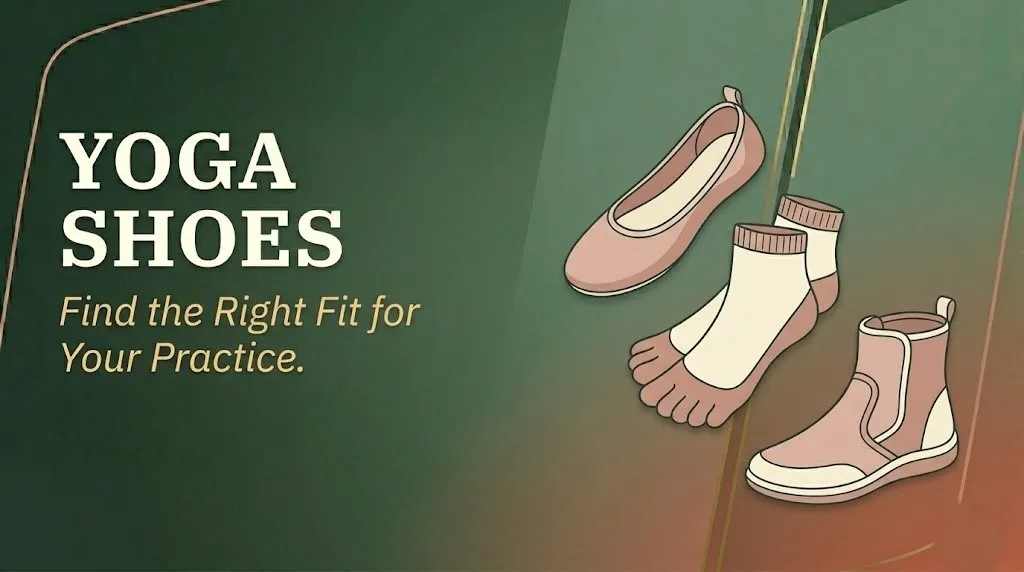
Here is the breakdown:
| Footwear Category | Key Features | Typical Yoga Style Match |
|---|---|---|
| Minimalist yoga shoes | Thin sole, wide toe box, full coverage | Outdoor yoga, cold studios, foot conditions |
| Grip / toe socks | Individual toe pockets or full-foot knit with rubber grip dots | Vinyasa, Hatha, studio use |
| Open-heel yoga sandals | Strapped toe-strap design, slip-on | Restorative, Yin, gentle Hatha |
| Ankle-height yoga boots | Knit or neoprene construction, minimal sole | Gentle flow, Hatha, cold climates |
| Barefoot training shoes | Slightly thicker than yoga-specific but zero-drop | Multi-use, transitional option |
The most versatile option for studio yoga is a grip sock or five-toe grip sock. These preserve nearly all of the proprioceptive feedback of bare feet while adding non-slip grip on studio floors, which can be slippery when sweaty.
For people managing foot conditions, a minimalist yoga shoe with light arch contouring and a non-slip sole provides meaningful support without the bulkiness of a standard sneaker. The American Podiatric Medical Association recommends zero-drop or near-zero-drop footwear for activities where foot alignment and balance are central, making traditional athletic trainers a poor fit for yoga.
The single most useful rule: the closer your yoga footwear sits to the ground and the thinner its sole, the less it disrupts your practice biomechanics.
Key Takeaway: Barefoot yoga is physiologically ideal for most people, but grip socks or minimalist shoes are a legitimate option for cold studios, foot conditions, or outdoor practice. The thinner the sole, the less you lose in proprioceptive feedback.
Best Yoga Shoes for Women
The best yoga shoes for women combine a wide toe box, thin non-slip sole, and flexible construction that moves with the foot rather than constraining it.
Women’s feet are anatomically distinct from men’s feet in ways that affect yoga footwear fit. Women generally have a narrower heel relative to forefoot width, a higher arch frequency, and different Achilles tendon angles. A yoga shoe designed without these differences in mind often fits poorly in the heel, causing slippage during poses like Adho Mukha Svanasana (Downward-Facing Dog), where the heel presses actively toward the mat.
What to look for in women’s yoga footwear:
- Wide toe box that allows toes to spread in standing poses without compression
- Minimal heel-to-toe drop, ideally zero or under 4mm, to preserve natural Tadasana alignment
- Non-slip grip pattern on the sole, with grip concentrated under the ball of the foot and heel
- Breathable upper in knit or mesh fabric to prevent overheating in flow classes
- Machine washable construction, since studio footwear accumulates sweat and mat debris quickly
For women practicing primarily Vinyasa or power yoga, grip socks are generally sufficient and allow more tactile mat feedback than a full shoe. For women managing plantar fasciitis or practicing in cold conditions, a low-profile minimalist shoe with light arch contouring adds meaningful support.
According to research published in the International Journal of Yoga, women demonstrate higher rates of hypermobility in ankle joints than men on average. This suggests that women with known ankle hypermobility should look for yoga footwear with slightly more lateral stability around the ankle, even if the sole remains minimal.
Modification note: Women who are pregnant should prioritize slip-on yoga footwear that does not require bending over to secure, particularly in the second and third trimesters. Open-heel designs or pull-on knit shoes work well here.
Mens Yoga Shoes
Men’s yoga shoes need to account for wider foot shapes, higher body weight loading on the foot, and different arch mechanics compared to women’s footwear.
Men are underrepresented in yoga footwear marketing despite being a growing segment of the practice. The Yoga Alliance reported in recent years that men now make up roughly 28% of yoga practitioners in the United States, a number that has grown steadily. Most yoga shoe products are marketed toward women, but the biomechanical fit requirements for men are meaningfully different.
Key differences in men’s yoga footwear needs:
- Wider overall width throughout the midfoot and forefoot, not just at the toe
- Higher weight tolerance in the grip sole, since more body mass is loaded through the foot in poses like Utkatasana (Chair Pose)
- Reinforced heel cup for men with overpronation, which is more common in men with flat arches
- Larger size range, with quality options extending to size 15 or above
Men practicing Ashtanga or Iyengar yoga rarely use footwear, as both traditions emphasize bare feet and precise foot alignment as part of the practice standard. Men in those styles who need foot support are often better served by targeted physical therapy for the underlying condition than by footwear.
Men attending yoga for the first time in a general studio class can wear grip socks without concern. Full yoga shoes for men are most relevant in outdoor yoga settings, cold home practice environments, or for men managing foot conditions like plantar fasciitis or post-surgical foot recovery.
Pose Tip:
- In Virabhadrasana I (Warrior I), men with flat arches will often see the back heel lift; a minimal yoga shoe with slight arch contouring can improve stability here
- Avoid thick-cushioned trainers; they elevate the heel and shift spinal loading forward
- Begin with grip socks and move to a minimalist shoe only if ankle support becomes a clear need
Shoes for Yoga Class: Studio Rules and Practical Etiquette
Most yoga studios in the United States require that shoes are removed before entering the practice space, meaning your yoga footwear is typically worn before and after class, not during.
This is a practical point that trips up many beginners. The phrase “shoes for yoga class” covers two distinct situations: footwear worn to travel to and from the studio, and footwear worn on the mat itself. These are different products with different requirements.
For traveling to the studio, any comfortable shoe that slips on and off easily near the door is appropriate. Flip-flops, slip-on sneakers, or casual flats are standard. This is not a technical decision.
For footwear worn on the mat, grip socks are the most widely accepted option in studio settings where barefoot practice is uncomfortable or not preferred. Many studios sell them at the front desk. They are minimal enough to not disrupt practice and add real non-slip function on studio floors, which can be polished wood or synthetic surfaces that become slippery in humid conditions.
Bikram/26&2 yoga studios are uniformly hot (40°C / 104°F), making any footwear on the mat uncomfortable and impractical. The heated environment also makes the mat surface reliably tacky, so grip is rarely an issue. Bare feet are nearly universal in this style.
Yin yoga and Restorative yoga classes involve long floor-based holds. Cold studio temperatures in these sessions mean some practitioners genuinely appreciate grip socks or soft knit yoga shoes during the class itself. A good teacher will never make a student feel judged for wearing them.
Key Takeaway: “Shoes for yoga class” usually means what you wear to get there, not what you wear on the mat. Grip socks are the accepted on-mat option in most studio styles, with hot yoga being the one context where any footwear during practice is impractical.
Yoga Shoes Arch Support: What Your Foot Type Actually Needs
Yoga shoes with arch support are most beneficial for people with flat feet (overpronation), high arches (supination), or plantar fascia pain, but the support should be minimal and non-restrictive.
This is where yoga footwear diverges most clearly from standard athletic shoe logic. In running or court sports, substantial arch support and cushioning are evidence-based recommendations. In yoga, however, intrinsic foot muscle activation is part of the practice. Heavy arch support in yoga footwear passively holds the arch in place instead of allowing the foot muscles to work, which can weaken those muscles over time if relied upon chronically.
The goal with yoga shoe arch support is light contouring: a subtle lift under the medial arch that prevents collapse during weight-bearing poses without taking over the job the foot’s own muscles should be doing.
The American College of Sports Medicine notes that strengthening intrinsic foot muscles through barefoot or near-barefoot exercise is one of the most effective long-term strategies for improving arch function. This is why experienced yoga teachers generally recommend starting barefoot and adding minimal arch support only when a specific condition warrants it.
What “appropriate arch support” looks like in yoga footwear:
- Medial arch contouring of 3 to 6mm height, not a firm orthotic insert
- Flexible midsole that bends with the foot through the metatarsophalangeal joints
- No heel lift that exceeds 4mm differential from heel to ball of foot
- Wide forefoot that allows the toes to grip the mat surface independently
If your arch pain is persistent and not improving with barefoot yoga, working with a podiatrist or physical therapist to assess your specific arch mechanics is the appropriate next step, not simply adding more support to your yoga shoe.
Yoga Shoes for Plantar Fasciitis
Yoga shoes for plantar fasciitis need to reduce strain on the plantar fascia ligament without eliminating all proprioceptive feedback from the foot sole.
Plantar fasciitis is inflammation of the thick band of connective tissue running along the bottom of the foot from heel to toe. The American Podiatric Medical Association estimates that plantar fasciitis affects roughly 2 million Americans each year. It is particularly common in people who spend long periods on hard floors, who have high arches or flat feet, or who have recently increased their activity level.
Yoga is frequently recommended by physical therapists as part of plantar fasciitis recovery. Poses like Uttanasana (Standing Forward Fold) and Supta Padangusthasana (Reclined Hand-to-Big-Toe Pose) stretch the Achilles tendon and calf complex, which reduces the tension pulling on the plantar fascia insertion at the heel.
The challenge is that some yoga poses load the plantar fascia directly. Standing barefoot on a hard studio floor during a long hold in Tadasana (Mountain Pose) can aggravate active plantar fasciitis.
For practitioners managing this condition:
- Cushioned heel insert inside a minimalist yoga shoe reduces heel strike load during standing poses
- Avoid thin flat-soled shoes with zero cushioning at the heel when plantar fasciitis is acutely inflamed
- Morning practice caution: plantar fasciitis is typically worst in the first 15 to 20 minutes of the day; practitioners with this condition should warm the foot gently before any weight-bearing yoga sequence
- Modify lunging poses by placing a folded blanket under the heel of the back foot to reduce Achilles tension
- Grip socks with a padded heel are a practical middle-ground option that does not require buying a full yoga shoe
Modification note: During acute plantar fasciitis flares, shift toward floor-based and reclined yoga sequences (Yin or Restorative) and limit standing pose duration until the acute inflammation settles.
Yoga Shoes for Seniors
Yoga shoes for seniors should prioritize non-slip grip, ease of putting on and removing, and mild ankle support without restricting natural foot movement.
Balance becomes a central concern in yoga for seniors. The National Center for Complementary and Integrative Health (NCCIH) has published findings showing that regular yoga practice reduces fall risk in older adults, with standing balance poses showing particularly consistent effects across multiple studies. The footwear a senior practitioner uses directly affects how safely and effectively those balance benefits transfer to real-world movement.
Several foot changes occur naturally with age that affect yoga footwear needs:
- Reduced plantar sensitivity from thinning of the fat pad on the heel and ball of the foot
- Decreased Achilles tendon elasticity, making deep heel-lowering poses more challenging
- Widened forefoot from decades of weight-bearing
- Higher likelihood of bunions, hammer toes, or other structural changes that affect shoe fit
For seniors, the ideal yoga footwear characteristics differ from younger practitioners:
| Feature | Why It Matters for Seniors |
|---|---|
| Slip-on or velcro closure | Reduces bending to tie laces, prevents balance challenge |
| Non-slip grip sole | Essential for balance poses like Vrksasana (Tree Pose) |
| Wide toe box | Accommodates bunions and age-related forefoot widening |
| Padded heel | Compensates for reduced plantar fat pad cushioning |
| Ankle-skimming height | Provides mild lateral ankle awareness without restricting movement |
Seniors who are new to yoga, or who are working with a health condition like osteoporosis or neuropathy, are encouraged to discuss footwear choices with their healthcare provider as part of an overall fall-prevention strategy.
Key Takeaway: Seniors benefit most from grip socks or minimal yoga shoes with non-slip soles, wide toe boxes, and easy on-off design. The NCCIH’s documented fall-risk reduction from yoga is best preserved when footwear does not create its own balance disruption.
Yoga Shoes for Flat Feet
Yoga shoes for flat feet should offer gentle medial arch contouring while still allowing the foot muscles to engage actively during poses.
Flat feet, clinically referred to as pes planus, occur when the medial longitudinal arch is reduced or absent. The foot rolls inward (overpronates) under body weight, which can create a chain reaction through the ankle, knee, and hip during yoga’s standing sequences. This is visible in poses like Tadasana (Mountain Pose) and Virabhadrasana II (Warrior II), where the inner ankle collapses toward the midline.
The approach to flat feet in yoga is different from what a running shoe would provide. Yoga teachers and physical therapists generally recommend working to strengthen the intrinsic foot muscles through practice rather than passively supporting the arch with a rigid insert.
That said, practitioners with flat feet who experience pain or ankle fatigue during yoga benefit from a yoga shoe with:
- Mild medial arch contouring of 3 to 5mm
- Flexible sole that does not restrict the metatarsophalangeal joints
- No rigid heel counter that locks the subtalar joint
- Wide toe box that allows the toes to grip and spread as a natural arch-activating mechanism
A specific cue that helps flat-footed practitioners even barefoot: actively lifting the inner ankle (“lift your arches”) while keeping all four corners of the foot in contact with the mat. This activates the tibialis anterior and tibialis posterior, which are the primary arch-lifting muscles. Over time, this reduces the degree of overpronation naturally.
Modification note: In Vrksasana (Tree Pose), flat-footed practitioners should use a wall for support until their standing arch strength improves, regardless of whether they are barefoot or wearing yoga shoes.
Can I Do Yoga in Sneakers?
You can technically do yoga in sneakers, but standard athletic sneakers create several problems that affect both safety and the quality of your practice.
The three main issues with sneakers in yoga are heel elevation, sole thickness, and lateral rigidity. Most athletic shoes have a heel-to-toe drop of 8 to 12mm. In yoga, this forward-tilted foot position shifts your weight over your toes in poses like Utkatasana (Chair Pose) and disrupts the neutral spine alignment in Tadasana (Mountain Pose).
Thick cushioned soles eliminate ground feel, making balance poses significantly harder. When you cannot sense the mat beneath your feet, your nervous system has less information to work with for postural correction. This is not a minor inconvenience; research from the Journal of Alternative and Complementary Medicine indicates that tactile feedback from the plantar surface of the foot is a primary input for balance regulation.
Rigid sneaker sides prevent the lateral ankle tipping that many yoga poses require, particularly in Virabhadrasana II (Warrior II) and seated poses where the foot needs to roll inward or outward.
Here is how common sneaker types perform on a yoga mat:
| Sneaker Type | Heel Drop | Mat Grip | Balance Feedback | Overall Yoga Suitability |
|---|---|---|---|---|
| Running shoe | 8 to 12mm | Poor | Very low | Not recommended |
| Cross-trainer | 4 to 8mm | Low | Low | Not recommended |
| Minimalist trail shoe | 0 to 4mm | Medium | Medium | Acceptable for outdoor only |
| Yoga-specific shoe | 0 to 2mm | High | High | Recommended |
| Grip socks | 0mm | High | Very high | Recommended |
If sneakers are your only option for a class, a low-profile cross-trainer is better than a bulky running shoe. But investing in a pair of grip socks costs less than most yoga mats and solves every problem sneakers create.
Yoga Grip Socks vs Yoga Shoes: Which Is Better?
Grip socks are the better choice for most studio yoga practitioners; full yoga shoes are better for specific conditions or outdoor use.
This comparison comes down to what you are trying to solve. Grip socks do one thing extremely well: they add non-slip traction to your foot on a studio mat without sacrificing any of the proprioceptive feedback of barefoot practice. They are light, washable, inexpensive, and accepted in virtually every yoga studio format.
Full yoga shoes add protection, warmth, and structural support that grip socks cannot offer. They are more relevant for:
- Outdoor yoga on grass, deck surfaces, or rough terrain
- Cold home practice where bare floors cause foot muscles to contract
- Foot conditions requiring mild arch support or cushioned heel protection
- Practitioners with sensory conditions (neuropathy, post-surgical numbness) who need a physical barrier between foot and mat
The proprioceptive difference between the two matters most in balance-intensive poses. A five-toe grip sock, which separates each toe individually, preserves toe spread nearly as well as bare feet. A full yoga shoe, even a minimalist one, creates some degree of sensory dampening.
Here is a direct side-by-side breakdown:
| Comparison Factor | Grip Socks | Minimalist Yoga Shoes |
|---|---|---|
| Proprioceptive feedback | Very high | Medium |
| Non-slip grip on studio mat | High | High |
| Warmth | Low to medium | Medium to high |
| Arch support | None | Mild to moderate |
| Studio acceptability | Universal | Generally accepted |
| Price range (2026 estimates) | $12 to $30 per pair | $45 to $120 per pair |
| Best use | Studio yoga, all styles | Outdoor, cold, foot conditions |
Yoga teachers generally recommend beginning with grip socks and adding a full yoga shoe only when a specific need arises that the socks cannot address.
Key Takeaway: Grip socks outperform sneakers in every yoga-relevant metric and are the practical first step for most practitioners. Yoga shoes earn their place in specific situations: outdoor practice, cold environments, and foot conditions that need mild structural support.
Yoga Boots
Yoga boots are ankle-height knit or neoprene footwear items designed for yoga and low-impact movement in cold studio or home environments.
The term “yoga boots” covers a narrow but real product category. These are not fashion boots or hiking boots. Yoga boots are soft-constructed, typically made from stretchy knit fabric or thin neoprene, and feature a minimal rubber grip sole. They rise to just above the ankle, offering mild warmth and a sense of ankle enclosure without restricting movement.
They are particularly useful for:
- Yin yoga and Restorative yoga practitioners in cold studios or unheated home spaces
- Seniors who find bare floors uncomfortably cold and prefer the psychological security of ankle-height coverage
- Practitioners with Raynaud’s syndrome or other circulation conditions that cause extreme cold sensitivity in the extremities
Yoga boots are not appropriate for dynamic styles like Vinyasa, Ashtanga, or power yoga. The ankle enclosure, even in a soft boot, limits the precise ankle articulation these styles require. The added weight and warmth of a boot-style product can also make more physically demanding sequences feel cumbersome.
If you are shopping for yoga boots, prioritize:
- Slip-on design with no buckles or laces
- Grip sole that covers heel and ball of foot rather than just the toe
- Breathable or moisture-wicking fabric to prevent foot dampness during longer holds
- No internal foam padding that would raise heel height above toe height
Modification note: Yoga boots are a reasonable accommodation for practitioners with circulation conditions, but any practitioner experiencing new cold sensitivity in the feet should have vascular circulation assessed by a physician, as it can indicate peripheral vascular disease.
Black Yoga Shoes: Practical Considerations Beyond Color
Black is by far the most popular color choice for yoga shoes and grip socks, but the color itself is less important than the materials and construction that sit underneath it.
That said, there are practical reasons black yoga footwear has become the default. Black grip soles show mat dirt and dust less visibly than white or light-colored soles. Black fabric conceals the inevitable sweat marks from extended practice. Black shoes and socks are also simply easier to coordinate with the mix of yoga wear most practitioners own.
What matters more than color:
- Colorfast dye that will not transfer to a light-colored yoga mat, particularly in hot conditions
- Fade-resistant fabric on the upper, since machine washing yoga footwear repeatedly will degrade cheap dyes
- Grip pattern visibility from the sole side, so you can inspect grip dot wear over time
One practical consideration: white and light-colored yoga footwear tends to show dirt and sole wear more clearly, which actually makes it easier to know when a product needs replacing. Black yoga shoes can hide deteriorating grip patterns that no longer provide adequate traction.
The grip sole on any yoga footwear should be inspected every three to four months in regular use. Worn grip dots provide significantly less traction than new ones, and practitioners often do not notice the decline until a slip occurs during a balance pose.
Best Shoes for Yoga by Style
The best yoga shoes vary by style: Vinyasa and Ashtanga practitioners need the least footwear, while Yin, Restorative, and outdoor yoga practitioners have the strongest case for using it.
Matching your footwear choice to your practice style is the most practically useful framework for this decision. Different yoga styles create different floor contact demands, temperature environments, and movement patterns.
| Yoga Style | Footwear Recommendation | Reason |
|---|---|---|
| Vinyasa | Barefoot or grip socks | Frequent transitions require full foot mobility |
| Ashtanga | Barefoot strongly preferred | Precise foot alignment is integral to the method |
| Hatha | Barefoot or grip socks | Moderate pace; either works well |
| Yin | Grip socks or yoga boots | Long floor holds in cooled studios |
| Restorative | Grip socks or soft yoga shoes | Warmth and comfort are priorities |
| Bikram / 26&2 | Barefoot (heat makes footwear impractical) | 40°C studio temperature; grip is not an issue |
| Iyengar | Barefoot strongly preferred | Foot alignment is precisely observed and corrected |
| Kundalini | Barefoot or grip socks | Often includes seated and kriya sequences |
| Outdoor Vinyasa | Minimalist yoga shoes | Terrain, debris, and temperature vary |
| Home practice | Grip socks or minimalist shoes | Hardwood and tile floors can be cold and slippery |
The Iyengar tradition is worth specific note here. Iyengar yoga places unusual precision on foot alignment. Teachers in this tradition actively observe and correct the position of every toe and every part of the arch. Footwear of any kind makes this teaching and self-correcting process significantly harder. Unless a specific medical need requires it, footwear is almost universally avoided in Iyengar practice.
For home practitioners, the most common overlooked issue is floor surface. Hardwood and tile floors are genuinely slippery under a yoga mat that lacks a non-slip backing. Grip socks provide an additional layer of grip between foot and mat in home environments where the mat tends to slide more than in a studio.
Where to Buy Yoga Shoes
Yoga shoes are available through specialty yoga retailers, general athletic stores, and online marketplaces, but the quality and fit standards vary significantly by purchase channel.
The most reliable way to buy yoga footwear is from a retailer that allows returns based on fit rather than limiting returns to defective products only. Yoga shoe fit is highly individual. What works for a narrow heel with a wide forefoot differs from what works for a standard-width foot. Buying from a retailer that will allow you to test fit on a mat surface and return if the grip or flexibility is wrong saves significant frustration.
Where to look:
- Specialty yoga studios that retail their own branded grip socks and shoes: these are tested by the studio’s own practitioners and often washable
- Athletic specialty stores with a yoga section: staff in these stores can often compare flexibility and sole thickness across brands
- Direct-from-brand online stores: most established yoga footwear brands offer free returns on footwear, which allows you to test grip and fit at home
- General online marketplaces: quality varies widely; focus on verified customer reviews that specifically mention grip durability, sole thickness, and whether the product runs large or small
What to avoid:
- Unbranded grip socks with no quality information: grip dots on cheap options often separate from the fabric after two or three washes
- Any yoga shoe with a heel elevation above 6mm: this negates most of the yoga-specific benefit
- Foam-soled yoga “sneakers” marketed as yoga shoes but built like athletic trainers
The grip sole is the most important functional element. Test it by placing the shoe or sock on the type of floor surface you practice on most often (mat over hardwood, mat over carpet, etc.) and applying lateral pressure. A quality grip sole should not slide.
Key Takeaway: Match your yoga footwear purchase to both your floor surface and your yoga style. For most studio practitioners, grip socks from a quality retailer with a return policy are the most cost-effective and practical starting point.
Frequently Asked Questions About Yoga Shoes
Do you actually need yoga shoes or is barefoot better?
Barefoot is better for most yoga practitioners because direct contact with the mat provides the proprioceptive feedback that makes balance poses effective and safe.
Yoga shoes or grip socks are worth considering if you have a foot condition, practice in cold spaces, or find your mat slippery on hard floors.
Start barefoot and add footwear only if a specific problem arises that bare feet cannot solve.
What are the best yoga shoes for plantar fasciitis?
The best yoga shoes for plantar fasciitis have a cushioned heel, mild medial arch contouring, and a flexible sole that does not restrict toe movement.
The American Podiatric Medical Association recommends zero-drop or near-zero-drop footwear for activities that require balance and foot alignment precision.
During an acute plantar fasciitis flare, limit standing yoga sequences and prioritize reclined or floor-based Yin and Restorative poses until inflammation decreases.
Can I wear sneakers to a yoga class?
Wearing standard sneakers to a yoga class is not recommended because the raised heel, thick sole, and rigid sides disrupt alignment, reduce mat grip, and block tactile foot feedback.
If sneakers are your only option, a low-profile cross-trainer with a heel drop under 6mm is better than a cushioned running shoe.
A pair of grip socks costs under $30 and solves every problem sneakers create on a yoga mat.
What is the difference between yoga socks and yoga shoes?
Yoga socks, also called grip socks, are thin knit footwear with rubber grip dots on the sole designed to add traction without reducing proprioceptive feedback.
Yoga shoes are full-coverage minimalist footwear with a thin non-slip sole, wide toe box, and sometimes mild arch contouring.
Grip socks are better for studio yoga; yoga shoes are better for outdoor practice, cold environments, or foot conditions requiring mild structural support.
Are there yoga shoes specifically designed for men?
Yes, men’s yoga shoes exist and differ from women’s styles in width, heel construction, and size range rather than solely in aesthetic design.
Men generally need a wider midfoot and forefoot fit, a more reinforced heel grip for higher body weight loading, and sizes extending to 14 or 15.
Grip socks are the most universal starting point for men in studio yoga; full minimalist yoga shoes become relevant for outdoor or cold-environment practice.
Your Next Step on the Mat
The most useful thing you can take from all of this is simple: start barefoot if you can. Feel the mat. Let your foot muscles do the work they were designed to do. Add footwear only when a specific situation, condition, or environment genuinely calls for it.
If you do need yoga footwear, begin with a quality pair of grip socks. They cost less than a yoga block, preserve your foot sensitivity, and work in every studio setting. From there, match your choice to your practice style and your specific foot needs using the guides in this article.
Your feet are the foundation of your entire practice. Treat that foundation with care, and the rest of the poses tend to follow.