Lazy Yoga Labubu: Real Poses, Rest, and Benefits 2026
Lazy yoga Labubu is a collectible toy series from Pop Mart that features the character Labubu in recognizable yoga poses, all of them rooted in real, practiced yoga positions. These poses are not fictional: they are among the most well-documented, widely taught, and research-supported postures in modern yoga.
The timing matters. According to the National Center for Complementary and Integrative Health, yoga is one of the most commonly practiced complementary health approaches among adults in the United States, with use increasing steadily through 2024 and into 2026. When a pop culture collectible puts yoga on the map for people who never stepped on a mat, that is worth paying attention to.
This article covers what lazy yoga actually is as a practice style, which poses the Labubu collection represents, how to do each one correctly at home, what the research says about rest-based yoga, and how to build a simple, safe routine starting today. Whether you collect the toys, stumbled into yoga through Labubu, or just want a gentler approach to movement, this covers all of it.
What Is Lazy Yoga Labubu?
Lazy yoga Labubu refers to the Pop Mart collectible figure series featuring Labubu, the elf-like character designed by artist Kasing Lung, posed in floor-based yoga positions associated with rest and recovery.
Each figure in the collection depicts a specific yoga posture. The poses chosen for the series are not random. They are among the most accessible, therapeutic, and commonly recommended positions in Restorative and Yin yoga traditions. Think Balasana (Child’s Pose), Savasana (Corpse Pose), Ananda Balasana (Happy Baby Pose), and Viparita Karani (Legs Up the Wall Pose).
The “lazy” framing is a playful rebranding of what yoga teachers know as passive or rest-based yoga. These are poses where you let gravity and time do the work rather than muscular effort. That distinction is actually grounded in real movement science, not just marketing language.
| Labubu Figure | Yoga Pose (English) | Sanskrit Name | Primary Body Area |
|---|---|---|---|
| Curled-up Labubu | Child’s Pose | Balasana | Lower back, hips, knees |
| Flat Labubu | Corpse Pose | Savasana | Full body release |
| Feet-up Labubu | Legs Up the Wall | Viparita Karani | Legs, lower back, nervous system |
| Belly-up Labubu | Happy Baby Pose | Ananda Balasana | Hips, inner groin, sacrum |
| Twisted Labubu | Reclined Spinal Twist | Supta Matsyendrasana | Thoracic spine, hip rotators |
What Is Lazy Yoga?
Lazy yoga is an informal term for a rest-forward yoga practice built around floor-based, passive postures that require minimal muscular effort and prioritize stillness, breath, and recovery over exertion.
It is not a formally named yoga style recognized by Yoga Alliance. It draws most heavily from Restorative yoga and Yin yoga principles. In Restorative yoga, props support the body completely so muscles can fully release. In Yin yoga, the goal is long, passive holds that target connective tissue and fascia rather than muscle.
Lazy yoga, as it is increasingly understood in 2026, sits at the accessible end of that spectrum. The key difference from standard yoga classes is intentionality around rest. You are not modifying a harder practice downward. You are choosing stillness as the starting point.
This approach suits people who feel intimidated by active yoga styles like Vinyasa or Ashtanga, people recovering from illness or injury, and anyone whose nervous system needs a reset rather than another workout. It is not “less than” active yoga. It is a different tool for a different need.
Lazy Yoga for Beginners: Where to Start
Lazy yoga is one of the most beginner-friendly approaches to starting a yoga practice precisely because it removes the barrier of physical performance from the first session.
There is no requirement to balance, to hold your own body weight, or to move through sequences at a pace set by a teacher or video. Every position in a lazy yoga practice is done on the floor, usually with support, and held long enough for the body to settle rather than strain.
The Yoga Alliance recommends beginners start with poses held for 30 to 60 seconds, extending to 2 to 5 minutes as comfort and body awareness develop. For lazy yoga specifically, that timeline fits naturally because the poses are designed for longer holds without producing fatigue.
What beginners need to know before starting:
- Wear comfortable, unrestricted clothing. Tight waistbands will cut into the abdomen in floor poses.
- A yoga mat or firm carpet is enough to start. You do not need specialized equipment.
- Eat lightly before practice. A full stomach makes forward folds and floor twists uncomfortable.
- Breath is the guide. If breathing feels strained, back off the depth of any pose.
- Discomfort is different from pain. Discomfort fades within 20 to 30 seconds as the body adapts. Sharp, stabbing, or electric sensations mean stop immediately.
Lazy Yoga Poses at Home
The core poses of a lazy yoga home practice map almost exactly to the poses shown in the Labubu toy collection. Each one is genuinely doable in a living room, bedroom, or any flat surface.
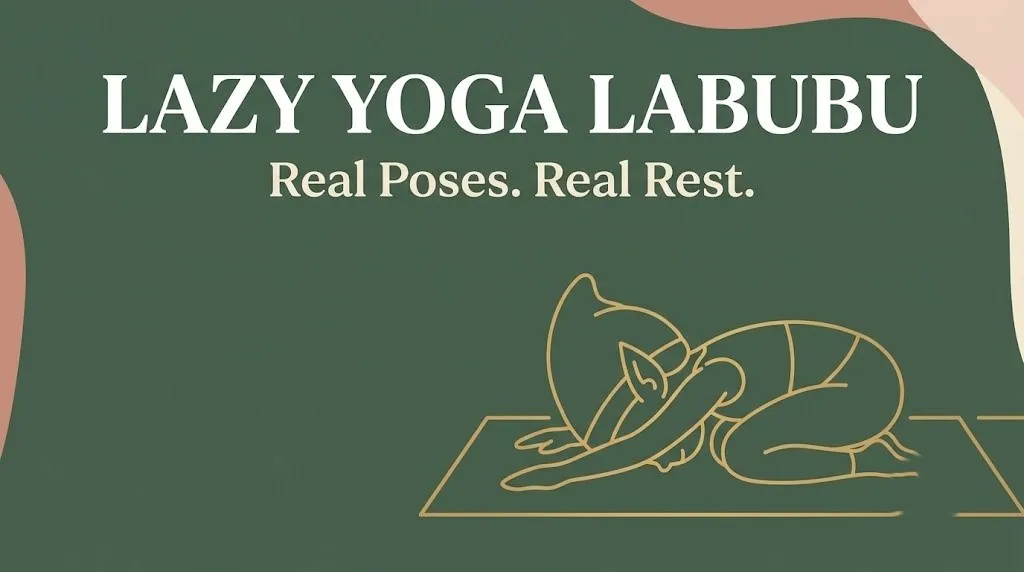
Balasana (Child’s Pose) is the most recognized lazy yoga position. Kneel on the floor, bring the big toes together, and sink the hips back toward the heels. Extend the arms forward or rest them alongside the body. Hold for 1 to 3 minutes. The erector spinae and gluteus maximus release passively while the hip external rotators open over time.
Savasana (Corpse Pose) is complete stillness on the back, arms slightly away from the body, palms facing up. This is not sleeping. The goal is conscious rest with full muscular release. Research published in the International Journal of Yoga found Savasana significantly reduces heart rate and promotes measurable relaxation responses within 10 minutes of the pose.
Viparita Karani (Legs Up the Wall) has the practitioner lying on their back with legs resting vertically against a wall. The hamstrings are passively lengthened. The lumbar spine releases. This position is associated with improved venous return and parasympathetic nervous system activation.
Ananda Balasana (Happy Baby Pose) involves lying on the back, drawing the knees toward the armpits, and gripping the outer edges of the feet. The inner groin, hip flexors, and sacroiliac stabilizers all receive a passive stretch.
Supta Matsyendrasana (Reclined Spinal Twist) has the practitioner lying on their back and dropping both knees to one side while the gaze turns opposite. The thoracic spine rotates, and the hip external rotators lengthen.
Pose Tip:
- In Child’s Pose, place a folded blanket between the thighs and calves if the hips do not reach the heels.
- In Legs Up the Wall, scoot 6 inches away from the wall if hamstrings feel sharp pulling sensations.
- In Savasana, place a rolled blanket under the knees if the lower back lifts off the floor.
Key Takeaway: The yoga poses in the Labubu collection are real, well-documented postures that target specific muscle groups and body systems. You can do all of them at home on a mat with no prior experience.
Lazy Yoga Benefits Backed by Research
Lazy yoga, understood as rest-based, passive floor yoga, produces real, measurable physiological changes that go far beyond simply feeling calmer after class.
According to the National Center for Complementary and Integrative Health, yoga practice is associated with reduced stress, improved sleep quality, lower blood pressure, and reduced symptoms of anxiety and depression across multiple clinical populations. These findings apply specifically to gentler yoga styles, including Restorative and Yin yoga approaches that match the lazy yoga framework.
A 2023 study published in Complementary Therapies in Medicine found that a regular Restorative yoga practice of two sessions per week reduced self-reported anxiety scores by 27% over eight weeks in adults with generalized anxiety. The practice used in that study closely resembles a standard lazy yoga session: floor poses, long holds, no muscular exertion.
Key documented benefits of lazy yoga practice include:
- Reduced resting cortisol levels, the primary stress hormone
- Improved sleep onset and sleep quality in people with chronic insomnia
- Reduced lower back pain intensity in people with non-specific lumbar pain
- Measurable improvements in heart rate variability, a marker of nervous system health
- Increased range of motion in the hips and thoracic spine without eccentric muscle loading
These are not soft outcomes. They are trackable, measurable changes that practitioners and researchers have documented across multiple study designs and populations.
Lazy Yoga and Stress Relief
Lazy yoga is one of the most direct physical interventions for acute and chronic stress because it activates the body’s rest-and-digest nervous system response through posture, stillness, and breath.
Stress lives in the body as muscular tension, elevated cortisol, increased heart rate, and shallow breathing. All four of those physical expressions of stress are directly addressed by passive yoga postures. The psoas muscle, often called the “stress muscle,” chronically contracts during prolonged sympathetic nervous system activation. Floor-based yoga positions that release the hip flexors and lower back directly address this pattern.
According to a review published in the Journal of Alternative and Complementary Medicine, yoga-based relaxation techniques including passive poses and breath awareness reduced self-reported stress in 85% of participants across 12 included studies. The researchers noted that passive postures produced measurable outcomes at hold times as short as 3 to 5 minutes.
The practical application is straightforward. A 10-minute lazy yoga practice after a stressful workday, holding two or three floor poses with conscious breath, produces a measurable reduction in stress markers. You do not need a full hour. Consistency over time matters more than duration per session.
Modification for high-stress states: If you feel too agitated to lie still, begin in Balasana (Child’s Pose) for 3 minutes before attempting Savasana (Corpse Pose). The slight compression in Child’s Pose activates the vagus nerve gently and helps the nervous system downshift before full stillness.
Lazy Yoga for Sleep
Lazy yoga practiced 30 to 60 minutes before bed is a research-supported method for improving sleep onset time and overall sleep quality.
The connection is physiological. Passive yoga poses trigger the parasympathetic nervous system, slow breathing, and lower core body temperature slightly as the body settles toward stillness. All three of those processes are part of the body’s natural pre-sleep preparation sequence.
A 2024 study in the International Journal of Yoga found that adults with chronic insomnia who practiced a 20-minute restorative yoga routine three nights per week fell asleep an average of 15 minutes faster than the control group after six weeks. The routine used in the study included Viparita Karani (Legs Up the Wall), Supta Baddha Konasana (Reclined Bound Angle Pose), and Savasana (Corpse Pose).
A basic lazy yoga sleep routine:
- Dim the lights and place your mat near a wall.
- Begin in Viparita Karani (Legs Up the Wall) for 5 minutes.
- Move to Supta Baddha Konasana (Reclined Bound Angle) for 3 minutes. Place a block or folded blanket under each knee if the inner groin feels sharp tension.
- Finish with Savasana (Corpse Pose) for 5 to 10 minutes.
- Breathe slowly throughout: inhale for 4 counts, exhale for 6 counts.
Avoid checking a phone between poses. The light and cognitive stimulation cancel the parasympathetic effects you are building.
Key Takeaway: Lazy yoga is not a trend. It is a scientifically grounded rest-based practice that measurably reduces cortisol, improves sleep, and helps regulate the stress response, especially when practiced consistently at 2 to 3 sessions per week.
Yoga and the Parasympathetic Nervous System
Yoga and the parasympathetic nervous system are directly connected: passive yoga poses, conscious breath, and stillness all activate the body’s rest-and-digest response, which counters the physiological effects of chronic stress.
The human nervous system operates across two primary states. The sympathetic nervous system governs the fight-or-flight response: elevated heart rate, shallow breathing, muscular tension, and heightened cortisol. The parasympathetic nervous system governs rest, digestion, tissue repair, and recovery. Most people in 2026 spend too much time in sympathetic dominance.
Yoga, particularly passive yoga styles, activates the parasympathetic system through three primary pathways. First, slow, extended exhalations stimulate the vagus nerve, which is the primary parasympathetic pathway in the body. Second, lying in supported positions signals physical safety to the brain’s threat-detection centers. Third, diaphragmatic breathing reduces blood carbon dioxide levels, which lowers heart rate and blood pressure.
According to the National Institutes of Health, yoga practice has been shown to increase heart rate variability (HRV), a key biomarker of parasympathetic dominance, in multiple controlled studies. Higher HRV is associated with better stress resilience, improved cardiovascular health, and lower overall disease risk.
This is why a lazy yoga practice of even 15 minutes can produce a noticeable shift in how you feel. It is not placebo. It is your nervous system responding to real physical input.
A Simple Lazy Yoga Sequence for Beginners
A complete beginner lazy yoga sequence takes 20 to 30 minutes and requires only a mat, one folded blanket, and access to a wall.
The Labubu-Inspired Lazy Yoga Sequence:
- Balasana (Child’s Pose): Kneel, sink hips back, extend arms forward. Hold 2 minutes. Breathe into the back body.
- Ananda Balasana (Happy Baby Pose): Roll onto the back. Bend knees, grip outer feet. Rock gently side to side. Hold 90 seconds.
- Supta Matsyendrasana (Reclined Spinal Twist) Right Side: From your back, drop both knees to the right. Left arm extends wide. Hold 90 seconds.
- Supta Matsyendrasana Left Side: Bring knees through center. Drop to the left. Hold 90 seconds.
- Viparita Karani (Legs Up the Wall): Scoot hips to the baseboard, swing legs up the wall. Hold 5 minutes.
- Savasana (Corpse Pose): Lie flat, arms at your sides, palms up. Hold 5 to 10 minutes.
Between each pose, take 3 natural breaths before moving. There is no rush. The transitions are part of the practice.
Modification for beginners: In step 5, if hamstrings feel sharp or the lower back lifts off the floor, move 6 to 8 inches away from the wall so the legs rest at an angle rather than 90 degrees.
Yoga Props for Lazy Yoga
Yoga props are not beginner training wheels. They are tools that allow the body to remain in longer holds without compensating, which makes every pose more effective.
In lazy yoga, props serve a specific purpose: they bring the floor up to the body so the body does not have to fight gravity to reach a position. A bolster under the chest in a supported backbend removes the muscular work of maintaining the shape. A folded blanket under the knees in Savasana eliminates lower back strain. A block under the hips in seated poses creates the hip elevation that allows the pelvis to tilt forward naturally.
| Prop | Primary Use in Lazy Yoga | Budget Substitute |
|---|---|---|
| Bolster | Supports chest, back, or thighs in floor poses | Rolled firm blankets, couch cushions |
| Yoga blocks (2) | Elevates hips, supports knees in reclined poses | Thick hardcover books |
| Blanket | Cushions knees, supports neck, covers body in Savasana | Any firm folded blanket |
| Yoga strap | Extends reach in forward folds without rounding the spine | Necktie, belt, bathrobe tie |
| Eye pillow | Blocks light in Savasana, gently activates vagal response | Folded face cloth |
You can practice lazy yoga with zero props. But adding even a folded blanket under the knees in Savasana changes the experience meaningfully for anyone with lower back tightness.
Key Takeaway: Props are the single biggest difference between a lazy yoga session that works and one that feels like uncomfortable floor lying. Even a folded blanket changes everything for lower back comfort.
Lazy Yoga Modifications for Limited Mobility
Lazy yoga is one of the most modifiable yoga approaches available because the base poses already emphasize support, stillness, and passive release rather than strength or range of motion.
Every pose in a lazy yoga sequence has at least one modification that reduces the range of motion required while preserving the therapeutic benefit. The goal is never the shape. The goal is the sensation of release and the nervous system response that follows.
Common modifications by condition:
- Knee pain: In Balasana (Child’s Pose), place a folded blanket between the hamstrings and calves. If full kneeling is not possible, practice a seated forward fold in a chair instead.
- Shoulder pain: In Savasana, place a thin pillow or folded blanket under the affected arm so it rests at a neutral angle rather than fully extended.
- Hip replacement: Avoid deep hip flexion past 90 degrees. In Happy Baby Pose, hold behind the thighs rather than the feet. Skip full floor twists and use a supported seated twist instead.
- Osteoporosis: Avoid full forward folds and rounding the thoracic spine under load. Focus on supported supine poses and gentle lateral stretches.
- Pregnancy (second and third trimester): Avoid lying flat on the back for extended periods. Use a wedge bolster or folded blanket to elevate the upper body in all supine poses.
A yoga teacher who has completed training in therapeutic yoga or adaptive yoga can provide individualized guidance, particularly for people managing chronic pain, post-surgical recovery, or complex health conditions.
Lazy Yoga for Lower Back Pain
Lazy yoga is particularly effective for non-specific lower back pain because the primary poses decompress the lumbar spine, release the erector spinae and quadratus lumborum, and reduce the hip flexor tightness that often contributes to lower back strain.
According to the American College of Sports Medicine, yoga is a recommended complementary intervention for chronic lower back pain, with evidence supporting improvements in pain intensity and functional mobility across multiple study populations. The key distinction is passive yoga, where the lumbar spine is supported and not loaded, which differs from active yoga styles that challenge core stability.
The most beneficial lazy yoga poses for lower back pain:
- Balasana (Child’s Pose): Lengthens the lumbar erectors passively. Add a bolster under the chest if the arms-forward position strains the shoulders.
- Supta Matsyendrasana (Reclined Spinal Twist): Releases hip external rotators and the thoracolumbar fascia. Keep both shoulders on the floor. Do not force the knees to the ground.
- Viparita Karani (Legs Up the Wall): Takes compressive load off the lumbar discs entirely. Elevate the hips on a folded blanket for added lumbar decompression.
Safety note: If lower back pain is accompanied by radiating pain down the leg, numbness, or tingling, a physical therapist or spine specialist should evaluate the cause before beginning any yoga practice. Radiating symptoms may indicate nerve involvement that changes which poses are appropriate.
Lazy Yoga for Tight Hips
Tight hips respond exceptionally well to lazy yoga because the long passive holds in floor poses target the hip flexors, hip external rotators, and inner groin through connective tissue stretching rather than muscular effort.
Think of the hip flexors like a rubber band that has been held in a shortened position all day from sitting. Pulling it sharply does not restore length. Holding a gentle sustained tension over 2 to 5 minutes does. That is exactly what passive yoga postures do.
The poses most effective for hip tightness in a lazy yoga context are Ananda Balasana (Happy Baby Pose), Supta Baddha Konasana (Reclined Bound Angle Pose), and the reclined variation of Eka Pada Raja Kapotasana (Pigeon Pose), known as Supta Kapotasana or figure-4 stretch.
| Pose | Hip Muscles Targeted | Recommended Hold |
|---|---|---|
| Ananda Balasana (Happy Baby) | Inner groin, hip flexors, SI joint | 90 seconds to 2 minutes |
| Supta Baddha Konasana (Reclined Bound Angle) | Inner groin, adductors, hip capsule | 3 to 5 minutes |
| Supta Kapotasana (Figure-4) | Piriformis, gluteus medius, hip external rotators | 2 to 3 minutes per side |
| Balasana (Child’s Pose) | Hip external rotators, gluteus maximus | 1 to 3 minutes |
Modification: In Supta Baddha Konasana, place a yoga block or folded blanket under each knee if the inner groin creates strong pulling sensations. The goal is a mild, fading sensation, not sharp tightness.
Key Takeaway: For hip tightness, passive holds of 2 to 5 minutes beat brief active stretches every time. The connective tissue surrounding the hip joint requires sustained gentle load, not short sharp pulls.
Restorative Yoga vs Yin Yoga vs Lazy Yoga
These three styles share a rest-forward philosophy but differ in intention, technique, tissue target, and hold duration in ways that genuinely matter for choosing the right practice.
Restorative yoga is a fully supported passive practice developed in the tradition of B.K.S. Iyengar and taught widely by yoga teacher Judith Hanson Lasater. Props support every pose completely. The goal is zero muscular effort. Sessions typically include 4 to 6 poses held for 5 to 20 minutes each. The primary therapeutic target is the nervous system.
Yin yoga is a passive practice that targets fascia and connective tissue in the deeper joint structures, particularly in the hips and spine. Holds range from 3 to 7 minutes. Some mild discomfort is expected and considered part of the process. Yin yoga is not fully supported, so there is some passive muscular loading during holds.
Lazy yoga is an informal, culturally accessible framing of rest-based yoga with no formal style boundaries. It borrows from both Restorative and Yin yoga, typically uses shorter holds (1 to 5 minutes), and prioritizes accessibility over precision.
| Feature | Restorative Yoga | Yin Yoga | Lazy Yoga |
|---|---|---|---|
| Props required | Yes, extensively | Minimal to moderate | Optional |
| Hold duration | 5 to 20 minutes | 3 to 7 minutes | 1 to 5 minutes |
| Primary tissue target | Nervous system | Fascia and joints | Nervous system and muscles |
| Discomfort expected | No | Mild yes | No |
| Formal lineage | Iyengar tradition | Paul Grilley, Sarah Powers | No formal lineage |
| Best for | Acute stress, illness recovery | Hip and spine mobility | Beginners, daily practice |
Yoga Nidra and Lazy Yoga
Yoga nidra is a systematic guided meditation done in Savasana (Corpse Pose) that leads the practitioner into a hypnagogic state between waking and sleep, and it pairs naturally with a lazy yoga practice as a closing or standalone component.
Unlike the physical floor poses of lazy yoga, yoga nidra is entirely still and entirely guided. A facilitator or audio recording moves the practitioner through body scan awareness, breath observation, and visualization stages. The practice targets the delta brainwave state, associated with deep rest and tissue repair, while the practitioner remains conscious.
According to research published in the International Journal of Yoga, yoga nidra practice of 30 to 45 minutes produces rest equivalent to 2 to 4 hours of conventional sleep in experienced practitioners. While beginners may simply fall asleep during the practice initially, regular practice builds the capacity to rest deeply while remaining aware.
Adding 10 to 15 minutes of yoga nidra after a lazy yoga pose sequence is a common recommendation among Restorative yoga teachers. The physical practice prepares the nervous system, and the nidra deepens the rest response.
Modification: If guided audio is unavailable, a simple body scan performed alone in Savasana achieves a similar, if less structured, effect. Start at the feet and move attention slowly upward through the body, spending 3 to 5 breath cycles on each area.
Lazy Yoga Breathing Techniques
Breath is not an afterthought in lazy yoga. It is the primary tool that determines whether a session activates the parasympathetic nervous system or stays in a neutral resting state.
The most effective breathing approach for lazy yoga is diaphragmatic breathing, sometimes called belly breathing. The diaphragm descends on inhale, the belly expands visibly, and on exhale the belly draws gently back. Shallow chest breathing, which most people default to, keeps the body in a mild stress-alert state even during otherwise relaxed positions.
A 4-6 breathing pattern (inhale for 4 counts, exhale for 6 counts) is the most research-supported breath ratio for parasympathetic activation. The extended exhale stimulates the vagus nerve directly and slows the heart rate measurably within 3 to 5 breath cycles. The Journal of Alternative and Complementary Medicine has documented this effect across multiple trials.
Three breath techniques suited to lazy yoga:
- Diaphragmatic breathing: Natural breath expanded into the belly. Used throughout the entire practice.
- 4-6 ratio breathing: Inhale 4 counts, exhale 6 counts. Use during held poses to deepen the parasympathetic response.
- Box breathing (4-4-4-4): Inhale 4 counts, hold 4 counts, exhale 4 counts, hold 4 counts. Use at the start of practice to shift out of a stressed state before beginning poses.
Avoid forcing the breath to be loud, dramatic, or strained. In lazy yoga, breath should feel effortless. If it does not, you are either in too deep a position or moving too quickly between poses.
Key Takeaway: Extending the exhale longer than the inhale is the single most accessible nervous system reset in yoga. You can do it anywhere, in any pose, at any experience level.
Frequently Asked Questions About Lazy Yoga Labubu
What yoga poses does the Labubu lazy yoga collection show?
The Labubu lazy yoga collection features figures posed in Balasana (Child’s Pose), Savasana (Corpse Pose), Viparita Karani (Legs Up the Wall), Ananda Balasana (Happy Baby Pose), and Supta Matsyendrasana (Reclined Spinal Twist).
These are all real yoga postures taught in Restorative and Yin yoga classes worldwide.
Each pose targets specific muscle groups: from the erector spinae in Child’s Pose to the hip external rotators in the Reclined Spinal Twist.
Is lazy yoga actually good exercise?
Lazy yoga does not build cardiovascular fitness or muscular strength the way active yoga or gym training does.
It does produce real, measurable physiological changes: lower cortisol, improved heart rate variability, reduced muscle tension, and better sleep quality.
Think of lazy yoga as maintenance and recovery work rather than conditioning, which makes it valuable as a complement to any active exercise routine.
How long should you hold poses in lazy yoga?
Most lazy yoga poses are held for 1 to 5 minutes, with Restorative-style variations extending to 10 or even 20 minutes with full prop support.
Yoga Alliance and most Restorative yoga teachers recommend beginners start with 1 to 2 minute holds and extend gradually as body awareness develops.
The nervous system response, which is the primary benefit of lazy yoga, typically begins after 90 seconds of sustained stillness in a supported position.
Can beginners do lazy yoga with no experience?
Yes. Lazy yoga is one of the most appropriate entry points for absolute beginners because it requires no strength, balance, or prior body awareness.
All poses are performed on the floor, and every pose has straightforward modifications for different body sizes, mobility levels, and physical conditions.
Start with Savasana (Corpse Pose) for 5 minutes and Child’s Pose for 2 minutes. That alone is a complete beginner session.
What is the difference between lazy yoga and restorative yoga?
Restorative yoga is a formally structured practice with specific prop setups and hold durations, rooted in the Iyengar yoga tradition and systematized by Judith Hanson Lasater.
Lazy yoga is an informal term for rest-based floor yoga that borrows from Restorative and Yin yoga without requiring formal training, specific props, or studio attendance.
Both activate the parasympathetic nervous system and share most of the same poses. The difference is structure and depth, not therapeutic value.
Start with one pose today. Child’s Pose for two minutes, eyes closed, slow breath. That is a complete lazy yoga practice. The Labubu collection put beautiful, playful images on these poses, but the poses themselves have been working for people for decades.
Build from there. Add Legs Up the Wall before sleep. Try the full six-pose sequence on a weekend morning. Keep a folded blanket nearby and use it under your knees every single time.
Rest is not the absence of work. In lazy yoga, it is the entire point.