Best Yoga Mat Bag: Types, Features & Top Picks 2026
A good yoga mat bag makes every practice easier, whether you are commuting to a studio or rolling out your mat at home. The right bag carries your mat comfortably, fits your gear, and supports your body without adding strain to your shoulders or back.
Yoga practice in 2026 looks very different than it did a decade ago. More people practice in multiple settings: studios, gyms, parks, and home spaces. The National Center for Complementary and Integrative Health reports that yoga participation in the United States has grown steadily, with tens of millions of practitioners now maintaining regular routines. That means more people carrying mats more often, and more need for gear that actually works.
This guide covers every major yoga mat bag type, from simple sling carriers to full-featured backpacks. You will learn how to match your bag to your mat size, your body, your practice style, and your travel habits.
What Is a Yoga Mat Bag and Do You Actually Need One?
A yoga mat bag is any carrying solution designed specifically to hold, protect, and transport a rolled yoga mat. That definition is simple, but the category covers everything from a single fabric tube with a drawstring to a structured backpack with padded compartments and ventilated pockets.
Do you need one? If you ever leave your home with a mat, yes. Carrying a mat under your arm for more than a few minutes creates real physical consequences. The trapezius and levator scapulae muscles on one side of your neck and upper back absorb the weight unevenly. Over time, that asymmetry contributes to muscle tension, postural imbalance, and neck discomfort.
The American Physical Therapy Association notes that asymmetric load carrying, meaning weight held on one side of the body, is a consistent contributor to upper back and neck strain. A bag with a cross-body strap or a two-strap backpack distributes that load far more evenly.
Beyond ergonomics, a yoga mat bag protects your mat from dirt, moisture, and UV damage. A clean mat lasts longer. Most quality mats cost between $60 and $150, so protecting that investment with a $20 to $40 bag is a straightforward decision.
Quick Summary:
- A yoga mat bag reduces the asymmetric shoulder and neck strain caused by carrying a mat freehand
- It protects the mat surface from dirt, sweat, and sun exposure
- Options range from minimalist tube carriers to full-featured backpacks
What Makes a Good Yoga Bag?
A good yoga bag holds your mat securely, fits your other essentials, and distributes its weight without pulling on one shoulder or neck. Those three things are not as simple as they sound, and most bags only get one or two of them right.
Weight distribution comes first. The cervical spine and rotator cuff take significant stress when a heavy mat hangs off one shoulder. A bag with a wide, padded shoulder strap spreads that load across a larger surface area. Two-strap backpack designs spread it across both shoulders and transfer some weight to the hips, which is the most ergonomically sound option for heavier mats.
Material matters for durability and hygiene. Nylon and polyester resist moisture and clean easily. Canvas breathes better but absorbs sweat. Bags with a dedicated wet compartment, sometimes called a sweat pocket or wet pocket, let you separate your post-practice mat from dry clothing without transferring moisture.
Closure type affects both security and convenience. Open-ended sling carriers are fast and lightweight but offer no weather protection. Drawstring closures are simple but can loosen during transit. Zippered openings provide the most security and are the best choice for commuters and travelers.
| Feature | Why It Matters | Best For |
|---|---|---|
| Wide padded shoulder strap | Reduces shoulder and neck strain | Daily commuters |
| Two-strap backpack design | Bilateral load distribution | Heavy mats, long distances |
| Zippered main compartment | Secure closure, weather protection | Travelers, urban commuters |
| Wet/dry compartment | Separates sweaty gear from dry items | Hot yoga, outdoor practice |
| Mesh side pockets | Quick-access water bottle storage | Studio practitioners |
| Adjustable straps | Fits different body heights and widths | All body types, seniors |
Yoga Mat Carriers: What Are Your Options?
Yoga mat carriers fall into two broad categories: dedicated mat-only carriers and multi-use bags that carry both a mat and your gear. Knowing which category fits your practice is the most important first decision you will make.
Dedicated mat carriers, including slings, tubes, and open-ended sleeves, are designed for the mat alone. They are lightweight, compact, and easy to grab on the way out the door. They work well for practitioners who travel light: mat, water bottle, maybe a towel, and that is it.
Multi-use bags carry the mat plus everything else: a change of clothes, shoes, toiletries, a yoga strap, blocks, or a laptop for practitioners who go straight from studio to work. These bags are bulkier and heavier empty, but they eliminate the need for a second bag.
According to a 2022 report from Yoga Alliance on practitioner habits, the majority of regular studio practitioners carry at least three to five non-mat items to class. That finding supports the case for a multi-use bag for anyone with a studio routine.
Carrier style also affects how the mat travels. An open-ended carrier leaves the mat ends exposed, which is fine for indoor transit but problematic in rain or dusty outdoor environments. A closed carrier or a bag with a full enclosure keeps the mat protected in all conditions.
| Carrier Type | Weight | Mat Protection | Extra Storage | Best Use Case |
|---|---|---|---|---|
| Open-ended sling | Lightest | Minimal | None | Short walks to studio |
| Drawstring tube | Light | Moderate | None | Studio-only practitioners |
| Tote bag with mat pocket | Moderate | Good | Yes | Studio to errands |
| Backpack with mat attachment | Heaviest | Excellent | Yes | Commuters, travelers |
| Duffel with mat compartment | Moderate-heavy | Good | Yes | Gym + studio combo |
Key Takeaway: Matching your bag type to how much you carry and how far you travel is the single most useful thing you can do before buying a yoga bag. No one bag style is best for everyone.
Types of Yoga Bags: A Complete Style Breakdown
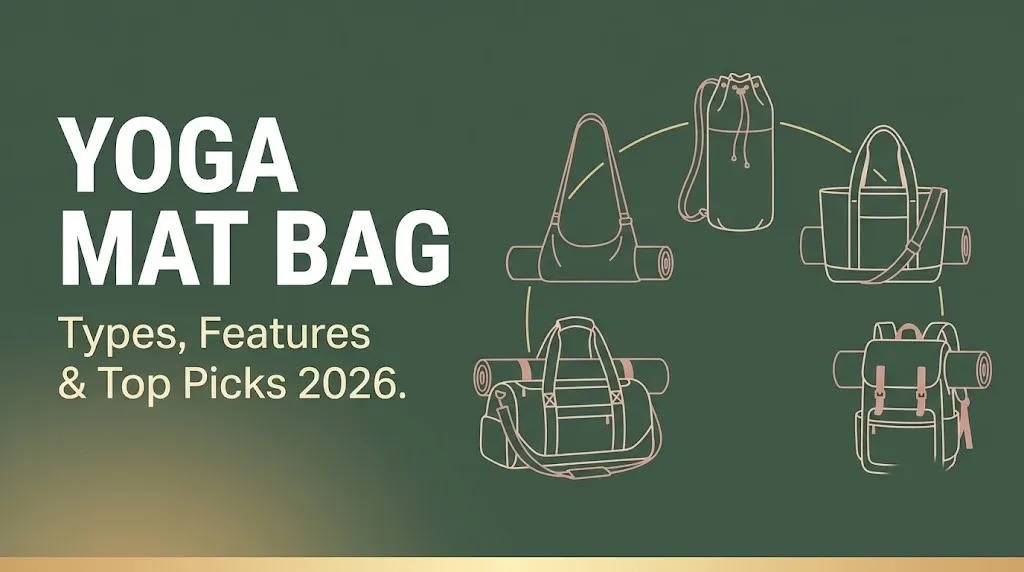
There are five main types of yoga bags in regular use today: sling carriers, drawstring bags, tote bags, duffel bags, and backpacks. Each has a different design logic, and each suits a different kind of practitioner.
Sling carriers are the most minimal option. They are a fabric sleeve with an adjustable strap. They hold the mat and nothing else. Fast to use, light to wear. Not ideal for anyone carrying more than a mat and a key.
Drawstring bags are slightly more enclosed. They wrap around the mat and cinch closed at the top. Some have a small external pocket for a phone or card. They work well for practitioners who want a clean, simple look.
Tote bags with a mat sleeve or external strap attachment are popular for studio practitioners who run errands before or after class. The mat attaches to the outside or slides into a long internal sleeve, while the main compartment holds clothing, toiletries, and accessories.
Duffel bags with a dedicated mat compartment are the go-to for practitioners who also go to the gym. They hold a full change of clothes, shoes, and multiple accessories alongside the mat. They are heavier but highly functional.
Backpacks with mat storage are the most ergonomically sound option for long carries. The mat attaches externally, usually through top and bottom loops, while the main bag holds everything else. Two shoulder straps distribute weight evenly across both sides of the body.
| Bag Type | Mat Access | Extra Storage | Ergonomics | Best Practice Type |
|---|---|---|---|---|
| Sling/carrier | Instant | None | One-shoulder | Studio only |
| Drawstring | Easy | Minimal | One-shoulder | Light carriers |
| Tote with mat slot | Moderate | Medium | One-shoulder | Studio + errands |
| Duffel | Requires unzipping | Large | Carried in hand or one shoulder | Gym + yoga combo |
| Backpack | Requires clipping | Very large | Two-shoulder, most ergonomic | Commuters, travelers |
Yoga Sling Bag: Lightweight Carrying Made Simple
A yoga sling bag is a single-strap carrier that holds a rolled mat over one shoulder or across the body. It is the lightest, fastest, and most minimalist yoga mat carrying solution available.
The cross-body version, where the strap runs diagonally from shoulder to opposite hip, is better for your thoracic spine and shoulder than a straight one-shoulder hang. The diagonal distribution shifts some weight toward the core rather than concentrating it entirely on one trapezius muscle.
Most sling bags are made from nylon or polyester webbing with a simple adjustable buckle. The mat slides into an open sleeve or sits in a ring carrier. They typically weigh under four ounces, which is meaningfully lighter than any other bag option.
The limitation is obvious: sling bags carry nothing else. If you arrive at class needing your water bottle, phone, and a change of clothes, you will need a second bag. That makes them practical only for practitioners who travel genuinely light, or who leave belongings in a car or locker.
Modification note: Practitioners with rotator cuff injuries, shoulder impingement, or chronic neck tension should use cross-body sling styles rather than one-shoulder hangs. The cross-body angle reduces the elevation and forward pull on the shoulder joint. If shoulder pain is ongoing, a two-strap backpack is the safer long-term choice, and consulting a physical therapist about load distribution is worth doing.
To use a yoga sling bag comfortably:
- Roll your mat tightly and secure it before sliding it into the carrier
- Adjust the strap length so the mat sits at hip level, not lower
- Position the strap diagonally across the chest for cross-body styles
- Switch carrying sides every ten to fifteen minutes on longer walks
- Remove the bag from your shoulder while waiting to reduce static shoulder load
Yoga Duffle Bag: For Practitioners Who Carry More
A yoga duffel bag is a larger, cylindrical or rectangular soft bag that carries both a yoga mat and full practice gear in a single bag. It is the best option for practitioners who transition from yoga to the gym, office, or travel without going home in between.
Most yoga duffel bags position the mat in one of two ways: a dedicated external sleeve that keeps the mat separate from clothing, or a removable mat sling attached to the outside of the bag. Both approaches keep the mat accessible without unpacking the main compartment.
The Journal of Bodywork and Movement Therapies has noted that carrying a heavy bag in one hand places asymmetric compressive load on the lumbar spine and one side of the pelvis. Duffel bags are typically hand-carried, which means practitioners carrying heavy loads should look for duffel designs with a padded shoulder strap option and switch sides regularly.
Duffle bags range from small, around 20 liters, to large, exceeding 40 liters. A 25 to 30 liter duffel comfortably fits a standard yoga mat plus a change of clothes, shoes, toiletries, and a water bottle. Larger versions accommodate extra props like a yoga strap, blocks, or a foam roller.
Look for a duffel with a wet/dry compartment. Separating sweaty gear from dry clothing matters, especially after a hot yoga or Vinyasa class where the mat surface holds significant moisture.
Key features to prioritize in a yoga duffel bag:
- External mat sleeve or attachment point keeps the mat separate from clothing
- Padded shoulder strap option for hands-free carrying
- Wet pocket with zipper for post-practice mat or wet gear
- Ventilated side panels to reduce odor buildup
- Hard base or structured bottom to keep the bag upright
Yoga Backpacks: Hands-Free and Spine-Friendly
A yoga backpack is the most ergonomically sound way to carry a heavy mat and full gear load. By distributing weight across both shoulders and, in some designs, the hips, it reduces the unilateral strain that one-shoulder bags place on the upper back and neck.
The American College of Sports Medicine recommends that carried load not exceed 10 to 15 percent of body weight when carrying for extended periods. A standard yoga mat weighs roughly two to three pounds. A full yoga gear load, including mat, clothes, water, props, and accessories, can reach eight to twelve pounds. A backpack that fits properly and has a hip belt transfers meaningful weight off the shoulders entirely.
Not all yoga backpacks are equal. Look for a design with external mat attachment loops, positioned at the top and bottom of the pack, so the mat rides upright against the back panel rather than hanging off one side. This keeps the center of gravity close to your spine.
A backpack is particularly well-suited for:
- Daily commuters who walk or cycle to the studio
- Practitioners who go directly from work or school to class
- Anyone with a mat heavier than three pounds
- People managing or recovering from shoulder discomfort
Modification note: Practitioners with lumbar spine sensitivity or low back pain should look for backpacks with a padded hip belt. Shifting load to the hips takes significant pressure off the lower back during long carries. A physical therapist can advise on the best carrying configuration for specific conditions.
Key Takeaway: If you regularly carry more than your mat and a water bottle, a backpack with two shoulder straps is the most body-friendly option. It distributes load bilaterally and keeps your spine more neutral during the commute.
Best Yoga Mat Backpack: What to Look for in 2026
The best yoga mat backpack in 2026 combines ergonomic carry design, durable weather-resistant materials, and enough compartment organization to replace both your gym bag and your everyday carry bag. That is a high bar, but several designs currently meet it.
The key structural feature is external mat attachment. The mat should clip or loop to the outside of the bag, not sit inside it. Inserting a full-size mat inside a backpack compresses the mat foam, wastes compartment space, and makes the bag nearly impossible to pack efficiently.
Look for a backpack with:
- Padded shoulder straps at least two inches wide
- A sternum strap to prevent the shoulder straps from sliding outward
- A hip belt for loads exceeding ten pounds
- At least two zippered compartments plus one quick-access outer pocket
- A side water bottle pocket that is accessible without removing the bag
- A dedicated laptop or tablet sleeve if you go straight from class to work
- Water-resistant nylon or coated polyester exterior
In 2026, several brands produce yoga-specific backpacks with ventilated back panels that reduce sweat buildup against your shirt during warm-weather carries. That feature is worth seeking out if you live in a warm climate or often walk significant distances.
| Feature | Standard Bag | Quality Yoga Backpack |
|---|---|---|
| Shoulder strap width | Narrow, under 1 inch | Wide, padded, 2+ inches |
| Mat attachment | Internal only | External loops top and bottom |
| Hip belt | Absent | Adjustable, padded |
| Wet compartment | None | Dedicated, zippered |
| Back panel | Flat | Ventilated or cushioned |
| Laptop sleeve | Rare | Common in commuter models |
Yoga Mat Bag with Pockets: Why Features Matter
A yoga mat bag with pockets is more than a convenience upgrade. For practitioners who carry props, accessories, a phone, keys, and a water bottle, dedicated pockets are the difference between an organized practice and a frustrating one.
The pocket configuration that matters most depends on your routine. Studio practitioners prioritize a quick-access outer pocket for their phone and key card. Commuters want a padded laptop sleeve and a water bottle holder. Hot yoga practitioners need a sealed wet pocket to quarantine a soaked mat after class.
Here is what each pocket type actually does:
- Quick-access outer pocket: Phone, key fob, transit card, no digging through the main compartment
- Side mesh pocket: Water bottle or thermos, accessible one-handed while walking
- Wet/dry zipped compartment: Separates wet mat or sweaty gear from dry clothing and electronics
- Padded internal sleeve: Laptop or tablet for practitioners who transition to work
- Internal zip pocket: Cards, cash, or small valuables kept separate from larger items
- Key clip hook: Prevents keys from sinking to the bottom of the main compartment
According to Yoga Alliance practitioner surveys, the most consistently requested gear feature among regular studio practitioners is a dedicated, sealed compartment for post-practice wet gear. This is especially relevant for hot yoga and power Vinyasa practitioners where the mat surface absorbs substantial sweat during class.
One practical note: bags with too many pockets become heavy before you pack anything in them. Prioritize two to three pockets that match your actual routine over ten pockets you will never use. Simplicity has weight advantages as well as organizational ones.
What Size Yoga Mat Bag Do You Need?
The size of your yoga mat bag depends on three factors: the diameter of your rolled mat, the length of your mat, and how much additional gear you plan to carry alongside it.
Standard yoga mats are 68 inches (173 cm) long and roll to approximately four to five inches (10 to 13 cm) in diameter. Most yoga mat bags are designed around these dimensions. If your mat is longer or thicker than standard, you need to check bag specifications carefully.
Mat dimensions and bag fit by type:
| Mat Type | Rolled Diameter | Rolled Length | Recommended Bag Interior |
|---|---|---|---|
| Standard 4mm mat | 4 to 4.5 inches | 68 to 72 inches | 68-inch carrier minimum |
| Thick 6mm mat | 5 to 6 inches | 68 to 72 inches | Wide-mouth or open-ended bag |
| Extra-thick 8mm mat | 6 to 7 inches | 68 to 72 inches | Open-ended sling or large duffel |
| Travel mat 1.5mm | 2 to 3 inches | 68 to 72 inches | Any standard bag with room to spare |
| Extra-long mat (84 inches) | 4 to 5 inches | 84 inches | 84-inch carrier required |
| Extra-wide mat (26 inches wide) | 5 to 6 inches | 68 to 72 inches | Open-ended or wide-mouth bag |
Always measure your rolled mat before purchasing a bag. Most manufacturers list interior dimensions or mat compatibility ranges in their product specifications. A bag that is half an inch too narrow makes rolling and unrolling the mat frustrating every single session.
If you plan to carry gear alongside the mat, size up. A 30-liter backpack holds a standard mat plus a full change of clothes, shoes, and accessories. A 20-liter bag fits a mat and light extras only.
Key Takeaway: Measure your rolled mat before buying any bag. A mat that is 6mm thick or extra-long will not fit a standard carrier, and discovering that at the studio entrance is not a good experience.
Yoga Mat Travel Bag: Carrying Your Practice Anywhere
A yoga mat travel bag is designed to transport a yoga mat safely across longer distances, including flights, road trips, and extended stays away from home. It does this through reinforced construction, secure closures, and often, compliance with airline carry-on or checked bag dimensions.
Most standard rolled yoga mats are too long to fit in an overhead bin as a traditional carry-on. A 68-inch mat in a carrier is approximately six feet long. Airlines generally allow these as an additional sports equipment item, not a standard carry-on bag. Policies vary by airline, so checking specific rules before travel is practical planning.
A travel yoga mat bag should have:
- Full-zip or drawstring closure to protect the mat from airport handling
- Reinforced carrying handles for overhead bin loading
- A durable, abrasion-resistant exterior material
- Clear labeling or ID window if checking the bag separately
- Optional: compression straps to reduce rolling during transport
Practitioners who travel frequently often choose a travel yoga mat (1.5mm to 2mm thickness) specifically because it packs into a smaller bag, fits inside a standard carry-on, and weighs under two pounds. The trade-off is cushioning. A 1.5mm travel mat provides far less joint cushioning than a 4mm or 6mm studio mat, which matters for practitioners with sensitive knees or wrists.
Modification note: If you practice on hard surfaces while traveling, such as hotel room carpet over concrete, bring a folded blanket or request extra towels from the hotel to layer under your travel mat. This partially compensates for reduced mat thickness without adding luggage weight.
The International Journal of Yoga has noted that maintaining a consistent practice while traveling correlates with lower stress levels and better sleep during travel periods. A dedicated travel bag makes that consistency practically possible.
Yoga Mat Bag for Thick Mats: Size and Weight Considerations
A thick yoga mat creates two carrying challenges: it rolls to a larger diameter, and it weighs more. Both factors affect which bag style works and which does not.
Thick mats, typically 6mm to 8mm, are common among:
- Beginners who want more joint cushioning
- Practitioners managing knee or wrist sensitivity
- People practicing restorative yoga or gentle Hatha on hard floors
- Seniors who need additional support under bony prominences like knees and hips
A 6mm mat rolled to its natural diameter is roughly five to six inches wide. That exceeds the opening of most drawstring tube carriers, which are sized for standard 4mm mats. Open-ended sling carriers or large-mouth backpacks are better options for thick mats.
Weight is the second consideration. A standard 4mm PVC mat weighs approximately two to three pounds. A thick 6mm mat in natural rubber or TPE can weigh four to six pounds. A 6mm Manduka PRO mat, one of the most popular thick mats available, weighs approximately seven pounds. That is a meaningful load difference.
For heavy mats:
- Use a backpack with a hip belt to shift weight off the shoulders
- Avoid long single-shoulder carries, which place the full load on one rotator cuff
- Look for bags with reinforced mat attachment loops that hold heavy weight without stretching
- Consider whether a lighter travel mat might serve better for commuting while keeping the thick mat at home
According to the American Physical Therapy Association, carrying loads exceeding 10 to 15 percent of body weight on a single shoulder increases the risk of upper back and neck strain. A seven-pound mat represents a relevant load for smaller-framed practitioners.
Yoga Mat Bag for Seniors: Comfort, Ease, and Reduced Strain
A yoga mat bag for seniors should prioritize ease of use, light weight, and ergonomic carrying design above all other features. Strength and joint changes that come with age make carrying strategies more consequential.
Seniors practicing yoga, which the International Journal of Yoga has documented as beneficial for balance, bone density maintenance, and fall prevention in older adults, often use thicker mats and additional props. That increases the total carry weight. The bag needs to accommodate this reality without adding unnecessary strain.
Key features for seniors:
- Wide, padded shoulder straps with non-slip grip lining
- Two-strap backpack design to distribute load bilaterally
- Lightweight bag construction (empty bag under 1.5 pounds)
- Simple closures: magnetic snaps or wide-mouth zippers rather than complicated buckles
- External mat attachment so the bag can be packed without lifting the mat overhead
- Carry handles positioned for easy lifting from a table or car seat
Rolling carts or wheeled bags are a genuinely practical option for seniors carrying heavier loads. A compact wheeled carry-on with an external mat strap eliminates shoulder and back load entirely. This is not a compromise. It is the smartest possible choice for a practitioner who prioritizes getting to class without arriving already tired.
Modification note: Seniors with osteoporosis, balance concerns, or a history of falls should avoid bag designs that attach to the back at height, since these can alter their center of gravity during walking. A bag worn at hip level or a wheeled option is safer for practitioners managing these conditions. A physician or occupational therapist can advise on the right approach for individual mobility situations.
Key Takeaway: For seniors, a two-strap backpack with a hip belt or a wheeled bag option is not a downgrade. It is the most practical, body-protective choice for carrying a heavy mat over any meaningful distance.
Yoga Mat Bag for Beginners: Keep It Simple to Start
A yoga mat bag for beginners does not need to be expensive or feature-rich. It needs to hold the mat, carry comfortably, and stay out of the way so the focus stays on learning to practice.
Beginners often do not yet know what they prefer to carry. They may not have props yet. They might not know whether they will practice at a studio or at home primarily. Spending $80 on a full-featured backpack before establishing a routine can mean buying the wrong thing.
The practical starting point is a drawstring tube carrier or a simple sling. Both cost between $15 and $35, hold a standard mat, and work for any studio or home practice. Once a practitioner has established a routine and knows what extra gear they actually use, they can upgrade to a more featured bag.
What beginners should look for:
- Compatibility with standard 4mm or 5mm mats
- Simple closure system that takes under five seconds to open and close
- At least one small pocket for a phone, key, and a card
- Lightweight fabric that does not add unnecessary heft
- Machine-washable construction for easy cleaning
The one feature beginners often underestimate is adjustability. A shoulder strap that does not adjust properly will sit at the wrong angle, causing the mat to swing during walking. An adjustable strap that locks at the right length makes a bigger practical difference than any advanced feature.
No need to buy a matching set or coordinate with practice gear. A functional, clean bag beats an expensive, complicated one for someone who is still building the habit of getting to class.
Yoga Gear Bag: When You Carry More Than Just Your Mat
A yoga gear bag is any multi-compartment bag designed to carry a full set of yoga equipment alongside the mat. This goes beyond a simple carrier and into the territory of a dedicated studio bag for the serious or frequent practitioner.
Regular practitioners who carry blocks, a strap, a bolster or folded blanket, a hand towel, grip socks, a water bottle, and a change of clothes are carrying a meaningful volume of equipment. A standard mat carrier handles none of it. A yoga gear bag is built for exactly this load.
Key differences between a yoga gear bag and a general gym bag:
| Feature | General Gym Bag | Yoga Gear Bag |
|---|---|---|
| Mat accommodation | Often absent | Dedicated sleeve or external loops |
| Interior organization | Minimal | Multiple compartments for props |
| Wet compartment | Uncommon | Standard in quality designs |
| Material texture | Varies | Often non-slip or mat-friendly lining |
| Ventilation | Basic | Enhanced for sweaty gear |
| Prop pockets | None | Designed for blocks, straps, bolsters |
The most useful yoga gear bags in 2026 have a dedicated block pocket, which is a structured, padded pocket sized for a standard foam yoga block (approximately 9 x 6 x 4 inches). Foam blocks are awkward to pack. A dedicated slot keeps them from crushing other items.
Practitioners who bring a bolster to class face the biggest gear challenge. A standard bolster is 24 inches long and eight inches in diameter. Very few commercial bags accommodate a bolster without a separate carry strategy. A large wheeled bag or a dedicated bolster strap handles this item separately from the main yoga gear bag.
How to Carry a Yoga Mat Without a Bag
Carrying a yoga mat without a bag is practical for very short distances, but there are right and wrong ways to do it that affect your posture and shoulder health. The simplest method is a mat strap, which is not a bag but is a significant improvement over bare-armed carrying.
A yoga mat strap is a single adjustable nylon or cotton webbing strap that cinches around the rolled mat and creates a shoulder loop. Most strap systems cost $5 to $15. They hold the mat securely, allow cross-body wearing, and weigh almost nothing. For a practitioner walking one block to a studio, this is a perfectly reasonable carrying solution.
The biomechanical concern with any mat strap is the same as with a sling bag: single-side carrying. The levator scapulae and upper trapezius on the carrying side elevate slightly to hold the mat’s weight. Over repeated sessions, that sustained elevation pattern can contribute to muscle shortening and tension on that side.
To carry a mat without a bag or strap:
- Roll the mat tightly from one end to minimize diameter
- Secure the roll with a rubber band or hair tie if the mat does not hold its shape
- Hold the mat under your non-dominant arm, pressed against your ribs
- Keep your carrying shoulder relaxed, not shrugged upward
- Switch sides every few minutes on walks longer than five minutes
- Avoid hanging the mat from one raised arm for extended periods
Modification note: If you find yourself carrying a mat without a bag regularly, even a basic drawstring carrier is worth the small investment. The American Physical Therapy Association consistently notes that sustained asymmetric posture is a preventable contributor to upper back and neck strain. A bag solves the problem entirely.
Key Takeaway: A yoga mat strap is the lightest and cheapest carrying alternative to a bag. It is a reasonable short-term solution but not the best long-term option for practitioners who walk more than a few minutes to class.
Frequently Asked Questions About Yoga Mat Bags
What size yoga mat bag do I need for a standard mat?
A standard yoga mat measures 68 inches long and rolls to four to five inches in diameter.
Any bag labeled for standard mats will fit these dimensions, but always confirm the listed interior bag length is at least 68 inches.
If your mat is extra-long (72 to 84 inches) or extra-thick (6mm or more), measure the rolled mat before buying and compare it to the bag’s stated interior dimensions.
Can I bring a yoga mat bag on a plane as a carry-on?
Most yoga mats in a carrier are six feet long and do not fit within standard overhead bin dimensions.
Airlines typically classify a yoga mat as a sporting equipment item rather than a carry-on bag, and policies on whether it counts toward your item allowance vary by carrier.
Checking your specific airline’s policy before travel is the practical step; some airlines allow it as a personal item, others require gate checking.
What is the difference between a yoga sling bag and a yoga backpack?
A yoga sling bag carries the mat over one shoulder using a single adjustable strap with minimal or no additional storage.
A yoga backpack uses two shoulder straps, distributes weight bilaterally across both shoulders, and typically includes multiple compartments for full gear.
The backpack is more ergonomically sound for heavy mats or long carries; the sling is faster and lighter for short, gear-light trips.
Are yoga mat bags one-size-fits-all?
No, yoga mat bags are not one-size-fits-all, though many are designed around the standard 68-inch, 4mm mat.
Extra-long mats, extra-thick mats, and extra-wide mats all require bags with larger or more adjustable dimensions.
Always check bag specifications against your mat’s rolled dimensions before purchasing.
What should I look for in a yoga mat bag if I have a shoulder injury?
A two-strap yoga backpack is the best option for anyone managing a shoulder injury, since it avoids placing the full mat load on one shoulder joint.
Look for a bag with a padded hip belt, which shifts some of the weight off the shoulders entirely.
If a backpack is not practical, a cross-body sling worn diagonally reduces shoulder elevation compared to a straight one-shoulder hang, but a physical therapist can advise you on the safest specific carry configuration for your injury.
Carrying Your Practice Well Matters as Much as the Practice Itself
The bag you choose is not separate from your yoga practice. It is part of the infrastructure that makes consistent practice possible. A bag that strains your shoulder or fails to fit your mat creates friction between you and your mat. That friction adds up.
Start with what you actually need: know your mat’s rolled dimensions, know how far you typically carry it, and know what else you bring to class. From there, the right bag style becomes obvious. A backpack for the commuter. A sling for the minimalist. A gear bag for the well-equipped regular.
Get that right, and the mat gets to the floor more often. That is the whole point.