Yoga Chair Guide: Best Picks, Poses & Safety 2026
A yoga chair is any chair specifically chosen or designed to support yoga poses, seated meditation, or chair-based yoga sequences. Choosing the right one is not complicated, but getting it wrong creates real problems: instability during poses, inadequate seat height, and restricted movement that defeats the purpose of the practice.
Chair yoga has moved well beyond senior centers and physical therapy clinics. According to the National Center for Complementary and Integrative Health (NCCIH), yoga is among the most practiced complementary health approaches in the United States, and accessible, seated adaptations are a growing part of that picture for people of all ages and abilities.
This guide covers everything that matters: how to choose the right chair, how the different types compare, which poses to start with, what the research says about benefits, and how to practice safely at home. No fluff. Just what you actually need.
What Is a Yoga Chair?
A yoga chair is any stable, armless or lightly structured chair used to support, modify, or extend yoga poses beyond what the floor allows. The term covers four distinct categories: the standard chair used in chair yoga classes, the Iyengar yoga prop chair, the yoga chaise lounge used in restorative practice, and the low meditation floor chair.
These four types serve entirely different purposes. A metal folding chair helps a practitioner perform a standing forward fold with back support. An Iyengar prop chair is a backless metal chair used to assist deep backbends and supported inversions. A yoga chaise lounge is a shaped, cushioned recliner designed for restorative poses and pranayama. A meditation floor chair provides low back support during seated breathwork.
Knowing which category you actually need saves money, time, and frustration. Most people searching for a yoga chair need the first category: a simple, armless, stable chair for chair yoga practice.
Quick Summary:
| Chair Type | Primary Use | Who It’s For |
|---|---|---|
| Armless standard chair | Chair yoga sequences, seated poses | Beginners, seniors, office practitioners |
| Iyengar prop chair | Backbends, inversions, assisted poses | Experienced Iyengar practitioners |
| Yoga chaise lounge | Restorative yoga, supported recline | Restorative yoga students, home practice |
| Meditation floor chair | Seated pranayama, meditation | Meditators with low back discomfort |
Chair for Yoga: What Makes It Different from a Regular Chair?
A chair suitable for yoga differs from a standard household chair in three functional ways: seat height, seat depth, and the absence of armrests. These three factors directly determine whether a pose is safe, accessible, or mechanically possible.
Seat height matters because feet must rest flat on the floor. When feet dangle, the hip flexors stay shortened and the lumbar spine rounds. This undermines the structural foundation every chair yoga pose is built on. A seat height between 17 and 18 inches works for most adults of average height.
Seat depth matters because a shallow seat allows the practitioner to sit at the front edge without the back of the thighs pressing against the chair. That edge-of-seat position is standard in chair yoga. Deeply cushioned sofas and recliners prevent it entirely.
Armrests block lateral movements, twists, and reaching sequences. Most authentic chair yoga instruction assumes an armless chair for this reason.
Key functional criteria for a yoga chair:
- Seat height: 17 to 18 inches from the floor (for adults of average height)
- Seat depth: 15 to 18 inches, firm surface preferred
- No armrests, or armrests that fully fold away
- Non-slip floor contact: rubber feet or a yoga mat beneath
- Chair weight: heavy enough to not slide; light enough to move easily
- Back support: straight back, not angled or cushioned excessively
Best Yoga Chair: What to Look for Before You Buy
The best yoga chair for your practice depends on how you plan to use it, your body dimensions, and your practice setting. There is no single universally best option, but there are clear quality indicators that separate a genuinely functional yoga chair from a standard office or dining chair.
Stability is the top priority. A chair that shifts or slides during a twist or lateral bend creates a fall risk, especially for seniors or people with balance challenges. Four-legged chairs are more stable than five-wheeled office chairs. Metal or solid hardwood frames outperform lightweight plastic for dynamic poses.
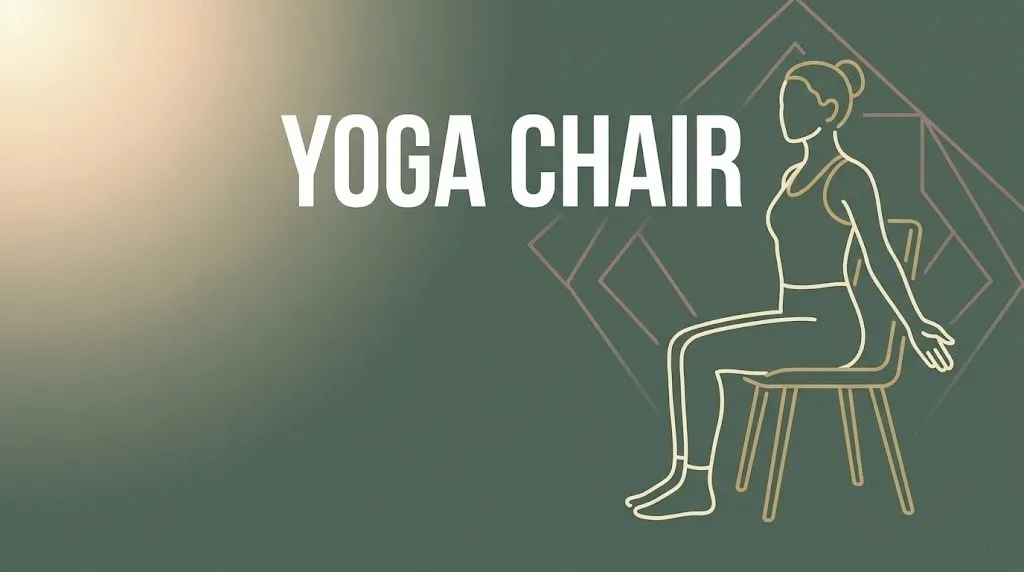
Surface material matters for sitting bones. A firm, flat, non-upholstered seat allows the practitioner to feel the floor through the chair. Thick foam cushions reduce proprioceptive feedback, which is the body’s sense of its own position. The American College of Sports Medicine notes that proprioception training is a central benefit of yoga, and it starts with ground contact.
Weight capacity is rarely discussed in yoga contexts, but it matters. Choose a chair rated for at least 250 pounds to ensure structural integrity under dynamic movement loads, not just static sitting weight.
Quick Summary:
| Feature | What to Look For | What to Avoid |
|---|---|---|
| Frame material | Steel, solid hardwood | Lightweight hollow plastic |
| Seat surface | Firm, flat, non-slip | Deep cushion, sloped seat |
| Armrests | None, or fully removable | Fixed wide armrests |
| Floor contact | Rubber feet or grip pads | Smooth plastic feet |
| Weight rating | 250 lbs minimum | Unspecified or under 200 lbs |
Key Takeaway: A yoga chair needs three things above everything else: a seat height that puts your feet flat on the floor, no armrests blocking your movement, and enough weight and grip to stay put during a twist.
Best Chair for Chair Yoga: Our Top Practical Picks
The best chair for chair yoga is a firm, armless, four-legged chair with rubber feet, a flat seat, and a straight back. Several common chair types meet these criteria without requiring a specialized purchase.
A standard metal folding chair is the most widely used chair in chair yoga classes globally. It is lightweight, durable, stable when feet are rubber-tipped, and inexpensive. The flat, non-cushioned seat provides excellent proprioceptive feedback. Its main limitation is fixed seat height, so shorter practitioners may need a folded blanket beneath their feet.
A wooden dining chair without armrests is the closest approximation for home use. Many already exist in homes. The criteria: straight back, no arm rests, firm seat, and four legs with non-slip floor contact. Adding a non-slip yoga mat beneath it solves most sliding issues.
A dedicated yoga practice chair from specialty suppliers includes features like extra-wide bases for stability, adjustable height options, and reinforced frames for weight-bearing poses. These are worth the investment for practitioners who practice daily or have significant mobility limitations.
Comparison: Common Chair Types for Chair Yoga
| Chair Type | Cost Range | Stability | Portability | Seat Adjustability |
|---|---|---|---|---|
| Metal folding chair | $20 to $50 | High | High | No |
| Armless dining chair | Varies | High | Low | No |
| Dedicated yoga chair | $80 to $200+ | Very High | Medium | Sometimes |
| Office chair (armless) | $60 to $150 | Medium | Low | Yes (height) |
Modification note: If you use a folding chair with slightly uneven legs on a hardwood floor, place the entire chair on a sticky yoga mat. This prevents sliding and stabilizes all four feet simultaneously.
What Kind of Chair for Chair Yoga Works Best?
The ideal chair for chair yoga is armless, four-legged, firm-seated, and stable enough to not slide during active movement. For most people, this translates to a metal folding chair, a wooden dining chair without armrests, or a purpose-built yoga chair.
The most common mistake is selecting a wheeled office chair. Even with wheels locked, rolling chairs shift unpredictably under lateral load. A lateral arm reach in seated yoga applies exactly that kind of force. This makes wheeled chairs genuinely unsafe for chair yoga sequences involving twists and side stretches.
Soft, deeply upholstered chairs present a different problem. Sinking into a cushion prevents the practitioner from sitting at the edge of the seat, which is where the pelvis needs to be for spinal extension in most seated poses. Think of it like trying to build a straight wall on an uneven foundation: the base determines everything above it.
What to prioritize based on practice type:
- For a beginner class or group setting: metal folding chair, armless, rubber feet
- For home practice: armless wooden dining chair on a yoga mat
- For seated meditation added to chair yoga: a chair with a straight back and firm seat, no cushion
- For a practitioner with significant balance limitations: a heavier chair (15 lbs or more) placed against a wall for the first few sessions
Modification: Shorter practitioners (under 5’3″) should always have a folded yoga blanket or foam block available to place under their feet. Dangling feet shift the pelvis into a posterior tilt, which rounds the lower back and reduces the safety and effectiveness of every pose.
Yoga Chaise Lounge: What It Is and Who It’s For
A yoga chaise lounge is a shaped, cushioned recliner designed specifically to support the body in restorative yoga positions, gentle backbends, and supported relaxation poses. It is not a chair in the traditional yoga sense and is not used for active chair yoga sequences.
The most well-known version is the Avana Yoga Chaise, a wedge-shaped foam and memory foam lounger that positions the body in a supported recline. The angled shape opens the chest, gently extends the thoracic spine, and reduces compression on the lumbar discs. This makes it genuinely useful for people with tight chest muscles, forward head posture, or mild thoracic kyphosis.
A yoga chaise lounge is best suited for:
- Restorative yoga practice at home
- Supported Savasana (Corpse Pose) variations
- Gentle chest openers like Matsyasana (Fish Pose) with support
- Pranayama and breathwork sessions where an angled, reclined position aids diaphragmatic breathing
- Recovery after vigorous practice
It is not appropriate for active chair yoga classes. If your goal is to do seated twists, forward folds, balance work, or structured sequences, a standard armless chair is the correct tool. The yoga chaise lounge serves a completely different function.
According to the Journal of Alternative and Complementary Medicine, restorative yoga practices that incorporate supported positions can reduce cortisol levels and promote parasympathetic nervous system activation, making supportive props like yoga chaises a legitimate part of a science-backed practice.
How to Use a Yoga Chaise Lounge
A yoga chaise lounge works by placing the body in a supported, angled recline that passively opens the front body without muscular effort. Using it correctly maximizes its benefit and prevents discomfort.
The most common use is a supported backbend. The wedge supports the thoracic spine while the head rests comfortably at the top of the incline. This position gently reverses the forward rounding that accumulates from sitting at a desk, driving, or looking at a phone screen for hours.
To use a yoga chaise lounge for a supported backbend:
- Place the chaise on a flat, stable surface with the lowest end facing away from you.
- Sit at the lower end and slowly recline backward, allowing your spine to follow the curve of the chaise.
- Let your arms rest at your sides or overhead, palms facing upward.
- Allow your chest to open passively. Do not force the stretch.
- Begin Ujjayi breath (slow, slightly audible breathing through the nose) to deepen relaxation.
- Hold for 3 to 10 minutes, depending on comfort.
- To exit, roll gently to one side before pressing up to seated.
Pose Tip:
- Place a folded blanket under your head if the neck feels compressed at the top of the recline.
- A yoga bolster placed beneath the knees reduces lumbar stress in the reclined position.
- People with significant acid reflux should avoid long holds in full recline.
Key Takeaway: A yoga chaise lounge is a restorative prop, not a practice chair. Use it for supported backbends and breathwork, not for active chair yoga sequences.
The Iyengar Yoga Chair: A Prop With a Specific Purpose
The Iyengar yoga chair is a backless or partially open-backed metal chair used in Iyengar yoga to assist practitioners in reaching deeper pose variations, supported inversions, and extended backbends that would otherwise require advanced flexibility or strength.
B.K.S. Iyengar, the founder of Iyengar yoga, developed this prop as part of a broader system of supported practice. The chair is typically a simple metal folding chair modified or selected so that the back rungs can be gripped from behind or practitioners can position their pelvis through the seat opening.
Common uses in Iyengar practice include:
- Viparita Dandasana (Inverted Staff Pose): A supported backbend where the upper back drapes over the seat edge.
- Supported Sarvangasana (Shoulder Stand): Using the chair as a prop to reduce neck and shoulder strain.
- Adho Mukha Svanasana (Downward Facing Dog) with hands on the chair seat for wrist or shoulder limitations.
- Uttanasana (Standing Forward Fold) with hands gripping the seat, reducing hamstring demand.
This chair is not appropriate for general chair yoga classes. It is used under the direct instruction of a trained Iyengar yoga teacher. Using it without guidance creates genuine injury risk, particularly in backbend and inversion variations that load the cervical spine.
According to the Yoga Alliance, Iyengar yoga teacher training requires a minimum of 500 hours with heavy emphasis on prop use. The Iyengar chair is considered an advanced prop, not a beginner tool.
Yoga Chair for Seniors: Why It Matters More Than You Think
Chair yoga for seniors is one of the most evidence-supported applications of yoga practice, and the chair itself is not an accommodation or a lesser version of “real yoga.” It is the appropriate tool for the population.
Research published in the International Journal of Yoga found that chair-based yoga programs significantly improved balance, lower body strength, and functional mobility in older adults over an 8-week period. Balance and functional mobility are the two physical factors most directly linked to fall prevention, which remains the leading cause of injury-related death in adults over 65, according to the Centers for Disease Control and Prevention (CDC).
For seniors, specific chair criteria matter more than for younger practitioners:
- Seat height must allow feet to rest flat on the floor. Many seniors have shorter stature and need a chair at 16 to 17 inches rather than the standard 17 to 18.
- Chair weight should be adequate to prevent sliding. A chair that moves creates immediate fall risk.
- Back support is more important for seniors than for younger practitioners. A chair with a straight back allows the practitioner to take brief rests without leaving the chair.
- Armrests are generally avoided during poses, but a chair with removable or side-mounted armrests can provide a safety point for sitting down and standing up.
Modification for seniors with significant balance challenges: Practice all standing and weight-shifting poses with the chair placed against a solid wall. This adds a layer of stability without altering the pose mechanics.
Chair Yoga Poses for Beginners: Where to Start
Chair yoga for beginners starts with four foundational poses that build body awareness, spinal mobility, and breath connection before moving into more complex sequences. These four cover the primary movement directions of the spine: extension, flexion, rotation, and lateral bending.
Sukhasana in chair (Seated Easy Pose): Sit at the front edge of the chair. Both feet flat on the floor. Spine tall. Hands resting on thighs. Take 5 breath cycles here to establish your base.
To practice the four foundational chair yoga poses:
- Tadasana in chair (Seated Mountain Pose): Sit at the edge of the seat. Feet hip-width apart, flat on the floor. Spine lengthens upward. Shoulders relax down and back. Hold for 5 breaths.
- Seated Cat-Cow (Marjaryasana-Bitilasana variation): Hands on knees. Inhale, arch the low back and lift the chest (Cow). Exhale, round the spine and tuck the chin (Cat). Repeat 6 to 8 rounds.
- Ardha Matsyendrasana in chair (Seated Spinal Twist): Sit tall. Place right hand on left knee, left hand on chair back. Inhale to lengthen. Exhale to rotate gently left. Hold 3 breaths. Repeat on the other side.
- Seated lateral stretch: Right arm reaches overhead and arcs left. Left hand presses gently on the seat beside the hip. Hold 3 breaths each side.
Modification: For practitioners with significant spinal stiffness, reduce the range of motion by 50% in all directions. The goal is movement within a comfortable range, not maximum stretch.
Key Takeaway: Start every chair yoga session with Seated Mountain Pose. Getting that foundation right, feet flat, spine tall, breath steady, sets the quality of everything that follows.
Chair Yoga Benefits: What the Research Actually Shows
Chair yoga produces measurable, documented benefits across multiple body systems, and the research behind it has grown meaningfully in recent years. This is not a gentle hobby with vague wellness perks. The evidence is specific.
According to a study published in the Journal of Alternative and Complementary Medicine, older adults who practiced chair yoga twice weekly for 8 weeks showed statistically meaningful reductions in pain interference and improvements in gait speed compared to a control group. Gait speed is a reliable predictor of overall functional health in aging adults.
A separate review in Complementary Therapies in Medicine found that yoga-based interventions, including chair-adapted versions, consistently reduced self-reported pain levels, improved sleep quality, and lowered markers of psychological distress in adults with chronic conditions.
Documented benefits with research support:
- Reduced joint pain and stiffness, particularly in the hips, knees, and lower back
- Improved balance and postural stability
- Increased range of motion in the thoracic and lumbar spine
- Reduced anxiety and depressive symptoms, linked to breathwork integration
- Improved sleep quality in adults with chronic pain
- Greater lower body functional strength in older adults
- Improved breathing capacity when pranayama is incorporated
The NCCIH notes that yoga’s combination of physical movement, breath regulation, and mindful attention appears to activate multiple pathways, making it more effective for chronic pain and stress than movement alone.
Chair Yoga for Back Pain: What Helps and What to Avoid
Chair yoga can reduce back pain, but the approach matters. Not all chair yoga poses are appropriate for every type of back issue, and generic “back pain yoga” advice applied without modification can worsen some conditions.
For general lower back discomfort linked to prolonged sitting or mild muscle tension, chair yoga is typically safe and helpful. Poses that gently mobilize the lumbar spine in flexion, extension, and rotation reduce stiffness by increasing circulation and restoring movement patterns.
For disc-related issues, including herniated or bulging discs, forward folds that round the lumbar spine can increase disc pressure. In these cases, maintaining a neutral spine during all forward-bending poses is the modification. Instead of folding forward from the waist, hinge from the hips with a straight back.
For sacroiliac joint pain, deep seated twists that push the pelvis into asymmetrical positions may aggravate symptoms. A physical therapist specializing in spinal conditions can clarify which movements are appropriate for your specific diagnosis before you start a chair yoga practice.
What helps vs. what to watch carefully:
| Movement Type | Generally Helpful | Use Caution With |
|---|---|---|
| Gentle spinal extension | Yes, for disc issues | Severe stenosis |
| Seated twists | Yes, for muscle tension | Herniated discs, SI joint pain |
| Forward folds with neutral spine | Yes | Lumbar rounding with disc issues |
| Lateral bends | Yes | Acute muscle spasm |
| Seated hip circles | Yes | Labral tears |
Chair Yoga for Flexibility: What to Realistically Expect
Chair yoga improves flexibility in measurable ways, but the timeline and degree of change depend on factors including age, starting range of motion, frequency of practice, and whether the tissues being stretched are primarily muscular or structural.
Muscular tightness responds relatively quickly. Practitioners who sit for extended periods typically carry chronic shortening in the hip flexors, hamstrings, and thoracic erector spinae. Research suggests that consistent stretching held for 30 to 60 seconds, practiced 3 to 5 days per week, produces noticeable increases in range of motion within 4 to 6 weeks.
Structural limitations, including joint capsule tightness, age-related tissue changes, or post-surgical scar tissue, respond more slowly and may not change as dramatically. This does not mean chair yoga is ineffective. It means the goal shifts from achieving a deeper range of motion to maintaining the range you have and reducing pain within that range.
A realistic expectation for a 50-year-old beginning chair yoga three times per week: meaningful improvement in hip and spinal mobility within 6 to 8 weeks. Noticeably easier daily movements, like reaching overhead or rotating to look behind you while driving, within 4 weeks.
Pose Tip:
- Hold flexibility-focused stretches for at least 3 breath cycles, roughly 15 to 20 seconds at minimum.
- For deeper tissue work, Yin-style holds of 1 to 3 minutes in supported seated stretches are more effective than brief repetitions.
- Never force a stretch past the point of discomfort. Mild tension is the target sensation.
Key Takeaway: Chair yoga for back pain and flexibility works best when you match the pose to your specific issue. Neutral spine forward folds for disc problems, gentle twists for muscle tension, and long holds for deeper tissue change.
Chair Yoga Modifications: Adapting Every Pose
Modifications in chair yoga are not a sign of doing less. They are the tool that makes yoga accessible across a genuine range of bodies, conditions, and experience levels. A good modification keeps the intention of a pose intact while adjusting its demand.
Seat-edge positioning is the single most commonly overlooked modification. Many beginners sit fully back in the chair. For most chair yoga poses, sitting at the front third of the seat allows the pelvis to tilt forward naturally, restoring lumbar curve and making spinal extension possible. This one adjustment changes the quality of every other pose.
Props within chair yoga extend what the chair alone provides:
- A yoga block placed under both feet equalizes the base for shorter practitioners.
- A folded yoga blanket under the sit bones raises the pelvis slightly, which reduces strain in forward folds for tight hamstrings.
- A yoga strap looped around the foot during a seated leg extension allows the hamstrings to lengthen without the practitioner rounding the spine to reach.
- A yoga bolster placed across the thighs in a forward fold gives the torso something to rest on, making the pose genuinely restorative.
Common modifications by population:
| Population | Modification Focus | Key Adjustment |
|---|---|---|
| Seniors with arthritis | Reduce grip pressure | Soft fists instead of full grip |
| People with osteoporosis | Avoid spinal flexion under load | Skip deep forward folds; use extension instead |
| People with Parkinson’s | Increase chair stability | Place chair against wall; use weighted chair |
| Post-surgical practitioners | Avoid movements near surgical site | Work with physical therapist for clearance |
| Beginners | Reduce range of motion | Stay at 50% of maximum stretch |
Chair Yoga Safety Tips: The Non-Negotiables
Chair yoga has a strong safety profile, but like any physical practice, it carries real risks when practiced carelessly. These are the non-negotiables that every practitioner should understand before the first session.
Chair stability comes first. Check all four legs before every session. A chair with even one wobbly leg becomes a fall risk during any weight-shifting pose. If practicing on a smooth floor, always place the chair on a non-slip yoga mat.
Breath should never be held. Many beginners unconsciously hold the breath during challenging poses, which increases internal pressure and can cause dizziness. If you notice you’ve stopped breathing, it’s a sign the pose is too intense or the form needs adjustment.
Pain is a stop signal, not a push-through signal. Mild muscular stretch is normal. Sharp, shooting, or joint pain is not. Stop, reset, and reduce the range of motion if pain occurs.
Key safety rules for every chair yoga session:
- Warm up with 5 minutes of seated breath awareness before any movement.
- Move within your comfortable range. Pain is information. Respect it.
- Place the chair on a non-slip surface every time, without exception.
- Do not practice within 2 hours of a heavy meal. The diaphragm needs freedom to move.
- If you have a cardiovascular condition, a recent surgery, or an acute injury, work with a certified yoga therapist or a physical therapist who understands yoga. A general class environment may not provide the individualization you need.
- For anyone with osteoporosis, avoid deep spinal flexion under load. This means no aggressive forward folds.
According to the NCCIH, yoga is generally considered safe when practiced appropriately for the individual’s health status. The key qualifier is “appropriately.”
Chair Yoga Sequences: Building a 20-Minute Practice
A well-structured chair yoga sequence moves through the body systematically, addresses all major spinal directions, and ends with a brief period of stillness. Twenty minutes practiced consistently three to four times per week produces meaningful results.
Structure of an effective 20-minute chair yoga sequence:
- Minutes 1 to 3: Breath awareness in Tadasana in chair (Seated Mountain Pose). Establish posture, ground the feet, calm the nervous system.
- Minutes 3 to 7: Spinal warm-up. Seated Cat-Cow for 6 rounds. Neck rolls (slow, within pain-free range). Shoulder circles forward and back, 5 repetitions each direction.
- Minutes 7 to 12: Main pose sequence:
- Ardha Matsyendrasana (Seated Spinal Twist): 3 breaths each side.
- Seated lateral bend: 3 breaths each side.
- Uttanasana in chair (Seated Forward Fold): Hinge from hips, hands toward the floor or resting on shins. 5 breaths.
- Virabhadrasana I in chair (Modified Warrior I): One foot steps back, front knee bends gently, arms reach overhead. 3 breaths each side.
- Vrksasana in chair (Seated Tree Pose): Lift one foot to rest on the opposite ankle or calf. Hands at heart center. 5 breaths each side.
- Minutes 12 to 18: Cool-down. Seated hip circles. Gentle spinal twists repeated with less intensity. Seated forward fold with bolster support.
- Minutes 18 to 20: Sukhasana in chair (Seated Easy Pose) with eyes closed. Focus on the natural rhythm of breath. Complete stillness.
Modification for a 10-minute version: Keep the breath awareness, one spinal twist each side, one lateral bend each side, and the closing stillness. Even a short practice done consistently outperforms an occasional long session.
Frequently Asked Questions About Yoga Chairs
What kind of chair do I need for chair yoga?
You need an armless, four-legged, firm-seated chair with non-slip feet and a seat height that lets your feet rest flat on the floor.
A metal folding chair or an armless wooden dining chair meets these criteria for most practitioners.
Avoid wheeled chairs, deeply cushioned chairs, and chairs with fixed wide armrests.
Can I do chair yoga with a regular kitchen chair?
Yes, most armless kitchen chairs work well for chair yoga practice.
Check that the seat height allows your feet to rest flat on the floor, and place the chair on a yoga mat to prevent sliding.
If the chair has armrests, they will limit reaching and twisting poses, so a fully armless version is preferred.
What is a yoga chaise lounge used for?
A yoga chaise lounge is used for restorative yoga positions, supported backbends, and pranayama practice in a reclined position.
It is not used for active chair yoga sequences or standing pose modifications.
It is best suited for home practice focused on recovery, relaxation, and passive chest and spinal opening.
Is chair yoga actually effective for seniors?
Yes. A study published in the Journal of Alternative and Complementary Medicine found that seniors practicing chair yoga twice weekly for 8 weeks showed reduced pain and improved gait speed.
Gait speed and balance are among the most important predictors of fall risk and functional independence in older adults.
Chair yoga provides these benefits without requiring floor-based movements that many seniors find difficult or unsafe.
How often should I do chair yoga to see results?
Most yoga teachers and physical therapists recommend practicing chair yoga three to four times per week for 20 to 30 minutes per session.
Research suggests that flexibility and balance improvements become noticeable within 4 to 8 weeks of consistent practice at this frequency.
Daily shorter sessions of 10 to 15 minutes can produce similar results to less frequent longer sessions for many practitioners.
Your chair is already in the room. That is the only equipment you need to begin. Start with Seated Mountain Pose today: sit at the front edge of a firm, armless chair, plant both feet flat on the floor, and take five slow, deliberate breaths with a tall spine. That is chair yoga.
Build from there, three times per week, using the sequence in this guide. Add props as your practice grows. And if you are managing a health condition, connect with a certified yoga therapist who can tailor the practice to your specific needs.
The research is clear and the practice is accessible. The chair just needs to be the right one.