Ritual One Yoga Dallas: Poses, Benefits, and Practice
Ritual one yoga is both a studio concept in Dallas and a broader approach to daily practice built around consistent, intentional movement. Whether you’re researching the Ritual One Yoga studio or looking to build your own single-daily-pose ritual at home, this guide gives you the specific information you need to start and sustain a practice that actually fits your life.
The case for a daily yoga ritual is backed by real data. According to the National Center for Complementary and Integrative Health (NCCIH), yoga is one of the most widely practiced complementary health approaches in the United States, with more than 21 million American adults reporting regular practice. Research published in the International Journal of Yoga consistently links daily or near-daily yoga practice to measurable reductions in cortisol, improved flexibility, and better sleep quality.
This article covers everything from what makes a practice count as a ritual, to the best poses for morning and evening sessions, to how long to hold each pose, to modifications for beginners, seniors, and people managing back pain. You’ll also find a breakdown of what to look for in a studio like Ritual One Yoga Dallas if you prefer guided, in-person classes.
What Is Ritual One Yoga
Ritual one yoga refers to a structured, intentional yoga practice built around a single anchor principle: consistency over volume. The “one” in the name signals a commitment to showing up daily, even if that means one pose, one breath sequence, or one focused session, rather than sporadic longer classes.
As a studio brand, Ritual One Yoga in Dallas offers structured classes across multiple yoga styles with an emphasis on habit-forming, accessible practice for all experience levels. As a home practice philosophy, it means choosing one pose or one short sequence and returning to it every day with full attention.
The concept draws on ideas from Hatha yoga tradition, where a single pose held with awareness is considered more valuable than dozens of poses performed without attention. Teachers trained in Iyengar yoga have long taught that depth in one pose produces more lasting change than breadth across many.
Quick Summary:
- “Ritual” in yoga means consistent, intentional return to practice
- “One” refers to a single anchor point: one pose, one time, one commitment
- Both studio-based and home-based practice can follow this framework
- The goal is sustainable habit, not peak athletic performance
Ritual One Yoga Dallas: What the Studio Offers
Ritual One Yoga Dallas is a yoga studio offering classes across multiple styles, including Vinyasa, Yin, and Restorative yoga, designed for practitioners at every level. Dallas-area students have reported that the studio emphasizes intentional sequencing and accessible entry points for beginners.
Studios operating under this model typically offer beginner-friendly class structures. Expect 60-minute to 90-minute sessions with a warm-up, a peak sequence, and a cool-down or Savasana (Corpse Pose). Many studios in this category also offer meditation and pranayama components as standalone or add-on sessions.
If you’re evaluating a yoga studio in Dallas, here’s what to look for before booking your first class:
| What to Check | Why It Matters |
|---|---|
| Instructor credentials (Yoga Alliance RYT-200 or RYT-500) | Ensures trained, safety-aware instruction |
| Class size limits | Smaller classes mean better alignment cues |
| Style variety (Vinyasa, Yin, Restorative) | Different styles serve different goals |
| Beginner-specific sessions | Not all “all levels” classes are truly beginner-safe |
| Props available (blocks, straps, bolsters) | Props are not optional for safe practice |
| Trial class or first-week offer | Low-risk way to assess studio fit |
Before attending any yoga studio, let the instructor know about any injuries, surgeries, or health conditions. That’s not a formality. A good teacher adjusts your practice based on that information.
What Makes a Yoga Practice a Ritual
A yoga practice becomes a ritual when the same action is performed at the same time, in the same way, with deliberate attention, day after day. The repetition is the point.
Behavioral science supports this. Research from habits and behavior change literature consistently shows that cue-routine-reward loops, which are exactly what a yoga ritual creates, are the most reliable mechanism for building long-term movement habits. Think of your ritual like brushing your teeth: the value is not in the intensity of any single session. The value compounds through repetition.
From a yogic perspective, a ritual includes three elements that separate it from a casual stretch or workout:
- Consistency of time: Morning, midday, or evening, but the same window each day
- Consistency of form: The same opening breath, the same opening pose, the same closing posture
- Presence of intention: A brief mental anchor before starting, even one breath with eyes closed
According to the American College of Sports Medicine, adults who attach physical activity to a fixed daily cue (a time of day, a location, or a preceding behavior) are significantly more likely to maintain the habit over 12 months than those who practice “when I have time.”
A practice does not need to be 60 minutes to qualify as a ritual. Five minutes of deliberate, consistent practice outperforms an occasional 90-minute class in terms of habit formation.
Key Takeaway: A yoga ritual is defined by repetition and intention, not duration. Five consistent minutes builds more long-term benefit than irregular hour-long sessions.
How to Build a Daily Yoga Ritual at Home
Building a home yoga ritual starts with choosing one anchor pose and one anchor time, then adding structure around those two decisions. Do not start by designing a 45-minute sequence. Start with one pose.
Here is a simple framework to launch a daily home practice:
- Choose your anchor pose. Pick one pose you can practice every day regardless of energy level. Balasana (Child’s Pose) or Marjaryasana-Bitilasana (Cat-Cow Pose) work well because they have no time-of-day restriction, require no warm-up, and suit most bodies.
- Choose your anchor time. Right after waking, during a lunch break, or before bed. Attach it to something you already do every day.
- Set a space. Lay out your mat in one specific spot. The physical cue of an unrolled mat is a proven behavioral trigger for practice.
- Open with one breath. Before moving, take one full inhale and exhale with your eyes closed. This single breath is your ritual’s opening gate.
- Practice your anchor pose. Hold for 5 to 10 breath cycles. Notice what you feel without trying to change it.
- Close with intention. One exhale. Eyes open. Done.
- Add poses gradually. After 2 weeks of daily practice, add one additional pose. Never add more than one pose per week in the first month.
The equipment you need to start is minimal: a non-slip mat and enough floor space to lie flat. Props become valuable as you deepen, but they are not required on day one.
Modification: If getting down to the floor is challenging, begin your ritual in a chair. Sukhasana (Easy Seated Pose) adapted to a chair counts. The movement matters less than the consistency.
Best Poses for a Daily Yoga Ritual
The best poses for a daily yoga ritual are those that balance accessibility, full-body benefit, and repeatability without requiring a warm-up or extensive setup. No single pose is universally “best.” The right anchor pose depends on your body, your goals, and your available time.
That said, research and experienced yoga teachers consistently point to a core group of poses suited to daily standalone or ritual practice:
| Pose Name | Sanskrit Name | Primary Benefit | Daily Hold Time | Best For |
|---|---|---|---|---|
| Child’s Pose | Balasana | Spinal decompression, nervous system calm | 1 to 3 minutes | Everyone |
| Cat-Cow Pose | Marjaryasana-Bitilasana | Spinal mobility, breath coordination | 10 to 20 breath cycles | Beginners, back pain |
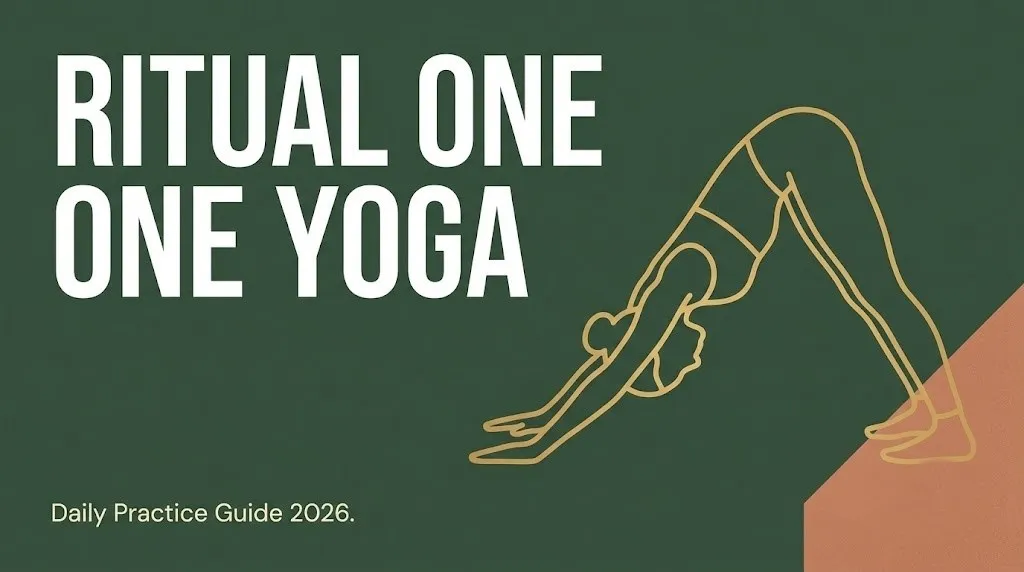
| Downward-Facing Dog | Adho Mukha Svanasana | Full-body stretch, shoulder and hamstring length | 5 to 10 breaths | Intermediate practitioners |
| Bridge Pose | Setu Bandha Sarvangasana | Glute and spine strength, hip flexor stretch | 5 breaths x 2 to 3 sets | Back pain, desk workers |
| Legs-Up-the-Wall | Viparita Karani | Circulation, nervous system reset, fatigue relief | 5 to 10 minutes | Seniors, insomnia, recovery |
| Standing Forward Fold | Uttanasana | Hamstring and lower back release | 1 to 2 minutes | Stiffness, morning practice |
| Mountain Pose | Tadasana | Posture awareness, grounding | 1 to 2 minutes | Every level, every day |
Safety note: Adho Mukha Svanasana (Downward-Facing Dog) is not appropriate daily practice for people with acute wrist, shoulder, or rotator cuff injuries. Substitute Balasana (Child’s Pose) or a supported wall version instead.
Morning Yoga Ritual: Poses and Sequence
A morning yoga ritual works best when it moves from passive and grounding to active and energizing, matching the body’s natural transition from sleep to wakefulness. The body is typically stiffer in the morning due to reduced joint fluid circulation during sleep, so beginning gently is not optional.
The spine has been horizontal for 6 to 8 hours. Discs are slightly more hydrated and vulnerable immediately after waking. Starting with twists or deep backbends before a gentle warm-up can irritate lumbar tissues. Yoga teachers and physical therapists generally recommend waiting at least 30 minutes after waking before practicing more demanding postures.
A practical 10-minute morning sequence:
- Begin lying on your back. Take 5 slow diaphragmatic breaths. Hands on belly.
- Supta Baddha Konasana (Reclining Bound Angle Pose). Soles of feet together, knees fall wide. Hold 2 minutes.
- Marjaryasana-Bitilasana (Cat-Cow Pose). Come to hands and knees. 10 breath cycles, linking movement to breath.
- Adho Mukha Svanasana (Downward-Facing Dog). Hold 5 breaths. Pedal the heels gently.
- Uttanasana (Standing Forward Fold). Walk feet to hands. Hang heavy for 1 minute, knees softly bent.
- Tadasana (Mountain Pose). Stand tall. 5 breaths. Eyes forward or closed.
- Close with ujjayi breath. One audible exhale. Practice complete.
Modification for mornings: If the floor feels too cold or distant, begin seated in a chair. Perform Cat-Cow seated, forward fold over your thighs, and close standing. The sequence adapts cleanly to a chair without losing its spine-mobility benefit.
Evening Yoga Ritual for Recovery and Sleep
An evening yoga ritual serves a different neurological purpose than morning practice. The goal shifts from activating the body to down-regulating the nervous system, transitioning from sympathetic (alert) to parasympathetic (rest) dominance.
A study published in Complementary Therapies in Medicine found that a consistent evening yoga and breathing practice significantly reduced insomnia symptoms and improved sleep onset time in adults with mild to moderate sleep disturbances. The key mechanism was breath-led, low-intensity movement that reduced heart rate and cortisol in the hour before bed.
An effective evening ritual avoids inversions that increase heart rate, strong backbends, or energizing pranayama like Kapalabhati (Skull-Shining Breath). Instead, prioritize:
- Viparita Karani (Legs-Up-the-Wall Pose): 5 to 10 minutes. Feet elevated, hips near or against the wall. Deeply calming for the nervous system and venous circulation.
- Supta Baddha Konasana (Reclining Bound Angle Pose): 3 to 5 minutes. Supported with a bolster under the spine if available.
- Savasana (Corpse Pose): 5 to 10 minutes. Not optional. This is where nervous system integration happens.
- Nadi Shodhana (Alternate Nostril Breathing): 5 to 10 rounds before or after movement.
Modification for evening practice: People with lower back sensitivity should place a folded blanket under the knees in Viparita Karani (Legs-Up-the-Wall Pose) rather than pressing the legs fully straight against the wall. This reduces hamstring tension and allows the lumbar spine to settle.
Key Takeaway: Morning rituals should move from gentle to grounding. Evening rituals should move from active to passive. The direction of the sequence matters as much as the poses themselves.
How Long Should You Hold a Pose in a Daily Yoga Ritual
Hold time in a yoga ritual depends on the style of practice and the goal of the pose, but for most daily ritual practitioners, 5 to 10 breath cycles (roughly 30 to 60 seconds) per pose is the functional sweet spot. This is not a universal rule. It is a starting point.
In Yin yoga, holds extend to 3 to 5 minutes, sometimes longer. The target tissue in Yin is the connective tissue (fascia, ligaments, joint capsules) rather than the muscles. Longer holds at low intensity are required to create adaptation in these slower-responding tissues.
In Vinyasa yoga, poses are often held for 1 to 5 breath cycles, with movement linking one pose to the next. For a standalone daily ritual focused on one or two poses, a 5-to-10-breath hold in a Vinyasa-style pose is appropriate.
| Practice Style | Typical Hold Time | Target Tissue | Best For |
|---|---|---|---|
| Vinyasa | 1 to 5 breaths | Muscle activation and flow | Energizing morning practice |
| Hatha | 5 to 10 breaths | Muscle length and joint mobility | General daily practice |
| Yin | 3 to 5 minutes | Fascia and connective tissue | Evening, recovery, flexibility |
| Restorative | 5 to 20 minutes | Nervous system, passive release | Stress, insomnia, chronic fatigue |
| Iyengar | Variable, with props | Alignment precision | Injury rehabilitation, seniors |
Safety note: Holding a pose longer does not automatically produce better results. Holding with poor alignment or significant pain produces injury, not progress. Ease is individual. A pose that feels like a deep stretch for one body feels like a sharp pain in another.
Yoga Ritual Benefits: What Research Actually Says
The benefits of a daily yoga ritual are documented across multiple health domains, from musculoskeletal function to cardiovascular health to mental wellbeing. The research base is substantial enough to take seriously, but specific outcomes depend on the style, frequency, and duration of practice.
According to the NCCIH, yoga is associated with reduced chronic low back pain, improved flexibility, reduced anxiety symptoms, and better sleep quality in adults who practice regularly. The word “regularly” in most studies means three or more sessions per week, often with sessions of 45 to 60 minutes.
Here’s what the research actually supports, by domain:
- Flexibility: A 2016 study in the International Journal of Yoga found measurable improvements in hamstring flexibility after 10 weeks of daily yoga, with changes appearing as early as week 4.
- Stress and cortisol: Research published in the Journal of Alternative and Complementary Medicine links yoga practice to reduced salivary cortisol levels compared to seated rest controls.
- Chronic back pain: The NCCIH identifies yoga as an evidence-supported option for adults with non-specific chronic low back pain, noting it is comparable to physical therapy in several trials.
- Sleep quality: Studies in Complementary Therapies in Medicine report improved sleep onset, duration, and quality in older adults who practiced yoga 3 to 5 times per week.
- Mental health: Research in Frontiers in Psychiatry links regular yoga practice to reduced symptoms of generalized anxiety and mild depression, with effects comparable to aerobic exercise in some populations.
One honest caveat: Most yoga research uses small sample sizes and self-reported outcome measures. The findings are promising and consistent, but yoga science is still a developing field. What the data does clearly support is that consistent practice produces real, measurable changes.
Is One Yoga Pose a Day Enough to See Results
One yoga pose practiced daily can produce real, measurable results if that pose is chosen strategically and performed consistently over weeks and months. It is not a replacement for a full practice, but it is not nothing either.
The key variable is what you’re measuring. One daily pose will not build cardiovascular endurance or muscular strength across the whole body. But Marjaryasana-Bitilasana (Cat-Cow Pose) practiced daily for 30 days can meaningfully improve thoracic and lumbar spinal mobility. Viparita Karani (Legs-Up-the-Wall Pose) practiced daily for 20 minutes can shift the nervous system toward parasympathetic dominance with consistent results in 2 to 3 weeks for many practitioners.
Think of it this way: one daily pose is like one daily glass of water. It won’t fully hydrate you on its own. But it creates a meaningful, consistent physiological input that adds up. The ritual builds the habit. The habit builds the practice. The practice builds the results.
Yoga teachers and physical therapists generally recommend this approach for:
- People returning to movement after injury
- Beginners overwhelmed by full-class commitment
- Seniors managing energy or mobility limitations
- Anyone who has tried and abandoned yoga multiple times before
The honest answer: One pose a day is enough to start building a real yoga habit. After 4 to 6 weeks of consistency, most practitioners naturally expand the practice because they begin to feel its effects.
Key Takeaway: One pose practiced every day for a month beats an inconsistent full practice every time. Start small. The habit itself is the first result.
Yoga Ritual for Stress Relief and Anxiety
A yoga ritual designed specifically for stress relief and anxiety targets the parasympathetic nervous system through slow movement, long exhales, and grounding poses. The breath is more important than the pose in this context.
According to research published in Frontiers in Psychiatry, yoga interventions combining movement with breath awareness reduced self-reported anxiety scores more effectively than movement alone. The breath regulation component appears to be the active ingredient. Specifically, exhaling for twice as long as the inhale (a 1:2 inhale-to-exhale ratio) activates the vagus nerve and slows heart rate within 2 to 3 breath cycles.
A stress-relief ritual built around this principle:
- Sit comfortably in Sukhasana (Easy Seated Pose) or in a chair.
- Inhale for 4 counts through the nose.
- Exhale for 8 counts through the nose or slightly parted lips.
- Repeat for 5 to 10 rounds before any physical poses.
- Move into Balasana (Child’s Pose) for 2 to 3 minutes.
- Transition to Viparita Karani (Legs-Up-the-Wall Pose) for 5 minutes.
- Close in Savasana (Corpse Pose) for 5 minutes.
Important note: If you are managing a diagnosed anxiety disorder, yoga can be an effective complementary support, but work with a licensed mental health professional alongside your practice. Yoga is not a substitute for clinical treatment, and your therapist or psychiatrist can help you integrate it safely.
Modification: People with vertigo or balance concerns should avoid Viparita Karani (Legs-Up-the-Wall Pose) with legs fully elevated. Instead, place the legs on a chair seat at 90 degrees for the same nervous system benefit without the vestibular challenge.
Yoga Ritual for Beginners: Where to Start
A beginner yoga ritual should start with three things: one simple pose, one consistent time, and zero expectations about how it should look. The biggest mistake beginners make is trying to follow a 30-day YouTube program before they understand what a single pose actually feels like in their body.
For week one, choose one of the following anchor poses:
- Balasana (Child’s Pose): Kneel, sit back toward heels, reach arms forward or alongside the body. Rest forehead on the mat or a block. Hold for 1 to 3 minutes. This pose requires no prior yoga experience and provides immediate spinal decompression.
- Marjaryasana-Bitilasana (Cat-Cow Pose): On hands and knees, alternate between arching the spine up (Cat) and letting the belly drop toward the floor (Cow). 10 slow breath cycles. This builds spinal mobility and body awareness simultaneously.
- Tadasana (Mountain Pose): Stand with feet hip-width apart, arms by sides, eyes forward. Hold for 2 minutes. Focus on breath and posture. This is harder than it looks. It teaches body awareness before demanding physical effort.
Pose Tip:
- Never force a stretch. Sensation is information. Sharp or electrical pain means stop.
- Use a folded blanket under the knees in Balasana (Child’s Pose) if kneeling is uncomfortable.
- In Marjaryasana-Bitilasana (Cat-Cow Pose), wrist discomfort means you need to shift weight back or make fists instead of flat palms.
- Start with 5 minutes total. Add 2 minutes per week.
According to the Yoga Alliance, students who receive basic alignment instruction in their first three sessions are significantly more likely to sustain practice for 6 months or more than those who self-teach exclusively from videos.
Yoga Ritual for Seniors and Limited Mobility
A yoga ritual for seniors should prioritize joint safety, fall prevention, and nervous system regulation over flexibility goals or pose complexity. The evidence base for yoga in older adults is strong and growing.
A study published in the International Journal of Yoga found that adults over 60 who practiced yoga 3 times per week for 12 weeks showed improvements in balance, gait speed, and self-reported quality of life compared to a non-yoga control group. Balance improvement is particularly relevant for seniors, as falls are among the leading causes of injury-related hospitalization in adults over 65 according to the National Institutes of Health.
A senior-friendly daily ritual focuses on these four areas:
| Goal | Recommended Pose | Adaptation |
|---|---|---|
| Balance | Tadasana (Mountain Pose) | Near a wall for support |
| Spinal mobility | Marjaryasana-Bitilasana (Cat-Cow) | Seated in a chair |
| Hip flexibility | Supta Baddha Konasana (Reclining Bound Angle) | Blocks under knees |
| Nervous system calm | Viparita Karani (Legs-Up-the-Wall) | Legs on chair instead of wall |
Chair yoga is a legitimate and effective practice style for seniors with limited floor mobility. Sitting in a stable, non-wheeled chair, practitioners can safely perform spinal twists, hip openers, forward folds, and breathing exercises. None of these require getting up and down from the floor.
Safety note: Seniors taking blood pressure medications, blood thinners, or medications affecting balance should check with their prescribing physician before practicing inversions or poses requiring single-leg balance, specifically because of medication side effects on coordination and circulation.
Key Takeaway: For seniors, chair yoga is not a lesser version of yoga. It is an equally valid practice that reduces fall risk, improves mobility, and supports nervous system health.
Yoga Ritual for Back Pain and Spinal Health
A daily yoga ritual targeting back pain should focus on spinal mobility, core stability, and hip flexor length rather than deep stretching of the low back in isolation. Stretching an already irritated lumbar spine without addressing the surrounding structures often makes things worse.
The NCCIH identifies yoga as one of the most researched non-pharmacological interventions for chronic non-specific low back pain, noting that multiple clinical trials have found it comparable to physical therapy for pain reduction and functional improvement over 12 weeks.
The most important distinction for back pain practice is this: tight hip flexors pull the pelvis forward, increasing lumbar lordosis (the curve of the low back), which compresses posterior spinal structures. This is where desk workers, people who sit for long hours, and those who sleep in the fetal position often feel pain. Stretching the hip flexors, rather than the low back directly, often produces faster and longer-lasting relief.
Poses for a back pain daily ritual:
- Marjaryasana-Bitilasana (Cat-Cow Pose): 10 slow cycles. Mobilizes every spinal segment.
- Setu Bandha Sarvangasana (Bridge Pose): 5 breaths held, 3 repetitions. Strengthens glutes and erector spinae while gently stretching hip flexors.
- Supta Kapotasana (Reclined Pigeon Pose): 2 minutes per side. Targets the piriformis and external hip rotators.
- Balasana (Child’s Pose): 2 minutes. Lengthens the lumbar spine passively.
Critical modification: Anyone with a diagnosed disc herniation or stenosis should avoid deep forward folds and prolonged flexion of the lumbar spine. For these individuals, Setu Bandha Sarvangasana (Bridge Pose) in its supported, passive version (block under the sacrum) is a safer daily option. Get guidance from a physical therapist or spine-aware yoga teacher before building an independent home practice with a diagnosed spinal condition.
Props and Equipment for a Home Yoga Ritual
The props you need for a home yoga ritual depend on your body, your practice style, and your specific goals. You do not need everything at once. Start with one mat and one block.
Here is an honest guide to what each prop does and who actually needs it:
| Prop | What It Does | Who Needs It Most |
|---|---|---|
| Non-slip yoga mat | Prevents sliding, protects joints, defines practice space | Everyone |
| Yoga block (x2) | Shortens distance to the floor, supports alignment | Beginners, seniors, people with tight hamstrings |
| Yoga strap | Extends reach in hamstring and shoulder stretches | People with limited flexibility or shoulder injury |
| Bolster | Supports the spine in Restorative poses | Restorative practitioners, prenatal, chronic fatigue |
| Folded blanket | Cushions knees, props under hips, adds height in seated poses | Seniors, people with knee sensitivity |
| Wall | Provides balance support, enables Viparita Karani | Free prop. Available everywhere. Underused. |
| Chair (stable, non-wheeled) | Enables chair yoga, supports standing balance poses | Seniors, people with limited floor mobility |
A practical note on mats: Mat thickness matters. A 4mm mat provides a balance of cushioning and stability for standing poses. A 6mm mat is better for people with joint sensitivity in the knees or wrists. Mats thicker than 6mm reduce proprioception (your sense of ground contact) and can make balance poses harder.
According to yoga teachers and equipment specialists, the two most underused props in home practice are the wall and a simple folded blanket. Both are free or already in your home. Both solve common alignment problems in beginner and senior practice.
How to Set an Intention Before Your Yoga Ritual
Setting an intention before your yoga ritual is the practice of choosing one word, phrase, or focus that anchors your attention for that session. It is not a wish or a goal. It is a direction for awareness.
In Sanskrit, this is related to the concept of Sankalpa, a short, positive statement of intent. In practical terms, it works the same way a pre-workout mental focus cue works in sports performance: it directs your attention away from distraction and toward the practice itself.
Research from behavioral science suggests that brief pre-activity mental cues improve both performance quality and session satisfaction. Yoga teachers in the Iyengar and Kundalini traditions have formalized this as part of opening ritual for decades. The NCCIH notes that mind-body practices that integrate intention-setting alongside physical movement show stronger outcomes in stress and anxiety research than physical-only yoga interventions.
How to set an intention in three steps:
- Sit quietly before moving. Even 30 seconds of stillness before practice creates a sensory threshold between regular life and your ritual.
- Choose one word or phrase. Examples: “steady,” “ease,” “I am grounded,” “I breathe slowly.” The shorter, the better.
- Return to it during practice. When your mind wanders (and it will), use your intention as an anchor, not a judgment.
For beginners who feel self-conscious about this: Your intention does not need to be spiritual or poetic. “I’m here” is a complete intention. “Five minutes for myself” works. The function is focus, not meaning-making.
A simple intention practice takes under 60 seconds and measurably improves session focus for most practitioners after just a few repetitions.
Key Takeaway: Setting an intention takes 60 seconds and costs nothing. It is one of the highest-return practices you can add to a ritual yoga session, especially if your mind tends to wander during movement.
Frequently Asked Questions About Ritual One Yoga
What is ritual one yoga and is it good for beginners?
Ritual one yoga is an approach to yoga practice centered on consistent, intentional daily sessions, often anchored by one pose or one short sequence.
It is well-suited for beginners because it removes the overwhelm of complex programming and replaces it with one simple, repeatable commitment.
Both the studio-based and home-based versions of this approach offer beginner-friendly entry points with modifications available for most poses.
How many days a week should I do a daily yoga ritual?
A daily yoga ritual means practicing every day, but even five to six days per week produces the habit-forming benefit that makes the ritual effective.
The American College of Sports Medicine and most yoga teacher training programs recommend rest or very gentle practice at least one day per week to allow tissue recovery.
If daily practice feels too rigid, start with five days per week and build from there.
Can one yoga pose a day actually improve flexibility?
Yes, one yoga pose practiced daily can produce measurable flexibility improvements, though the timeline depends on which pose, your starting point, and how consistently you practice.
Research published in the International Journal of Yoga found flexibility gains appearing within 4 weeks of daily practice in adult participants.
Holding a single pose like Uttanasana (Standing Forward Fold) or Supta Baddha Konasana (Reclining Bound Angle Pose) for 1 to 3 minutes daily produces consistent results over a 6-to-8-week period for most people.
What is the best time of day to do a yoga ritual?
The best time for your yoga ritual is whatever time you can actually stick to every day, because consistency matters more than timing.
That said, morning practice tends to favor energizing and mobility-focused sequences, while evening practice works better for nervous system down-regulation and sleep preparation.
Your body’s circadian rhythm affects tissue temperature and joint lubrication, meaning joints are typically stiffer in the morning and more pliable in the late afternoon.
What props do I need to start a home yoga ritual?
To start a home yoga ritual, you need one non-slip mat and one yoga block.
The mat defines your practice space and prevents slipping. One block shortens the distance to the floor in forward folds and supports alignment in dozens of foundational poses.
A yoga strap and a folded blanket are the next most useful additions, but they are not required for a beginning daily practice.
Start Simple and Let the Ritual Build Itself
The most effective yoga ritual is the one you actually do today, tomorrow, and the day after. Not the one that looks most impressive on paper.
Choose one pose. Set one time. Practice it tomorrow. That’s the entire first step.
As you build the habit, use the pose breakdowns, modification options, and breath sequences in this guide to expand at your own pace. Whether you’re working with a studio like Ritual One Yoga Dallas or rolling out a mat in your living room, the principle is the same: repetition is the practice, and the practice is the point.