Bliss Yoga: Poses, Benefits & Beginner Guide 2026
Bliss yoga is a calming, breath-centered approach to yoga that prioritizes deep relaxation, nervous system regulation, and sustained mental ease over athletic performance. It draws from restorative and Hatha yoga traditions, combining held poses, intentional breathwork, and inward focus to create what practitioners describe as a state of effortless, grounded contentment.
The National Center for Complementary and Integrative Health (NCCIH) recognizes yoga as an evidence-supported practice for managing stress, improving sleep, and reducing anxiety symptoms. Research published in the International Journal of Yoga has found that slow, mindful yoga practices measurably lower cortisol levels and improve heart rate variability in regular practitioners.
This guide covers everything a new or returning practitioner needs to know: what bliss yoga actually is, how it works in the body, the best poses to start with, how to build a home practice, and specific guidance for seniors, those with back pain, and people managing anxiety.
What Is Bliss Yoga
Bliss yoga is a yoga practice style built around the principle of Ananda, the Sanskrit word for deep, unconditional contentment or inner joy. It is not a single trademarked method. Instead, it is a framework that draws from Hatha, Restorative, and Yin yoga traditions, emphasizing slow movement, long holds, conscious breathing, and full-body release over strength-building or aerobic intensity.
The practice typically features poses held for two to five minutes at a time. The focus is on letting the nervous system settle, not on deepening a stretch through effort. You are not working to achieve a shape. You are working to let one go.
Most bliss yoga classes and home sessions follow a predictable arc: a gentle standing or seated warm-up, a series of supported floor poses, and an extended Savasana (Corpse Pose) at the end. Props are common and encouraged. Silence or soft ambient sound is typical.
| Feature | Bliss Yoga | Vinyasa Yoga | Restorative Yoga |
|---|---|---|---|
| Pace | Slow to very slow | Moderate to fast | Very slow |
| Hold time per pose | 2 to 5 minutes | 5 to 10 breaths | 5 to 20 minutes |
| Props used | Yes, optional | Rarely | Yes, essential |
| Primary goal | Inner calm, nervous system ease | Strength and flow | Deep tissue release, recovery |
| Intensity | Low to moderate | Moderate to high | Very low |
| Best for | Stress, anxiety, sleep, beginners | Fitness, flow, energy | Injury recovery, deep fatigue |
Bliss yoga is appropriate for most adults regardless of fitness level, though individual poses always require attention to specific physical conditions.
Bliss Yoga Philosophy and Meaning
The philosophical core of bliss yoga comes from the Taittiriya Upanishad, one of the principal Upanishads of classical Indian philosophy, which describes the Anandamaya kosha: the bliss body or the innermost layer of human experience beyond thought, sensation, and energy.
This is not abstract mysticism in a practical yoga context. It is a map. Practitioners are guided to move from physical sensation (the body), through breath (the energy body), into a state where mental chatter quiets and a baseline of ease becomes accessible. That state is Ananda in applied terms.
Bliss yoga also incorporates the concept of pratyahara, which is the fifth of Patanjali’s Eight Limbs of Yoga. Pratyahara means withdrawal of the senses. When you close your eyes, soften your grip on effort, and allow the body to yield into a supported pose, you are practicing pratyahara whether you use that word or not.
This philosophical grounding separates bliss yoga from generic relaxation classes. The intent is not just to feel good during class. It is to train the nervous system to return to ease more quickly in daily life. That is a teachable, trainable skill.
Quick Summary:
- Ananda: Sanskrit for deep, unconditional inner contentment
- Anandamaya kosha: the bliss body, innermost experiential layer in yogic philosophy
- Pratyahara: sensory withdrawal, a deliberate inward shift of attention
- The practical goal: train the nervous system to access calm as a default, not a rare event
Bliss Yoga Benefits
Bliss yoga offers measurable physical, mental, and neurological benefits supported by current research on slow, mindful yoga practices.
According to a study published in the Journal of Alternative and Complementary Medicine, regular participation in slow, restorative yoga styles produced a statistically meaningful reduction in salivary cortisol, the primary stress hormone, after eight weeks of consistent practice, three sessions per week.
The physical benefits are equally real. Long-held, supported poses gently lengthen the hamstrings, hip flexors, psoas muscle, and thoracic spine over time. This is not aggressive stretching. It is sustained positional loading that allows connective tissue to adapt gradually.
Benefits documented across bliss yoga and closely related restorative practices include:
- Reduced cortisol and stress hormone levels
- Improved sleep quality and sleep onset time
- Lower resting heart rate and improved heart rate variability
- Reduced muscle tension across the shoulders, neck, and lumbar spine
- Improved hip flexor and hamstring length over time
- Greater somatic awareness (the ability to notice physical sensation without reacting)
- Reported improvements in mood and reduced symptoms of mild to moderate anxiety
The American College of Sports Medicine notes that flexibility and mobility improvements from yoga are most consistent in slow-hold practices where tissues are held under gentle load for extended periods, rather than dynamic stretching.
Bliss Yoga and the Nervous System
Bliss yoga works directly on the autonomic nervous system, specifically by activating the parasympathetic branch, which is responsible for rest, digestion, and recovery.
Most adults spend a disproportionate amount of time in sympathetic nervous system dominance: the fight-or-flight state driven by cortisol, adrenaline, and vigilance. Bliss yoga uses three specific mechanisms to counter this: slow diaphragmatic breathing, long passive holds in supported positions, and deliberate withdrawal of sensory input (closing the eyes, reducing stimulation).
The vagus nerve is central to this process. It is the primary conduit of parasympathetic signals from the brain to the heart, lungs, and digestive organs. Slow, deep exhalations specifically activate the vagus nerve. Research published in PLOS ONE found that slow breathing at approximately six breath cycles per minute maximally activates vagal tone and produces measurable heart rate variability improvements within a single session.
| Nervous System State | What Activates It | What Bliss Yoga Does Instead |
|---|---|---|
| Sympathetic (fight-or-flight) | Stress, fast breathing, screen time | Interrupts activation through breath slowing |
| Parasympathetic (rest-digest) | Slow breath, safety, stillness | Directly activates through long exhales and held poses |
| Vagal tone (health marker) | Measured via heart rate variability | Improved through consistent practice over weeks |
People with chronic stress, generalized anxiety disorder, or high-pressure work environments tend to show the most rapid initial benefits from bliss yoga. However, it is not a replacement for clinical mental health treatment in cases of diagnosed anxiety disorders. If you are working with a therapist or prescribing physician, bliss yoga can function as a complementary support, not a substitute.
Bliss Yoga and Mental Health
Bliss yoga has a documented effect on mental health outcomes, particularly for stress, anxiety, low mood, and emotional regulation.
The National Center for Complementary and Integrative Health reviewed multiple trials and found that yoga practices emphasizing slow movement, breath awareness, and relaxation consistently reduced self-reported anxiety scores and improved mood stability in participants across age groups. These effects were most pronounced in people who practiced at least two to three times per week.
The mechanism is partly neurochemical. GABA (gamma-aminobutyric acid) is the nervous system’s primary calming neurotransmitter. A 2010 study published in the Journal of Alternative and Complementary Medicine used MRI spectroscopy to measure brain GABA levels before and after a yoga session. Practitioners showed a 27% increase in GABA compared to a walking control group. This finding has been replicated in subsequent research using restorative and slow yoga formats.
Bliss yoga also builds what researchers call interoceptive awareness: the ability to notice your own internal physical states (tension, breath rate, heart rate) and respond deliberately rather than reactively. This skill is increasingly recognized as a buffer against anxiety and depression.
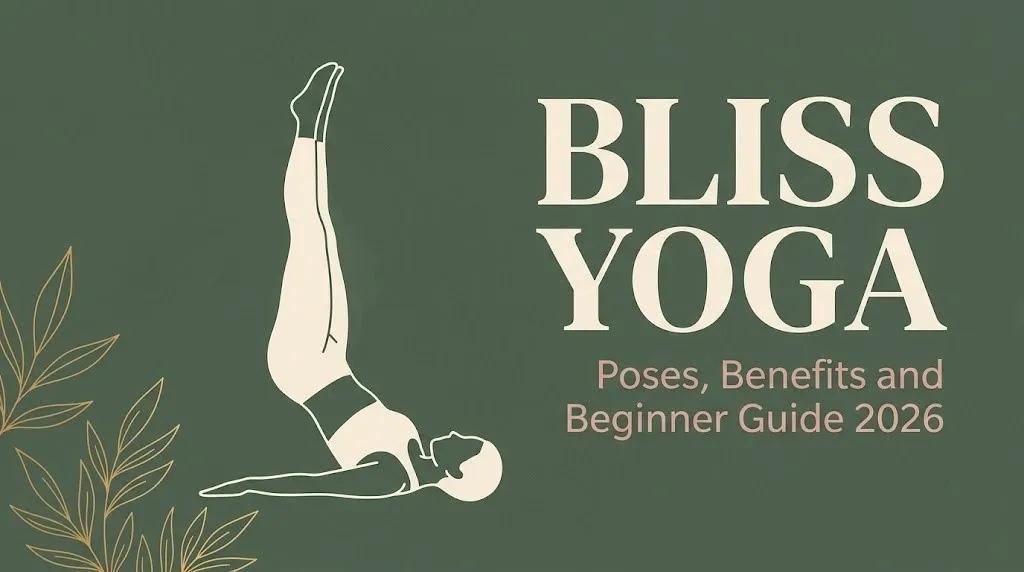
Pose Tip:
- For mood support, Viparita Karani (Legs-Up-the-Wall Pose) held for five to ten minutes is one of the most consistently reported poses for calming the nervous system
- Place a folded blanket under the hips to lift the pelvis slightly and decompress the lumbar spine
- Eyes closed and natural breathing (no forced breath) maximizes the calming effect for most practitioners
Key Takeaway: Bliss yoga is not just about feeling pleasant during class. It directly changes how your nervous system and brain chemistry function. Research links it to lower cortisol, higher GABA, and measurable improvements in anxiety and mood over consistent weeks of practice.
Bliss Yoga Poses
The core poses of a bliss yoga practice are selected for their ability to release muscular tension, decompress the spine, and signal safety to the nervous system through supported, non-effortful positions.
The following poses form the backbone of most bliss yoga sessions. Each is listed with its Sanskrit name on first use, its primary target area, and a basic alignment note.
Key poses and what they target:
- Balasana (Child’s Pose): Hips, lumbar spine, and shoulders. Rest the forehead on a block if the floor is too far away.
- Supta Baddha Konasana (Reclined Bound Angle Pose): Hip adductors, inner thighs, and groin. Place blocks or folded blankets under each knee to avoid strain.
- Viparita Karani (Legs-Up-the-Wall Pose): Hamstrings, lower back, and the venous return system. Sit close enough to the wall that the legs are nearly vertical without strain.
- Setu Bandha Sarvangasana (Bridge Pose): Gluteus maximus, hamstrings, and thoracic spine. Use a block under the sacrum for a supported, passive version.
- Ananda Balasana (Happy Baby Pose): Sacroiliac joint, inner groin, and lumbar spine. Hold the outer edges of the feet or use a strap around the arches if the hands cannot reach.
- Janu Sirsasana (Head-to-Knee Forward Bend): Hamstrings and lumbar spine. Sit on a folded blanket to avoid rounding aggressively through the lower back.
- Savasana (Corpse Pose): Full passive release of all muscular effort. Hold for a minimum of five minutes. Use a bolster under the knees for low back comfort.
Safety note: None of these poses should produce sharp, shooting, or nerve-related pain. Dull, even muscle sensation during a long hold is normal. Tingling, sharp pain, or pressure in the joints is a signal to ease out of the pose and adjust the support.
Bliss Yoga Sequence
A well-structured bliss yoga sequence moves the body from gentle activation through progressive release, ending in complete stillness.
Below is a complete beginner-friendly bliss yoga sequence, designed for approximately 45 to 60 minutes at home. Hold each pose for 3 to 5 minutes unless otherwise noted.
To practice this bliss yoga sequence:
- Sukhasana (Easy Pose) for 3 minutes. Sit cross-legged on a folded blanket. Place hands on knees, palms up. Close the eyes. Take ten slow, natural breaths before beginning any movement.
- Neck rolls and shoulder circles for 1 minute. Slow and non-forced. Three circles in each direction for each joint.
- Balasana (Child’s Pose) for 3 to 5 minutes. Knees wide, big toes touching, arms extended forward or resting alongside the body. Support the forehead on a block if needed.
- Ananda Balasana (Happy Baby Pose) for 3 minutes. On the back, knees bent toward armpits, hold outer feet or use a strap. Rock gently side to side if comfortable.
- Supta Baddha Konasana (Reclined Bound Angle Pose) for 5 minutes. Soles of feet together, knees falling wide. Blocks under each knee. Hands resting on the belly or open at sides.
- Setu Bandha Sarvangasana (Bridge Pose), supported for 3 to 5 minutes. Place a yoga block at medium height under the sacrum. Let the hips rest on the block with zero muscular effort.
- Viparita Karani (Legs-Up-the-Wall Pose) for 5 to 10 minutes. Sit sideways to the wall, then swing legs up. A folded blanket under the hips is optional but recommended for comfort.
- Janu Sirsasana (Head-to-Knee Forward Bend) for 3 minutes per side. One leg extended, one knee bent out to the side. Fold forward gently over the extended leg. Rest forearms or a bolster on the leg if the torso cannot reach.
- Savasana (Corpse Pose) for a minimum of 8 to 10 minutes. No effort. No adjustment. Bolster under the knees for low back comfort. Let everything go.
The sequence above targets the lumbar spine, hip flexors, hamstrings, thoracic spine, and inner groin progressively. It does not require significant flexibility at the outset.
Bliss Yoga Breathing Techniques
Breathwork is not an optional add-on in bliss yoga. It is the primary mechanism through which the practice produces its calming and physiological effects.
Two breathing techniques are most commonly used in bliss yoga sessions. Both are accessible to beginners and do not require prior pranayama experience.
Ujjayi breath (Victorious Breath) is created by slightly constricting the back of the throat while breathing through the nose. The result is a soft, ocean-like sound on both the inhale and exhale. Ujjayi breath extends the breath cycle naturally, making each breath slower and longer. This activates the parasympathetic nervous system within minutes.
To practice Ujjayi breath:
- Inhale through the nose for a count of 4.
- Briefly pause at the top of the inhale for 1 count.
- Exhale slowly through the nose for a count of 6 to 8, with a slight throat constriction creating the audible sound.
- Pause at the bottom of the exhale for 1 count before inhaling again.
- Continue for 5 to 10 minutes, or throughout the entire practice.
Nadi Shodhana (Alternate Nostril Breathing) is a pranayama technique shown in research published in the International Journal of Yoga to balance the activity of the left and right hemispheres of the brain and reduce both heart rate and perceived stress within a single session. It is particularly effective before or after a bliss yoga sequence.
To practice Nadi Shodhana:
- Sit in Sukhasana (Easy Pose) with the spine tall.
- Rest the left hand on the left knee. Bring the right hand to the face.
- Close the right nostril with the right thumb. Inhale slowly through the left nostril for 4 counts.
- Close both nostrils with the right thumb and ring finger. Pause for 2 counts.
- Release the right nostril. Exhale slowly through the right nostril for 6 to 8 counts.
- Inhale through the right nostril for 4 counts. Close both. Pause for 2 counts. Exhale through the left nostril.
- This completes one cycle. Practice 5 to 10 cycles.
Modification: If seated floor positions are uncomfortable, both techniques can be practiced in a chair with feet flat on the floor and the spine supported.
Key Takeaway: Breathwork is the engine of bliss yoga, not the decoration. Ujjayi breath and Nadi Shodhana both have measurable effects on heart rate, stress hormones, and brain activity within a single session. You don’t have to meditate to get the benefit. You just have to breathe deliberately.
Bliss Yoga Modifications for Beginners
Bliss yoga is genuinely accessible for beginners, but “accessible” does not mean every pose works for every body without adjustment.
The most common beginner barrier is tight hamstrings, which cause the lower back to round aggressively in any forward fold. The fix is simple: sit on a folded blanket or yoga block, which tilts the pelvis forward and allows the spine to lengthen rather than collapse.
The second most common issue is discomfort in the knees during floor poses. For any kneeling or seated pose, place a folded blanket behind the knees or between the calf and hamstring to reduce joint compression. This is not cheating. It is the difference between a sustainable practice and one that causes injury.
| Pose | Common Beginner Difficulty | Modification |
|---|---|---|
| Balasana (Child’s Pose) | Knees or hips don’t reach floor | Blanket under knees, block under forehead |
| Supta Baddha Konasana (Reclined Bound Angle) | Inner groin strain | Blocks under each knee |
| Viparita Karani (Legs-Up-the-Wall) | Tight hamstrings pull low back | Move hips further from wall, slight knee bend |
| Savasana (Corpse Pose) | Low back discomfort flat | Bolster or rolled blanket under knees |
| Janu Sirsasana (Head-to-Knee Forward Bend) | Cannot reach foot | Loop a strap around the arch of the extended foot |
| Ananda Balasana (Happy Baby Pose) | Cannot hold feet | Use a strap around the arches, or hold behind the thighs |
Beginners should start with 30-minute sessions. Three sessions per week is a well-supported starting frequency for building familiarity and physical adaptation without overexertion.
Bliss Yoga for Seniors
Bliss yoga is one of the most appropriate yoga approaches for adults over 60, because it prioritizes ease, support, and breath over strength demands or deep range-of-motion requirements.
The primary physical considerations for seniors in a yoga practice include: reduced bone density, changes in joint cartilage thickness, reduced balance and proprioception, and slower recovery from muscular exertion. Bliss yoga addresses all of these by design. Most poses are performed on the floor or in a supported position, removing balance as a risk factor entirely.
The Harvard T.H. Chan School of Public Health notes that regular yoga practice in older adults is associated with reduced fall risk, improved balance scores, and measurable improvements in lower-body strength over 12 weeks. While those findings emerge from various yoga styles, the low-impact nature of bliss yoga makes it easier to maintain consistency, which is the key variable in all long-term health outcomes.
For seniors, specific adjustments are standard practice:
- Replace floor-based Balasana (Child’s Pose) with a seated forward fold in a chair, leaning the torso toward the thighs with hands on the knees.
- Practice Viparita Karani (Legs-Up-the-Wall Pose) with the hips further from the wall and a folded blanket under the pelvis for support.
- Use a chair for all seated breathwork and meditation components.
- Avoid deep hip rotation poses if you have a hip replacement. Check with your orthopedic provider before introducing any pose involving external rotation of the hip joint beyond 90 degrees.
- Hold poses at the lower end of the time range (2 to 3 minutes) until the body adapts.
Pose Tip for Seniors:
- Setu Bandha Sarvangasana (Bridge Pose) on a block is one of the most beneficial poses for older practitioners. It gently extends the thoracic spine, which tends to flex forward with age, and activates the posterior chain without joint strain.
- Keep feet hip-width apart and parallel. Do not force the knees together.
Bliss Yoga for Chronic Pain and Back Pain
Bliss yoga can be a practical, research-supported tool for managing chronic musculoskeletal pain, particularly low back pain, when practiced with appropriate modifications.
A 2017 review published in Annals of Internal Medicine found that yoga was as effective as physical therapy for reducing low back pain intensity and improving function over the short and medium term. The yoga interventions studied involved slow, posture-based sessions, not intensive or athletic formats.
The key for people with back pain is avoiding poses that load the lumbar spine under compression or excessive flexion without support. That means:
- Always support the lower back in floor poses with a blanket, bolster, or block.
- Avoid deep unsupported forward folds if the lumbar spine rounds significantly.
- Prioritize decompression poses: Viparita Karani (Legs-Up-the-Wall Pose), supported Setu Bandha Sarvangasana (Bridge Pose) on a block, and Balasana (Child’s Pose) with the knees spread wide.
For sacroiliac joint pain specifically, Supta Baddha Konasana (Reclined Bound Angle Pose) with both knees generously supported on blocks is one of the most consistently recommended poses by physical therapists. It allows the sacroiliac joint to release without loading it asymmetrically.
For people with spinal stenosis or disc-related pain, forward folds may aggravate symptoms. In those cases, focus the practice on gentle backbending and decompression. If you are under the care of a physical therapist or spine specialist for a diagnosed condition, share your intended practice with them before beginning.
What to skip if you have acute back pain:
- Deep forward folds without significant prop support
- Twists with locked pelvis
- Any pose requiring sustained loaded spinal flexion
- Prone backbends (Bhujangasana/Cobra, Salabhasana/Locust) during flare-ups
Key Takeaway: For back pain and chronic discomfort, bliss yoga works best when you treat the props as load management tools, not training wheels. The block under your sacrum in Bridge Pose is doing real therapeutic work. Use it every time.
Bliss Yoga Props and Equipment
Props are not optional in a genuine bliss yoga practice. They are the mechanism that makes long holds safe, sustainable, and effective for the nervous system.
Without adequate support, the body cannot fully release muscular effort. Partially contracted muscles generate low-level sympathetic activation. That is the opposite of the practice goal. A well-propped pose allows complete passive surrender to gravity, which is what triggers the parasympathetic response.
| Prop | Primary Use | Why It Matters in Bliss Yoga |
|---|---|---|
| Yoga bolster | Under knees in Savasana, under spine in supported backbends, under hips in Viparita Karani | Allows full passive release without discomfort |
| Yoga blocks (2) | Under sacrum in supported Bridge, under knees in Bound Angle, under forehead in Child’s Pose | Creates height, reduces strain, supports joints |
| Yoga blanket (2 to 3) | Under hips for seated poses, behind knees, over the body in Savasana for warmth | Warmth supports parasympathetic activation; joint padding prevents distraction |
| Yoga strap | Around arches in Happy Baby, around foot in forward folds | Extends the practitioner’s reach without effort or strain |
| Yoga mat | Non-slip base for all floor work | Prevents slipping in supported poses and maintains orientation |
| Chair (standard, armless) | Seated modifications, arm rests, balance support for seniors | Removes floor-access barrier entirely |
| Wall | Support for Viparita Karani | Provides passive resistance for leg elevation without muscular effort |
Budget-conscious practitioners can improvise: firm sofa cushions work as bolsters, thick folded bath towels work as blankets, and hardcover books can function as blocks in a pinch. A proper mat is worth investing in for grip and cushioning.
Bliss Yoga Home Practice Setup
Setting up a home bliss yoga practice takes less space and equipment than most people expect. The bigger challenge is creating a consistent environmental cue that signals the nervous system to shift into practice mode.
The space itself needs to be approximately 6 feet by 8 feet, the length of a yoga mat plus enough room to extend arms and legs fully. That fits in most living rooms, bedrooms, or spare rooms without major rearrangement.
Environmental factors that support a bliss yoga home practice:
- Temperature: Slightly warm rooms (68 to 72 degrees Fahrenheit) support muscular release. Cold environments activate tension as a thermoregulatory response, working against the practice goal.
- Lighting: Dim or indirect lighting. Bright overhead lights trigger alertness, not ease. A lamp in the corner or natural late-afternoon light works well.
- Sound: Silence, very soft ambient sound, or gentle nature sounds at low volume. Avoid music with lyrics or variable tempo during long-hold practice, as it re-engages the analytical mind.
- Phone: Fully silenced and face-down, or in another room. Not on silent with visible notifications. The visual prompt of a phone screen reactivates the sympathetic nervous system within seconds of noticing it.
A consistent practice time matters more than the length of each session. Research on habit formation published in the European Journal of Social Psychology found that location and time consistency reduce the effort required to initiate a behavior by approximately 40% over a 12-week period. Choosing a specific 30-minute window daily builds a reliable practice more effectively than longer, irregular sessions.
Quick Summary for Home Setup:
- 6×8 foot floor space, clear of obstacles
- One mat, one bolster or large cushion, two blocks or thick books, one or two blankets
- Dim lighting, comfortable temperature, no phone notifications visible
- Same time, same space, every session
Bliss Yoga for Anxiety and Sleep
Bliss yoga is particularly well-matched to the physiological profile of anxiety and sleep disruption, because both conditions involve chronic overactivation of the sympathetic nervous system.
According to the National Center for Complementary and Integrative Health, yoga practices that include breathwork and guided relaxation have shown consistent benefits for sleep quality across multiple randomized controlled trials, including improvements in sleep onset latency (the time it takes to fall asleep) and total sleep duration.
For anxiety, the mechanism is direct. Slow exhalations, gentle inversions like Viparita Karani (Legs-Up-the-Wall Pose), and long holds in supported floor poses all reduce the physiological markers of anxiety: elevated cortisol, elevated heart rate, and heightened muscle tension. These are not metaphorical effects. They are measurable changes in blood chemistry and nervous system output.
The best time for a bliss yoga practice targeting sleep is 60 to 90 minutes before bed. Practicing closer to bedtime can occasionally produce enough physical awareness to delay sleep onset in sensitive individuals. The 60 to 90 minute window allows the parasympathetic state to consolidate without crossing into early sleep stages during the practice itself.
Poses most consistently recommended for anxiety and pre-sleep bliss yoga practice:
- Viparita Karani (Legs-Up-the-Wall Pose): 8 to 10 minutes, eyes closed
- Supta Baddha Konasana (Reclined Bound Angle Pose): 5 to 7 minutes with full knee support
- Balasana (Child’s Pose): 3 to 5 minutes, arms alongside the body rather than extended, to reduce any sensation of effort
- Savasana (Corpse Pose): 10 to 15 minutes with a bolster under the knees and a light blanket over the body
Modification for severe anxiety: If lying flat on the back worsens anxious sensations (a common experience for people with acute anxiety or PTSD-related hypervigilance), practice in a supported seated position with the back against a wall instead. The effect is similar, and the sense of having a supported back can meaningfully reduce anxious activation.
Key Takeaway: For anxiety and poor sleep, the sequencing and timing of your bliss yoga practice matter as much as the poses themselves. A 30-minute session of supported inversions and breathwork, practiced 60 to 90 minutes before bed, is more effective than a longer irregular session practiced at inconsistent times.
Frequently Asked Questions About Bliss Yoga
What is the difference between bliss yoga and restorative yoga?
Bliss yoga and restorative yoga share similar goals but differ in philosophical emphasis.
Restorative yoga focuses almost entirely on passive tissue release using extensive props, with poses held for 10 to 20 minutes each.
Bliss yoga incorporates breathwork, light movement, and a conscious philosophical intention toward Ananda (inner contentment), making it slightly more active and philosophically framed than a pure restorative class.
How long should I hold poses in a bliss yoga practice?
Most bliss yoga poses are held for 2 to 5 minutes per position.
Long holds allow the nervous system to register safety and shift into parasympathetic dominance, which cannot happen in shorter hold times.
In a dedicated session, Savasana (Corpse Pose) is typically held for 8 to 12 minutes, longer than in most other yoga styles.
Can beginners do bliss yoga with no experience?
Yes. Bliss yoga is one of the most beginner-friendly yoga approaches available.
The slow pace, use of props, and absence of strength or balance demands mean that physical fitness level is rarely a barrier to entry.
Beginners should start with 30-minute sessions, use props generously, and build session length over several weeks.
Does bliss yoga help with anxiety and stress?
Research supports bliss yoga and similar slow, mindful practices for reducing anxiety and physiological stress markers.
The National Center for Complementary and Integrative Health identifies yoga as an evidence-supported complementary approach for anxiety, particularly when it includes breathwork and relaxation techniques.
If you have a diagnosed anxiety disorder, bliss yoga works best as a complement to clinical treatment, not as a standalone intervention.
What equipment do I need to start bliss yoga at home?
To begin a basic home bliss yoga practice, you need a yoga mat, two yoga blocks, one blanket, and access to a wall.
A yoga bolster is a worthwhile addition if you practice regularly, but a firm sofa cushion can serve the same function initially.
You do not need special clothing, a studio membership, or digital equipment to get started.
Start Where You Are
Bliss yoga does not ask you to be flexible, fit, or experienced. It asks you to slow down, breathe deliberately, and stay long enough in one position for your nervous system to believe it is safe to let go. That is the entire practice.
Pick one pose this week. Viparita Karani (Legs-Up-the-Wall Pose) for eight minutes before bed is a genuinely good starting point. You need a wall, a folded blanket, and eight minutes. That is a complete bliss yoga practice on day one.
Build from there. Three sessions per week, 30 minutes each, is enough to produce measurable changes in sleep, anxiety, and physical tension over six to eight weeks. Your body already knows how to rest. This practice teaches it to get there faster.