Reiki Yoga: Benefits, Poses, and How to Start in 2026
Reiki yoga is a practice that combines the slow, intentional movement and breathwork of yoga with the hand-placement and energetic awareness principles drawn from Reiki, a Japanese system of energy-based healing. It is not a single trademarked style, but a growing approach used by yoga teachers, integrative health practitioners, and home practitioners to deepen rest, reduce stress, and bring greater body awareness to a movement practice.
According to the National Center for Complementary and Integrative Health (NCCIH), both yoga and Reiki are widely used as complementary approaches for stress, pain, and emotional regulation, with yoga having the stronger body of published clinical research. Understanding where the documented science ends and the experiential framework begins is exactly what makes an honest guide to this topic worth reading.
This article covers what reiki yoga actually is, what the research supports, which poses and sequences work best, and how to build a safe, effective home practice. Whether you are brand new to both disciplines or an experienced yoga practitioner adding an energetic layer to your routine, this guide gives you real, practical tools.
What Is Reiki Yoga
Reiki yoga refers to the integration of Reiki’s foundational principles, specifically intentional touch, energetic awareness, and mindful presence, into a yoga movement practice. Reiki itself is a Japanese technique developed by Mikao Usui in the early 20th century, centered on the idea that a practitioner can support another person’s wellbeing through gentle, intentional hand placement.
Yoga, of course, has its own ancient lineage rooted in Indian philosophy, spanning asana (physical posture), pranayama (breathwork), and meditation. In a combined reiki yoga setting, the physical postures of yoga provide the structural container. The Reiki principles add a layer of slow intentionality, body scanning, and energetic awareness.
In practical terms, a reiki yoga session often looks like a very slow Hatha or Restorative yoga class. Poses are held longer. Breath is more conscious. The practitioner, whether solo or guided, brings deliberate attention to specific areas of the body, particularly those associated with the chakra system, the energy centers recognized in both yogic philosophy and Reiki’s framework.
It is worth being clear about what this is not. Reiki yoga is not a clinically certified medical treatment. It does not replace conventional medical or psychological care. What it offers is a structured, somatic practice that many practitioners find deeply calming, which is backed up to a point by yoga’s documented effects on the nervous system.
Key characteristics of a reiki yoga session:
- Slow-paced movement with extended pose holds (2 to 5 minutes per pose)
- Deliberate, gentle breathwork woven through each position
- Body scanning and mindful attention to sensation
- Optional use of self-directed hand placement at key body areas
- Emphasis on parasympathetic nervous system activation over physical challenge
Reiki Yoga Benefits
The benefits associated with reiki yoga span both the well-researched effects of yoga on the body and the less clinically established but widely reported effects of Reiki on subjective wellbeing. Understanding which is which matters.
On the yoga side, the evidence is clear. A 2021 review published in the International Journal of Yoga found that regular yoga practice significantly reduces perceived stress, improves sleep quality, and lowers salivary cortisol levels in healthy adults. When yoga is practiced at a slower pace with longer holds, as in a reiki yoga format, the parasympathetic nervous system response is more pronounced.
On the Reiki side, the NCCIH notes that while Reiki is among the most commonly used biofield therapies in the United States, the clinical evidence remains preliminary. Most studies are small, and methodology varies widely. That said, several controlled studies have found Reiki associated with reductions in self-reported anxiety, pain, and fatigue, particularly in hospital and palliative care settings.
When combined, the documented and experiential benefits most practitioners report include:
- Reduced muscle tension and physical holding patterns
- Lower perceived stress and emotional reactivity
- Improved interoceptive awareness (the ability to sense internal body states)
- Deeper quality of rest and relaxation response
- Greater sense of calm and grounded presence after practice
- Improved body-breath coordination
- Reduced subjective experience of anxiety
The honest framing is this: yoga provides the biomechanical and physiological mechanism. Reiki contributes the intentional awareness layer. Together, they create a practice that is slower, more body-attuned, and more restorative than most standard yoga classes.
Reiki Yoga vs. Regular Yoga: What Is Actually Different
Reiki yoga differs from a standard yoga class primarily in pace, intention, and the role of body awareness as a focal point rather than physical achievement. Regular yoga classes, particularly Vinyasa or Ashtanga, prioritize movement sequencing, breath-movement synchronization, and progressive physical challenge.
Reiki yoga inverts those priorities. The body is moved slowly and held still. The breath becomes a tool for sensing, not just for endurance. Physical challenge is minimal by design. The goal is activation of the parasympathetic nervous system, the rest-and-digest state, rather than cardiovascular conditioning or muscular strength building.
| Feature | Reiki Yoga | Vinyasa Yoga | Restorative Yoga |
|---|---|---|---|
| Pace | Very slow | Moderate to fast | Very slow |
| Pose holds | 2 to 5 minutes | 1 to 5 breaths | 5 to 20 minutes |
| Physical challenge | Low | Moderate to high | Very low |
| Props used | Bolsters, blocks, blankets | Blocks, straps | Bolsters, blankets, chairs |
| Primary focus | Energetic awareness + body scan | Strength, flexibility, flow | Passive tissue release |
| Best for | Stress, anxiety, sleep, pain | Fitness, strength, cardio | Injury recovery, deep rest |
| Reiki integration | Yes, core element | No | Occasionally |
One practical distinction is the role of hand placement. In reiki yoga, practitioners are often taught to rest their own hands on specific body areas during a pose, such as the lower abdomen in Balasana (Child’s Pose) or the sternum in Viparita Karani (Legs-Up-the-Wall Pose). This self-directed touch is not typically part of a standard yoga class.
Key Takeaway: Reiki yoga is yoga slowed way down with intentional body awareness added in. If you have ever wanted your yoga practice to feel less like a workout and more like a moving meditation, this is the format worth exploring.
Reiki Yoga for Stress Relief and Anxiety
Reiki yoga works for stress relief primarily through its direct activation of the vagus nerve and the parasympathetic nervous system. Slow, diaphragmatic breathing combined with extended static holds tells the nervous system it is safe. The body responds by lowering heart rate, reducing cortisol output, and shifting out of the fight-or-flight state.
According to a 2019 study published in Complementary Therapies in Medicine, participants who practiced slow yoga breathing for 20 minutes showed measurable improvements in heart rate variability (HRV), a reliable indicator of parasympathetic nervous system function. Higher HRV is consistently associated with lower anxiety and better stress resilience.
For people managing anxiety specifically, the slow and predictable nature of reiki yoga is a clinical advantage. Fast-paced yoga can actually exacerbate anxiety symptoms in some individuals, particularly those with hyperarousal tendencies. Reiki yoga’s emphasis on stillness, breath, and gentle self-touch provides a grounding input the nervous system can work with, not against.
A simple stress-relief reiki yoga pause you can use right now:
- Sit or lie down in a comfortable position.
- Place one hand on your chest and one on your lower belly.
- Inhale slowly for 4 counts, feeling your belly rise first.
- Exhale slowly for 6 counts, feeling both hands lower.
- Hold for 2 counts at the bottom of the exhale.
- Repeat for 10 breath cycles (approximately 5 minutes).
This is not a full session. It is an entry point. The extended exhale is what triggers the parasympathetic shift. Most people notice a physical change in tension within 3 to 4 breath cycles.
Safety note: If you experience dizziness, tingling, or lightheadedness during any breath practice, return to your natural breath immediately. Extended breath retention is not appropriate for people with respiratory conditions unless guided by a trained practitioner.
Reiki Yoga Sequence for Beginners
A beginner reiki yoga sequence is built around five to seven simple poses held for 2 to 4 minutes each, connected by slow, conscious breathing. The entire session runs 30 to 45 minutes and requires no prior yoga experience.
The goal is not flexibility or strength. The goal is presence. You are learning to stay with your body, breath, and sensation rather than achieving a specific shape.
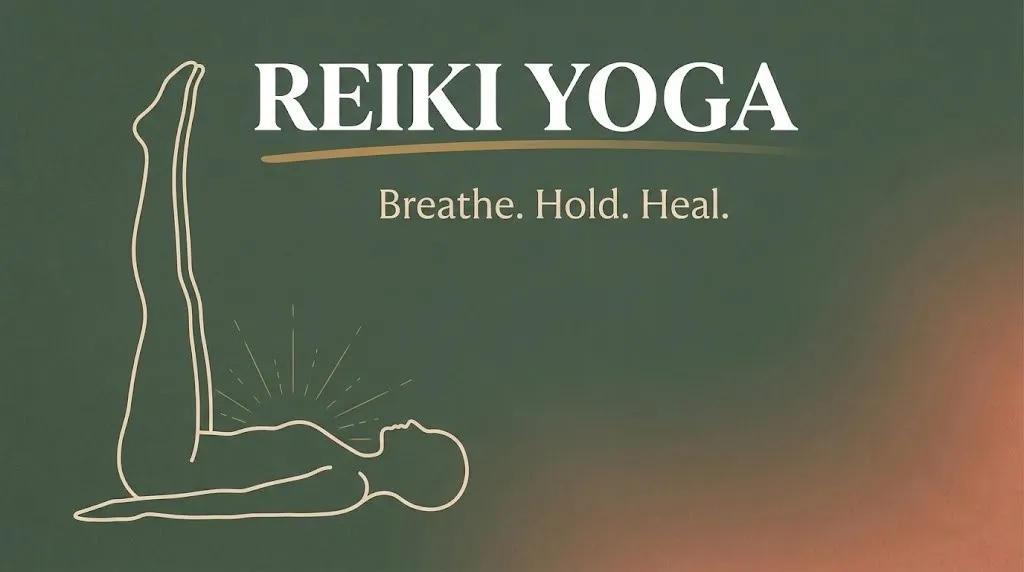
Beginner Reiki Yoga Sequence (30 to 40 minutes):
- Tadasana (Mountain Pose) standing, 2 minutes: Stand with feet hip-width apart. Close your eyes. Place hands on your lower belly. Take 8 slow breaths. Scan from head to feet for held tension.
- Balasana (Child’s Pose), 3 minutes: Kneel and fold forward with arms extended or resting alongside the body. Place one hand on your lower back. Breathe into that space. Modification: place a bolster or folded blanket under your chest for support.
- Setu Bandha Sarvangasana (Bridge Pose), 2 to 3 minutes: Lie on your back. Press feet flat. Lift hips slowly. Rest hands on the lower abdomen or ribcage. Breathe into the chest expansion. Modification: place a block under the sacrum for a supported version.
- Supta Baddha Konasana (Reclining Bound Angle Pose), 4 minutes: Lie on your back with the soles of your feet together and knees falling open. Place one hand on your heart and one on your belly. Breathe slowly. Modification: support each knee with a folded blanket or block.
- Viparita Karani (Legs-Up-the-Wall Pose), 5 minutes: Swing your legs up the wall. Rest arms at your sides or place hands on your lower belly. Breathe without effort. Modification: place a folded blanket under the hips for elevation.
- Savasana (Corpse Pose), 5 to 10 minutes: Lie flat on your back. Arms slightly away from the body, palms facing up. Let go of deliberate breath control. Allow the body to rest completely. Use an eye pillow if available.
Transitioning between poses should take 30 to 60 seconds. Move slowly. No rushing.
Reiki Yoga Poses
The poses that work best in a reiki yoga context share specific qualities: they allow the body to become still, they support the breath, and they create space for internal awareness rather than demanding external effort. Most come from Restorative yoga and Yin yoga traditions.
| Pose | Sanskrit Name | Hold Time | Focus Area | Reiki Hand Placement |
|---|---|---|---|---|
| Child’s Pose | Balasana | 2 to 5 min | Lower back, hips | Lower back or sacrum |
| Legs-Up-the-Wall | Viparita Karani | 5 to 10 min | Nervous system, legs | Lower belly |
| Reclining Bound Angle | Supta Baddha Konasana | 3 to 5 min | Hips, inner groin, heart | Chest and belly |
| Corpse Pose | Savasana | 5 to 15 min | Full body integration | Chest or alongside body |
| Bridge Pose | Setu Bandha Sarvangasana | 1 to 3 min | Spine, hips, chest | Lower ribcage |
| Standing Forward Bend | Uttanasana | 2 to 3 min | Hamstrings, spine | Lower back |
Each pose is chosen for its ability to reduce physical guarding, which is the body’s habitual tension held in response to stress. The psoas major, the deep hip flexor that runs from the lumbar spine to the femur, is a key target in many of these poses. The psoas is sometimes called the “muscle of the soul” in somatic traditions because it responds directly to threat and stress. Releasing it through long-held hip-opening poses has measurable effects on subjective relaxation.
Pose Tip:
- Never force any pose to its maximum range in a reiki yoga context
- Props are not optional extras; they are the practice
- In every pose, find the edge of sensation without crossing into pain
- Beginners: use blocks, blankets, or a bolster in every floor pose until the body is familiar with the shapes
Key Takeaway: The poses in reiki yoga are not about what you look like. They are about creating conditions for the nervous system to slow down. The slower and more supported you are, the more effective the practice becomes.
Reiki Yoga Breathwork
Breathwork in reiki yoga is the primary mechanism through which the practice produces its calming effects. The breath is not ornamental. It is the physiological tool that communicates safety to the nervous system.
Two pranayama techniques are most commonly paired with reiki yoga: Ujjayi (Victorious Breath) and Nadi Shodhana (Alternate Nostril Breathing). Ujjayi involves a gentle throat constriction that creates an ocean-like sound on both the inhale and exhale. This auditory feedback anchors the mind to the present moment and slows the breath rate naturally.
According to the Harvard T.H. Chan School of Public Health, slow breathing at 5 to 6 breaths per minute consistently activates the parasympathetic nervous system and improves HRV. Ujjayi breath, when practiced correctly, naturally slows the breath to approximately this rate.
To practice Ujjayi breath in a reiki yoga session:
- Sit comfortably or lie in Savasana (Corpse Pose).
- Inhale slowly through the nose for 4 counts.
- As you exhale, slightly constrict the back of the throat, creating a soft “hahhh” sound with the mouth closed.
- The exhale should last 5 to 6 counts.
- Continue for 5 to 10 minutes before moving into postures.
Nadi Shodhana (Alternate Nostril Breathing) is used at the close of a session to balance the left and right hemispheres of the nervous system. Research published in the Journal of Alternative and Complementary Medicine has found it associated with reduced anxiety and improved autonomic balance.
Breathwork modification for beginners: If Ujjayi feels forced or creates tension in the throat, simply breathe naturally through the nose and focus on extending the exhale to be one to two counts longer than the inhale. The extended exhale is the key variable. The technique is secondary.
Reiki Yoga for Sleep
Reiki yoga supports sleep quality primarily by reducing physiological and psychological arousal before bed. Poor sleep is frequently driven by an overactive sympathetic nervous system, the “alert” state, that has not successfully downshifted by bedtime. A 20 to 30 minute reiki yoga session in the evening directly targets this mechanism.
A 2020 review in the International Journal of Environmental Research and Public Health found that yoga-based interventions consistently improved sleep onset, duration, and quality across multiple adult populations. The greatest effects were seen in practices that emphasized slow movement, long holds, and conscious breathing over physical exertion.
For sleep-specific reiki yoga, the sequence is simple and should be practiced in dim lighting, ideally within one hour of your target sleep time.
Evening Reiki Yoga for Sleep (25 minutes):
- Supta Baddha Konasana (Reclining Bound Angle Pose), 5 minutes with supported knees. Place hands on the chest. Breathe slowly.
- Viparita Karani (Legs-Up-the-Wall Pose), 8 minutes. Use a folded blanket under the hips. Let the arms rest open.
- Uttanasana (Standing Forward Bend), 3 minutes with soft knees. Rest forearms on the thighs or use blocks.
- Balasana (Child’s Pose), 4 minutes with a bolster under the chest.
- Savasana (Corpse Pose), 5 minutes or until sleep begins.
Use an eye pillow during Savasana if you have one. The gentle weight on the eyelids stimulates the oculocardiac reflex, which slows heart rate. It is a small thing that makes a noticeable difference.
Note: If you experience restless leg syndrome or peripheral neuropathy, Viparita Karani (Legs-Up-the-Wall Pose) may not be appropriate in its full form. A reclined version with the legs resting on a bolster or chair seat is a suitable alternative. Anyone managing a sleep disorder alongside a medical condition should discuss integrative practices with their healthcare provider as part of an overall care plan.
Reiki Yoga for Seniors
Reiki yoga is particularly well-suited to older adults because its emphasis on slow movement, long holds, breath awareness, and props removes the common barriers that prevent seniors from maintaining a regular yoga practice. There is no need for floor-to-standing transitions in every pose, and the entire practice can be adapted for a chair.
According to the American College of Sports Medicine, yoga-based programs for adults over 65 have been shown to improve balance, reduce fall risk, decrease perceived pain, and improve psychological wellbeing. These findings apply directly to the restorative, slow-paced format that defines reiki yoga.
Seated Chair Reiki Yoga for Seniors:
| Pose | Chair Adaptation | Hold Time | Focus Area |
|---|---|---|---|
| Mountain Pose (Tadasana) | Sit tall at chair edge, feet flat | 2 minutes | Posture, breath awareness |
| Forward Fold | Hinge forward from hips, let arms hang | 2 minutes | Lower back, hamstrings |
| Seated Twist | Hand on opposite knee, rotate gently | 90 seconds each side | Thoracic spine, digestion |
| Supported Bridge | Lie on mat, block under sacrum | 2 to 3 minutes | Hips, lower back |
| Chair Savasana | Recline in chair with eyes closed | 5 minutes | Full-body rest |
Breath awareness is the non-negotiable in senior reiki yoga. Even when physical mobility is very limited, the breath practice alone produces the parasympathetic benefits that make this approach worth maintaining. Seniors with osteoporosis should avoid deep forward folds and twists without guidance from a physical therapist familiar with their bone density status. Those with vertigo should skip inversions including Viparita Karani (Legs-Up-the-Wall Pose) and focus on seated and supine poses only.
Key Takeaway: Reiki yoga is genuinely accessible for older adults. A chair, a blanket, and 20 minutes of slow breath-led movement is a complete practice. The slow pace is a feature, not a limitation.
Reiki Yoga for Chronic Pain
Reiki yoga addresses chronic pain through two converging pathways: the physical release of held muscle tension and the neurological downregulation of the pain-threat response. Chronic pain is not simply a tissue injury. Research increasingly shows it involves a sensitized nervous system that amplifies pain signals beyond the original source.
A 2021 systematic review published in Complementary Therapies in Medicine found that slow, mindfulness-based yoga practices reduced chronic low back pain intensity and improved functional movement in adults who had lived with pain for more than three months. The mechanism was partly attributed to reduced cortisol and partly to improved interoceptive awareness, the ability to distinguish between tissue sensation and threat response.
In a reiki yoga context, the hand-placement component plays a specific role. Resting warm hands on a painful area, such as the lower back in Balasana (Child’s Pose) or the hips in Supta Baddha Konasana (Reclining Bound Angle Pose), provides tactile input that can interrupt the pain-attention loop. This is not a cure. It is a practical neurological interrupt that many pain specialists recognize in somatic approaches.
Important: People with fibromyalgia, inflammatory arthritis, or post-surgical recovery should approach reiki yoga under guidance from a physical therapist or an integrative medicine practitioner who can assess safe range of motion and appropriate modifications. The gentleness of the practice is an asset, but it does not mean all poses are appropriate for all pain conditions.
Chronic pain adaptations:
- Use support props under every joint (blocks, bolsters, folded blankets)
- Never push into the sensation of referred pain or nerve pain
- Begin with hold times of 60 to 90 seconds before extending to 2 to 3 minutes
- Prioritize supine poses over standing if weight-bearing is painful
- End every session with at least 10 minutes of Savasana (Corpse Pose)
Restorative Yoga and Reiki
Restorative yoga is the closest structural relative to a full reiki yoga session, and the two practices are most naturally combined. Restorative yoga is a style developed largely through the teachings of B.K.S. Iyengar and popularized in Western practice by Judith Hanson Lasater. It uses props to support the body in passive positions held for 5 to 20 minutes per pose, with the explicit goal of activating deep parasympathetic rest.
When Reiki principles are layered into a Restorative yoga session, the practitioner adds intentional hand placement, extended body scanning, and directed breath awareness to each propped pose. The result is a practice that is even slower and more internally focused than standard Restorative yoga alone.
According to research published in the Journal of Alternative and Complementary Medicine, Restorative yoga demonstrated measurable reductions in subjective fatigue, anxiety, and depressed mood across multiple trials. Combining that framework with Reiki’s attentive presence model deepens the internal focus without adding any physical complexity.
Props commonly used in a Restorative-Reiki session:
- Bolster: supports the chest in Supta Baddha Konasana and the torso in prone or supine poses
- Blankets (2 to 3): folded under the head, knees, or draped over the body for warmth
- Yoga blocks (2): support the knees in hip-opening poses or the sacrum in supported Bridge Pose
- Eye pillow: blocks light and provides gentle oculocardiac pressure during Savasana
- Yoga strap: maintains limb position in long holds without muscular effort
The combination of restorative yoga and reiki is particularly recommended for people returning from illness, people in high-stress life periods, and those in active emotional processing. The practice asks nothing of the body while giving the nervous system everything it needs to reset.
Yin Yoga and Reiki
Yin yoga and reiki yoga share a similar pace and philosophy but target different tissue systems. Yin yoga, developed in its modern Western form by Paul Grilley and Sarah Powers drawing on Taoist principles, targets the connective tissue: fascia, ligaments, and joint capsules. Poses are held for 3 to 5 minutes minimum, and the muscles are intentionally relaxed so stress reaches the deeper layers of the body.
Reiki principles integrate naturally into Yin yoga because both demand the same quality: patient, non-striving attention. In a Yin-Reiki session, the practitioner holds each pose with deliberate awareness of the body area engaged, applying the same scanning and hand-placement principles used in full reiki yoga practice.
| Comparison Point | Yin Yoga | Reiki Yoga | Yin-Reiki Combined |
|---|---|---|---|
| Target tissue | Fascia, ligaments, joints | All systems, energetic focus | Fascia + energetic awareness |
| Hold time | 3 to 5+ minutes | 2 to 5 minutes | 4 to 6 minutes |
| Muscle engagement | Passive (muscles released) | Passive to light | Passive |
| Breath role | Natural, unforced | Deliberate, directed | Deliberate, directed |
| Best for | Joint mobility, fascia health | Stress, energy balance | Stress + deep tissue work |
A key caution: Yin yoga’s long holds in deep hip or spinal positions are not appropriate for everyone. People with hypermobility, sacroiliac joint instability, or recent joint surgery should consult with a physical therapist before committing to 4- to 5-minute deep holds. In a Yin-Reiki practice, “going as deep as possible” is never the goal. Finding the edge and staying there without pushing is.
Key Takeaway: Restorative and Yin yoga are the natural structural homes for Reiki integration. If you already practice either style, adding Reiki awareness requires no new poses, only a shift in attention and the addition of deliberate breath and hand placement.
Reiki Yoga at Home
A home reiki yoga practice is entirely viable and does not require professional certification in Reiki or advanced yoga training. What it requires is a basic understanding of the poses, a few props, a quiet space, and a consistent schedule.
The greatest barrier most people face is not equipment. It is the transition from intention to action. Research on habit formation from behavioral science consistently shows that reducing friction (keeping your mat rolled out, having props within reach) is more predictive of practice consistency than motivation level.
What you need for a home reiki yoga setup:
- A yoga mat (non-slip surface)
- One yoga bolster or two firm bed pillows
- Two yoga blocks (cork or foam)
- Two to three blankets (fleece or cotton)
- An eye pillow (optional but highly recommended)
- A timer or a soft-alarm app to track pose holds
- A quiet space with dim lighting
How to build a consistent home practice:
- Choose a consistent time: morning after waking or evening before bed are most effective based on stress-reduction research.
- Start with 20 minutes, three times per week.
- Use the beginner sequence in this article for your first four weeks.
- After four weeks, extend sessions to 30 to 40 minutes and add one additional pose per week.
- Keep a practice journal: one sentence after each session describing your body’s response. This builds interoceptive awareness over time.
Online audio recordings of guided reiki yoga sessions can be used to support home practice, particularly for beginners who find silence challenging. The guidance anchors attention and reduces the chance of rushing through holds.
Reiki Yoga Contraindications and Safety
Reiki yoga is generally among the gentler and lower-risk physical practices available, but “gentle” does not mean “without consideration.” There are specific conditions and circumstances where modification or medical input is warranted before starting.
According to the NCCIH, both yoga and Reiki are considered low-risk when practiced appropriately, but yoga-related injuries most commonly occur when practitioners push into pain, skip warm-up preparation, or attempt unsupported positions without adequate strength or flexibility.
Conditions that require modification or professional guidance before starting reiki yoga:
- Active or recent spinal disc herniation: deep forward folds and long spinal flexion holds may increase intradiscal pressure; work with a physical therapist on appropriate modifications
- Glaucoma or retinal conditions: inversions including Viparita Karani (Legs-Up-the-Wall Pose) increase intraocular pressure and should be avoided without ophthalmologist clearance
- Pregnancy (second and third trimester): supine positions for extended holds may compress the vena cava; left-lateral lying or supported inclined positions are safer; specialized prenatal yoga guidance is recommended
- Severe osteoporosis: deep forward folds and unsupported twists carry fracture risk; chair-based and supine adaptations are the safer format
- Active inflammatory conditions (flare states): any form of physical yoga is better paused during an inflammatory flare; gentle breath practice can continue
- Acute psychiatric episodes: Reiki’s internal-focus and body-awareness components can be destabilizing during active psychotic or severe dissociative episodes; trauma-informed yoga guidance from a trained professional is recommended in these cases
General safety rules for all reiki yoga practitioners:
- Pain is a stop signal, not something to breathe through
- Tingling, numbness, or sharp sensation in any pose means coming out immediately
- Always support the head, knees, and lower back with props in floor poses
- Warm the body with 3 to 5 minutes of gentle movement before entering long static holds
Frequently Asked Questions About Reiki Yoga
What is reiki yoga and how does it work?
Reiki yoga combines the physical postures and breathwork of yoga with the intentional body awareness and hand-placement principles of Reiki, a Japanese energy-based practice developed by Mikao Usui.
It works by using slow-held yoga poses, conscious breathing, and directed attention to activate the parasympathetic nervous system and reduce physiological and psychological stress.
The yoga component provides the documented physical mechanism; the Reiki component adds a layer of intentional energetic awareness that practitioners report deepens the meditative quality of the practice.
Can I practice reiki yoga at home without a teacher?
Yes, reiki yoga can be practiced at home without a certified teacher, particularly using a beginner sequence of restorative or yin-style poses with deliberate breath and gentle self-directed hand placement.
Starting with a 20 to 30 minute guided audio session or following a structured written sequence helps establish correct hold times and breath patterns before practicing entirely independently.
If you have a health condition, spinal injury, or are new to yoga entirely, beginning with at least two in-person or live-streamed classes helps ensure your alignment and breathing technique are safe before going solo.
What is the best yoga pose for reiki energy healing?
Savasana (Corpse Pose) is widely considered the most effective pose for Reiki integration because it places the body in complete passive rest, allowing full attention to breath, sensation, and energetic awareness without physical effort.
Viparita Karani (Legs-Up-the-Wall Pose) and Supta Baddha Konasana (Reclining Bound Angle Pose) are close alternatives because they support the body fully while opening the chest and hips, which are areas often associated with held tension.
The “best” pose is ultimately the one where your body feels most supported and your breath is most natural.
Is reiki yoga good for anxiety and sleep problems?
Reiki yoga is among the better-supported complementary approaches for both anxiety and sleep, primarily because its slow pace and extended breathwork directly activate the parasympathetic nervous system.
A 2020 review in the International Journal of Environmental Research and Public Health found yoga-based interventions consistently improved sleep quality and reduced anxiety across adult populations, with the strongest effects in slow, restorative formats matching the reiki yoga approach.
It is not a replacement for clinical treatment of anxiety disorders or chronic insomnia, but it is a well-suited adjunct practice that carries low risk and practical daily applicability.
Who should not practice reiki yoga?
People with active spinal disc herniation, glaucoma, uncontrolled high blood pressure, or severe osteoporosis should modify or avoid specific poses within reiki yoga and discuss suitability with a physical therapist or their treating physician as part of their overall care.
People in the second and third trimester of pregnancy should avoid extended supine holds and practice only with a qualified prenatal yoga instructor.
Most other adults can begin a gentle reiki yoga practice safely, with appropriate props and a commitment to staying within a pain-free range of motion.
Start Where You Are
Reiki yoga does not demand flexibility, prior knowledge, or a special certification. It asks only that you slow down, breathe deliberately, and bring genuine attention to your body. That is a practice anyone can begin today.
Roll out your mat, stack two blankets under your knees, and start with five minutes in Supta Baddha Konasana (Reclining Bound Angle Pose). Place one hand on your chest and breathe out for longer than you breathe in. Notice what shifts.
Three sessions per week, 20 to 30 minutes each, is enough to feel a meaningful change in your stress response within four weeks. Start there. Add time and poses as your body asks for more.