Goat Yoga Orlando: 2026 Guide to Classes and What to Expect
Goat yoga Orlando is a real wellness experience where a certified yoga instructor leads a Hatha-style class on a farm while friendly goats wander freely among participants, climbing on mats, nuzzling practitioners, and turning a standard yoga session into something genuinely unlike anything in a studio. If you’re wondering whether it’s worth doing and what actually happens when you get there, this guide answers every question before you book.
The experience is more than novelty. Research published in Frontiers in Psychology found that brief, positive interactions with animals reduce cortisol levels and increase oxytocin, the bonding hormone linked to feelings of calm and social connection. Adding those effects to a yoga class creates a physiological response that is measurably different from practicing alone on a studio mat.
This guide covers where to find goat yoga in and near Orlando, what Alaska Farms offers, which poses you’ll practice, how to prepare for your first class, and whether it suits beginners, seniors, kids, and everyone in between. Everything here is based on real yoga instruction principles and documented animal-interaction research, not travel-blog impressions.
Goat Yoga Orlando: What the Experience Actually Involves
Goat yoga Orlando is an outdoor yoga class held on a working farm, led by a certified yoga instructor, with Nigerian dwarf or pygmy goats roaming freely throughout the session.
The class itself is yoga. A real instructor leads real poses with real alignment cues. The difference from a studio class is the environment: open air, grass underfoot, farm sounds surrounding you, and goats that have been socialized to be comfortable around people, mats, and the slow deliberate movements of yoga practice.
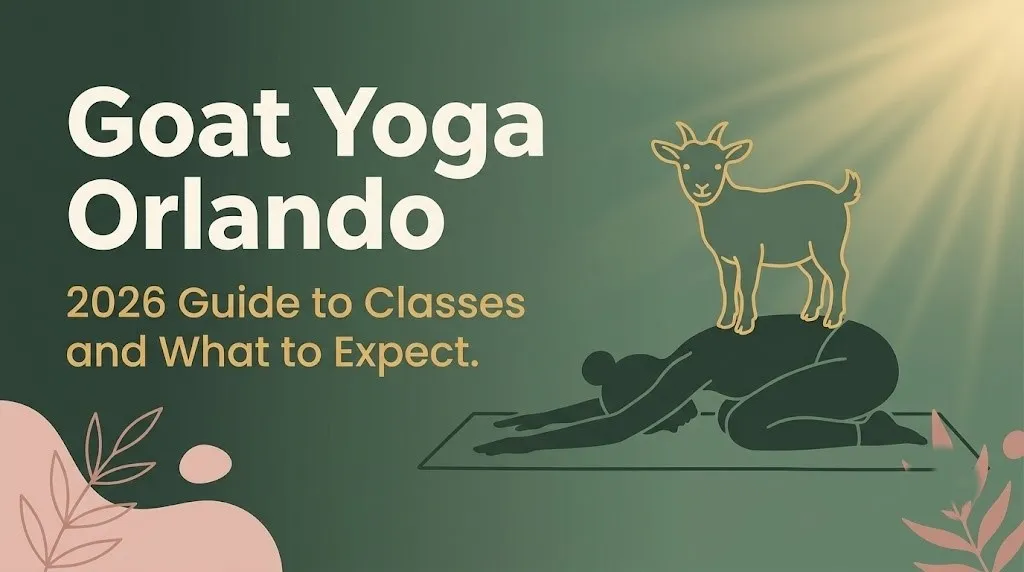
The goats are not passive decorations. They explore freely. They may step on your mat, nudge your shoulder during Balasana (Child’s Pose), or stand on your back when you’re on all fours in Marjaryasana (Cat Pose). That unpredictability is part of what makes goat yoga different from any controlled studio experience. You cannot plan for a goat. You can only respond with patience and humor.
Classes in the Orlando area typically run 45 to 60 minutes, followed by 15 to 20 minutes of open time for photos and goat interaction. Group sizes vary by venue, but most Orlando-area goat yoga experiences cap attendance at 20 to 30 participants per session to ensure individual goat interaction for everyone.
Quick Summary:
- Duration: 45 to 60 minutes of yoga, 15 to 20 minutes of post-class goat time.
- Setting: Outdoor farm, grass surface, open air.
- Instructor: Certified yoga teacher leading structured poses.
- Goats: Socialized Nigerian dwarf or pygmy goats; free-roaming throughout class.
What Is Goat Yoga?
Goat yoga is a yoga class format where live goats interact freely with participants during a standard yoga session, combining the physical and mental benefits of yoga with the documented stress-reducing effects of animal interaction.
The practice originated in 2016 at a farm in Oregon when yoga instructor Lainey Morse combined her goats’ natural friendliness with a yoga class format. The concept spread quickly because it addressed something that traditional yoga classes sometimes don’t: the removal of self-consciousness and performance anxiety. It’s hard to take yourself too seriously when a goat is chewing on your hair.
The yoga component is typically Hatha yoga, the most accessible and widely taught style. Hatha classes move at a pace that allows participants to hold poses long enough for alignment cues to land, which matters in an outdoor setting with distractions. The slower pace also makes the experience genuinely enjoyable rather than exhausting for participants who are primarily there for the animal interaction.
From a physiological standpoint, goat yoga is a legitimate yoga practice with added animal-interaction benefits layered on top. The parasympathetic nervous system responds to both gentle yoga movement and positive animal contact. Running both activators simultaneously deepens the overall calming response.
Modification note: The Hatha-based format used in most goat yoga classes is appropriate for participants who have never practiced yoga before. No prior experience is expected or required at any Orlando-area goat yoga venue.
Goat Yoga Florida: Where to Find Classes in 2026
Goat yoga Florida options are concentrated in Central Florida, with several farms within a 30-to-60-minute drive of downtown Orlando offering regular outdoor sessions throughout the year.
Florida’s climate makes year-round outdoor yoga practical in ways that northern states cannot match. The challenge in Central Florida is heat and humidity, particularly from June through September. Most Florida goat yoga venues schedule their sessions in the early morning, between 8:00 a.m. and 10:00 a.m., to avoid the midday heat that would make an outdoor class uncomfortable for both participants and goats.
The goat yoga scene in Florida has grown since 2019 and continues to expand. Venues range from established working farms with permanent yoga infrastructure (covered areas, mats provided, restroom access) to smaller hobby farms that offer seasonal pop-up sessions. The quality of the yoga instruction varies significantly between venues.
What to look for in a Florida goat yoga venue:
- Certified yoga instructor with a Yoga Alliance RYT-200 credential or higher
- Shade or covered area for the class, especially in summer months
- Socialized goats that have been habituated to people and class settings
- Early morning scheduling to avoid Florida’s peak heat hours
- Sanitation facilities on-site (restrooms, hand washing stations)
- Clear booking and cancellation policy in case of weather changes
Key Takeaway: Goat yoga in Florida is most enjoyable when booked for early morning sessions at venues with certified instructors and properly socialized animals. The experience is genuinely wellness-oriented, not just a photo opportunity, when the yoga instruction is credible.
Goat Yoga at Alaska Farms: What You Need to Know
Goat yoga at Alaska Farms is one of the most well-known goat yoga experiences in the Central Florida area, offering outdoor sessions on a working farm setting within reasonable driving distance of Orlando.
Alaska Farms has established itself as a go-to goat yoga destination for Orlando-area residents because of its accessible location, regular class schedule, and the farm’s genuine agricultural identity. The goats at Alaska Farms are farm-raised, socialized from birth to be comfortable around people, and managed by farm staff who understand animal welfare alongside the class experience.
Booking at Alaska Farms typically happens online in advance. Sessions sell out, particularly on weekends and during tourist-heavy seasons in Central Florida. Spring break, holiday weekends, and bachelorette party bookings fill quickly. If you’re planning to attend with a group, booking two to four weeks ahead is a practical minimum.
What Alaska Farms goat yoga typically includes:
- Mat use included (bring your own if you prefer your personal mat)
- Open-toed footwear not recommended on farm surfaces (more on this in the gear section)
- Photography encouraged during both the class and the open interaction period
- No prior yoga experience required
- Age minimums vary by session (confirm at booking for specific class age policies)
The farm setting means outdoor conditions apply. Florida weather can shift quickly. Most Alaska Farms sessions proceed unless there is active lightning or severe storm warning. Light rain typically does not cancel sessions.
Yoga With Goats Orlando: How the Class Is Structured
A yoga with goats Orlando class follows a structured sequence led by a certified instructor, typically beginning with grounding breathwork, moving through a standing and floor pose sequence, and closing with a guided relaxation while goats continue to roam.
The structure mirrors a standard Hatha yoga class in both pacing and content. The instructor sets the intention, guides breath awareness, and leads participants through a sequence of poses appropriate for all levels. What makes the structure different is the instructor’s built-in flexibility, literally and figuratively, to pause, acknowledge a goat moment, and return to the sequence without losing the class.
A typical goat yoga Orlando class structure looks like this:
| Class Phase | Duration | What Happens |
|---|---|---|
| Welcome and centering | 5 minutes | Breathwork, intention setting, goat introductions |
| Warm-up sequence | 10 minutes | Gentle spinal movement, Cat-Cow, seated stretches |
| Standing pose sequence | 15 to 20 minutes | Warrior poses, balance poses, hip openers |
| Floor pose sequence | 10 to 15 minutes | Child’s Pose, Downward Dog, gentle backbends |
| Relaxation | 5 to 10 minutes | Savasana or seated meditation |
| Open interaction | 15 to 20 minutes | Free time with goats, photos, feeding if offered |
The relaxation phase, Savasana (Corpse Pose), is typically the most memorable part of a goat yoga class. Lying flat on your back with eyes closed while goats approach and occasionally stand nearby creates a uniquely grounding sensory experience that no studio class replicates.
Goat Yoga Benefits: What Research Says About Animals and Wellness
Goat yoga benefits include the combined effects of physical yoga practice and the well-documented psychological benefits of positive human-animal interaction, particularly reduced cortisol and increased oxytocin.
The yoga component delivers what yoga always delivers: improved flexibility through sustained stretching of the hamstrings, hip flexors, and thoracic spine, core activation through balance-demanding poses, and activation of the parasympathetic nervous system through breath regulation. These are not small or speculative benefits. The National Center for Complementary and Integrative Health (NCCIH) has reviewed substantial evidence supporting yoga’s role in stress reduction, pain management, and improved sleep quality.
The animal interaction layer adds something distinct. Oxytocin, the neuropeptide associated with social bonding and feelings of safety, is released during positive physical contact with animals, including simply being near them in a calm setting. A 2019 study published in Frontiers in Psychology found that participants who interacted with animals for as little as 10 minutes showed measurable reductions in cortisol compared to control groups who did not interact with animals.
Goat yoga delivers both stimuli simultaneously. You’re holding Virabhadrasana II (Warrior II) while a goat nudges your elbow. Your body is doing yoga work. Your nervous system is also receiving the calming signal of animal proximity. Both things are happening at once.
Documented goat yoga benefits include:
- Cortisol reduction from combined yoga and animal interaction
- Oxytocin release from proximity and contact with goats
- Improved mood through novelty, laughter, and sensory engagement
- Flexibility gains from Hatha-style pose sequences
- Social connection in group class settings with a shared unusual experience
Key Takeaway: Goat yoga’s benefits are backed by separate bodies of research on yoga and on animal-assisted interaction, and the evidence suggests the combination is more effective for stress reduction than either activity alone.
Animal Assisted Yoga Benefits: The Science Behind the Smiles
Animal assisted yoga benefits are grounded in the documented field of animal-assisted activities (AAA), where trained or farm-socialized animals are present during therapeutic or wellness sessions to enhance the physiological and psychological outcomes of the activity.
The field of animal-assisted intervention is well-established in clinical settings, particularly for anxiety, depression, and post-traumatic stress. The Human-Animal Interaction Bulletin, published by the American Psychological Association, documents the growing evidence base for how animal contact influences mood, social behavior, and stress physiology in healthy adults.
The mechanism is partly autonomic. Petting or being near calm animals stimulates the vagus nerve, the primary nerve of the parasympathetic system. Vagal stimulation slows heart rate, reduces blood pressure, and creates the physiological conditions that yogic breathwork also targets. The two approaches converge on the same nervous system pathway, which is why animal-assisted yoga appears to produce deeper relaxation than yoga alone in several preliminary studies.
Goats specifically are well-suited to this role for practical reasons. They are small enough not to intimidate participants, social enough to approach people voluntarily, and curious enough to provide constant gentle engagement without aggressive behavior when properly socialized. Nigerian dwarf and pygmy goats, the breeds most commonly used in goat yoga, are particularly known for their calm, friendly temperament.
According to the American Journal of Public Health, exposure to animals in structured activity settings is associated with reduced systolic blood pressure and lower self-reported anxiety. These effects are measurable within a single session, which is the duration of most goat yoga classes.
Is Goat Yoga a Real Workout?
Goat yoga is a light to moderate workout equivalent to a beginner Hatha yoga class, providing meaningful benefits for flexibility, balance, and stress reduction, but not an aerobic or strength-training substitute.
Honest answer: if you’re looking for cardiovascular conditioning or progressive muscle loading, goat yoga is not your primary training tool. A well-structured Vinyasa or Ashtanga class delivers substantially more physical demand. Goat yoga’s Hatha base prioritizes accessibility, which means the intensity stays low to moderate throughout the session.
What goat yoga does deliver physically:
- Flexibility training through sustained holds in poses targeting the hips, hamstrings, and spine
- Balance training through standing poses like Vrksasana (Tree Pose) on a grass surface, which adds instability compared to a studio floor
- Core engagement in poses like Phalakasana (Plank Pose) and Marjaryasana-Bitilasana (Cat-Cow)
- Light muscular activation in the legs, shoulders, and core during standing sequences
The American College of Sports Medicine (ACSM) defines moderate-intensity exercise as activity requiring 3 to 6 METs (metabolic equivalents). A Hatha yoga session falls at roughly 2.5 to 3.5 METs, placing it at the low end of moderate intensity. For sedentary individuals or those returning from a break in activity, that’s a meaningful starting point.
Think of goat yoga like a pleasantly challenging walk in a park versus a running workout. It’s real exercise. It’s just not the highest-intensity tool in the wellness toolkit, and it doesn’t need to be.
Goat Yoga Poses: What You’ll Practice on the Mat
Goat yoga classes use standard Hatha yoga poses adapted for outdoor surfaces and participant experience levels, with particular emphasis on poses that keep the body accessible to goat interaction.
The poses in a goat yoga class are not special or goat-specific. They’re the foundational poses of Hatha yoga, selected because they are safe for all levels, hold-able for multiple breaths, and structured in ways that make goat interaction natural rather than disruptive.
Here are the poses most commonly practiced in goat yoga Orlando sessions:
| Pose (Sanskrit) | Pose (English) | Why It Works in Goat Yoga |
|---|---|---|
| Marjaryasana-Bitilasana | Cat-Cow | All-fours position invites goats to walk on the back |
| Balasana | Child’s Pose | Back surface accessible; deeply calming |
| Adho Mukha Svanasana | Downward Facing Dog | Goats often walk beneath; creates a “tunnel” effect |
| Virabhadrasana I | Warrior I | Standing pose; goats often circle participants |
| Virabhadrasana II | Warrior II | Wide-legged stance; goats explore the open space between legs |
| Vrksasana | Tree Pose | Balance challenge amplified by goat-proximity distraction |
| Savasana | Corpse Pose | Lying position; goats often approach resting practitioners |
To practice Balasana (Child’s Pose) safely on a grass surface:
- Kneel on your mat with knees wider than hip-width to accommodate any firmness in the ground below.
- Sink the hips back toward the heels. If hips don’t reach heels, place a folded blanket between the thighs and calves.
- Walk hands forward until arms extend, forehead resting on the mat or on stacked fists.
- Breathe slowly for 5 to 8 breaths. Let the back relax and broaden.
- Stay present. If a goat steps on your back, the weight is light and typically calming.
Modification note: Practitioners with knee sensitivity should use a folded blanket under the knees on grass surfaces and keep the knees only as wide as comfortable.
Key Takeaway: The poses in goat yoga are real yoga poses, practiced with real alignment principles. The goats don’t replace the instruction; they add an unpredictable, sensory-rich layer to a legitimate Hatha practice.
Goat Yoga for Beginners: What to Know Before You Go
Goat yoga is one of the most beginner-friendly yoga formats available because the playful environment removes self-consciousness, the Hatha pacing allows time for adjustment, and no prior yoga experience is expected.
First-time yogis often avoid studio classes because they worry about looking inexperienced. Goat yoga eliminates that concern entirely. When a goat is wandering across your mat, everyone in the class is equally distracted and equally delighted. The normal social anxiety of a yoga class disappears because the shared absurdity of the situation creates immediate solidarity.
The poses are accessible. A good goat yoga instructor will offer modifications throughout, including seated versions of standing poses, chair support where available, and verbal guidance that assumes no prior knowledge. Beginners do not need to know Sanskrit pose names, have any flexibility, or own yoga gear in advance. Most venues provide mats.
What beginners should keep in mind:
- You will not be judged. Everyone is there primarily to interact with goats.
- Modifications are normal and expected. Ask the instructor for options if any pose feels uncomfortable.
- Listen to your body. Outdoor surfaces are less predictable than studio floors. Slow down in any balance pose if you feel unsteady.
- The instructor will lead. Follow verbal cues. Don’t worry about watching others’ form.
The only genuine beginner caution in goat yoga is the outdoor surface. Grass and packed earth change the proprioceptive demands of standing poses. New practitioners should widen their stance slightly in standing poses and stay close to their mat for grounding reference.
What to Wear to Goat Yoga
Wear comfortable, form-fitting athletic clothing that covers the knees and most of the legs to goat yoga, and choose closed-toe shoes or clean bare feet for the actual class.
Florida’s heat makes this advice feel counterintuitive. The instinct is to wear as little as possible outdoors in summer. But goat yoga adds two variables that change the clothing equation: the animals and the farm surface.
Goats have hooves. Those hooves are small but firm. If a goat steps on your bare shin, it registers. Leggings that cover the legs to the ankle protect the skin from hoof pressure, small scrapes from farm surfaces, and grass irritation during floor poses.
What to wear:
- Leggings (full-length or at least to the mid-calf): protection from hooves, grass, and UV exposure during outdoor class
- Fitted top: a loose shirt rides up during forward folds and becomes a goat chew toy during floor poses
- Sports bra with minimal hardware: the all-fours and floor poses put pressure on the chest; padded underwire is uncomfortable on grass
- Closed-toe athletic shoes or sneakers to the farm: bare feet or grip socks on the mat during the actual class
- Hat or visor: Florida sun during morning outdoor sessions requires UV protection for the head and face
- Sunscreen applied before arrival: apply at least 15 minutes before class starts
What to avoid:
- Shorts (hoof contact on bare legs; grass irritation during floor poses)
- Open-back or strappy tops (goats are curious; loose straps get nibbled)
- Sandals or flip-flops on farm surfaces (uneven ground and animal waste create real trip and sanitation risks)
Goat Yoga What to Expect: A Class Walkthrough
Arriving at a goat yoga Orlando session, you can expect a farm check-in, mat setup on a designated outdoor area, an introduction to the goats, a 45 to 60 minute guided Hatha yoga class, and a post-class open interaction period.
The arrival experience is different from a studio. You’ll check in at a farm entrance or outdoor table rather than a reception desk. Staff or volunteers will direct you to the mat setup area. Mats are usually pre-laid or available to borrow. You choose a spot, remove your shoes, and settle in before class begins.
The instructor will introduce the goats before the session starts. This usually includes a brief explanation of the animals’ names, their temperament, and the ground rules for the class: no picking up the goats, no loud noises that might startle them, and no feeding from personal items (feeding is typically reserved for the post-class period if offered).
During the class, goats roam freely. They don’t follow instructions. They may ignore you entirely for ten minutes and then decide your mat is the most interesting place on the farm. Both outcomes are fine. The instructor continues leading poses regardless, and participants learn quickly that yoga with unpredictable interruptions is actually a surprisingly effective mindfulness practice.
Post-class open interaction is where most of the phone photography happens. This period usually runs 15 to 20 minutes and allows participants to feed, pet, and photograph the goats without the structure of the yoga session.
Key Takeaway: Goat yoga is a genuinely structured yoga class with a certified instructor, real poses, and a documented physiological rationale. It’s not just a photo opportunity; the combination of Hatha yoga and animal interaction creates measurable stress-reduction effects that standard studio classes don’t replicate in the same way.
Goat Yoga Tips for First Timers
First-time goat yoga participants should arrive early, apply sunscreen before class, leave expectations for a perfect yoga practice at the car, and bring a spirit of patience and humor.
The single most common mistake first-timers make is approaching goat yoga with the same mindset they bring to a studio class. Goat yoga is yoga and it is also unpredictable animal-assisted chaos, and the sooner you accept both things simultaneously, the more you’ll enjoy it.
Practical first-timer tips:
- Arrive 10 to 15 minutes early. Farm check-in takes longer than studio check-in. Give yourself time to settle before class begins.
- Apply sunscreen before you leave home. Sunscreen applied in a farm setting contaminates water and animal areas. Do it before you arrive.
- Bring water. Most farm venues are outdoors with limited shade. Florida mornings are humid. Hydrate before, during, and after.
- Leave valuables in your car. Goats are curious and persistent. Phones, wallets, and jewelry left on mats become targets for investigation.
- Lower your expectations for physical challenge. Goat yoga is a wellness experience, not a training session. Enjoy the light intensity for what it is.
- Dress appropriately for Florida heat. Lightweight, coverage-appropriate clothing beats full-coverage heavy fabric in humidity.
- Tell the instructor about injuries or limitations before class. Farm surfaces change the demands of outdoor poses, and the instructor can offer modifications.
One thing almost every first-timer agrees on: the post-class goat interaction time is worth staying for. Budget the full session time plus the interaction period into your schedule. Leaving early means missing the part most people remember longest.
Goat Yoga for Kids Orlando: Is It Family Friendly?
Goat yoga Orlando is generally family-friendly for children ages 5 and older, though age policies vary by venue and individual class type.
Children tend to love goat yoga more than adults. The absence of performance pressure, the tangible excitement of animal interaction, and the physical accessibility of Hatha poses make the experience naturally suited to younger participants. A child who would never sit still in a studio yoga class will often hold Balasana (Child’s Pose) patiently for an entire minute when a goat is sitting nearby.
The practical considerations for bringing children:
- Age minimums vary. Most Orlando-area goat yoga venues set minimum ages between 5 and 8 years. Confirm the specific age policy when booking.
- Children must be supervised. Even at venues that welcome children, a parent or guardian should stay beside the child throughout the class.
- Smaller children may be startled. Goats can move quickly and unexpectedly. Introduce children to the animals calmly before the class begins to reduce any anxiety.
- Sun protection is non-negotiable. Children’s skin burns faster than adults’ in Florida’s morning sun. Apply SPF 30 or higher before arriving.
| Age Group | Suitability for Goat Yoga | Key Consideration |
|---|---|---|
| Under 5 | Generally not recommended | Most venues set 5+ minimum; attention span and goat-safety concerns |
| 5 to 8 years | Suitable with parent beside them | Some venues require adult-to-child ratio |
| 9 to 12 years | Well-suited | Can follow instructions independently; highly engaged |
| 13 and up | Fully suitable | Can participate as independent attendees at most venues |
Goat yoga is also a strong option for family birthday experiences, school group outings, and summer holiday activities in the Central Florida area.
Goat Yoga vs Regular Yoga: Key Differences
Goat yoga and regular studio yoga share the same foundational poses and instructor-led format, but differ in environment, physical intensity, predictability, and the psychological dimension of the experience.
Regular yoga, practiced in a studio on a clean flat surface with controlled temperature and lighting, is the more controlled environment. The instructor’s cues land cleanly. You can focus on alignment. The progression of difficulty across weeks and months is trackable. Studio yoga is the better format for building a consistent, skill-developing practice.
Goat yoga serves a different purpose. It is a wellness experience with measurable benefits, but the format is not designed for progressive skill development. You won’t go to goat yoga to refine your Natarajasana (Dancer Pose) or advance your Sirsasana (Headstand). The presence of animals makes sustained concentration on complex poses impractical. That’s the design, not a flaw.
| Dimension | Regular Studio Yoga | Goat Yoga |
|---|---|---|
| Environment | Indoor, controlled, predictable | Outdoor farm, variable, unpredictable |
| Physical intensity | Low to high depending on style | Low to moderate (Hatha-based) |
| Animal presence | None | Central to the experience |
| Stress reduction mechanism | Yoga breathwork and parasympathetics | Yoga plus oxytocin from animal interaction |
| Skill development | Progressive over time | Not designed for progression |
| Social experience | Structured class community | Shared novelty, high laughter index |
| Best for | Regular practice, skill building | Wellness events, stress relief, beginners, groups |
The honest recommendation: use regular yoga for your weekly practice. Use goat yoga for what it genuinely does well: a joyful, research-supported, animal-assisted wellness experience that resets stress hormones and reminds you that movement doesn’t have to be serious to be meaningful.
Frequently Asked Questions About Goat Yoga Orlando
What is goat yoga and how does it work?
Goat yoga is a Hatha yoga class held outdoors on a farm where socialized goats roam freely among participants during the session.
A certified yoga instructor leads the class through standard poses while goats interact with participants, walk on mats, and occasionally climb on practitioners in positions like Child’s Pose or Cat-Cow.
The combination of yoga and animal contact produces measurable stress reduction through both the yoga practice and the oxytocin response triggered by positive animal interaction.
Is goat yoga good for beginners with no yoga experience?
Yes, goat yoga is one of the most accessible formats for absolute beginners because the playful environment removes self-consciousness and the Hatha-style pacing allows time for instruction and adjustment.
No prior yoga experience, flexibility, or equipment is required at most Orlando-area venues, and instructors offer modifications throughout the class.
The shared novelty of the animal experience creates immediate social ease, making it much less intimidating than a traditional studio class for first-time yoga participants.
What should I wear to goat yoga in Florida?
Wear full-length or mid-calf leggings, a fitted top, and closed-toe shoes for the walk to the mat area in Florida goat yoga sessions.
Florida’s heat makes light clothing appealing, but full leg coverage protects against goat hooves, grass irritation, and UV exposure during the outdoor morning session.
Apply SPF 30 or higher sunscreen before leaving home, bring water, and wear a hat or visor for sun protection during the class.
Can kids do goat yoga in Orlando?
Most Orlando-area goat yoga venues welcome children ages 5 and older, though specific age minimums vary by venue and class type.
Children are well-suited to goat yoga because the animal interaction holds their attention, the poses are accessible without prior experience, and the outdoor farm setting is naturally engaging for younger participants.
Parents should confirm the age policy when booking, apply sunscreen before arrival, and stay beside younger children throughout the session.
Is goat yoga actually a good workout or just for fun?
Goat yoga delivers real physical benefits equivalent to a beginner Hatha yoga class, including flexibility training, light core engagement, and balance work, but it is not a high-intensity aerobic or strength workout.
The American College of Sports Medicine (ACSM) places Hatha yoga at roughly 2.5 to 3.5 METs, which qualifies as light to low-moderate exercise, appropriate for sedentary individuals or those returning to movement.
For regular physical conditioning, goat yoga works best as a complementary wellness activity alongside a more demanding exercise routine rather than as a standalone workout.
Roll Out Your Mat and Meet the Goats
Goat yoga Orlando is worth doing at least once. Not because it will replace your regular practice, but because it does something your studio mat cannot: it makes yoga feel like play again.
Book an early morning session at Alaska Farms or another Central Florida venue. Wear your leggings. Apply your sunscreen. Lower your expectations for a perfect practice and raise them for an experience that will stick with you longer than most studio classes.
The goat that climbs on your back during Child’s Pose is not a distraction. It’s the practice.