Hot Yoga 8 Poses: Benefits, Safety & How to Start 2026
Hot yoga 8 refers to an 8-pose sequence practiced in a heated studio, typically between 80 and 105 degrees Fahrenheit, designed to build flexibility, cardiovascular endurance, and mental focus in a single session. Whether you’re stepping into a heated room for the first time or refining a series you’ve been practicing for months, understanding the structure and science behind these poses makes every class safer and more effective.
According to the National Center for Complementary and Integrative Health (NCCIH), yoga practice in general is associated with improvements in pain, stress, and overall physical function, and practicing in heat adds a layer of cardiovascular demand that research continues to examine closely. A 2018 study published in the Journal of Alternative and Complementary Medicine found that hot yoga significantly improved glucose tolerance and lower-body strength in sedentary adult participants after eight weeks.
This article walks you through every element of hot yoga 8: the exact poses and how to perform them, the research on benefits, who should modify or skip certain poses, how to hydrate and prepare, and how hot yoga compares to practicing at room temperature. You’ll come away knowing exactly what to expect and how to approach it safely.
What Is Hot Yoga 8?
Hot yoga 8 is an 8-pose foundational series practiced in a room heated between 80 and 105 degrees Fahrenheit, designed to warm the muscles rapidly and challenge the body’s thermoregulatory system while building strength and balance.
The “8” in hot yoga 8 refers to the number of core poses in the sequence. Some studios use it as an introductory program: eight total classes designed to help beginners master the foundational postures of heated yoga practice. Other studios structure it as a focused 45 to 60 minute class built around eight signature poses drawn from the broader Bikram yoga or 26 and 2 tradition.
Hot yoga itself is an umbrella term. It includes Bikram yoga (a strict 26-pose, 2-breathing-exercise series practiced at exactly 105 degrees and 40 percent humidity), as well as studio-branded heated classes that vary in temperature and pose selection. Hot yoga 8 typically pulls from the same foundational posture bank as Bikram yoga but distills it into a shorter, more accessible format.
It’s worth being specific here: hot yoga and Bikram yoga are not the same thing, even though they overlap. Bikram yoga has a fixed sequence and environment. Hot yoga 8 is more flexible in structure, though the poses often come from the same Hatha yoga tradition.
Quick Summary:
| Format | Poses | Temperature | Duration |
|---|---|---|---|
| Bikram Yoga (26 and 2) | 26 poses, 2 breathing exercises | 105°F / 40% humidity | 90 minutes |
| Hot Yoga 8 | 8 core poses | 80 to 105°F | 45 to 60 minutes |
| Standard Hot Vinyasa | Varies | 80 to 95°F | 60 minutes |
Hot Yoga 8 Poses and Their Names
The 8 poses in a standard hot yoga 8 series cover standing balance, forward folding, backbending, and complete rest, giving the whole body a structured workout from feet to spine.
These are the eight postures most commonly featured across hot yoga 8 programs, listed with their Sanskrit and English names:
- Tadasana (Mountain Pose): The standing foundation. Grounds the feet, activates the postural muscles, and establishes breath before the series begins.
- Utkatasana (Chair Pose): A deep squat-like hold targeting the quadriceps, gluteus maximus, and core stabilizers. Builds lower body strength under heat-driven cardiovascular demand.
- Virabhadrasana I (Warrior I): A lunging posture engaging the hip flexors, quadriceps, and shoulder girdle. Builds strength and stability through the entire kinetic chain.
- Trikonasana (Triangle Pose): A lateral stretch targeting the hamstrings, obliques, and IT band. Opens the thoracic spine and improves lateral mobility.
- Dandayamana Janushirasana (Standing Head to Knee Pose): A one-legged balance that challenges hamstring flexibility, core control, and hip stability simultaneously.
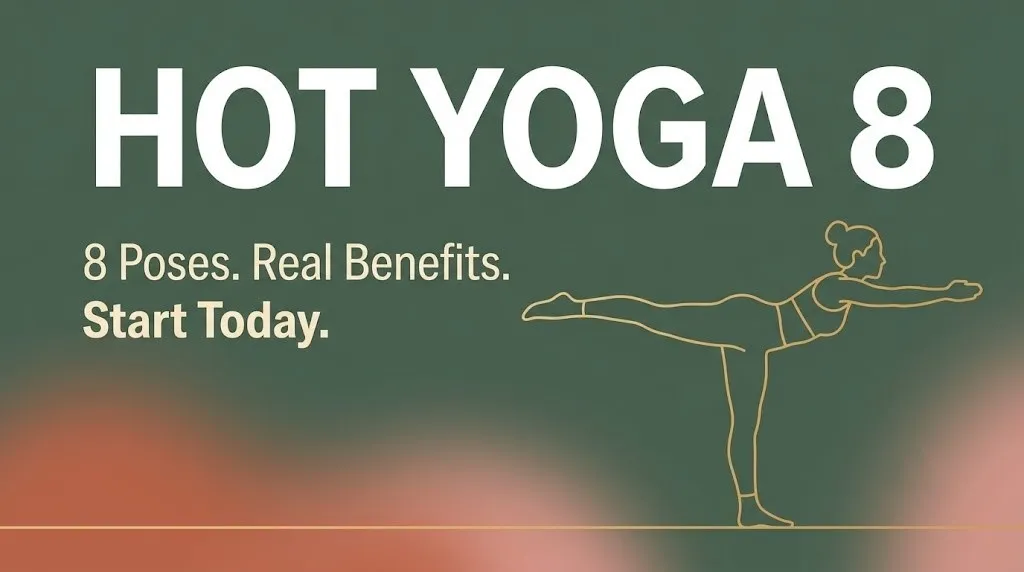
- Tuladandasana (Balancing Stick Pose): A horizontal balance targeting the erector spinae, hamstrings, and posterior deltoids. Requires full-body tension and breath control.
- Bhujangasana (Cobra Pose): A prone backbend activating the erector spinae and rhomboids, counterbalancing forward folds and improving spinal extension.
- Savasana (Corpse Pose): Mandatory rest between and after active poses. Allows the nervous system to integrate work done, lower heart rate, and prevent heat-related stress.
Best Hot Yoga Poses for Beginners
For beginners, the most accessible hot yoga 8 poses are Tadasana (Mountain Pose), Bhujangasana (Cobra Pose), and Savasana (Corpse Pose), because they require the least balance and joint mobility while still delivering measurable physical benefit.
Beginners often assume the standing balance poses like Dandayamana Janushirasana (Standing Head to Knee Pose) are where the real work happens. That’s partially true. But for someone new to a heated room, the most important poses to master first are the ones that teach body awareness, breath control, and heat tolerance simultaneously.
Tadasana (Mountain Pose) looks simple. In a hot room, standing still with active posture while managing breathwork at 95 degrees is genuinely demanding. Getting comfortable with stillness in the heat before adding complexity pays dividends in every subsequent pose.
Pose Tip for Beginners:
- In Utkatasana (Chair Pose), keep your weight in your heels, not your toes. Push the knees back and keep the chest lifted.
- In Trikonasana (Triangle Pose), rest your lower hand on a yoga block rather than reaching the floor. This preserves spinal alignment without forcing range of motion.
- In Dandayamana Janushirasana (Standing Head to Knee Pose), hold the standing pose without the forward fold at first. Build single-leg balance before attempting the full expression.
How to Do a Hot Yoga Sequence Step by Step
A properly structured hot yoga 8 sequence moves from grounding and standing poses to balance, folding, backbending, and finally supine rest, each section building on the physical preparation of the one before it.
To practice the full hot yoga 8 series:
- Arrive 5 minutes early. Sit quietly on your mat. Let your body acclimate to the room temperature before the class begins.
- Begin in Tadasana (Mountain Pose). Stand with feet together, arms at your sides. Press all four corners of the feet into the mat. Take 5 full breath cycles here.
- Move into Utkatasana (Chair Pose). Inhale and sweep arms overhead. Exhale and sit the hips back and down. Hold for 5 to 8 breath cycles. Rise on an inhale.
- Step back into Virabhadrasana I (Warrior I). Ground the back foot at a 45-degree angle. Square the hips forward as much as your body allows. Hold 5 breaths per side.
- Transition to Trikonasana (Triangle Pose). Widen the stance. Open arms to a T-shape. Reach the front hand toward the shin or a block. Hold 5 breaths per side.
- From standing, shift to Dandayamana Janushirasana (Standing Head to Knee Pose). Shift weight to one foot. Hold the raised foot with interlaced hands. Keep the standing leg straight. Hold 5 to 10 breaths per side.
- Come to standing, arms wide for Tuladandasana (Balancing Stick Pose). Hinge forward at the hip, extending one leg back until the body forms a T-shape. Hold 10 seconds.
- Lower to the floor. Press into Bhujangasana (Cobra Pose). Elbows slightly bent, chest lifted, gaze slightly forward. Hold 3 to 5 breaths.
- Lower completely. Rest in Savasana (Corpse Pose) for a minimum of 2 minutes. Do not skip this step.
Modification for limited mobility: In step 4 through 6, use a yoga strap looped around the foot to replace the grip of the hands. This maintains alignment without forcing end-range hamstring flexibility.
Key Takeaway: In hot yoga 8, the progression from grounding to balance to backbend to rest is intentional: each section prepares the body for the next demand. Skipping Savasana in a heated class is not just ineffective, it’s a genuine physiological risk.
Hot Yoga Breathing Techniques
Breath control is the single most underrated skill in hot yoga 8: how you breathe directly determines how well you tolerate heat, sustain balance, and recover between poses.
The primary breath technique used in hot yoga is Ujjayi Pranayama, sometimes called “ocean breath” or “victorious breath.” You create a slight constriction at the back of the throat, breathing through the nose only. The result is a soft audible sound and a slower, more controlled breath cycle. This technique activates the parasympathetic nervous system, which counteracts the physiological stress response the heat naturally triggers.
According to research published in the International Journal of Yoga, Ujjayi breathing is associated with reduced heart rate and lower perceived exertion during physically demanding yoga practice. In a hot room, this effect becomes practically significant because perceived heat stress and actual physiological heat stress are both influenced by the nervous system’s state.
Kapalabhati Pranayama (skull-shining breath, a rapid exhale pump) is sometimes included in hot yoga warm-ups to clear the respiratory tract and stimulate circulation. It is not appropriate for people who are pregnant, have high blood pressure, or experience anxiety.
Breathing rules for hot yoga 8:
- Breathe through your nose at all times during poses. Mouth breathing accelerates fluid loss and reduces the calming effect of breath work.
- Never hold your breath during a balance pose. This spikes blood pressure momentarily.
- Between poses, slow the breath deliberately before moving on. Let the heart rate drop before entering the next posture.
Hot Yoga Benefits Backed by Research
Hot yoga 8 delivers measurable benefits across flexibility, cardiovascular function, bone density, and psychological resilience, with a growing body of peer-reviewed research supporting many of these claims.
A 2018 study in the Journal of Alternative and Complementary Medicine tracked 80 sedentary adults who practiced Bikram-style hot yoga three times per week for eight weeks. Researchers found significant improvements in glucose tolerance, deadlift strength, and lower-body flexibility compared to the non-yoga control group.
A separate study published in Complementary Therapies in Medicine examined hot yoga’s effect on bone mineral density in premenopausal women. After five years of regular practice, participants showed measurably higher bone density in the spine and hip compared to matched controls who did not practice yoga. This is particularly relevant for women approaching perimenopause.
According to the National Center for Complementary and Integrative Health (NCCIH), yoga practice in general is one of the most commonly used complementary health approaches in the United States, with more than 21 million adult Americans practicing as of the most recent national survey. The NCCIH notes that yoga shows the strongest research support for managing low back pain and improving mental health outcomes.
Research-backed benefits of hot yoga 8:
- Improved lower-body strength and muscle endurance
- Enhanced hamstring and hip flexor flexibility
- Measurable improvements in cardiovascular capacity at submaximal effort
- Reduced fasting blood glucose levels in sedentary adults
- Improved self-reported mood and reduced anxiety scores
- Higher bone mineral density with long-term consistent practice
Hot Yoga and Weight Loss: What the Science Says
Hot yoga burns more calories than room-temperature yoga, but significantly less than commonly claimed: actual energy expenditure during a 90-minute Bikram-style class averages around 330 calories for women and 460 calories for men, according to a 2014 study from Colorado State University.
That study, conducted by Brian Tracy and Robyn Coburn and published in the journal Medicine and Science in Sports and Exercise, is one of the most cited in this field. Participants wore metabolic measurement equipment during actual hot yoga classes. The results surprised many practitioners. The heat makes yoga feel dramatically harder than it actually is calorie-wise.
That doesn’t mean hot yoga is ineffective for body composition. It builds lean muscle in the quadriceps, hamstrings, gluteal group, and erector spinae, all of which increase resting metabolic rate over time. Weight management through yoga works best when practice is consistent (three or more times per week) and combined with adequate protein intake and sleep.
The American College of Sports Medicine recommends that weight management programs combine aerobic conditioning, resistance training, and flexibility work. Hot yoga 8 addresses all three categories within a single session, which makes it genuinely time-efficient for people managing busy schedules.
Calorie burn comparison (approximate, 60-minute session):
| Activity | Calories Burned (avg adult) |
|---|---|
| Hot Yoga 8 (60 min) | 220 to 340 |
| Room-Temperature Yoga | 150 to 200 |
| Hot Vinyasa | 260 to 400 |
| Swimming (moderate) | 300 to 430 |
Hot Yoga for Flexibility and Joint Health
Hot yoga 8 improves flexibility by combining passive muscle warming from the environment with active lengthening through held poses, allowing connective tissues to achieve greater range of motion than they typically can at room temperature.
Think of cold muscle tissue like a rubber band pulled out of a freezer. It stretches, but stiffly, and is more likely to snap at the end range. Warm tissue behaves more like the same rubber band after being held in your hand for a few minutes. It gives more. It returns to position more smoothly. Hot yoga uses environmental heat to create that effect throughout the entire body before the first pose begins.
The poses that deliver the strongest flexibility results in a hot yoga 8 sequence are Trikonasana (Triangle Pose) for the hamstrings and lateral spine, Dandayamana Janushirasana (Standing Head to Knee Pose) for the posterior chain, and Bhujangasana (Cobra Pose) for the thoracic extensors.
A study published in the International Journal of Yoga found that practitioners with 8 weeks of consistent hot yoga practice showed measurably greater hip flexion range of motion than a control group practicing the same poses in a room-temperature environment. The difference was most pronounced in participants over 40.
Pose Tip:
- Avoid forcing end-range stretches in the heat. The warmth masks discomfort signals. What feels fine during class can produce a strain 12 hours later.
- In Dandayamana Janushirasana (Standing Head to Knee), use a yoga strap around the foot if the hamstrings are tight. Never round the spine to reach the foot.
- For joint hypermobility: micro-bend the knees in all straight-leg poses. Do not lock the joints.
Key Takeaway: Hot yoga 8 improves flexibility partly because of the heat and partly because the poses specifically target the hamstrings, hip flexors, and spinal extensors. The heat is a tool, not the whole story, and it comes with a real risk of overstretching that practitioners must actively manage.
Hot Yoga Mental Health and Stress Relief
Hot yoga 8 reduces self-reported stress and anxiety through a combination of structured breath work, sustained physical exertion, and post-exercise nervous system recovery, all of which act on the body’s cortisol and serotonin pathways.
This is one of the areas where the research is actually quite solid. A 2017 study published in Complementary Therapies in Medicine found that participants who practiced hot yoga twice weekly for six weeks reported significantly lower depression and anxiety scores on standardized psychological measures compared to a waitlist control group.
The mechanism is partly physical. Sustained aerobic effort, even modest aerobic effort like hot yoga, elevates brain-derived neurotrophic factor (BDNF), which supports neuroplasticity and mood regulation. The breath-focused, movement-synchronized nature of hot yoga 8 also engages the prefrontal cortex and reduces amygdala reactivity, the same pathway targeted by mindfulness meditation.
Savasana (Corpse Pose) at the end of a hot yoga class is not optional time for the mind to wander. Research on yoga’s psychological benefits consistently identifies the final rest period as one of the most neurologically active phases of the session. The parasympathetic nervous system shift during Savasana is measurable via heart rate variability data.
For people managing mild to moderate anxiety, the structure of a fixed 8-pose sequence can itself be therapeutic. Knowing exactly what comes next reduces cognitive load and allows the nervous system to settle rather than anticipate.
Hot Yoga Modifications for Beginners and Seniors
Every hot yoga 8 pose has a modification that makes it appropriate for beginners, seniors, people with limited joint mobility, or individuals returning from injury: the key is knowing which adjustment applies to your situation.
Modification is not a lesser version of yoga. It is yoga practiced with accuracy. A beginner doing Utkatasana (Chair Pose) with hands on hips and knees bent to 30 degrees is building the exact same neuromuscular pathway as an advanced practitioner going to 90 degrees of knee flexion. The load differs, but the skill development is the same.
Modifications by pose:
| Pose | Beginner Modification | Senior or Limited Mobility Modification |
|---|---|---|
| Utkatasana (Chair Pose) | Reduce squat depth to 30 degrees | Sit on the edge of a chair, press to standing |
| Virabhadrasana I (Warrior I) | Shorten stance length | Use wall for balance; lower arms to heart height |
| Trikonasana (Triangle Pose) | Hand on yoga block at shin height | Side-lying version on the mat |
| Dandayamana Janushirasana (Standing Head to Knee) | Stand and hold bent knee without folding | Seated hamstring stretch with strap |
| Tuladandasana (Balancing Stick) | One hand on wall, smaller hip hinge | Skip; substitute a seated forward fold |
| Bhujangasana (Cobra Pose) | Baby Cobra with elbows bent | Supported on forearms only (Sphinx position) |
For practitioners over 65, the American College of Sports Medicine recommends that any exercise program in a heated environment begin at the lowest available temperature and shortest duration, with explicit physician clearance for anyone with cardiovascular, renal, or autonomic nervous system conditions.
Hot Yoga Safety and Contraindications
Hot yoga 8 is generally safe for healthy adults, but it carries real risks for people with specific health conditions, and those risks are not always clearly explained in class or online.
Heat stress is the primary concern. The body cools itself through sweating and skin-surface heat dissipation. When the environment is already 95 to 105 degrees, this cooling system is working at maximum capacity before the first pose begins. Adding physical exertion on top of environmental heat load can push the body toward heat exhaustion or, in severe cases, hyperthermia.
Who should not practice hot yoga 8 without medical clearance:
- People with cardiovascular disease, including unmanaged hypertension or a history of heart attack
- Anyone who is pregnant (core body temperature elevation above 102°F carries documented risk to the fetus, per Harvard Medical School guidelines)
- People with multiple sclerosis (MS): heat is a well-documented MS symptom trigger; even moderate heat exposure can temporarily worsen neurological symptoms
- Anyone with heat-sensitivity disorders, including certain autoimmune conditions
- People with active infections causing fever
- Anyone who has not eaten or hydrated adequately in the 3 to 4 hours before class
Signs to leave the room immediately:
- Dizziness or lightheadedness that persists
- Nausea that does not resolve with rest in the pose
- Visual changes or tingling in the extremities
- Inability to focus on simple breath counting
Key Takeaway: Hot yoga 8 has real contraindications that go beyond “drink more water.” If you have a cardiovascular condition, an autoimmune disorder, or are pregnant, discuss the specific risks of heated practice with a physician who understands your full health history before attending your first class.
Hot Yoga and Heart Health and Blood Pressure
Hot yoga 8 can improve cardiovascular fitness in healthy adults, but it places genuine stress on the heart and circulatory system, and for people with existing heart conditions or unmanaged hypertension, that stress requires careful evaluation.
During a hot yoga class, heart rate typically elevates to between 60 and 80 percent of maximum heart rate, comparable to a moderate-intensity aerobic workout. The American College of Sports Medicine classifies exercise at this intensity as cardiovascular conditioning. For healthy individuals, this is beneficial.
The complication arises with blood pressure. Inversions, backbends, and sustained isometric holds all cause transient blood pressure spikes. In a heated room, blood is also being directed toward the skin for cooling, which reduces blood pressure in the core. This combination creates cardiovascular variability that the body handles well in healthy states but can stress an already-compromised system.
A 2016 study in Preventive Cardiology found that a 12-week program of heated yoga practice reduced resting systolic blood pressure by an average of 5 mmHg in adults with elevated but not clinical hypertension. That is a meaningful effect. However, the same study excluded participants with blood pressure above 140/90 mmHg for safety reasons.
Blood pressure guidance for hot yoga:
- If resting blood pressure is consistently below 130/80, hot yoga is generally low-risk for the cardiovascular system.
- If blood pressure is between 130/80 and 140/90, hot yoga at moderate temperatures (80 to 85°F) with close attention to dizziness is reasonable.
- If blood pressure exceeds 140/90, consult a cardiologist specifically about heat exposure and isometric exercise before beginning.
Hot Yoga Hydration: How Much Water You Actually Need
For a 60-minute hot yoga 8 class, most yoga teachers and sports medicine practitioners recommend drinking 16 to 20 ounces of water in the 2 hours before class, sipping during class only if needed, and replacing 24 ounces per pound of body weight lost within 2 hours after class.
Hydration in hot yoga is more nuanced than “drink a lot of water.” Drinking large volumes of plain water without replacing electrolytes (particularly sodium, potassium, and magnesium) can dilute blood sodium levels, a condition called hyponatremia. This is rare but well-documented in endurance athletes and hot yoga practitioners who drink excessive plain water during long sessions.
The American College of Sports Medicine recommends that exercisers in high-heat environments consume beverages containing 200 to 300 mg of sodium per 16 ounces during sessions lasting more than 60 minutes. For hot yoga 8 classes under 60 minutes, plain water pre- and post-class is generally sufficient.
Hydration protocol for hot yoga 8:
| Timing | Recommendation |
|---|---|
| Night before | Drink 60 to 80 oz of water throughout the day |
| 2 hours before class | 16 to 20 oz of water or electrolyte drink |
| During class | Sip only if thirsty; 4 to 6 oz maximum |
| Immediately after | 16 to 20 oz of water or coconut water |
| 2 hours after | Continue hydrating until urine is pale yellow |
Caffeine and alcohol both increase fluid loss. Avoid both in the 4 hours before a hot yoga session. If you are taking diuretic medications, discuss fluid intake and hot exercise specifically with the prescribing physician.
Hot Yoga Temperature and Studio Environment Explained
Hot yoga 8 is practiced at temperatures ranging from 80 to 105 degrees Fahrenheit, with humidity between 30 and 60 percent depending on the studio’s approach, and the specific combination of heat and humidity has direct effects on how hard any given session feels.
Temperature and humidity are not interchangeable. A room at 105°F and 40 percent humidity (traditional Bikram conditions) feels dramatically different from a room at 95°F and 60 percent humidity. Higher humidity impairs the body’s evaporative cooling system. Sweat cannot evaporate from skin as efficiently, so core temperature rises faster with less physical effort required.
Most non-Bikram hot yoga studios operate between 80 and 95°F, which is more accessible for beginners and places less thermoregulatory demand on the body. Research published in the International Journal of Environmental Research and Public Health indicates that exercise performance and heat tolerance improve with repeated heat exposure over 10 to 14 days, a process called heat acclimatization.
Studio temperature guide:
| Temperature | Humidity | Best For | Key Consideration |
|---|---|---|---|
| 80 to 85°F | 40 to 50% | Beginners, seniors | Lowest physiological risk |
| 90 to 95°F | 40 to 50% | Intermediate practitioners | Standard hot yoga format |
| 100 to 105°F | 40% | Experienced; Bikram-style | Requires full heat acclimatization |
A good-quality yoga mat with grip is not optional in hot conditions. Sweat-covered standard mats become dangerously slippery, increasing fall risk during balance poses. Use a dedicated hot yoga mat or a yoga towel laid over a standard mat.
Key Takeaway: The temperature in a hot yoga room matters more than most practitioners realize. Starting at 80 to 85°F and building tolerance over two to three weeks before moving to 95 to 105°F is not caution for its own sake. It is how heat acclimatization actually works, and it makes the practice sustainable long-term.
Hot Yoga vs Regular Yoga: Key Differences
Hot yoga 8 and room-temperature yoga produce many of the same long-term adaptations in strength and flexibility, but the heat adds cardiovascular demand, accelerated muscle warmth, and distinct physiological risks that make them meaningfully different practices rather than interchangeable ones.
The most practical difference for a beginner is this: at room temperature, yoga is the primary challenge. In a hot yoga class, managing the body’s heat response is an additional task layered on top of the physical poses. Some people find this galvanizing. Others find it overwhelming. Neither response is wrong.
Flexibility gains are often faster in a heated environment, at least initially, because warm connective tissue elongates more readily. Strength gains, however, are comparable between heated and non-heated yoga, according to a 2014 study in Medicine and Science in Sports and Exercise. The heat does not add muscular challenge; the poses do.
Key differences at a glance:
| Factor | Hot Yoga 8 | Room-Temperature Yoga |
|---|---|---|
| Flexibility gains | Faster short-term | Slower but lower injury risk |
| Cardiovascular demand | Higher (heat + movement) | Lower (movement only) |
| Calorie burn | Higher | Lower |
| Injury risk | Higher (overstretching, heat) | Lower |
| Accessibility | Requires heat tolerance | Accessible to nearly all |
| Props needed | Towel, grip mat, electrolytes | Blocks, strap, bolster |
| Best for | Adults with heat tolerance | All ages and fitness levels |
For practitioners managing chronic pain or recovering from musculoskeletal injuries, room-temperature yoga with a qualified teacher is generally the more appropriate starting point. The heat adds a variable that requires active management, and that management capacity is better established once the fundamental poses are learned.
Frequently Asked Questions About Hot Yoga 8
What is hot yoga 8 and how is it different from regular hot yoga?
Hot yoga 8 is a focused series of 8 core yoga poses practiced in a heated room, typically used as an introductory format or condensed version of longer hot yoga programs.
Regular hot yoga classes, especially full Bikram sessions, use 26 poses and 2 breathing exercises over 90 minutes at a fixed temperature of 105°F.
Hot yoga 8 is shorter, more accessible, and often practiced at slightly lower temperatures, making it more suitable for beginners and people new to heated exercise.
How many calories do you burn doing hot yoga?
A 60-minute hot yoga 8 session burns approximately 220 to 340 calories for the average adult, according to metabolic research from Colorado State University.
This is higher than room-temperature yoga but lower than commonly believed, because the heat makes the practice feel harder than it metabolically is.
Longer sessions and higher-intensity pose sequences increase the calorie burn meaningfully.
Is hot yoga safe for beginners with no yoga experience?
Hot yoga 8 at lower temperatures (80 to 85°F) is manageable for most healthy beginners, provided they hydrate well, listen to their bodies, and feel free to rest in Savasana (Corpse Pose) at any point.
Beginners without prior yoga experience should consider taking one or two room-temperature classes first to learn the basic poses before adding the heat variable.
The most important safety rule for a beginner: leave the room at the first sign of dizziness, nausea, or visual disturbance.
What should I bring to my first hot yoga class?
Bring a yoga towel to lay over your mat, a water bottle with at least 20 ounces pre-filled, moisture-wicking clothing that covers as little skin as needed, and a change of dry clothes for after.
A dedicated hot yoga mat or a standard mat with a towel grip layer is important for safety during balance poses.
Arrive 10 minutes early to acclimate to the room temperature before the session begins.
Can you do hot yoga if you have high blood pressure?
People with resting blood pressure consistently above 140/90 mmHg should get specific medical clearance before practicing in a heated environment above 85°F.
At moderate blood pressure ranges (130 to 139/80 to 89 mmHg), lower-temperature hot yoga may be appropriate, but monitoring for dizziness and modifying any overhead or inverted poses is important.
A 2016 study in Preventive Cardiology found that 12 weeks of heated yoga practice reduced resting systolic blood pressure by an average of 5 mmHg in adults with elevated but not clinical hypertension.
Start Simply, Stay Consistent
Pick one pose from the hot yoga 8 sequence this week and practice it at room temperature until the alignment feels natural. Then try a studio class at the lowest available temperature. Build from there.
The heat is a tool. Like any tool, it works best when you know how to handle it. Get comfortable with the poses first. Learn your breath in the heat second. Progress the temperature and complexity third.
That layered approach is how hot yoga 8 becomes a sustainable, genuinely beneficial practice rather than something you tried once and decided was not for you.