Airplane Yoga Pose (Dekasana): Complete Guide 2026
The airplane yoga pose, known in Sanskrit as Dekasana, is a standing balance pose that trains single-leg stability, posterior chain strength, and focused attention simultaneously. It builds the kind of full-body coordination that transfers directly into better posture, athletic performance, and everyday balance.
Balance training matters more than most people realize. According to the American College of Sports Medicine, single-leg balance training improves proprioceptive function and reduces fall risk across all age groups, making poses like Dekasana relevant well beyond the yoga mat. The research base for standing balance training is substantial and consistent.
This guide covers everything you need: the correct technique with detailed alignment cues, the specific muscles the pose targets, breathwork that actually improves your hold, beginner and senior modifications, a comparison with Warrior III, and full sequencing guidance for building this pose into a real practice.
What Is the Airplane Yoga Pose (Dekasana)?
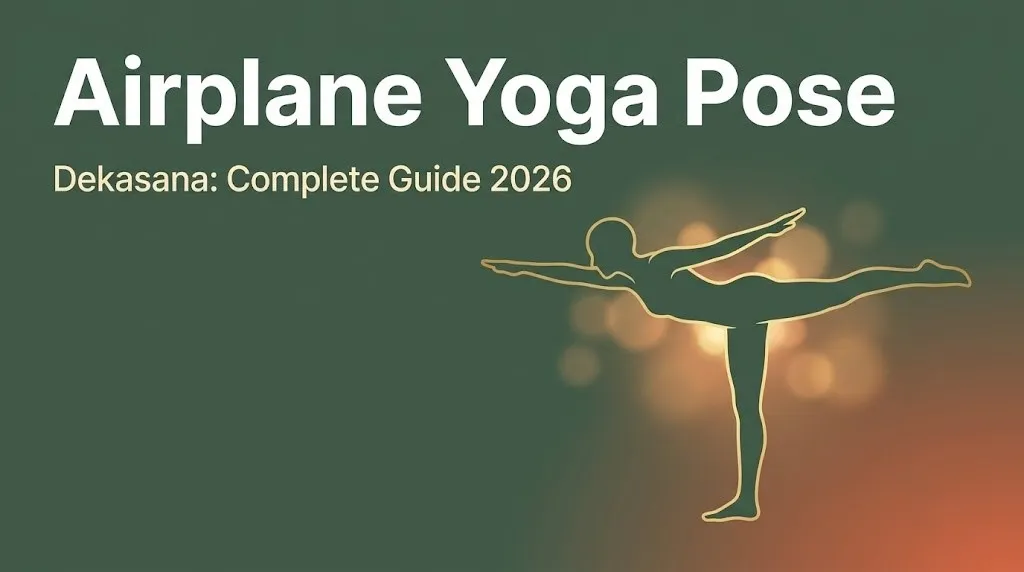
Dekasana, commonly called Airplane Pose in English, is a standing balance posture in which the practitioner balances on one leg, tips the torso forward until it is roughly parallel to the floor, and extends both arms out to the sides like the wings of an aircraft.
The body creates a long horizontal line from the fingertips of one hand to the heel of the lifted leg. The standing leg bears the full load of body weight. The spine stays long and neutral rather than rounding or compressing.
This pose appears in Hatha, Vinyasa, and Iyengar yoga traditions. Its relative accessibility compared to Virabhadrasana III (Warrior III) makes it a common entry point for practitioners learning standing balance work. The arm position (out to the sides rather than reaching forward) creates a wider base of visual and muscular reference.
Pose Tip:
- The goal is a long spine, not a high back leg.
- Arms stay at shoulder height or slightly below. Not above.
- Eyes fix on one still point on the floor, roughly 3 to 4 feet ahead of the standing foot.
Modification note: If the word “balance” immediately causes anxiety, know that every practitioner wobbles in this pose, especially early on. Wobbling is the nervous system learning. It is not a failure.
What Muscles Does the Airplane Pose Work?
Dekasana (Airplane Pose) primarily engages the gluteus maximus, hamstrings, and erector spinae of the lifted leg side, while the standing leg recruits the tibialis anterior, peroneals, and soleus for continuous micro-balance adjustments.
Think of the posterior chain as a single linked cable running from your heel to the base of your skull. In Airplane Pose, you are tensioning that cable isometrically. Every muscle along the back of the body is working to keep the lifted leg level and the spine long.
The transverse abdominis, the deepest layer of abdominal muscle, acts as the central stabilizer. Without its engagement, the lumbar spine sags, the hips rotate, and the pose collapses. This is why Airplane Pose is genuinely a core exercise, not just a balance drill.
The upper body is not passive. The rhomboids and posterior deltoids work to hold the arms at shoulder height against gravity. Letting the arms drop is one of the first signs that upper back endurance is limiting the pose.
Primary muscles engaged in Dekasana:
| Muscle Group | Location | Role in the Pose |
|---|---|---|
| Gluteus maximus | Back of hip, lifted leg | Hip extension to lift and hold the leg |
| Hamstrings | Back of thigh, lifted leg | Assists hip extension, controls leg position |
| Erector spinae | Along the spine | Maintains spinal extension against gravity |
| Transverse abdominis | Deep core | Lumbar stabilization throughout the hold |
| Rhomboids | Between shoulder blades | Holds arm position, opens chest |
| Posterior deltoids | Back of shoulder | Keeps arms at shoulder height |
| Tibialis anterior | Front of shin, standing leg | Ankle dorsiflexion control and balance |
| Peroneals | Outer lower leg, standing leg | Lateral ankle stability |
| Soleus | Deep calf, standing leg | Continuous postural micro-adjustments |
How to Do the Airplane Yoga Pose: Step-by-Step Instructions
To practice Dekasana (Airplane Pose):
- Begin standing in Tadasana (Mountain Pose) with your feet hip-distance apart. Take 3 breath cycles to settle your weight evenly across both feet.
- Shift your weight onto your right foot. Press all four corners of the right foot firmly into the floor. Engage the right thigh by gently lifting the kneecap.
- On an exhale, begin to hinge forward at the right hip. At the same time, lift the left leg behind you. Move the torso and the lifted leg as one counterweighted unit.
- Continue hinging until your torso is roughly parallel to the floor and your left leg is at hip height. The left leg does not need to be higher. Hip height is correct and safe.
- Extend both arms out to the sides at shoulder height. Palms face down. Spread your fingers actively.
- Keep your left hip squared toward the floor. Do not let it rotate open toward the ceiling.
- Lengthen through the crown of your head and through the heel of your lifted left foot simultaneously. Create length in two directions.
- Fix your gaze on one still point on the floor about 3 to 4 feet ahead of your standing foot.
- Hold for 3 to 5 breath cycles. Inhale to lengthen. Exhale to stabilize through the core.
- To release: on an exhale, slowly lower the left foot to the floor. Return to Tadasana. Repeat on the left side.
Modification: If your hamstrings are tight and the torso cannot hinge forward without the lower back rounding, bend the standing knee slightly. This is not a compensation. It is correct mechanics for your current range of motion.
Airplane Pose Alignment Tips: What Most Practitioners Get Wrong
The most common error in Dekasana (Airplane Pose) is lifting the back leg too high, which compresses the lumbar spine and rotates the pelvis open, destroying the alignment the pose is designed to build.
Hip height is the target. Not ceiling height. When the back leg rises past hip level, the lower back takes the strain and the glutes stop doing their job. The practitioner thinks they look impressive. The lower back disagrees.
The second most common error is rounding the upper back. When the torso hinges forward, the chest wants to collapse. Resisting that collapse is the actual upper back work of this pose. Think of pressing the floor away with your gaze, not letting your eyes fall to your standing foot.
The third error is letting the standing hip shift outward. The pelvis should stay level and centered over the standing foot. When the hip juts to the side, the standing leg’s stabilizers switch off and the whole structure becomes unstable.
Quick alignment checklist for Dekasana:
- Lifted leg at hip height, not higher
- Spine long from crown to heel, not arched or rounded
- Both hips level and squared toward the floor
- Arms at shoulder height, fingertips reaching away from center
- Standing knee soft, not hyperextended
- Gaze forward and slightly down, not straight up
Pose Tip:
- Place your hand on your standing hip to check. If the hip is pushing out to the side, draw it back under the pelvis.
- A slight bend in the standing knee is correct for most bodies. Locking the knee creates hyperextension risk.
- For beginners: stand near a wall and touch one fingertip to it for orientation without leaning weight into it.
Key Takeaway: The airplane yoga pose builds full posterior chain strength and single-leg balance simultaneously, but only when the back leg stays at hip height and the spine stays genuinely long rather than arched.
Breathing During Airplane Pose: How Breath Controls Balance
Breath directly controls balance in Dekasana (Airplane Pose) because the exhale activates the transverse abdominis, the deep core muscle that stabilizes the lumbar spine and prevents the torso from pitching forward or sideways during the hold.
Most practitioners hold their breath the moment they feel wobbly. This is the opposite of helpful. A held breath raises thoracic pressure and disconnects the stabilizing core muscles. The wobble gets worse, not better.
Ujjayi pranayama (Victorious Breath) is the most effective breath pattern for standing balance poses. It involves a slight constriction at the back of the throat that slows the breath rate and creates a mild internal pressure that supports the spine. Think of it as breathing through a slightly foggy window. The sound is soft, audible to you but not to your neighbor.
The inhale creates length. The exhale creates stability. Use them differently. On each inhale, feel your spine grow longer through the crown and through the lifted heel simultaneously. On each exhale, draw the lower belly gently inward. That is the transverse abdominis doing exactly what it is supposed to do.
Breath pattern guide for Dekasana:
| Breath Phase | Action | Effect on Pose |
|---|---|---|
| Inhale (4 counts) | Lengthen spine, reach through lifted heel | Creates axial extension, reduces compression |
| Exhale (6 counts) | Draw lower belly gently in and up | Activates transverse abdominis, stabilizes lumbar |
| Between breaths | Keep a soft ujjayi constriction | Maintains internal pressure and spinal support |
Modification note: If ujjayi breath is unfamiliar, start by simply exhaling slowly through the nose for 2 counts longer than the inhale. This slows the breath rate and activates the parasympathetic nervous system, which reduces the fight-or-flight wobble response many beginners feel in balance poses.
Airplane Pose Benefits for Strength, Balance, and Focus
Dekasana (Airplane Pose) builds single-leg balance, posterior chain strength, and focused attention in one integrated shape, making it one of the most efficient standing poses in a yoga sequence.
According to a 2019 study published in the International Journal of Yoga, regular practice of standing balance postures was associated with measurable improvements in postural stability and proprioceptive accuracy in healthy adults after eight weeks of practice at three sessions per week. Airplane Pose fits squarely within this category of evidence-supported balance training.
The strength benefits are real and specific. The gluteus maximus and hamstrings work isometrically against gravity for the entire hold. The erector spinae maintains spinal extension without rest. This is meaningful muscular endurance training, not light stretching.
The focus benefit is often underestimated. Holding a single-leg balance requires the visual, vestibular, and proprioceptive systems to coordinate simultaneously. Practicing this regularly trains the nervous system to organize sensory input more efficiently. Over time, this translates to better body awareness in everyday movement.
Documented benefits of Dekasana:
- Single-leg balance improvement: Proprioceptive training shown to improve postural stability, per the International Journal of Yoga.
- Posterior chain endurance: Glutes, hamstrings, and erector spinae work isometrically throughout each hold.
- Core strength: Transverse abdominis engagement throughout the pose trains deep stabilization.
- Upper back endurance: Rhomboids and posterior deltoids hold against gravity for the duration.
- Mental focus: The demand for sustained concentration trains attentional control.
- Hip stability: Strengthens the hip abductors and external rotators of the standing leg.
- Ankle stability: Continuous micro-adjustments in the standing ankle build proprioceptive ankle strength.
Airplane Pose for Beginners: How to Build Up Safely
Beginners can learn Dekasana (Airplane Pose) most safely by starting with a wall for light fingertip support and a bent standing knee, which reduces the balance demand without changing the essential shape or muscle engagement of the pose.
The wall method is not a lesser version. It is the correct starting point for anyone whose balance training is limited or whose hamstrings restrict forward hinging. Place your mat parallel to a wall. Extend the arm closest to the wall toward it. Let one fingertip touch the surface lightly. Not lean. Touch.
The bent standing knee modification deserves more attention than most yoga teachers give it. Tight hamstrings pull on the sitting bones, which tilts the pelvis and rounds the lower back when hinging forward. Bending the standing knee allows the pelvis to tilt forward correctly, which keeps the spine long. Once hamstring flexibility improves over weeks of consistent practice, the knee can gradually straighten.
Beginner progression for Airplane Pose:
| Stage | What to Do | Duration |
|---|---|---|
| Stage 1 | Wall touch, standing knee bent, torso at 45 degrees | Weeks 1 to 2 |
| Stage 2 | Wall touch, standing knee soft, torso at 60 to 70 degrees | Weeks 3 to 4 |
| Stage 3 | No wall, standing knee soft, torso parallel to floor | Weeks 5 to 6 |
| Stage 4 | No wall, standing leg straight, full pose | Week 7 onward |
Practice on both sides in every session. The non-dominant side will feel noticeably weaker. That asymmetry is useful information. The weaker side deserves more practice, not less.
Key Takeaway: Beginners who use a wall and a bent standing knee are practicing Dekasana correctly for their current body. The goal is spinal length and hip engagement, not the appearance of the final shape.
Airplane Pose Modifications: Props and Variations by Body Type
Dekasana (Airplane Pose) can be adapted with a yoga block, a chair, or a wall to make it accessible for any body type, mobility level, or experience, while preserving the core alignment principles of the pose.
The yoga block under the standing hand is the most underused modification in this pose. If tight hamstrings or a limited forward hinge prevent the torso from reaching parallel without rounding, placing a block under the hand of the lifted-leg side gives the torso a shorter distance to hinge through. The block brings the floor closer without collapsing the spine.
A chair back can serve as a balance support. Stand behind the chair, hold the chair back lightly with both hands, and hinge forward into the pose shape. This takes the balance demand nearly off the table and lets the practitioner focus entirely on the spinal length and hip engagement.
Modification guide by body type and condition:
| Body Type or Condition | Modification | Why It Helps |
|---|---|---|
| Tight hamstrings | Bend standing knee, block under hand | Allows forward hinge without lumbar rounding |
| Limited balance | One fingertip on wall or chair back | Reduces proprioceptive demand |
| Shoulder impingement | Arms alongside body instead of out to sides | Removes shoulder elevation and impingement risk |
| Lower back sensitivity | Reduce forward hinge angle to 45 degrees | Decreases spinal load |
| Hip replacement | Practice at wall, lift back leg only to 30 degrees | Reduces hip joint stress |
| Hypermobile joints | Micro-bend in standing knee and standing ankle | Prevents joint hyperextension |
Advanced variation: practitioners with strong balance can bring the arms forward alongside the ears (like the nose of the airplane rather than the wings) for a more demanding shoulder and upper back hold. This is not easier. It removes the lateral arm position that many practitioners use as a visual stabilizer.
Airplane Pose for Seniors: How to Adapt the Pose Safely
Seniors can practice a safe and effective version of Dekasana (Airplane Pose) using a chair back for support, reducing the forward hinge to a comfortable range, and focusing on the hip extension and spinal lengthening that deliver the pose’s primary benefits.
Balance training is particularly relevant for older adults. The National Center for Complementary and Integrative Health (NCCIH) recognizes yoga-based balance practice as a evidence-supported approach to reducing fall risk in older adults. Falls are a leading cause of injury in adults over 65 in the United States. Single-leg balance training directly addresses this risk.
The full version of Dekasana, with the torso parallel to the floor and the standing leg fully loaded, is not the right starting point for most seniors. Reducing the hinge to 30 to 45 degrees still trains the same hip extensors and standing leg stabilizers. The pose mechanics work at any angle, not only at full parallel.
Adapted sequence for seniors:
- Stand behind a sturdy chair. Place both hands lightly on the chair back.
- Shift weight to the right foot. Keep a soft bend in the right knee.
- Hinge forward at the hip to a comfortable depth, 30 to 45 degrees for most beginners.
- Lift the left leg behind you to a comfortable height, even a few inches is sufficient.
- Hold for 3 breath cycles. Breathe slowly and steadily.
- Lower the left foot. Pause. Repeat on the left side.
Safety note: Seniors with osteoporosis should avoid deep forward hinges. A physical therapist familiar with the practitioner’s bone density can advise on the appropriate hinge depth before beginning this practice.
Airplane Pose for Kids: Why Children Love This Shape
Children take to Dekasana (Airplane Pose) immediately because the airplane imagery gives them a clear physical goal: extend outward in every direction like a plane in flight, which naturally produces the correct shape without complex verbal cuing.
The pose is genuinely appropriate for children from about age 4 upward. At that developmental stage, single-leg balance is an established motor skill, and the playful imagery makes the practice feel like a game rather than exercise.
For children’s yoga practice, use these teaching approaches:
- Make airplane sounds. Silly, yes. Effective, absolutely. The sound-making naturally controls the breath.
- Fly to a destination. “We’re flying to the beach. Where are we going?” keeps attention focused and breath continuous.
- Race to stay flying longest. A gentle balance challenge between children adds motivation and builds concentration.
- Lower the altitude. Tell younger children to “fly lower” rather than cueing technical hinge depth. They naturally find the right depth for their body.
Why the pose benefits children physically:
- Builds single-leg balance during a critical developmental window for proprioceptive training.
- Strengthens the gluteus medius and hip abductors, often underdeveloped in children who sit for long school hours.
- Trains sustained attention, which research suggests yoga practice supports in school-age children.
- Introduces breathwork through playful imagery rather than formal instruction.
According to a 2016 study published in the Journal of Alternative and Complementary Medicine, school-age children who practiced yoga twice weekly for 12 weeks showed measurable improvements in attention and balance scores compared to a control group.
Modification note: Children with hypermobility should be cued to keep a micro-bend in the standing knee to prevent joint hyperextension. Watch for knees that lock back fully. One gentle verbal cue is all it takes: “soft knee, not locked.”
Key Takeaway: Whether you’re 6 or 76, the alignment principle stays the same: long spine, hip-height back leg, steady breath, and a fixed gaze point. The support underneath changes. The pose mechanics do not.
Airplane Pose Contraindications: Who Should Skip or Modify It
Dekasana (Airplane Pose) should be skipped in its full form by anyone with an acute ankle sprain, active lumbar disc herniation, recent hip labral repair, or uncontrolled vertigo, as these conditions create specific risks that the pose’s balance and hinge demands can aggravate.
Ankle injuries are the most common limiting factor. The standing ankle in this pose is performing continuous proprioceptive work under full body weight. An unstable or recently sprained ankle is not equipped for this demand. Using a chair for support reduces but does not eliminate the ankle load.
Lumbar disc issues deserve specific attention. The forward hinge places the lumbar spine in a position that can increase intradiscal pressure if the core is not actively stabilizing. Anyone with a history of lumbar disc herniation should practice with a significantly reduced hinge angle and bent standing knee, or skip the pose entirely during an active flare-up and work with a physical therapist to determine when return to the pose is appropriate.
Contraindication summary:
| Condition | Recommendation | Alternative |
|---|---|---|
| Acute ankle sprain | Skip until healed | Vrksasana (Tree Pose) with wall |
| Active lumbar disc herniation | Skip during flare-up | Supported Bridge Pose |
| Hip labral repair (recent) | Wait for clearance from surgeon | Chair-supported hip extension |
| Uncontrolled vertigo | Skip or use chair with eyes open | Seated balance work |
| Hip replacement (recent) | Modified with chair, limited lift | Seated leg lifts |
| Knee hyperextension | Micro-bend in standing knee always | Same pose, cued differently |
| Third trimester pregnancy | Center of gravity shifted; use wall | Chair-supported version |
Safety note: Practitioners with any of these conditions who want to continue practicing should work with both a yoga teacher experienced in therapeutic modifications and the healthcare provider managing their specific condition.
Airplane Pose vs. Virabhadrasana III (Warrior III): What Is the Difference?
Dekasana (Airplane Pose) and Virabhadrasana III (Warrior III) are both single-leg standing balance poses with the torso parallel to the floor, but they differ in arm position, energy direction, muscular emphasis, and the overall intention the pose creates in the body.
In Virabhadrasana III, the arms reach forward alongside the ears in one long line from fingertips to lifted heel. This position lengthens the anterior chain and emphasizes the sensation of forward momentum. The body feels like an arrow. Every line converges toward the front of the room.
In Dekasana, the arms open out to the sides at shoulder height. This position engages the rhomboids and posterior deltoids differently. The body feels expansive rather than directional. The balance challenge shifts slightly because the lateral arm position provides a wider visual reference point, which many practitioners find makes balance easier to maintain than Warrior III.
Side-by-side comparison:
| Feature | Dekasana (Airplane Pose) | Virabhadrasana III (Warrior III) |
|---|---|---|
| Arm position | Out to the sides at shoulder height | Forward alongside the ears |
| Primary feeling | Wide, expansive, winged | Directional, arrow-like |
| Balance difficulty | Moderate (lateral arms help visually) | Moderate to challenging |
| Upper back muscles | Rhomboids, posterior deltoids emphasized | Serratus anterior, trapezius emphasized |
| Core demand | High | High |
| Best for | Beginners to standing balance work | Intermediate practitioners |
| Common in | Hatha and Vinyasa yoga | Vinyasa and Ashtanga yoga |
Neither pose is superior. They train overlapping and distinct qualities. Practicing both in a sequence, one after the other on each side, builds the full range of posterior chain coordination and upper body endurance that standing balance work can develop.
Warm-Up Poses to Practice Before Airplane Pose
Preparing the body for Dekasana (Airplane Pose) means warming up the hamstrings, glutes, ankle stabilizers, and core before asking them to hold the load of a single-leg balance with a full forward hinge.
Think of the body before warm-up like a cold rubber band. It can stretch, but it does not want to, and it snaps back harder. Five to seven minutes of targeted preparation changes the tissue quality and the neurological readiness of every muscle the pose requires.
Recommended warm-up sequence before Dekasana:
| Pose | Sanskrit Name | Preparation Function | Hold |
|---|---|---|---|
| Mountain Pose | Tadasana | Grounds single-leg weight awareness | 5 breaths each side |
| Chair Pose | Utkatasana | Warms glutes, quads, and ankle stability | 5 to 8 breaths |
| Low Lunge | Anjaneyasana | Opens hip flexors of the back leg | 5 breaths each side |
| Standing Forward Fold | Uttanasana | Lengthens hamstrings for the hinge | 8 to 10 breaths |
| Tree Pose | Vrksasana | Introduces single-leg balance with support | 5 to 8 breaths each side |
| Plank Pose | Phalakasana | Activates transverse abdominis and core | 5 breaths |
Ankle preparation is often skipped but makes a measurable difference in balance quality. Before practicing, stand on one foot with eyes open for 20 to 30 seconds per side. Then repeat with eyes closed for 10 to 15 seconds. This simple drill activates the proprioceptive system before the pose demands it.
Modification note: If any warm-up pose causes discomfort, reduce the depth or skip it and substitute a gentler movement. Warm-up is preparation, not performance.
Key Takeaway: A warm-up that specifically targets hamstrings, ankle stability, and single-leg balance changes how airplane pose feels from the very first attempt. Skip the warm-up and the pose will feel harder, shakier, and less satisfying.
How to Sequence Airplane Pose in a Yoga Flow
Dekasana (Airplane Pose) works best in a yoga sequence after the body is warm and the hamstrings and glutes are already engaged, typically in the second half of a standing pose sequence and before the cool-down floor work begins.
In a Vinyasa flow, Airplane Pose fits naturally after Virabhadrasana I (Warrior I) and Virabhadrasana II (Warrior II) on each side. The Warriors warm the hips and establish leg strength. Transitioning from Warrior I into Dekasana on the same side capitalizes on that warmth.
In a Hatha class, the pose can be held for longer, up to 8 to 10 breath cycles, because the slower pace allows for deeper muscular engagement and alignment refinement. In Hatha, it is common to practice the pose near a wall and use the longer hold time to explore the alignment cues in real time.
Sample standing sequence with Dekasana:
- Tadasana (Mountain Pose), 5 breaths
- Utkatasana (Chair Pose), 5 breaths
- Virabhadrasana I (Warrior I), right side, 5 breaths
- Dekasana (Airplane Pose), right side, 5 breaths
- Return to Tadasana, transition to left side
- Virabhadrasana I, left side, 5 breaths
- Dekasana, left side, 5 breaths
- Forward fold to transition to floor work
Avoid placing Dekasana early in a practice before the posterior chain is warm. The glutes and hamstrings are slow to activate from a cold start. Placing a demanding single-leg balance pose at the beginning of a sequence sets the practitioner up for frustration and wobbling that has more to do with tissue temperature than skill.
Cool-Down Poses to Practice After Airplane Pose
After Dekasana (Airplane Pose), the hamstrings, glutes, erector spinae, and standing leg stabilizers have all worked under sustained load and benefit from targeted release and lengthening before the practice ends.
The cool-down serves two functions. It returns the muscles to their resting length after isometric contraction. It also brings the nervous system down from the focused, alert state that balance work creates. Think of the cool-down as the exhale of the whole practice. The work is done. Now you let it settle.
Recommended cool-down sequence after Dekasana:
| Pose | Sanskrit Name | Purpose | Hold |
|---|---|---|---|
| Standing Forward Fold | Uttanasana | Releases hamstrings and lower back | 8 to 10 breaths |
| Reclined Hand to Big Toe | Supta Padangusthasana | Deep hamstring lengthening | 8 breaths each side |
| Reclined Figure Four | Sucirandhrasana | Hip external rotator release (glutes) | 8 breaths each side |
| Supine Spinal Twist | Supta Matsyendrasana | Thoracolumbar fascia release | 5 to 8 breaths each side |
| Legs Up the Wall | Viparita Karani | Ankle and calf recovery, nervous system rest | 5 to 10 minutes |
| Corpse Pose | Savasana | Full body integration and rest | 5 to 10 minutes |
Savasana after balance-intensive work is not optional. The nervous system needs time to process and consolidate what it learned during the single-leg balance training. Cutting Savasana short reduces the neurological benefit of everything that came before it.
Modification note: For practitioners with tight hamstrings, use a strap around the foot in Supta Padangusthasana (Reclined Hand to Big Toe Pose) to keep the spine flat on the mat. Never yank the leg toward the face. The stretch is in the hamstring, not in the effort.
Frequently Asked Questions About the Airplane Yoga Pose
What is the airplane pose in yoga called in Sanskrit?
The airplane pose in yoga is called Dekasana in Sanskrit.
The name comes from “deca,” relating to the number ten, and the extended body shape resembles the wingspan of an aircraft.
It is sometimes listed as a variation of Virabhadrasana III (Warrior III) in style-specific traditions, though most yoga teachers treat it as a distinct pose with its own alignment principles.
How long should you hold the airplane yoga pose?
Most yoga teachers recommend holding Dekasana for 3 to 5 breath cycles for beginners, roughly 15 to 30 seconds.
Intermediate and advanced practitioners can extend the hold to 8 to 10 breath cycles, roughly 45 to 60 seconds, for greater muscular endurance and proprioceptive training.
Balance poses benefit from longer holds over time, but only when the alignment is maintained throughout. A short, well-aligned hold is more beneficial than a long, collapsed one.
Is airplane pose the same as Warrior III?
Dekasana (Airplane Pose) and Virabhadrasana III (Warrior III) are not the same pose, though they share the same single-leg balance foundation with the torso parallel to the floor.
The key difference is arm position: Airplane Pose extends the arms out to the sides, while Warrior III reaches the arms forward alongside the ears.
This difference shifts the muscular emphasis in the upper back and changes the balance experience, making Airplane Pose generally more accessible for beginners.
What muscles does airplane pose work?
Dekasana (Airplane Pose) primarily works the gluteus maximus, hamstrings, and erector spinae of the lifted leg side, plus the transverse abdominis throughout the hold.
The standing leg recruits the tibialis anterior, peroneals, and soleus for continuous ankle stability and balance micro-adjustments.
The upper back muscles, specifically the rhomboids and posterior deltoids, work to hold the arms at shoulder height against gravity.
Can beginners do the airplane yoga pose?
Yes, beginners can practice Dekasana (Airplane Pose) safely using a wall for light fingertip support and a bent standing knee to reduce the hamstring demand.
Starting with a 45-degree forward hinge rather than a full parallel position preserves all the core and hip extension benefits while reducing the balance and flexibility demands.
Progress gradually over 4 to 6 weeks by decreasing wall contact and straightening the standing leg as strength and balance improve.
Take One Good Hold Over Ten Shaky Attempts
The airplane yoga pose rewards patience more than effort. One clean hold, with a long spine, level hips, and a steady breath, teaches the body more than ten attempts where the form collapses halfway through.
Start with the wall. Bend the standing knee. Fix your gaze. Breathe. Three breath cycles, done well, is all you need today.
Come back to the mat three times this week. The balance will improve faster than you expect.