Yoga Village: Your Full Community Practice Guide 2026
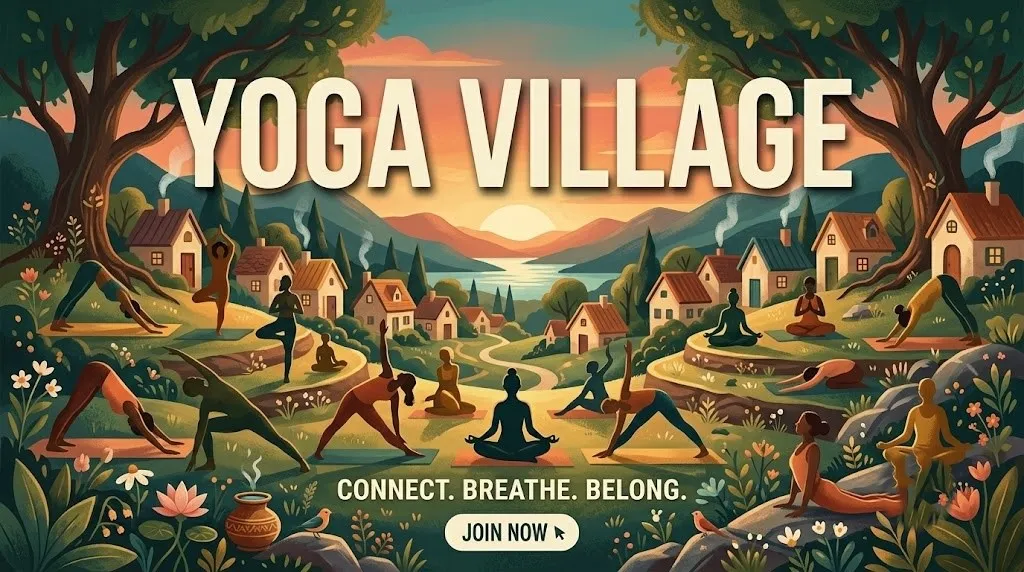
A yoga village is a community-centered approach to yoga practice where people of different levels, ages, and backgrounds practice together in a shared, supportive environment. It is built on the idea that yoga works better when you are not practicing alone.
The research behind this is worth knowing. According to the National Center for Complementary and Integrative Health (NCCIH), yoga is one of the most widely practiced complementary health approaches in the United States, with over 21 million adults reporting regular practice. Group settings have been shown in multiple studies to increase adherence and reduce dropout rates compared to solo practice.
This guide covers everything you need to know about the yoga village model: what it is, how schedules are structured, which styles work best in community settings, what the research says about group practice benefits, and how to build your own yoga village at home or online in 2026.
What Is a Yoga Village?
A yoga village is a structured community of practitioners who share a consistent schedule, a common space (physical or virtual), and a commitment to practicing yoga together over time. Unlike a drop-in studio where faces change every class, a yoga village builds ongoing relationships between students and teachers.
The “village” metaphor is deliberate. Traditional yoga was transmitted through small communities, not large anonymous classes. The village model aims to restore that intimacy at a modern scale.
Think of it like a neighborhood book club compared to a library. Both involve books. One builds connection, accountability, and depth over time.
Yoga villages may operate as dedicated studios, community center programs, church hall groups, online cohorts, or informal neighborhood circles. The format matters less than the consistency and the sense of shared practice.
| Feature | Yoga Village | Traditional Drop-In Studio |
|---|---|---|
| Class size | Typically 6 to 20 students | Often 20 to 40 students |
| Student-teacher familiarity | High, ongoing relationship | Low, changes each class |
| Schedule consistency | Fixed, recurring community schedule | Variable, book as you go |
| Skill progression tracking | Common | Rare |
| Community accountability | Built into the model | Generally absent |
Yoga Village Community Practice: How It Actually Works
Yoga village community practice centers on regularity, shared progression, and mutual support among practitioners. It is not just about showing up to the same room; it is about practicing alongside the same people long enough to grow together.
In practice, this means a yoga village typically runs fixed weekly sessions at the same times. Students are expected to attend most sessions rather than dropping in randomly. Teachers learn each student’s physical patterns, limitations, and goals.
According to a study published in the International Journal of Yoga, social cohesion within a group yoga setting is associated with greater consistency in attendance and improved self-reported well-being compared to solo or irregular practice.
The community aspect also changes how modifications work. A teacher who knows that three students in a class have lower back sensitivity can proactively cue modifications, offer props before they are needed, and sequence classes to support the whole group’s actual bodies, not a hypothetical average student.
This is where the yoga village model genuinely differs from the standard studio experience. The instruction gets sharper because the teacher knows who is in the room.
Pose Tip:
- In community settings, teachers often use partner cues where students observe each other’s alignment with consent. This is an educational tool, not a performance.
- Arrive five minutes early at your first session so the teacher can note any relevant injuries or limitations before class begins.
- Wear comfortable, non-restrictive clothing. You will be moving from standing to seated to supine positions within most sessions.
Yoga Village vs. Yoga Studio: What Is the Real Difference?
The practical difference between a yoga village and a conventional yoga studio is the relationship model, not the building or the poses. A yoga studio is a business offering classes to customers. A yoga village is a community offering practice to members.
That distinction shapes everything from how teachers plan sequences to how students support each other. In a yoga studio, the teacher designs a generic class for whoever shows up. In a yoga village, the sequence evolves based on the community’s shared progression over weeks and months.
Studios often prioritize variety and novelty to retain paying customers. Yoga villages prioritize depth and repetition to build genuine skill. Both have value. They serve different needs.
| Dimension | Yoga Village | Yoga Studio |
|---|---|---|
| Primary goal | Community growth and shared practice | Commercial class delivery |
| Teacher-student relationship | Ongoing, personalized | Session-by-session |
| Sequence design | Cumulative, builds over time | Session-specific, often self-contained |
| Cost model | Often membership or donation-based | Per-class or monthly unlimited |
| Best for | Long-term practitioners and beginners building habits | Variety-seekers and travelers |
| Online option | Common and effective | Available but less personal |
Neither model is superior. The question is which one matches your current needs and lifestyle.
Key Takeaway: A yoga village is a community practice model built on ongoing relationships, consistent schedules, and shared progression. It is fundamentally different from a drop-in studio experience, and that difference directly affects how much you learn and how consistently you practice.
Yoga Village Schedule: How Classes Are Structured
A well-designed yoga village schedule typically runs three to five sessions per week, covering different styles, intensity levels, and focus areas across those days. This ensures that every practitioner in the community has options that match their energy, body, and goals on any given day.
Most yoga village schedules are built around a core weekly structure. Morning sessions tend to be energizing (Vinyasa or Hatha). Midday sessions are often shorter and restorative. Evening sessions frequently emphasize deep stretching, breathwork, or meditation.
Here is a sample weekly yoga village schedule structure:
| Day | Time | Style | Duration | Level |
|---|---|---|---|---|
| Monday | 7:00 AM | Hatha | 60 min | All levels |
| Tuesday | 6:00 PM | Vinyasa Flow | 60 min | Beginner-Intermediate |
| Wednesday | 12:00 PM | Restorative | 45 min | All levels |
| Thursday | 7:00 AM | Hatha | 60 min | All levels |
| Friday | 6:00 PM | Yin Yoga | 75 min | All levels |
| Saturday | 9:00 AM | Community Practice | 90 min | All levels |
| Sunday | Rest or self-practice |
The American College of Sports Medicine recommends that flexibility-focused activity, which yoga provides, be practiced at least two to three days per week for measurable benefit. A yoga village schedule that offers daily options makes hitting that minimum effortless.
Yoga Village Schedule for All Levels: Beginner Through Advanced
A yoga village schedule built for all levels needs to do two things simultaneously: make beginners feel safe and give advanced practitioners something worth showing up for. These goals are not mutually exclusive, but they require thoughtful planning.
The most effective mixed-level schedules offer tiered entry points within the same class rather than separating students into different sessions by ability. A skilled yoga village teacher cues three versions of every pose: a foundational version, a standard version, and a deeper option.
According to the Yoga Alliance, skilled use of modifications within a single class is one of the most consistent markers of high-quality teaching. Students learn by watching practitioners at other levels when the atmosphere is supportive rather than competitive.
For beginners navigating a yoga village schedule for the first time:
- Start with one or two sessions per week, not five.
- Choose Hatha yoga sessions first. The pace is slower and the alignment cues are more detailed.
- Tell the teacher your experience level before class. A good teacher will check in with you during the session.
- Do not skip Savasana (Corpse Pose) at the end. It is a pose, not a nap, and it is where nervous system regulation happens.
For advanced practitioners:
- Use the all-levels sessions to refine technique and practice teaching yourself.
- The challenge at an advanced level is precision, not difficulty. A beginner’s class done with full attention is not a step backward.
Best Yoga Styles for Group Practice
The best yoga styles for group community practice are those that allow modification, support social pacing, and do not require specialized heated environments or equipment. Hatha yoga, Restorative yoga, and Vinyasa yoga are the most consistently effective in yoga village settings.
Hatha yoga is the broadest category. It emphasizes individual poses held for several breath cycles with detailed alignment instruction. It is accessible to nearly everyone and supports the kind of careful, personalized teaching that yoga village communities depend on.
Vinyasa yoga links movement to breath in flowing sequences. It builds heat, cardiovascular fitness, and coordination. It works well in community settings because sequences can be standardized and repeated across weeks, letting students track their own progress.
Restorative yoga uses props extensively to support the body in passive positions. It is ideal for evening community sessions or as a recovery practice. The Journal of Alternative and Complementary Medicine has published research showing Restorative yoga significantly lowers self-reported anxiety and improves sleep quality.
| Style | Pace | Props Needed | Best Time of Day | Ideal For |
|---|---|---|---|---|
| Hatha | Slow to moderate | Blocks, strap | Morning or evening | All levels, beginners |
| Vinyasa | Moderate to fast | Mat only | Morning | Active adults, intermediate |
| Restorative | Very slow | Bolsters, blankets, blocks | Evening | Stress recovery, all levels |
| Yin | Slow, long holds | Bolsters, blocks | Evening | Fascia, joint mobility |
| Chair Yoga | Slow | Chair | Any time | Seniors, limited mobility |
Ashtanga yoga and Bikram/26&2 yoga also appear in some yoga village settings but are less suited to true mixed-level community practice. Ashtanga follows a fixed sequence requiring prior knowledge. Bikram requires a heated room at 105 degrees Fahrenheit, which creates access and health barriers for many practitioners.
Key Takeaway: For a yoga village that genuinely serves everyone in the community, schedule a mix of Hatha, Vinyasa, and Restorative sessions. Yin and chair yoga should appear at least once per week to serve seniors and people managing chronic conditions.
Yoga Village Group Practice Benefits
Group yoga practice delivers measurable benefits beyond what solo practice alone provides. Social motivation, shared breath rhythms, and the accountability of showing up for people who expect you are documented drivers of behavioral consistency.
A study published in Complementary Therapies in Medicine found that participants in group yoga programs reported greater reductions in perceived stress and higher self-rated mental health scores than those practicing solo, even when session frequency was identical.
The benefits of yoga village group practice include:
- Increased consistency: People attend more regularly when others expect them.
- Improved technique: Watching others perform poses provides visual feedback your own body cannot give you.
- Stronger motivation: Group energy during physically challenging poses sustains effort longer than solo practice.
- Accountability structure: Missing a session feels more meaningful when a community notices.
- Shared breath: Synchronized breathing in group practice measurably reduces heart rate variability stress markers, according to research in the International Journal of Yoga.
- Reduced social isolation: Regular community contact has direct mental health benefits independent of the yoga itself.
None of these benefits require a large group. A yoga village of five to eight consistent practitioners achieves all of them.
The physical benefits of yoga, including improved flexibility, reduced lower back pain, and better balance, are well documented in solo practice. In group settings, those benefits are augmented by the psychological factors above, which is why retention rates in community yoga programs substantially exceed those of home-only practice apps.
Yoga Village Mental Health Benefits
The mental health benefits of yoga village practice are among the most well-supported outcomes in the research literature. Group yoga practice addresses anxiety, depression, and chronic stress through multiple biological and social pathways simultaneously.
According to the National Center for Complementary and Integrative Health (NCCIH), yoga has shown consistent evidence for reducing symptoms of anxiety and depression, with effects comparable to moderate aerobic exercise in some clinical populations. Community settings amplify these effects by adding the documented benefits of social connection.
The physiological mechanism involves the parasympathetic nervous system. Yoga’s emphasis on slow, controlled breathing activates the vagus nerve and shifts the body out of the stress response. Ujjayi breath, the oceanic throat breath used in many Vinyasa and Hatha classes, is specifically associated with increased parasympathetic tone.
In a yoga village setting, the communal silence between poses and the shared experience of arriving in Savasana (Corpse Pose) together create a form of social co-regulation. Think of it like a tuning fork: when one well-regulated nervous system is present in a room, others begin to synchronize toward calm. This is not mysticism. It reflects documented research on physiological co-regulation through proximity and shared rhythm.
People managing depression should be aware that the community accountability built into yoga village practice addresses one of the most common depression symptoms: withdrawal from social contact. Showing up to practice is itself therapeutic.
Those with anxiety disorders may find Restorative yoga sessions in a community context particularly effective. Passive long holds with prop support, combined with the safety cue of being in a familiar group, create conditions where the nervous system genuinely settles.
What Does the Research Say? Yoga Village Research and Science
The science behind yoga village and community yoga practice draws from three decades of growing clinical research. The evidence base is now strong enough that major health institutions no longer treat yoga as an alternative practice but as a documented wellness tool.
Key findings from the research literature:
- A 2021 study in the Journal of Alternative and Complementary Medicine found that participants in structured community yoga programs showed measurable reductions in cortisol (the primary stress hormone) after eight weeks of consistent group practice.
- The Harvard T.H. Chan School of Public Health has documented yoga’s role in reducing chronic inflammation markers, particularly in practitioners over 50.
- Research in the International Journal of Yoga indicates that group yoga practice produces larger improvements in self-reported quality of life than solo practice over a 12-week period.
- The American College of Sports Medicine recognizes yoga as a valid mode of flexibility training that also supports muscular endurance, balance, and stress management.
| Research Focus | Source | Finding |
|---|---|---|
| Stress reduction | Journal of Alternative and Complementary Medicine | Cortisol reduction after 8 weeks of group practice |
| Quality of life | International Journal of Yoga | Greater gains in group vs. solo practice over 12 weeks |
| Inflammation | Harvard T.H. Chan School of Public Health | Reduced inflammatory markers, especially in adults 50+ |
| Anxiety and depression | NCCIH / NIH | Evidence-based for symptom reduction comparable to moderate aerobic exercise |
| Sleep quality | Journal of Alternative and Complementary Medicine | Restorative yoga improves self-reported sleep in 6 weeks |
The research does not suggest yoga cures disease. It does suggest that consistent, community-supported yoga practice produces measurable changes in stress hormones, inflammatory markers, mood, and physical function in a broad range of adults.
Key Takeaway: The science is not theoretical. Eight weeks of consistent community yoga practice shows measurable cortisol reduction, improved quality of life, and better sleep compared to solo or no practice. The community element is not a bonus. It is part of the mechanism.
Yoga Village Poses and Sequences
The core poses that appear most consistently in yoga village community classes are accessible, effective, and modifiable for a wide range of bodies. These are not beginner-only poses. They are the architectural pillars of nearly every yoga style.
Foundational yoga village poses:
- Tadasana (Mountain Pose): The base of all standing work. Engages the quadriceps, tibialis anterior, and erector spinae. Establishes postural awareness before every standing sequence.
- Adho Mukha Svanasana (Downward-Facing Dog): Stretches the hamstrings, calves, and spine while strengthening the deltoids and serratus anterior. One of the most frequently cued transition poses in community classes.
- Virabhadrasana I (Warrior I): Builds hip flexor strength and mobility, engages the glutes, and challenges balance. Common in Hatha and Vinyasa sequences.
- Virabhadrasana II (Warrior II): Opens the hips and strengthens the quadriceps. Requires active engagement of the adductors in the back leg to stabilize the pelvis.
- Balasana (Child’s Pose): A universal rest pose. Lengthens the lumbar spine, stretches hip external rotators, and provides a moment of autonomic regulation between active poses.
- Setu Bandha Sarvangasana (Bridge Pose): Strengthens the gluteus maximus, hamstrings, and pelvic floor. The most commonly used supine strengthening pose in all-levels community classes.
- Savasana (Corpse Pose): Final integration. Not optional. Allows the nervous system to absorb the practice.
A basic yoga village community sequence for all levels:
- Begin in Sukhasana (Easy Seated Pose). Close the eyes and take five slow breaths.
- Move to hands and knees. Practice Marjaryasana-Bitilasana (Cat-Cow Pose) for eight breath cycles.
- Press back into Adho Mukha Svanasana (Downward-Facing Dog). Hold for five breaths. Pedal the heels alternately.
- Walk feet toward hands. Rise to Tadasana (Mountain Pose).
- Step back to Virabhadrasana I (Warrior I) on the right side. Hold five breaths. Switch sides.
- Return to standing. Take Virabhadrasana II (Warrior II) on each side for five breaths.
- Come to the floor. Set up Setu Bandha Sarvangasana (Bridge Pose) with feet hip-width. Lift and hold for five breaths. Lower slowly.
- Draw knees to chest. Rock gently side to side.
- Extend fully into Savasana (Corpse Pose). Rest for five to ten minutes.
Yoga Village Breathing Techniques
Breath is the element that makes yoga different from stretching. In a yoga village setting, breathwork is typically woven into every session and sometimes offered as a stand-alone practice called Pranayama.
The two most common breathing techniques in community yoga practice are:
Ujjayi Pranayama (Victorious Breath or Ocean Breath):
This breath is produced by slightly constricting the back of the throat while breathing through the nose. The sound resembles gentle ocean waves. It creates internal heat, slows the breath rate, and helps practitioners maintain focus during physical sequences. Most Hatha and Vinyasa village classes use Ujjayi as the default breath throughout the session.
To practice Ujjayi:
- Sit comfortably in Sukhasana (Easy Seated Pose).
- Inhale through the nose. Exhale through the mouth as if fogging a mirror.
- Close the mouth. Repeat the exhale through the nose while maintaining the same throat constriction.
- Continue for five to ten breath cycles. The sound should be audible only to you.
- Apply this breath to your physical practice, linking movement to each inhale and exhale.
Nadi Shodhana (Alternate Nostril Breathing):
This technique alternates breath through the left and right nostrils. According to a study in the International Journal of Yoga, Nadi Shodhana practice is associated with measurable reductions in heart rate and perceived anxiety after just five minutes of practice.
Modification: People with significant nasal congestion or recent sinus surgery should practice through whichever nostril is clear, or return to simple nasal breathing until cleared.
Safety note: Both techniques should feel calming, not strained. If light-headedness occurs, return to natural breathing immediately.
Key Takeaway: Breathwork is not the warm-up or the cool-down. In a yoga village practice, breath is the spine of the session. Learning even one technique, Ujjayi or Nadi Shodhana, immediately deepens every physical pose you do.
Yoga Village Modifications for Beginners
Modifications in yoga are not compromises. They are precision tools that allow every practitioner to access the intended benefit of a pose without injury or strain. In a yoga village context, modifications are normalized because the teacher sees the same students week after week.
Common modifications for beginners in community yoga classes:
| Pose | Standard Version | Beginner Modification | Why It Helps |
|---|---|---|---|
| Adho Mukha Svanasana (Downward Dog) | Straight legs, heels toward floor | Knees bent, focus on spine lengthening | Reduces hamstring strain; protects lower back |
| Virabhadrasana I (Warrior I) | Full lunge depth | Shorter stance, hands on hips | Reduces hip flexor strain; improves balance |
| Setu Bandha Sarvangasana (Bridge Pose) | Full lift, arms alongside body | Block under sacrum for Restorative version | Removes active muscular demand; supports recovery |
| Balasana (Child’s Pose) | Hips to heels, arms extended | Blanket between thighs and calves | Reduces knee compression; makes pose accessible |
| Adho Mukha Svanasana (Downward Dog) | Full weight-bearing on wrists | Forearm plank or fists on mat | Removes wrist compression; carpal tunnel safe |
Beyond pose-specific modifications, beginners in a yoga village setting should know:
- It is always appropriate to rest in Balasana (Child’s Pose) when the pace feels too fast.
- Props are not a sign of weakness. Using a block in Virabhadrasana II (Warrior II) to support the front thigh or a strap in forward folds is standard intelligent practice.
- Soreness after the first two or three sessions is normal. Sharp or joint-specific pain is a signal to stop and tell the teacher.
Yoga Village for Seniors
Yoga village practice is genuinely well suited to older adults when classes are thoughtfully designed. Seniors benefit from both the physical outcomes (balance, flexibility, joint stability) and the social outcomes (community connection, reduced isolation, cognitive engagement).
The physical concerns specific to seniors in a yoga village context include:
- Balance: Standing poses require adequate ankle, hip, and core stability. Teachers should always offer a wall or chair as a support option without waiting to be asked.
- Bone density: High-impact inversions and deep twists may be contraindicated for people with diagnosed osteoporosis. Weight-bearing standing poses like Tadasana (Mountain Pose) and modified Virabhadrasana I (Warrior I) are generally considered safe and bone-supportive.
- Joint changes: Arthritis, replaced hips or knees, and reduced spinal range of motion require specific modifications. Teachers in yoga village settings who know their senior students can plan sessions accordingly.
According to the National Center for Complementary and Integrative Health (NCCIH), yoga practice in older adults is associated with improvements in balance, gait speed, and reduced fear of falling, all of which contribute directly to injury prevention.
Chair yoga is a specific modification format where standing poses are performed while seated in or standing alongside a sturdy chair. It is appropriate for seniors with limited lower body strength, balance deficits, or recent surgery. Most yoga village schedules should include at least one chair-friendly session per week.
A senior practitioner with no prior yoga experience should:
- Begin with chair yoga or a specifically labeled gentle or senior session.
- Inform the teacher of any joint replacements, fracture history, or cardiovascular conditions before the first class.
- Avoid deep forward folds if there is spinal stenosis, and avoid full inversions (where the head drops below the heart) with uncontrolled hypertension.
Yoga Village for Health Conditions
Yoga village practice can be adapted to support people managing a wide range of health conditions. The key is appropriate modification and a teacher who understands the specific physical considerations involved.
Conditions commonly supported in yoga village settings and key adaptations:
- Chronic lower back pain: Avoid deep forward folds without support. Prioritize core strengthening through poses like Setu Bandha Sarvangasana (Bridge Pose) and modified plank. Avoid Adho Mukha Svanasana (Downward Dog) if it provokes pain at the lumbar spine; forearm support or a wall modification removes the compression.
- Anxiety and panic disorder: Restorative and Yin yoga sessions, with their emphasis on long holds, prop support, and slow breathing, are the most appropriate styles. Fast-paced Vinyasa can sometimes provoke anxiety in susceptible individuals due to elevated heart rate. Start slow.
- Arthritis: Gentle Hatha yoga with modifications reduces joint stiffness and improves range of motion. The Arthritis Foundation recommends yoga as a low-impact option appropriate for most people with osteoarthritis when practiced at a comfortable intensity.
- Hypertension (high blood pressure): Avoid inversions and breath retention. Slow Hatha or Restorative yoga with a focus on calming breathwork is appropriate. A 2019 study in Complementary Therapies in Medicine found that a 12-week yoga program produced measurable reductions in systolic and diastolic blood pressure in adults with pre-hypertension.
- Type 2 diabetes: Yoga supports blood glucose regulation through stress reduction and improved muscle insulin sensitivity. Any style is generally appropriate, though a person whose medication affects blood pressure should have a qualified medical professional review their exercise clearance before beginning.
- Insomnia: Evening Yin or Restorative sessions in a community setting specifically designed to activate the parasympathetic nervous system are among the most evidence-supported non-pharmacological approaches to sleep support available.
Anyone managing an active health condition should inform the yoga village teacher before their first session so that the teacher can offer appropriate cues, modifications, and alternative poses within the class structure.
Key Takeaway: Yoga village practice is not just for healthy young adults. When teachers know their students’ actual health situations, every session can be genuinely safe and beneficial for people managing chronic pain, anxiety, arthritis, hypertension, and sleep disorders.
Yoga Village Props and Equipment
The right props do not just make yoga safer. They make it more accurate. A block under your hand in a standing pose does not make the pose easier; it makes the alignment correct so the intended muscles actually engage.
Essential props for a yoga village setting:
| Prop | Primary Use | Best Material | Who Needs It Most |
|---|---|---|---|
| Yoga blocks (two per student) | Extend reach in forward folds and standing poses | Cork (firm support) or foam (lighter) | Beginners, people with tight hamstrings |
| Yoga strap | Bridge gaps in shoulder and hamstring flexibility | Cotton or nylon | Tight shoulders, early forward fold work |
| Yoga bolster | Support in Restorative and Yin poses | Buckwheat or firm foam fill | All practitioners; essential for seniors |
| Yoga blanket | Cushion knees, support chest, prop under hips | Wool or heavy cotton | All levels; joint protection |
| Yoga mat | Non-slip surface | Natural rubber (most stable) | Everyone; travel mats for outdoor village sessions |
| Chair (sturdy, armless) | Support in standing and seated modifications | Any stable chair without wheels | Seniors, people with limited mobility |
| Wall | Balance support, inversion support | N/A | Everyone; underused in community settings |
For a community or yoga village setting, buying one set of shared props is a practical solution. Two blocks, one strap, and one bolster per student are a reasonable minimum. Blankets can be shared if laundered between sessions.
At home, if bolsters are cost-prohibitive, a firm sofa cushion or a tightly rolled blanket achieves most of the same support in Restorative poses.
How to Create a Yoga Village at Home
Building a yoga village at home requires three things: a consistent group of people, a reliable schedule, and a clear practice structure. The space can be a living room. The group can be four friends. The teacher can be a rotating leadership model where one person guides each session.
Steps to create a home yoga village:
- Find your core group. Start with three to eight people who live nearby or are willing to meet online. Consistency matters more than size.
- Set a fixed schedule. Choose two or three recurring weekly times. Non-negotiable consistency is what makes a village. A group that meets “whenever works” is not a village; it is a casual plan.
- Designate a practice space. Clear at least a 6-by-8-foot area per person. Remove furniture if needed. Ensure the floor is clean and non-slippery. Outdoor practice on grass is an option in warmer seasons.
- Choose a class structure. Use a shared online resource, a recorded class, or one group member who has yoga teaching experience. Rotate leadership to distribute engagement.
- Gather basic props. Each participant needs a mat, two blocks, and a strap at minimum. Bolsters are ideal for the restorative session you should include at least once per week.
- Build a sample village schedule. Start with two sessions per week: one active session (Hatha or Vinyasa) and one restorative session. Add a third once the group rhythm is established.
- Create community accountability. A simple group message thread for check-ins, pose questions, and scheduling keeps the energy alive between sessions.
For online yoga villages, video platforms that allow group participation work well. Assign one person per session to manage the technology so the teacher can focus entirely on the practice.
According to the Journal of Alternative and Complementary Medicine, home-based group yoga programs with consistent structure show comparable health outcomes to studio-based programs after twelve weeks. You do not need a studio. You need a community.
Modification for solo practitioners: If you cannot find a group immediately, a two-person yoga village between you and one other person is a genuine starting point. The accountability and shared breath of even one companion change the practice meaningfully.
Frequently Asked Questions About Yoga Village Practice
What is a yoga village and how is it different from a regular yoga studio?
A yoga village is a community of practitioners who practice together consistently over time, building relationships, shared progression, and mutual accountability.
A regular yoga studio offers classes to paying customers who may change from session to session, with no expectation of ongoing connection.
The difference is relational depth, not physical space or pose selection.
What should I expect from my first yoga village class?
Expect to be welcomed, asked about your experience level and any physical limitations, and introduced to the community.
Most yoga village classes begin with breathwork or quiet centering, move through a structured sequence of poses, and end with Savasana (Corpse Pose) and sometimes a brief group discussion.
Arrive five minutes early, introduce yourself to the teacher, and plan to do less than you think you can on the first day.
How many times a week should I practice yoga in a community setting?
The American College of Sports Medicine recommends flexibility-focused activity at least two to three days per week for measurable physical benefit.
Most yoga teachers and physical therapists suggest two to four sessions per week as an effective starting range for community yoga practice.
More is not always better; one to two rest days per week supports muscle recovery and prevents overuse patterns.
Can I create a yoga village practice at home with friends?
Yes, a home yoga village is practical and effective with as few as three to four people who commit to a fixed weekly schedule.
You need minimal equipment: a mat, two blocks, and a strap per person, plus a clear practice space of at least six by eight feet per practitioner.
Research published in the Journal of Alternative and Complementary Medicine shows that structured home-based group yoga programs produce health outcomes comparable to studio settings after twelve weeks.
Is yoga village practice safe for seniors and people with health conditions?
Yoga village practice is safe for most seniors and people with common health conditions when the teacher knows each student’s physical situation and provides appropriate modifications.
Seniors with osteoporosis, joint replacements, or balance deficits should look for classes that explicitly include chair yoga options and avoid sessions that include unsupported inversions or deep twisting.
Anyone managing an active cardiovascular condition, recent surgery, or a condition that affects exercise safety should get clearance from a qualified medical professional before beginning any new physical practice.
Building Your Yoga Village Practice Starts With One Session
Start with two sessions per week and one clear group commitment. That is genuinely all a yoga village requires to take root. Pick Hatha yoga as your first style, gather one block and a strap per person, and run a 45-minute session using the community sequence described in this guide.
Props matter. A schedule matters. But the most important thing is showing up for the same people, at the same time, consistently. That is what turns a workout into a practice and a practice into a community.
Give it eight weeks. The research and the experience of thousands of practitioners agree: that is when it becomes something you protect rather than something you squeeze in.