Puppy Yoga St Louis: Classes, Benefits & What to Expect
Puppy yoga St Louis events combine a gentle yoga practice with the presence of young dogs, creating a session that is simultaneously calming, playful, and genuinely good for your nervous system. If you’ve been curious about whether it’s worth booking a spot, the short answer is yes, and this guide explains exactly what you’re getting into.
Research from the Human Animal Bond Research Institute (HABRI) confirms that interacting with dogs measurably reduces cortisol levels and increases oxytocin in both humans and animals within minutes of contact. That’s not feel-good marketing. That’s documented physiological change.
Here you’ll find where to find classes in the St. Louis area, what the yoga component actually looks like, how to prepare your body, what the science says, and who should plan ahead or sit this one out.
What Is Puppy Yoga?
Puppy yoga is a group yoga class conducted in the presence of young puppies, who roam freely across the mat space, interact with participants, and occasionally climb onto people mid-pose.
The yoga component is real, not performative. Most puppy yoga classes draw from Hatha yoga or gentle Vinyasa yoga sequences, using poses that are accessible to beginners and don’t require previous experience. The goal isn’t to achieve advanced postures. It’s to move the body, breathe intentionally, and let the puppy chaos add an unpredictable layer of joy to a practice that can sometimes feel too serious.
The puppies are typically sourced from local shelters, rescue organizations, or ethical breeders and are monitored by handlers throughout the class. Sessions are designed so the animals are never distressed and always have access to water, rest areas, and the ability to move away from participants.
What makes puppy yoga distinct from a standard yoga class is not just the animals. It’s the shift in psychological atmosphere. Laughter is common. Distraction is expected. Perfection is off the table. For many people, especially those who feel self-conscious in traditional yoga studios, that shift is exactly what makes the practice accessible.
Quick Summary:
- Puppy yoga is a hybrid wellness event combining yoga movement with live puppy interaction
- Most classes are beginner-friendly and draw from Hatha or gentle Vinyasa styles
- Puppies roam freely; participants can interact, cuddle, or simply practice alongside them
- Classes typically run 60 to 75 minutes and accommodate all fitness levels
Puppy Yoga St Louis: Where to Find Classes and Events
Puppy yoga in St Louis is offered through a growing number of yoga studios, animal rescue organizations, and pop-up wellness event companies operating across the metropolitan area and surrounding suburbs.
St. Louis has a strong rescue and adoption culture, and several local organizations have partnered with yoga instructors to run regular puppy yoga sessions that double as adoption events. These aren’t just fitness classes. They’re community gatherings where the puppies are often available for adoption, making the event meaningful beyond the mat.
Studios and venues offering puppy yoga in the St. Louis area tend to concentrate in neighborhoods like the Central West End, Maplewood, and Clayton, as well as in suburban areas like Chesterfield and Kirkwood. Outdoor sessions are also increasingly common at parks and event spaces during warmer months.
| Venue Type | What to Expect | Best For |
|---|---|---|
| Yoga studio partnership | Structured class with qualified instructor | Yoga beginners wanting guidance |
| Rescue organization event | Adoption-focused, less structured yoga | Animal lovers, families |
| Pop-up wellness event | Social atmosphere, mixed skill levels | Groups, corporate outings |
| Outdoor park session | Seasonal, weather-dependent | Casual participants, summer events |
To find current sessions, search local St. Louis event platforms, check with area rescue shelters like the Humane Society of Missouri, and follow St. Louis-based yoga studios on their social channels. Classes fill quickly and typically require advance registration.
Modification note: Many St. Louis puppy yoga events offer seated or chair-accessible modifications. If you have mobility concerns, contact the organizer before booking to confirm accommodations are available.
What to Expect at a Puppy Yoga Class
A puppy yoga class typically begins with a brief orientation, moves through a gentle 45 to 60-minute yoga sequence, and ends with an open cuddle period where participants can spend unstructured time with the puppies.
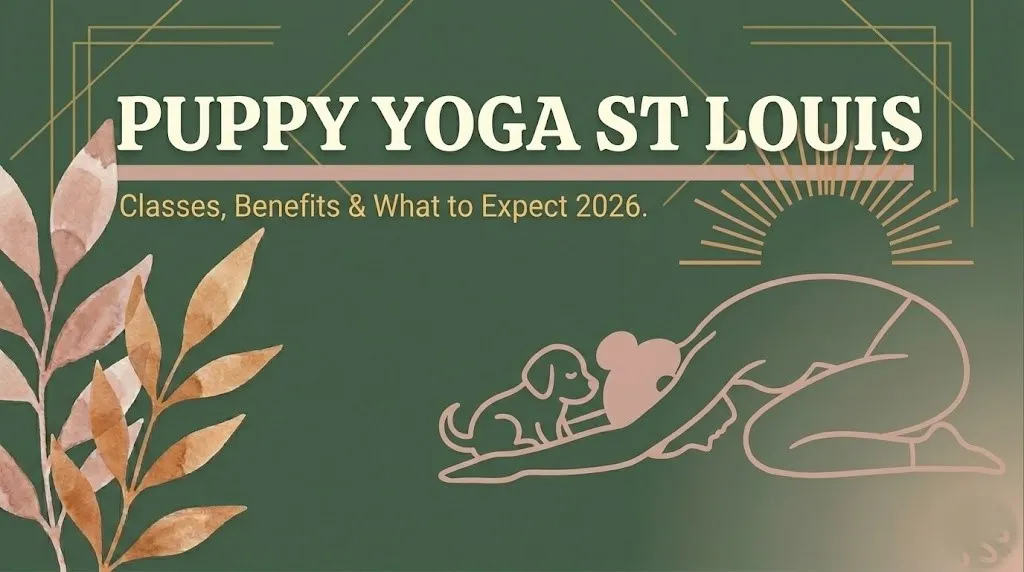
The orientation covers ground rules: don’t pick up the puppies without permission, don’t wake sleeping pups, don’t force interaction if a puppy moves away. Handlers are present throughout to ensure both participant and animal safety. This is important context. Puppy yoga is not a petting zoo. The animal welfare protocols matter, and reputable organizers take them seriously.
During the yoga portion, expect accessible poses held for moderate durations. The instructor guides movement, but don’t expect a perfectly controlled class environment. Puppies will wander onto your mat during Balasana (Child’s Pose). One might sit on your feet during Savasana (Corpse Pose). Part of the appeal is accepting the interruption with good humor.
The energy in the room tends to be warm and social. Most participants are beginners or casual yoga practitioners. There’s no performance pressure. People laugh. People pause to photograph a puppy curled up in their lap. If you’re expecting the silence of a traditional Yin yoga or meditation class, recalibrate your expectations before you arrive.
Pose Tip:
- Go in with low expectations about “perfecting” any pose. The puppies will ensure it
- Stay low in your poses when possible. Floor-level positions invite more puppy interaction
- Avoid wearing loose dangling jewelry or scarves that could attract biting or pulling from playful pups
Key Takeaway: Puppy yoga is a real yoga class with a genuinely documented wellness boost from human-animal contact, and it’s one of the most beginner-friendly ways to try yoga in a non-intimidating environment.
Puppy Yoga Benefits for Mental and Physical Health
Puppy yoga benefits the body and mind through two overlapping pathways: the physical effects of gentle yoga movement and the neurochemical effects of positive animal interaction.
On the yoga side, a typical puppy yoga session activates the parasympathetic nervous system through slow movement, diaphragmatic breathing, and sustained gentle holds. This reduces heart rate, lowers blood pressure, and shifts the body out of stress-response mode. These are the same physiological effects documented in gentle Hatha yoga practice.
On the animal interaction side, the documented benefits are substantial:
- Reduced cortisol (stress hormone): Research from HABRI found that interacting with animals for as little as 10 minutes significantly reduced salivary cortisol in study participants.
- Increased oxytocin: Often called the bonding hormone, oxytocin rises in both humans and dogs during positive physical interaction. This promotes feelings of calm, trust, and social connection.
- Lower blood pressure: The Centers for Disease Control and Prevention (CDC) notes that pet interaction is associated with decreased blood pressure and reduced triglyceride levels.
- Improved mood: Contact with animals increases serotonin and dopamine activity, the same neurochemicals targeted by antidepressant medications, according to research published in the Journal of Alternative and Complementary Medicine.
- Reduced social anxiety: Group yoga settings can feel intimidating. The presence of puppies acts as a social buffer, making it easier to relax among strangers.
- Greater mindfulness: Attending to a puppy’s movements naturally pulls attention into the present moment, producing an effect similar to structured mindfulness practice.
The Science Behind Animal-Assisted Yoga and Stress Relief
Animal-assisted yoga works by combining two independently validated stress-reduction mechanisms: the physiological effects of slow, breath-led movement and the neurochemical effects of positive human-animal interaction.
These two systems reinforce each other. Slow yoga breathing activates the vagus nerve, shifting the autonomic nervous system toward parasympathetic dominance. Physical contact with a dog triggers a separate but complementary oxytocin release that amplifies that calming effect. Together, they produce a stress-response reduction that neither experience delivers as efficiently alone.
According to the National Center for Complementary and Integrative Health (NCCIH), mind-body practices including yoga show consistent positive effects on perceived stress, anxiety, and mood in controlled clinical studies. Animal-assisted interventions are documented in a growing body of research as having measurable effects on cortisol, blood pressure, and self-reported wellbeing.
A 2019 study published in AERA Open, a peer-reviewed journal, found that college students who participated in animal-assisted stress relief sessions showed measurably lower stress markers compared to control groups who did not interact with animals. The effects were immediate and did not require prolonged exposure.
Think of the combined experience like two volume controls turned down at the same time. Yoga turns down the nervous system’s “alarm” channel through breath and movement. Puppy contact turns down the stress hormone channel through neurochemical means. The result is a quieter baseline than either approach produces individually.
A study published in the International Journal of Yoga found that even a single session of gentle yoga reduced state anxiety scores in participants across multiple demographic groups. Combining that with animal interaction creates a compounded calming effect with real neurobiological grounding.
Puppy Yoga Poses for Beginners
The yoga poses used in puppy yoga sessions are specifically chosen for accessibility. They are floor-based, low-impact, and do not require flexibility, prior experience, or significant upper-body strength.
The most common poses in a puppy yoga class include:
- Balasana (Child’s Pose): Kneeling and folding forward over the thighs. The lower back and hips release passively. Puppies frequently investigate this position from behind. Modification: place a folded blanket between thighs and calves if the hips don’t reach the heels.
- Marjaryasana-Bitilasana (Cat-Cow Pose): On hands and knees, alternating between rounding and arching the spine with the breath. Gentle spinal mobilization. Modification: perform from seated in a chair, rounding and extending the upper back only.
- Adho Mukha Svanasana (Downward-Facing Dog Pose): Hands and feet on the floor, hips lifted to form an inverted V shape. Targets the hamstrings, calves, and shoulder girdle. Modification: bend the knees generously or perform with hands on a chair seat instead of the floor.
- Virabhadrasana I (Warrior I Pose): Standing lunge with arms overhead. Builds lower body strength and opens the hip flexors. Modification: shorten the stance and rest hands on the thighs rather than lifting overhead.
- Savasana (Corpse Pose): Lying flat on the back in complete stillness. The integrative close of the class. Puppies will almost certainly join you here. No modification needed; this pose is accessible to everyone.
To practice Marjaryasana-Bitilasana (Cat-Cow Pose) as your first move in puppy yoga:
- Start on hands and knees with wrists under shoulders and knees under hips.
- Inhale and let the belly drop toward the floor, lifting the chest and tailbone gently (Cow).
- Exhale and round the entire spine toward the ceiling, tucking chin and tailbone (Cat).
- Move slowly for 5 to 8 breath cycles, letting the breath lead the movement.
- Return to a neutral spine and pause before the next pose.
Key Takeaway: The yoga in puppy yoga is real and beginner-appropriate, and knowing which poses to expect lets you arrive with a body that’s physically ready, even if you’ve never been on a mat before.
How to Prepare for Your First Puppy Yoga Class
Preparing for puppy yoga involves both physical preparation and practical logistics that most first-timers overlook entirely.
On the physical side, you don’t need to be flexible or fit to attend. However, some basic body preparation helps. Arriving well-hydrated, having eaten a light meal at least 90 minutes before class, and wearing clothes you can move in comfortably will make the session more enjoyable. Stiff joints benefit from a 5 to 10 minute walk beforehand to warm up the hips and knees before floor-based poses.
On the practical side, a few things are commonly forgotten:
- Bring your own yoga mat if you prefer your own surface, though most events provide mats
- Leave fragranced products at home; strong perfumes and scented lotions can irritate dogs
- Bring a change of clothes or a small towel. Puppies are young. Accidents happen occasionally.
- Arrive 10 to 15 minutes early for the orientation. Instructors cover animal handling guidelines before the session starts.
Mentally, prepare to let go of class structure expectations. Puppy yoga instructors are managing both a yoga sequence and the behavior of live animals simultaneously. The pacing will vary. Poses may be held longer if a puppy is settled in someone’s lap. Laughter is part of the format.
The American College of Sports Medicine notes that even low-intensity movement like gentle yoga produces cardiovascular and musculoskeletal benefits when practiced consistently. You don’t need to push for intensity. Show up, breathe, and let the session be what it is.
Modification note: If you haven’t practiced yoga before and have knee or hip concerns, let the instructor know before class begins. A good puppy yoga instructor will offer modifications so you can participate comfortably without risking joint strain.
Puppy Yoga Class Structure and How Long Sessions Last
A standard puppy yoga session runs 60 to 75 minutes and follows a recognizable three-part structure: orientation, movement practice, and open puppy time.
The orientation phase lasts approximately 5 to 10 minutes and covers animal welfare guidelines, what to expect during the class, and any house rules specific to the venue. This is not optional attendance. The guidelines protect both participants and animals.
| Phase | Duration | What Happens |
|---|---|---|
| Orientation | 5 to 10 min | Ground rules, handler introductions, animal welfare briefing |
| Yoga sequence | 40 to 50 min | Guided gentle Hatha or Vinyasa flow with puppies present |
| Open cuddle time | 15 to 20 min | Unstructured puppy interaction, photos, socialization |
| Total | 60 to 75 min | Full session from arrival to close |
The yoga sequence portion uses accessible, floor-level poses with minimal transitions. Instructors avoid fast-paced sequences in puppy yoga specifically because quick movements can startle animals. The pace tends to be slower than a standard Hatha class and closer to a gentle flow.
The open cuddle portion at the end is what many participants look forward to most. With the formal yoga portion complete, people sit, lie down, or simply relax while puppies explore freely. This unstructured period produces some of the highest oxytocin release of the entire session, since it involves sustained, reciprocal interaction rather than brief passing contact.
Modification note: If floor sitting is uncomfortable during the open cuddle portion, bring a small folded blanket or ask if chairs are available. Most organizers accommodate this without difficulty.
Key Takeaway: The class is structured so the yoga comes first and the unstructured puppy time comes last, and that order is intentional: the yoga prepares your nervous system to receive the calming effect of the animal interaction most deeply.
Puppy Yoga for Anxiety and Mood Support
Puppy yoga is particularly well-suited for people managing anxiety because it combines two evidence-based mood regulation tools: movement-based stress reduction and social bonding through animal contact.
Anxiety often manifests physically, as shallow breathing, shoulder tension, jaw clenching, and a chronically activated sympathetic nervous system. Gentle yoga directly addresses these patterns. Slow, diaphragmatic breathing used throughout a yoga session activates the vagus nerve, which signals the body to reduce its alarm state.
According to the National Center for Complementary and Integrative Health (NCCIH), yoga is one of the most studied complementary approaches for anxiety management, with multiple randomized controlled trials showing reduced anxiety symptoms following regular practice. Even a single session produces measurable reductions in state anxiety scores.
Adding animal contact amplifies this effect. Research from HABRI documents that interacting with a dog for as little as 10 minutes produces measurable drops in cortisol, the hormone most directly associated with the physiological experience of anxiety. For people whose anxiety spikes in social settings or unfamiliar environments, the presence of puppies provides a social anchor: something warm, neutral, and unthreatening to focus on.
Puppy yoga is not a treatment for clinical anxiety disorders. People with diagnosed anxiety conditions, including generalized anxiety disorder, social anxiety disorder, or PTSD, should continue working with their mental health provider. A yoga teacher trained in trauma-informed approaches is better suited to those needs than a standard puppy yoga class.
That said, for everyday stress, mood dips, and the kind of accumulated tension that builds across a long workweek, puppy yoga is a well-supported, practical option that asks very little of your body and delivers measurably to your nervous system.
Puppy Yoga With Rescue Dogs in St Louis
Many puppy yoga events in St Louis partner directly with local rescue organizations, using the class as both a wellness event and an adoption awareness opportunity.
This model benefits everyone involved. The yoga studio or event organizer gains a meaningful community hook. The rescue organization gets their animals socialized, handled gently by multiple people, and introduced to potential adopters in a low-stress setting. Participants get a deeper sense of purpose in attending. The class becomes more than a workout. It becomes a contribution.
The Humane Society of Missouri, one of the largest animal welfare organizations in the St. Louis region, has been involved in community wellness programming, and local shelters across St. Louis County regularly coordinate with event companies to bring rescue puppies into community spaces. Some sessions include brief adoption profiles for each puppy, allowing attendees to learn the dog’s name, age, and personality before class begins.
There are practical differences to know about rescue puppy yoga versus breeder-sourced sessions:
- Rescue puppies may have had fewer socialization experiences, so their comfort levels with handling vary
- Handlers at rescue events tend to be more active in monitoring individual puppy stress signals
- Some sessions use slightly older dogs rather than very young puppies, depending on shelter availability
- Adoption fees and processes are handled separately from the yoga event registration
If supporting rescue is important to you, look specifically for events labeled as adoption events or rescue partnerships when searching for St. Louis sessions.
Modification note: Rescue puppy yoga events are generally as accessible as standard sessions. If you have specific needs, contact the organizing rescue directly, as most are highly accommodating.
Puppy Yoga for Kids and Families in St Louis
Puppy yoga for kids in St Louis is increasingly offered as a family-friendly version of the standard session, with age-appropriate poses, shorter class durations, and handling guidelines tailored for younger participants.
Children respond exceptionally well to animal-assisted activities. Research from HABRI indicates that children who participate in animal-assisted programs show reductions in self-reported anxiety and increases in prosocial behavior. The combination of movement, animal interaction, and structured social play supports emotional regulation in ways that passive activities do not.
Family-friendly sessions typically differ from adult classes in these ways:
- Hold times for poses are shorter, usually 20 to 30 seconds rather than 60 to 90 seconds
- The yoga sequence is simplified, focusing on playful poses that children recognize naturally
- Instructions use animal-themed language to make the poses relatable (being a dog in Downward Dog, curling up like a puppy in Child’s Pose)
- The ratio of open play time to structured yoga is higher
Age recommendations vary by organizer. Most family-friendly sessions welcome children aged 5 and up, with parental supervision throughout. Very young children (under 3) may not handle the unpredictability of live animals well and can also startle puppies unexpectedly.
Poses well-suited for children in puppy yoga:
- Adho Mukha Svanasana (Downward-Facing Dog Pose): Kids love the connection to actual dogs
- Balasana (Child’s Pose): Natural resting position that invites puppy interaction
- Marjaryasana-Bitilasana (Cat-Cow Pose): Playful spinal movement that children find intuitive
Modification note: Children with a fear of dogs (cynophobia) should not be brought to puppy yoga without a prior gradual exposure plan developed with a child psychologist.
Key Takeaway: Family-format puppy yoga in St Louis is one of the most research-supported, low-pressure ways to introduce children to both yoga and structured animal interaction, with documented benefits for emotional regulation and anxiety reduction.
Puppy Yoga for Seniors and Older Adults
Puppy yoga for seniors offers a low-impact movement experience with documented mood and social benefits, but it requires a few additional considerations around floor access, joint safety, and individual health conditions.
The physical demands of a puppy yoga class are genuinely manageable for most older adults. The floor-based, slow-paced nature of the practice aligns well with the gentle yoga approaches recommended by the American College of Sports Medicine for adults over 65, which emphasize flexibility, balance, and low-load movement performed at least two days per week.
The social dimension is equally relevant. Loneliness and social isolation are documented risk factors for cognitive decline and cardiovascular disease in older adults. Puppy yoga provides a warm, structured social environment with a built-in conversation starter (the puppies), reducing the social friction that prevents many seniors from attending group fitness classes.
Practical considerations for seniors attending puppy yoga:
| Concern | Practical Solution |
|---|---|
| Difficulty getting to the floor | Ask organizer about chair alternatives; many provide them |
| Joint pain in knees or hips | Use a double-thick mat, knee pads, or a folded blanket |
| Fear of falling while in poses | Stay close to a wall or chair for balance support |
| Dog jumping or sudden movement | Alert the handler; they can redirect puppies from your space |
| Fatigue mid-class | Resting in Balasana (Child’s Pose) is always acceptable |
People with osteoporosis should avoid deep forward folds that load the thoracic spine. Savasana (Corpse Pose) and Supta Baddha Konasana (Reclined Bound Angle Pose) are safe and comfortable alternatives that still allow full puppy interaction from a floor-level resting position.
What to Wear and Bring to Puppy Yoga
Wear comfortable, stretchy clothing that covers enough skin to protect against puppy nails, and bring only what fits in a small bag since space in puppy yoga venues is usually limited.
The clothing question matters more in puppy yoga than in regular classes. Young puppies have sharp nails and tend to climb. Bare legs and arms invite more scratching. Lightweight leggings and a fitted long-sleeve layer are a common choice. Avoid loose-knit fabrics or anything with dangling threads that puppies might chew.
Here’s what to bring:
- Your own yoga mat (optional but preferred for hygiene; most venues provide mats, but personal mats are cleaner)
- A small towel for wiping hands after puppy contact and for any unexpected messes
- Water bottle (sealed lid; not an open bottle on the floor)
- Any medication if you have a known mild dog allergy and plan to manage it proactively
- Comfortable grip socks or bare feet; shoes are removed before entering the yoga space
What to leave behind:
- Strong perfume or scented lotion (irritates dogs and other participants)
- Open food or snacks (attracts puppies and disrupts the class)
- Expensive jewelry or watches (risk of scratching or loss)
- Large bags that take up shared floor space
Pose Tip:
- Tie hair back securely; puppies investigate anything loose near face level
- Choose darker colored clothing; puppy paw prints show less on dark fabric
- Bring an extra layer for Savasana, as body temperature drops during floor rest
Puppy Yoga Safety, Allergies, and Who Should Skip It
Puppy yoga carries a small set of real safety considerations that reputable organizers address proactively, and that participants should understand before booking.
Animal allergy: Dog dander (the microscopic skin particles shed by dogs) is the primary allergen. People with known dog allergies who wish to attend should speak with their allergist before the session, as the enclosed space and extended contact can produce a stronger allergic response than a brief outdoor dog encounter. Taking antihistamines as directed by an allergist before attending is a strategy some participants use. Those with severe allergic asthma should not attend without a clear plan in place.
Fear of dogs (cynophobia): Puppy yoga is not an appropriate setting for exposure therapy to dog phobia. The unpredictability of multiple puppies in a confined space can be intensely activating for someone with significant dog fear. Gradual, controlled exposure with a psychologist is the appropriate approach for phobia treatment.
Physical safety in poses: Puppies can distract you mid-pose. Don’t attempt poses beyond your current comfort level simply because you’re caught up in the excitement of the environment. Falls from overextended balancing poses are the most common minor injury in yoga generally. The puppy environment increases distraction, which increases that risk slightly.
Who should skip puppy yoga:
- People with severe dog allergies or allergic asthma
- People with active dog phobia
- Very young children (under age 4 to 5, depending on temperament)
- People in the acute phase of a musculoskeletal injury, where any uncontrolled movement (from an enthusiastic puppy) could aggravate the area
According to the Centers for Disease Control and Prevention (CDC), standard hygiene practices after animal contact include washing hands thoroughly, especially before touching the face or eating. This applies directly to puppy yoga: wash hands after the session before touching food.
Key Takeaway: Puppy yoga is genuinely safe for most people when run by a responsible organizer, but dog allergies and cynophobia are real contraindications that deserve honest self-assessment before you book.
Puppy Yoga Gifts and Group Events in St Louis
Puppy yoga makes an exceptionally practical gift because it’s a complete, time-limited experience that suits almost any adult and requires no prior knowledge or special equipment from the recipient.
Gift certificates for puppy yoga classes are offered by most St. Louis studios and event companies that run regular sessions. For occasions like birthdays, bachelorette events, team-building outings, or “just because” gifts, a puppy yoga session is a memorable alternative to physical products. It creates a shared experience and generates the kind of positive emotional memory that material gifts rarely match.
For group bookings, most St. Louis puppy yoga organizers accommodate:
- Bachelorette and bridal party events: Private sessions are bookable for groups of 8 to 20 people at many venues
- Corporate wellness events: Team-building sessions with puppy yoga are increasingly popular for workplace stress management programs. The social equalizer effect of the puppies removes hierarchy and makes participation low-pressure.
- Birthday party groups: Adult and family birthday sessions can usually be arranged privately
- Friend group outings: Standard public classes typically cap at 15 to 25 participants to keep the puppy-to-person ratio manageable
When booking a group event, ask the organizer specifically:
- What is the maximum group size for a private session?
- Can the session be themed or customized (e.g., with a rescue adoption focus)?
- Is there flexibility in scheduling for private groups?
- Are there any dietary or physical accommodation needs they can address?
Private sessions generally cost more per person than public classes but deliver a more personalized experience. For corporate bookings, many organizers provide a brief wellness context talk alongside the yoga and puppy component, which strengthens the event’s professional development framing.
Frequently Asked Questions About Puppy Yoga St Louis
What is puppy yoga and what actually happens in a class?
Puppy yoga is a group yoga session where young puppies roam freely while participants practice gentle poses on the mat.
The class typically follows a structured Hatha or gentle flow sequence lasting 40 to 50 minutes, followed by 15 to 20 minutes of open puppy interaction time.
Handlers monitor the animals throughout, and the yoga poses are chosen specifically for beginner accessibility and floor-level positions that invite natural puppy contact.
Is puppy yoga good for beginners who have never done yoga before?
Yes. Puppy yoga is one of the most beginner-friendly yoga formats available because the informal atmosphere removes performance pressure entirely.
Poses are chosen for accessibility, hold times are short, and instructors offer modifications throughout the session.
If you’ve never been on a yoga mat, puppy yoga is a genuinely good starting point.
Are there puppy yoga classes in St Louis that use rescue dogs?
Yes. Several St. Louis puppy yoga events partner with local rescue organizations, including shelters in St. Louis County and the surrounding metro area.
These sessions function as adoption awareness events alongside the yoga component, with individual puppy profiles sometimes shared at the start of class.
Search for events specifically tagged as “rescue partnership” or contact the Humane Society of Missouri and local shelters directly to find current scheduling.
What should I wear and bring to a puppy yoga class?
Wear comfortable, stretchy clothing that covers your arms and legs to protect against puppy nails.
Bring a yoga mat (if you have one), a small sealed water bottle, a hand towel, and any allergy medication if you have mild dog sensitivities.
Leave strong perfume, open food, and large bags at home.
Is puppy yoga safe for people with dog allergies or a fear of dogs?
People with mild dog allergies can often attend with antihistamine preparation, but those with severe allergic asthma should evaluate their risk carefully with an allergist before attending any enclosed puppy event.
People with significant fear of dogs (cynophobia) should not use puppy yoga as an exposure setting, as the unpredictable multi-dog environment is not controlled enough for safe phobia management.
Both groups are best served by addressing their specific condition with an appropriate professional before booking.
Book the session you’ve been thinking about and go in with reasonable expectations. Bring your mat, wear clothes you don’t mind getting puppy paw prints on, and arrive a few minutes early to hear the handling guidelines.
Start with one public class before committing to a group event. You’ll learn quickly whether the format suits you, and most participants leave wanting to come back.
The yoga is real, the science is solid, and the puppies are worth every minute.