Lucent Yoga: Complete Practice and Benefits Guide 2026
Lucent yoga is a mindful movement practice that blends slow, deliberate postures with conscious breathwork to create a clear, sustainable home yoga routine. It is designed for people who want the physical benefits of yoga without the intensity of fast-paced Vinyasa flows or the strict sequencing of Ashtanga.
The National Center for Complementary and Integrative Health (NCCIH) reports that yoga is one of the most widely used complementary health approaches in the United States, with over 21 million adults practicing regularly as of the most recently published national health survey. That number keeps rising as people look for low-impact, evidence-backed ways to manage stress, improve mobility, and sleep better.
This guide covers what lucent yoga actually is, how to build a home practice from scratch, which poses to start with, how seniors and people with back pain can modify safely, and what the current research says about yoga’s real effects on the body and nervous system.
What Is Lucent Yoga?
Lucent yoga is a practice approach that prioritizes clarity, ease, and conscious movement over athletic performance or rigid sequencing. The word “lucent” means clear, glowing, or translucent. Applied to yoga, it describes a way of practicing where every breath and every position is deliberate, visible to the practitioner’s own awareness, and free from strain.
This is not a trademarked studio system or a formally codified style the way Iyengar yoga or Bikram yoga are. Think of it instead as a practice philosophy. It draws most heavily from Hatha yoga’s emphasis on steady postures, Restorative yoga’s use of props and long holds, and mindfulness meditation’s focus on present-moment awareness.
What sets lucent yoga apart from a generic “gentle yoga” class is its active attention to breath quality. Practitioners are asked to notice the texture of each inhale and exhale throughout a session, not just at the beginning during a check-in. That continuous breath awareness is what gives the practice its characteristic quality of lightness and presence.
Pose Tip:
- In lucent yoga, comfort in a pose is not passive. It means you are actively maintaining the shape with relaxed effort.
- If you are holding your breath to stay in a position, the position is too intense for that day.
- Ease is the target. Not collapse, and not strain.
Lucent Yoga Philosophy and Core Principles
The philosophy behind lucent yoga rests on three foundational ideas: awareness before effort, sustainability over intensity, and adaptation as a skill rather than a compromise.
Awareness before effort means you observe how your body feels before deciding how far to go in any given pose. This sounds simple. In practice, most beginners override body signals in the first session and end up sore for two days. Lucent yoga practitioners learn to set a “half-effort” intention and then consciously invite more range of motion only when the breath stays smooth.
Sustainability over intensity means the practice is designed to be done daily, or near-daily, for years rather than as a periodic intense session. The NCCIH notes that consistency in yoga practice produces greater long-term benefit for pain and mental health outcomes than frequency of intensive sessions.
Adaptation as a skill means modifying a pose is treated as intelligent practice, not failure. A block under the hand is not a beginner prop. It is a tool that allows the correct muscles to engage without compensating elsewhere.
| Core Principle | What It Means in Practice | Common Beginner Mistake |
|---|---|---|
| Awareness before effort | Assess sensation before deepening | Forcing range of motion immediately |
| Sustainability over intensity | Practice regularly at moderate effort | Skipping weeks, then overdoing one session |
| Adaptation as skill | Use props to achieve correct alignment | Avoiding props out of pride |
Lucent Yoga for Beginners: Where to Actually Start
Beginners should start lucent yoga with three foundation poses held for 5 to 8 breath cycles each, practiced on a flat, non-slip surface. That is the entire first week.
The instinct for most beginners is to find a 60-minute class and push through it. Research published in the International Journal of Yoga suggests that shorter, consistent sessions produce better adherence in new practitioners than longer sessions practiced irregularly. Start with 15 to 20 minutes. Build from there.
Your first three poses should be Balasana (Child’s Pose), Marjaryasana-Bitilasana (Cat-Cow Pose), and Viparita Karani (Legs Up the Wall). These three poses address spinal decompression, segmental spinal mobility, and nervous system downregulation. They cover a wide range of physical needs with very low injury risk.
Do not try to “look like the picture” in your first week. The shape of the pose matters far less than your awareness of what you feel inside it. That awareness is the practice, not the aesthetic outcome.
- Keep your first sessions to 15 to 20 minutes
- Choose a time of day you can repeat consistently (morning works well; evening before sleep works well)
- Have a blanket nearby for padding under knees or to support the neck in floor poses
- Do not skip Savasana (Corpse Pose) at the end, even if it feels like “just lying down”
Key Takeaway: Lucent yoga is a practice philosophy, not a rigid style. Its three core principles are awareness before effort, sustainability over intensity, and adaptation as skill. Beginners do best with 15 to 20 minutes daily rather than infrequent long sessions.
How to Set Up Your Lucent Yoga Home Practice
A home lucent yoga practice needs three things: a clear space, a consistent time, and a minimal set of props. Everything else is optional.
Your space should allow you to lie flat with arms extended overhead and both legs stretched out to each side. That is roughly 6 feet by 4 feet. A yoga mat helps, but a carpeted floor works for most floor-based poses. Hard floors without a mat are not suitable for seated poses or poses that load the knees.
Consistency in time matters more than length of session. Think of your practice time like a standing appointment you keep with yourself. Morning practitioners tend to report better adherence in survey data from yoga teachers and physical therapists, likely because no other obligations have accumulated yet to crowd it out.
| Prop | What It Does | When You Need It |
|---|---|---|
| Yoga block (foam or cork) | Brings the floor closer to your hands | Forward folds, low lunges, seated poses |
| Yoga strap or belt | Extends reach in hamstring stretches | When hands don’t reach feet comfortably |
| Yoga bolster or firm pillow | Supports the body passively in long holds | Restorative poses, Savasana, Legs Up the Wall |
| Folded blanket | Pads knees, supports neck, warms body | Any floor pose involving knees or lying down |
| Wall | Provides balance and alignment feedback | Standing poses, Legs Up the Wall |
Sound is worth considering. A quiet room works best for a lucent yoga practice. Background music without lyrics supports breath focus better than silence or spoken-word audio for most beginners, based on consistently reported practitioner preference.
Lucent Yoga Poses: Step-by-Step Instructions
Lucent yoga’s core pose library emphasizes the spine, hips, and nervous system over the upper body. Here are three foundational poses with full alignment cues.
Balasana (Child’s Pose)
To practice Balasana:
- Kneel on your mat with knees hip-width apart and big toes touching.
- Sit your hips back toward your heels as far as comfortable without strain.
- Walk your hands forward on the mat until your arms are fully extended.
- Rest your forehead on the mat or on a folded blanket.
- Take 5 to 8 slow breaths here. Feel the lower back expand on each inhale.
- Walk your hands back and rise slowly on an inhale.
Modification: If your hips do not reach your heels, place a folded blanket between the backs of your thighs and calves. People with knee pain can also keep the knees wider than hip-width and use a block under the forehead for support.
Marjaryasana-Bitilasana (Cat-Cow Pose)
To practice Cat-Cow:
- Come to a hands-and-knees position. Wrists under shoulders, knees under hips.
- On an inhale, drop the belly, lift the tailbone and chest. This is Cow.
- On an exhale, press the floor away, round the spine toward the ceiling. This is Cat.
- Move slowly. Let the breath drive the movement, not the other way around.
- Continue for 8 to 10 breath cycles.
Modification: Those with wrist discomfort should make fists with the hands instead of placing flat palms on the floor. Those with knee issues should place a folded blanket under both knees.
Viparita Karani (Legs Up the Wall)
To practice Viparita Karani:
- Sit sideways next to a wall with your hip touching it.
- As you lie back, swing your legs up the wall in one smooth motion.
- Adjust until your lower back is fully on the floor and your legs rest against the wall.
- Place your arms slightly away from your sides, palms facing up.
- Stay for 3 to 5 minutes, breathing naturally.
- To exit, bend your knees and roll to one side before sitting up.
Modification: Place a folded blanket under your hips to tilt the pelvis slightly and reduce lower back pressure. If the hamstrings are very tight, move your hips further from the wall so your legs can rest at an angle rather than fully vertical.
Building a Lucent Yoga Sequence for Daily Practice
A complete daily lucent yoga sequence should move the body through six broad movement categories: spinal flexion and extension, lateral bending, hip opening, hamstring lengthening, grounding, and nervous system rest.
You do not need to cover all six every day. A 20-minute daily session can address three or four categories and rotate through the others across the week. Think of your weekly practice like a rotating menu rather than a fixed recipe you repeat identically each day.
Below is a sample 25-minute sequence that covers all six categories.
| Order | Pose | Sanskrit Name | Hold Time | Category |
|---|---|---|---|---|
| 1 | Easy Seated Pose with breath check | Sukhasana | 2 minutes | Grounding |
| 2 | Cat-Cow | Marjaryasana-Bitilasana | 8 to 10 cycles | Spinal flex/extend |
| 3 | Child’s Pose | Balasana | 5 breaths | Spinal flexion, hip opener |
| 4 | Seated Side Stretch | (lateral flexion from Sukhasana) | 4 breaths per side | Lateral bending |
| 5 | Standing Forward Fold | Uttanasana | 5 to 8 breaths | Hamstring lengthening |
| 6 | Mountain Pose breath work | Tadasana | 6 breaths | Grounding |
| 7 | Legs Up the Wall | Viparita Karani | 3 to 5 minutes | Nervous system rest |
| 8 | Corpse Pose | Savasana | 3 minutes | Integration and rest |
Never skip Savasana. The Journal of Alternative and Complementary Medicine has published multiple studies showing that the final rest period in a yoga session plays a measurable role in the parasympathetic response that reduces cortisol and heart rate. It is not filler. It is physiology.
Key Takeaway: A complete lucent yoga sequence covers six movement categories across the week. Rotating through them daily is more sustainable than repeating the identical sequence, and skipping Savasana eliminates a key physiological recovery step.
Lucent Yoga Benefits for Mind and Body
Lucent yoga produces benefits across the musculoskeletal, nervous, and endocrine systems when practiced consistently over weeks and months. These are not promises. They are outcomes documented in peer-reviewed research.
According to the National Center for Complementary and Integrative Health (NCCIH), regular yoga practice is associated with improvements in flexibility, muscle strength, balance, and stress reduction. The NCCIH specifically notes that evidence for yoga’s role in reducing chronic low back pain is among the strongest in complementary health research.
A 2019 review published in Complementary Therapies in Medicine analyzed 37 controlled trials on yoga and mental health outcomes. Researchers found consistent, moderate-to-strong effects on anxiety, depressive symptoms, and stress markers including salivary cortisol. These findings held across different yoga styles, which supports the idea that the core mechanisms including breath regulation and mindful movement are what drive results.
Key physical benefits documented in research include:
- Improved spinal flexibility and reduced stiffness in the thoracic and lumbar spine
- Increased hamstring and hip flexor length over 8 to 12 weeks of regular practice
- Better balance and proprioception, especially in adults over 60
- Reduced cortisol levels after single sessions, with cumulative effects over time
- Lower resting heart rate in regular practitioners compared to matched non-practitioners
- Improved sleep quality, including faster sleep onset and fewer nighttime wakings
These are real, measurable outcomes. They are not the product of any single yoga style exclusively. They are products of consistent, mindful practice of the type lucent yoga is built around.
How Lucent Yoga Helps with Stress and Anxiety
Lucent yoga reduces stress by activating the parasympathetic nervous system through slow breathing, deliberate movement, and extended rest postures. This is the “rest and digest” branch of the autonomic nervous system, directly opposite to the stress response.
When you hold a pose like Viparita Karani (Legs Up the Wall) for 3 to 5 minutes while breathing slowly, the body interprets stillness and slow exhalations as a signal of safety. Heart rate drops. Cortisol decreases. The muscles around the jaw, shoulders, and abdomen soften. This is not metaphorical. It is a measurable physiological cascade.
According to a study published in the International Journal of Yoga in 2021, practitioners who completed an 8-week yoga intervention showed statistically significant reductions in perceived stress scores compared to a control group. Breath-focused practices showed the strongest effect sizes.
The anxiety piece is specifically tied to the extended exhale. When your exhale is longer than your inhale, the vagus nerve is stimulated, which slows cardiac activity and promotes a sense of calm. Lucent yoga’s emphasis on breath awareness makes this physiological mechanism accessible to anyone, including people who find traditional meditation difficult to sustain.
Pose Tip:
- For stress relief, extend your exhale to be one to two counts longer than your inhale
- Try a 4-count inhale and 6-count exhale while holding any still pose
- This breath ratio activates the vagal brake, the physiological term for the vagus nerve’s calming effect on the heart
Lucent Yoga Breathing Techniques
Breathing in lucent yoga is not decorative. The breath is the primary tool. Three specific techniques form the core of the practice.
1. Diaphragmatic breathing is the baseline technique. Place one hand on your chest and one on your belly. Breathe so the lower hand rises first and more. The chest should move minimally. This signals to the nervous system that respiration is efficient and relaxed, not shallow and stressed.
2. Ujjayi breath (sometimes called ocean breath or victorious breath) involves a soft constriction at the back of the throat that creates a gentle audible sound on both the inhale and exhale. It is commonly used in Vinyasa yoga and works well in lucent yoga’s moving poses because it gives the practitioner something concrete to listen to, which anchors attention to the present moment.
3. Extended exhale breathing is the technique with the strongest research backing for anxiety reduction. According to a 2023 study published in Physiological Reports, cyclic sighing (a double inhale through the nose followed by a long exhale through the mouth) reduced anxiety and improved mood more effectively than other tested breathing interventions over a 5-minute period. Lucent yoga incorporates this as a transition tool between poses.
| Technique | Best Used During | Effect on Nervous System |
|---|---|---|
| Diaphragmatic breathing | All seated and floor poses | Baseline parasympathetic activation |
| Ujjayi breath | Moving sequences | Sustained attention, paced movement |
| Extended exhale | Transitions and cool-down | Vagal stimulation, anxiety reduction |
| Cyclic sighing | Stress peaks, pre-session reset | Rapid cortisol reduction |
Breath work does not require a separate meditation session. It is woven into every pose, every transition, and every rest in a lucent yoga practice.
Key Takeaway: The extended exhale is the most research-supported breathing technique in lucent yoga’s toolkit. Even four to six minutes of 4-count inhale, 6-count exhale breathing produces measurable reductions in cortisol and perceived anxiety.
Lucent Yoga for Seniors
Lucent yoga is well-suited to older adults because its emphasis on slow movement, props, and breath awareness directly addresses the physical and neurological changes that come with aging. Balance, joint mobility, and fall prevention are the three areas where research support is strongest.
The Harvard T.H. Chan School of Public Health notes that yoga interventions in adults over 65 have shown improvements in static and dynamic balance, both of which are direct predictors of fall risk. A 2022 review in Complementary Therapies in Medicine found that yoga practiced 2 to 3 times per week for 8 or more weeks reduced fall risk scores in older community-dwelling adults.
Joints change with age. Cartilage thins. Synovial fluid production decreases. This means seniors need shorter holds in standing poses, more support under the knees in floor poses, and extra attention to wrist loading. A chair is one of the most underused props in senior yoga practice.
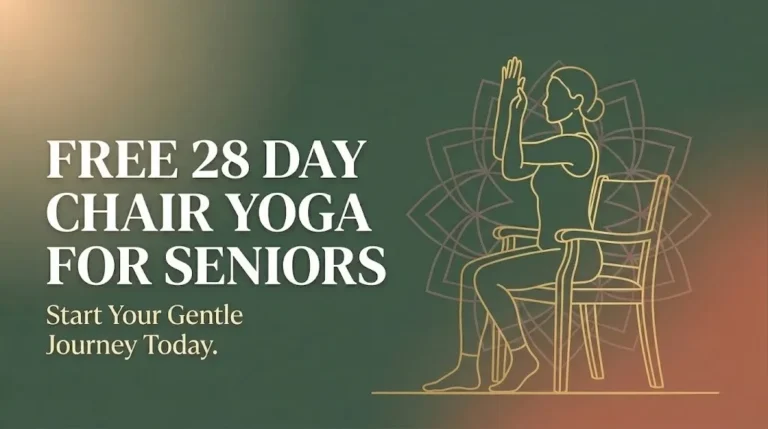
Chair-adapted versions of core lucent yoga poses:
- Chair Tadasana (Mountain Pose): Sit at the front edge of a sturdy chair, feet flat on the floor, spine tall. Practice diaphragmatic breathing for 1 to 2 minutes.
- Seated Cat-Cow: Same chair position. On inhale, arch the lower back and lift the chest. On exhale, round the spine and drop the chin. Move through 8 to 10 cycles.
- Seated Forward Fold: From chair, hinge forward at the hips with a straight back, letting hands rest on thighs or shins. Do not round aggressively. Hold for 4 breaths.
- Supported Viparita Karani: Use a wall and a chair. Sit sideways next to the wall. Rest legs up the wall or at an angle, using a folded blanket under the hips.
Seniors with osteoporosis should avoid deep spinal flexion (aggressive rounding of the spine) and full Uttanasana (Standing Forward Fold) without a wall or chair for support. A yoga teacher with senior-specific training or a physical therapist familiar with yoga-based movement can help individualize modifications.
Can Lucent Yoga Help with Back Pain?
Lucent yoga can reduce the intensity and frequency of chronic low back pain when practiced consistently, using proper alignment and appropriate modifications. This is one of yoga’s most well-researched applications.
According to the NCCIH, yoga for chronic low back pain has sufficient evidence to be considered a safe, effective complementary approach. The NCCIH notes that yoga’s combination of spinal mobility, core engagement, and stress reduction addresses multiple contributing factors of low back pain simultaneously.
The key poses for lower back care in a lucent yoga practice are Balasana (Child’s Pose), Marjaryasana-Bitilasana (Cat-Cow Pose), Viparita Karani (Legs Up the Wall), and gentle supine twists. These poses decompress the lumbar spine, activate the multifidus and transverse abdominis (the deep stabilizing muscles of the lower back), and reduce the muscle guarding that comes with chronic pain.
What lucent yoga does not do is fix structural issues like herniated discs or spinal stenosis on its own. People with a diagnosed spinal condition should work with their orthopedic physician or physical therapist to identify which poses are safe and which to avoid before starting any yoga practice.
Modifications for back pain:
- Use a folded blanket under the hips in Child’s Pose to reduce sacroiliac joint compression
- In Cat-Cow, do not let the lower back sag dramatically in Cow. Keep it gentle.
- Avoid deep backbends like Urdhva Mukha Svanasana (Upward-Facing Dog) until core stability is established
- For all floor poses, roll to one side before sitting up. Never jackknife straight from lying flat.
Lucent Yoga Modifications and Props
Props are not training wheels in lucent yoga. They are precision instruments that allow the body to access correct alignment, and the correct alignment is what produces the benefit.
A yoga block under the hand in Uttanasana (Standing Forward Fold) does not mean the practitioner “cannot do” a forward fold. It means the hamstrings and lower back can decompress fully without the compensating hip shift that happens when someone reaches for the floor before their range of motion allows it.
According to the Yoga Alliance, the appropriate use of props is a core competency in yoga teacher training, not an afterthought. This reflects decades of observation that unmodified poses practiced with compensating movement patterns create the injuries that give yoga an unfair reputation for being risky.
| Condition | Recommended Modification | Prop Used |
|---|---|---|
| Tight hamstrings | Block under hands in forward folds | Foam or cork block |
| Knee pain | Blanket under knees in all floor poses | Folded blanket |
| Wrist pain | Fists instead of flat palms in Cat-Cow | No prop needed |
| Hip tightness in Child’s Pose | Blanket between thighs and calves | Folded blanket |
| Lower back discomfort in Savasana | Blanket under knees | Folded blanket |
| Balance challenges in standing poses | Hand on wall or chair back | Wall or chair |
| Hamstring tightness in Legs Up the Wall | Hips further from wall at an angle | Bolster or folded blanket under hips |
The one prop every home lucent yoga practitioner should own first is a foam block, not a mat. Most people already have a carpeted or soft floor surface. Very few people have a reliable way to bring the floor closer to their hands, and that single modification unlocks safe forward folds, accessible lunges, and comfortable seated poses.
Key Takeaway: Props are alignment tools, not beginner accessories. A foam block is the single most useful first purchase for a home lucent yoga practice, solving more alignment problems than any other prop.
How Lucent Yoga Compares to Hatha and Restorative Yoga
Lucent yoga sits between Hatha yoga and Restorative yoga in terms of effort level, active engagement, and pace. Understanding where it falls helps practitioners choose it intentionally rather than landing on it by accident.
Hatha yoga is a broad category that describes most pose-based yoga. Classes labeled “Hatha” typically involve holding poses for several breaths with moderate physical engagement. There is usually some active muscular work involved. Vinyasa yoga is a subset of Hatha in which poses are linked by breath-led transitions, creating a flowing, often aerobically demanding sequence.
Restorative yoga uses extensive props to fully support the body in passive positions held for 5 to 20 minutes per pose. The muscular effort is essentially zero. The goal is complete nervous system downregulation. There is no strength building component.
Lucent yoga includes both active holding and passive resting. It uses props more liberally than most Hatha classes but requires more conscious engagement than pure Restorative practice. The breath awareness component is more continuously emphasized than in typical Hatha classes.
| Feature | Lucent Yoga | Hatha Yoga | Restorative Yoga |
|---|---|---|---|
| Pace | Slow to moderate | Moderate | Very slow |
| Physical effort | Low to moderate | Moderate | Very low (passive) |
| Prop use | High | Low to moderate | Very high |
| Breath focus | Continuous throughout | Beginning and end | Beginning and end |
| Hold times | 5 to 10 breaths | 3 to 5 breaths | 5 to 20 minutes |
| Best for | Daily practice, stress, back pain | Building strength and flexibility | Recovery, burnout, insomnia |
Yin yoga is also often compared here. Yin targets the connective tissue (fascia, ligaments, joint capsules) rather than muscle, with holds of 3 to 5 minutes in passive positions. Lucent yoga shares some of Yin’s floor-based quality but does not specifically target connective tissue or require the same depth of passive surrender.
Lucent Yoga Safety and Contraindications
Lucent yoga is among the lower-risk yoga approaches available. That does not mean it is without risk. Every physical practice carries some potential for strain or injury when done without proper attention to body signals.
The NCCIH notes that the most common yoga-related injuries involve the lower back, shoulders, and knees, and that most are due to overstretching, skipping modifications, or practicing while fatigued or distracted. Lucent yoga’s emphasis on awareness before effort directly addresses all three causes.
Specific situations where caution or adjustment is needed:
- Recent surgery: Anyone within 6 to 8 weeks of an abdominal, spinal, or joint surgery should have a cleared return-to-movement plan from their surgeon before starting floor-based yoga.
- Uncontrolled hypertension: Inversions, including Viparita Karani (Legs Up the Wall), can briefly increase intracranial pressure. Someone managing blood pressure with medication should ask their prescribing physician whether passive inversions are appropriate.
- Glaucoma: Same concern with inversions. Eye pressure increases in positions where the head is below or level with the heart for extended periods.
- Osteoporosis (moderate to severe): Poses involving aggressive spinal flexion (rounding of the back under load) carry fracture risk in people with significant bone density loss. A physical therapist familiar with osteoporosis-safe movement can help identify safe modifications.
- Second and third trimester pregnancy: Standard forward folds and prone (belly-down) poses are not appropriate. A prenatal-specialized yoga teacher should guide practice during pregnancy.
- Severe sciatica flare: During acute sciatic nerve irritation, certain hip stretches and forward folds can increase nerve compression. Rest and gentle walking are generally recommended during acute flare, with yoga resuming during the sub-acute phase.
This list is not exhaustive. A good rule: if a pose produces sharp, shooting, or burning pain, stop immediately. Dull muscular sensation that fades between poses is normal stretching. Sharp or radiating pain is not.
Lucent Yoga Cool-Down Poses and Better Sleep
The final 5 to 10 minutes of a lucent yoga session are where the nervous system transitions from active awareness to genuine rest. These poses are also the most effective standalone practice for people who want to use yoga specifically to improve sleep.
A 2020 meta-analysis published in the Journal of Alternative and Complementary Medicine found that yoga significantly improved sleep quality in adults with chronic insomnia compared to control groups, with the strongest effects seen in practices that included long holds in supine (lying-down) positions and slow breathing.
The best cool-down poses for sleep preparation:
- Supta Baddha Konasana (Reclined Bound Angle Pose): Lie on your back. Bring the soles of the feet together and let the knees fall out to each side. Place blocks or rolled blankets under each thigh for support. Hold for 3 to 5 minutes.
- Supine Spinal Twist (Supta Matsyendrasana): Lie on your back. Draw one knee to the chest and guide it across the body with the opposite hand. Extend the same-side arm to the side, palms up. Hold for 1 to 2 minutes per side.
- Savasana (Corpse Pose): Lie completely flat. Place a folded blanket under the knees to reduce lumbar compression. Palms face up. Eyes closed. Remain still for 5 minutes minimum.
Modification for sleep preparation: If lying flat on the floor is uncomfortable, practice Savasana on a firm mattress or sofa instead. The critical element is stillness and breath, not the surface.
Timing matters. Practicing these poses within 30 to 60 minutes of your intended sleep time appears to produce stronger sleep-onset benefits than practicing earlier in the evening, based on patterns observed consistently in yoga-for-insomnia research.
Key Takeaway: Cool-down and sleep-preparation poses in lucent yoga work best within 30 to 60 minutes of sleep. Savasana held for 5 minutes minimum is not optional. It is where the physiological recovery from the session is consolidated.
Frequently Asked Questions About Lucent Yoga
What is lucent yoga exactly?
Lucent yoga is a mindful movement practice that combines slow, prop-supported postures with continuous breath awareness to create a sustainable, low-intensity yoga experience.
It draws primarily from Hatha and Restorative yoga traditions but places stronger emphasis on breath quality throughout each pose, not just at the beginning of a session.
The name reflects the practice’s core quality: clarity of movement and presence, without strain or performance.
Is lucent yoga good for complete beginners?
Yes, lucent yoga is one of the most beginner-accessible approaches to yoga because it prioritizes awareness and ease over flexibility or strength.
New practitioners can start with just three poses held for 5 to 8 breaths each and build from there over several weeks.
The Yoga Alliance recommends that beginners focus on breath awareness and basic alignment before attempting more demanding sequences, which is exactly what lucent yoga is built around.
How long should a lucent yoga session be?
Most yoga teachers and physical therapists recommend beginners start with 15 to 20 minutes per session and build to 30 to 45 minutes over 4 to 6 weeks.
Research published in the International Journal of Yoga suggests that shorter, consistent sessions produce better adherence than occasional long sessions for new practitioners.
A 20-minute daily practice outperforms a 90-minute weekly session in both physical outcomes and habit formation.
What equipment do I need for lucent yoga at home?
The only essential item is a non-slip surface, which can be a yoga mat, a carpeted floor, or a non-slip rug.
A foam yoga block and a folded blanket cover approximately 80% of common alignment needs for beginner and intermediate lucent yoga practice.
A strap, bolster, and access to a wall are helpful additions as your practice develops, but none are required to start.
Can seniors do lucent yoga safely?
Seniors can practice lucent yoga safely with appropriate modifications, particularly chair adaptations and reduced hold times in standing poses.
The Harvard T.H. Chan School of Public Health recognizes yoga as a beneficial practice for older adults, with documented improvements in balance, mobility, and fall risk reduction.
Seniors with osteoporosis, recent joint replacement, or cardiovascular conditions should discuss any new movement practice with their treating physician or physical therapist before beginning.
Start Where You Are
Lucent yoga does not require flexibility, a studio membership, or an hour of free time. It requires a clear surface, three poses, and the willingness to pay attention to your breath.
Start with Balasana (Child’s Pose), Marjaryasana-Bitilasana (Cat-Cow), and Viparita Karani (Legs Up the Wall) this week. Hold each for 5 breaths. End with 3 minutes of Savasana (Corpse Pose). Do that four days in a row. See how your lower back, your sleep, and your stress level respond.
The practice builds itself when you give it a chance to start.