Yoga Pillows and Bolsters: The Complete 2026 Guide
Yoga pillows, more accurately called yoga bolsters, are firm, structured support props used in restorative, Yin, and Hatha yoga to hold the body in passive poses for extended periods without muscular effort. If you’ve been wondering whether you need one, how to use it, or which type fits your practice and body, this guide covers everything from filling types to pose-specific placement instructions.
Props like bolsters are not accessories for advanced practitioners. According to the National Center for Complementary and Integrative Health (NCCIH), supported and restorative yoga practices are among the most accessible forms of yoga for managing chronic pain, anxiety, and sleep disruption. The bolster is the prop that makes these practices work.
This guide covers what yoga pillows and bolsters actually are, how they differ from regular pillows, which filling and shape to choose, and step-by-step instructions for using one in five foundational poses. You’ll also find condition-specific guidance for back pain, pregnancy, seniors, and meditation practice.
Yoga Pillows and Bolsters: What They Are and Why They Matter
Yoga pillows and bolsters are firm, densely filled support props designed to hold the body in passive yoga poses, freeing the muscles from the work of maintaining position so the nervous system can shift into a rest-and-repair state.
The word “bolster” distinguishes these props from regular sleeping or decorative pillows. A yoga bolster is considerably firmer and more structurally stable. It maintains its shape under the weight of a torso, pelvis, or legs for holds lasting three to twenty minutes. A regular pillow compresses under body weight and loses its supportive geometry within seconds.
B.K.S. Iyengar, the founder of Iyengar yoga and one of the most influential figures in modern Western yoga, pioneered the systematic use of props including bolsters, blocks, straps, and chairs as tools that make poses anatomically accessible for every body. His approach, now standard across restorative and Yin yoga traditions, established the principle that props are not a sign of limitation but a sign of intelligent practice.
The practical impact of a bolster is significant. Placing one under the spine in Supta Baddha Konasana (Reclined Bound Angle Pose) allows the chest and hip flexors to open passively over five to ten minutes. No active muscular effort is required. The structural support does the work that active stretching would normally need sustained effort to achieve.
Why yoga bolsters matter for your practice:
- They allow passive, gravity-assisted stretching of the hip flexors, chest, and spine
- They support long holds (3 to 20 minutes) that produce connective tissue and fascial release
- They make restorative poses accessible for people with limited flexibility or mobility
- They reduce nervous system activation, supporting the parasympathetic “rest and digest” response
- They provide joint-specific support for practitioners managing chronic pain or recovering from injury
Yoga Bolster vs Regular Pillow: What Is the Actual Difference
A yoga bolster differs from a regular pillow in firmness, structural density, and shape consistency under load, making them functionally non-interchangeable for sustained supportive poses.
A standard sleeping pillow compresses to near-flat under the weight of a torso. Try placing one under your mid-back in a reclined pose and you’ll feel it collapse within thirty seconds, shifting the spine into an unsupported curve rather than maintaining the gentle opening arc that the exercise requires. A yoga bolster maintains its height and shape throughout a ten-minute hold, providing consistent support that the nervous system can actually surrender into.
The shape difference matters too. Round bolsters maintain a cylindrical cross-section that supports the natural curve of the lumbar spine and the opening of the thoracic spine when placed under the back. Rectangular bolsters provide a flat, stable platform suitable for seated forward folds, prone poses, and supporting the legs. Regular pillows achieve neither geometry reliably because their filling shifts and redistributes under pressure.
Cost is the common reason people try a regular pillow first. If you’re genuinely curious about bolster-supported yoga before committing to a purchase, fold two or three firm blankets into a tight rectangular stack. This is the traditional alternative and actually approximates a firm rectangular bolster well. It won’t replicate a round bolster’s geometry, but it demonstrates the prop’s value effectively.
| Feature | Yoga Bolster | Regular Pillow |
|---|---|---|
| Firmness under body weight | Maintains shape and height | Compresses to near-flat |
| Hold time support (10+ minutes) | Consistent throughout | Loses structure within minutes |
| Shape consistency | Stable round or rectangular form | Shifts and redistributes |
| Available shapes | Round, rectangular, pranayama | Standard bed shapes only |
| Washable cover | Yes (most have removable covers) | Varies |
| Typical weight | 3 to 7 pounds | 1 to 2 pounds |
Types of Yoga Bolsters: Round, Rectangular, and Specialty Shapes
The three main yoga bolster shapes are round (cylindrical), rectangular (flat-topped), and pranayama (thin, elongated), each designed for different poses and different types of body support.
Round bolsters have a cylindrical shape, typically 24 to 26 inches long and 9 to 10 inches in diameter. Their curved profile makes them ideal for spinal extension poses, where the bolster placed perpendicular to the spine creates a gentle backbend arc. They also work well for supporting the pelvis in forward fold variations and for propping under the knees in Savasana (Corpse Pose). Round bolsters suit practitioners who focus on chest opening, spinal extension, and hip flexor release.
Rectangular bolsters have a flat top surface and square or near-square cross-section, typically 24 to 26 inches long and 12 to 14 inches wide by 6 to 8 inches tall. The flat surface is more versatile for seated forward folds, prone poses, and configurations where the practitioner sits on the bolster. Most restorative yoga teachers consider the rectangular bolster the more versatile of the two shapes for mixed-pose sequences.
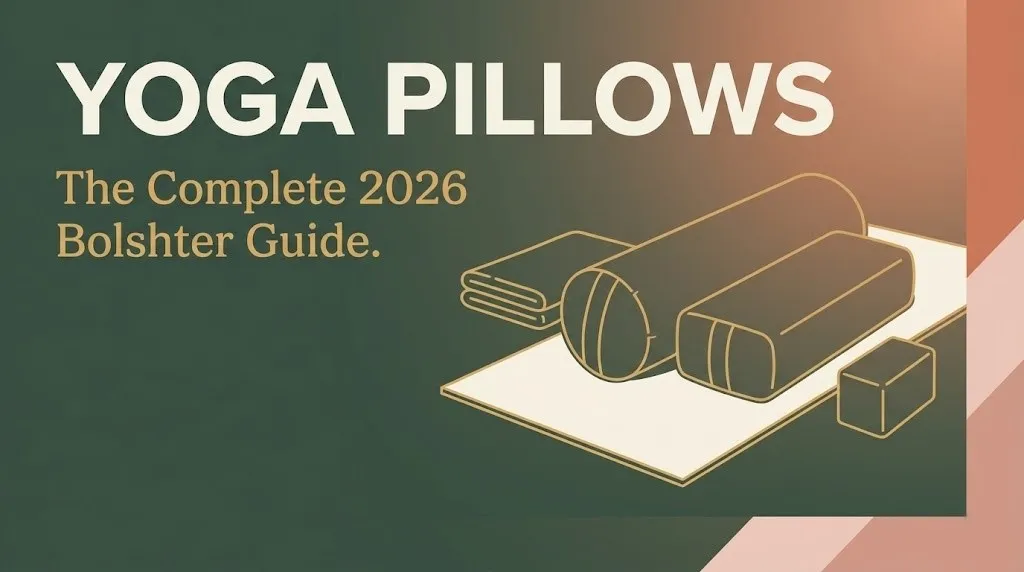
Pranayama bolsters are thinner and longer than standard bolsters, designed specifically to support the spine in a reclined position during breath work. They tend to run 24 to 30 inches long and only 5 to 6 inches in diameter, producing a subtler lift that keeps the lumbar spine supported without creating a dramatic backbend. They suit practitioners with limited thoracic spine mobility or those who find standard round bolsters too intense for spinal extension work.
| Bolster Shape | Dimensions (Typical) | Best Poses | Best For |
|---|---|---|---|
| Round (cylindrical) | 24 to 26″ L x 9 to 10″ diameter | Spinal extension, hip opening, Savasana knee support | Chest opening, backbend prep |
| Rectangular (flat-top) | 24 to 26″ L x 12 to 14″ W x 6 to 8″ H | Seated forward folds, prone poses, sitting support | Versatile all-around use |
| Pranayama (thin, elongated) | 24 to 30″ L x 5 to 6″ diameter | Reclined breathing, gentle spinal support | Breath work, limited thoracic mobility |
Key Takeaway: Round bolsters are best for spinal extension and chest opening. Rectangular bolsters are more versatile for mixed restorative sequences. If you can only buy one, start with rectangular.
Buckwheat Yoga Bolster: What It Is and Who Should Use It
A buckwheat yoga bolster is filled with buckwheat hulls, the outer shells of buckwheat seeds, which shift and mold to the body’s contours while still providing firm, adjustable support.
Buckwheat hulls behave differently from any other bolster filling. They are not compressible in the way foam or kapok is. Instead, they redistribute under pressure, conforming specifically to the shape pressing into them. This makes a buckwheat bolster feel more personalized and body-responsive than a fixed-shape foam or kapok bolster. The support adjusts to your spinal curve rather than imposing a standard shape onto your body.
The trade-offs are weight and sound. Buckwheat bolsters are noticeably heavier than kapok or foam-filled equivalents of the same size, often ranging from 5 to 9 pounds compared to 3 to 5 pounds for kapok. They also produce a subtle rustling sound when repositioned during practice. For most students this is a minor inconvenience. For practitioners with sound sensitivity or those practicing in shared sleeping spaces, it is worth noting.
Buckwheat yoga bolsters are best for:
- Practitioners who want a bolster that molds to individual spinal curves
- Students with non-standard body geometry who find firm, fixed bolsters uncomfortable
- Meditation practitioners who want a bolster that adjusts to seated position changes
- Practitioners managing lower back conditions where a one-size-fits-all shape is inadequate
- Anyone who prefers a natural, organic filling over synthetic foam
Avoid buckwheat bolsters if you have a known buckwheat allergy (rare but possible) or if you practice in a space where the rustling sound would cause disturbance.
Large Yoga Bolster: When Size Matters in a Support Prop
A large yoga bolster, typically measuring 26 inches or longer and 12 to 14 inches in diameter or width, provides more surface area for full-body support and is particularly suited for taller practitioners, broader builds, or poses requiring the bolster to support the entire torso.
Standard bolsters were designed with average adult body proportions in mind. For practitioners over 5 feet 10 inches, a standard 24-inch bolster may not fully support the torso from the sacrum to the shoulder blades in reclined spinal extension poses. The result is an unsupported gap either at the lumbar region or the upper back, which prevents the full opening the pose is designed to produce.
Large bolsters are also better suited for Supta Baddha Konasana (Reclined Bound Angle Pose) in practitioners with a longer torso, for Viparita Karani (Legs Up the Wall Pose) where the bolster supports the sacrum and lower back, and for any reclined pose where the practitioner’s weight needs distribution across a longer contact surface.
The practical downside of large bolsters is storage and portability. A bolster measuring 28 by 14 inches with a firm kapok or cotton filling weighs 6 to 8 pounds and occupies notable floor space. For home practitioners with dedicated yoga rooms this is not a concern. For people practicing in shared living spaces, a standard-size rectangular bolster may be more practical.
Pose Tip:
- If a standard bolster leaves a gap under your lumbar spine, fold a blanket to fill the gap
- For very tall practitioners, two rectangular bolsters placed end to end can approximate a large bolster’s length
- Measure your torso from sacrum to shoulder blades before purchasing to confirm a large bolster is actually needed
Brentwood Yoga Bolster: What Sets Cotton-Filled Bolsters Apart
Brentwood Home is a brand associated with natural, cotton-filled yoga bolsters that use tightly compressed cotton batting to create a firm, stable support prop that maintains its shape without synthetic materials.
Cotton filling occupies a middle position in the bolster firmness spectrum. It is firmer than kapok (which compresses somewhat over time) but less adjustable than buckwheat hulls. A well-made cotton bolster provides consistent, predictable support across years of practice without significant breakdown in structure. Brentwood Home bolsters, in particular, have earned a reputation for dense construction and organic fabric covers, appealing to practitioners who prioritize natural materials throughout their home practice setup.
Cotton bolsters tend to run warmer against the body than kapok or buckwheat, which can be either a benefit or a drawback depending on your practice environment. In cooler rooms or during winter practice, this warmth is appreciated. In already-warm studio environments or during active restorative sequences where the body generates significant heat, it can feel uncomfortable over long holds.
Cotton-filled bolsters are best for:
- Practitioners who want organic, natural materials without synthetic foam
- Students who prefer firm, unchanging support rather than the moldable feel of buckwheat
- Practitioners managing chronic back conditions who need consistent, predictable bolster height
- Anyone who runs cold during practice and benefits from the warmth cotton retains
- Home practitioners seeking a long-lasting, low-maintenance prop
The Brentwood Home brand specifically offers bolsters with GOTS-certified organic cotton covers, which matters for practitioners with chemical sensitivities or skin sensitivities to synthetic dyes.
Key Takeaway: Cotton-filled bolsters like Brentwood Home products offer firm, consistent, natural support that outlasts kapok and suits practitioners who want predictable bolster height for therapeutic poses.
Yoga Bolster Filling Types Compared: Buckwheat, Kapok, Foam, and Cotton
The four primary yoga bolster fillings are buckwheat hulls, kapok fiber, foam, and cotton batting, each with distinct firmness, weight, durability, and body-response characteristics that determine which practitioners they suit best.
Kapok is a natural plant fiber harvested from the seed pods of the Ceiba tree. It is light, relatively firm when packed tightly, and produces a bolster that feels supportive without being rigid. Kapok bolsters tend to compress gradually over years of use, losing approximately 10 to 20 percent of their height over three to five years of regular practice. Many yoga teachers consider kapok the standard recommendation for restorative yoga beginners because it balances firmness with accessibility.
Foam bolsters, typically made from high-density polyurethane or memory foam, provide consistent firmness that does not change over time. They are the lightest option per unit volume and the easiest to carry between practice locations. The trade-off is that foam does not breathe like natural fillings. It can retain body heat against the skin during long holds and may feel less congruent to environmentally-conscious practitioners.
Think of the filling choice like selecting a mattress. Buckwheat is like a futon: firm, body-responsive, heavy, and durable. Kapok is like a medium-firmness natural latex mattress: supportive, slightly yielding, gradually compressing with use. Foam is like memory foam: consistent, non-responsive, lightweight. Cotton is like an innerspring: firm, stable, warm, and long-lasting.
| Filling | Firmness | Weight | Durability | Best For |
|---|---|---|---|---|
| Kapok | Medium-firm | Light (3 to 4 lbs) | Compresses over 3 to 5 years | Beginners, restorative yoga |
| Buckwheat hulls | Firm, body-moldable | Heavy (5 to 9 lbs) | Very durable | Custom support, meditation |
| Cotton batting | Firm, stable | Medium (4 to 6 lbs) | Very durable | Therapeutic use, natural materials |
| High-density foam | Very firm, consistent | Light (2 to 4 lbs) | Durable, no compression | Travel, portability |
| Memory foam | Medium, contouring | Light to medium | Durable | Comfort-focused practitioners |
How to Use a Yoga Bolster: Step-by-Step for Five Key Poses
A yoga bolster is used by positioning it under a specific part of the body to provide passive support in a pose, allowing gravity and time rather than muscular effort to produce the desired stretch or release.
The five most common bolster-supported poses appear in nearly every restorative and Yin yoga class. Learning the correct bolster placement for each pose is more important than the pose shape itself. Incorrect placement undermines the pose’s benefit and can create discomfort that prevents the nervous system from settling.
Supta Baddha Konasana (Reclined Bound Angle Pose) with bolster spinal support:
- Place the bolster on your mat, positioned lengthwise along your spine direction.
- Sit in front of the short end of the bolster, with your sacrum touching the end of the bolster.
- Bring the soles of the feet together and let the knees fall open to the sides.
- Place folded blankets under each knee to support the inner thighs if the groin feels strained.
- Recline back over the bolster so it supports the full length of your spine and head.
- Rest arms out to the sides at 45 degrees, palms facing up.
- Hold for 5 to 10 minutes, breathing naturally. Release by rolling to one side.
Modification for lumbar sensitivity: Place the bolster perpendicular to your spine under only the mid and upper back. Keep the lower back on the mat with a folded blanket supporting the lumbar curve. This reduces spinal extension demand while still opening the chest.
Balasana (Child’s Pose) with bolster torso support:
- Kneel with knees wide and big toes touching behind you.
- Place the bolster lengthwise between your thighs on the mat.
- Fold forward, bringing your torso to rest on the bolster.
- Turn your head to one side, resting one cheek on the bolster.
- Let arms drape naturally on either side of the bolster.
- Hold for 3 to 5 minutes. Halfway through, turn the head to face the opposite direction.
Modification for knee sensitivity: Place a rolled blanket in the crease behind the knees before folding forward. This reduces knee flexion demand. Anyone with acute knee injury should confirm the degree of knee flexion is pain-free before settling into the hold.
Viparita Karani (Legs Up the Wall Pose) with bolster sacral support:
- Place the bolster approximately 4 to 6 inches from a clear wall section.
- Sit sideways on the bolster with one hip touching the wall.
- Swing both legs up the wall as you recline your torso back onto the mat.
- The bolster should sit under your sacrum and lower back, with your hips slightly elevated.
- Rest arms by your sides, palms up. Close your eyes.
- Hold for 5 to 15 minutes.
Modification for tight hamstrings: Move the bolster farther from the wall, allowing a slight bend in the knees. This reduces the posterior chain tension that prevents the legs from fully relaxing up the wall.
Yoga Bolster for Restorative Yoga: Poses and Placement Guide
In restorative yoga, the bolster functions as the primary structural support that allows the body to hold passive poses for three to twenty minutes without muscular engagement, which is what distinguishes restorative yoga from all other styles.
Restorative yoga was systematized by B.K.S. Iyengar and later popularized in the West by teacher Judith Hanson Lasater, whose research and teaching established the style as a therapeutic yoga practice rather than simply a gentle alternative to active yoga. The key principle is complete passive support: if any muscle is working to hold the pose, the prop is incorrectly placed.
A study published in the International Journal of Yoga found that restorative yoga practice over eight weeks produced measurable reductions in anxiety, cortisol levels, and self-reported stress in adults with elevated psychological stress scores. The bolster is not decorative in this context. It is the mechanism that makes the extended passive holds possible, which is where the nervous system benefit occurs.
Common restorative bolster configurations:
- Prone backbend support: Bolster placed under the sternum and frontal ribs, allowing the spine to extend gently in a face-down position. Arms drape over the ends of the bolster.
- **Supported *Matsyasana (Fish Pose)*: Bolster placed perpendicular to the spine under the thoracic spine and shoulder blades. Head rests on a folded blanket. Legs extend long or in *Baddha Konasana (Bound Angle Pose)*.
- **Supported *Setu Bandha Sarvangasana (Bridge Pose)*: Bolster placed under the sacrum at low height, supporting the pelvis in a gently elevated position without muscular effort.
Modification for all restorative poses: If the bolster creates any sensation of strain rather than passive release, add a folded blanket to reduce the prop height. Restorative poses should feel like relief, not effort.
Key Takeaway: In restorative yoga, if any muscle is working to hold the pose, the bolster is in the wrong position. Correctly placed props produce zero muscular effort and complete passive surrender.
Yoga Bolster for Back Pain and Lumbar Support
A yoga bolster supports back pain management by creating passive spinal decompression and gentle hip flexor release in poses that are otherwise inaccessible for people with lumbar sensitivity, without requiring the muscular effort that can aggravate an already irritated spine.
Chronic lower back pain often involves a combination of tight hip flexors, restricted lumbar mobility, and heightened nervous system sensitivity. The iliopsoas muscle, which connects the lumbar spine to the femur, becomes shortened in people who sit for long periods and contributes to anterior pelvic tilt and lumbar compression. A bolster placed under the thoracic spine in a reclined position allows the iliopsoas to lengthen passively over a sustained hold, which active stretching often cannot achieve without triggering guarding responses.
According to the Journal of Alternative and Complementary Medicine, restorative yoga practices that include supported inversions and passive hip opener poses show associations with reduced chronic lower back pain intensity and improved functional mobility in adults with non-specific lower back pain. The effect accumulates over weeks of consistent practice rather than appearing after a single session.
How to use a bolster for lower back support:
- Place the bolster lengthwise on your mat.
- Lie back over the bolster so it sits under your mid-back and thoracic spine.
- Keep the lower back on the mat with a folded blanket supporting the natural lumbar curve.
- Bend the knees with feet flat on the mat if full leg extension causes lower back discomfort.
- Hold for 5 to 8 minutes, breathing slowly through the nose.
- Roll to one side to exit. Do not sit up directly from this position.
Anyone with acute disc herniation or radiculopathy should work with a physical therapist to determine appropriate spinal extension range before using any bolster for back-extension poses. A physical therapist familiar with yoga props can help identify which configurations are appropriate for the specific condition.
Yoga Bolster for Pregnancy and Postpartum Recovery
Yoga bolsters are particularly useful during pregnancy for supporting the body in side-lying poses, seated positions, and modified forward folds that become inaccessible as the abdomen grows and the center of gravity shifts.
Prenatal yoga benefits from bolster support at almost every stage of pregnancy. In the first trimester, bolsters assist with fatigue management and stress reduction through supported restorative poses. In the second and third trimesters, they make seated poses more accessible by elevating the pelvis in cross-legged or Sukhasana (Easy Seat) positions, which reduces hip flexor tension and allows a more neutral pelvic position as the lumbar curve increases.
The American College of Obstetricians and Gynecologists (ACOG) advises pregnant individuals to avoid lying flat on the back after the first trimester, as this position can compress the inferior vena cava and reduce blood flow to the fetus. Bolsters allow modified reclined poses where the torso remains elevated enough to avoid this concern. A bolster placed lengthwise under the torso in a 30 to 45 degree incline makes many restorative poses safe throughout pregnancy.
Postpartum recovery use cases for bolsters:
- Supporting the thoracic spine in gentle backbend poses to counter the forward rounding from nursing and carrying
- Elevating the hips in cross-legged positions to reduce pelvic floor pressure during early postpartum healing
- Supporting Viparita Karani (Legs Up the Wall Pose) for lower limb fluid drainage and fatigue reduction
- Propping under the knees in Savasana (Corpse Pose) to reduce lumbar tension during rest periods
Postpartum practitioners should discuss the timing and appropriate intensity of yoga poses with their obstetric provider, particularly for any poses that involve core engagement or abdominal pressure before healing is confirmed complete.
Yoga Bolster for Seniors: Accessibility and Joint Support
Yoga bolsters make restorative and Hatha yoga accessible for older adults by reducing the floor distance that stiff joints must travel and providing stable support that prevents the balance challenges associated with unsupported floor poses.
Older adults face specific physical barriers to yoga practice: reduced hip and knee flexion range, decreased bone density that makes hard floor contact uncomfortable, reduced proprioceptive sensitivity that increases fall risk, and longer recovery time from exercise-induced tissue fatigue. A bolster addresses several of these barriers simultaneously.
Placing a bolster under the knees in Savasana (Corpse Pose) removes the lumbar strain that prevents many adults over 60 from resting comfortably on the floor for five to ten minutes. Sitting on a bolster rather than the floor in cross-legged meditation raises the pelvis above the knees, which dramatically reduces hip flexor and knee joint strain in seated positions. These are not workarounds. They are anatomically correct configurations that suit bodies with reduced joint range.
According to the National Center for Complementary and Integrative Health (NCCIH), yoga practice including supported and restorative formats shows associations with improved balance, reduced fall risk, and better self-reported quality of life in adults over 65. The bolster is what makes these formats accessible for seniors who cannot comfortably practice unsupported floor poses.
Bolster uses specifically valuable for seniors:
- Under the knees in Savasana to reduce lumbar compression
- Seated on, to elevate the hips above the knees in cross-legged poses
- Under the thoracic spine in gentle supported backbend positions
- Between the thighs in side-lying rest poses for hip joint support
- Under the forehead in prone poses to avoid neck compression
Key Takeaway: For seniors, sitting on a bolster in cross-legged poses rather than directly on the floor is a single adjustment that immediately reduces hip flexor and knee strain, making meditation and floor practice accessible at any age.
Yoga Bolster for Meditation and Pranayama
A yoga bolster used in meditation and pranayama practice elevates and tilts the pelvis forward, which reduces lumbar strain, opens the hip angle, and allows the spine to maintain a natural upright position without the constant muscular effort that unsupported seated meditation requires.
Sitting cross-legged on a flat floor places most adults in posterior pelvic tilt, where the pelvis tips backward and the lumbar spine rounds. This rounded position compresses the diaphragm, restricts breath capacity, and requires the erector spinae muscles to work continuously to prevent collapse. After five to ten minutes, this muscular effort becomes fatigue, and the mind shifts from breath awareness to physical discomfort management.
Sitting on a bolster or placing it under the knees in a kneeling position resolves this entirely for most practitioners. The pelvic elevation produces anterior tilt, allowing the lumbar curve to re-establish naturally. The erector spinae can relax. The diaphragm has full room to expand. Ujjayi Pranayama (Victorious Breath) and Nadi Shodhana (Alternate Nostril Breathing) both depend on unrestricted diaphragmatic movement, which unsupported seated positions often prevent.
Bolster configurations for seated meditation:
- Cross-legged on bolster: Sit on the center of the bolster with both knees wider than the bolster edges. This elevates the pelvis and reduces hip flexor and knee pressure.
- Kneeling on bolster: Kneel with the bolster placed lengthwise between your calves and thighs, sitting back onto the bolster. This mimics a meditation bench position.
- Reclined pranayama: Place the bolster lengthwise under the spine for reclined breath work, with a folded blanket under the head.
Modification for knee sensitivity in cross-legged position: Place folded blankets under each knee rather than letting them hang in the air, which strains the knee ligaments. The knees should always be supported or at the same height as the hips when sitting on a bolster.
What Size Yoga Bolster Should You Choose
The right yoga bolster size depends on your torso length, the poses you practice most, your body weight, and whether you plan to use the bolster primarily for restorative poses, seated meditation, or pregnancy support.
Torso length is the primary factor for reclined support poses. A bolster should span from the sacrum to the back of the head in spinal extension poses. If you are under 5 feet 5 inches, a standard 24-inch bolster likely covers this span. If you are between 5 feet 5 inches and 5 feet 10 inches, a 26-inch bolster provides more reliable coverage. Practitioners over 5 feet 10 inches should measure their sacrum-to-occiput distance and choose a bolster at least 2 inches longer, or use a large format bolster.
Height matters for seated use. Sitting on a bolster that is too tall tips the pelvis too far forward, which shortens the hip flexors rather than lengthening them. Sitting on one that is too low fails to resolve the posterior pelvic tilt that the elevation is meant to correct. Most adults find a rectangular bolster height of 6 to 8 inches appropriate for seated meditation. Petite practitioners often prefer 5 to 6 inches.
| Practitioner Height | Recommended Length | Recommended Height | Best Shape |
|---|---|---|---|
| Under 5’4″ | 24 inches | 5 to 6 inches | Round or rectangular |
| 5’4″ to 5’9″ | 24 to 26 inches | 6 to 8 inches | Rectangular |
| 5’10” and above | 26 to 30 inches | 7 to 9 inches | Large rectangular |
| Pregnant (2nd/3rd trimester) | 26 to 30 inches | 8 to 10 inches | Large rectangular |
| Meditation-focused | 24 inches | 5 to 6 inches | Round or pranayama |
How to Clean and Care for a Yoga Bolster
Most yoga bolsters have a removable zippered cover that is machine washable, while the inner filling should be aired out regularly but not submerged in water or placed in a washing machine.
Cleaning the cover is straightforward. Remove the zippered cover, check the care label for temperature guidance, and machine wash on a gentle or delicate cycle in cold or warm water. Tumble dry on low heat or line dry to preserve the fabric’s color and weave integrity. Most bolster covers wash well without special treatment. Cotton and organic cotton covers should be washed in cold water to prevent shrinkage.
The inner filling requires different care. Kapok and cotton fillings should never be submerged in water. Moisture trapped inside the filling creates conditions for mold and mildew development, which is both a hygiene concern and a structural problem as the filling clumps and loses its even distribution. If the inner filling develops an odor, remove it from the cover and air it in direct sunlight for several hours. UV exposure kills most surface bacteria and dissipates odor effectively.
Bolster care by filling type:
- Kapok: Air in sunlight monthly. Never wet. Replace if filling has compressed more than 30 percent.
- Buckwheat: Spread on a flat surface in the sun to dry if any moisture exposure occurs. Check for hull integrity annually.
- Cotton: Air in sunlight. If moisture contamination occurs, discard and replace. Cotton holds moisture and mold risk longer than other fillings.
- Foam: Wipe surface with a damp cloth if the cover is not removable. Air dry fully before recovering.
- Cover fabric: Machine wash cold, gentle cycle. Line dry or tumble low. Never iron at high heat if the cover includes synthetic threads.
Key Takeaway: Wash the bolster cover monthly and air the filling in direct sunlight every four to six weeks. Never submerge the inner filling in water, regardless of filling type.
Frequently Asked Questions About Yoga Pillows
What is the difference between a yoga bolster and a regular pillow?
A yoga bolster is a firm, densely filled prop that maintains its shape under full body weight for holds lasting 5 to 20 minutes.
A regular pillow compresses to near-flat under body weight within seconds and cannot provide consistent structural support for yoga poses.
If you need a temporary substitute, tightly folded blankets approximate a firm rectangular bolster better than any standard bed pillow.
What is a yoga bolster used for?
A yoga bolster is used to support the body in passive yoga poses, allowing muscles to fully release rather than holding the pose through muscular effort.
Common uses include spinal support in reclined backbend poses, seated elevation for meditation, knee support in Savasana, and full torso support in Child’s Pose and restorative forward folds.
Bolsters are central to restorative yoga and Yin yoga practice, and are widely used in prenatal yoga and therapeutic yoga for chronic pain management.
What size yoga bolster should I get?
Most adults between 5 feet 4 inches and 5 feet 9 inches do well with a standard 24 to 26 inch bolster at 6 to 8 inches in height.
Practitioners over 5 feet 10 inches should look for a large format bolster at 26 to 30 inches long to ensure full spinal support in reclined poses.
For meditation and seated use, a round or pranayama bolster at 5 to 6 inches in diameter suits most body sizes regardless of height.
Can beginners use yoga bolsters?
Beginners benefit enormously from yoga bolsters because they make poses accessible before flexibility or strength have developed sufficiently to hold the shapes independently.
A bolster in Child’s Pose, for example, allows a complete beginner to rest comfortably in a pose that requires significant hip and knee flexibility in its unsupported version.
Starting your home practice with a rectangular bolster gives you a versatile prop that supports at least five foundational poses immediately.
How do you use a yoga bolster for back pain?
Place the bolster lengthwise under the thoracic spine in a reclined position, with the lower back supported by a folded blanket on the mat, and hold for 5 to 8 minutes.
This configuration creates passive spinal decompression and gentle hip flexor lengthening without requiring muscular effort, which can aggravate an irritated lumbar spine.
Anyone with acute disc herniation or nerve pain should work with a physical therapist to confirm appropriate spinal extension range before using a bolster in back extension poses.
Your Practice, Properly Supported
A yoga bolster is one of the most practical investments you can make in your home yoga practice. Start with a rectangular bolster if you’re undecided on shape. Use it under your thoracic spine in a reclined pose tonight for five minutes. That single experience will clarify what these props do better than any description.
Practice Supta Baddha Konasana (Reclined Bound Angle Pose) three times per week with the bolster supporting your spine. Add folded blankets under each knee. Set a timer for seven minutes.
Notice how the nervous system responds when the body is completely supported and asked to do nothing at all.