Fun Yoga Poses: Top Creative Picks for 2026 Practice
Fun yoga poses are not a lesser category of yoga. They are often the entry point that keeps people practicing long enough to actually feel the benefits. When a pose challenges your balance, makes you laugh at yourself, or requires you to think rather than just stretch, it creates the kind of engagement that builds a lasting practice.
Research published in Frontiers in Psychology has found that playful movement and novel physical challenges activate the brain’s reward circuitry in ways that repetitive, familiar movement does not. This has direct implications for motivation and consistency in yoga practice. The poses that feel like play are often the ones that bring people back to the mat.
This guide covers 18 specific yoga poses organized by audience, skill level, and purpose. You’ll find poses for kids, for partners, for flexibility, for stress relief, and for advanced practitioners ready to try something genuinely new. Every pose includes instructions, modifications, and honest notes on who it suits best.
Fun Yoga Poses: What Makes a Pose Actually Fun?
Fun yoga poses are poses that engage your attention, challenge your coordination, or surprise you with how your body responds, creating an experience that feels like discovery rather than obligation.
Not every pose that looks impressive is fun to do. And not every fun pose looks dramatic from the outside. A pose can be fun because it requires balance that makes you wobble, because it opens a part of the body you didn’t know was stiff, or because it looks nothing like what you expected yoga to be.
The psychological mechanism here is real. According to the American Psychological Association, novelty-seeking behavior activates the dopaminergic reward system, the same neural pathway involved in motivation and pleasure. When yoga includes unfamiliar shapes, balance challenges, or creative sequencing, the brain responds differently than it does to a routine you’ve done a hundred times.
For yoga teachers, this matters practically. Students who experience curiosity and mild challenge during a class are more likely to return. For home practitioners, building in poses that require genuine attention breaks the monotony that often leads to practice dropout.
What makes a yoga pose fun varies by person:
- Balance challenges that require focus and produce a genuine response when you wobble
- Arm balances that feel counterintuitive and rewarding when you find the weight shift
- Inversions that change your spatial orientation and perspective
- Partner shapes that require communication and coordination
- Animal-named poses that invite imagination and reduce self-consciousness
Interesting Yoga Poses: The Ones Nobody Talks About
Interesting yoga poses are the ones that appear rarely in beginner classes but are far more accessible than they look, including poses that most practitioners overlook entirely.
Astavakrasana (Eight-Angle Pose) is one of the most visually striking arm balances in Hatha yoga and is also more achievable than its name suggests. The pose involves threading one leg over the upper arm and extending both legs to the side while balancing on the hands. It requires wrist stability, core control, and hip flexibility rather than extreme upper body strength.
Vasisthasana (Side Plank Pose) in its full expression, with the top leg raised and the arm extended, looks spectacular and builds real lateral core strength. Most practitioners know the basic version but have never tried the full variation. The full version turns a functional strength exercise into something that genuinely requires concentration and body awareness.
Garudasana (Eagle Pose) stands out because it works against every postural assumption the body makes. The arms wrap into each other, the legs cross and hook, and the whole shape requires the practitioner to find stillness inside a position that feels like organized compression. It stretches the rhomboids, posterior deltoids, and IT band in a way almost nothing else does.
Interesting yoga poses to explore beyond the basics:
- Astavakrasana (Eight-Angle Pose): Arm balance requiring core and hip flexibility
- Vasisthasana (Side Plank Pose) full variation: Lateral strength and balance
- Garudasana (Eagle Pose): Compression stretch for posterior shoulders and IT band
- Viparita Virabhadrasana (Reverse Warrior): Lateral spine extension that most people skip
- Ardha Chandrasana (Half Moon Pose): Balance and hip opening combined
Unique Yoga Poses: Shapes You Have Probably Never Tried
Unique yoga poses include shapes from traditional yoga that rarely appear in mainstream classes, offering fresh physical experiences for practitioners who feel they have seen everything.
Pincha Mayurasana (Feathered Peacock Pose) is a forearm balance, the inversion most practitioners skip on the way to trying a full handstand. The pose builds anterior deltoid and serratus anterior strength in a way that handstands do not, and the alignment challenge is distinct. It is genuinely difficult and genuinely rewarding when it clicks.
Tittibhasana (Firefly Pose) requires practitioners to straighten both legs out to the sides while balanced on the hands, with the backs of the upper thighs resting on the upper arms. It is a combination of hip flexibility, hamstring length, and core compression that most people have simply never attempted. The pose looks impossible until you understand the weight-shifting mechanics.
Krounchasana (Heron Pose) is a seated pose that extends one leg straight up toward the face while sitting on the other foot. It is an intense hamstring and hip flexor stretch presented in a shape that feels nothing like a standard forward fold. People who have done hundreds of yoga classes often try Heron Pose and feel like beginners again, which is part of what makes it valuable.
Modification note: All three of these poses require strong foundational strength and flexibility. Practitioners with wrist injuries should avoid Pincha Mayurasana and Tittibhasana. Anyone with tight hamstrings should use a yoga strap around the extended foot in Heron Pose and work toward the full extension gradually.
Key Takeaway: The most interesting and unique yoga poses are often the ones your regular class never includes. Trying even one unfamiliar pose per week is enough to reactivate the curiosity that sustains a long-term practice.
Fun Yoga Poses for Beginners: Where to Start Without Overwhelm
Fun yoga poses for beginners are poses that produce an immediate, satisfying physical response without requiring strength or flexibility that takes months to develop.
Vrksasana (Tree Pose) is the classic beginner balance pose, and it is genuinely fun because it exposes the difference between standing and actually balancing. The moment the standing leg begins to wobble, the whole body has to respond. That feedback loop, feel the wobble, adjust, find steadiness, is both instructive and entertaining for new practitioners.
Anjaneyasana (Low Lunge) does something beginners almost always feel immediately: it opens the hip flexors in a way that creates a distinct, satisfying release. Many beginners describe this as one of the first yoga poses where they genuinely feel something happening. When a pose produces that kind of clear physical feedback, it becomes motivating rather than abstract.
Ustrasana (Camel Pose) surprises many beginners because it looks like a backbend but feels more like a full-body opening. The anterior chest, hip flexors, and quadriceps all stretch simultaneously. The sensation of the heart lifting toward the ceiling is unlike anything in a forward fold or standing pose, and that novelty is part of what makes it engaging for new practitioners.
Beginner modifications:
- Vrksasana (Tree Pose): Keep the raised foot at the ankle rather than the inner thigh. Practice near a wall for balance support.
- Anjaneyasana (Low Lunge): Place a folded blanket under the back knee for padding. Keep the front knee directly above the ankle.
- Ustrasana (Camel Pose): Keep hands on the lower back rather than reaching for the heels. Tuck toes under to raise heel height if reaching is not yet accessible.
Fun Yoga Poses for Kids: What Actually Works on a Mat
Fun yoga poses for kids are most effective when they are named after animals, involve sound, or require some kind of physical interaction with another person or object.
Children respond to yoga through imagination before they respond to instruction. A pose called Balasana (Child’s Pose) is often less engaging than “we’re going to curl up like a sleeping hedgehog.” The shape is identical, but the entry point is different. For teachers or parents doing yoga with children, animal-themed and story-based framing is not dumbing it down; it is meeting the child’s developmental stage accurately.
Poses that work particularly well with children include Adho Mukha Svanasana (Downward-Facing Dog), which invites barking and wagging; Bhujangasana (Cobra Pose), which encourages hissing and lifting; and Simhasana (Lion Pose), which involves a wide-open face and a roaring exhale that children find immediately appealing. Simhasana also has a practical benefit: it releases facial tension and stimulates the vagus nerve through the forced exhalation, which can help settle an overstimulated child.
According to a study published in the International Journal of Yoga, children who participated in school-based yoga programs showed improvements in attention, emotional regulation, and body awareness compared to control groups. Playful poses were more consistently practiced and retained by younger children than purely instructional ones.
Safety note: Children’s joints and connective tissue are more flexible and less stable than adults’. Avoid deep passive holds in young children and never push a child into a deeper range of motion than they naturally achieve. Fun should always be the priority, not the shape.
Fun Yoga Poses for Two People: Partner Practice That Actually Works
Fun yoga poses for two people, often called partner yoga or the acro yoga foundational tier, work best when communication is treated as part of the pose rather than an interruption to it.
**Double *Adho Mukha Svanasana* (Partner Downward-Facing Dog)** is the most accessible partner pose. One person comes into a standard Downward-Facing Dog. Their partner places their hands in front of the first person’s hands and their feet on the lower back of the first person, pressing up into their own Downward-Facing Dog. The result is a gentle spinal traction for the base person and an unusual elevated variation for the top person. Both practitioners feel the pose differently because of the contact.
Seated back-to-back twists involve both partners sitting cross-legged, spine against spine. One person twists to the right, the other to the left, and each uses the other person’s knee or thigh as a resistance point to deepen the twist. The social element changes the experience: partners naturally guide each other into appropriate depth, which reduces the tendency to overstretch when practicing alone.
Partner yoga requires clear verbal communication about comfort, depth, and any physical limitations before starting. People with back injuries, recent surgeries, or balance disorders should inform their partner before attempting any weight-bearing partner shape.
Pose Tip:
- In partner poses, the more mobile person should always adapt to the less mobile partner’s range.
- Start with non-weight-bearing partner poses before progressing to any acrobatic shapes.
- A spotter is recommended for any partner pose where one person is elevated off the ground.
Key Takeaway: Partner yoga and kids’ yoga both succeed when you prioritize the experience over the shape. Wobbling together, laughing, and adjusting in real time is exactly what makes social yoga more memorable than solo practice.
Yoga Poses for Creativity: The Movement-Mind Connection
Yoga poses for creativity are poses that shift your body’s spatial relationship to gravity, require novel coordination patterns, or create physical stillness that allows mental divergence.
The connection between movement and creative cognition is well-documented. A study published in Frontiers in Psychology found that walking and movement activities improved both convergent and divergent thinking compared to seated rest. While that specific study focused on walking, subsequent yoga research has replicated the finding: novel physical positions and breath-focused movement create conditions where creative thinking is more accessible.
Natarajasana (Dancer’s Pose) is the pose most often associated with artistic and creative expression in yoga. Physically, it requires a balance of extension and reach that creates a genuinely beautiful shape when practiced with attention. The arm reaching forward and the leg lifting behind create opposing forces that the body resolves through breath and focus. Holding a pose that requires this degree of coordinated attention leaves little space for rumination, which is itself a form of cognitive reset.
Inversions, including Adho Mukha Svanasana (Downward-Facing Dog) and Sirsasana (Headstand), shift blood flow patterns and change the practitioner’s visual perspective literally. Many experienced practitioners report that inversions produce a mental clarity that is distinct from what they feel in standing or seated poses. The change in gravitational orientation appears to interrupt habitual thought patterns and create brief windows of cognitive novelty.
Modification for inversions: Anyone with unmanaged high blood pressure, glaucoma, or a history of detached retina should avoid full inversions and practice mild forward folds instead, which offer some of the head-below-heart benefit at lower pressure.
Yoga Poses for Mood Improvement: What the Research Supports
Yoga poses for mood improvement work through at least two distinct mechanisms: direct physiological changes in stress hormone levels, and the attentional focus that interrupts negative thought cycles.
According to the National Center for Complementary and Integrative Health, yoga practice has been associated with reductions in anxiety symptoms in multiple clinical reviews, with findings strongest for people practicing at least two to three times per week. The mood-related benefits are not exclusive to any one pose, but certain categories of poses produce more consistent mood responses than others.
Backbends, including Virabhadrasana I (Warrior I) with the chest lifted, Ustrasana (Camel Pose), and Bhujangasana (Cobra Pose), open the anterior chest and stimulate the sympathetic nervous system briefly before the cool-down produces a parasympathetic rebound. Many practitioners report feeling more alert and positive after a backbend sequence, a pattern consistent with research on thoracic extension and mood in posture science.
Viparita Karani (Legs-Up-the-Wall Pose) is one of the most consistently reported mood-improving poses among yoga practitioners. It is gentle, accessible, requires no strength or flexibility, and places the legs above the heart in a way that reduces venous return pressure and creates a distinctive calming sensation. It takes three minutes and can be done before bed against any wall in any room.
Mood-improving poses to practice regularly:
- Ustrasana (Camel Pose): Anterior chest opening; post-backbend parasympathetic rebound
- Viparita Karani (Legs-Up-the-Wall Pose): Restorative inversion; accessible to almost everyone
- Virabhadrasana I (Warrior I): Chest lift and breath expansion; energizing without overstimulating
- Balasana (Child’s Pose): Immediate nervous system calming; activates the vagus nerve
- Savasana (Corpse Pose): Full parasympathetic activation; the most undervalued mood tool in yoga
Key Takeaway: Mood improvement from yoga is not about one pose being magic. It is about the physiological sequence: brief stimulation through effort, followed by intentional release and breath-focused rest.
Fun Yoga Poses for Adults: Rediscovering Play on the Mat
Fun yoga poses for adults work best when they deliberately challenge the self-consciousness that most adults bring to a new physical activity. Adults often stop playing because they stop allowing themselves to be bad at something without judgment.
Bakasana (Crow Pose) is the arm balance that most adult practitioners try and fail the first several times, often pitching forward or collapsing the elbows, and then suddenly get on a random Tuesday with no obvious reason. That moment of unexpected success, after multiple failed attempts, produces a specific kind of satisfaction that is difficult to replicate in poses that work the first time.
The mechanics of Crow Pose teach adults something important: the forward weight shift required to lift the feet is much more extreme than the body’s instincts suggest. Most people stop well before the center of gravity actually shifts over the wrists. Learning to trust the geometry of the pose, and to override the fear of falling, is a genuinely valuable skill that transfers beyond the mat.
Ardha Chandrasana (Half Moon Pose) is another pose that challenges adult practitioners in a productive way. The requirement to balance on one leg while rotating the torso open, extending the lifted leg, and reaching one arm toward the floor and the other toward the ceiling creates a spatial problem that requires genuine concentration to solve.
To practice Bakasana (Crow Pose):
- Squat with feet hip-width apart. Place your hands on the floor shoulder-width apart, fingers spread wide.
- Bend your elbows to roughly 90 degrees, creating a shelf with your upper arms.
- Place your inner knees onto your upper arms, as high toward the armpits as possible.
- Shift your weight forward over your hands until your feet naturally lighten off the floor.
- Keep your gaze forward, not down. Hold for 3 to 5 breaths.
- Lower your feet gently and rest in a squat.
Modification: Place a folded blanket under your face as a safety net. This removes the fear of falling forward and allows you to commit to the weight shift.
Yoga Poses That Look Cool: Impressive Shapes Worth Learning
Yoga poses that look cool are often the poses that appear most frequently on social media, but their visual appeal is sometimes disconnected from their functional benefit or the time required to practice them safely.
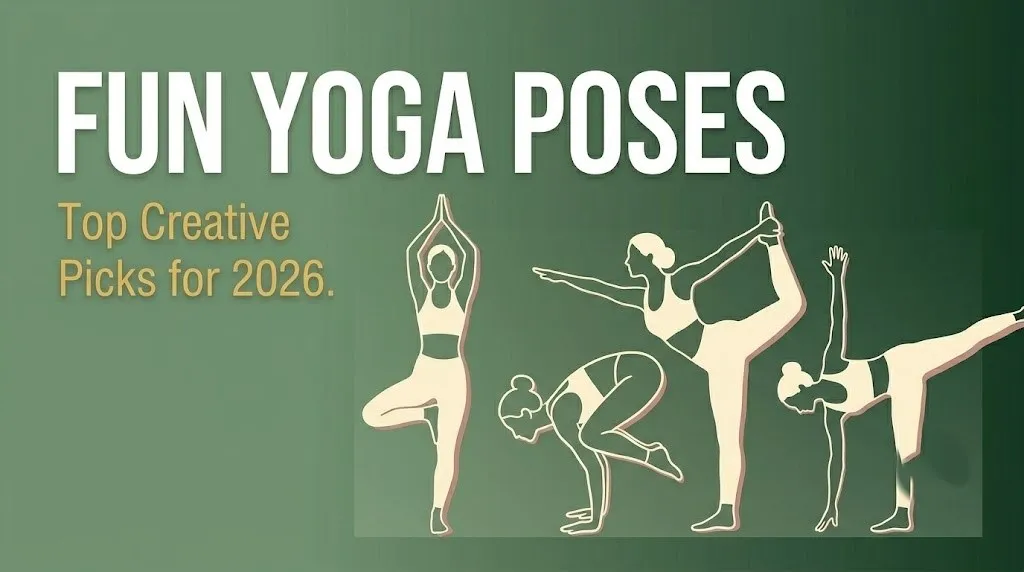
Natarajasana (Dancer’s Pose) is the most photographed yoga pose for good reason. Its shape, one leg grounded, the other lifted behind while the opposite arm reaches forward, creates a visual line that communicates both strength and grace simultaneously. Practicing it safely requires solid hip flexor flexibility in the lifted leg and stable ankle and knee proprioception in the standing leg.
Sirsasana (Headstand) is consistently one of the most requested poses by yoga students who want to try something impressive. It requires methodical preparation: the cervical spine and shoulder girdle must be strong enough to bear weight before any attempt at the full inversion. Practitioners who jump to headstand without building this foundation risk neck injury. The preparation poses, including Dolphin Pose and Salamba Sarvangasana (Supported Shoulderstand), build the necessary strength and are worth spending months on before attempting the full inversion.
Eka Pada Rajakapotasana (One-Legged King Pigeon Pose), the full backbend version of Pigeon Pose, is visually stunning and represents a genuine combination of hip flexibility, thoracic extension, and shoulder mobility. Most practitioners work toward it for years and experience gradual, measurable progress along the way. That progression itself is part of what makes these poses interesting rather than just decorative.
Pose Tip:
- For Natarajasana (Dancer’s Pose), practice near a wall and use a strap around the lifted foot until balance and extension develop independently.
- For Sirsasana (Headstand), never practice alone until you can hold the pose comfortably for 60 seconds. A spotter or wall prevents cervical injury during the learning phase.
- Set a realistic timeline of 6 to 12 months of consistent preparation before attempting advanced backbend inversions.
Yoga Poses That Are Challenging but Fun: The Sweet Spot
Yoga poses that are challenging but fun occupy a specific zone that sports psychologists call flow state, where the difficulty of the task is high enough to require full attention but not so high that it produces anxiety or shutdown.
Research from the American Psychological Association on flow states in physical activity indicates that tasks producing this level of engagement, difficult enough to require focus, achievable enough to maintain belief in success, are associated with the highest levels of positive affect and intrinsic motivation. Yoga poses that sit at the edge of a practitioner’s ability are exactly this kind of task.
Garudasana (Eagle Pose) is genuinely difficult to do correctly. Wrapping the arms so that the palms press together, while simultaneously crossing and hooking the legs, while squatting, while maintaining a neutral spine, is a coordination problem that demands total attention. Most people spend multiple classes discovering that they have been doing a simplified version of the wrap and that the actual full pose is quite different.
Parsva Bakasana (Side Crow Pose) takes the basic Crow Pose mechanics and adds a rotational element that completely changes the challenge. The body turns to one side before lifting, requiring oblique strength and a rotational weight shift that beginners find completely disorienting at first. It is one of those poses where the moment of understanding the geometry is genuinely exciting.
To practice Garudasana (Eagle Pose):
- Stand in Tadasana (Mountain Pose). Shift weight onto your right foot.
- Bend both knees slightly. Cross your left thigh over your right thigh.
- If possible, hook your left foot behind your right calf.
- Bring both arms forward, cross the left arm under the right arm, and bend the elbows.
- Work toward pressing the palms together. Lift the elbows to shoulder height.
- Hold for 5 breaths, then switch sides.
Modification: Keep the toes of the crossed foot touching the floor if hooking is not yet accessible. Use a single arm wrap if both arm and leg wraps simultaneously create too much to manage.
Key Takeaway: The poses that keep you on the mat longest are the ones that sit just beyond your current ability. Too easy and you disengage; too hard and you give up. The challenging but fun zone is where real skill development happens.
Interesting Yoga Poses for Flexibility: Beyond the Basic Forward Fold
Interesting yoga poses for flexibility target ranges of motion that standard sequences rarely touch, including thoracic rotation, shoulder external rotation, and deep hip external rotation in positions other than seated.
Parivrtta Trikonasana (Revolved Triangle Pose) is a standing twist that requires thoracic rotation, hamstring flexibility, and hip stability simultaneously. It is far more demanding than a standard Trikonasana (Triangle Pose) and reaches the posterior hip and IT band in a rotated position that produces a distinctly different sensation.
Gomukhasana (Cow Face Pose) in the arm variation tests shoulder external rotation on one side and internal rotation on the other simultaneously. Many practitioners discover through this pose that one shoulder has dramatically less range than the other, which has direct relevance to anyone with shoulder impingement or a history of rotator cuff issues. Using a yoga strap between the hands allows practitioners to work toward the full bind without forcing the shoulder joint.
Kapotasana (Full Pigeon Pose) should be distinguished from the common Eka Pada Rajakapotasana prep that most classes call “Pigeon.” The full pose is a kneeling backbend where the hands reach back and take hold of the heels. It requires a degree of thoracic extension and hip flexor length that represents years of preparation for most adults. Working toward it is the interesting part, not just the destination.
Modification: For Gomukhasana (Cow Face Pose) arm variation, hold a yoga strap between the hands and walk them toward each other over time. Never force the shoulder into range it does not have.
Fun Yoga Sequences for Home Practice: Putting It All Together
Fun yoga sequences for home practice work best when they have a clear theme, a progression from accessible to challenging, and at least one pose that makes you genuinely uncertain whether you can do it.
The mistake most home practitioners make is defaulting to the same 20-minute sequence they learned in their first class. This is not bad, but it is not growth, and it is often why home practice starts to feel like a chore rather than a choice. Adding one new or unfamiliar pose to your existing sequence once per week is enough to maintain engagement without overwhelming preparation.
A playful home sequence might move through: Balasana (Child’s Pose) for settling, Surya Namaskar (Sun Salutation) for warming up, Vrksasana (Tree Pose) for balance, Viparita Virabhadrasana (Reverse Warrior) for lateral extension, Ardha Chandrasana (Half Moon Pose) for balance challenge, a Bakasana (Crow Pose) attempt or preparation, and Viparita Karani (Legs-Up-the-Wall Pose) for a cool-down.
Home practice sequence with approximate timing:
- Balasana (Child’s Pose): 2 minutes; settling breath
- Surya Namaskar (Sun Salutation): 3 rounds; body warm-up
- Vrksasana (Tree Pose): 5 breaths each side; balance focus
- Viparita Virabhadrasana (Reverse Warrior): 5 breaths each side; lateral extension
- Ardha Chandrasana (Half Moon Pose): 4 breaths each side; balance challenge
- Bakasana (Crow Pose) practice: 3 to 5 attempts; the playful peak
- Kapotasana prep or Eka Pada Rajakapotasana (Pigeon Pose): 2 minutes each side; hip release
- Viparita Karani (Legs-Up-the-Wall Pose): 3 to 5 minutes; recovery
Modification: Skip Bakasana and substitute Navasana (Boat Pose) as the challenging peak if wrist issues are present.
Yoga Poses for Play and Exploration: Getting Out of Your Head
Yoga poses for play and exploration are specifically those that invite curiosity about what happens next rather than demanding a predetermined outcome.
The idea of play in yoga has legitimate research support. According to a review published in the Journal of Alternative and Complementary Medicine, yoga practices that emphasized exploration, breath awareness, and self-inquiry produced higher long-term adherence rates than programs focused solely on achieving specific pose forms. The orientation toward curiosity, rather than performance, changes the practitioner’s relationship to their own body.
Slow Vinyasa with no fixed sequence is one of the most effective ways to introduce play into yoga. Rather than following a predetermined flow, the practitioner moves from one pose to the next based on what the body suggests: if a hip feels tight, they explore hip openers; if the shoulders feel heavy, they reach upward. This is often called intuitive movement in therapeutic yoga contexts.
Yin yoga practices, where poses are held passively for 3 to 5 minutes each, create a different kind of exploration. The long hold time means the practitioner spends most of the time noticing subtle sensations rather than achieving a shape. Many people find this form of practice unexpectedly challenging because it requires tolerating physical sensation and mental stillness simultaneously. That tolerance itself is a skill worth developing.
Pose Tip:
- Set a timer rather than counting breaths during exploratory practice. This removes the clock from conscious attention.
- Keep a simple yoga journal for one sentence about what you noticed in each session. This builds body awareness faster than any instructional content alone.
- Try one pose you have never done before in every third home practice session.
Key Takeaway: Yoga that feels like play is not less serious than yoga that feels like work. The research on adherence and long-term benefit consistently favors practices that practitioners actually want to return to.
Unique Yoga Poses for Advanced Practitioners: Genuinely New Territory
Unique yoga poses for advanced practitioners are poses that require combinations of strength, flexibility, and body awareness that standard intermediate classes do not develop, specifically arm balances, deep backbends, and complex inversions.
Astavakrasana (Eight-Angle Pose) is named after the sage Astavakra, whose body was bent in eight places. The pose requires threading one leg over the upper arm, crossing the ankles, and extending both legs to the side while balanced on the hands. It demands hip external rotation, core lateral stability, and wrist loading tolerance that most practitioners have not specifically trained. The learning curve is steep but the pose is more accessible than it looks once the hip threading mechanics are understood.
Eka Hasta Bhujasana (Elephant Trunk Pose) involves extending one straight leg to the side while seated, then pressing the hands into the floor to lift the hips and the extended leg off the mat simultaneously. It requires serratus anterior strength, hip flexor engagement, and a specific wrist positioning that distributes load efficiently. This pose rarely appears in group classes and represents a genuine step into advanced arm balance territory for many practitioners.
Vrschikasana (Scorpion Pose) is the full expression of Pincha Mayurasana (Feathered Peacock Pose) with the back arched and the feet descending toward the head. It requires exceptional thoracic and lumbar extension, shoulder stability, and confident forearm balance. Practitioners who attempt it without sufficient foundation risk spinal compression and shoulder injury. A properly supported preparation practice, including the forearm balance and progressive back extension, should precede any attempt at the full pose.
Advanced practitioners with prior shoulder surgery, spinal fusion, or wrist instability should work with a qualified yoga therapist before attempting any of these poses, rather than relying on group class settings where individualized attention is limited.
Fun Yoga Poses Names with Instructions: A Quick Reference Guide
Fun yoga poses with names and instructions gives practitioners a practical starting point for independent home exploration, combining the what with the how in a single usable format.
Many practitioners know the name of a pose from class but cannot reconstruct it at home without instruction. The gap between hearing a pose name and being able to practice it safely is exactly where most home practice breaks down. Below is a quick reference for some of the most engaging poses in this article, summarized for independent home practice.
| Pose Name (Sanskrit) | English Name | Primary Challenge | Best For |
|---|---|---|---|
| Bakasana | Crow Pose | Arm balance, forward weight shift | Adults, intermediate+ |
| Vrksasana | Tree Pose | Single-leg balance | All levels |
| Natarajasana | Dancer’s Pose | Balance and hip extension | Intermediate |
| Garudasana | Eagle Pose | Coordination and compression | All levels |
| Ardha Chandrasana | Half Moon Pose | Balance and hip opening | Intermediate |
| Astavakrasana | Eight-Angle Pose | Arm balance and hip threading | Advanced |
| Pincha Mayurasana | Feathered Peacock Pose | Forearm inversion | Advanced |
| Viparita Karani | Legs-Up-the-Wall Pose | Restorative inversion | All levels |
| Vasisthasana | Side Plank Pose | Lateral core strength | All levels with modification |
| Simhasana | Lion Pose | Breath and facial release | Kids and adults |
Modification note: For any pose marked “all levels,” the full expression still varies by body. Start with the modification and progress when form is stable across multiple sessions.
Yoga Poses for Groups: What Works When You Are Not Practicing Alone
Yoga poses for groups work best when they are structured around shared breath, synchronized movement, or collaborative shapes that require everyone’s participation to complete.
Group yoga is distinct from both solo practice and partner yoga. With three or more people, the social dynamics shift: there is more potential for distraction but also more motivation and accountability. Research from Yoga Alliance training frameworks and community yoga programs consistently shows that group practice improves adherence compared to solo practice, particularly for beginners.
Circle breathing is a group practice technique rather than a single pose. Participants stand in a circle and pass a breath around: one person begins a slow exhale, the next begins as the first finishes, and so on around the circle. This develops breath awareness and creates a sense of shared rhythm that is distinct from anything possible in solo practice.
**Group *Vrksasana* (Tree Pose)** involves participants standing in a line or circle, each placing one hand on the shoulder of the person beside them, and attempting to hold the balance collectively. The connection to others changes the proprioceptive experience entirely, most people find it simultaneously easier and harder than solo Tree Pose.
Group yoga safety notes:
- Avoid competitive comparisons in group settings. Peer observation can push participants beyond their appropriate range.
- Designate a leader for any group sequence to prevent simultaneous instruction from multiple people.
- Ensure adequate space between participants before beginning. In group settings, spatial awareness drops and mat boundaries are often ignored.
- Check in with everyone before partner or group contact poses. Never assume consent to physical contact.
Yoga Poses for Stress Relief and Fun: When Serious and Playful Overlap
Yoga poses for stress relief and fun are not mutually exclusive categories. The most effective stress-relief poses are often the ones that also produce a sense of play, lightness, or unexpected physical delight.
According to the Journal of Alternative and Complementary Medicine, yoga practice consistently produces reductions in self-reported stress and physiological markers of stress, including cortisol levels and heart rate variability, across multiple study populations. The most effective protocols included a combination of movement, breath awareness, and conscious rest, which is exactly what a well-designed fun yoga sequence delivers.
Viparita Virabhadrasana (Reverse Warrior) is worth singling out here because it produces an immediate sense of physical spaciousness that many practitioners describe as relief. The side body, including the quadratus lumborum, external obliques, and intercostal muscles, opens in a way that is both gentle and satisfying. It looks good, feels good, and builds on the standing strength of Warrior II without adding complexity.
Simhasana (Lion Pose) deserves attention as a stress-relief tool specifically because it is genuinely funny to do. Wide eyes, protruding tongue, and a forceful roaring exhale. The forced exhalation activates the vagus nerve and stimulates the parasympathetic nervous system. The social awkwardness of doing it produces laughter, which has its own documented stress-reduction effect. A pose that makes you laugh and simultaneously stimulates your vagal tone is doing more than most people expect.
Stress-relief and fun poses to finish any practice:
- Viparita Karani (Legs-Up-the-Wall Pose): Accessible, calming, and immediately effective
- Simhasana (Lion Pose): Vagal stimulation through forceful exhalation; genuinely entertaining
- Balasana (Child’s Pose): Deep nervous system calming; safe for almost everyone
- Savasana (Corpse Pose): Full parasympathetic activation; non-negotiable for stress relief
- Viparita Virabhadrasana (Reverse Warrior): Side body opening with an expansive, uplifting quality
Key Takeaway: The overlap between fun and stress relief in yoga is not accidental. Laughter, novelty, and physical lightness activate the same parasympathetic pathways as intentional relaxation practices. Choosing poses that do both is efficient and sustainable.
Frequently Asked Questions About Fun Yoga Poses
What are the most fun yoga poses for beginners?
The most engaging yoga poses for beginners include Vrksasana (Tree Pose) for balance, Anjaneyasana (Low Lunge) for immediate hip opening, and Simhasana (Lion Pose) for its breath and humor.
These poses produce clear physical feedback, require no prior strength or flexibility, and offer accessible modifications for every body type.
Start with one new pose per session rather than attempting an entirely new sequence, and use a wall or yoga block to support balance poses until confidence builds.
Are there fun yoga poses I can do with my kids?
Yes, animal-themed yoga poses work best with children, including Adho Mukha Svanasana (Downward-Facing Dog), Bhujangasana (Cobra Pose), and Simhasana (Lion Pose).
Framing poses as animals, telling a story during the sequence, and encouraging sounds and movement keeps children engaged far better than technical instruction does.
Keep sessions short, between 10 and 20 minutes, and prioritize laughter and play over correct alignment, especially with children under eight years old.
What yoga poses are good for boosting mood and creativity?
Backbends including Ustrasana (Camel Pose) and Virabhadrasana I (Warrior I), combined with restorative poses like Viparita Karani (Legs-Up-the-Wall Pose), produce the most consistent mood improvements in yoga research.
According to the National Center for Complementary and Integrative Health, yoga practice reduces anxiety symptoms with effects strongest at two to three sessions per week.
For creativity specifically, inversions and novel balance poses that require full attentional focus create the cognitive reset that supports divergent thinking after practice.
What is the hardest but most fun yoga pose to learn?
Bakasana (Crow Pose) is consistently reported by practitioners as the most rewarding arm balance to learn, partly because the moment it clicks feels sudden and unexpected.
The learning process involves multiple sessions of attempting the forward weight shift without yet getting airborne, which builds both wrist strength and psychological tolerance for failure.
Most practitioners achieve their first successful Crow Pose hold within four to eight weeks of consistent practice when using the blanket safety net modification.
Can two people do yoga poses together at home?
Yes, partner yoga poses including seated back-to-back twists, double Adho Mukha Svanasana (Downward-Facing Dog), and synchronized breathing exercises are all accessible at home without instruction or special equipment.
The most important preparation is verbal communication before starting: both partners should share any physical limitations, injuries, or discomfort boundaries before attempting any contact poses.
Start with non-weight-bearing partner poses and progress to supported or elevated shapes only after both partners feel comfortable with the communication required.
Start with One Pose That Makes You Uncertain
Pick one pose from this article that you genuinely don’t know if you can do. Not the hardest one. Just one that sits at the edge of what feels familiar.
Try it today, without expectation of succeeding. Set a folded blanket nearby. Keep your breath steady. Notice what happens when you get it wrong and try again.
That process, attempting, adjusting, discovering, is the part of yoga that nobody talks about enough. It is also the part that keeps people coming back.