Yoga Barbie: 2026 Guide for Parents, Kids, and Collectors
A yoga Barbie is a Mattel Barbie doll designed around a yoga theme, typically dressed in yoga attire, posed in a recognizable yoga position, and packaged with accessories like a yoga mat, blocks, or a water bottle. What makes this particular toy worth more than a quick gift-guide scan is the genuine opportunity it creates to introduce children to real yoga practice through play.
The American Academy of Pediatrics identifies play-based learning as the most effective developmental tool for children under ten. Yoga-themed imaginative play, including yoga doll play, gives children a natural, low-pressure entry point into body awareness, breathing habits, and physical movement that research consistently links to improved focus, flexibility, and emotional regulation.
This guide covers the full 2026 yoga Barbie range, what the doll can model in terms of real yoga poses, how parents can use it as a teaching tool, what the research says about yoga for children, and what to look for whether you are buying for a three-year-old or a Barbie collector.
Yoga Barbie: What It Is and Why Kids Love It
A yoga Barbie is any Barbie doll produced by Mattel that incorporates yoga themes through its outfit, accessories, career role, or articulated flexibility features designed to hold yoga-style poses.
The yoga Barbie concept fits within Mattel’s broader “Barbie Career” doll line, which has included over 200 careers since the 1960s. The yoga teacher and yoga practitioner versions reflect the documented growth of yoga participation in the United States. The NCCIH reported that yoga participation among American adults grew from approximately 9.5 percent in 2012 to over 14 percent by 2022, and children’s yoga programs have grown proportionally alongside adult practice.
Kids are drawn to yoga Barbie for a simple reason: the doll models a recognizable activity they may see a parent, teacher, or older sibling doing. That recognition creates a natural bridge between imaginative play and imitation-based learning. Children learn physical skills partly through watching and copying, and a doll that holds a recognizable body position gives them a concrete visual model.
The yoga theme also carries an implicit message that yoga is something a capable, active person does. That framing matters for children who may perceive yoga as “adult” or “serious.” A familiar doll format makes the practice feel accessible and age-appropriate.
| Yoga Barbie Type | Key Feature | Best For |
|---|---|---|
| Yoga Teacher Barbie | Yoga outfit, mat, teaching accessories | Ages 3 to 7, imaginative classroom play |
| Flexible/Poseable Barbie | Articulated joints for pose holding | Ages 5 and up, pose exploration |
| Collector Yoga Barbie | Premium detail, limited release | Adult collectors, display |
| Yoga Barbie Playset | Full studio setup with props | Ages 4 to 8, expanded play scenario |
Yoga Barbie Dolls: The Full Product Range in 2026
Yoga Barbie dolls in 2026 span several distinct product categories, from entry-level play dolls to articulated pose-holding versions and collector-grade limited editions.
Mattel’s yoga-themed Barbie line has expanded considerably since the original yoga teacher doll. The current range includes standard fashion dolls dressed in yoga attire, more articulated “Made to Move” versions with flexible joints at the hips, knees, shoulders, elbows, and wrists, and yoga-themed playsets that include studio environments, props, and additional figures.
The “Made to Move” series is the most yoga-appropriate from a pose-accuracy standpoint. These dolls have approximately 22 articulated points of movement, allowing them to hold positions that resemble actual yoga postures including seated forward folds, Warrior-style standing poses, and simple balance poses.
Standard yoga Barbie fashion dolls are dressed for yoga but have limited joint articulation. They are better suited for storytelling and role play than for demonstrating specific pose shapes. Parents who want to use the doll as a yoga teaching tool should look specifically for the “Made to Move” version rather than a standard yoga-outfit Barbie.
What to look for when buying a yoga Barbie doll:
- Joint articulation points (more joints means more pose options)
- Included accessories (yoga mat, blocks, water bottle, towel)
- Age recommendation on the packaging (varies from 3 and up to 6 and up depending on small parts)
- Diversity of available dolls in the yoga theme (Mattel has released yoga Barbie versions across multiple skin tones and hair types since 2016)
- Whether the set is part of a playset ecosystem compatible with other Barbie sets the child already owns
Barbie Doll Yoga: What Poses the Doll Can Model
A poseable yoga Barbie doll can model several recognizable yoga positions that correspond directly to real poses practiced in children’s and adult yoga classes.
This is where the toy’s educational value becomes genuinely practical. When a “Made to Move” yoga Barbie holds a pose shape, a parent can name that pose, demonstrate it in their own body, and invite the child to try it. The doll acts as a three-dimensional reference that a flat image or verbal description cannot replicate.
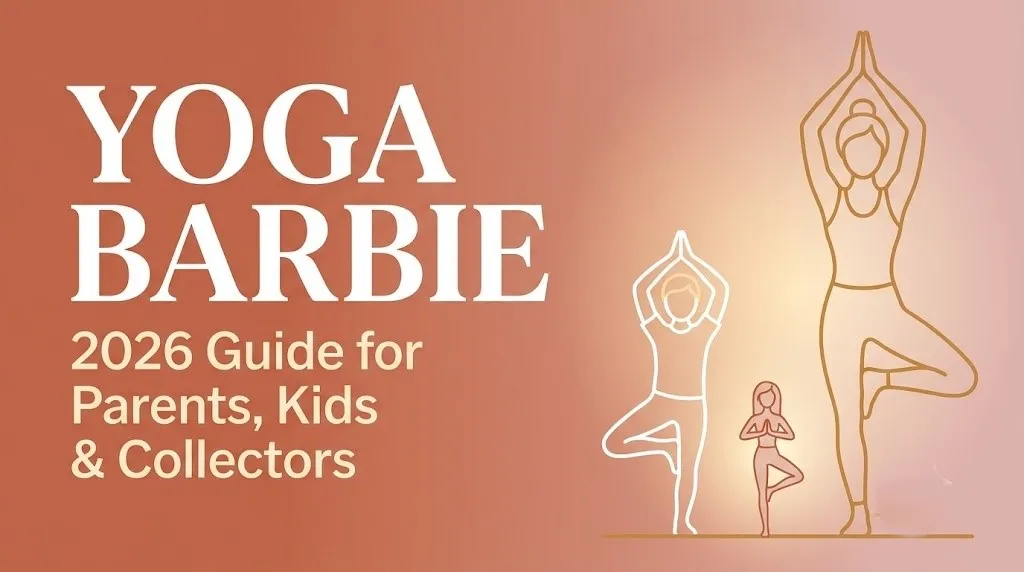
Yoga poses a poseable Barbie can model, with Sanskrit and English names:
- Vrksasana (Tree Pose): one leg lifted, foot pressed to inner calf or thigh, arms raised or at heart center
- Tadasana (Mountain Pose): standing tall, arms alongside the body, feet together or hip-width apart
- Adho Mukha Svanasana (Downward-Facing Dog): inverted V shape, hands and feet pressing into the mat
- Balasana (Child’s Pose): hips to heels, forehead lowered, arms extended or alongside the body
- Sukhasana (Easy Seated Pose): cross-legged seated position, hands on knees
- Virabhadrasana I (Warrior I Pose): front knee bent over ankle, back leg straight, arms raised overhead
- Marjaryasana-Bitilasana (Cat-Cow Pose): on hands and knees, spine arching and rounding
Safety note for children practicing these poses: In Vrksasana (Tree Pose), teach children to place the raised foot on the inner calf or inner thigh only, never directly against the side of the knee joint. Lateral pressure on the knee’s collateral ligaments is not safe, especially for growing bodies.
Key Takeaway: The “Made to Move” yoga Barbie is the most useful version for teaching real poses because its articulated joints can actually hold recognizable yoga shapes that children can imitate with their own bodies.
Yoga Barbie Accessories and Sets: What Comes in the Box
Yoga Barbie sets typically include a yoga mat, one or more yoga props like blocks or a water bottle, a yoga outfit for the doll, and occasionally a second doll or studio environment depending on the playset tier.
The accessories included vary by product line. Entry-level yoga Barbie dolls may include only the doll in yoga clothing. Mid-range sets add a rolled yoga mat and one prop. Full playsets can include a mat, blocks, a water bottle, a rolled towel, a studio backdrop, and sometimes a second figure representing a yoga student or pet.
From a practical yoga standpoint, the prop accessories are worth attention. When a yoga mat accessory is included, parents can use it as a natural conversation opener: “Barbie has a yoga mat, and we have one too. Want to use yours while Barbie uses hers?” That parallel play setup, where the child mirrors the doll’s activity, is a recognized strategy in early childhood movement education.
What yoga Barbie accessories typically represent and how to use them educationally:
- Yoga mat: introduce the concept of a personal practice space and a non-slip surface for movement
- Yoga block: explain that blocks help you reach the floor or support your balance when a pose feels far away
- Water bottle: naturally reinforces hydration habits before and after movement
- Yoga towel: introduces the concept of managing sweat and maintaining grip in more active practice
- Studio backdrop or playset environment: creates an imaginative yoga class scenario that children can use to role-play as teacher and student
Yoga Barbie Age Range and Gift Guide
Yoga Barbie dolls are appropriate for children as young as three years old for simple yoga fashion dolls, with more articulated or complex playsets recommended from ages five and up due to smaller accessories.
Mattel prints age recommendations on all packaging, and those guidelines are based on small-parts safety standards set by consumer product safety regulations. A yoga Barbie with a yoga mat accessory that has small block pieces or detachable accessories carries a minimum age of three to five years, while fully accessorized playsets with multiple small props may be labeled for ages six and up.
For gift selection, the child’s existing interests and play style matter as much as the age range. A child who already shows interest in yoga, movement, or mimicking adult activities will engage more deeply with a poseable yoga Barbie than one who prefers fashion-focused play.
Yoga Barbie gift guide by age and interest:
| Age Range | Best Yoga Barbie Type | Why It Works |
|---|---|---|
| Ages 3 to 4 | Simple yoga fashion Barbie | Large doll, minimal small parts, safe for younger hands |
| Ages 5 to 6 | Yoga Barbie with mat and props | Accessory play adds richness; child can manage small props safely |
| Ages 7 to 9 | Made to Move poseable Barbie | Pose exploration; can be used alongside real yoga practice |
| Ages 10 and up | Collector yoga Barbie or full playset | More detail; imaginative scenario play; potential for real yoga interest |
| Adult collectors | Collector or limited edition release | Premium detail, display quality, not designed for active play |
Yoga Barbie vs. Regular Barbie: What Makes It Different
A yoga Barbie differs from a standard Barbie in three ways: its themed clothing and accessories, its potential for increased joint articulation in the “Made to Move” line, and its positioning as a role model for an active, wellness-oriented lifestyle.
Standard Barbie fashion dolls focus primarily on clothing variety and career storytelling. A yoga Barbie takes that career framing and adds a physical practice dimension. The yoga teacher version specifically positions Barbie as someone who instructs others in movement, which gives children a role model for both activity and teaching.
The joint articulation difference is the most functionally significant. A standard Barbie doll has limited pose range. The “Made to Move” yoga Barbie was specifically designed with yoga in mind, featuring approximately 22 articulation points that allow a far wider range of body positions. That difference is the gap between a doll that “looks like” it does yoga and one that can actually demonstrate a recognizable pose shape.
From a parent’s perspective, the yoga theme also opens conversational doors that a standard fashion Barbie does not. Discussing what the doll is doing in a pose, why that pose might feel good in the body, and how the child could try it creates an educational bridge that a doll dressed for a gala or beach vacation does not naturally provide.
Pose Tip:
- Use a “Made to Move” yoga Barbie specifically when teaching pose shapes; the articulation makes the body position readable
- A standard yoga-themed fashion Barbie is better for storytelling and role play scenarios
- Both types can be used together: one as the “teacher” doll and one as the “student”
Key Takeaway: The “Made to Move” version and a standard yoga fashion Barbie serve different play purposes. If real yoga instruction is part of your goal, the articulated version is the one worth buying.
Yoga Poses Kids Can Learn from Yoga Barbie
Children can learn several foundational yoga poses by using the yoga Barbie doll as a visual model, then practicing the same shapes in their own bodies with a parent or caregiver guiding them.
This approach works because children are natural imitators. Child development research consistently shows that children between ages three and eight learn motor skills most effectively through visual demonstration followed by guided imitation. A poseable doll holding a consistent pose shape provides a patient, always-available visual reference that a moving adult instructor cannot.
A kid-friendly sequence based on poses yoga Barbie can model:
- Begin in Tadasana (Mountain Pose): stand tall, feet hip-width apart, arms alongside the body. Ask the child to “stand like a mountain, strong and still.” Hold for 5 slow breaths.
- Move to Vrksasana (Tree Pose): shift weight onto one foot. Place the other foot on the inner calf (not the knee). Bring hands to heart center or raise arms overhead like branches. Hold for 3 to 5 breaths per side.
- Try Adho Mukha Svanasana (Downward-Facing Dog): hands and feet on the mat, hips lifted, forming an inverted V. Bend the knees generously. Hold for 5 breaths. Tell the child to “wag their tail” by gently shifting hips side to side.
- Come to Balasana (Child’s Pose): knees wide, hips toward heels, forehead resting down. Arms extended forward. Hold for 8 slow breaths while belly breathing.
- Close in Savasana (Corpse Pose): lie flat on the back, arms slightly away from the body, eyes closed. Rest quietly for 2 to 3 minutes.
Modification for younger children: Keep all poses to three breaths maximum. Use playful animal names instead of Sanskrit. Mountain Pose becomes “tall giraffe.” Tree Pose becomes “tree with branches.” Downward Dog stays as “puppy stretch.” This reduces cognitive load and keeps the practice feeling like play rather than instruction.
How to Use Yoga Barbie to Teach Real Yoga to Children
Using a yoga Barbie doll as a yoga teaching tool means setting up a parallel play scenario where the child and the doll practice poses together, with a parent or caregiver guiding both.
This strategy works with children as young as three. The doll provides a non-threatening model. The child does not feel watched or evaluated because the “teacher” is directing both the child and the doll equally. That psychological dynamic reduces self-consciousness and increases willingness to try unfamiliar body positions.
A step-by-step parent guide to using yoga Barbie as a teaching prop:
- Set up two yoga mats side by side, one for the child and one for the doll (or a folded towel for the doll’s mat).
- Place the yoga Barbie in a starting pose, such as Sukhasana (Easy Seated Pose). Ask the child to copy the doll’s position.
- Name the pose in English first: “Barbie is sitting in a cross-legged seat.” Then introduce the Sanskrit name simply: “Yoga teachers call this Sukhasana.”
- Practice each pose for three to five slow breaths. Let the child count the breaths aloud.
- Let the child be the teacher for the next pose: they set the doll’s position first, then you both copy what the doll is doing.
That last step, letting the child direct the doll, is particularly effective. Research in Frontiers in Psychology on play-based learning found that children retain physical skills longer when they teach the skill to another person or object compared to simply practicing it themselves.
Modification for children with limited attention spans: Keep the entire session to five minutes maximum for children under five. Extend by two minutes per year of age as the child develops. Three well-practiced poses hold more value than ten rushed ones.
Key Takeaway: Letting the child be the teacher who sets the doll’s pose is the single most effective learning strategy in yoga Barbie play. Teaching a skill reinforces it more deeply than practicing it alone.
Kids Yoga at Home: A Parent-Friendly Practice Guide
Kids yoga at home is any structured or semi-structured movement practice where children practice yoga poses, breathing exercises, or simple meditation with a parent, caregiver, or independently using a visual reference like a yoga doll.
You do not need yoga experience to start a home yoga practice with a child. You need consistency, playfulness, and a willingness to be in the poses yourself rather than watching from the side. Children are far more likely to engage with a physical activity when they see an adult doing it alongside them.
The most effective home yoga sessions for children follow a simple structure:
- Opening breath: three slow, full belly breaths together before any movement
- Warm-up poses: two or three gentle, familiar poses to wake up the body (Mountain Pose, Cat-Cow, Child’s Pose)
- Active poses: two or three standing or balance poses (Tree Pose, Warrior I, Downward Dog)
- Cool-down and rest: one or two calming poses followed by Savasana or quiet breathing
Keep sessions short. Yoga teachers and child development specialists generally recommend five to ten minutes per year of age as a rough session length guide. A four-year-old benefits from a 15 to 20-minute session. A seven-year-old can sustain 30 minutes with variety and engagement built in.
Props to use for kids yoga at home:
- A child-sized yoga mat (non-slip, approximately 60 by 24 inches)
- Two small yoga blocks (foam blocks at the standard 4-inch height work for most children)
- A blanket for Savasana (Corpse Pose) to help children settle
- The yoga Barbie doll as a pose reference and play companion
Benefits of Yoga for Children: What Research Says
Yoga produces measurable physical and psychological benefits for children across a wide age range, with the strongest evidence appearing in studies focused on school-age children between five and twelve.
The National Center for Complementary and Integrative Health (NCCIH) identifies yoga as a practice with good evidence for reducing anxiety and stress in children and adolescents. A 2018 review in Complementary Therapies in Medicine, analyzing fifteen studies on yoga in school settings, found that yoga programs consistently improved children’s emotional regulation, attention, and self-esteem compared to control groups.
Physical benefits are equally well-documented. A study published in the International Journal of Yoga found that children who participated in a structured yoga program twice weekly for twelve weeks showed measurable improvements in balance, flexibility, and core strength compared to a control group. These physical literacy foundations support performance in all physical activities, not just yoga.
Documented benefits of yoga for children:
- Improved balance and proprioception (International Journal of Yoga)
- Enhanced flexibility in the hip flexors, hamstrings, and thoracic spine (Complementary Therapies in Medicine)
- Reduced anxiety and stress reactivity (NCCIH research summary)
- Improved attention span and focus, particularly in children with attention challenges (Journal of Alternative and Complementary Medicine)
- Stronger core stabilizer muscles supporting posture and spinal health
- Better emotional regulation and reduced behavioral difficulties in school settings
- Improved sleep quality in children with anxiety (Frontiers in Psychology)
These benefits emerge from consistent practice, generally defined in research as two or more sessions per week for eight to twelve weeks. Even one session per week produces positive trends, but more frequency accelerates the outcomes.
Yoga and Mindfulness for Kids: Beyond the Doll
Yoga and mindfulness for children extend far beyond physical poses, encompassing breath awareness, body scan practices, and simple concentration exercises that support mental health and emotional development.
The yoga Barbie doll is a useful entry point, but the most lasting benefit comes when children internalize the habits the doll represents: slowing down, breathing deliberately, noticing how their body feels. Those habits are the definition of mindfulness, and research consistently shows they produce long-term emotional regulation benefits when established in childhood.
Simple breath-based mindfulness exercises children can practice alongside yoga poses:
- Belly breathing: place a hand on the belly and feel it rise on the inhale and fall on the exhale; practice for one to two minutes
- Count breathing: inhale for four counts, exhale for four counts; increase to six counts as children develop capacity
- Body scan: lie in Savasana (Corpse Pose) and notice sensations in each body part from feet to head; a guided version can be done in three to five minutes
- Star breathing: trace the five points of an imaginary star shape with a finger, inhaling and exhaling at each point; popular with children ages four to eight
According to the Journal of Alternative and Complementary Medicine, brief mindfulness exercises of three to five minutes, practiced consistently in school settings, produced measurable reductions in anxiety and improvements in attention in children between six and twelve years old. The same principle applies to home practice.
Modification for very young children: For children under five, body scan and extended breath counts may be too abstract. Use tactile anchors instead: “feel your belly go up like a balloon” or “make your exhale sound like wind.” Concrete, sensory language matches this developmental stage.
Key Takeaway: The breathing exercises and body awareness practices that yoga teaches are the deepest benefit of yoga for children, outlasting any specific pose and building emotional regulation habits that research shows persist into adolescence.
Yoga Barbie and Body Image: A Balanced Parent Perspective
Yoga Barbie, like all Barbie dolls, raises legitimate questions about body image, and parents benefit from a clear-eyed look at both the concerns and the specific features of the yoga-themed version that differentiate it from earlier Barbie representations.
Mattel has made documented changes to the Barbie line since 2016, introducing dolls with three additional body types (tall, petite, and curvy) alongside the original proportions, and expanding skin tone and hair type diversity substantially. Yoga Barbie dolls are available across these body type variations, which means the product line reflects a broader range of body shapes than earlier Barbie generations did.
The yoga-specific framing adds another layer worth considering. Yoga Barbie positions physical activity, not appearance, as the central identity of the doll. Research in the Journal of Alternative and Complementary Medicine found that children who engage in movement-based activities with a focus on physical capability rather than physical appearance show stronger body satisfaction and self-esteem than children whose movement activities are appearance-focused.
Parents can actively reinforce this framing by keeping the focus on what the body can do rather than how it looks. When practicing yoga alongside the doll, language matters:
- Instead of: “Can you make your body look like Barbie’s?”
- Use: “What does Tree Pose feel like in your body right now?”
- Instead of: “Try to be as flexible as Barbie.”
- Use: “Let’s breathe and see how far feels comfortable for you today.”
That language shift mirrors the approach recommended by yoga teachers and child psychologists for keeping movement experiences positive and body-affirming for children.
Yoga Barbie Collector Editions and Special Releases
Yoga Barbie collector editions are limited-production or premium versions of yoga-themed Barbie dolls designed primarily for adult collectors rather than active child play.
Mattel produces collector-grade Barbie dolls through its “Barbie Signature” and “Barbie Collector” lines. Yoga-themed versions in these lines feature more detailed clothing, premium materials, display stands, and collector packaging that is not intended to be opened for play. These differ significantly from the standard yoga Barbie play dolls in both price point and construction.
Collector yoga Barbie dolls are typically not articulated for pose-holding in the way the “Made to Move” play dolls are. Their value is in aesthetic detail: precisely embroidered yoga outfits, accurately scaled yoga props, detailed facial paint, and limited production numbers. They are display items, not movement models.
What to know before buying a collector yoga Barbie:
- Check whether the packaging states “Collector Edition” or “Barbie Signature”; these indicate display-quality products
- Collector dolls are generally not suitable for children under ten due to delicate details and the intent to keep them in original packaging
- Limited-edition yoga Barbies tied to cultural moments (specific years, anniversaries, or collaborations) tend to appreciate in collector value if kept sealed in original packaging
- The articulation in collector versions is limited compared to “Made to Move” play dolls; do not expect the collector version to hold yoga poses if removed from packaging
Yoga Barbie Gift Ideas by Age and Interest
The best yoga Barbie gift depends on whether the recipient is a child who will actively play with the doll, an older child interested in both yoga and Barbie, or an adult collector who wants a display piece.
For children actively practicing or learning yoga, a “Made to Move” yoga Barbie paired with a child-sized yoga mat and a beginner kids’ yoga card set creates a complete and genuinely educational gift. The doll gives them a pose model. The mat gives them a practice space. The card set gives them guided sequence prompts they can use independently.
For children who love imaginative play but are newer to yoga, a yoga teacher Barbie playset with a studio environment is more appropriate. The story-building potential is high and the yoga exposure is organic rather than instructional.
Yoga Barbie gift ideas by recipient:
| Recipient | Best Gift Configuration | Why |
|---|---|---|
| Child ages 3 to 5 | Yoga fashion Barbie plus child yoga mat | Safe accessories, play-friendly, mat starts real practice |
| Child ages 6 to 8 | Made to Move Barbie plus yoga card deck | Pose modeling plus structured guided practice |
| Child ages 9 to 11 | Yoga teacher Barbie playset plus yoga journal | Inspires independent practice and creative play |
| Teen yoga enthusiast | Collector-style yoga Barbie as display item | Celebrates the yoga interest without treating them as a young child |
| Adult Barbie collector | Barbie Signature yoga edition | Premium display quality, limited edition value |
| Parent gift bundle | Child yoga mat, Made to Move Barbie, simple kids yoga book | Complete package for introducing yoga through play |
Frequently Asked Questions About Yoga Barbie
What is a yoga Barbie and what poses can it do?
A yoga Barbie is a Barbie doll by Mattel with a yoga theme, dressed in yoga clothing and packaged with yoga accessories like a mat and blocks.
The “Made to Move” version has approximately 22 articulation points and can hold poses including Tree Pose (Vrksasana), Downward-Facing Dog (Adho Mukha Svanasana), Child’s Pose (Balasana), and Warrior-style standing positions.
Standard yoga fashion Barbie dolls have limited articulation and are better suited for role play than for demonstrating specific pose shapes.
What age is yoga Barbie appropriate for?
Yoga Barbie dolls are appropriate for children ages three and up for basic fashion dolls, with more accessorized sets recommended from age five and up due to small prop pieces.
Mattel prints age recommendations on all packaging based on consumer product safety standards for small parts.
Collector-edition yoga Barbies are designed for adults and are generally not appropriate as active play toys for children under ten.
Can I use a yoga Barbie doll to teach my child real yoga?
Yes, a poseable yoga Barbie doll works well as a visual model for teaching children real yoga poses through a parallel play approach.
Set the doll in a pose, name it in English and then in Sanskrit, and invite the child to copy the position in their own body alongside the doll.
Research in Frontiers in Psychology found that children retain physical skills most effectively when they engage in visual imitation followed by guided practice, which is exactly what doll-guided yoga play provides.
Is yoga good for children and what does research say?
Yes, yoga is well-supported by research as a beneficial practice for children across physical and psychological domains.
The NCCIH identifies yoga as having good evidence for reducing anxiety and stress in children, and a review in Complementary Therapies in Medicine found that school-based yoga programs consistently improved children’s emotional regulation, attention, and self-esteem.
Physical benefits including improved balance, flexibility, and core strength were documented in a study published in the International Journal of Yoga after twelve weeks of twice-weekly yoga practice in school-age children.
What comes with a yoga Barbie set?
The accessories included with a yoga Barbie set vary by product tier and range from just the doll in yoga clothing to full sets with a yoga mat, blocks, water bottle, towel, and studio backdrop.
Entry-level yoga Barbie dolls typically include only the doll and outfit.
Full yoga Barbie playsets include a rolled mat, one or more props, and sometimes a studio environment or second figure for role play.
Take It Off the Shelf and Onto the Mat
The best thing you can do with a yoga Barbie is use it as an invitation. Set the doll in Vrksasana (Tree Pose) on your child’s dresser, unroll two mats side by side, and practice the pose together for five minutes.
Pick one pose today. Balasana (Child’s Pose) is the most accessible starting point for almost every child. Three slow breaths in that shape, next to the doll, is a complete beginning.
The doll will keep the invitation open every day it sits on the shelf. You just have to answer it once.