Topless Yoga: Benefits, Poses & Safety Guide 2026
Topless yoga is a yoga practice performed without a shirt, and for many practitioners, removing that layer is one of the most physically informative decisions they make on the mat. The skin becomes a direct feedback system, sharpening alignment, deepening breath awareness, and changing how you experience every pose.
This matters more than it sounds. Research published in the International Journal of Yoga has documented how tactile and proprioceptive cues directly influence movement precision and body awareness during mindful movement practices. Reducing the barrier between your skin and the air around you is not a gimmick: it taps into your body’s existing sensory wiring.
This guide covers what topless yoga actually is, which yoga styles suit it best, how proprioception and breath work differently without a shirt, which poses are best suited for beginners, and how to practice safely at home. You’ll also find honest guidance on body image, temperature regulation, and mat hygiene.
Topless Yoga: What It Is and Why People Practice It
Topless yoga is exactly what it sounds like: a yoga practice done without wearing a shirt or top garment, leaving the torso bare. People practice it for a range of reasons, from physical comfort and heat management to improved tactile feedback and body acceptance work.
The practice is not new. Yoga’s roots in ancient India involved minimal clothing, and several traditional lineages practiced with the upper body uncovered as a matter of cultural norm. In contemporary yoga, topless practice gained mainstream attention partly through hot yoga and Bikram/26&2 yoga, where high room temperatures made heavy clothing impractical.
Today, topless yoga spans every style: Hatha, Vinyasa, Yin, and Restorative practice. It happens in private home studios, specialized group classes, and outdoor sessions. The reasons practitioners choose it have expanded well beyond heat management, touching on neuroscience, mindfulness, and body image work.
It is worth being clear about one thing. Topless yoga is not inherently sexual. It is a physical practice choice, much like barefoot running versus running in shoes. The absence of a layer changes what you feel, what you notice, and how you move.
Key reasons practitioners choose topless yoga include:
- Greater skin-to-air contact for natural cooling during dynamic or heated practice
- Sharper proprioceptive feedback during alignment-intensive poses
- Visible monitoring of muscle engagement and rib cage movement
- A body-positive challenge to habitual self-concealment
- Reduced fabric interference during deep spinal twists and backbends
What Is Topless Yoga Exactly?
Topless yoga refers to any yoga practice where the practitioner removes their shirt or top garment, practicing with the upper torso bare. It is a practice style choice, not a distinct yoga tradition or lineage.
The distinction matters. Topless yoga is not a new yoga system. It does not have its own philosophy, breathing system, or pose sequence. It is a variable within your existing practice: one you add to Hatha, Vinyasa, Yin, or any other style you already practice.
Some studios offer specifically branded shirtless or topless yoga classes, typically in heated rooms. These are most often structured as Vinyasa flow or hot yoga sessions, where temperature already minimizes the urge to wear heavy layers.
At home, topless yoga is simply a choice you make before stepping onto your mat. There are no prerequisites. You do not need to be at a specific fitness level, body weight, or experience level to practice without a shirt.
The most common misunderstanding is that topless yoga requires a specific body type. It does not. The practice is body-neutral in its mechanics. Your skin’s sensory network functions the same regardless of your size, shape, or fitness history.
| Practice Context | Common Yoga Styles | Room Temperature |
|---|---|---|
| Heated studio class | Bikram/26&2, Hot Vinyasa | 95 to 105 degrees F |
| Warm studio class | Vinyasa flow, Power yoga | 80 to 90 degrees F |
| Home practice | Hatha, Vinyasa, Yin, Restorative | Room temperature |
| Outdoor practice | Hatha, Vinyasa, Yin | Ambient temperature |
Topless Yoga Benefits for Body and Mind
The physical and psychological benefits of topless yoga are rooted in real physiology, not wellness marketing. Practicing without a shirt changes how your nervous system receives information about your own body.
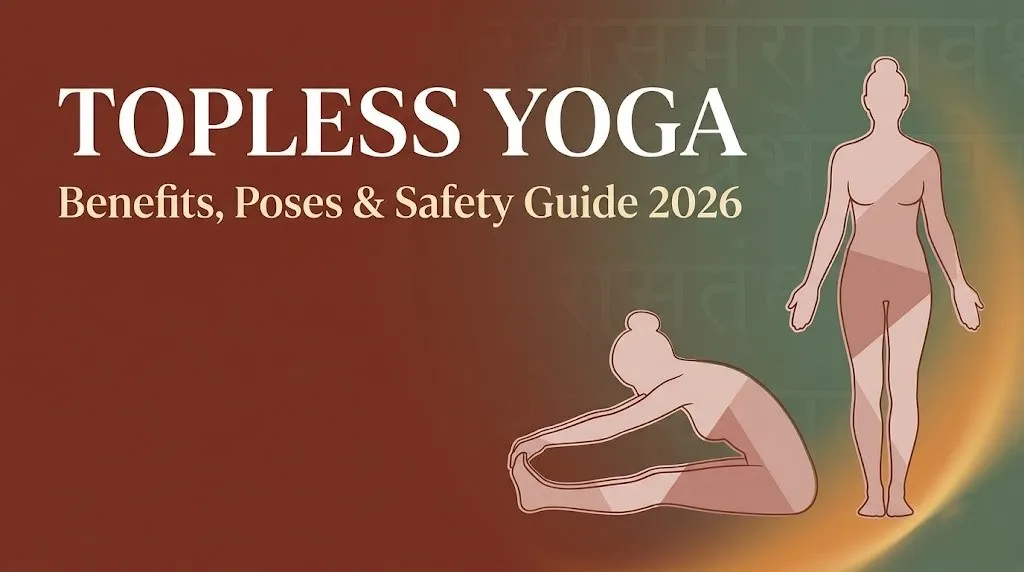
According to the National Center for Complementary and Integrative Health (NCCIH), yoga practice in general supports improvements in flexibility, balance, stress regulation, and body awareness. Removing a shirt layer amplifies several of these effects specifically by increasing the quantity and quality of sensory signals your skin sends to your brain during movement.
From a purely physical standpoint, topless yoga:
- Reduces core temperature during heated or dynamic practice
- Allows visible observation of rib cage expansion during breathing exercises
- Improves tactile feedback in prone and supine poses, where the torso contacts the mat
- Eliminates fabric bunching or shifting that disrupts alignment cues in deep twists and forward folds
From a psychological standpoint, regular topless practice has been associated by yoga therapists with reduced body-monitoring anxiety over time. The logic is straightforward: repeated neutral exposure to your own body in a non-evaluative context gradually reduces the emotional charge that body self-consciousness carries.
Key benefits supported by yoga science research include:
- Improved proprioceptive accuracy during balance poses
- Stronger interoceptive awareness (sensing internal body states) during breathwork
- Reduced perceived exertion in heated environments due to better thermoregulation
- Increased comfort with physical self-exposure, supporting body image work
Key Takeaway: Topless yoga is a practice choice, not a yoga style. Removing your shirt increases skin-based sensory feedback, and that single change meaningfully affects how precisely you sense and correct your alignment during every pose.
Topless Yoga, Body Awareness, and Proprioception
Practicing topless yoga directly enhances proprioception, the body’s ability to sense its own position and movement in space. When skin is exposed, the density of sensory receptors available to send positional signals to the brain increases significantly.
Your skin contains specialized receptors called Meissner’s corpuscles, Ruffini endings, and Pacinian corpuscles. These detect light touch, skin stretch, and deep pressure respectively. When you wear a fitted shirt, these receptors still function, but they receive muffled, fabric-filtered signals. Bare skin receives direct, unfiltered input from the air, mat surface, and your own moving body parts.
In practical yoga terms, this means:
- In Trikonasana (Triangle Pose), you’ll feel spinal rotation through the skin of your ribs and back more precisely
- In Virabhadrasana II (Warrior II), the stretch across your chest is palpable without a layer muffling it
- In supine poses, the contact of your shoulder blades against the mat gives real-time feedback about whether they are symmetrically grounded
A 2022 analysis published in Complementary Therapies in Medicine noted that enhanced tactile feedback during movement practices correlates with improved balance outcomes and reduced fall risk in older adults. This is one reason yoga teachers who specialize in seniors often recommend tactile feedback tools, and bare skin is among the most direct options available.
Pose Tip:
- In Adho Mukha Svanasana (Downward-Facing Dog), notice the air pressure on your exposed upper back. That sensation guides whether your thoracic spine is rounding or lengthening.
- In Bhujangasana (Cobra Pose), the contact of your abdomen against the mat tells you exactly how much your pelvis is tilting.
- Beginners: Focus on one body region per session. Try noticing only what your upper back feels in three poses before expanding attention to the whole body.
Topless Yoga, Breath Connection, and Pranayama
Topless yoga creates a more direct relationship between your breath and your body because you can see and feel your rib cage moving without fabric distortion. This is especially relevant during pranayama, the formal breathwork practices within yoga.
In Ujjayi pranayama (ocean breath), the ribcage expands laterally and the belly rises and falls in a coordinated rhythm. Wearing a shirt can disguise whether this rhythm is happening correctly. Practicing topless, you can watch and feel your intercostal muscles, the small muscles between your ribs, expand with each inhale and draw inward with each exhale.
Kapalabhati pranayama (skull-shining breath) involves rapid, forceful exhales driven by sharp abdominal contractions. Topless practice makes these contractions visible in real time. Practitioners and teachers consistently report this visibility improves the precision of the technique for beginners.
According to a 2021 study published in the Journal of Alternative and Complementary Medicine, pranayama practice significantly reduced cortisol levels and improved autonomic nervous system balance. Topless practice enhances breathwork by giving practitioners a clearer sensory signal of whether their breathing mechanics are correct.
Nadi Shodhana (alternate nostril breathing), a Kundalini and Hatha yoga staple, is performed seated and involves no special physical demands. Topless practice here serves a different function: it reduces distracting physical sensations from fabric and helps practitioners settle more quickly into stillness.
Modification: If you feel self-conscious observing your bare abdomen during breathwork, place one hand lightly on your lower ribs and one on your belly. This tactile anchor is as informative as visual observation and removes the need to look at your body directly.
Best Yoga Styles for Topless Practice
Not every yoga style is equally suited to topless practice. The best match depends on room temperature, physical intensity, floor contact time, and how much skin-to-mat contact the poses involve.
Bikram/26&2 yoga is the most historically associated style with shirtless practice. The room is heated to 105 degrees Fahrenheit with 40 percent humidity. Removing your shirt is less a philosophy choice and more a practical survival decision for many practitioners.
Hot Vinyasa is the second most natural fit. Dynamic sequences in a heated room generate substantial body heat. Topless practice here supports thermoregulation and makes sweat management more straightforward.
Hatha yoga at room temperature is an excellent choice for beginners to topless practice. The slower pace and longer holds give you time to notice sensory feedback from your skin without being rushed by a faster flow.
Yin yoga involves long holds, often 3 to 5 minutes, in floor-based poses. Many of these poses place the torso against the mat. Skin-to-mat contact during Yin is direct and informative, making topless practice particularly sensory-rich in this style.
Restorative yoga is worth considering for body image work specifically. The supported, deeply relaxed positions encourage interoception and parasympathetic activation, and practicing topless in a safe, private environment during Restorative practice is genuinely therapeutic for many people.
| Yoga Style | Temperature | Intensity | Topless Practice Benefit |
|---|---|---|---|
| Bikram/26&2 | 105 degrees F | Moderate-high | Thermoregulation, sweat management |
| Hot Vinyasa | 85 to 100 degrees F | High | Cooling, tactile feedback in flow |
| Hatha | Room temperature | Low-moderate | Alignment feedback, beginner-friendly |
| Yin | Room temperature | Low | Deep mat contact, interoception |
| Restorative | Room temperature | Very low | Body image work, parasympathetic activation |
Kundalini yoga involves significant breathwork and seated practice. Topless practice suits the breathwork components well, though the style’s emphasis on flowing garments is culturally traditional. Practice whatever feels aligned with your intentions.
Key Takeaway: Hot Vinyasa and Hatha yoga are the best entry points for topless yoga practice. Yin yoga is the sleeper recommendation: floor-based holds with long durations make skin-to-mat feedback genuinely instructive for alignment.
Topless Yoga Poses for Beginners
The best topless yoga poses for beginners are those where skin exposure actively improves your alignment cues or where clothing would typically bunch, shift, or restrict movement.
Tadasana (Mountain Pose) is the ideal starting point. Standing tall, bare, and still draws your attention immediately to how you hold your spine. The absence of a shirt makes postural habits like shoulder rounding or chest collapsing immediately noticeable.
To practice Tadasana (Mountain Pose) topless:
- Stand with feet hip-width apart, toes pointing forward.
- Press all four corners of each foot evenly into the floor.
- Engage your quadriceps gently, lifting your kneecaps without locking your joints.
- Lengthen your tailbone toward the floor and lift your sternum.
- Roll your shoulders back and down, letting your arms hang naturally.
- Breathe in through your nose for 4 counts. Feel your ribs expand laterally.
- Hold for 5 breath cycles. Notice what your skin tells you about your posture.
Bhujangasana (Cobra Pose) is particularly rewarding topless. The contact of your abdomen and lower ribs against the mat gives precise feedback about spinal engagement.
Virabhadrasana II (Warrior II) opens the chest dramatically. Topless practice lets you feel the skin across your sternum and collarbones stretch as you open your arms wide.
Balasana (Child’s Pose) is deeply grounding. The contact of your forehead with the mat and your thighs against your belly creates a full sensory wrap.
Modification for beginners: If Bhujangasana (Cobra Pose) creates lower back compression, keep your elbows bent and your chest only 2 to 3 inches off the floor. This is Sphinx pose and delivers the same skin-to-mat feedback with significantly less spinal loading.
People with herniated lumbar discs should skip full Cobra entirely and stay in Sphinx, or skip prone backbends and substitute Bitilasana (Cow Pose) on hands and knees instead.
Topless Yoga vs. Clothed Yoga: What Actually Changes?
Practicing topless yoga changes three specific things compared to clothed yoga: sensory input quality, thermoregulation efficiency, and psychological relationship to your body. Everything else stays the same.
Sensory input is the biggest mechanical difference. Skin receptors receive unfiltered information about touch, pressure, temperature, and stretch. A shirt, even a thin one, creates a layer of signal buffering. Think of it like wearing thin gloves while trying to type on a touchscreen: the information still transmits, but with less precision.
Thermoregulation changes because your skin is your body’s primary cooling surface. Sweat evaporates more efficiently from bare skin than through fabric. The American College of Sports Medicine notes that evaporative cooling is the most effective heat-dissipation mechanism during exercise, and uncovered skin maximizes this process.
Psychologically, clothed yoga allows you to move without visually or tactilely confronting your body. This is neither good nor bad; it simply means that topless practice introduces a layer of body-awareness that clothed practice does not require.
| Variable | Clothed Yoga | Topless Yoga |
|---|---|---|
| Proprioceptive signal quality | Filtered through fabric | Direct and unfiltered |
| Thermoregulation efficiency | Reduced by fabric layer | Maximized via evaporation |
| Body self-monitoring | Lower during practice | Higher during practice |
| Alignment visibility | Limited | High, especially for rib cage and spine |
| Mat hygiene considerations | Fabric absorbs sweat | Skin contact requires mat cleaning |
One honest note: topless yoga is not automatically better than clothed yoga. It is different. Some practitioners find fabric’s light compression grounding. Others find it distracting. The choice is yours, and neither approach is inherently superior.
Topless Yoga and Body Image
Topless yoga can be a meaningful tool for body image work, but it works best when approached gradually and without performance pressure. Practicing without a shirt in a safe, private space repeatedly exposes you to your own body in a neutral, functional context.
Body image research distinguishes between body appreciation and body satisfaction. Body satisfaction refers to liking how your body looks. Body appreciation refers to valuing what your body does, regardless of its appearance. Yoga, including topless yoga, is far more effective at building body appreciation than at changing body satisfaction scores.
A study published in Complementary Therapies in Medicine found that regular yoga practice increased body appreciation and reduced self-objectification in adult practitioners, particularly in women. The proposed mechanism is that yoga shifts attention from how the body appears to what the body can do.
Practicing topless accelerates this shift in a specific way. The absence of concealing clothing removes a habitual form of body management. Over time, many practitioners report that this exposure normalizes their relationship with their own physical form.
This is not guaranteed. For people managing body dysmorphic disorder or active eating disorders, topless practice without therapeutic support may not be appropriate. If your body image distress is clinically significant, working with a yoga therapist trained in trauma and body image is worth prioritizing over a solo practice change.
Modification: Start with topless practice in a dimly lit space without mirrors. This keeps the sensory benefits while reducing visual self-monitoring. Add mirror practice only when you genuinely feel ready, not because you think you should.
Key Takeaway: Topless yoga shifts attention from how your body looks to what it can feel and do. That shift, practiced consistently over weeks rather than days, is where the body image benefit actually builds.
Topless Yoga, Mindfulness, and Self-Acceptance
Mindfulness in yoga is about sustained, non-judgmental attention to present-moment experience. Topless yoga is a direct amplifier of this practice because bare skin delivers continuous, moment-to-moment sensory data that demands your attention.
When you practice Vinyasa or Hatha yoga topless, the temperature of the air on your back, the texture of the mat under your belly, and the stretch sensation across your chest all become available mindfulness anchors. Most experienced yoga teachers describe the skin as an underused sensory organ during clothed practice.
The practice of noticing without judging is the core of mindfulness. Feeling your belly expand during Ujjayi pranayama and simply registering that sensation, without evaluating whether it looks a certain way, is precisely the mental skill that mindfulness training develops.
Harvard T.H. Chan School of Public Health has published research indicating that mind-body practices, including yoga, consistently reduce self-reported anxiety and rumination. The mechanism involves shifting cognitive resources away from evaluative self-monitoring and toward present sensory experience. Topless yoga adds a layer of physical immediacy to this shift.
Self-acceptance is not a single event. It is a repeated choice made in small moments. Stepping onto your mat, removing your shirt, and paying attention to your breath for 30 minutes is one such moment. Doing it again tomorrow is another.
Key mindfulness anchors available during topless yoga:
- The temperature difference between skin areas exposed to air vs. pressed against the mat
- The subtle movement of skin over the rib cage during inhale and exhale
- The stretch sensation across the chest in backbends and chest-opening poses
- The warmth generated by muscle activation in the upper back and shoulders
How to Start Topless Yoga at Home
Starting topless yoga at home is the most practical and private entry point, especially for beginners building body confidence. You need no special equipment beyond your existing yoga mat and a clear floor space.
To begin your first topless yoga session at home:
- Choose a warm, private room. Cold air on bare skin creates muscle guarding, which works against relaxation and alignment.
- Set your room temperature between 68 and 78 degrees Fahrenheit for a standard session.
- Lay your mat down and place a folded towel nearby for sweat management.
- Remove your shirt before you step onto the mat. Do not leave it on and plan to remove it mid-session. Committing fully at the start builds the habit.
- Begin with Tadasana (Mountain Pose) for 5 breath cycles. Let your skin adjust to the air temperature.
- Move through 3 to 5 familiar poses before attempting anything new. Practice what you know first, topless.
- End with Savasana (Corpse Pose) for a minimum of 3 minutes. Notice the sensations on bare skin as your heart rate slows and your body temperature drops.
What you need for home topless yoga:
- A non-slip yoga mat, preferably natural rubber for grip even when damp
- A small towel for mat hygiene
- A warm, private space with adequate floor clearance
- Optional: yoga blocks for balance poses, a strap for tight hamstrings
Start with sessions of 20 to 30 minutes. Build to 45 to 60 minutes as topless practice becomes familiar and comfortable. There is no minimum threshold you must meet before starting.
Topless Yoga Safety and Contraindications
Topless yoga is safe for most people, but several specific conditions warrant extra consideration before removing your shirt. Safety in topless yoga practice covers four areas: skin health, thermal management, psychological readiness, and musculoskeletal caution.
Skin conditions: People with active eczema, psoriasis, or open skin irritations should assess whether mat contact will aggravate their condition. Natural rubber or cork mats have different surface textures from synthetic PVC mats. Testing mat contact on the forearm before a full session is a reasonable first step.
Thermal management: Practicing topless in cold environments creates a real risk of muscle spasm, particularly in the upper back and shoulders. The trapezius and erector spinae are the muscles most likely to guard against cold. Keep the room comfortably warm, especially during slow-paced practices like Yin or Restorative yoga.
Psychological readiness: This is not a contraindication to practicing, but it is a consideration. If the thought of removing your shirt creates significant distress rather than mild discomfort, starting with a trusted teacher in a one-on-one setting, or working through the discomfort with a therapist first, is a reasonable approach.
Musculoskeletal caution:
- People with shoulder impingement or rotator cuff injuries should use the same pose modifications topless as they would clothed. Removing your shirt does not change the mechanics of an injured shoulder.
- People with lumbar disc herniations should avoid deep backbends regardless of clothing status.
- People with joint hypermobility benefit from topless practice’s enhanced proprioceptive feedback, but should still use blocks and straps to prevent overstretching.
Who should consult their physical therapist or orthopedic specialist before starting:
- Those recovering from shoulder, spinal, or wrist surgery within the past 6 months
- People with active nerve impingement symptoms (numbness, tingling in the arms)
- Anyone who experiences dizziness in heated practice environments
Key Takeaway: Topless yoga is safe for most practitioners. The two conditions that most warrant extra caution are active skin conditions that may be aggravated by mat contact and practicing in cold environments, where muscle guarding becomes a real physical risk.
Topless Yoga Modifications for Seniors and Limited Mobility
Topless yoga is accessible for seniors, and the enhanced proprioceptive feedback it provides is arguably more valuable for older adults than for any other group. Balance decline and reduced spatial body awareness are documented challenges of aging, and practices that sharpen sensory input directly address these issues.
A 2022 review in Complementary Therapies in Medicine found that yoga practice in adults over 60 improved balance, reduced fall risk, and increased body confidence when practiced consistently for 8 weeks or more. The review noted that tactile feedback tools, including mat contact and hands-on adjustments, were among the variables associated with better outcomes.
For seniors practicing topless yoga, modifications focus on three areas:
Temperature sensitivity: Older adults often have reduced thermoregulatory efficiency. Keep the room warm, between 72 and 78 degrees Fahrenheit, for topless practice. Avoid heated studio topless yoga until you have assessed your heat tolerance in a standard warm environment.
Joint protection:
- Use yoga blocks under the hands in Trikonasana (Triangle Pose) to reduce wrist loading
- Practice Virabhadrasana I (Warrior I) with the back heel pressing against a wall for balance support
- In Bhujangasana (Cobra Pose), keep elbows bent and the chest low. This is Sphinx position and delivers the same skin-to-mat feedback with minimal spinal load.
Chair yoga adaptation: All topless yoga benefits, including proprioceptive feedback and breath awareness, are available in chair yoga. Sitting on a sturdy chair without arms, topless, and practicing Ujjayi pranayama with hands resting on bare thighs is a fully valid topless yoga session for practitioners with significant mobility limitations.
| Pose | Standard Version | Senior Modification |
|---|---|---|
| Trikonasana (Triangle Pose) | Hand to shin or floor | Block under lower hand, feet closer together |
| Virabhadrasana II (Warrior II) | Open stance, arms parallel | Shorter stance, back heel to wall for balance |
| Bhujangasana (Cobra Pose) | Extended arms, deep backbend | Sphinx position, elbows bent, chest 2 to 3 inches off mat |
| Adho Mukha Svanasana (Downward-Facing Dog) | Full inversion | Bent knees, or skip and substitute table top position |
| Savasana (Corpse Pose) | Flat on floor | Reclined in chair, blanket over legs for warmth |
Topless Yoga Mat Hygiene and Temperature Regulation
Mat hygiene and temperature management are the two most practical logistical considerations for topless yoga. Neither is complicated, but skipping them leads to real problems.
Mat hygiene: When you practice topless, your bare back, belly, and chest contact the mat directly. Sweat transfers to the mat surface without a shirt acting as an absorbent barrier. This means mat cleaning frequency increases.
Practical mat hygiene protocol:
- Wipe your mat with a yoga mat spray or a diluted white vinegar solution after every topless session
- Allow your mat to dry fully before rolling it up. Rolling a damp mat traps bacteria and accelerates mat degradation.
- A thin yoga towel placed over the mat surface during practice reduces direct skin-to-mat sweat transfer and extends your mat’s usable lifespan
The best mat materials for topless yoga:
| Mat Type | Grip When Wet | Hygiene Ease | Best For |
|---|---|---|---|
| Natural rubber | Excellent | Easy to wipe | General topless practice |
| Cork surface | Very good | Good, naturally antimicrobial | Hot and heated practice |
| PVC | Moderate | Easy to wipe | Budget option |
| TPE (thermoplastic elastomer) | Good | Easy to wipe | Travel and home use |
Temperature regulation: Topless yoga amplifies your body’s natural evaporative cooling. This is a benefit in heated environments, but it requires awareness in cool rooms. A drop from 78 to 65 degrees Fahrenheit during a session, for example from an air conditioning cycle, can cause involuntary muscle tension in the upper back and shoulders.
The American College of Sports Medicine recommends keeping exercise environments above 65 degrees Fahrenheit for bare-skin movement practices to prevent cold-induced muscle guarding. For topless yoga specifically, 70 to 80 degrees Fahrenheit is the optimal range for most practitioners.
Keep a lightweight long-sleeved layer nearby during home practice. If you feel your upper back or neck tightening during the session, put it on. Muscle guarding will undermine every alignment cue topless practice is designed to provide.
Topless Yoga Mental Health Benefits
Topless yoga offers mental health benefits through two separate mechanisms: the physiological effects of yoga practice itself, and the specific psychological work involved in practicing with reduced concealment.
The NCCIH documents that yoga practice reduces perceived stress, improves mood, and supports better sleep quality across multiple peer-reviewed studies. These benefits apply regardless of what you wear. The question for topless yoga is what additional psychological work the practice adds.
The first mechanism is body neutrality reinforcement. Repeated exposure to your own body in a functional, non-evaluative context reduces the emotional reactivity that body self-consciousness generates. Yoga teachers who specialize in eating disorder recovery have used this principle clinically: gradual, voluntary exposure to one’s body during movement reduces avoidance behavior over time.
The second mechanism is interoceptive improvement. Interoception refers to the ability to sense internal body states: hunger, fatigue, heart rate, breath rhythm, emotional sensations. A 2023 study in the International Journal of Yoga found that yoga practitioners who reported higher interoceptive awareness also reported significantly lower anxiety scores and better emotional regulation capacity.
Topless practice enhances interoception by adding skin-based sensory data to the internal sensory stream. When your bare skin feels the air moving, your chest expanding, and your back muscles engaging, your brain receives richer information about your physiological state. That richness supports the kind of self-awareness that underlies emotional regulation.
Mental health benefits associated with topless yoga practice:
- Reduced self-objectification over time, through repeated body-function focus
- Improved interoceptive accuracy supporting emotional awareness
- Lower cortisol response to practice-related self-exposure
- Increased comfort with physical vulnerability, which yoga therapy associates with reduced social anxiety
- Better sleep quality through parasympathetic nervous system activation during restorative topless practice
Modification for those managing anxiety: Begin topless practice with eyes closed. Remove the visual component entirely and focus only on breath and skin sensation. This reduces visual self-monitoring while preserving the proprioceptive and interoceptive benefits.
Key Takeaway: The mental health benefits of topless yoga come from two directions at once: yoga’s well-documented stress reduction effects, and the specific psychological work of practicing with less concealment, which builds interoceptive awareness and body neutrality over time.
Frequently Asked Questions About Topless Yoga
Is topless yoga safe for beginners?
Topless yoga is safe for most beginners when practiced in a warm, private space with familiar poses.
Start with 20 to 30 minute sessions using poses you already know, and focus on sensory feedback rather than performance.
If you have active skin conditions, joint injuries, or significant body image distress, address those factors before or alongside starting topless practice.
What yoga poses are best for practicing topless?
The best topless yoga poses are those with high skin-to-mat contact or large chest and back openings, including Bhujangasana (Cobra Pose), Trikonasana (Triangle Pose), and Virabhadrasana II (Warrior II).
Floor poses like Balasana (Child’s Pose) and Savasana (Corpse Pose) also provide rich tactile feedback during topless practice.
Begin with Tadasana (Mountain Pose) to orient your awareness before moving into more complex shapes.
Does practicing yoga without a shirt actually improve body awareness?
Yes. Bare skin delivers unfiltered proprioceptive signals from specialized skin receptors, including Meissner’s corpuscles and Ruffini endings, that fabric partially muffles.
Research published in Complementary Therapies in Medicine has linked enhanced tactile feedback during movement practice to improved balance and body position accuracy.
The improvement is most noticeable in alignment-sensitive poses and during breathwork where rib cage movement is directly observable.
Can topless yoga help with body image and confidence?
Topless yoga supports body appreciation, which is valuing what your body does, more reliably than it improves body satisfaction, which is liking how your body looks.
A study in Complementary Therapies in Medicine found regular yoga practice reduced self-objectification and increased body appreciation in adult practitioners.
The body image benefit builds gradually over weeks of consistent practice, not from a single session.
What should I put on my mat when doing topless yoga to manage sweat?
Lay a thin yoga towel over your mat surface for direct skin contact during topless practice.
Natural rubber and cork mats offer the best grip when damp, and both should be wiped with a yoga mat spray or diluted white vinegar solution after every session.
Allow your mat to dry fully before rolling it to prevent bacteria growth and extend its lifespan.
Start Simple. Start Honest. Start Wherever You Are.
Remove one layer. Step onto your mat. Notice what you feel.
That is the entire beginning of topless yoga. Not a philosophical commitment, not a body transformation plan. Just skin on air, breath in body, and a little more honest attention to where you actually are.
Start with three familiar poses in a warm room. Hold Tadasana (Mountain Pose) for five breaths and pay attention to your rib cage. Try one prone pose and notice what the mat tells your belly. Then lie in Savasana (Corpse Pose) and let your nervous system settle. That is a complete, valid first session.
Three sessions per week over four weeks is enough to notice a genuine difference in how clearly you sense your own body during practice.