Yoga Pants Camel Toe: Causes, Fixes and 2026 Guide
Yoga pants camel toe happens when leggings fabric bunches or pulls into the crotch area, creating visible fabric definition that most practitioners find distracting and uncomfortable during class. The problem is almost always caused by a combination of wrong fabric weight, poor gusset construction, and sizing that doesn’t match the demands of yoga movement specifically.
The activewear market has grown substantially in recent years, with the global yoga apparel sector valued at over 35 billion dollars in 2023 according to market research published by the Global Industry Analysts. Yet most legging purchases are made without any understanding of the textile engineering that determines whether a pair of yoga pants will actually perform during a deep squat or a wide-legged forward fold.
This guide covers the specific causes of camel toe in yoga pants, the fabric and construction features that prevent it, how to test leggings before committing to a purchase, which yoga poses create the most risk, and the hygiene and health considerations that no one else in this space is talking about honestly.
What Causes Yoga Pants Camel Toe?
Yoga pants camel toe is caused by fabric being pulled upward into the crotch area due to insufficient fabric at the crotch seam, fabric that is too thin to resist movement, or a fit that is too tight across the hips and thighs relative to the waist.
The physics of the problem are straightforward. When you bend forward, squat, or open the hips in a yoga pose, the skin and soft tissue of the pelvic region shift position and take up more space. If the fabric doesn’t have enough length and width at the crotch seam to accommodate this shift, it gets pulled inward. Thin fabric amplifies the problem because it deforms and clings rather than holding its shape.
Three structural issues create the most camel toe risk:
- Insufficient crotch seam length: The fabric between the front and back of the legging is too short, creating upward tension during any hip flexion movement
- Thin or low-opacity fabric: Fabric under approximately 220 GSM (grams per square meter) in standard nylon-spandex blends tends to become transparent and clingy when stretched
- Overly tapered fit: Leggings cut very narrowly through the inner thigh create the most vertical tension at the crotch point when the legs move apart
Sizing also plays a role that is often misunderstood. Going down a size in yoga pants to get a “compression fit” actually increases camel toe risk dramatically. Smaller sizing means less fabric volume at the crotch, which means more upward pulling in any open-hip position.
| Cause | Why It Happens | Solution |
|---|---|---|
| Short crotch seam | Insufficient fabric length for hip movement | Choose pants with a longer or gusseted crotch |
| Thin fabric | Deforms and clings when stretched | Look for fabric at 220+ GSM |
| Too-tight fit | Less fabric volume causes upward pull | Size up from your usual compression size |
| No gusset | Single seam bunches under movement | Choose diamond or flat-seam gusset construction |
| Low-quality stretch | Fabric doesn’t recover after stretching | Four-way stretch fabrics recover better |
Yoga Pants Fabric and Construction: What Actually Prevents Camel Toe
The single most effective structural feature for preventing camel toe in yoga pants is a combination of sufficient fabric weight, a properly designed gusset, and flat-seam construction at the crotch point.
Fabric construction matters more than brand name. A premium-priced pair of leggings from a recognizable brand can still produce camel toe if the gusset is inadequate. A mid-priced pair with proper construction will outperform it consistently. Understanding what to look for moves the decision from brand loyalty to technical evaluation.
The three construction features most directly linked to camel toe prevention:
- Gusset design: A diamond-shaped or triangular gusset panel sewn into the crotch area adds the extra fabric volume needed to accommodate hip movement without pulling. The gusset should be at least 3 inches wide at its widest point to be functionally effective.
- Flat-seam or bonded seam construction: Traditional serged seams create a raised ridge at the crotch that adds bulk and creates a focal point for bunching. Flat seams lie flush against the skin and distribute tension more evenly.
- Double-layer front panel: Some leggings include a second layer of fabric at the front lower abdomen and crotch area. This adds opacity and creates a thicker barrier that resists deformation during deep hip-flexion movements.
Fabric composition also matters. Nylon-spandex blends with a higher nylon percentage tend to be thicker, more opaque, and more resistant to bunching than polyester-spandex blends at equivalent pricing. A blend of 78% nylon and 22% spandex is a standard target for performance-grade yoga leggings.
What Is a Gusset in Yoga Pants and Does It Really Help?
A gusset in yoga pants is an additional panel of fabric sewn into the crotch area to add width, depth, and mobility without creating bunching or visible seams.
The word “gusset” comes from garment construction terminology. In yoga pants specifically, it refers to a triangular, diamond, or rectangular piece of fabric inserted at the point where the inseams meet the crotch seam. Its purpose is functional, not decorative. Without a gusset, the three seams of a standard legging meet at a single point under the crotch. This point bears enormous tension during any movement that spreads or flexes the hips.
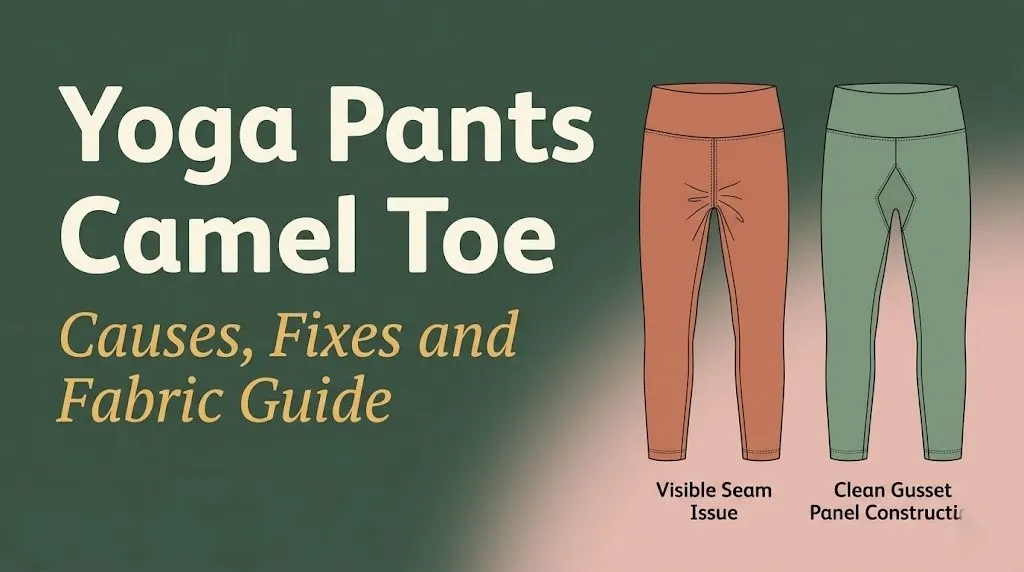
A well-designed gusset does three things:
- It adds extra fabric volume at the crotch so there is material to accommodate hip movement without pulling inward.
- It distributes seam tension across a wider area rather than concentrating it at a single point.
- It reduces the depth and definition of the crotch seam visible from the outside.
Not all gussets are equal. A gusset that is too small, poorly positioned, or made from a different fabric than the main body of the legging will not perform well. The best gussets are made from the same fabric as the surrounding panels, are at minimum 3 inches wide, and are sewn with flat seams rather than raised serged seams.
Quick Summary: Gusset Quality Check
- Width: At minimum 3 inches at the widest point
- Fabric: Same material as the main body, not a contrasting panel
- Seam type: Flat-seam or bonded construction, not raised serging
- Shape: Diamond or triangular, not a simple folded seam
The gusset test is simple: hold the legging up to the light and look at the crotch area. A functional gusset will be visible as a distinct panel. A legging without one will show three seams converging at a single point.
Key Takeaway: The gusset is the single most important structural feature for preventing camel toe in yoga pants, but size, material match, and seam type all determine whether the gusset actually works or just exists on paper.
Yoga Pants Fabric Weight: Understanding GSM and Opacity
Fabric weight in yoga pants is measured in GSM, which stands for grams per square meter, and this number directly predicts how opaque, structured, and camel-toe-resistant a fabric will be under the stretch of yoga movement.
GSM is the textile industry’s standard measurement for fabric density. A higher GSM means more yarn per unit area, which translates to a thicker, heavier fabric that resists stretch-induced transparency and clings less when pulled. For yoga leggings specifically, GSM below 200 is considered lightweight and high-risk for both camel toe and see-through issues during forward folds.
General GSM guidelines for yoga pants:
- Under 180 GSM: Very lightweight. High transparency risk when stretched. Not recommended for yoga practice.
- 180 to 220 GSM: Mid-weight. Adequate for low-intensity yoga formats. May show camel toe in deep hip-flexion poses.
- 220 to 280 GSM: Performance weight. Recommended for most yoga styles including Vinyasa and Hatha.
- 280 GSM and above: Heavy compression weight. Excellent opacity and structure. Ideal for hot yoga and high-intensity formats.
Most reputable activewear brands do not publish GSM on product listings, which is frustrating and worth being direct about. The workaround is the squat test in-store or the bend test at home. Pull the fabric across two fingers and hold it to a light source. If you can see the light through it clearly, it is too thin for yoga practice regardless of the brand name or price point.
Opacity is not just about modesty. Fabric that becomes transparent when stretched also has less structural integrity to resist the pulling forces that create camel toe. Thick, opaque fabric holds its shape during movement. Thin, semi-transparent fabric deforms in the direction of every tension force applied to it.
Four-Way Stretch and Why It Matters for Camel Toe Prevention
Four-way stretch fabric moves with the body in all directions and returns to its original shape after stretching, which is the mechanical property that most directly prevents camel toe during yoga movement.
Two-way stretch fabric stretches in one direction only, either lengthwise or widthwise, but not both. Four-way stretch fabric stretches in all four directions simultaneously. This distinction is directly relevant to camel toe because yoga movement pulls fabric in multiple directions at once. When you drop into Malasana (Garland Pose), the fabric at the crotch is being pulled downward by body weight, outward by the width of the squat, and upward by the tension between the waistband and the thighs. Two-way stretch can’t accommodate all these vectors simultaneously. Four-way stretch can.
The second critical property is recovery. A fabric that stretches four ways but doesn’t spring back after stretching will permanently deform over time, losing its shape and camel-toe resistance after repeated wearing and washing. This is why cheap leggings that feel good in the store become baggy and misshapen after ten washes. The elastane content (spandex or Lycra) is what provides recovery, and a higher elastane percentage within reason produces better long-term recovery.
The practical standard for yoga leggings: look for a minimum of 18 to 22% elastane content in a nylon-spandex or polyester-spandex blend. Above 30% elastane can actually reduce the structural integrity of the fabric, making it feel slippery and reducing camel-toe resistance rather than improving it.
- Two-way stretch: Moves in one direction; insufficient for yoga movement demands
- Four-way stretch: Moves in all directions simultaneously; appropriate for yoga
- Elastane range for best performance: 18 to 22% in the blend
- Recovery test: Stretch the fabric hard for 10 seconds; it should spring back fully within 2 seconds
How to Test Yoga Pants for Camel Toe Before You Buy
You can reliably test yoga pants for camel toe risk before purchasing by using three specific physical tests that replicate the fabric demands of common yoga positions.
These tests take 60 seconds in a changing room or 5 minutes at home with a return policy. They are more reliable than any brand name, price point, or product description claim. Every person should run these tests before committing to a new pair of leggings regardless of marketing language.
The three essential tests:
- The squat test: Put the leggings on and drop into a deep squat with feet hip-width apart and knees tracking over the toes. Look in a mirror at the crotch area. Any visible bunching, pulling, or fabric definition is a camel toe failure. Also check the back for see-through at the seat.
- The bend-forward test: Stand and fold forward at the hips, bringing fingers toward the floor. Hold for 10 seconds. Check the crotch for upward bunching. This replicates Uttanasana (Standing Forward Fold) and Adho Mukha Svanasana (Downward-Facing Dog).
- The wide-leg test: Step feet wide apart and let the inner thighs separate. This replicates Prasarita Padottanasana (Wide-Legged Forward Fold) and seated open-hip poses like Baddha Konasana (Bound Angle Pose). Any upward pull at the crotch in this position indicates insufficient gusset or fabric volume.
Modification note: For anyone who uses a wheelchair or cannot stand, perform the forward-fold and wide-leg tests from a seated position. The fabric tension in these positions still reveals gusset and fabric performance accurately.
Key Takeaway: The squat test, the forward-fold test, and the wide-leg test together take under two minutes and will tell you more about camel-toe resistance than any product description ever will.
Yoga Pants Sizing and Camel Toe: Getting the Fit Right
Wearing yoga pants in the correct size, which may be larger than your usual compression-wear size, is one of the most effective and overlooked ways to prevent camel toe.
The activewear industry’s messaging around “compression fit” and “second-skin feel” has trained many practitioners to size down. This is counterproductive for camel-toe prevention. Leggings that are one size too small have less fabric volume at the crotch, which means more upward pulling during any hip-opening movement. A properly fitted yoga legging should feel snug but not tight. The waistband should stay in place without digging in, and there should be no horizontal lines of tension across the thighs or hips when standing.
Signs that your yoga pants are the wrong size for camel-toe prevention:
- Horizontal tension lines across the front of the thighs when standing
- Waistband that rolls or digs in after 10 minutes of wear
- Any visible bunching at the crotch in a standing position before movement begins
- Difficulty pulling the legging up past the hips without a struggle
Size charts between brands vary considerably. A medium in one brand’s standard legging line may fit more like a small in another’s. Sizing up from your usual size when trying a new brand is a lower-risk strategy than sizing down. If the waist is too large in the larger size, look for leggings with a wide-band waist or an adjustable drawstring rather than forcing a smaller size on the hips.
Petite and tall sizing also affects camel-toe risk. Standard-length leggings on a tall body create upward tension at the crotch because the inseam is too short for the leg length. Petite-length leggings on a standard or tall body create similar tension in reverse. Inseam length that matches your actual leg length is as important as waist and hip measurement.
High-Waisted Yoga Pants and Camel Toe: Does Rise Height Help?
High-waisted yoga pants can reduce camel toe risk by adding fabric length between the waistband and the crotch seam, creating more material to accommodate hip movement without pulling.
The rise of a legging refers to the distance between the waistband and the crotch seam. A mid-rise legging has less fabric in this zone than a high-rise. When you move into a forward fold or squat, the waistband stays relatively in place while the crotch seam is pulled forward and downward. More fabric in the rise zone means the seam has more slack to accommodate this movement before pulling upward into the crotch.
High-rise leggings address camel toe through this mechanism, but only when the gusset construction is also adequate. A high-rise legging with no gusset and thin fabric will still produce camel toe. The rise height is one contributing factor among several, not a standalone solution.
The additional practical benefit of high-rise yoga pants is waistband stability during inverted and forward-folding poses. A waistband that sits above the hip bones during Adho Mukha Svanasana (Downward-Facing Dog) stays in place more reliably than a mid-rise band that sits on or below the hip bones, where it tends to fold or roll.
| Rise Type | Waistband Position | Camel Toe Risk | Best For |
|---|---|---|---|
| Low-rise | Below hip bones | Highest risk | Not recommended for yoga |
| Mid-rise | At hip bones | Moderate risk | Lower-intensity formats |
| High-rise | Above hip bones | Lower risk | All yoga styles |
| Ultra-high / full-length | At or above navel | Lowest risk with good gusset | Hot yoga, vigorous Vinyasa |
Which Yoga Poses Create the Most Camel Toe Risk?
The yoga poses that create the most camel toe risk are those that involve maximum hip flexion combined with leg separation, because these positions apply the most upward tension to the crotch seam simultaneously.
Understanding which poses are highest-risk helps you test leggings specifically in those positions and prioritize fabric and gusset construction accordingly. The standing bend-over test covers many bases, but seated open-hip poses create a different pattern of tension that standing tests don’t fully replicate.
Highest-risk poses for camel toe, in order of crotch-seam tension:
- Malasana (Garland Pose): Full squat with feet wide and hips below knees. Maximum hip flexion and abduction simultaneously.
- Baddha Konasana (Bound Angle Pose): Seated with soles of feet together and knees falling outward. Wide inner thigh separation with forward fold option.
- Prasarita Padottanasana (Wide-Legged Forward Fold): Feet wide apart, torso folding toward the floor. Wide stance plus forward fold creates dual-direction tension.
- Utkatasana (Chair Pose): Hip flexion with knees bent. Less extreme than the above but sustained tension over multiple breath cycles.
- Adho Mukha Svanasana (Downward-Facing Dog): Hip flexion with straight legs. The posterior pull on fabric during this pose reveals gusset adequacy clearly.
Modification note for Malasana (Garland Pose): If camel toe in this pose is unavoidable regardless of legging choice, place a rolled blanket under the heels and widen the feet slightly. This reduces the depth of the squat and decreases the tension load on the crotch seam, while still providing hip-opening benefit.
Key Takeaway: Malasana (Garland Pose) and Baddha Konasana (Bound Angle Pose) are the two highest-risk poses for camel toe, making them the definitive test positions to use when evaluating any new pair of yoga pants.
Yoga Pants for Hot Yoga: Fabric Performance Under Heat
Fabric performance in a heated yoga studio differs from performance at room temperature, and leggings that pass a standard camel-toe test in a cool changing room can fail in a 95°F Bikram or infrared yoga room.
Heat changes two properties of synthetic fabric simultaneously. First, the elastane fibers relax slightly at elevated temperatures, reducing the fabric’s recovery speed after stretching. This means fabric that springs back quickly at room temperature may recover more slowly in a heated room, staying deformed longer at the crotch point after each deep hip-flexion movement.
Second, sweat saturates the fabric. Wet fabric weighs more, clings more, and has less structural resistance to deformation than dry fabric. A legging that is camel-toe-resistant when dry can produce visible bunching within 20 minutes of a hot yoga class once sweat saturation has altered its weight and texture.
For hot yoga specifically, the fabric recommendations shift:
- Prioritize nylon over polyester: Nylon absorbs less water than polyester in equivalent blends, maintaining better structural properties when wet
- Choose higher GSM fabric: Heavier fabric retains more structural integrity when wet than lightweight fabric
- Avoid cotton-blend yoga pants: Cotton absorbs and holds water, becoming significantly heavier and more clingy when saturated with sweat
- Test with the “wet-hand” test: Press a damp hand firmly to the crotch area of the legging. If the fabric deforms visibly and clings, it will do the same in a hot yoga class
The American College of Sports Medicine notes that moisture-wicking fabric in athletic wear maintains better contact comfort and thermoregulation during heated exercise compared to cotton or non-wicking synthetics. For hot yoga practitioners, this performance characteristic directly intersects with camel-toe resistance.
Yoga Pants Hygiene and Vulvar Health: What the Research Says
The fabric choice in yoga pants is not just a comfort and modesty concern. For people with vulvas, extended wear of certain synthetic fabrics during humid exercise can contribute to skin irritation, contact dermatitis, and disrupted vaginal microbiome conditions.
The American College of Obstetricians and Gynecologists notes that tight, non-breathable clothing in the pelvic region can contribute to increased local moisture, warmth, and friction, conditions that support the growth of Candida (yeast) and bacterial species associated with vulvovaginitis. This is not a claim that yoga pants cause infections directly, but rather that fabric choice affects the local environment in the pelvic region in ways that matter for people who practice yoga in heated studios regularly.
The relevant variables are breathability and moisture retention. A fabric that traps sweat against the vulvar skin for a 90-minute hot yoga class creates a warmer, wetter environment than a breathable fabric that moves moisture away from the skin. The American Academy of Dermatology notes that contact dermatitis from synthetic activewear elastic and dyes is a documented clinical presentation, particularly in people with sensitive skin or latex allergy.
Practical recommendations from a hygiene standpoint:
- Change out of yoga pants immediately after class. Do not run errands or sit in a coffee shop post-class in wet leggings.
- Wash yoga pants after every single session. Sweat residue in synthetic fabric creates a breeding environment for bacteria between wearings.
- Consider seamless or flat-seam pants for sensitive skin. Raised seams create friction against vulvar tissue during hip-flexion movements.
- Natural fiber liners: Some practitioners use a thin cotton or bamboo-fabric liner inside leggings during class for direct skin contact breathability.
Breathable and Moisture-Wicking Fabrics for Yoga Practice
Breathable, moisture-wicking yoga pant fabrics move sweat away from the skin surface rather than holding it against the body, which improves both comfort and hygiene during practice while also maintaining better fabric structural integrity during heated sessions.
Moisture-wicking works through capillary action within the fabric’s fiber structure. Synthetic fibers like nylon and polyester do not absorb water into the fiber itself the way cotton does. Instead, they move liquid along the fiber surface through capillary channels, spreading it across a larger area where it can evaporate. This keeps the fabric lighter, drier, and more structurally stable during dynamic movement.
| Fabric | Moisture-Wicking | Breathability | Camel Toe Resistance | Best For |
|---|---|---|---|---|
| Nylon-spandex | Excellent | Moderate to high | Excellent (if 220+ GSM) | All yoga styles |
| Polyester-spandex | Good | Moderate | Good (varies by GSM) | Vinyasa, Hatha |
| Cotton-spandex | Poor | High | Poor (becomes heavy when wet) | Light stretching only |
| Bamboo-polyester | Moderate | High | Moderate | Yin, Restorative |
| Recycled polyester-spandex | Good | Moderate | Good | Eco-conscious practitioners |
| Merino wool blend | Good | Excellent | Moderate | Cool-climate yoga, Yin |
Antimicrobial fabric treatments, often marketed as “odor-resistant” in activewear, use silver ions or zinc-based compounds to reduce bacterial growth in fabric during wear. Research published in the International Journal of Environmental Research and Public Health found that silver-ion antimicrobial treatments in textile fabrics effectively reduced bacterial counts compared to untreated fabrics. For hot yoga practitioners who practice frequently, this treatment adds a meaningful hygiene benefit.
How to Care for Yoga Pants to Maintain Camel Toe Resistance
Proper washing and care of yoga pants directly affects how long the fabric maintains its camel-toe-resistant properties, because the elastane fibers that provide four-way stretch and recovery degrade faster when exposed to heat and harsh detergents.
Elastane (spandex or Lycra) is heat-sensitive. Washing yoga pants in hot water, and especially tumble-drying them on high heat, degrades the elastane fiber over time, reducing the fabric’s recovery speed and four-way stretch capacity. A legging that springs back perfectly after 10 washes and fits beautifully may become baggy and shapeless after 30 washes if cared for incorrectly.
Best practices for extending the camel-toe-resistant life of yoga pants:
- Cold wash only: Use cold water (30°C / 86°F or below) in every wash cycle
- Gentle cycle: The agitation of a standard wash cycle stresses fabric fibers. Delicate or hand-wash cycle settings reduce mechanical stress.
- Mild detergent: Standard laundry detergents contain enzymes and bleaching agents that degrade spandex faster than formulas designed for activewear
- Never tumble dry: Air-dry yoga pants flat or hung. Never put them in a dryer on any heat setting.
- Avoid fabric softener: Fabric softener coats synthetic fibers with a waxy residue that reduces moisture-wicking function and can break down fabric structure over time
- Wash after every use: Sweat residue and body oils degrade elastic fibers. Wearing the same pair twice without washing reduces garment lifespan faster than washing does.
Following these care guidelines can extend the functional life of quality yoga pants from approximately 1 year with poor care to 3 to 4 years with proper maintenance.
Best Yoga Pant Styles for Camel Toe Prevention in 2026
The best yoga pant styles for camel-toe prevention in 2026 share four construction features: a properly designed gusset, four-way stretch fabric at 220 GSM or above, flat-seam construction at the crotch, and a high-rise waistband.
No specific brand recommendation is possible without real-time testing, and brand quality varies by product line within a single brand. What this guide gives you instead is a technical checklist that lets you evaluate any yoga pant you encounter against objective performance criteria.
The complete camel-toe prevention checklist for 2026:
- Gusset present: Visible as a distinct panel at the crotch, minimum 3 inches wide
- Fabric weight: 220 GSM or above in nylon-spandex or performance polyester-spandex
- Elastane content: 18 to 22% for optimal stretch-and-recovery balance
- Four-way stretch: Fabric stretches in all directions and recovers within 2 seconds
- Flat or bonded seams: No raised seam ridge at the crotch point
- High-rise waistband: Above the hip bones, stays in place during inversions
- Opacity test passes: Hold fabric over two fingers and hold to light. No visible skin tone.
- Double-layer front panel: Optional but adds opacity and structural reinforcement
- Squat test passes: No visible bunching or fabric definition in a full squat
- Forward-fold test passes: No upward pulling during a 10-second standing forward fold
Budget does not determine quality on this checklist. A $30 pair of leggings with all ten features will outperform a $120 pair missing four of them. The checklist is the evaluation tool. Brand name is a starting point at best.
Frequently Asked Questions About Yoga Pants Camel Toe
Why do my yoga pants give me camel toe?
Yoga pants cause camel toe when there is insufficient fabric volume at the crotch to accommodate hip movement, which pulls fabric upward into the crotch area.
The most common causes are missing or too-small gusset, fabric that is too thin to hold its shape when stretched, and a size that is too small relative to your hip and thigh measurements.
Correcting any one of these factors reduces camel toe risk; correcting all three eliminates it in most cases.
What is a gusset in yoga pants and does it actually help?
A gusset is an additional fabric panel sewn into the crotch of yoga pants to add width and depth, preventing seam bunching during hip-flexion movements.
A well-made gusset that is at least 3 inches wide, made from the same fabric as the main body, and sewn with flat seams will measurably reduce camel toe compared to the same legging without one.
A poorly designed gusset that is too small or made from a contrasting fabric provides limited functional benefit.
How do I test yoga pants for camel toe before buying?
Test yoga pants with three movements: a deep squat, a standing forward fold, and a wide-leg stance.
These three positions replicate the hip-flexion demands of Malasana (Garland Pose), Uttanasana (Standing Forward Fold), and Prasarita Padottanasana (Wide-Legged Forward Fold).
Any visible bunching, upward pulling, or fabric definition in any of these positions indicates the legging will produce camel toe during yoga practice.
Are high-waisted yoga pants better for preventing camel toe?
High-waisted yoga pants reduce camel toe risk by adding more fabric length between the waistband and the crotch seam, giving the fabric more slack to accommodate hip movement.
This benefit is real but conditional: a high-rise legging with no gusset and thin fabric will still produce camel toe, because rise height is one factor among several.
High-rise combined with a proper gusset and adequate fabric weight produces the most reliable camel-toe prevention.
Can tight yoga pants cause health problems?
Very tight yoga pants worn for extended periods in heated environments can contribute to increased local moisture and warmth in the pelvic region, which the American College of Obstetricians and Gynecologists notes as a condition that supports yeast and bacterial overgrowth.
The American Academy of Dermatology documents contact dermatitis from synthetic activewear elastic and dyes as a real clinical presentation in people with sensitive skin.
The practical solution is to change out of yoga pants immediately after class, wash them after every session, and choose breathable fabrics with moisture-wicking properties for heated practice.
The Right Pair Is Out There
Finding yoga pants that genuinely prevent camel toe is a solvable problem. The checklist in this guide, gusset, fabric weight at 220 GSM or above, four-way stretch, high-rise waistband, and flat seam construction, covers every variable that matters.
Run the three tests in every changing room before you commit. Squat. Fold forward. Step wide. If the fabric holds its position in all three, you’ve found a pair that will hold up in class.
Change out of them immediately after practice, wash cold every time, and never put them in the dryer. Do that consistently and the right pair will last for years.