What Is Asana Yoga? Full Meaning and 2026 Guide
Asana yoga refers to the physical posture practice within yoga, where “asana” is the Sanskrit word for a seated or held body position, and in modern usage it encompasses every pose from a simple forward fold to a full backbend. Understanding what asana actually means separates students who follow instructions from students who understand what they’re doing and why it matters.
The National Center for Complementary and Integrative Health reports that yoga is practiced by more than 21 million adults in the United States, the majority of whom engage primarily through asana. Yet most practitioners have never been told what the word itself means, where the concept originated, or how classical systems like Sivananda organized postures into a coherent sequence with a physiological rationale behind it.
This guide covers the Sanskrit definition and etymology of asana, Patanjali’s original instructions, the eight-limb context, the Sivananda classical system, every major asana category, the research on what poses actually do for the body, and a practical framework for beginning or refining your own practice.
What Is Asana Yoga: Definition and Meaning
Asana yoga refers to yoga practice centered on physical postures, where each posture is called an asana, meaning a steady and comfortable position held with awareness and breath.
The term comes from the Sanskrit root “as,” meaning “to sit” or “to be present.” While the original meaning referenced seated meditation positions specifically, the word expanded over centuries of Hatha yoga development to include every standing, kneeling, prone, supine, balancing, and inverted position practiced in a modern yoga class.
What makes a posture an asana, as opposed to just a stretch or an exercise position, is the combination of three elements: physical form, breath awareness, and mental attention. An asana practiced with controlled breath and focused attention is yoga. The same position practiced mindlessly is just movement. That distinction matters practically, not just philosophically.
For beginners encountering the word in a class setting, “asana” and “pose” are used interchangeably by most English-speaking teachers. You’ll hear both, and they refer to the same thing in practice. Knowing the Sanskrit origin helps you understand why yoga teachers use Sanskrit names at all: the classical vocabulary carries a precision that English translations sometimes soften.
Quick Summary: What Asana Means
- Sanskrit root: “as,” meaning to sit or to be present
- Original meaning: a seated meditation position
- Modern meaning: any physical posture in yoga practice
- Three required elements: physical form, breath, and mental attention
- Used interchangeably with “pose” in modern English-language yoga classes
What Does Asana Mean in Sanskrit?
In Sanskrit, asana means “a position comfortably held,” with the emphasis on both the comfort and the steadiness of the position.
Sanskrit is an ancient Indo-European language that served as the scholarly and religious language of classical India. Yoga texts were composed in Sanskrit for centuries, which is why every classical pose name carries a Sanskrit word at its root. Tadasana (Mountain Pose) combines “tada” (mountain) with “asana” (posture). Adho Mukha Svanasana (Downward-Facing Dog) combines words meaning “downward-facing dog” with “asana.” The naming convention is always descriptive: it tells you what the body resembles or what quality the pose invokes.
The word itself appears in classical texts going back at least 2,000 years, though its application evolved considerably over time. In the oldest yoga texts, asana referred almost exclusively to the sitting posture used for prolonged meditation. The idea of asana as a physical practice with dozens of distinct forms developed primarily through the Hatha yoga tradition, which emerged roughly in the 10th to 15th centuries CE.
Understanding the Sanskrit root shifts how you experience a pose. When you know that “sthira sukham asanam,” Patanjali’s definition, means “the posture should be steady and comfortable,” you understand that struggling and forcing are not part of the design. The word itself carries the instruction.
According to the International Journal of Yoga, regular asana practice across multiple studies is associated with improved proprioception, reduced pain perception, and enhanced body awareness, outcomes that align with the classical intention of developing stable, attentive physical presence.
Asana in the Yoga Sutras: What Patanjali Actually Said
Patanjali’s Yoga Sutras, composed approximately 2,000 years ago, define asana in sutra 2.46 as “sthira sukham asanam,” which translates as “the posture should be steady and at ease.”
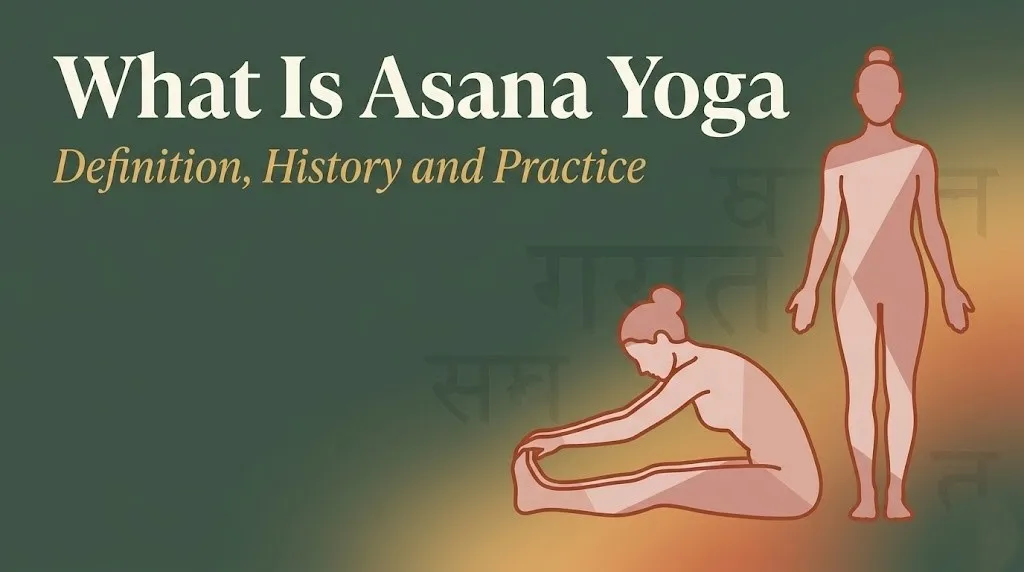
This is one of the most quoted and least explained lines in all of yoga literature. Patanjali did not describe dozens of poses. He described the quality that any posture should have: stability without rigidity, ease without collapse. The specific physical forms were left to later traditions to develop.
Sutra 2.47 adds “prayatna shaithilyananta samapattibhyam,” meaning the posture is mastered through the release of effort and the contemplation of the infinite. In plain terms: the body stops straining and the mind stops grasping. That is when an asana is truly being practiced, not just performed.
Sutra 2.48 completes the thought: when asana is mastered, the practitioner is no longer disturbed by opposing sensations, such as heat and cold, or discomfort and pleasure. Patanjali’s asana is not a physical fitness system. It is training the nervous system to remain stable under varying conditions.
This classical framing matters for modern practitioners because it reframes what success in a pose looks like. The goal is not depth of range or visual appearance. The goal is quality of presence. A shallow pose practiced with full attention and steady breath outranks a deep pose fought for and held with tension.
| Yoga Sutra | Sanskrit | English Meaning |
|---|---|---|
| 2.46 | Sthira sukham asanam | The posture should be steady and at ease |
| 2.47 | Prayatna shaithilyananta samapattibhyam | Mastered through release of effort and infinite awareness |
| 2.48 | Tato dvandva anabhighatah | Then one is not disturbed by opposing conditions |
Key Takeaway: Patanjali defined asana as “steady and comfortable,” which means that forcing depth or fighting discomfort in a pose is actually working against the classical definition of what asana is supposed to be.
Asana and the Eight Limbs of Yoga
Asana is the third of the eight limbs described in Patanjali’s Yoga Sutras, sitting between ethical guidelines and breath practices in a specific developmental sequence.
The eight limbs, called Ashtanga in Sanskrit (not to be confused with the Ashtanga yoga style), are: Yama (ethical restraints), Niyama (personal observances), Asana (posture), Pranayama (breath regulation), Pratyahara (sense withdrawal), Dharana (concentration), Dhyana (meditation), and Samadhi (integrated awareness). Each limb was understood as preparation for the next.
Asana’s placement in this sequence is intentional. Before the breath can be regulated effectively, the body needs to be capable of sitting still without discomfort. Before the mind can concentrate, the nervous system needs the stability that comes from a prepared, healthy body. Asana was designed to create the physical conditions in which deeper practices become possible.
This context explains something that confuses many modern yoga students: why a class that involves movement, sweat, and physical challenge also produces mental calm. The body and nervous system are not separate systems being worked on independently. Asana addresses them simultaneously.
Most contemporary yoga classes focus almost entirely on this third limb. That’s not inherently wrong. Asana practice produces real, documented benefits for the body and mind. But knowing where it sits in the larger system prevents the common mistake of thinking that getting into an advanced pose is the point. It never was.
- Yama: Ethical guidelines for relating to others
- Niyama: Personal disciplines and self-study
- Asana: Physical posture practice (the third limb)
- Pranayama: Breath regulation (fourth limb)
- Pratyahara: Withdrawal of the senses (fifth limb)
- Dharana: Focused concentration (sixth limb)
- Dhyana: Sustained meditation (seventh limb)
- Samadhi: Complete absorption (eighth limb)
Classic Yoga: What Makes a System Classical?
A classical yoga system is one that draws directly from ancient texts and traditional lineage transmission, maintaining a structured sequence of practices that reflect the original philosophical framework of yoga rather than modern fitness adaptations.
The word “classical” in the yoga context has a specific meaning. It distinguishes lineage-based systems from contemporary hybrid formats. Sivananda yoga, Iyengar yoga, Ashtanga yoga (in the Krishnamacharya lineage), and Kundalini yoga as taught by Yogi Bhajan are all considered classical systems because they trace directly to a named teacher and a codified methodology.
Classical systems share certain characteristics. They include a set sequence of asanas rather than variable programming. They integrate pranayama and meditation rather than treating them as optional additions. They place asana within an ethical and philosophical framework rather than presenting it purely as physical exercise.
This matters for a student choosing a practice because classical systems offer something contemporary hybrid formats generally don’t: a coherent reason for why the poses are practiced in a particular order. In the Sivananda system, for example, the sequence moves from inverted poses to backbends to forward folds in a specific physiological progression that makes anatomical sense.
| System | Founded By | Sequence Type | Key Emphasis |
|---|---|---|---|
| Sivananda | Swami Sivananda / Vishnudevananda | Fixed 12-pose sequence | Classic poses, pranayama, relaxation |
| Iyengar | B.K.S. Iyengar | Structured, prop-supported | Precision alignment |
| Ashtanga | Krishnamacharya / Pattabhi Jois | Fixed six series | Breath-movement linkage |
| Kundalini | Yogi Bhajan | Kriya-based sets | Energy and mantra |
Sivananda Yoga Poses: The 12 Basic Asanas Explained
The Sivananda yoga system teaches 12 basic asanas as the foundation of a complete classical practice, selected for their combined effect on the entire body and nervous system.
Swami Vishnudevananda, a student of Swami Sivananda of Rishikesh, codified this sequence in the 20th century as a systematic introduction to classical yoga. The 12 poses are not arbitrary. They were chosen to move the spine in every direction, compress and release every major organ system, and provide both stimulating and calming effects within a single session.
The 12 basic Sivananda asanas are:
- Sirsasana (Headstand): Inverts blood flow, strengthens the shoulder girdle and core
- Sarvangasana (Shoulder Stand): Stimulates the thyroid region, calms the nervous system
- Halasana (Plow Pose): Stretches the posterior cervical spine and hamstrings
- Matsyasana (Fish Pose): Counter-pose to Shoulder Stand, opens the anterior thoracic spine
- Paschimottanasana (Seated Forward Fold): Stretches the entire posterior chain
- Bhujangasana (Cobra Pose): Extends the thoracic and lumbar spine, strengthens the posterior chain
- Shalabhasana (Locust Pose): Strengthens the lower back and glutes
- Dhanurasana (Bow Pose): Combines Cobra and Locust, opens the anterior body
- Ardha Matsyendrasana (Half Lord of the Fishes Pose): Rotates the thoracic spine, compresses and releases abdominal organs
- Kakasana (Crow Pose): Balancing arm support, builds wrist and core strength
- Pada Hastasana (Standing Forward Fold): Lengthens the hamstrings with gravitational assistance
- Trikonasana (Triangle Pose): Lateral flexion, hamstring stretch, thoracic rotation
Modification note: Sirsasana (Headstand) is contraindicated for people with cervical spine injuries, glaucoma, high blood pressure, or those new to yoga without teacher supervision. Substitute Viparita Karani (Legs-Up-the-Wall Pose) until shoulder and core strength supports a safe inversion.
Key Takeaway: The Sivananda sequence is not a random collection of poses. Each of the 12 asanas was chosen because it addresses a specific physiological system, and the order of the sequence creates a cumulative effect that a random class structure rarely achieves.
Types of Asana in Yoga: Categories and What They Do
Yoga asanas are organized into categories based on the body’s orientation and the primary physiological effect, and understanding these categories helps a practitioner build a balanced practice rather than repeatedly working the same muscle groups.
The major categories and their primary effects are:
- Standing asanas: Build leg strength, improve balance and proprioception, develop postural awareness. Examples: Tadasana (Mountain Pose), Virabhadrasana I (Warrior I), Trikonasana (Triangle Pose).
- Seated asanas: Target the hamstrings, hip flexors, and spinal extensors in a stable, lower-center-of-gravity position. Examples: Paschimottanasana (Seated Forward Fold), Dandasana (Staff Pose).
- Supine asanas: Performed lying face up. Reduce spinal load, allow passive hip and spinal work. Examples: Setu Bandha Sarvangasana (Bridge Pose), Savasana (Corpse Pose).
- Prone asanas: Performed lying face down. Strengthen the posterior chain, develop thoracic extension. Examples: Bhujangasana (Cobra Pose), Shalabhasana (Locust Pose).
- Balancing asanas: Develop proprioception, core stability, and focused attention. Examples: Vrksasana (Tree Pose), Kakasana (Crow Pose).
- Inverted asanas: Reverse the relationship of the body to gravity. Support lymphatic circulation and calm the nervous system. Examples: Sarvangasana (Shoulder Stand), Viparita Karani (Legs-Up-the-Wall Pose).
- Twisting asanas: Rotate the thoracic spine, compress and release abdominal organs. Examples: Ardha Matsyendrasana (Half Lord of the Fishes Pose).
- Backbending asanas: Extend the spine, open the anterior body, stimulate the sympathetic nervous system. Examples: Ustrasana (Camel Pose), Dhanurasana (Bow Pose).
A balanced weekly practice includes poses from every category, not just the ones that feel comfortable.
Standing Asanas for Beginners
Standing asanas are the foundational category for building body awareness, postural strength, and balance in new practitioners. They are typically the first poses taught in any beginner yoga class.
The standing position is familiar to every human body. This makes standing poses accessible as entry points while offering genuine physical challenge. Muscle groups engaged in standing asanas include the quadriceps, hamstrings, glutes, hip abductors, and core stabilizers, along with the postural muscles of the thoracic and lumbar spine.
To practice Virabhadrasana II (Warrior II):
- Stand at the top of your mat in Tadasana (Mountain Pose) with feet together.
- Step one foot back approximately 3 to 4 feet, turning the back foot to 45 to 90 degrees.
- Bend the front knee until it tracks directly over the second toe, aiming for a 90-degree angle.
- Extend both arms to shoulder height, reaching in opposite directions.
- Turn the gaze over the front hand. Keep the torso upright, not leaning forward.
- Hold for 5 to 8 breath cycles, then step forward to return.
Modification note: Anyone with front knee osteoarthritis should reduce the depth of the bend to a pain-free range, keeping the knee well behind the ankle. Those with shoulder impingement should keep the arms at a lower angle rather than at full shoulder height.
Pose Tip: Warrior II Alignment
- Front knee tracks over the second toe, never collapsing inward
- Both feet press firmly into the floor throughout the hold
- Seniors: practice with a chair alongside for balance support
Seated and Supine Asanas: Benefits and Technique
Seated and supine asanas form the second major block of most classical yoga sequences, offering deep stretching of the posterior chain and lower-load spinal work after the effort of standing poses.
Seated asanas like Paschimottanasana (Seated Forward Fold) target the hamstrings, calves, and spinal extensors in a position where the base of support is wide and stable. The challenge in seated forward folds is maintaining a flat spine and hinging from the hips rather than rounding the lower back. This distinction determines whether the hamstrings are being stretched or the lumbar spine is being compressed.
To practice Paschimottanasana (Seated Forward Fold):
- Sit on the mat with legs extended straight in front of you, feet flexed.
- Press the sitting bones down and lengthen the spine upward on an inhale.
- On an exhale, hinge forward from the hips, keeping the spine long.
- Hold the shins, ankles, or feet with a yoga strap if the hands don’t reach.
- With each exhale, allow the body to release slightly deeper without forcing.
- Hold for 5 to 10 breath cycles, then inhale to return upright.
Supine asanas reduce load on the lumbar spine by placing the body horizontal. Setu Bandha Sarvangasana (Bridge Pose) in the supine category is particularly effective for building the glutes, hamstrings, and spinal extensor muscles while protecting the lumbar discs from compression. It’s one of the most accessible backbend variations for people with lower back sensitivity.
Modification note: In Paschimottanasana (Seated Forward Fold), sit on a folded blanket to tilt the pelvis forward if the lower back rounds immediately. The blanket elevation allows the hamstrings to stretch without the lumbar spine compensating.
Key Takeaway: The distinction between hinging forward from the hips versus rounding the lower back is the single most important technical point in every seated forward fold, and getting it right determines whether the pose helps or harms the lumbar spine.
Backbend and Twisting Asanas: Purpose and Safety
Backbending asanas extend the spine and open the anterior body, while twisting asanas rotate the thoracic spine and create compression-and-release patterns in the abdominal region. Both categories require specific safety awareness.
Backbends are stimulating poses. They activate the sympathetic nervous system branch to a greater degree than most other pose categories, producing an energizing effect that is why backbends are typically placed in the middle of a sequence rather than at the end. They engage the spinal extensors, glutes, hip flexors (eccentrically, in lengthening), and pectoral muscles.
To practice Bhujangasana (Cobra Pose) safely:
- Lie face down with legs extended and the tops of the feet pressing into the mat.
- Place palms flat beside the lower ribs, elbows close to the body.
- On an inhale, press through the hands and lift the chest, drawing the thoracic spine into extension.
- Keep elbows with a soft bend. Do not straighten the arms fully unless the back allows it without compression.
- Draw the shoulder blades toward each other and downward.
- Hold for 3 to 5 breath cycles, then exhale to lower.
Twisting asanas like Ardha Matsyendrasana (Half Lord of the Fishes Pose) target the obliques and thoracic rotators. The key safety point is that all spinal twists should originate in the thoracic spine, not the lumbar. The lumbar spine has very limited rotational capacity. Forcing rotation there creates shear forces rather than stretch.
Modification note: For backbends, people with lumbar disc herniation should limit the lift height and stop immediately if any sensation travels into the legs. For twists, those with sacroiliac joint pain should keep both sitting bones grounded and reduce the degree of rotation to a comfortable range.
Asana Benefits Backed by Research
Asana practice produces measurable, documented benefits for the musculoskeletal system, cardiovascular system, and autonomic nervous system, supported by published research across multiple peer-reviewed journals.
The National Center for Complementary and Integrative Health (NCCIH) reviewed clinical evidence on yoga and found consistent support for reduced lower back pain, improved flexibility and balance, decreased anxiety and stress symptoms, and better sleep quality in regular yoga practitioners. These outcomes were present across multiple yoga styles, all of which use asana as the primary physical component.
A study published in the International Journal of Yoga found that participants practicing yoga twice weekly for 12 weeks showed measurable improvements in hamstring flexibility, balance scores, and self-reported physical function compared to non-practicing control groups. The improvements were present in adults ranging from their 20s through their 60s.
Cardiovascular effects are real but modest. The American College of Sports Medicine classifies yoga as light to moderate intensity aerobic activity depending on the style, with Vinyasa yoga reaching moderate cardiovascular intensity in healthy adults. This places regular asana practice within the evidence base for cardiovascular health maintenance when practiced at sufficient frequency.
Key research-supported benefits of regular asana practice:
- Reduced chronic lower back pain: Comparable to physical therapy outcomes in multiple controlled trials
- Improved hamstring and hip flexibility: Measurable after 6 to 8 weeks of twice-weekly practice
- Reduced cortisol levels: Documented post-session in multiple reviewed studies
- Improved balance and fall prevention: Particularly in adults over 60
- Lower resting blood pressure: In practitioners with mild hypertension over 12 weeks of regular practice
One clear-eyed note: benefits are style-specific and frequency-dependent. Yin yoga produces different outcomes than Vinyasa. Two sessions per week produces different results than one. Honest research claims require honest context.
Asana for Back Pain and Spinal Health
Asana is among the most well-researched non-pharmacological interventions for chronic lower back pain, with outcomes that match or approach those of physical therapy in multiple controlled trials.
The Spine Journal published research finding that yoga produced clinically meaningful pain reduction and functional improvement in adults with chronic non-specific lower back pain at 12-week follow-up. The mechanisms are understood: asana builds the deep core stabilizing muscles, including the multifidus and transverse abdominis, that support the lumbar spine during every movement of daily life. When these muscles are weak, the larger global muscles compensate, creating the pattern of chronic tension and fatigue that so many adults experience in the lower back.
Asana addresses spinal health from three angles simultaneously. First, it strengthens the muscles that support the spine. Second, it stretches the hip flexors and hamstrings whose tightness pulls the lumbar spine out of neutral. Third, it trains movement awareness so that practitioners carry correct spinal alignment into daily activity rather than just during class.
Poses particularly effective for spinal health include:
- Setu Bandha Sarvangasana (Bridge Pose): Builds glutes and hamstrings, reduces lumbar load
- Balasana (Child’s Pose): Decompresses the lumbar spine with gravity assistance
- Bhujangasana (Cobra Pose): Strengthens spinal extensors in a supported position
- Marjaryasana / Bitilasana (Cat/Cow Pose): Moves the spine through gentle flexion and extension, warming the intervertebral discs
Modification note: Anyone with a known lumbar disc herniation should approach backbends with caution and work with a physical therapist or experienced yoga therapist before attempting poses that extend the lumbar spine, particularly Bhujangasana (Cobra Pose) in its full expression.
Key Takeaway: Asana’s effectiveness for back pain comes from building core stability and reducing hip and hamstring tightness simultaneously, addressing root causes rather than simply providing temporary relief.
Asana for Stress and the Nervous System
Asana reduces stress through direct neurological mechanisms, not just by giving the mind a pleasant hour away from daily demands.
The breath regulation embedded in every asana class, particularly ujjayi pranayama (victorious breath), activates the vagus nerve and shifts the autonomic nervous system toward parasympathetic dominance. Parasympathetic activation reduces heart rate, lowers blood pressure slightly, and decreases the circulating level of cortisol, the body’s primary stress hormone.
A study published in Complementary Therapies in Medicine found that participants who practiced yoga twice weekly over 8 weeks showed measurable reductions in perceived stress scores and improvements in heart rate variability, a marker of autonomic nervous system health and stress resilience. These outcomes were present regardless of whether participants were beginners or experienced practitioners.
Think of the nervous system like a car that has been idling in a traffic jam for hours. The engine is running hot even though nothing is moving. Asana practice, particularly when paired with slow controlled breathing, gives the engine a chance to cool. The poses require enough physical engagement to interrupt the rumination cycle, while the breath requirement prevents the kind of performance anxiety that makes gym-style exercise sometimes increase rather than decrease stress.
Savasana (Corpse Pose), the final resting pose that closes every classical practice, is when the nervous system integrates the regulatory effect of the preceding session. Skipping it is the single most common and most consequential error beginners make. The research on post-exercise parasympathetic recovery consistently shows that a period of intentional rest following physical activity enhances the recovery effect beyond what passive rest produces.
Pose Tip: Savasana Done Well
- Lie flat on your back, arms 6 to 12 inches from the body, palms facing upward
- Allow the feet to fall naturally outward without effort
- Hold for a minimum of 5 minutes. Ten minutes produces measurably deeper recovery.
- Seniors or those with lower back discomfort: place a bolster under the knees throughout
Asana Modifications and Props for Beginners
Every asana has a modification, and using props is not a beginner shortcut. It is how classical yoga was designed to be practiced by real human bodies with real structural variation.
B.K.S. Iyengar, whose Iyengar yoga system is one of the most rigorously documented alignment-based traditions, developed the systematic use of props specifically because he understood that forcing a body into an ideal pose shape produces harm rather than benefit. Blocks, straps, and bolsters allow the pose’s intended anatomical effect to occur in bodies that can’t yet access the full expression.
| Prop | Primary Function | Best Used For |
|---|---|---|
| Yoga block (foam or cork) | Brings floor closer; supports alignment | Standing poses, seated forward folds, bridge support |
| Yoga strap | Extends reach; maintains limb position | Forward folds, shoulder stretches, supine leg work |
| Bolster | Full body support in passive positions | Restorative poses, Yin holds, Savasana |
| Yoga blanket | Joint padding; hip elevation in seated | Seated poses, kneeling poses, under the knees in Savasana |
| Wall | Stability; inversion support | Balance poses, Legs-Up-the-Wall, standing backbends |
| Chair | Full accessibility for limited mobility | Chair yoga, standing balance support, seated inversions |
The most productive mindset shift for a new practitioner is this: a pose practiced correctly at 60% of its visual depth produces more physiological benefit than the same pose forced to full depth with poor alignment. Props make the 60% version correct. Without props, the full-depth attempt often produces strain at the joints and no real stretch at the target tissues.
Modification note: For practitioners with wrist pain or weakness in any weight-bearing asana, placing yoga wedges under the heels of the hands reduces wrist extension and distributes load more safely across the forearm bones rather than concentrating it at the carpal bones.
How Long Should You Hold an Asana?
The appropriate hold duration for an asana depends on the yoga style being practiced and the specific physiological goal of the pose, and ranges from a single breath cycle in Vinyasa to 5 minutes or more in Yin yoga.
General guidelines from yoga teachers and physical therapists:
| Style | Typical Hold Duration | Primary Goal |
|---|---|---|
| Vinyasa | 1 to 3 breath cycles per pose | Cardiovascular flow, breath linkage |
| Hatha | 5 to 10 breath cycles (20 to 60 seconds) | Alignment, muscular engagement |
| Yin | 3 to 5 minutes | Connective tissue and fascia |
| Restorative | 5 to 20 minutes | Nervous system downregulation |
| Bikram / 26&2 | 20 to 60 seconds, two sets | Muscular conditioning, heat adaptation |
For beginners in any style, the practical answer is: hold until you can no longer maintain the alignment cues you were given, then release. Holding a pose past the point where form collapses does not add benefit. It adds compensation patterns.
According to research reviewed by the American College of Sports Medicine, flexibility improvements from static stretching require a cumulative weekly stretch duration of at least 60 seconds per muscle group. In yoga terms, this means holding a pose for 30 seconds and repeating it twice, or holding a Yin pose for a full minute, meets the threshold for producing lasting flexibility adaptation.
Modification note: Seniors or anyone with joint replacements should limit hold durations in weight-bearing standing poses to 5 to 7 breath cycles initially, adding duration incrementally as strength and confidence build over several weeks of practice.
How Often Should You Practice Asana?
Most yoga teachers and sports medicine practitioners recommend practicing asana at least two to three times per week to produce measurable, lasting physical and mental benefits.
One session per week maintains the body awareness gained in class and provides a weekly nervous system reset. Two sessions per week begins producing measurable flexibility improvement after four to six weeks. Three or more sessions per week accelerates physical adaptation and produces more consistent stress-regulation effects across the full week.
The ACSM’s guidelines for flexibility training recommend stretching major muscle groups two to three times per week. Asana practiced at that frequency fully satisfies this recommendation while providing balance training, body awareness, and breath regulation simultaneously.
A practical progression for someone new to asana practice:
- Weeks 1 to 3: One or two sessions per week. Priority: learning to follow cues and recognizing how your body responds.
- Weeks 4 to 8: Two sessions per week. Measurable flexibility and reduced muscle tension typically appear in this period.
- Week 9 onward: Two to four sessions per week, based on recovery, schedule, and how the body feels between sessions.
Signs that your current frequency is working well:
- Reduced muscle soreness between sessions
- Improved ease in poses you found challenging four weeks earlier
- Better sleep quality on practice days
Signs to pull back and rest more:
- Persistent joint soreness that does not resolve within 48 hours
- Feeling fatigued rather than refreshed after class
- Noticeably declining performance in poses you had stabilized
Rest is not wasted time. Asana adaptation happens during recovery, when the tissues repair and the nervous system consolidates what it learned.
Key Takeaway: Two to three asana sessions per week is the evidence-supported minimum for lasting physical and mental change, and consistency over months matters more than frequency in any single week.
Frequently Asked Questions About Asana Yoga
What is the difference between yoga and asana?
Yoga is the complete eight-limbed system that includes ethics, posture, breathwork, sense withdrawal, concentration, meditation, and absorption, while asana refers specifically to the physical posture component, which is the third limb.
In contemporary Western usage, “doing yoga” almost always means practicing asana, because that is the component most widely taught in studios and classes.
Asana is a part of yoga, not the whole of it, though it is a genuinely valuable entry point to the broader practice.
What did Patanjali say about asana in the Yoga Sutras?
Patanjali defined asana in sutra 2.46 as “sthira sukham asanam,” meaning the posture should be steady and at ease.
He added in sutra 2.47 that asana is mastered through release of effort and contemplation of the infinite, meaning that straining and forcing are incompatible with the classical definition.
Patanjali described only one pose category in detail, the seated meditation position, leaving the diversity of physical forms to later Hatha yoga traditions.
What are the 12 basic poses of Sivananda yoga?
The 12 basic Sivananda asanas are Sirsasana (Headstand), Sarvangasana (Shoulder Stand), Halasana (Plow Pose), Matsyasana (Fish Pose), Paschimottanasana (Seated Forward Fold), Bhujangasana (Cobra Pose), Shalabhasana (Locust Pose), Dhanurasana (Bow Pose), Ardha Matsyendrasana (Half Lord of the Fishes Pose), Kakasana (Crow Pose), Pada Hastasana (Standing Forward Fold), and Trikonasana (Triangle Pose).
They are sequenced to move the spine in every direction and address every major organ system within a single practice session.
The sequence was codified by Swami Vishnudevananda, a student of Swami Sivananda of Rishikesh, in the 20th century.
How long should you hold an asana as a beginner?
Beginners in Hatha yoga are generally advised to hold each pose for 5 to 10 breath cycles, roughly 20 to 60 seconds.
Yin yoga holds run from 3 to 5 minutes per pose, while Vinyasa yoga moves through poses in 1 to 3 breath cycles.
Hold each pose only as long as correct alignment can be maintained, and release when form starts to break down rather than pushing through.
Is asana the same as Hatha yoga?
Asana is not the same as Hatha yoga, but Hatha yoga is the traditional system within which the physical posture practice of asana was most extensively developed.
Hatha yoga includes asana, pranayama, mudras (gestures), and other practices, making it broader than asana alone.
In modern studios, “Hatha class” typically refers to a slow, alignment-focused asana session, which is accurate as far as it goes but represents only one aspect of what classical Hatha yoga encompasses.
Begin With One Pose Today
The most direct application of everything in this guide is practical: pick one pose from the Sivananda sequence, learn its correct alignment, and practice it with five slow breaths today. Bhujangasana (Cobra Pose) and Paschimottanasana (Seated Forward Fold) are both accessible starting points with clear, documented benefits.
Use a strap in the forward fold if your hands don’t reach your feet. That is not a limitation. That is the pose working correctly.
Asana practice is cumulative. The understanding you bring to the mat compounds with every session. Start today with one pose and one clear breath.