Daya Yoga: Compassion Practice, Poses and Benefits 2026
Daya yoga is a compassion-centered approach to yoga practice rooted in the Sanskrit principle of daya, meaning kindness and mercy, and it shapes both the physical poses you choose and the inner attitude you bring to the mat. Whether you practice at a daya yoga studio or at home, this approach treats the body with the same care you would extend to someone you genuinely love.
The National Center for Complementary and Integrative Health notes that yoga, particularly when practiced with mindful intention, produces documented reductions in stress hormones, anxiety scores, and self-reported pain levels. Adding a compassion framework to that physical practice amplifies those outcomes by addressing the psychological layer that pure movement alone does not reach.
This guide covers what daya means in yoga philosophy, how it connects to specific poses and breathwork, what the research says about compassion-based practices and mental health, and how to adapt this approach for beginners, seniors, and people managing chronic conditions.
Daya Yoga: What This Practice Actually Is
Daya yoga is a yoga practice organized around the principle of compassion as both a philosophical foundation and a physical practice method, meaning every pose, breath, and rest period is chosen and approached with kindness toward the body rather than demand or judgment.
Unlike a specific codified style such as Ashtanga or Bikram/26&2, daya yoga is a philosophical orientation that can be applied within multiple yoga formats. A teacher can bring daya principles to a Hatha class, a Yin yoga session, or a Restorative yoga sequence. What changes is not the pose library but the relationship between the practitioner and the experience.
The practice asks three specific things from the practitioner. First, choose poses that meet the body where it actually is, not where you think it should be. Second, apply breathwork that calms rather than pushes. Third, respond to difficulty in a pose with curiosity rather than criticism.
This sounds conceptually straightforward. In practice, most adults find it genuinely challenging. Years of performance-oriented fitness culture train people to push through discomfort rather than investigate it. Daya yoga asks for a different relationship with effort entirely.
| Daya Yoga Feature | Description |
|---|---|
| Core principle | Compassion (daya) toward the self and body |
| Primary yoga styles used | Restorative, Yin, Hatha, gentle Vinyasa |
| Session emphasis | Breath, body acceptance, sustainable effort |
| Prop use | Extensive: blocks, bolsters, blankets, straps |
| Who it suits best | Beginners, seniors, people with chronic conditions, self-critical practitioners |
What Is Daya in Yoga: The Full Definition
Daya in yoga refers to compassion, kindness, and mercy, and it appears as one of the ethical virtues described within the broader framework of classical yoga philosophy, particularly in texts that expand on Patanjali’s Yoga Sutras.
The concept is not modern or invented by any contemporary studio brand. It appears in ancient Sanskrit texts as one of the qualities cultivated through yoga practice to reduce suffering, in the self and in others. Some translations render daya as “empathy toward all living beings.” Others describe it as the opposite of cruelty, whether cruelty toward others or the more common and subtle cruelty we direct toward ourselves.
In practical yoga terms, daya means treating your own body as worthy of care. It means choosing a modification not because you failed but because the modification serves you better on this particular day. It means staying in Balasana (Child’s Pose) when the teacher calls for a more demanding pose, without shame.
This is where daya separates itself from vague wellness positivity. It has a specific application: responding to your body’s signals with the same warmth you would naturally extend to a person you care for. Research in psychology bears this out as a genuinely trainable skill, not just a pleasant idea.
Bold finding: A study published in the journal Mindfulness found that self-compassion, the ability to treat oneself with kindness during difficulty, was significantly associated with lower levels of anxiety, depression, and rumination across diverse adult populations. Yoga emerged as one of the most consistent delivery methods for building this skill.
Daya Sanskrit Meaning and Its Roots in Yoga Philosophy
Daya is a Sanskrit noun derived from the root “day,” meaning to sympathize, to feel for, or to show mercy. Its meaning encompasses compassion directed toward those who are suffering, including the suffering parts of oneself.
Within classical yoga philosophy, daya appears in several important texts and contexts. The Yoga Sutras of Patanjali establish the ethical framework of the Yamas (social ethics) and Niyamas (personal observances). Daya functions as a virtue within this system, often discussed in relation to ahimsa (non-harming) and karuna (compassion, a term borrowed from Buddhist philosophy). These three concepts overlap but are distinct.
Ahimsa asks you not to harm. Daya asks you to actively offer kindness. Karuna specifically addresses the compassion that arises in response to witnessing suffering. Together, they create a complete ethical orientation toward both practice and daily life.
Understanding this philosophical genealogy matters for practitioners because it explains why daya yoga is not simply “being gentle with yourself.” It is a trained ethical stance rooted in one of the oldest systematized philosophies of human wellbeing. The application on the yoga mat is real, practical, and grounded in a tradition spanning over two thousand years.
Pose Tip:
- When you notice frustration or judgment arising during a pose, treat that mental event as information, not failure.
- A daya-aligned response to difficulty is: “What does my body actually need right now?” rather than “Why can’t I do this?”
- Use a prop before you reach the edge of discomfort. That is daya in physical form.
Key Takeaway: Daya is not a mood or a marketing term. It is a specific Sanskrit virtue meaning compassion toward all beings, including yourself, and it has direct, practical application every time you step onto a yoga mat.
Daya Yoga Studio: What to Expect from a Compassion-Centered Class
A daya yoga studio offers classes structured around compassion principles, meaning the teaching language, sequencing choices, and physical environment are all designed to reduce self-judgment and support practitioners at every experience level and body type.
In a well-run daya yoga studio, teachers avoid language that implies failure or inadequacy. You will not hear “this pose is easy” or “anyone can do this.” Instead, teachers offer multiple variations of every pose before students even attempt it, framing modifications as equally valid choices rather than concessions for the less capable.
The physical setup of a daya-oriented studio typically reflects the philosophy. Props are prominently displayed and actively encouraged, not stored in a corner as an afterthought. Class sizes tend to be smaller than high-intensity studio formats, allowing for individual attention and adjustment. Music, when used, is quiet and intentional rather than driving.
Class formats at daya yoga studios commonly include:
- Gentle Hatha yoga: Slower-paced, prop-supported, with extended hold times and minimal flow transitions
- Restorative yoga: Fully supported poses held for 5 to 20 minutes using bolsters, blankets, and blocks to allow complete muscle release
- Yin yoga: Passive, floor-based poses held for 3 to 5 minutes, targeting connective tissue and joint mobility
- Trauma-informed yoga: Specially trained instruction that emphasizes choice, body sovereignty, and non-coercive cueing
What sets a daya yoga studio apart from a generic gentle yoga class is the intentional language of compassion woven through every aspect of the session. It is a pedagogical approach, not just a class descriptor.
Daya and Ahimsa in Yoga Philosophy: How They Work Together
Daya and ahimsa are two of the most related ethical principles in yoga philosophy, and understanding how they differ clarifies why daya adds something that ahimsa alone cannot provide.
Ahimsa, the first of Patanjali’s Yamas, means non-harming or non-violence. It is a restraint: a commitment to not cause harm through actions, words, or thoughts. Applied to yoga practice, ahimsa asks you not to force your body into positions that cause pain, not to judge your progress harshly, and not to compare yourself destructively to other practitioners.
Daya goes further. Where ahimsa says “do not harm,” daya says “actively offer kindness.” It is the difference between refraining from criticism and choosing to speak encouragingly. Both matter. But daya requires an affirmative act of compassion rather than simply the absence of harm.
On the yoga mat, this distinction becomes physically tangible. Ahimsa prevents you from forcing a hamstring stretch beyond its limit. Daya motivates you to place a block under your hand in Trikonasana (Triangle Pose) before you feel strain, because your body deserves support proactively, not just when it is already hurting.
According to the International Journal of Yoga, yoga practitioners who report practicing with self-compassionate intention show greater long-term adherence to practice and lower rates of practice-related injury than those practicing with achievement-oriented motivation. The ahimsa-daya pairing offers a practical framework for building that intention deliberately.
Modification: In any standing pose, placing a hand on the wall or using a block at any height shifts the orientation from performance to support. That choice is daya embodied in a prop.
Daya Yoga Poses: The Best Asanas for a Compassion Practice
The best poses for a daya yoga practice are those that invite the body to release rather than perform, create space rather than demonstrate flexibility, and prioritize sustainable comfort over achievement.
These are not necessarily “beginner” poses in the conventional sense. Many advanced practitioners find deeply held restorative positions more challenging than vigorous sequences, precisely because restorative work requires letting go of the drive to produce visible results. Staying still and allowing the body to soften demands a particular kind of discipline.
The foundational daya yoga poses include:
- Balasana (Child’s Pose): Gently lengthens the lumbar spine and releases the hip external rotators. Encourages inward attention and breath awareness. Hold for 5 to 10 breaths or longer. Knees can be together or wide apart.
- Supta Baddha Konasana (Reclined Bound Angle Pose): Opens the hip adductors and anterior chest. Fully supported with bolster under the spine and blocks under the outer thighs.
- Viparita Karani (Legs-Up-the-Wall Pose): Mild inversion that calms the parasympathetic nervous system. Relieves lower leg fatigue. Hold for 5 to 15 minutes.
- Setu Bandha Sarvangasana (Bridge Pose): Strengthens the gluteus maximus and hamstrings. A supported version with a block under the sacrum becomes a passive chest opener.
- Supta Matsyendrasana (Supine Spinal Twist): Releases the quadratus lumborum and thoracic rotators. Always performed without forcing the upper shoulder to the floor.
- Savasana (Corpse Pose): The most daya-aligned pose in yoga. Complete stillness. Complete acceptance of the body as it is in this moment.
Modification: In Balasana (Child’s Pose), people with knee sensitivity should place a tightly folded blanket between the back of the thighs and calves to reduce knee flexion range. Never push through sharp knee pain in this position.
Daya Yoga Sequence for Beginners
A beginner daya yoga sequence runs 30 to 45 minutes and prioritizes unhurried transitions, long holds, and at least two props per pose to ensure every position is supportive rather than effortful.
The sequence below serves as a compassion-based floor practice. It requires a yoga mat, two blocks, one bolster or rolled blanket, and a wall for the Legs-Up-the-Wall position.
To practice a daya yoga beginner sequence:
- Begin lying on your back. Close the eyes. Take 5 slow breaths. Notice where the body contacts the floor without trying to change anything.
- Move into Supta Baddha Konasana (Reclined Bound Angle Pose). Place blocks under each outer thigh. Rest here for 10 breaths.
- Draw the knees to the chest. Rock gently side to side for 5 breaths.
- Roll to one side and press to sitting. Move to Marjaryasana-Bitilasana (Cat-Cow Pose) on hands and knees. Move at your own breath pace for 8 to 10 rounds.
- Press back into Balasana (Child’s Pose) with knees wide. Place a bolster under the chest if available. Hold for 10 to 15 breaths.
- Come to lying. Shift to Supta Matsyendrasana (Supine Spinal Twist). Right knee crosses left. Hold for 8 breaths. Switch sides.
- Move to the wall. Swing the legs up for Viparita Karani (Legs-Up-the-Wall Pose). Stay for 5 to 10 minutes.
- Return to center. Settle into Savasana (Corpse Pose) for at least 5 minutes. Cover yourself with a blanket if available.
Modification for seniors or those with limited floor mobility: Steps 1 through 6 can be adapted to a chair. Use a supportive chair without wheels. Perform the twist by placing the right hand on the outside of the left knee and gently rotating. Skip steps 7 and 8 or substitute Viparita Karani with legs elevated on a chair seat.
Key Takeaway: A daya yoga sequence is not measured by how many poses you complete. It is measured by whether you treated your body with care throughout, which means every modification you chose was the practice, not a departure from it.
Daya Yoga Breathing Techniques
Daya yoga breathing techniques prioritize the extended exhale, nasal breath, and diaphragmatic engagement because these specific patterns activate the parasympathetic nervous system and create the physiological conditions for compassion to arise naturally.
The connection between breath and emotional state is not metaphorical. It is neurological. The vagus nerve, which connects the brainstem to the heart, lungs, and gut, responds directly to breath rate and depth. Slow, deep nasal breathing with a longer exhale than inhale stimulates vagal tone, which reduces heart rate, lowers cortisol, and shifts the nervous system away from reactive states.
Think of the breath as a volume dial for your nervous system. Shallow, fast breathing turns it up toward reactivity. Slow, diaphragmatic breathing with an extended exhale turns it down toward receptivity. Daya practice requires the latter.
Three breathing techniques used in daya yoga:
- Diaphragmatic breathing: Inhale through the nose, allowing the belly to rise before the chest. Exhale slowly, letting the belly fall. Begin with a 4-count inhale and 6-count exhale.
- Nadi Shodhana pranayama (Alternate Nostril Breathing): Close the right nostril with the right thumb. Inhale left for 4 counts. Close the left nostril with the ring finger. Exhale right for 6 counts. Inhale right for 4. Exhale left for 6. This is one cycle. Repeat for 5 to 10 cycles.
- Extended exhale breathing: Simply breathe in for 4 counts and out for 6 to 8 counts, without alternating nostrils. The extended exhale is the active calming mechanism.
A study published in Frontiers in Psychology found that slow paced breathing with extended exhales produced measurable reductions in self-reported anxiety and improvements in heart rate variability within a single 20-minute session. Heart rate variability is a direct physiological marker of parasympathetic nervous system function.
Modification: People with a history of breath-related anxiety (sometimes associated with panic disorder) should practice breathwork in a seated position with eyes open initially. Reducing breath count lengths to 3 counts in and 4 counts out is a gentler entry point.
Daya Yoga Benefits: What the Research Shows
Daya yoga delivers benefits across physical flexibility, nervous system regulation, pain management, emotional wellbeing, and long-term practice adherence, and the evidence supporting each of these outcomes is stronger in 2026 than it has ever been.
The physical benefits align with documented yoga research broadly. The lumbar spine, hip joints, thoracic spine, and shoulder girdle all show improved range of motion with consistent gentle yoga practice. A 2019 review published in Complementary Therapies in Medicine found that yoga practiced two to three times per week for 12 weeks produced measurable improvements in spinal flexibility and self-reported pain scores in adults with musculoskeletal conditions.
The psychological benefits are where daya yoga’s compassion orientation adds its specific contribution. According to research at Harvard T.H. Chan School of Public Health, self-compassion practices combined with physical movement produce greater reductions in perceived stress than physical movement alone. The combination addresses both the body and the mental patterns that determine how the body experiences stress.
Key documented benefits of daya yoga practice:
- Reduced self-criticism: Compassion-based practices measurably reduce the frequency of self-critical thoughts over 8 to 12 weeks
- Improved flexibility: Consistent gentle yoga practice improves joint range of motion across all age groups
- Lower cortisol: Slow breath-based yoga reduces salivary cortisol markers
- Better sleep quality: Restorative-format yoga sessions improve sleep onset and duration in multiple studies
- Increased body acceptance: Practitioners report improved body image after consistent compassion-based practice
- Greater long-term adherence: Compassion-oriented practitioners maintain their practice longer than achievement-oriented practitioners
Daya Yoga and Mental Health
Daya yoga supports mental health through three distinct mechanisms: physiological nervous system regulation, cognitive reframing of self-directed criticism, and the cultivation of interoception (the ability to notice and respond appropriately to the body’s internal signals).
The physiological pathway is the most direct. As described in the breathwork section, slow yoga practice activates the vagus nerve and shifts the autonomic nervous system toward the parasympathetic state. This shift reduces anxiety symptoms, improves mood regulation, and supports emotional resilience over time. These are not temporary effects. Research indicates they compound with consistent practice.
The cognitive pathway works differently. Daya yoga teaching explicitly invites practitioners to notice self-critical thoughts during challenging poses and respond with curiosity rather than amplification. Over time, this practice trains the prefrontal cortex to interrupt automatic self-critical loops. This is essentially mindfulness-based cognitive training delivered through the vehicle of physical movement.
The interoception pathway is perhaps the least discussed but most important for mental health. According to the National Center for Complementary and Integrative Health, yoga improves interoceptive awareness, which is the ability to accurately sense and interpret signals from inside the body. Poor interoception is associated with both anxiety and depression. Yoga, practiced mindfully, is one of the few accessible, low-cost tools for improving it.
Bold finding: A 2020 review in Frontiers in Psychology found that yoga-based interventions improved interoceptive awareness scores across 14 controlled studies, with the greatest improvements seen in practices that combined slow movement with breath awareness and body scanning. Daya yoga incorporates all three elements.
Key Takeaway: Daya yoga addresses mental health through your nervous system, your thinking patterns, and your body awareness simultaneously. No single pharmaceutical or talk-therapy intervention touches all three pathways at once.
Yoga and Self-Compassion Research: What Scientists Have Found
The scientific case for self-compassion as a health-promoting practice is now substantial, and yoga has emerged as one of the most effective delivery mechanisms for building it in adults who struggle with traditional meditation.
Dr. Kristin Neff at the University of Texas at Austin has conducted landmark research establishing self-compassion as a measurable psychological construct with three components: self-kindness (treating oneself warmly during difficulty), common humanity (recognizing that suffering is a shared human experience), and mindfulness (observing one’s thoughts without over-identification). All three components are actively trained within a daya yoga framework.
A study published in the journal Mindfulness found that a 12-week yoga intervention produced measurable increases in self-compassion scores using Neff’s validated Self-Compassion Scale. Participants who began the study with high self-criticism showed the greatest improvement, suggesting that yoga’s benefits are largest for those who need them most.
This finding has a specific implication for practitioners. You do not need to feel compassionate before starting a daya yoga practice. The practice builds the capacity. Showing up consistently matters more than feeling the philosophy immediately.
Yoga’s advantage over seated meditation for self-compassion building is access. Many adults who report difficulty sitting still for meditation find that compassionate movement gives the restless mind something to do while the deeper attitudinal work happens in the background. The pose is the vehicle. Daya is the direction of travel.
Modification for skeptics: If the philosophical language of compassion feels unfamiliar or uncomfortable, start with the physical practice only. Choose a supported, restorative pose. Notice without judging. Stay longer than feels necessary. The attitudinal shift tends to follow the physical experience rather than precede it.
Daya Yoga for Anxiety
Daya yoga reduces anxiety through a combination of vagal stimulation, slow breath regulation, and the deliberate practice of responding to uncomfortable sensations with curiosity rather than avoidance. This makes it particularly suited to anxiety management.
Anxiety often operates through a cycle of threat detection, physical tension, and mental amplification. The body tightens. The mind interprets that tightness as evidence of danger. The cycle accelerates. Daya yoga interrupts this pattern at the physical level first, using slow breath and supported poses to tell the body’s threat-detection system that the environment is safe.
A 2019 study published in the Journal of Alternative and Complementary Medicine found that 8 weeks of twice-weekly yoga practice reduced anxiety scores by a measurable margin in adults with self-reported elevated baseline anxiety. The most effective sessions combined breathwork with slow, supported movement, matching the daya yoga format closely.
Poses that specifically address anxiety in a daya framework:
- Viparita Karani (Legs-Up-the-Wall Pose): Calms the nervous system within 5 minutes. The mild inversion reduces sympathetic nervous system activation.
- Supta Baddha Konasana (Reclined Bound Angle Pose) with eye pillow: Closing the visual field reduces external stimulation and supports inward focus.
- Balasana (Child’s Pose): The forward fold position naturally calms the vagus nerve and reduces heart rate.
- Extended exhale breathing in any comfortable position: The exhale activates the parasympathetic response directly.
Safety note: For people with severe anxiety disorders, particularly panic disorder, some inverted or reclined poses can initially feel threatening. Starting with seated positions and keeping the eyes open during breathwork reduces this risk. Working with a yoga therapist who has training in trauma-informed approaches is worth seeking for significant clinical anxiety.
Daya Yoga for Chronic Pain
Daya yoga is particularly well-matched to chronic pain management because it removes the performance demand that makes many exercise formats counterproductive for people living with persistent pain.
Chronic pain involves both tissue-level and nervous system-level processes. The nervous system of someone with chronic pain is often sensitized, meaning it registers threat signals at lower thresholds than a non-sensitized system. Forceful or demanding exercise approaches can worsen this sensitization. Gentle, compassion-based movement works with the sensitized system rather than against it.
The American College of Physicians’ 2017 guidelines specifically recommended yoga as a first-line non-pharmacological intervention for chronic low back pain. The guidelines emphasized that the yoga approach should be non-forcing and adapted to individual capacity, which is precisely the framework daya yoga provides.
For people managing chronic pain through daya yoga:
- Start with Marjaryasana-Bitilasana (Cat-Cow Pose). This gentle spinal mobilization warms the lumbar erectors and thoracic rotators without compressive load.
- Use the supported Bridge Pose (block under the sacrum in Setu Bandha Sarvangasana): This passively opens the anterior hip and gently engages the gluteus maximus without demanding effort.
- Never measure a daya yoga session for chronic pain by how much you did. Measure it by whether you stayed present and responsive to your body throughout.
- Pain during a pose is a signal to modify immediately, not an obstacle to push through.
Bold safety note: Yoga teachers are not pain specialists. If you are managing a diagnosed chronic pain condition, discussing your yoga practice with a physical therapist or pain management specialist ensures your session design is appropriate for your specific condition.
Key Takeaway: Daya yoga for chronic pain works because it removes the performance layer that aggravates pain-sensitized nervous systems. The compassion framework is not a soft add-on. It is the clinically relevant part.
Daya Yoga for Beginners: How to Start
Starting daya yoga as a beginner means beginning with the attitude before the poses, which is genuinely different from how most people approach their first yoga class.
Most beginners worry about flexibility, strength, or looking competent in a class setting. Daya yoga reframes the starting point entirely. The first skill is noticing what you actually feel in your body, without immediately judging whether that feeling is good or bad, right or wrong. That noticing is the practice. Everything else follows from it.
Practically, beginning a daya yoga practice looks like this:
- Choose a Restorative yoga or gentle Hatha class as your starting format. These formats move slowly enough to let you develop body awareness before adding flow complexity.
- Gather at minimum: one yoga mat, two blocks, and one blanket. These three items allow you to practice every foundational daya pose safely.
- Start with 20 to 30 minutes, three times per week. Consistency at shorter duration builds more skill than occasional long sessions.
- When a teacher offers a modification, take it without hesitation. In daya yoga, choosing the supportive option is the whole point.
One practical reframe for beginners: difficulty in a pose is information, not failure. If your hips are tight in Supta Baddha Konasana (Reclined Bound Angle Pose), the tight hips are not a problem to overcome. They are a part of your body asking for support. Putting a block under each thigh is the daya response.
According to the National Center for Complementary and Integrative Health, yoga practiced consistently by beginners for 8 weeks produces measurable improvements in flexibility, sleep quality, and self-reported wellbeing. Eight weeks is a realistic starting commitment for any new practitioner.
Daya Yoga for Seniors: Adapting the Practice
Seniors can practice daya yoga with genuine physical and psychological benefit by adapting the format to account for reduced joint mobility, changed balance capacity, and the specific physiological needs of aging connective tissue and bone structure.
The research case for yoga in older adults is strong. A review published in the Journal of Alternative and Complementary Medicine found that yoga practiced twice weekly for 12 weeks improved balance, flexibility, and quality of life scores in adults over 60. Daya yoga’s compassion framework makes it an especially suitable approach for older practitioners because it inherently removes competitive pressure and accommodates the reality that bodies change with age.
Specific adaptations for seniors in a daya yoga practice:
- Chair-supported poses: All standing balance poses can be practiced with one hand on a sturdy chair back. Virabhadrasana I (Warrior I) and Virabhadrasana II (Warrior II) become accessible and safe with this modification.
- Elevated floor work: Use a bolster or firm cushion under the hips in any seated floor position. This reduces demand on the hip flexors and lumbar spine from floor sitting.
- Shortened hold times: Seniors with joint stiffness may find that 3 to 5 breath holds work better than the 10-breath holds appropriate for younger practitioners. The principle is the same; the duration adjusts.
- Wall support for balance: Standing poses near a wall eliminate fall risk without reducing the strength and flexibility benefits.
- Room temperature awareness: Older adults are more susceptible to both cold and heat stress during exercise. Practice in a comfortably warm but not hot room.
Bone density considerations matter specifically for seniors in daya yoga. People with diagnosed osteoporosis should avoid spinal flexion under load (such as rounding forward in seated forward folds) and any position that creates compressive rotation of the vertebrae. A yoga therapist or physical therapist familiar with osteoporosis guidelines can help design an appropriate session.
Restorative Yoga and Compassion: The Natural Connection
Restorative yoga is the physical format that most naturally embodies daya principles, and understanding why illuminates what makes compassion-based yoga functionally different from any other movement approach.
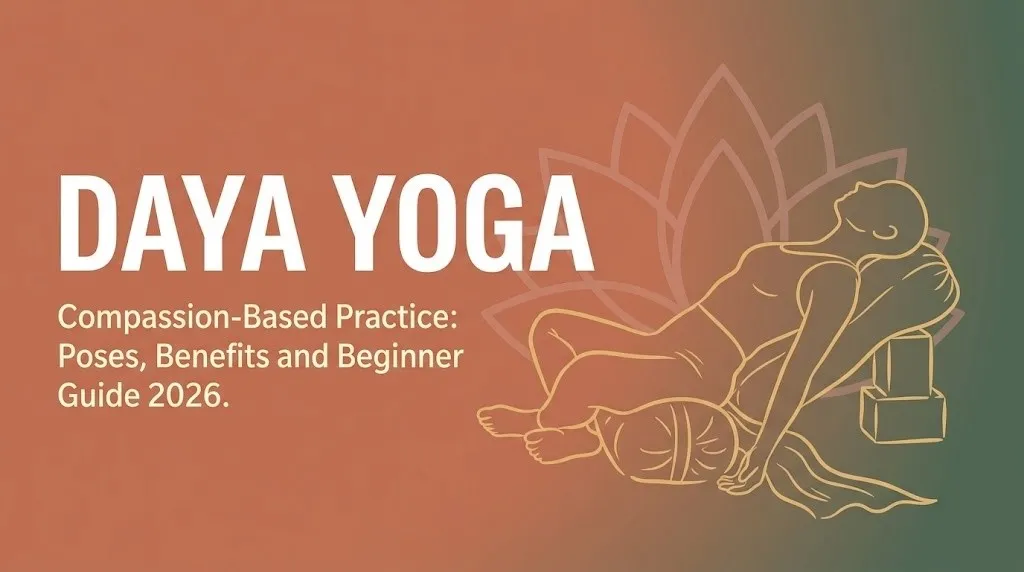
Restorative yoga uses props to support the body completely in passive positions, eliminating the need for muscular effort to maintain a pose. When a bolster holds your spine in a gentle backbend and a blanket supports your arms, your muscles do not need to work. They can release. This is not laziness. It is a specific physiological state that demands surrender rather than effort.
That surrender is where the compassion practice lives in its most concentrated form. Lying supported in a bolstered Supta Baddha Konasana (Reclined Bound Angle Pose) for ten minutes requires you to stay with yourself without doing anything to fix, change, or improve your experience. That is daya. It is the practice of being present with yourself as you are, not as you intend to become.
According to Complementary Therapies in Medicine, restorative yoga practiced for 8 weeks significantly reduced perceived stress and improved sleep quality in a sample of healthcare workers. The format’s passive, supported nature appears to allow a deeper nervous system reset than active yoga formats produce within the same time frame.
Restorative yoga for a daya practice at home requires only basic props:
- A yoga mat for foundation
- Two to three blankets for prop building and warmth
- One bolster or two tightly rolled blankets as a substitute
- Two blocks for height adjustment in seated and semi-reclined positions
- An eye pillow or folded cloth to cover the eyes in final relaxation
The wall is also a free and endlessly adjustable prop. Viparita Karani (Legs-Up-the-Wall Pose) requires nothing but a wall and a folded blanket under the hips. It is one of the most therapeutically effective positions in restorative yoga and costs nothing to access.
Modification for people who find stillness difficult: If lying still in restorative positions triggers restlessness or anxiety, begin with 3-minute holds and extend gradually over several weeks. Add a blanket for warmth and weight, which provides tactile grounding for a restless nervous system.
Frequently Asked Questions About Daya Yoga
What does daya mean in yoga?
Daya is a Sanskrit word meaning compassion, kindness, and mercy, and in yoga philosophy it refers to the practice of extending genuine care toward all beings, including oneself.
It appears in classical yoga texts as an ethical virtue alongside ahimsa (non-harming) and karuna (compassion in response to suffering).
On the yoga mat, daya means choosing poses and approaches that treat the body as worthy of support, not as an obstacle to be overcome.
Is daya yoga the same as restorative yoga?
Daya yoga is not the same as restorative yoga, though the two share core values and restorative formats are often used within a daya yoga framework.
Restorative yoga is a specific physical format using props to create fully supported passive poses. Daya yoga is a philosophical orientation that can be applied to restorative, gentle Hatha, Yin, or any other format.
Think of daya as the attitude and restorative yoga as one of its most natural physical expressions.
How do I bring compassion into my yoga practice?
Bring compassion into your practice by taking modifications before you feel strain rather than after, and by treating every moment of rest as a valid and complete choice.
Notice when you judge your body for what it cannot do. Replace that judgment with a question: “What does this part of my body actually need right now?”
Using props proactively and staying in restorative positions longer than feels comfortable are two of the most concrete daya practices on the mat.
Can daya yoga help with anxiety and stress?
Yes. Daya yoga reduces anxiety through slow breath regulation, vagal nerve stimulation in supported poses, and the deliberate practice of responding to discomfort with curiosity rather than avoidance.
A 2019 study in the Journal of Alternative and Complementary Medicine found that twice-weekly yoga practice for 8 weeks measurably reduced anxiety scores in adults with elevated baseline anxiety.
The compassion framework adds a specific layer: it trains the practitioner to stop treating anxious sensations as emergencies, which itself reduces the anxiety feedback loop.
What yoga poses are best for a daya or compassion-based practice?
The best poses for a daya yoga practice are fully supported, passive positions that invite the body to release rather than perform, particularly Balasana (Child’s Pose), Supta Baddha Konasana (Reclined Bound Angle Pose), Viparita Karani (Legs-Up-the-Wall Pose), Supta Matsyendrasana (Supine Spinal Twist), and Savasana (Corpse Pose).
These poses are chosen not because they are physically simple but because they create the conditions for genuine body acceptance: supported, unhurried, and oriented toward release.
Any of these poses can be made more or less accessible with blocks, blankets, and bolsters to suit any body or experience level.
The Practice Starts With One Pose
The most practical thing you can do today is simpler than any sequence. Lie on your back. Put your legs up the wall in Viparita Karani (Legs-Up-the-Wall Pose). Stay for five minutes. Notice what you feel without changing it.
That is daya yoga. It does not require a studio, a mat, or prior experience. It requires only the decision to treat your body as worthy of rest.
From there, build three sessions per week using the beginner sequence in this guide. Add a bolster or two rolled blankets under your spine in Supta Baddha Konasana (Reclined Bound Angle Pose). Let the props do the work your muscles do not need to do. That exchange is the entire practice.