17 Essential Hatha Yoga Poses for a Grounded Practice
Hatha yoga poses are the physical postures that form the foundation of one of the world’s most grounding and approachable styles of yoga. This practice uses static holds and conscious breathing to build strength, mobility, and a deep connection to the present moment. If you have ever wanted a single clear guide to building your own safe, effective practice, you will find it here.
The reason this matters now, in 2026, is that movement science is catching up with what Hatha practitioners have known for generations. Slow, loaded mobility work and regulated breathing directly signal the parasympathetic nervous system. A 2023 review published in the Journal of Clinical Medicine confirmed that static stretching protocols, a core component of Hatha, demonstrably increase heart rate variability, a key marker of stress resilience and recovery. This is not just stretching. It is a data-backed form of neural training.
You will learn what truly defines a Hatha practice, how to breathe for better results, and the exact sequence of poses that prioritizes your safety. You will find detailed breakdowns for beginners, targeted sequences for seniors and those with back pain, and a clear look at advanced progressions. We will also answer the most common questions that come up before your first class. This is your roadmap to stepping onto the mat with knowledge and confidence.
Hatha Yoga Poses
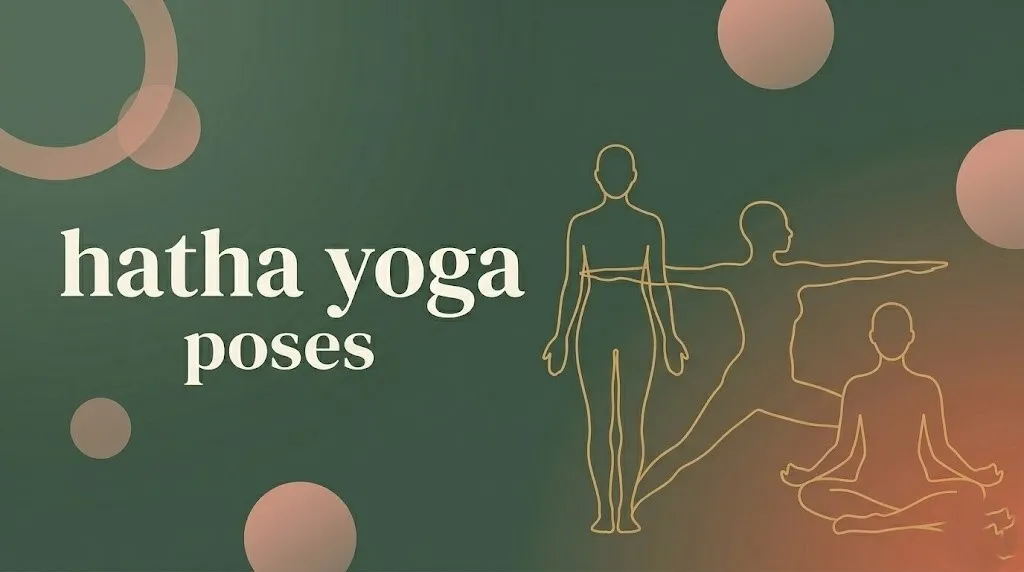
Hatha yoga poses are a collection of physical postures designed to create balance between strength and flexibility while preparing the body for seated meditation. The practice uses isometric muscle engagement, where you hold a position under tension without changing the muscle length, to build stability from the inside out. Unlike faster, more dynamic styles, Hatha asks you to settle into a shape, refine your alignment, and observe your breath.
A hallmark of this approach is the pairing of opposite actions. For a forward fold, you draw the belly in while reaching the heart forward. In a standing balance, you press down firmly through the standing foot while lifting up through the crown of the head. This simultaneous activation and surrender teaches the nervous system to remain calm during effort. The longer holds, often five to ten breath cycles, give your connective tissue time to release safely.
Physiologically, these poses improve proprioception, which is your brain’s ability to sense your body’s position in space. This is not a mysterious concept. It is the reason your balance improves with consistent practice and why you move with more ease. The result is a practice that feels steady, methodical, and deeply rejuvenating rather than exhausting.
Key Takeaway: Hatha yoga poses use long, static holds to build functional strength and body awareness, making the practice a form of active meditation rather than a workout.
Hatha Yoga Asanas
The term hatha yoga asanas refers specifically to the physical postures within the broader Hatha tradition, a system with roots stretching back to the 15th-century text the Hatha Yoga Pradipika. The word “asana” originally meant “seat,” but it now encompasses the full repertoire of standing, seated, and supine poses. Understanding this distinction helps frame the practice correctly: the poses serve the higher goal of a stable, comfortable seat for breathwork and meditation.
In a modern context, asanas are categorized by the movement of the spine and the position of the body in space. The core categories include standing poses for grounding, forward bends for introspection, backbends for front-body opening, twists for detoxification, and inversions for perspective shifts. A well-sequenced Hatha class touches each of these categories to systematically move the spine through its full range of motion. By the end of a session, the body feels fully explored, not overworked.
The biomechanics here are distinct. When you hold an asana, you give the Golgi tendon organs, which are sensory receptors at the junction of muscles and tendons, enough time to signal your muscles to relax. This is the mechanism behind the deep, lasting flexibility that develops through a consistent Hatha practice. It is a slow, safe, and scientifically sound process that cannot be rushed.
| Category | Spinal Action | Example Asana |
|---|---|---|
| Standing Poses | Axial Extension/Grounding | Tadasana, Virabhadrasana II |
| Forward Bends | Flexion | Paschimottanasana, Uttanasana |
| Backbends | Extension | Bhujangasana, Setu Bandha Sarvangasana |
| Twists | Rotation | Ardha Matsyendrasana |
| Inversions | Decompression | Adho Mukha Svanasana |
What Is Hatha Yoga
Hatha Yoga is a branch of yoga that uses physical techniques, namely asana and pranayama, to purify and strengthen the body as a preparation for deeper spiritual practices. In the West, it has evolved to describe a slower-paced class where you hold each pose for several breaths rather than flowing quickly from one to another. This makes it the classic “one-size-fits-most” starting point for a physical yoga practice.
From a teacher’s perspective, Hatha is about energetic architecture. You are not just “doing a stretch.” You are consciously choosing a pose to build heat, then following it with a pose to dissipate heat. You tense a muscle group to make its opposing group relax more deeply, a phenomenon known as reciprocal inhibition. This intentional, intelligent design is what separates a Hatha practice from a random set of stretches.
The mental training is just as significant as the physical. Holding a pose that is moderately challenging forces your mind to confront the urge to fidget and flee. You learn to observe physical sensation without immediately reacting to it. This skill, developed on a sticky mat, becomes a transferable life skill. It is the practice of staying calm in uncomfortable but safe situations, a tool with applications far beyond the yoga room.
Benefits of Hatha Yoga Poses
The benefits of hatha yoga poses extend well beyond simple flexibility, influencing joint health, mental focus, and autonomic nervous system regulation. According to the National Center for Complementary and Integrative Health, yoga is one of the most popular complementary health approaches for managing pain and reducing stress, a claim supported by a growing body of robust clinical research.
For joint health, the controlled, low-impact movement circulates synovial fluid, which nourishes cartilage and keeps joints lubricated. The isometric holds are particularly effective for building the stabilizing muscles around vulnerable joints like the knees and shoulders. Instead of the repetitive impact stress that can occur in running, Hatha builds joint resilience through static, controlled loading. This makes it a sustainable practice for healthspan and longevity.
The mental and emotional payoff is dramatic. A focused Hatha practice lowers cortisol levels by activating the parasympathetic “rest and digest” system. A 2022 meta-analysis in the Journal of Occupational Health found that workplace yoga interventions, predominantly Hatha-based, were associated with a significant reduction in perceived stress and burnout. It is one of the most evidence-backed tools for mental health that also happens to improve your posture.
Key Takeaway: The primary benefits are better parasympathetic tone (a calmer brain-body connection) and stronger, more lubricated joints from long-duration, low-impact holds.
Hatha Yoga Poses for Beginners
Selecting the right hatha yoga poses for beginners is about finding postures that deliver maximum body awareness with minimal risk of injury. The goal at the start is not to achieve the deepest expression of a pose, but to map the pose in your nervous system. You are learning the internal feeling of a straight spine in a forward fold or an open chest in a gentle backbend.
The most effective beginner poses are those that work with gravity. Supine poses, where your spine is fully supported by the floor, allow you to stretch your hamstrings or open your hips without having to also balance your body weight. Standing poses are also foundational because they are functional. They teach you the foot-to-core connection that improves walking gait and posture. Props like blocks and straps are not crutches for beginners; they are tools that build correct motor patterns from day one.
The following three poses are your best starting points. They are high-yield, low-risk, and teach the core principles of alignment and breath that will apply to every other posture you ever learn.
1. Supta Padangusthasana (Reclining Hand-to-Big-Toe Pose)
- Lie on your back with both legs extended.
- Inhale, draw your right knee toward your chest.
- Loop a strap around the arch of your right foot, holding the strap with both hands.
- Exhale, slowly extend your right leg toward the ceiling, keeping a micro-bend in your knee to protect the hamstring insertion.
- Feel a mild sensation in the back of the leg. Hold for 8 to 10 breaths. Switch sides.
2. Bitilasana Marjaryasana (Cat-Cow Pose)
- Start on your hands and knees with shoulders stacked over wrists and hips over knees.
- Inhale, let your belly drop, lift your chest and tailbone toward the ceiling.
- Exhale, press into your hands, round your entire spine up toward the ceiling, drawing your navel in.
- Move slowly and deliberately, syncing each movement to the full length of one breath cycle for one minute.
3. Vrksasana (Tree Pose)
- Stand tall with your feet hip-width apart.
- Shift your weight into your left foot. Place the sole of your right foot against your left inner ankle, calf, or thigh. Avoid placing it directly on the knee joint.
- Bring your hands together at your heart in Anjali Mudra. Fix your gaze on one non-moving point.
- Hold for 5 to 8 steady breaths. Release and switch sides.
Modification: For Vrksasana, if balancing is a challenge, stand with your back against a wall for support. The wall is not a shortcut. It gives your brain the proprioceptive feedback it needs to learn the balance pattern without fear of falling.
Hatha Yoga Breathing
Hatha yoga breathing, or pranayama, is the systematic control of breath that transforms a physical stretch into a complete mind-body practice. It is the element that truly distinguishes Hatha from purely mechanical calisthenics. The breath serves as the bridge between the autonomic nervous system and your conscious awareness. It is the only bodily function that runs automatically but you can also override and control.
The foundational breath technique used in most modern Hatha classes is Ujjayi, often called Ocean Breath. It involves a slight constriction of the glottis, the space at the back of your throat, which creates a soft, oceanic sound on the inhale and exhale. This audible sound serves two key functions. It provides a focal point for the mind that quiets mental chatter. It also creates slight back-pressure in the respiratory system that allows for slower, fuller oxygen exchange in the lungs.
Harvard Health Publishing notes that slow, diaphragmatic breathing in the range of five to seven breaths per minute can significantly lower blood pressure and improve baroreflex sensitivity. This is the precise breathing rate that a well-paced Hatha class naturally cultivates. It is a powerful, low-tech tool for shifting your body from a sympathetic “fight-or-flight” state to a parasympathetic “rest-and-digest” state.
| Breath Technique | Method | Primary Use in Hatha |
|---|---|---|
| Ujjayi (Ocean Breath) | Constrict throat, breathe through nose | Maintains focus, builds internal heat, anchors the mind |
| Dirga (Three-Part Breath) | Breathe into belly, ribs, then upper chest | Calms the nervous system, taught in Savasana or at start of class |
| Nadi Shodhana (Alternate Nostril) | Alternate closing right and left nostrils | Balances the two brain hemispheres, deeply soothing before meditation |
Hatha Yoga Sequence
A hatha yoga sequence is a deliberate, intelligently ordered arrangement of postures designed to warm up the body, safely access deeper poses, and then systematically cool it down. A logical sequence is not a random playlist of stretches. It is a therapeutic progression that respects the architecture of the human body, starting with simple, warm movements and building to a single physiological peak before winding back down.
The opening segment must generate internal heat in the large, dense joints. You start with gentle spinal mobilization like Cat-Cow and slow Sun Salutation variations. This synovial warm-up is non-negotiable. It increases the viscosity of the fluid in your hip and shoulder joints, reducing friction and preparing the body for load. After 5 to 10 minutes, you move into the standing, weight-bearing part of the practice, the true strength-building phase.
The sequence then peaks. This could be a deeper backbend, a longer-held balance, or a challenging hip opener. Everything before this point was preparation. After the peak, the sequence immediately reverses. You counterpose the intense work with gentle neutralizing postures, followed by supine floor work and a long, supported Savasana for nervous system integration. Without this arc, a sequence is just a collection of poses, not a practice.
Key Takeaway: A proper sequence follows a wave: warm-up, build heat, reach a peak, systematically cool down, integrate in stillness. Skipping the cool-down is like running a car engine hot and then never turning it off.
Hatha Yoga Beginner Poses
Hatha yoga beginner poses must prioritize non-weight-bearing joint mobilization and the building of core confidence before moving to complex standing balances. The safe, smart entry point is the floor. When your spine is supported by the ground, your nervous system can relax, and you can focus purely on the targeted muscle action without the added neurological demand of balance.
From the floor, beginners can safely explore hip mobility and spinal articulation. These foundational postures are not “easy” versions of advanced poses. They are the direct biomechanical ancestors. Mastering a bridge pose on your back teaches you the pelvic stability needed for a standing warrior pose. A reclining twist teaches the spinal rotation required for safe, seated twists later on. This stepwise approach builds a durable, pain-free body.
Props are essential learning tools at this stage. A block placed under a hand in a side bend can be the difference between collapsing your torso and achieving an elegant, beneficial spinal curve. The cue is simple: bring the floor up to you instead of collapsing your body toward the floor. This preserves the integrity of the pose while your body learns the correct pattern.
Try this beginner floor sequence:
- Apanasana (Knees-to-Chest Pose): Lie on your back, hug both knees in to release the low back.
- Supta Matsyendrasana (Reclining Spinal Twist): From your back, open your arms into a T, let both knees fall to one side.
- Setu Bandha Sarvangasana (Supported Bridge): On your back, press into your feet, lift your hips, and place a block under your sacrum. Rest here.
Modification: For Reclining Spinal Twist, if the knees do not reach the floor, place a folded blanket or a bolster under your knees. The goal is a gentle spinal rotation, not forcing the knees down. Support the range of motion you have.
Hatha Yoga Class Sequence
A standard 60-minute hatha yoga class sequence offers a complete, well-rounded physical practice that follows a proven, repeatable blueprint. It starts with a brief centering and pranayama practice, typically 2 to 3 minutes of observing the natural breath while seated comfortably. This signals to the mind that the practice has begun, creating a distinct boundary from the rest of your day.
The physical sequence then follows a logical arc: warm-up (5-10 min), standing sequence (20-25 min), a peak floor or balancing sequence (10-15 min), and a cooldown leading to Savasana (10-15 min). The standing sequence often takes the form of a classic flow held at a Hatha pace: Mountain to Forward Fold, Half Lift, step back to Plank, lower, Cobra, push back to Downward-Facing Dog, step forward, rise to Mountain. Each pose is held for three to five breaths, not one per breath.
The final segment is the most important and the most often skipped: Savasana. It is not a “break.” It is an active, conscious relaxation that allows your nervous system to fully integrate the neural and muscular benefits of the practice. The American College of Sports Medicine highlights that a dedicated cool-down is crucial for preventing blood pooling and promoting recovery, a principle directly applied in this final rest. A complete class sequence leaves you feeling more grounded and alert than when you arrived.
| Class Segment | Duration | Objective | Example Content |
|---|---|---|---|
| Centering & Breath | 3-5 min | Shift into a parasympathetic state | Seated Ujjayi, body scan, intention setting |
| Joint Mobilization | 5-7 min | Lubricate joints, warm the spine | Cat-Cow, pelvic tilts, neck rolls, wrist circles |
| Main Practice | 30-35 min | Build strength, mobility, and focus | Standing poses, balances, a peak backbend or hip opener |
| Cooldown & Surrender | 10-12 min | Counterpose, quiet the nervous system | Supine twists, Happy Baby, Supported Bridge |
| Final Rest (Savasana) | 5-8 min | Integrate practice, induce deep rest | Complete physical stillness with guided mental relaxation |
Beginner Hatha Yoga Poses
The best beginner hatha yoga poses are those that are both accessible and highly educational, teaching the fundamental principles that advanced postures are built upon. You want poses that provide clear, immediate feedback. If you are rounding your back, a good teacher’s cue should make it immediately obvious, allowing you to self-correct. This builds an internal library of good form that you can access in any class.
Standing forward folds like Uttanasana are perfect for learning the concept of spinal lengthening under the weight of gravity. Warrior II, Virabhadrasana II, is the masterclass in shoulder and hip stabilization. It is a wide-angle, externally rotated stance that demands you engage your back leg’s glute and quadriceps while keeping your front leg’s knee tracking over the ankle. These are big, clear actions that leave no room for ambiguity.
Another key beginner pose is the lunge. A low, static lunge teaches hip flexor release, a critical need for anyone who sits at a desk. The longer you hold a lunge in a Hatha practice, the more the psoas muscle has a chance to release its habitual grip. You learn to relax a muscle that is chronically tight, a skill of immense value.
Key Takeaway: The most valuable beginner poses are not the simplest shapes but the clearest teachers. They are poses that make correct alignment feel obvious, not confusing.
Hatha Yoga Positions
Hatha yoga positions is a term often used interchangeably with poses, but the word “positions” usefully shifts the focus to the exact geometry of the body in space. It brings attention to the precise placement of hands, feet, and the angle of the spine. This precision is what protects your joints and ensures the right muscles are doing the work.
Consider the position of your pelvis in any seated or standing pose. If the pelvis is in a posterior tilt, the lower back rounds. If it is in an anterior tilt, the back overarches. A neutral pelvic position is the key to a healthy spine. This is why Hatha teachers spend so much time on verbal cues for the “sit bones.” Finding a clean, stable position of the pelvis is the single most important structural task in most poses.
Similarly, the position of your shoulder blades matters enormously in arm-bearing positions. In Plank or Downward Dog, a common error is letting the shoulder blades wing out or collapsing the chest toward the floor. The correct position involves protraction, pressing the floor away to spread the shoulder blades. This engages the serratus anterior muscle and creates a stable, protected shoulder girdle. The “position” is the protection.
Pose Tip:
- In any standing pose, always check the position of your front knee. It must point in the same direction as your second and third toes.
- The correct foot position grounds the entire kinetic chain up through the knee, hip, and into the spine. Misalignment at the ankle creates strain at the lumbar spine.
- Beginners should always look down at their feet in a balance pose first to visually establish the correct foot position before shifting their gaze.
Hatha Yoga Flow Sequence
A hatha yoga flow sequence bridges the gap between a fully static Hatha hold and the one-breath-per-movement rhythm of a Vinyasa class. It links three to five poses together on the thread of the breath, but holds each pose for a full, slow exhale before moving to the next inhale-driven shape. This is sometimes called a “slow flow” and is a superior way to build heat while still preserving the meditative, grounding quality of Hatha.
The classic Sun Salutation A, or Surya Namaskar A, performed at a Hatha pace, is the ultimate flow sequence. Instead of a dynamic jump-back, you mindfully step one foot back at a time, then lower one knee at a time. The full sequence becomes a moving meditation. You are not rushing to finish. You are exploring the transition between Mountain Pose and Forward Fold, feeling the distribution of weight in your feet change with every inch of movement.
This technique is exceptional for training interoception, or your ability to perceive internal body signals. Moving slowly through a flow sequence gives your brain the time it needs to integrate sensory information from your joints and muscles. For people who feel disconnected from their bodies or struggle with chronic tension, a slow Hatha flow can be a more powerful tool for reconnection than a seated meditation.
Key Takeaway: A Hatha flow sequence uses the structure of linked poses to create a moving meditation by holding each transition, not by rushing through them.
Yoga Hatha Poses
The phrase yoga hatha poses simply reinforces the specific style of practice we are building, one defined by its moderate pace and intense focus on alignment. It is the “how” of the physical practice as much as the “what.” Two people can both do the exact same pose, say Warrior I, but one does it with a Hatha approach and the other with a Vinyasa approach.
The Hatha practitioner in Warrior I spends the first breath simply settling into the shape. They press down through the outer edge of the back foot, square their hips toward the front of the mat, and lift their ribcage away from their front hip. They hold this active engagement for five slow breaths, making micro-adjustments all the while. The Vinyasa practitioner may reach the shape on an inhale and immediately exhale to the next pose.
This difference in method changes the physical result. The Hatha hold builds significantly more isometric strength and teaches the muscle fibers to fire more efficiently in a fixed position. For someone rehabbing an injury, a Hatha approach to a pose is always safer than a dynamic approach because it reduces the momentum that can cause overstretching. The “how” is the entire point.
Hatha Yoga for Seniors
Hatha yoga for seniors is one of the most research-backed, effective forms of exercise for maintaining functional independence, improving balance, and reducing fall risk. The practice can be fully adapted by using props like sturdy chairs, bolsters, and wall space for support. No one is “too old” or “too stiff” to begin; the practice simply meets the body where it is.
A primary focus for seniors should be on hip extension and thoracic spine mobility. These two movement patterns are the ones most severely lost with age and a more sedentary lifestyle. Gentle lunges with a chair for support restore hip extension, which is critical for a healthy walking gait. Seated twists and side bends maintain the flexibility of the ribcage, which directly supports deeper, easier breathing.
Balance training is another pillar. According to a study published in the Journal of Alternative and Complementary Medicine, a 12-week Hatha yoga program for older adults resulted in significant improvements in the Berg Balance Scale, a clinical measure of static and dynamic balance. Poses like a modified Tree Pose with one hand on a wall are simple, safe, and remarkably effective for training proprioception and preventing falls.
Top 3 Senior-Safe Hatha Poses:
- Chair Virabhadrasana II (Seated Warrior II): Sit sideways on a sturdy, armless chair. Extend one leg straight out to the side. The bent knee’s leg stays in line with the hip. This opens the inner thighs and hips with zero balance risk.
- Wall-Assisted Tadasana (Mountain Pose): Stand with your back touching a wall from your heels to the back of your head. This retrains the neutral spine alignment and powerfully activates the postural muscles.
- Supported Supta Baddha Konasana (Reclining Bound Angle): Lie back on a bolster placed lengthwise from your sacrum to your head. Let the soles of your feet touch and knees fall open. This is a passive, restorative chest and hip opener.
Advanced Hatha Yoga Poses
Advanced hatha yoga poses are defined not by their visual complexity but by the practitioner’s refined internal awareness and control during a long, steady hold. Progressing in your practice means taking a familiar pose and adding a layer of difficulty, not by contorting, but by deepening the engagement and lengthening the hold time.
One method of progression is to remove your base of support. Taking a pose you know on your mat, like a low lunge, and practicing it on a firm, flat surface like a bare floor can instantly change your stability. Another is to close your eyes. Performing a simple Tree Pose with eyes closed forces your brain to rely solely on internal proprioceptive signals from your foot and ankle, dramatically increasing the balance challenge.
Longer hold times are the most authentic Hatha progression. Holding a basic pose like Plank Pose for two to three minutes, instead of 30 seconds, transforms it from a muscular endurance drill into a test of mental fortitude and full-body integrative strength. This is where the deep somatic and neural adaptations occur. The goal is not to perform an exotic new pose. The goal is to find a new depth in a foundational one.
Key Takeaway: Advanced Hatha is measured by your ability to hold a basic pose with impeccable, steady alignment for one, two, or three minutes, not by how contorted the shape is.
Hatha Yoga vs Vinyasa
Hatha yoga vs Vinyasa is a comparison between two distinct approaches to the same physical postures. The primary technical difference is pace and the relationship to the breath. In a Hatha class, one pose is held for multiple breath cycles, typically 3 to 10, and the practitioner enters, refines, holds, and then exits the pose before moving to the next one.
Vinyasa, by contrast, synchronizes one breath with one movement. Each inhale or exhale is a specific instruction: “Inhale, arms up. Exhale, fold forward.” The practice flows without long pauses. This makes Vinyasa more cardiovascular and aerobic. Hatha, on the other hand, is a more anaerobic, strength-building, and neuromuscular-training-focused practice. One is not better than the other, but they serve vastly different physiological and psychological purposes.
For someone managing high cortisol and stress, Hatha is often the superior choice. It taps into the parasympathetic nervous system directly and does not risk elevating cortisol through intensity. For someone seeking a “yoga workout” to build a sweat and elevate their heart rate, a Vinyasa class is more appropriate. A 2022 study in the International Journal of Yoga found that while both improved mood, Hatha practice had a more immediate and pronounced effect on state anxiety reduction compared to a brisk Vinyasa flow.
| Attribute | Hatha Yoga | Vinyasa Yoga |
|---|---|---|
| Primary Focus | Isometric strength, joint stability, nervous system down-regulation | Cardiovascular health, muscular endurance, coordination |
| Pace/Tempo | Slow, static holds; 3-10 breaths per pose | Continuous, dynamic flow; 1 breath per movement |
| Intensity | Mild to moderate; more mentally intense | Moderate to high; physically demanding |
| Best For | Beginners, stress relief, rehab, seniors, focus on alignment | Weight loss goals, athletes, building heat, variety-seekers |
Hatha Yoga Poses for Back Pain
A targeted sequence of hatha yoga poses for back pain can be as effective as physical therapy for chronic, non-specific low back pain. The key is not just stretching the back, but strengthening the supporting muscles like the glutes and core, and releasing the muscles that pull on the pelvis, primarily the hip flexors and hamstrings.
The psoas major, a deep hip flexor that attaches to the lumbar spine, is a prime suspect in many cases of chronic low back pain. When it is tight, it pulls the lumbar spine into excessive extension (an anterior pelvic tilt), compressing the facet joints. A supported, long-held lunge with the back knee down is one of the most therapeutic poses for gently lengthening this muscle. This directly reduces the tug on the spine.
A landmark 2017 study in the Annals of Internal Medicine found that a yoga program was non-inferior to physical therapy for reducing pain and improving function in predominantly low-income, diverse adults with chronic low back pain. The findings suggested that yoga is a reasonable, evidence-based alternative to standard medical care for this condition. The Hatha approach, with its slow pace and emphasis on form, is the ideal delivery method for these therapeutic sequences.
Therapeutic Sequence for a Sensitive Back:
- Supta Padangusthasana (Reclining Hand-to-Big-Toe): Lying on your back with a strap, this pose releases the hamstrings without any compressive load on the spine.
- Apanasana (Knees-to-Chest): Gently massages the low back muscles and promotes a posterior pelvic tilt.
- Anjaneyasana (Low Lunge) with blocks: Place blocks under both hands for support. Focus on sinking the hips forward to stretch the psoas without letting the front knee travel past the ankle.
- Setu Bandha Sarvangasana (Supported Bridge): Strengthens the glutes and hamstrings, the muscles needed to support the low back. Hold for 1-2 minutes.
Contraindication: Avoid deep forward bends like full Paschimottanasana during an acute disc-related flare-up, as spinal flexion can aggravate certain disc conditions. A qualified yoga therapist can help determine which movements are right for your specific diagnosis.
Frequently Asked Questions About Hatha Yoga Poses
What are the 12 basic asanas in hatha yoga?
A classic list of 12 basic asanas often includes Sirsasana (Headstand), Sarvangasana (Shoulderstand), Halasana (Plow), Matsyasana (Fish), Paschimottanasana (Seated Forward Bend), Bhujangasana (Cobra), Salabhasana (Locust), Dhanurasana (Bow), Ardha Matsyendrasana (Spinal Twist), Mayurasana (Peacock), Padahastasana (Hand to Foot), and Trikonasana (Triangle).
However, for most modern beginners, a safer list substitutes the risky inversions with foundational poses like Downward Dog and Warrior II until sufficient strength and instruction are in place.
The “basic 12” is a historical goal, not a starting point.
How long should you hold a hatha yoga pose?
Most Hatha teachers recommend holding poses for 5 to 10 slow, even breaths, which translates to roughly 30 seconds to 2 minutes.
Longer holds, from 2 to 5 minutes, are more characteristic of Yin or Restorative yoga, though a Hatha practice may include 2-minute holds for deep hip openers.
A shorter 3-breath hold is better for building a neuromuscular connection to a new, complex pose.
Is hatha yoga good for weight loss?
Hatha yoga contributes to weight loss indirectly, primarily through building lean muscle mass and reducing cortisol, a stress hormone linked to belly fat storage.
A practice with long holds of standing poses builds more isometric muscular endurance than many people expect, which increases your basal metabolic rate over time.
However, if your primary goal is rapid weight loss, pairing Hatha yoga 2-3 times per week with more aerobic activity like walking or a Vinyasa practice will yield the fastest results.
Can I practice hatha yoga at home by myself?
Yes, a home practice is one of the most effective ways to build a consistent Hatha yoga habit, and it was how the practice was traditionally done for centuries.
Start with a short, 20-minute sequence of 6-8 poses you know well and feel confident performing safely, such as Cat-Cow, Downward Dog, Warrior II, and Reclining Twist.
Record yourself with your phone to check your alignment against the cues you’ve learned, as without a teacher’s eye, self-feedback is essential.
What is the hardest hatha yoga pose for beginners?
Surprisingly, the hardest pose for most beginners is not an extreme backbend, but Tadasana (Mountain Pose) because it requires a level of full-body active awareness that is easy to mistake for just standing.
Other mentally difficult beginner poses are the ones that require a long, quiet hold without distraction, like seated forward folds, where the mind wants to fidget more than the hamstrings want to stretch.
A pose is hard not because of its shape, but because it forces you to confront your mental restlessness.
Your practice does not need to look like the photos you see online. The most profound benefits of Hatha yoga come from consistent, patient work in a few key poses, not from a sprawling library of shapes you cycle through once a month. The sequence and principles you have here are your entire kit.
Start with the 15-minute beginner floor sequence three times this week. Use your props to build the correct architecture from day one. Pay more attention to the sound and depth of your Ujjayi breath than the depth of your forward fold. If you do this, you will have built the foundation for a lifelong, independent, and pain-free practice. The mat is there whenever you need it.