SUP Yoga: Beginner’s Guide to Paddle Board Yoga 2026
SUP yoga is the practice of performing yoga poses on a stand-up paddleboard floating on water. It combines the balance demands of paddleboarding with the strength, flexibility, and breathwork of traditional yoga to create a practice that challenges your body in ways a studio floor simply cannot.
Interest in outdoor and water-based fitness practices has grown steadily since 2020. According to the National Center for Complementary and Integrative Health (NCCIH), yoga participation among American adults has increased substantially over the past decade, with outdoor and non-traditional settings becoming increasingly common entry points for new practitioners.
This guide covers everything you need to start paddle board yoga safely and confidently. You’ll find the best beginner poses, board setup advice, what to wear, how to handle falling in, and what research says about why this practice works as well as it does.
What Is SUP Yoga?
SUP yoga is yoga practiced on a stand-up paddleboard, typically anchored in calm water such as a lake, bay, or gentle river. The board acts as both your mat and your platform, floating beneath you while you move through poses, breathe, and hold positions.
The acronym SUP stands for stand-up paddleboarding. In a typical SUP yoga class, participants paddle out to an anchored location, secure their boards, and practice a sequence of yoga poses on the water’s surface. The board’s constant micro-movement adds a proprioceptive challenge that is entirely absent on a studio floor.
SUP yoga is not a recognized style of classical yoga in the way that Hatha, Vinyasa, or Iyengar are. Think of it as an application: you are using yoga poses, breathwork, and sequencing principles within an outdoor, water-based environment. Most SUP yoga classes draw from Hatha or Vinyasa frameworks, moving at a pace that allows for balance adjustments on the water.
The practice first appeared in Hawaii in the early 2000s and spread globally through the 2010s. It is now taught on every continent where warm-weather water access allows.
| Feature | Land Yoga | SUP Yoga |
|---|---|---|
| Surface | Stable mat or floor | Floating inflatable or solid board |
| Balance demand | Moderate | High; board moves with water |
| Core engagement | Active throughout | Constant, involuntary stabilization |
| Environment | Indoor or outdoor studio | Open water, lake, bay, or pool |
| Accessibility for beginners | High | Moderate with proper board setup |
SUP Yoga Benefits: What Your Body and Mind Gain
Paddle board yoga delivers the recognized benefits of a land yoga practice while adding unique physical demands that target your balance, deep core, and neuromuscular system simultaneously. That combination is one reason many practitioners find it more physically demanding than it looks from the shore.
The core benefits fall into two categories: those shared with all yoga forms, and those specific to the unstable water surface. Both matter.
Benefits shared with yoga broadly include improved flexibility, better posture, reduced stress markers, and enhanced breath awareness. The National Center for Complementary and Integrative Health (NCCIH) notes that yoga has been studied for its effects on stress, anxiety, low back pain, and general well-being, with many trials showing positive outcomes across these areas.
Benefits that are specific to the water environment include heightened proprioceptive demand (your nervous system constantly recalibrating balance), increased transverse abdominis and multifidus activation (your deepest core stabilizers), and a documented mood-lifting effect associated with time spent near and on open water, which researchers sometimes call the “blue mind” effect.
Key benefits of SUP yoga include:
- Improved core stability through constant balance recalibration on an unstable surface
- Enhanced ankle and hip joint proprioception, which supports fall prevention in daily life
- Full-body muscle engagement, particularly the gluteus medius, tibialis anterior, and deep spinal muscles
- Reduced psychological stress associated with outdoor, nature-based movement
- Greater pose awareness because sloppy alignment causes the board to wobble immediately as feedback
- Cardiovascular demand slightly higher than land yoga due to the stabilization effort
Modification note: People with active inner ear disorders or vestibular conditions should check with a vestibular physical therapist before attempting SUP yoga. The moving water surface can intensify symptoms of vertigo or dizziness.
SUP Yoga vs. Land Yoga: What Is Actually Different?
The primary difference between SUP yoga and land yoga is the instability of the surface beneath you, which fundamentally changes how your muscular and nervous systems have to work to maintain any position. On land, your mat is fixed. On water, the board responds to your every shift in weight, your breath, and even the ripples created by nearby boats or wind.
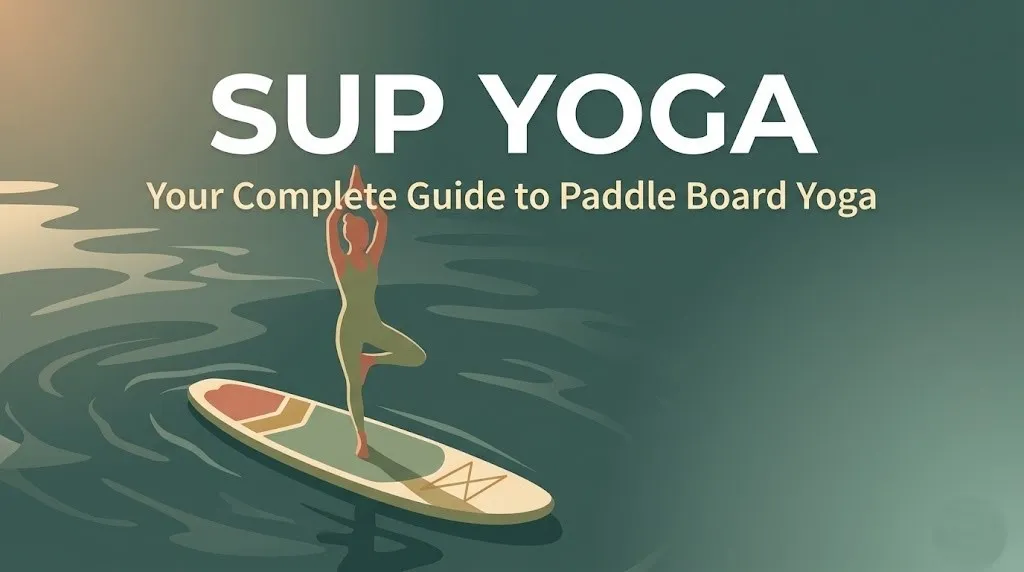
This changes yoga in ways that surprise first-timers. Poses that feel effortless on a studio mat can feel genuinely demanding on water. Vrikshasana (Tree Pose) on a paddleboard requires constant micro-adjustments from the ankle through the hip. Adho Mukha Svanasana (Downward-Facing Dog) on water requires your wrists and shoulders to absorb subtle shifting in all three planes of motion.
The mental experience differs too. Land yoga in a studio can be inward and meditative from the start. SUP yoga demands a focused, present-moment attention to your body’s relationship to the board. Many practitioners describe it as “forced mindfulness.” You cannot zone out. The water will let you know immediately.
| Factor | Land Yoga | SUP Yoga |
|---|---|---|
| Pose difficulty | Varies by style | Elevated for all levels due to surface |
| Focus required | Moderate to high | Very high; constant surface adjustment |
| Core demand | Style-dependent | Always high |
| Feedback mechanism | Teacher or mirror | Board wobble is immediate feedback |
| Weather dependency | None | Significant; wind and waves matter |
| Equipment cost | Mat, blocks, strap | Board, leash, PFD, anchor |
Key Takeaway: SUP yoga is not easier than land yoga. It is a distinct physical challenge that makes familiar poses harder while adding unique benefits that a studio floor cannot provide.
Best Yoga Poses for a Paddleboard
The best yoga poses for a paddleboard are those with a wide, low base of support, clear bilateral symmetry, and manageable weight distribution across the board’s centerline. High inversions, deep backbends, and asymmetrical standing poses with narrow bases are the most challenging and should be attempted only after solid board confidence.
For most practitioners, these poses build a reliable SUP yoga foundation:
- Balasana (Child’s Pose): Kneeling, hips back, arms forward or alongside the body. Low center of gravity. Excellent starting and resting pose.
- Marjaryasana-Bitilasana (Cat-Cow): On hands and knees along the board’s centerline. Gentle spinal wave. Warms the back without destabilizing.
- Adho Mukha Svanasana (Downward-Facing Dog): Hands and feet shoulder-hip-width apart, hips lifted. Board wobble is most felt through the wrists and shoulders here.
- Virabhadrasana I (Warrior I): Standing lunge with arms overhead. Face perpendicular to the board’s length for best stability.
- Vrikshasana (Tree Pose): Never place the lifted foot directly against the standing knee. Position it above or below the joint. Keep drishti (gaze point) fixed on a distant, non-moving object.
- Navasana (Boat Pose): Seated, knees bent, torso angled back, arms forward. A strong core pose with manageable board interaction.
- Savasana (Corpse Pose): Lying flat, arms slightly away from the body, eyes closed. One of the most unique and powerful SUP yoga experiences. The gentle rocking of the water becomes a somatic rest tool.
Safety note for all standing poses: Keep your feet parallel to the board’s stringer (the centerline). Feet placed sideways across the board significantly reduce your lateral stability.
Pose Tip:
- On your first session, practice every pose from your knees before attempting it standing
- Fix your drishti on a stationary point on shore during all balance poses
- Sit down between poses if the board wobbles more than 10 to 15 degrees
Beginner Paddleboard Yoga Sequence Step by Step
A solid beginner paddleboard yoga sequence starts low to the board, builds confidence through ground-level poses, and only introduces standing work after your body has adjusted to the water’s movement. Rushing to standing poses in the first ten minutes is the most common beginner mistake.
This 30-minute sequence is appropriate for first or second sessions on the water:
To practice this beginner SUP yoga sequence:
- Paddle to your anchored location. Drop anchor or have a guide secure the board. Sit cross-legged at the board’s center and take 10 slow Ujjayi breaths (victorious breath: slight throat constriction on the exhale, audible breath rhythm).
- Move to hands and knees. Check that your hands align with your shoulders and your knees align with your hips. Perform 8 rounds of Marjaryasana-Bitilasana (Cat-Cow), coordinating movement with breath.
- Press back into Balasana (Child’s Pose) for 5 breaths. Rest your forehead on the board surface or on stacked hands.
- Walk hands forward to Adho Mukha Svanasana (Downward-Facing Dog). Hold for 5 breaths. Bend your knees generously if your hamstrings are tight. Notice the board’s response to your weight shifts.
- Lower to the board, flip to your back. Perform Setu Bandha Sarvangasana (Bridge Pose): feet flat, knees bent, press hips upward. Hold for 5 breaths, lower slowly. Repeat twice.
- Come to seated for Navasana (Boat Pose): knees bent, lean back slightly, arms forward. Hold for 3 breaths. Rest. Repeat twice.
- Rise to kneeling. Shift weight to your feet and slowly stand. Practice Utkatasana (Chair Pose) first: feet hip-width apart, knees bent, arms forward. This low, wide stance is the safest entry to standing work on water.
- From Chair Pose, slowly straighten to standing. Attempt Vrikshasana (Tree Pose) on your dominant-balance side first. Hold for 3 to 5 breaths per side.
- Close with Savasana (Corpse Pose): lie flat for 3 to 5 minutes. Let the water movement do the work.
Modification for beginners with limited balance: Stay in kneeling or seated variations for your first two sessions. There is no rush to stand. The board gives you honest feedback about when your core and ankles are ready.
SUP Yoga as a Core Workout: What the Science Says
SUP yoga is a legitimate core workout because practicing yoga on an unstable surface requires continuous, involuntary activation of the deepest abdominal and spinal muscles, specifically the transverse abdominis, multifidus, and obliques, throughout every pose. This is not the same as deliberately “engaging your core” in a Pilates class. The water forces it.
Research on unstable surface training broadly supports this. A study published in the Journal of Strength and Conditioning Research found that performing exercises on unstable surfaces increased activation of the transverse abdominis and internal obliques compared to the same movements on stable ground. While that specific study examined exercise movements rather than yoga poses, the underlying neuromuscular mechanism is the same.
Think of it this way: the board beneath you behaves like a very large, very slow balance board. Every weight shift, every breath that moves your ribcage, every arm extension sends a subtle tipping signal to your legs and spine. Your stabilizer muscles respond before your conscious mind can issue the instruction. That automatic, rapid-fire stabilization is the core workout.
The practical implication is that SUP yoga works muscles that most gym routines and even land yoga practices do not reliably target. The multifidus, for example, is a small spinal muscle that plays a large role in lumbar stability and is frequently undertrained in people with low back pain.
| Core Muscle | Role in SUP Yoga | Why It Matters |
|---|---|---|
| Transverse abdominis | Compresses and stabilizes spine | Foundation of all safe spinal loading |
| Multifidus | Controls vertebral micro-movement | Critical for low back health |
| Internal and external obliques | Manages rotation and lateral balance | Engaged by every lateral weight shift on the board |
| Gluteus medius | Stabilizes hip and pelvis during single-leg poses | Prevents hip drop in standing poses |
| Tibialis anterior | Controls ankle dorsiflexion and balance | First line of balance response to board tilt |
Key Takeaway: SUP yoga trains the deep stabilizing muscles of the spine and hips through involuntary activation, a mechanism that neither land yoga nor most gym workouts can replicate on a consistent basis.
SUP Yoga for Balance: How an Unstable Surface Trains Your Nervous System
SUP yoga improves balance by repeatedly challenging your proprioceptive system, the network of sensory receptors in your joints, muscles, and skin that tells your brain where your body is in space, forcing rapid, automatic recalibration with every movement. This is why the effects of regular SUP yoga practice often transfer to improved balance in daily life.
Balance is not a fixed physical trait. It is a trainable neuromuscular skill. Your brain learns balance by practicing balance, and it learns most quickly when the challenge is just at the edge of your current capacity. A stable yoga mat rarely provides that edge. A paddleboard on water does, naturally and continuously.
According to the American College of Sports Medicine (ACSM), proprioceptive training on unstable surfaces is a recognized method for improving functional balance and reducing fall risk, particularly in older adults. SUP yoga delivers this training through an enjoyable and complete physical practice rather than isolated balance drills.
The specific mechanisms involved:
- Ankle and foot receptors fire rapidly in response to board tilt, improving ankle proprioception over time
- The vestibular system (inner ear balance apparatus) is continuously engaged by the water’s micro-movement
- Visual fixation, or the practice of drishti (steady gaze point), trains the visual contribution to balance independently of the moving water surface
- Repeated practice builds what physical therapists call “righting reactions”: faster, more automatic responses to unexpected balance challenges
Modification for people with documented balance disorders: Remain seated or kneeling for all SUP yoga practice if you have a diagnosed vestibular condition, moderate to severe peripheral neuropathy, or a history of falls. Seated SUP yoga still delivers meaningful proprioceptive training for the spine and hips without the fall risk of standing poses on water.
How to Set Up Your Paddleboard for Yoga
The correct setup for paddleboard yoga centers everything on the board’s centerline, removes the paddle from underfoot, and uses an anchor or tie-off to prevent drift during your practice. Without these three steps, your session will feel unstable and frustrating regardless of your yoga skill level.
To set up your paddleboard for yoga:
- Check the traction pad (the textured grip surface on the deck). For yoga, the pad should cover most of the board’s center section. Many yoga-specific boards have full-deck traction. If your board’s pad is only in the rear third, bring a thin non-slip mat that fits within the board’s width.
- Secure your leash to your ankle before entering the water. In SUP yoga, where you will be lying down or inverting, a coiled leash attached to the ankle is less hazardous than a straight leash.
- Drop a sand anchor or tie off to a dock, buoy, or anchor line. Practicing yoga on a board that is drifting is significantly more difficult and potentially dangerous. Anchoring is not optional for focused yoga practice.
- Place your paddle flat beneath the bungee cord storage at the front of the board or secure it horizontally across the nose. Never leave it loose underfoot.
- Check wind conditions before you start. A light breeze of under 10 mph is manageable. Anything above 15 mph will make balance poses genuinely unsafe for most practitioners.
- Wear your personal flotation device (PFD) in any open water where currents, boat traffic, or depth require it. In many jurisdictions, this is legally required for paddleboard users.
Tip: Kneel when paddling out to your practice spot. Standing on the board before you anchor it wastes energy and increases fall risk before your practice even begins.
Best Board for SUP Yoga: Width, Length, and Volume Explained
The best board for SUP yoga is a wide, stable inflatable or solid epoxy board with a full-deck traction pad, ideally measuring at least 32 inches wide, 10 to 11 feet long, and carrying a volume of 200 to 300 liters. Width is the single most important factor. A board that is too narrow will tip continuously and make practice miserable.
Most standard paddleboards are 28 to 31 inches wide, which is adequate for paddling but borderline for yoga. Yoga-specific boards range from 32 to 36 inches wide, with some purpose-built boards reaching 38 inches. That extra width creates a dramatically more stable platform for kneeling, lying, and standing poses.
| Board Spec | Minimum for SUP Yoga | Ideal for SUP Yoga | Notes |
|---|---|---|---|
| Width | 31 inches | 33 to 36 inches | Wider is more stable for yoga |
| Length | 10 feet | 10 to 11 feet | Longer boards track better |
| Volume | 180 liters | 200 to 300 liters | Higher volume supports more weight |
| Construction | Solid epoxy or inflatable | Quality inflatable with drop-stitch core | Inflatable is softer for kneeling |
| Traction pad | Partial rear pad | Full-deck grip pad | Essential for bare feet in all poses |
| Fin setup | Single center fin | Single or 2+1 fin setup | Single fin tracks well; reduces drag |
Inflatable vs. solid board for yoga: Most yoga practitioners prefer inflatable SUP boards. They are softer on knees and joints during kneeling poses, they deflate for transport and storage, and quality drop-stitch inflatables are rigid enough to perform well on water. A fully inflated quality inflatable board (15 PSI and above) should not feel spongy underfoot.
For rental: When renting for your first SUP yoga class, specifically request the widest board available. Do not accept a narrow touring or racing board regardless of what else is available.
Key Takeaway: Board width is the single most important factor for SUP yoga stability. A board under 31 inches wide will fight you in every pose. Spend the extra money or ask specifically for a wider rental.
What to Wear for SUP Yoga
For SUP yoga, wear form-fitting athletic clothing that stays in place when wet, dries quickly, and does not create loose fabric that can catch on the board or interfere with your view of your own alignment. Assume you will get wet. Plan accordingly.
Loose yoga pants are a poor choice for SUP yoga. Wide-leg pants fill with water when you fall in and drag against the board surface. Leggings, board shorts, rash guards, and fitted bikini tops are the most functional choices.
What to wear for SUP yoga:
- Bottom: High-waisted fitted leggings or board shorts. Leggings with a grip waistband are ideal; they stay in place through inversions.
- Top: A fitted rash guard or athletic tank with built-in support. Loose tops slide forward in Adho Mukha Svanasana (Downward-Facing Dog) and obstruct your view of the board.
- Footwear: Bare feet are standard and preferred for grip and sensory connection to the traction pad. Thin water shoes or neoprene socks are acceptable in cold water or on rough surfaces.
- Sun protection: A lightweight long-sleeve rash guard protects against reflected sunlight on water. Apply water-resistant sunscreen to all exposed skin at least 20 minutes before launching.
- Hair: Secure long hair. Loose hair falls across your face in Adho Mukha Svanasana (Downward-Facing Dog) and during Savasana (Corpse Pose) when you are lying flat.
Cold water note: In water temperatures below 60°F (15°C), a wetsuit is appropriate. Hypothermia risk from repeated falls in cold water is real. Water temperature matters more than air temperature.
SUP Yoga Safety Tips Every Practitioner Needs
The most important SUP yoga safety principle is this: the water is your environment, not your obstacle, and every decision you make before and during practice should account for the real possibility of entering it unexpectedly. Treating falls as a normal and manageable part of the practice, rather than a failure, is the foundation of safe SUP yoga.
Beyond that core mindset shift, these safety standards apply to every session:
- Check conditions before launching. Water current speed, wind, visibility, and boat traffic all change the risk profile of your session.
- Never practice alone in open water. A partner on the water or a clearly visible observer on shore is required at all times.
- Wear your leash always. If you fall and your board drifts away, the leash is the only thing keeping you connected to your flotation device.
- Know how to fall. Fall flat and wide, away from the board’s hard edges. Do not dive headfirst into unknown water depth.
- Avoid practicing in moving water. Rivers with current, tidal channels, and water near boat launch areas are not appropriate SUP yoga settings.
- Skip inversions near other boards. Poses that invert your head, such as a modified Adho Mukha Svanasana (Downward-Facing Dog) with feet elevated, reduce your spatial awareness significantly on water.
According to the American College of Sports Medicine (ACSM), outdoor water activities require awareness of environmental conditions that change rapidly. Always have an exit plan if weather deteriorates.
Who should not practice SUP yoga without medical guidance: People with uncontrolled epilepsy, those who have experienced a recent concussion, anyone with active inner ear disorders causing unpredictable vertigo, and people who cannot swim independently should obtain clearance from a qualified medical professional before practicing in open water.
Falling Off Your Paddleboard During Yoga
Falling off your paddleboard during yoga is not a failure; it is an expected and frequent part of the practice, and knowing how to fall and recover safely is a skill you should practice deliberately before your first full yoga session. Most injuries associated with paddleboard yoga come not from falling but from falling awkwardly onto the board’s edge or into unknown-depth water.
The safe fall technique:
- When you feel the tipping point, do not grab the board with your hands.
- Push yourself away from the board’s edge with your feet.
- Aim to enter the water flat and wide, like a controlled starfish rather than a pencil dive.
- Keep your arms slightly raised to protect wrists during water entry.
- Surface, grab the board’s handle or side rail (not the nose or tail), and kick your way back onto the board from the side.
Getting back on the board:
- Position yourself at the center of the board’s side, at the carry handle.
- Place both hands flat on the deck, kick your legs up behind you to the water’s surface.
- Use a hip-kick to slide your body onto the board in one motion, landing on your stomach.
- Pause in this prone position to stabilize before kneeling or standing.
Modification for those anxious about falling: In your first session, practice the falling-and-returning sequence deliberately in shallow, warm water before beginning any yoga poses. Removing the fear of the fall removes the tension that actually causes most falls.
Key Takeaway: Learning to fall and re-board confidently is a non-negotiable part of SUP yoga preparation. Practice it deliberately before your first session so the experience does not interrupt or frighten you mid-practice.
SUP Yoga for Seniors: Adaptations and Safety Considerations
SUP yoga can be a genuinely beneficial practice for older adults when adapted correctly, specifically by prioritizing seated and kneeling poses, choosing the widest available board, and practicing in calm, shallow, supervised water. The balance training benefits of an unstable water surface are particularly relevant to fall prevention, which is a documented priority for adults over 65.
The NCCIH notes that yoga practice in older adults has been associated with improvements in balance, flexibility, and self-reported quality of life in multiple clinical reviews. The unstable surface of a paddleboard can enhance these balance benefits, provided the practice is appropriately modified.
Practical adaptations for senior SUP yoga practitioners:
- Stay seated or kneeling for all poses in the first several sessions, or indefinitely if standing on water creates anxiety or excessive wobble
- Practice Marjaryasana-Bitilasana (Cat-Cow) on hands and knees to maintain spinal mobility without balance risk
- Use Navasana (Boat Pose) with the knees bent and feet flat on the board rather than the classic V-shape leg extension
- Setu Bandha Sarvangasana (Bridge Pose) lying on the board is accessible and strengthens the gluteus maximus, hamstrings, and lumbar spine with no balance risk
- Paschimottanasana (Seated Forward Fold) is an excellent seated option that stretches the hamstrings and lower back from a stable seated position
- Replace Savasana (Corpse Pose) with a supported recline: knees bent, feet flat, arms resting. This reduces the disorientation some older adults feel when fully supine on moving water
Who should consult a medical professional before attempting SUP yoga: Adults over 65 with a documented history of falls, anyone using medications that affect balance or blood pressure, and those with osteoporosis or significant joint replacement history should receive guidance from a physical therapist or sports medicine physician before practicing on open water.
SUP Yoga Mental Health Benefits: What Research Indicates
SUP yoga supports mental health through two overlapping pathways: the well-documented psychological benefits of yoga practice itself, and the separate mood-regulating effects of spending time on and near open water. Research on each pathway individually is substantial, and the combination appears to amplify both.
A study published in the Journal of Alternative and Complementary Medicine found that yoga practice was associated with reduced perceived stress and lower cortisol levels in healthy adults after an 8-week program. While this research was conducted in studio settings, the physiological stress response is the mechanism being addressed, not the location.
The water component adds something the studio cannot. Research in environmental psychology, including work cited in Complementary Therapies in Medicine, supports what marine biologist Wallace J. Nichols popularized as the “blue mind” concept: proximity to water tends to lower cognitive arousal, reduce rumination, and increase feelings of calm and perspective. The mechanisms are not fully understood but involve both sensory engagement and reduced sympathetic nervous system activation.
For SUP yoga practitioners specifically, the mental health pathway includes:
- The mandatory present-moment focus required to balance on water, which functions similarly to structured mindfulness practice
- Breathwork such as Ujjayi breath and Nadi Shodhana (alternate nostril breathing), both of which directly activate the parasympathetic nervous system
- The aesthetic and sensory experience of practicing yoga surrounded by sky, water, and natural light
- The social element of group SUP yoga classes, which the NCCIH identifies as a contributing factor in yoga’s anxiety-reducing effects
Modification note: For individuals managing clinical anxiety or depression, SUP yoga is best used as a complement to, not a replacement for, evidence-based treatment. Movement in natural environments can be a meaningful part of a broader care plan.
SUP Yoga Instructor Certification: What to Look For
A qualified SUP yoga instructor should hold both a registered yoga teacher credential from a Yoga Alliance-recognized school and a water safety certification relevant to the environment where they teach. Neither qualification alone is sufficient. Yoga expertise without water safety knowledge creates risk. Water safety certification without yoga expertise creates poor instruction.
Yoga Alliance is the primary global body for yoga teacher credentialing. Their RYT 200 (Registered Yoga Teacher, 200 hours) and RYT 500 designations indicate a minimum standard of training in yoga philosophy, anatomy, sequencing, and teaching methodology. Look for an instructor whose credential is listed in Yoga Alliance’s public registry.
Water safety requirements vary by location and setting. At minimum, a SUP yoga instructor should hold a current CPR and first aid certification and should have completed a recognized paddleboard safety course or open-water lifeguard training. Some certifying bodies, such as the World Paddle Association (WPA) and Paddle Canada, offer water-specific SUP instructor credentials that complement yoga training.
What to look for when choosing a SUP yoga class or instructor:
- RYT 200 or higher credential listed in the Yoga Alliance public registry
- Demonstrated experience teaching on water specifically (ask how many SUP yoga classes they have taught, not just attended)
- Pre-class safety briefing that includes fall technique, board return, weather policy, and emergency procedures
- Maximum class size of 8 to 12 students per instructor on open water
- Availability of different board widths to accommodate different body sizes and experience levels
- A policy on participant swimming ability and conditions for cancellation
Caution: Online or weekend SUP yoga “certifications” that require no prior yoga training or water safety qualification should be approached with skepticism. Teaching yoga on water without foundational training in both domains creates unacceptable risk for students.
Key Takeaway: When choosing a SUP yoga class, ask to see your instructor’s Yoga Alliance registration number and their water safety credential. Both matter equally. Neither is optional.
Frequently Asked Questions About SUP Yoga
Is SUP yoga good for beginners with no paddleboarding experience?
Yes, SUP yoga is accessible to beginners who have no paddleboarding experience, provided they start on a wide, stable board in calm, supervised water with a qualified instructor. Most first-timers are surprised to find that yoga experience is a bigger advantage than paddleboarding experience in a first SUP yoga session. Starting with kneeling and seated poses removes nearly all of the instability concern until your confidence on the water builds naturally.
What size paddleboard do I need for yoga?
For yoga, a board should be at least 32 inches wide, 10 to 11 feet long, and have a volume of 200 liters or more. Width is the most important specification: a wider board creates a dramatically more stable platform for kneeling, seated, and standing yoga poses. Yoga-specific SUP boards are made in widths up to 36 to 38 inches and are worth requesting or renting specifically for this use.
How hard is it to do yoga on a paddleboard?
SUP yoga is more physically demanding than land yoga for most practitioners because the unstable water surface requires constant balance adjustment throughout every pose. Familiar poses feel different and more effortful on water, particularly Vrikshasana (Tree Pose), Adho Mukha Svanasana (Downward-Facing Dog), and any single-leg standing variation. Starting with seated and kneeling poses and progressing to standing only after board confidence develops makes the learning curve genuinely manageable.
Can you do SUP yoga if you can’t swim?
Practicing SUP yoga in open water without the ability to swim is not recommended by most qualified SUP yoga instructors or water safety organizations. A personal flotation device (PFD) reduces but does not eliminate drowning risk, particularly if you are disoriented after an unexpected fall into cold water. If you are a non-swimmer who wants to try SUP yoga, start in a supervised pool environment with a lifeguard present and a board tethered to the pool wall.
What are the best SUP yoga poses to start with?
The best starting poses for SUP yoga are those performed close to the board’s surface: Balasana (Child’s Pose), Marjaryasana-Bitilasana (Cat-Cow), Adho Mukha Svanasana (Downward-Facing Dog), and Savasana (Corpse Pose). These poses keep your center of gravity low, distribute your weight across a wide area of the board, and give you the most forgiving margin for balance adjustments. Add standing poses like Utkatasana (Chair Pose) and Vrikshasana (Tree Pose) only after spending at least 20 minutes in ground-level and kneeling poses on the water.
Start Where You Are, Right Now
The best thing about paddle board yoga is that it meets you exactly where your body is today. You do not need to be an experienced yogi. You do not need to be a strong paddler. You need a stable board, calm water, and the willingness to fall in and climb back on.
Start with one session in a guided class. Spend the first 20 minutes on your knees. Notice what the water teaches you about your own balance, your own breath, and where your attention wanders. That feedback is immediate, honest, and unlike anything a studio floor can offer.
Come back three times. By the third session, the wobble that felt alarming in session one will feel like information. That shift is the practice working.