Find Restorative Yoga Near Me: Benefits & Guide 2026
Finding restorative yoga near me means finding a class where the practice is the exact opposite of pushing harder. Restorative yoga uses fully supported, long-held poses to activate your body’s rest-and-digest system, the parasympathetic nervous system, and it is one of the most accessible and research-supported yoga styles available in 2026.
The National Center for Complementary and Integrative Health notes that yoga practices emphasizing relaxation and breathwork show measurable reductions in psychological stress and improvements in cardiovascular markers. Restorative yoga is the style most specifically designed to produce those outcomes.
This guide covers what restorative yoga is, how it differs from Yin and Hatha, which poses you’ll practice, how to use props, who benefits most, and how to find a quality class locally or online, including what to look for at studios like Crave Yoga in Mountain View, California.
What Is Restorative Yoga?
Restorative yoga is a style of yoga that uses props to fully support the body in passive poses held for 5 to 20 minutes each, with the goal of activating the parasympathetic nervous system rather than building strength or flexibility.
The practice traces its roots to Iyengar yoga and the work of yoga teacher and Yoga Journal editor Judith Lasater, who developed restorative yoga from B.K.S. Iyengar’s prop-supported approach to asana. Where Iyengar used props to achieve precise alignment, Lasater used them to achieve complete muscular release. That shift in intention is what defines restorative yoga to this day.
A typical class includes only four to six poses in a 60 to 90-minute session. That’s not a typo. You hold Supta Baddha Konasana (Reclined Bound Angle Pose) for eight minutes. You hold Viparita Karani (Legs-Up-the-Wall Pose) for ten. The stillness is the practice.
The Cleveland Clinic describes restorative yoga as a practice designed to give the body a period of complete mental and physical relaxation, distinct from any yoga style that requires muscular engagement or aerobic effort.
Key characteristics of restorative yoga:
- 4 to 6 poses per session, each held 5 to 20 minutes
- All poses are fully supported by props: bolsters, blankets, blocks, straps, eye pillows
- No active muscular engagement required
- Focus is on breath awareness and nervous system regulation
- Appropriate for nearly all bodies, including those with injury, illness, or chronic fatigue
Modification note: Even “fully supported” poses require careful prop setup. If you’re new, tell your teacher before class. They will help you arrange props so the position feels genuinely comfortable, not just approximately correct.
Restorative Yoga vs Yin Yoga
Restorative yoga and Yin yoga are often confused, but they have different physical targets and different physiological goals. Restorative yoga targets the nervous system. Yin yoga targets fascia and connective tissue.
In a Yin class, you hold passive floor poses for 3 to 7 minutes with the intention of applying mild stress to the fascia, ligaments, and joint capsules around the hips, spine, and knees. Think of your hip flexors like a bungee cord held shortened all day. Yin gently pulls that cord longer over time. There is sensation. Sometimes significant sensation.
Restorative yoga does not pursue sensation. The body should feel neutral to deeply comfortable at all times. If you feel a stretch in restorative yoga, you probably need more props under the relevant joint.
| Feature | Restorative Yoga | Yin Yoga |
|---|---|---|
| Primary target | Parasympathetic nervous system | Fascia, connective tissue |
| Sensation goal | None, full comfort | Mild to moderate stretch |
| Hold duration | 5 to 20 minutes | 3 to 7 minutes |
| Prop use | Heavy, body fully supported | Light to moderate |
| Muscular engagement | Zero | Zero (but tissue is stressed) |
| Best for | Stress, burnout, illness, sleep | Joint mobility, flexibility |
| Suitable for acute injury | Generally yes | Generally no |
Both styles are yin-based practices, meaning they are passive and floor-based, as opposed to active yang styles like Vinyasa or Ashtanga. But they serve different needs on different days. A student with chronic fatigue needs restorative. A student with hip tightness from prolonged sitting may benefit more from Yin.
Modification note: If you have osteoporosis, spinal disc issues, or recent hip surgery, speak with a physical therapist before practicing Yin yoga. Restorative yoga is generally the safer starting point for these conditions.
Restorative Yoga Benefits
Restorative yoga produces several well-documented physical and psychological benefits when practiced regularly, primarily through the activation of the rest-and-digest response and the reduction of cortisol.
The most direct benefit is nervous system regulation. When the body is held in a comfortable, supported position with slow, diaphragmatic breathing for an extended period, the sympathetic nervous system (fight-or-flight) down-regulates and the parasympathetic nervous system (rest-and-digest) activates. This shifts blood flow toward the digestive organs, lowers heart rate, and reduces circulating stress hormones.
Research published in Complementary Therapies in Medicine found that regular yoga practice that emphasizes relaxation postures and breathwork produced statistically significant decreases in depression, negative affect, and anxiety, with effects maintained at a two-month follow-up period.
Documented benefits include:
- Reduced cortisol levels, the primary stress hormone
- Improved heart rate variability, a key marker of cardiovascular and nervous system health
- Better sleep quality, particularly falling asleep and reducing nighttime waking
- Reduced anxiety and depressive symptoms, supported by multiple clinical trials
- Improved cognitive flexibility, with one study showing restorative practitioners scored better on cognitive sorting tasks than non-yoga control groups
- Relief from physical tension in the thoracic spine, neck, and hip flexors
- Improved immune function through chronic stress reduction
Modification note: Benefits are most consistent with sessions of at least 45 minutes, practiced two or more times per week. Shorter or less frequent sessions can still offer acute stress relief but produce fewer long-term systemic changes.
Key Takeaway: Restorative yoga isn’t “just stretching.” It’s a nervous system intervention that produces measurable reductions in stress hormones and anxiety markers, and the research supporting these effects is considerably more specific than most yoga class descriptions suggest.
Restorative Yoga for Stress and Anxiety
Restorative yoga is one of the most effective yoga styles for stress and anxiety because it directly targets the body’s stress response system, not just its surface tension.
Stress exists in the nervous system before it appears in the muscles. When cortisol is chronically elevated, the body maintains a baseline of readiness: heart rate stays slightly elevated, digestion is suppressed, sleep is fragmented. Restorative yoga interrupts this cycle not by relaxing individual muscles but by shifting the entire autonomic nervous system out of sympathetic dominance.
The National Center for Complementary and Integrative Health confirms that yoga practices incorporating relaxation and breath techniques show improvements in physical and psychological stress measures across multiple well-designed studies.
The mechanism is diaphragmatic breathing in a fully supported body position. When the body is horizontal, warm, and still, and the breath is slow and abdominal, the vagus nerve receives signals that reduce the sympathetic tone system-wide. This is why restorative yoga works even when people feel too tired or wired to do anything active.
Specific poses most effective for anxiety include:
- Viparita Karani (Legs-Up-the-Wall Pose): reversal of gravitational blood flow, direct vagal stimulation
- Supta Baddha Konasana (Reclined Bound Angle Pose): chest and hip opening, diaphragmatic breathing space
- Savasana (Corpse Pose) with eye pillow: sensory reduction supports deep parasympathetic activation
Modification note: For people with significant anxiety, the silence and stillness of restorative yoga can feel initially uncomfortable rather than calming. This is normal and passes with practice. Starting with a guided class, where the teacher offers gentle verbal cues throughout, typically eases the transition.
Restorative Yoga for Sleep
Restorative yoga improves sleep by reducing cortisol and activating the parasympathetic nervous system in the evening hours, preparing the body physiologically for sleep onset.
Poor sleep and chronic stress are linked by the same hormonal pathway: elevated cortisol in the evening suppresses melatonin production and keeps the sympathetic nervous system engaged past bedtime. A 60-minute restorative yoga session in the late afternoon or early evening interrupts this cascade.
Harvard T.H. Chan School of Public Health research on mind-body practices indicates that regular relaxation-focused yoga practitioners report improvements in sleep onset latency (the time it takes to fall asleep) and fewer nighttime awakenings.
The most effective evening restorative sequence for sleep typically includes:
- Viparita Karani (Legs-Up-the-Wall Pose), 10 minutes, with a bolster under the hips
- Supta Baddha Konasana (Reclined Bound Angle Pose), 8 minutes, with blocks under both knees
- Supta Matsyendrasana (Supine Spinal Twist), 5 minutes per side, with a bolster between the knees
- Savasana (Corpse Pose), 10 minutes, with an eye pillow and blanket over the body
The room should be dim. Phone notifications should be off. Even one full cycle of this sequence, practiced 60 to 90 minutes before bed, reduces the activation level that prevents sleep onset.
Modification note: Those with gastroesophageal reflux should avoid a fully flat Savasana. Elevating the upper body with a bolster or folded blankets under the thoracic spine provides a comfortable alternative.
Restorative Yoga for Back Pain
Restorative yoga reduces back pain primarily by releasing the lumbar erectors, psoas, and thoracic paraspinals through long-hold passive positions that bypass the muscular guarding response.
Acute pain causes muscles to guard. The body tightens around an injured area to protect it, but this guarding eventually creates secondary tension that outlasts the original injury. Standard stretching can’t fully release guarded muscles because active stretching triggers the same protective response. Restorative yoga, by contrast, eliminates the need for muscular effort entirely.
According to the National Center for Complementary and Integrative Health, yoga practices designed for relaxation have shown consistent benefit for chronic low back pain in multiple randomized controlled trials, with effects comparable to physical therapy for non-specific low back pain.
The best-supported restorative poses for back pain include:
- Setu Bandha Sarvangasana (Supported Bridge Pose): places a block or bolster under the sacrum, gently decompressing lumbar vertebrae
- Supta Matsyendrasana (Supine Spinal Twist): releases thoracic and lumbar rotation restrictions without compressing discs
- Supported Balasana (Child’s Pose) with a bolster under the torso: tractioning the lumbar spine passively
Safety note: People with acute disc herniation, spinal stenosis, or recent spinal surgery should work with both a physical therapist and a yoga teacher trained in therapeutic yoga before attending general restorative classes. Not all poses are appropriate for all back conditions, and a qualified teacher will ask about your history before suggesting modifications.
Key Takeaway: Restorative yoga works for back pain by bypassing muscular guarding, not by forcing the tissue to release. This is why it succeeds where active stretching fails, especially for people who have had chronic tension for months or years.
Restorative Yoga Poses for Beginners
The core poses of restorative yoga are accessible for complete beginners because they require no prior flexibility, strength, or coordination. What they do require is correct prop setup.
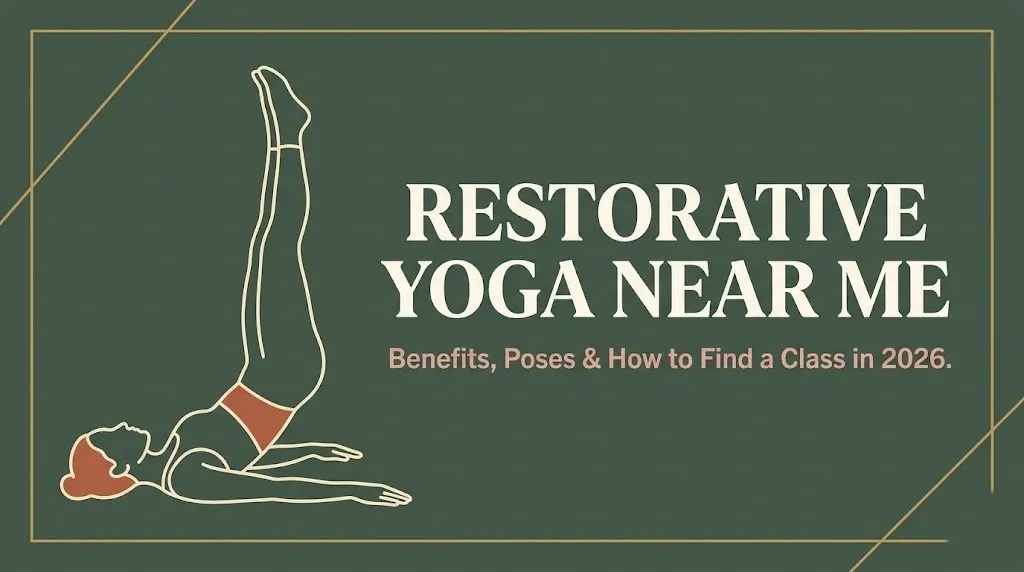
Supta Baddha Konasana (Reclined Bound Angle Pose) is the foundational pose of restorative yoga. It opens the inner thighs, groin, and chest while the entire back rests on the floor or a bolster. Primary muscles involved: adductors (inner thighs), psoas, hip external rotators. Joints involved: hip joints, sacroiliac joint, knee joints.
To practice Supta Baddha Konasana:
- Sit upright on your mat with a bolster or folded blankets behind you.
- Bring the soles of your feet together, letting your knees fall open to each side.
- Place a yoga block or folded blanket under each knee. The inner thigh sensation should be minimal to absent.
- Slowly lower your back onto the bolster. Your spine should be fully supported from tailbone to head.
- Rest your arms at your sides, palms facing up. Close your eyes.
- Breathe slowly into your belly. Hold for 5 to 10 minutes.
- To release: press the soles of your feet to the floor, let your knees come together, roll to one side, and pause before sitting up.
For Viparita Karani (Legs-Up-the-Wall Pose):
- Sit sideways with your hip as close to the wall as comfortable.
- Swing both legs up the wall as you lower your torso to the floor.
- Slide a folded blanket or thin bolster under your hips to gently elevate the pelvis.
- Rest your arms at your sides, close your eyes, and breathe slowly.
- Hold for 8 to 12 minutes.
- To release: bend your knees, slide your feet down the wall, roll to one side.
Modification note: If your hamstrings feel strained in Viparita Karani, move your hips a few inches away from the wall to reduce the stretch angle.
How to Set Up Restorative Yoga Props
Getting your props set up correctly before a restorative pose is 90% of the practice. A poorly supported body cannot release. A well-supported body releases almost automatically.
The standard prop kit for restorative yoga includes:
- Bolster: a firm, rectangular or round cushion for supporting the spine, hips, or knees
- Yoga blocks: two or more, used under knees, hips, or hands
- Yoga blankets: folded for height adjustments or spread over the body for warmth
- Yoga strap: for poses involving leg extension
- Eye pillow: gently weighs on the eyes to deepen parasympathetic activation
You do not need to buy all of these before your first class. Studios provide them. For home practice, substitute freely: a firm sofa cushion works as a bolster, folded towels work as blankets, thick books can serve as blocks.
| Prop | Purpose | Home Alternative |
|---|---|---|
| Bolster | Spine and hip support | Firm sofa cushion or rolled blanket |
| Yoga block | Knee and hip height support | Thick hardcover books, stacked |
| Yoga blanket | Temperature regulation, height | Folded beach towel |
| Yoga strap | Leg extension in lying poses | Necktie or dog leash |
| Eye pillow | Sensory reduction | Folded face cloth |
The most common mistake in self-guided restorative practice is using too-soft props. A bolster should be firm enough to support the spine without sinking. A pillow is not a bolster. If the prop sinks under your weight, the position collapses and the body remains engaged rather than releasing.
Modification note: For seniors or those with limited floor mobility, several restorative poses can be adapted to a chair or low bed. A blanket folded over a chair seat, with the legs extended and resting on a second chair, approximates the spinal release of Viparita Karani without floor transitions.
Key Takeaway: The props are not optional accessories in restorative yoga. They are the mechanism. A bolster placed under the spine is what tells the nervous system the body is safe to let go.
Restorative Yoga Sequence at Home
A complete at-home restorative sequence takes 45 to 60 minutes and covers the major areas where tension accumulates: the hips, lumbar spine, thoracic spine, and hip flexors.
Before starting, gather your props, dim the lights, set a timer for each pose, and place your phone across the room. The setup takes five minutes and makes the practice possible.
Full beginner home sequence:
- Supported Balasana (Child’s Pose), 5 minutes: Kneel with a bolster lengthwise between your thighs. Lower your torso onto the bolster. Arms forward or alongside the body.
- Setu Bandha Sarvangasana (Supported Bridge Pose), 8 minutes: Lie on your back with knees bent. Lift hips and slide a block on its lowest height under the sacrum. Lower hips onto the block. Arms rest at sides.
- Supta Baddha Konasana (Reclined Bound Angle Pose), 8 minutes: As described in the previous section. Add a bolster under the spine for greater chest opening.
- Supta Matsyendrasana (Supine Spinal Twist), 5 minutes per side: Lie on your back, draw the right knee to the chest, guide it across the body to the left. Place a bolster or blanket under the right knee if it doesn’t reach the floor comfortably. Left arm extends out. Repeat on the other side.
- Viparita Karani (Legs-Up-the-Wall Pose), 10 minutes: As described above.
- Savasana (Corpse Pose), 10 minutes: Lie flat, legs slightly apart, arms away from the body, palms up. Blanket over the body. Eye pillow on the eyes. Let the floor hold you completely.
Modification note: If any pose creates discomfort in the low back, add more support beneath that area rather than pushing through. Restorative yoga should never cause pain.
Restorative Yoga for Seniors
Restorative yoga is particularly well-suited for seniors because it asks nothing of the body that the body cannot give. No balance challenges, no weight-bearing transitions, no aerobic demand.
The primary barriers for older adults entering yoga, fear of falling, joint discomfort, and the belief that flexibility is a prerequisite, do not apply to restorative yoga. Every pose is floor-based and fully supported. Transitions between poses are slow and deliberate. Most restorative sessions are conducted in a quieter, more spacious environment than active yoga classes.
The Journal of Alternative and Complementary Medicine has documented that yoga practices emphasizing gentle movement and relaxation improve functional flexibility, reported pain levels, and quality of life in adults over 60, with effects comparable to supervised stretching programs.
For seniors specifically, the most beneficial restorative modifications include:
- Chair-adapted Viparita Karani: legs elevated on a chair seat while seated in another chair, supporting venous return without floor transitions
- Bolstered Savasana: a blanket roll under the knees to relieve low back compression
- Wall-supported Supta Baddha Konasana: performed on a firm surface with extra blanket padding under the knees and hips
Safety note: Seniors with severe osteoporosis should avoid forward fold positions that load the thoracic spine under compression. A yoga teacher with senior yoga or therapeutic yoga certification, credentialed through Yoga Alliance as an E-RYT with relevant specialty training, is the best guide for individually adapted practice.
What to Expect in Your First Restorative Yoga Class
Your first restorative yoga class will likely feel unfamiliar for the first 10 to 15 minutes, and then genuinely unlike anything else.
You will arrive to a room that is usually warmer and quieter than a standard yoga class. There are no mirrors. The lights are dim or off. Bolsters, blocks, and blankets are stacked along the walls or pre-arranged in stations. Your teacher will spend several minutes helping every student set up props before each pose begins. This is normal and expected. It is not wasted time.
Once you settle into your first pose, the most common experience is noticing every uncomfortable sensation in your body that ordinary movement masks: a tight hip, a restless mind, a low-level hum of tension in the neck. This is the practice working, not failing.
What to bring to your first class:
- Comfortable clothing you could sleep in: leggings, soft trousers, a long-sleeved layer
- Warm socks (feet cool quickly in still poses)
- Water (you won’t need much, but having it helps)
- An open attitude toward doing nothing
What the teacher will provide:
- All necessary props: bolsters, blocks, blankets, straps, eye pillows
- Setup guidance for each pose
- Verbal breath cues throughout holds
- Adjustments offered with your consent
Modification note: It is completely appropriate to ask your teacher before class if any poses can be adapted for a specific condition or injury. Good restorative teachers welcome this conversation. It is a sign of genuine expertise, not inconvenience.
Key Takeaway: The first restorative class often feels strange because you’re not used to doing nothing in a group setting. By the third class, most people report it feels like the most productive hour of their week.
How to Find a Good Restorative Yoga Studio
Finding a quality restorative yoga class requires knowing what separates genuinely skilled restorative instruction from a standard class that moves slowly.
Three markers of a well-run restorative class:
First, the teacher spends time on prop setup. A good restorative class spends five to ten minutes arranging each pose before it begins. If your teacher moves through setup in under two minutes and doesn’t adjust individual students, the class is likely not truly restorative.
Second, the instructor has specific training in restorative yoga or therapeutic yoga, not just a general 200-hour certification. Look for credentials like E-RYT (Experienced Registered Yoga Teacher through Yoga Alliance), a specialty certification in restorative yoga, or training with a named lineage such as Judith Lasater’s Relax and Renew method.
Third, the class has a maximum of 12 to 15 students. Restorative teaching requires individual attention. Large restorative classes of 20 or more students often can’t deliver the prop adjustment quality the practice requires.
How to search locally:
- Search the Mindbody or ClassPass app for “restorative yoga” filtered to your city, read instructor bios for credentials
- Call studios directly and ask whether their restorative teacher has specialty training
- Look for studios affiliated with Yoga Alliance’s 300-hour or specialty therapeutic programs
What to ask before your first class:
- How many props are provided?
- How many students are in the class?
- What is the teacher’s specific training in restorative yoga?
Modification note: If no qualified in-person restorative class is available near you, online options from platforms like YogaWorks or Down Under School of Yoga provide credentialed instruction accessible from any location.
Crave Yoga Restorative Classes
Crave Yoga is a modern yoga studio in Mountain View, California, in the heart of Silicon Valley, offering restorative yoga alongside Vinyasa, Yin, prenatal yoga, sound healing, and meditation. It was founded in December 2021 by Helena McLoughlin, a yoga and fitness teacher with over 20 years of experience on the San Francisco Peninsula.
Crave Yoga’s restorative instruction is led by Evangeline Ventura, a California board-certified physical therapist in outpatient orthopedics since 2002, who completed her 200-hour teacher training through Avalon Yoga. Her class combines traditional restorative asana with Yin principles and functional physical therapy rehabilitation exercises. For students managing orthopedic conditions alongside a yoga practice, this combination of PT expertise and restorative training is genuinely unusual.
The studio also offers hot stone restorative classes, yin-restorative blend sessions, seasonal sound bath and restorative workshops, and corporate wellness programs. Its community mission includes support for The Art of Yoga Project, a nonprofit providing yoga and mindfulness to marginalized youth in the Bay Area.
Studio highlights include:
- Weekly restorative and Yin classes, Vinyasa, Power, Bhakti Flow, and more
- Free guided meditation and Reiki healing classes on Mondays at 6:45pm
- 14-day unlimited intro offer for new students
- Monthly workshops including seasonal yin and restorative events
- Retreats and private event bookings for individuals and corporate groups
- Shower and bathroom facilities, indoor bicycle storage, and proximity to Caltrain at Castro Street Station
Modification note: Crave Yoga welcomes all experience levels explicitly. If you are a beginner attending your first restorative class, tell the front desk when you arrive. Teachers at studios with this level of specialty training are well-equipped to help you set up correctly.
How Often Should You Practice Restorative Yoga?
Restorative yoga can be practiced safely every day, but most teachers and researchers recommend two to three sessions per week for consistent nervous system and stress management benefits.
ClassPass and yogaworks both note that restorative yoga is low-impact enough for daily use without recovery concerns. The body is not being stressed, loaded, or fatigued in restorative practice. There is no muscular breakdown requiring repair. The limiting factor is time, not physical recovery.
That said, frequency alone doesn’t determine outcomes. A restorative practice of 45 to 60 minutes, practiced twice weekly, produces more benefit than a 20-minute session practiced daily, because the nervous system needs sustained time in a parasympathetic state to fully shift its baseline.
General frequency recommendations by goal:
| Goal | Recommended Frequency | Minimum Session Length |
|---|---|---|
| Acute stress relief | 1 to 2 times per week | 45 minutes |
| Chronic anxiety or insomnia | 3 to 4 times per week | 45 to 60 minutes |
| Back pain management | 2 to 3 times per week | 45 minutes |
| General maintenance | 1 to 2 times per week | 45 minutes |
| Athletic recovery | Day after intense training | 30 to 45 minutes |
Research published in the International Journal of Yoga found that yoga practices with a relaxation emphasis showed benefits beginning within 4 to 8 weeks of consistent practice. Occasional one-off sessions provide temporary relief but do not produce the longer-term autonomic and hormonal adaptations that regular practice builds.
Modification note: If you can only commit to one class per week, make it longer rather than shorter. A single 75-minute restorative session per week produces more cumulative benefit than three 20-minute sessions.
Key Takeaway: Twice a week, 45 to 60 minutes each session, is the sweet spot for most people to see measurable benefits from restorative yoga within 6 to 8 weeks of starting.
Frequently Asked Questions About Restorative Yoga Near Me
What is the difference between restorative yoga and yin yoga?
Restorative yoga targets the parasympathetic nervous system and aims for complete comfort with no sensation. Yin yoga targets fascia and connective tissue and involves mild to moderate sustained stretch. Both are passive and floor-based, but restorative yoga uses heavy prop support to eliminate effort, while Yin uses lighter support and accepts sensation as part of the work.
How long do you hold poses in a restorative yoga class?
Restorative yoga poses are typically held for 5 to 20 minutes each. A 60-minute class may include only four to six poses total. The long hold times are what create the parasympathetic response; shorter holds do not produce the same nervous system effect.
Is restorative yoga good for beginners?
Yes, restorative yoga is one of the most beginner-friendly styles because it requires no strength, flexibility, or prior yoga experience. The only prerequisite is the ability to lie still for extended periods, and even that becomes easier with practice and proper prop support. Beginners should tell their teacher they are new so prop setup can be fully guided before each pose.
What props do I need for restorative yoga at home?
The core props are a bolster (or a firm sofa cushion), two yoga blocks (or thick hardcover books), and two folded blankets. An eye pillow and yoga strap are helpful additions but not required for a complete beginner sequence. Studios always provide all props, so you do not need to purchase anything before attending your first class.
How often should I do restorative yoga to see results?
Two to three times per week, in sessions of 45 to 60 minutes, produces consistent stress-reduction and sleep benefits within 4 to 8 weeks. A single well-structured session can provide immediate relief from acute stress, but sustained changes to cortisol levels and nervous system baseline require regular practice over weeks. If once per week is your realistic frequency, make sessions longer, at least 60 to 75 minutes, to compensate for the reduced frequency.
Start with one of the poses from this guide tonight. Lie down on your mat, stack two books where a block would go, place your legs up the wall, and simply breathe for ten minutes. That is restorative yoga. No studio required for the first step.
When you are ready for a class, look for a teacher with specific restorative training, a room that provides all props, and a class size under 15 students. Studios like Crave Yoga in Mountain View show what thoughtful restorative programming looks like, with physically-trained instructors and specialty workshops alongside a regular weekly schedule.
Your nervous system knows how to rest. Restorative yoga gives it permission.