Baby Cobra Yoga: Beginner to Advanced Pose Guide 2026
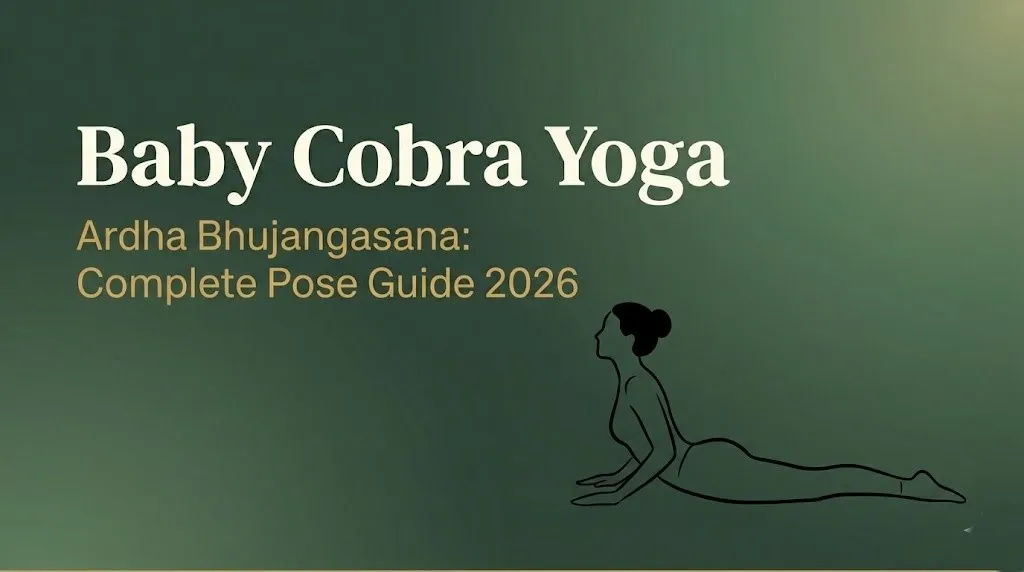
Baby cobra yoga, known in Sanskrit as Ardha Bhujangasana, is a gentle prone backbend where the chest lifts off the floor using back muscle strength, with the elbows remaining bent and the pubic bone staying in contact with the mat throughout. It is one of the most accessible backbends in yoga, appropriate for beginners, people with back sensitivity, and seniors, yet it is also a technically precise pose that most practitioners perform incorrectly.
Lower back pain is one of the most common reasons people turn to yoga. According to the National Center for Complementary and Integrative Health (NCCIH), yoga is among the most frequently cited complementary approaches for managing chronic low back discomfort, with multiple studies showing measurable improvements in pain and function over eight to twelve weeks of consistent practice. Baby cobra, practiced correctly, is a foundational part of that evidence base.
This guide covers the exact mechanics of the pose, how it differs from full cobra and sphinx, which muscles it targets and why, who benefits and who should skip it, and how it fits into a complete yoga practice. Every claim is sourced. Every technique point is specific.
Baby Cobra Yoga: What It Is and Why It Belongs in Every Practice
Baby cobra yoga is a low-amplitude prone spinal extension exercise where the lift comes from active engagement of the erector spinae and multifidus, not from pushing into the hands.
That last point is the most misunderstood aspect of the pose. Most beginners press their palms into the mat and extend their elbows to create the lift. That makes the arms do the work instead of the back. The result looks similar from the outside, but the muscle activation, spinal load, and therapeutic benefit are completely different.
Baby cobra earns its place in nearly every yoga tradition. In Hatha yoga, it is a standalone strengthening posture. In Vinyasa yoga, it appears as a lower-intensity substitute for full cobra within Surya Namaskar (Sun Salutation). In Restorative yoga, a very shallow version is sometimes used with prop support for people who cannot tolerate prone positions without discomfort.
The pose is genuinely accessible to most bodies, though ease is always individual. A practitioner with an acute lumbar disc herniation, significant thoracic stiffness, or wrist sensitivity will need modifications. None of those factors necessarily exclude someone from the pose entirely.
Pose Tip:
- The pubic bone stays on the mat for the entire duration. If it lifts, you have moved into full cobra territory.
- The lift height in baby cobra is small. Two to four inches of chest clearance from the mat is typically enough.
- The elbows remain close to the body, bent at roughly 90 degrees or more, not straightened.
What Is Baby Cobra Pose and How Does It Differ From Full Cobra?
Baby cobra (Ardha Bhujangasana) differs from full cobra (Bhujangasana) primarily in the degree of spinal extension, the role of the arms, and how much body weight is transferred through the wrists and hands.
In baby cobra, the elbows stay bent and close to the torso. The hands may rest lightly on the mat or hover slightly above it. The lift is generated almost entirely by the posterior chain muscles, specifically the erector spinae, multifidus, and posterior deltoid. The spinal extension is modest, typically focused in the thoracic and lower thoracic regions.
In full Bhujangasana, the elbows extend further, often reaching a soft extension or near-straightening. The hands press more actively into the mat. The body lifts higher, which increases the degree of lumbar extension and shifts more load to the lower back. The hip flexors lengthen more dramatically in full cobra, and the pubic bone may lift slightly off the mat.
| Feature | Baby Cobra (Ardha Bhujangasana) | Full Cobra (Bhujangasana) |
|---|---|---|
| Elbow position | Bent, close to body | Partially to fully extended |
| Arm contribution to lift | Minimal | Moderate to active |
| Pubic bone contact | Stays on mat | May lift slightly |
| Spinal extension range | Low to moderate | Moderate to high |
| Lumbar load | Lower | Higher |
| Primary muscles lifting | Erector spinae, multifidus | Erector spinae, plus arm press |
| Best for | Beginners, back sensitivity | Intermediate practitioners |
Modification: Anyone unsure which version to practice should begin with baby cobra. It is easier to progress to full cobra once the back muscles are adequately prepared than to recover from a lumbar strain from attempting full cobra prematurely.
Ardha Bhujangasana: The Sanskrit Name and Yoga Tradition Behind Baby Cobra
Ardha Bhujangasana translates directly from Sanskrit as “half serpent pose,” where “ardha” means half, “bhujanga” means serpent or cobra, and “asana” means pose.
The “half” in the name is significant. It signals that this is an incomplete expression of the full pose, not a lesser one. In classical Hatha yoga texts, the graduated approach to backbends was understood as both physically protective and energetically progressive. You work through the partial form before the complete form.
Bhujangasana (full Cobra Pose) appears in the Gheranda Samhita, one of the classical Hatha yoga texts, described as a posture that warms the body and activates the spinal energy channels. Baby cobra, as the accessible entry to this family of poses, carries the same foundational intention: controlled spinal extension, posterior chain activation, and chest opening.
The pose family that includes baby cobra also encompasses Salamba Bhujangasana (Sphinx Pose), where the forearms rest on the mat, and Urdhva Mukha Svanasana (Upward-Facing Dog), where the hips lift fully off the mat. Understanding this progression helps practitioners choose the right expression for their body on any given day.
Modification: Practitioners who are new to Sanskrit names need not memorize them to practice well. What matters is understanding that baby cobra is intentionally modest in its spinal extension, and that the name “half cobra” reflects deliberate restraint, not limitation.
Key Takeaway: Baby cobra is not a watered-down pose. It is the technically precise half-expression of cobra that demands genuine back muscle engagement, and getting it right matters more than reaching for the fuller version too soon.
What Muscles Does Baby Cobra Yoga Work?
Baby cobra primarily targets the erector spinae, multifidus, posterior deltoid, middle and lower trapezius, and the wrist extensor muscles that stabilize the hands against the mat.
Understanding which muscles do the work clarifies why so many practitioners do this pose incorrectly. When the hands press hard into the mat to push the chest up, the arm muscles (triceps, shoulder flexors) take over. The posterior back muscles, which are the intended targets, do far less work. The therapeutic benefit diminishes.
The correct muscle activation sequence works like this. As you inhale and prepare to lift, the erector spinae along the thoracic and lumbar spine begin contracting isometrically. The multifidus, which are the small deep stabilizing muscles between each vertebra, engage to support spinal segmental control. The posterior deltoids and middle trapezius draw the shoulders back and down, opening the chest without straining the neck.
The wrist extensors work throughout the pose to keep the hands flat and stable against the mat. For practitioners with wrist sensitivity, this sustained wrist extensor load is the primary complaint, which is why prop modifications that reduce wrist angle are effective.
Primary muscles engaged in baby cobra:
- Erector spinae (iliocostalis, longissimus, spinalis): Primary movers creating the spinal extension lift
- Multifidus: Deep segmental stabilizers of the lumbar and thoracic spine
- Posterior deltoid: Draws arms back, assists in chest opening
- Middle and lower trapezius: Depresses and retracts the shoulder blades
- Latissimus dorsi (lower fibers): Assists in posterior shoulder positioning
- Wrist extensors: Stabilize the hands against the floor
Modification: Practitioners with wrist pain can practice the pose with fists rather than flat hands, or with the forearms on the mat (transitioning toward Salamba Bhujangasana/Sphinx Pose), which removes wrist extension load completely.
Baby Cobra Yoga Benefits: What the Research Supports
The documented benefits of baby cobra yoga include spinal extensor strengthening, improved thoracic mobility, reduced chronic lower back discomfort, and enhanced body awareness in the posterior chain.
The most clinically relevant evidence base comes from research on prone press-up exercises, which baby cobra closely resembles. The McKenzie method, a widely studied physical therapy protocol for lumbar spine rehabilitation, uses prone press-ups as a primary therapeutic tool. A review published in the Spine Journal found that repeated prone extension movements produced measurable centralization of lumbar disc symptoms in a subset of patients with herniated discs, meaning pain that radiated into the leg progressively moved back toward the spine, which is a positive clinical sign.
Baby cobra is not identical to a McKenzie press-up, but the spinal extension mechanics overlap substantially. The key difference is that baby cobra emphasizes back muscle activation rather than arm-assisted pressing, which makes it arguably more therapeutically direct for the posterior chain.
According to the International Journal of Yoga, yoga practices that include prone backbend postures are associated with improved thoracic spine mobility and reduced upper back stiffness in office workers and sedentary populations, groups where thoracic kyphosis (rounding of the upper back) is prevalent.
Additional researched and documented benefits include:
- Strengthened lumbar and thoracic extensor muscle groups
- Improved intervertebral disc nutrition through alternating compression and extension
- Greater chest wall mobility and respiratory capacity
- Reduced thoracic kyphosis over time with consistent practice
- Improved proprioceptive awareness in the lower back and sacral region
Modification: Practitioners seeking specifically therapeutic benefits should practice baby cobra with slow, deliberate holds of 5 to 10 breath cycles rather than quick repetitions. The sustained isometric engagement of the back muscles produces more meaningful strengthening stimulus.
How to Do Baby Cobra Pose: Step-by-Step Instructions
Ardha Bhujangasana (Baby Cobra Pose) is entered from a prone position (lying face down) and requires no props for most practitioners, though modifications are available.
To practice Baby Cobra Pose:
- Lie face down on your mat with legs extended, feet together or hip-width apart. Rest your forehead on the mat.
- Place your hands flat on the mat beside your lower ribs. Fingertips should be roughly level with the bottom of your ribcage. Elbows point straight back, close to the body.
- Press the tops of your feet, thighs, and pubic bone gently but firmly into the mat. This grounding through the pelvis is non-negotiable.
- On an inhale, engage the erector spinae and begin to lift the chest and forehead off the mat. The arms assist minimally. Try to hover the hands slightly above the mat as a test: if you can still lift without them, your back muscles are doing the work correctly.
- Draw the shoulder blades down and together. Lift the sternum forward and up rather than just tilting the head back. Keep the neck long. Gaze is slightly forward and downward, not straight up.
- Hold for 3 to 5 breath cycles (approximately 15 to 30 seconds). Keep the breath slow and steady.
- On an exhale, slowly lower the chest back to the mat. Rest the forehead on the mat or turn it to one side. Allow the back muscles to release for at least one full breath before repeating.
Modification for beginners: Place the hands slightly further forward than described above, giving the elbows more bend. This reduces the spinal extension demand and makes the lift feel more manageable.
Modification for wrist sensitivity: Make loose fists and press the knuckles into the mat. This reduces the angle of wrist dorsiflexion significantly while maintaining hand contact with the floor.
Key Takeaway: The single most common error in baby cobra is pressing into the hands to create the lift. Test your form by hovering the hands briefly: if the chest drops, your back muscles need more development before you rely less on arm assistance.
Baby Cobra Common Mistakes and How to Fix Them
The most common mistakes in baby cobra yoga are pressing into the hands too aggressively, tilting the head back rather than lengthening the neck, and lifting the pubic bone off the mat.
Each of these errors has a specific fix, and understanding why they happen helps prevent them from becoming ingrained habits.
| Common Mistake | What It Looks Like | How to Fix It |
|---|---|---|
| Pressing into hands too hard | Arms straighten; chest lifts high | Hover hands briefly above mat; re-engage back muscles |
| Head tilting back | Neck crunches; chin juts up | Keep gaze forward and down; chin stays roughly parallel to floor |
| Pubic bone lifting | Hips rise off mat | Press pubic bone and thighs firmly down before lifting |
| Elbows flaring wide | Shoulders rise toward ears | Pin elbows close to torso throughout |
| Holding the breath | Shoulders tense; face tightens | Use a slow ujjayi breath throughout the hold |
| Lifting too high too fast | Lower back compression | Keep the lift small; prioritize engagement over height |
| Feet separating | Legs rotate outward | Actively draw the inner thighs together throughout |
The head position mistake deserves specific attention. When the head tilts back excessively, the cervical spine compresses and the neck muscles strain. The fix is to think of lengthening the crown of the head forward and slightly upward rather than tipping the chin toward the ceiling.
A study referenced in the Journal of Bodywork and Movement Therapies found that incorrect cervical positioning during prone extension exercises was associated with greater reported neck discomfort post-practice. The evidence supports maintaining cervical neutrality in baby cobra rather than encouraging a full head extension.
Modification: Practitioners who habitually press into their hands can practice the pose with their hands completely lifted off the mat, resting the backs of the hands on the lower back. This removes the arm-pressing option entirely and forces genuine back muscle engagement.
Baby Cobra vs Sphinx Pose: Which One Is Right for You?
Baby cobra and Salamba Bhujangasana (Sphinx Pose) are both prone backbends, but they differ in elbow position, muscle demand, and therapeutic application.
In Salamba Bhujangasana (Sphinx Pose), the forearms rest fully on the mat, elbows directly beneath the shoulders. This creates a passive spinal extension supported by the arm structure. The back muscles are engaged but less so than in baby cobra, because the forearms bear significant weight. Sphinx is often described as a more passive backbend, appropriate for Yin yoga and Restorative yoga contexts where the goal is connective tissue release over longer holds.
Baby cobra, in contrast, is an active backbend. The back muscles are contracting to create and maintain the lift. The arms provide minimal support. This makes baby cobra more appropriate for building posterior chain strength, while sphinx is more appropriate for passive thoracic opening and longer hold durations.
| Feature | Baby Cobra (Ardha Bhujangasana) | Sphinx Pose (Salamba Bhujangasana) |
|---|---|---|
| Arm position | Hands on mat, elbows bent | Forearms flat on mat |
| Muscle demand | Active back muscle contraction | More passive; arms bear more weight |
| Wrist load | Moderate | None (forearms on mat) |
| Appropriate hold time | 15 to 45 seconds | 1 to 5 minutes (Yin contexts) |
| Yoga style context | Hatha, Vinyasa, Restorative | Yin, Restorative, therapeutic |
| Best for | Strengthening posterior chain | Passive thoracic opening |
| Lower back load | Mild to moderate | Mild |
Modification: Practitioners with active wrist pain should choose Sphinx Pose over baby cobra as the primary backbend in their practice, since forearms bear the load rather than extended wrists.
Baby Cobra Pose for Beginners: Building a Safe Backbend Practice
Baby cobra is among the best first backbends for beginners because its small range of motion makes it safer than more demanding poses while still producing genuine spinal strengthening stimulus.
For someone who has never practiced yoga backbends, the prone position itself can feel unusual. The body is not accustomed to bearing weight on the front of the hips and thighs while extending the spine. That unfamiliarity, not weakness, is often what makes beginners feel unstable in their first few baby cobras.
The progression for beginners should be gradual. Start with only two to three repetitions per session, holding for three breath cycles each. This is less than most classes prescribe, but it respects the fact that the erector spinae and multifidus fatigue quickly in people who are not accustomed to prone extension work. Progressing slowly prevents the muscle soreness and reluctance that can discourage new practitioners.
According to the American College of Sports Medicine, progressive overload is the foundational principle of muscular development. Applied to baby cobra: add one repetition or two breath counts to each session rather than holding longer or adding repetitions too quickly.
Beginners should also prioritize breath coordination from the first class. Inhale to prepare and begin the lift. Exhale or maintain steady breath during the hold. Exhale to lower. This rhythm coordinates the diaphragm with spinal stabilization and reduces the temptation to brace and hold the breath.
Modification for absolute beginners: Place a folded yoga blanket under the lower belly and pelvis. This slightly elevates the hips and reduces the lumbar extension demand during the lift, making the pose more comfortable for people with tight hip flexors or lumbar sensitivity.
Key Takeaway: Beginners get more benefit from two to three well-executed baby cobras with full back muscle engagement than from six repetitions performed by pressing into the hands. Technique always precedes volume.
Baby Cobra Yoga Modifications for Seniors and Limited Mobility
Baby cobra can be adapted for older adults and practitioners with limited mobility using prop support, reduced range of motion, and alternative entry positions.
Seniors often bring specific physical considerations to prone backbends: reduced thoracic spine mobility from years of postural habit, reduced bone density that affects how much spinal loading is appropriate, and potentially tighter hip flexors that make the prone position itself uncomfortable.
The most practical modification for seniors is the folded blanket under the chest. Placing a folded blanket beneath the sternum at the start creates a slight pre-lift, reducing how far the chest needs to travel to reach the hold position. This can make an enormous functional difference for practitioners with stiff thoracic spines.
Seniors with osteoporosis should discuss the degree of spinal extension appropriate for their bone density with a physician who understands their specific imaging or density measurements, as high-load spinal extension is generally managed cautiously in this population.
| Modification | Props Needed | Best For |
|---|---|---|
| Blanket under lower belly | 1 folded blanket | Tight hip flexors; lumbar sensitivity |
| Blanket under chest | 1 folded blanket | Stiff thoracic spine; seniors |
| Fist position for hands | No props | Wrist sensitivity or pain |
| Forearm transition (Sphinx) | No props | Very limited wrist mobility |
| Towel roll under forehead | 1 small rolled towel | Neck stiffness; difficulty resting forehead |
| Shorter hold duration | No props | Seniors; deconditioned practitioners |
| Hands hovering above mat | No props | Training posterior chain activation |
Modification for practitioners with shoulder surgery history: Avoid any version of the pose where the arm position creates discomfort at the shoulder joint. Transitioning to Sphinx Pose (Salamba Bhujangasana) with forearms on the mat generally reduces shoulder joint load sufficiently for most post-surgical presentations, but specific clearance from a physical therapist familiar with the surgical repair is advisable.
Baby Cobra for Lower Back Pain: What to Know Before You Try It
Baby cobra can benefit people with certain types of lower back discomfort, but it is not appropriate for all back pain presentations and should be approached with specific guidance.
The key distinction in lower back pain management is between flexion-intolerant and extension-intolerant back conditions. Flexion-intolerant conditions, such as many posterior lumbar disc herniations, often respond well to extension exercises. Extension-intolerant conditions, such as lumbar spondylolisthesis, lumbar stenosis, or facet joint arthritis, typically worsen with spinal extension poses.
A study published in the Spine Journal found that extension-based exercises reduced pain centralization in a subset of patients with lumbar disc herniation over a four-week treatment period. Baby cobra falls within this extension-based category, though it is less aggressive than the full McKenzie press-up protocol.
For people whose lower back pain increases during or immediately after baby cobra, the pose is likely extension-intolerant for their specific presentation. Continuing through increasing pain is not a yoga principle. Stopping and exploring Balasana (Child’s Pose) or Marjaryasana-Bitilasana (Cat-Cow) instead is always the appropriate response.
Key guidance for practicing baby cobra with lower back concerns:
- Start with a very small lift, one to two inches of chest clearance only.
- Hold for two to three breaths initially rather than longer durations.
- Rest in Balasana (Child’s Pose) after each repetition to assess how the back responds.
- Never push through sharp, shooting, or radiating pain. Dull muscle fatigue is normal. Sharp pain is a stop signal.
- Practitioners with diagnosed lumbar conditions should discuss specific exercise clearance with a physical therapist or spine specialist before beginning any prone extension practice.
Modification: For people with significant lower back sensitivity, practicing the chest lift with hands completely off the mat (arms resting alongside the body) reduces arm involvement and limits the lift to what the back muscles can manage unassisted, which is naturally a smaller, safer range.
Who Should Avoid Baby Cobra Pose and Key Contraindications
Baby cobra pose should be skipped or significantly modified by anyone with active lumbar extension pain, lumbar spondylolisthesis, spinal stenosis, a recent spinal surgery, or during the second and third trimesters of pregnancy.
These contraindications are specific to the spinal extension component of the pose. They are not reasons to avoid yoga entirely, but they do mean that the particular mechanics of baby cobra are not appropriate for these presentations without individualized clinical guidance.
Contraindications and considerations in detail:
- Lumbar spondylolisthesis: Forward slippage of one vertebra over another is aggravated by extension. Baby cobra in any form is generally contraindicated.
- Lumbar spinal stenosis: Spinal extension narrows the already compromised spinal canal. Extension-based poses typically worsen symptoms.
- Active lumbar disc herniation with extension intolerance: Some disc presentations worsen with extension. A physical therapist can assess directional preference before recommending prone extension exercises.
- Recent spinal surgery (within 6 to 12 months): Surgical clearance and physical therapist guidance are needed before any spinal loading exercise.
- Pregnancy (second and third trimester): Prone positioning places direct pressure on the growing uterus. Avoid entirely from mid-pregnancy onward.
- Wrist fracture or recent wrist surgery: The wrist extension load in baby cobra contraindicates the pose during acute recovery.
- Cervical disc herniation with extension symptoms: The neck does not fully extend in baby cobra, but any cervical sensitivity warrants a modified gaze position.
Safe alternative for contraindicated practitioners: Cat-Cow (Marjaryasana-Bitilasana) delivers spinal mobility in both flexion and extension while weight-bearing through the wrists only in a more neutral angle and without prone compression. It is widely recommended by physical therapists as a safer alternative for many of the conditions listed above.
Key Takeaway: Baby cobra is not appropriate for all back conditions. Extension-intolerant presentations like stenosis and spondylolisthesis require alternatives, and any sharp, radiating, or worsening pain during the pose is a clear signal to stop and reassess with a qualified practitioner.
Baby Cobra Pose in Sun Salutation and Vinyasa Sequences
In Vinyasa yoga and Hatha yoga sun salutations, baby cobra appears as a lower-intensity alternative to either Bhujangasana (full Cobra) or Urdhva Mukha Svanasana (Upward-Facing Dog) within the Surya Namaskar (Sun Salutation) sequence.
Understanding its place in the flow prevents confusion when a teacher offers it as a modification. In a traditional sun salutation, the practitioner transitions from Chaturanga Dandasana (Four-Limbed Staff Pose) or a lowered plank directly into an upward-facing heart opener. The three main options at that point are: full cobra, baby cobra, or upward dog.
Baby cobra is the lowest-intensity of these three options. It asks the least of the wrists (since they do not bear significant weight), places the least demand on the shoulder girdle, and requires the least lumbar extension range. Teachers often cue it for students who are newer to practice, have wrist concerns, or are working through a more fatigued body.
| Position in Sun Salutation | Pose Option | Best For |
|---|---|---|
| Heart opener, lower intensity | Ardha Bhujangasana (Baby Cobra) | Beginners; wrist sensitivity; back sensitivity |
| Heart opener, moderate | Bhujangasana (Full Cobra) | Intermediate practitioners |
| Heart opener, higher intensity | Urdhva Mukha Svanasana (Upward Dog) | Experienced; strong wrists and shoulders |
In a sun salutation context, baby cobra is typically held for only one breath cycle rather than the longer holds used in a standalone practice. The tempo of Vinyasa means the pose comes and goes quickly. This brief hold is still therapeutically meaningful because the posterior chain activates consistently across multiple repetitions in a session.
Modification for Vinyasa context: Practitioners who are fatigued midway through a Vinyasa sequence can lower all the way to the mat, skip the heart opener entirely, and come straight into Balasana (Child’s Pose) to rest before continuing. No pose in a sequence is mandatory.
Baby Cobra Yoga Sequence: How to Warm Up and Cool Down Around the Pose
A well-structured practice around baby cobra prepares the thoracic spine, hip flexors, and wrists for the demands of prone extension and then releases any residual tension afterward.
Skipping the warm-up is the most common preparation error practitioners make. Coming directly from sitting or lying down into prone extension without warming the posterior chain produces less muscle activation and more protective guarding from the nervous system. The result is a shallower, less effective pose.
Recommended warm-up sequence before baby cobra:
- Marjaryasana-Bitilasana (Cat-Cow): 8 to 10 rounds. Mobilizes the entire spine in both flexion and extension. Warms the erector spinae progressively.
- Adho Mukha Svanasana (Downward-Facing Dog): Hold for 5 breaths. Warms the wrists, shoulders, and posterior chain.
- Balasana (Child’s Pose): Hold for 5 breaths. Creates gentle spinal flexion before transitioning to extension.
- Transition to prone position. Take 3 breaths with forehead on mat before beginning the lift.
Recommended cool-down after baby cobra:
- Balasana (Child’s Pose): Always the immediate post-cobra counterpose. Hold for 5 to 10 breaths. Provides spinal flexion to balance the extension just performed.
- Supta Matsyendrasana (Supine Spinal Twist): Both sides. Releases the thoracolumbar fascia and paravertebral muscles after sustained contraction.
- Shavasana (Corpse Pose): Allow at least 2 minutes of complete rest after a baby cobra practice to let the posterior chain muscles fully release.
The cool-down matters more than most practitioners realize. After repeated isometric contractions of the erector spinae, the muscles need deliberate lengthening and nervous system downregulation before they return to resting length efficiently.
Modification: Practitioners who find Child’s Pose uncomfortable due to knee pain can substitute Supta Balasana (Reclined Child’s Pose) by lying on the back and hugging both knees to the chest. This delivers the same spinal flexion counterpose without knee joint loading.
Frequently Asked Questions About Baby Cobra Yoga
What is the difference between baby cobra and full cobra pose?
Baby cobra (Ardha Bhujangasana) uses a small chest lift driven by back muscle engagement, with elbows bent and the pubic bone remaining on the mat throughout.
Full cobra (Bhujangasana) involves a higher chest lift with elbows more extended, arms contributing more to the lift, and a greater degree of lumbar and thoracic extension.
Baby cobra is the safer starting point for beginners and people with back sensitivity, while full cobra is appropriate once the posterior chain muscles are adequately conditioned.
Is baby cobra pose safe for lower back pain?
Baby cobra can be safe and beneficial for certain types of lower back pain, specifically conditions that respond well to spinal extension, such as some posterior lumbar disc herniations.
It is not appropriate for extension-intolerant conditions, including lumbar spinal stenosis, spondylolisthesis, or facet joint arthritis, where spinal extension typically worsens symptoms.
Anyone with diagnosed lower back conditions should discuss whether extension-based exercises are appropriate for their specific presentation with a physical therapist before practicing.
How long should you hold baby cobra pose?
Most yoga teachers recommend holding baby cobra for 3 to 5 breath cycles, approximately 15 to 30 seconds, in a standalone practice context.
In a Vinyasa sun salutation, the hold is typically one breath cycle only, in rhythm with the flow.
Beginners should start with shorter holds of two to three breaths and extend gradually as the back muscles develop endurance.
Can beginners do baby cobra yoga?
Yes, baby cobra is one of the most beginner-friendly backbends in yoga because its small range of motion makes it accessible to most bodies.
The technique requires attention, specifically keeping the pubic bone on the mat and letting the back muscles do the lifting rather than pressing into the hands, but neither requires prior flexibility or strength.
Beginners should start with two to three repetitions per session and build gradually over several weeks.
What is the Sanskrit name for baby cobra pose?
The Sanskrit name for baby cobra pose is Ardha Bhujangasana, which translates as “half serpent pose.”
“Ardha” means half, “bhujanga” means serpent or cobra, and “asana” means pose or posture.
The “half” signals that this is an intentionally partial expression of full Bhujangasana (Cobra Pose), not a lesser variation but a distinct pose with its own specific alignment and therapeutic applications.
The Most Practical Thing You Can Do Right Now
Roll out your mat and lie face down. Place your hands beside your lower ribs, elbows close to your body. Before you lift, press your pubic bone and thighs firmly into the mat. Then, on your next inhale, hover your hands a centimeter above the mat and try to lift your chest using only your back muscles.
That hover test will tell you everything about where you are in this pose.
Practice baby cobra three times per week, two to three repetitions per session, and assess your lower back response for at least two weeks before extending hold times or adding repetitions. The pose builds the posterior chain steadily, and the results show up clearly in how your whole back feels day to day.