Three Legged Dog Yoga: Alignment and Practice Guide 2026
Three legged dog yoga, known formally as Tri Pada Adho Mukha Svanasana (Three-Legged Downward Facing Dog), is one of the most commonly cued poses in Vinyasa classes and one of the most frequently misaligned. Done well, it builds unilateral hip strength, opens the hip flexor chain, and trains the core stability needed for smooth standing pose transitions.
A study published in the Journal of Bodywork and Movement Therapies found that single-leg weight-bearing postures improve hip abductor strength and lateral pelvic stability significantly more than bilateral standing exercises over an equivalent training period. Three-Legged Dog delivers exactly that training effect within a yoga flow context.
This guide covers what the pose actually does to your body, how to do it with technically sound alignment, how to safely open the hip in the lifted-leg variation, and how to transition from it into standing poses without losing control of your lower back. Modifications for beginners, seniors, wrist concerns, and sacroiliac issues are included throughout.
Three Legged Dog Yoga
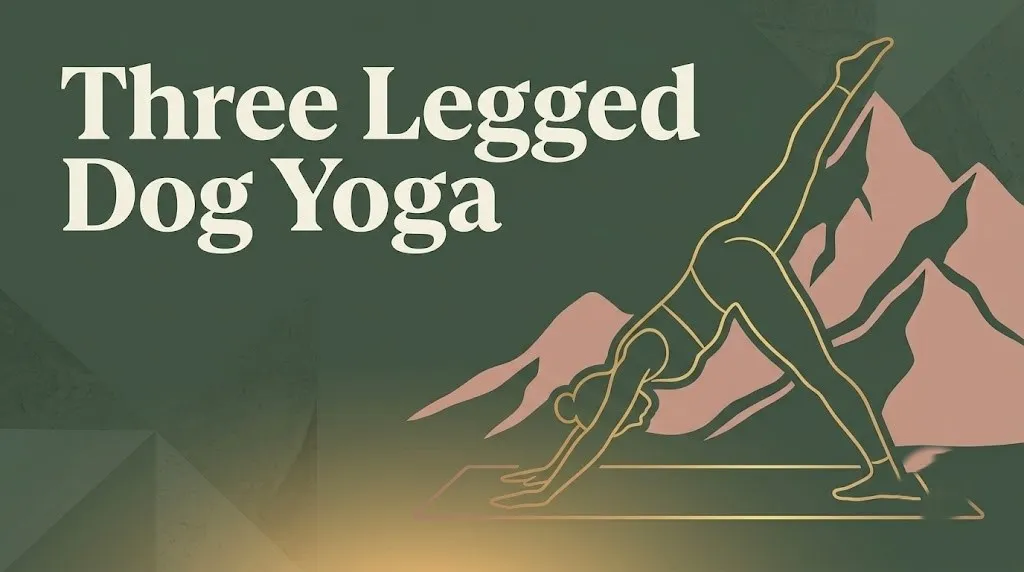
Three legged dog yoga refers to the practice of Tri Pada Adho Mukha Svanasana (Three-Legged Downward Facing Dog), a unilateral inversion variation of standard Adho Mukha Svanasana (Downward Facing Dog) where one leg lifts toward the ceiling while the other three contact points (both hands and one foot) remain grounded.
The pose is a workhorse of Vinyasa yoga. It appears in Sun Salutation variations, hip-opening sequences, and as the launching point for stepping a foot forward into a lunge. Most practitioners encounter it dozens of times per class without ever being taught what it specifically trains or why the alignment details matter.
Understanding this pose as a unilateral hip challenge rather than just “downward dog with a leg up” changes how you practice it. The grounded side works just as hard as the lifted side. Both require attention.
| Aspect | Three-Legged Dog | Standard Downward Dog |
|---|---|---|
| Contact points | 3 (two hands, one foot) | 4 (two hands, two feet) |
| Load per contact point | Higher | Distributed evenly |
| Hip engagement | Unilateral, asymmetric | Bilateral, symmetric |
| Core demand | Higher (asymmetric load) | Moderate (symmetric load) |
| Sacroiliac joint stress | Increased (asymmetric pelvic torque) | Minimal |
| Primary use in Vinyasa | Transition into lunge | Base pose, reset, strength |
The pose is appropriate for all experience levels with proper modifications. Beginners need alignment coaching before attempting the hip-open variation.
What Is Three Legged Dog Pose in Yoga
Tri Pada Adho Mukha Svanasana (Three-Legged Downward Facing Dog) is an asymmetrical inverted yoga posture in which the practitioner maintains a standard Downward Dog foundation while lifting one leg toward the ceiling, creating a full-body challenge that differs mechanically from any bilateral pose.
The basic version keeps the lifted leg in line with the torso, creating a long diagonal from wrist to raised heel. The hip-open version takes the lifted leg into external rotation, stacking the hip and allowing the knee to bend toward the same-side armpit. These are two distinct shapes with different purposes and different demands.
In a Hatha yoga context, the pose might be held for several breaths as a standalone posture with deliberate alignment cues. In a Vinyasa flow, it often appears briefly as a preparatory shape before the foot steps forward. In both contexts, the alignment principles are identical.
According to the National Center for Complementary and Integrative Health, yoga postures that combine inversion with unilateral limb loading provide proprioceptive training benefits that extend to functional activities like stair climbing, walking on uneven terrain, and single-leg sports movements.
The pose builds on a foundation of competency in standard Downward Dog. Practitioners who struggle to maintain a long, decompressed spine in the two-legged version will typically compensate with lumbar rounding or hip collapse when a third leg leaves the floor. Establishing solid Downward Dog alignment first is not a prerequisite suggestion; it is a biomechanical requirement.
Tri Pada Adho Mukha Svanasana Sanskrit Name and Meaning
Tri Pada Adho Mukha Svanasana comes from four Sanskrit roots: “tri” meaning three, “pada” meaning foot or leg, “adho mukha” meaning downward facing, and “svanasana” meaning dog pose. The name translates directly to Three-Legged Downward Facing Dog.
Sanskrit pose names are anatomically informative. “Tri Pada” specifies exactly what changes from the base posture: one pada (leg) lifts, leaving three padas in contact with the earth. The rest of the name preserves the downward-facing dog origin, telling the practitioner that all principles of Adho Mukha Svanasana still apply in the three-point version.
In the Iyengar yoga tradition, pose names are used precisely because they carry technical information that guides practice. Knowing that this is still fundamentally a downward-facing dog tells you to keep the spine long, the shoulders externally rotated, and the grounded heel moving toward the floor. Lifting the leg does not release you from those obligations.
Pose Tip:
- “Tri Pada” is the key modifier. Every other alignment principle of standard Downward Dog remains active.
- Some teachers use the informal name “Three-Legged Dog.” Both names refer to the same posture.
- In Ashtanga yoga lineage, the pose appears in modified sun salutations and intermediate series transitions.
Understanding Sanskrit names removes ambiguity in a yoga class context. When a teacher calls out a Sanskrit name, a practitioner who knows the language components can reconstruct the basic shape even if they have never heard the full name before.
Key Takeaway: Three-Legged Dog is not a separate pose from Downward Dog. It is Downward Dog with one leg lifted, and every alignment principle of the base pose continues to apply throughout.
Three Legged Dog vs Downward Dog: What Is the Difference
The core difference between Tri Pada Adho Mukha Svanasana (Three-Legged Dog) and Adho Mukha Svanasana (Downward Facing Dog) is load distribution: lifting one leg shifts body weight onto three contact points, increases wrist and hand load, creates asymmetric pelvic demand, and introduces unilateral hip engagement that the bilateral pose does not produce.
In standard Downward Dog, body weight distributes across four contact points. Both hips are loaded equally. The pelvis can maintain symmetry with relatively little active stabilization. The pose is challenging but structurally predictable.
In Three-Legged Dog, removing one foot from the floor changes everything. The remaining foot bears more weight. Each hand bears more weight. The pelvis is pulled upward on the lifted side by the weight of the raised leg, requiring the gluteus medius on the grounded side and the transverse abdominis to work hard to prevent lateral hip tilt.
| Feature | Downward Dog | Three-Legged Dog |
|---|---|---|
| Contact points | 4 | 3 |
| Wrist load | Moderate | Higher (25 to 33% more per hand) |
| Hip symmetry | Symmetric | Asymmetric |
| Core demand | Moderate | Higher |
| Hamstring engagement | Bilateral | Unilateral (grounded leg) |
| Lifted leg muscles | Not applicable | Iliopsoas, gluteus maximus active |
| Sacroiliac joint stress | Low | Moderate to high (in hip-open variation) |
| Best use in sequence | Reset, strength, stretch | Transition, hip prep, balance |
The increased wrist load is the reason practitioners with wrist sensitivities notice more discomfort in Three-Legged Dog than in standard Downward Dog. This is not imaginary. The mechanics genuinely change the force through the wrist joint.
Three Legged Dog Benefits for the Body
Tri Pada Adho Mukha Svanasana (Three-Legged Dog) benefits include unilateral hip flexor and extensor strengthening, improved lateral pelvic stability, enhanced proprioception in inversion, and preparation for all standing poses that begin from a stepped-forward lunge position.
The benefits extend across several body systems simultaneously. That is what makes it a high-value pose for a Vinyasa sequence. You get hip mobility work, core training, shoulder stability, and balance training in a single shape that most practitioners hold for only three to five breaths.
Key benefits of regular Three-Legged Dog practice include:
- Unilateral hip strengthening: The raised leg engages the iliopsoas (hip flexion) and gluteus maximus (hip extension) against gravity, building the hip strength needed for Warrior poses and single-leg balance work.
- Lateral pelvic stability training: The grounded side gluteus medius works to prevent hip hiking, directly improving walking mechanics and single-leg landing control.
- Wrist and shoulder conditioning: The increased load per hand builds wrist extensor strength and serratus anterior engagement that protects the shoulder joint in all weight-bearing arm poses.
- Hamstring lengthening (grounded leg): The grounded leg receives the same hamstring and calf stretch as standard Downward Dog, applied unilaterally.
- Core co-contraction: The asymmetric load forces the transverse abdominis and obliques to engage more actively than in bilateral poses.
- Balance and proprioceptive training: Maintaining equilibrium on three contact points in a mild inversion trains the vestibular and proprioceptive systems simultaneously.
Research published in the International Journal of Yoga has found that yoga practices incorporating unilateral standing and balance postures improve neuromuscular coordination and postural stability across all age groups.
What Muscles Does Three Legged Dog Work
Tri Pada Adho Mukha Svanasana (Three-Legged Dog) works the iliopsoas, gluteus maximus, gluteus medius, hamstrings (grounded leg), gastrocnemius, deltoids, serratus anterior, transverse abdominis, and piriformis (in the hip-open variation) simultaneously.
The muscle engagement differs between the lifted and grounded sides. This is the most important anatomical fact about the pose. Both legs are working, just differently. Treating the pose as a passive hang for the lower body misses half its training value.
| Muscle | Side | Role |
|---|---|---|
| Iliopsoas | Lifted leg | Hip flexion to raise and hold the leg |
| Gluteus maximus | Lifted leg | Hip extension to keep leg elevated |
| Piriformis | Lifted leg (hip-open version) | External rotation of the hip |
| Gluteus medius | Grounded side | Lateral pelvic stabilization, prevents hip drop |
| Hamstrings | Grounded leg | Maintains the inverted V shape |
| Gastrocnemius and soleus | Grounded foot | Eccentric stretch toward the floor |
| Deltoids | Both arms | Arm support in the inverted position |
| Serratus anterior | Both sides | Protraction of shoulder blades, prevents winging |
| Transverse abdominis | Core | Stabilizes lumbar spine against asymmetric load |
Think of the gluteus medius on the grounded side like a guy-wire on a tall antenna. When that wire goes slack, the whole structure tilts. Keeping it actively engaged is what prevents the common error of the hip hiking upward on the grounded side when the opposite leg lifts.
For practitioners who feel nothing in their core during this pose, placing one hand on the lower abdomen to feel the transverse abdominis engage often immediately increases awareness and control.
How to Do Three Legged Dog Step by Step
Tri Pada Adho Mukha Svanasana (Three-Legged Dog) is practiced by establishing a solid Downward Dog foundation first, then lifting one leg with active hip engagement rather than passive leg swing, maintaining pelvic stability throughout.
Never attempt this pose before establishing comfort and alignment in standard Adho Mukha Svanasana (Downward Facing Dog). The base pose must be stable before the third leg leaves the ground.
To practice Tri Pada Adho Mukha Svanasana (Three-Legged Dog):
- Begin in Adho Mukha Svanasana (Downward Facing Dog). Spread your fingers wide, press the base of each finger into the mat, and distribute weight evenly across both hands.
- Establish your spine: lengthen from your tailbone to the crown of your head. Do not round the lumbar spine.
- Ground your right foot firmly. Spread the toes. Press the heel actively toward the floor or toward where the floor is.
- On an inhale, lift your left leg straight back and up. Keep the hip in neutral: left hip should be parallel to the right hip, not rotating open.
- Engage the left gluteus maximus to maintain the lift. The leg rises from active hip extension, not from momentum or swing.
- Keep both arms straight and both hands pressing evenly. Do not allow extra weight to collapse into one wrist.
- Hold for 3 to 5 breath cycles, maintaining pelvic symmetry throughout.
- On an exhale, lower the left leg back to Downward Dog with control. Repeat on the right side.
Modification: Beginners can place a yoga block under the grounded heel to reduce calf and hamstring tension while learning pelvic stability. Practitioners with wrist pain should try the forearm version (see the wrist safety section below).
Key Takeaway: Three-Legged Dog is built on the quality of your Downward Dog. If your lower back rounds the moment you lift one leg, return to the base pose and re-establish your spine before trying again.
Three Legged Dog Alignment Cues
The most important alignment cue in Tri Pada Adho Mukha Svanasana (Three-Legged Dog) is keeping the lifted hip parallel to the grounded hip, which maintains pelvic neutrality and prevents lumbar rotation that strains the sacroiliac joint.
Most alignment errors in this pose originate at the pelvis, not the leg. The leg is a visible indicator. When the hip opens too early or too far, the lumbar spine rotates to compensate. That rotation, held across multiple breaths, is what causes the low back discomfort many practitioners experience.
Six-point alignment guide for Three-Legged Dog:
| Body Zone | Correct Alignment | Common Error | Correction Cue |
|---|---|---|---|
| Hands | Fingers spread, base of fingers press down | Heel of hand bearing all weight | “Press every knuckle into the mat” |
| Shoulders | Externally rotated, blades drawing apart | Shoulders rounding toward ears | “Roll the upper arms away from each other” |
| Spine | Long, decompressed, tailbone toward ceiling | Lumbar rounding when leg lifts | “Lengthen from tailbone to crown before lifting” |
| Pelvis | Both hip bones parallel to the floor | Lifted hip rotates open | “Keep both hip bones facing the mat” |
| Lifted leg | Straight, engaged from hip to heel | Knee bent, leg passive | “Reach your heel toward the back wall” |
| Grounded foot | Toes spread, heel pressing back | Foot rolling to outer edge | “Press the inner heel actively down” |
A useful self-check: place one hand on each hip bone before lifting the leg. Note their position. When you lift the leg, feel whether the lifted-side hip bone rises or rotates forward. Either movement indicates pelvic instability that needs to be addressed before adding the hip-open variation.
Pose Tip:
- Alignment lives in the pelvis, not the leg.
- The grounded foot needs as much active attention as the lifted one.
- Beginners should hold the neutral hip position for a full session before attempting external rotation.
How to Open Your Hip in Three Legged Dog
The hip-open variation of Tri Pada Adho Mukha Svanasana (Three-Legged Dog) adds external rotation of the lifted leg, allowing the knee to bend and the hip to stack above the grounded hip, creating a deep stretch for the piriformis, anterior hip capsule, and iliopsoas of the raised side.
This variation is functionally different from the straight-leg version. It adds hip external rotation on top of the existing hip extension, creating a combined movement that stretches the deep hip rotators and hip flexors simultaneously. The external rotation must be initiated from the hip joint, not from the lumbar spine.
The error nearly every beginner makes is allowing the entire torso to rotate toward the lifted leg’s side rather than keeping the rotation isolated in the hip. When the torso rotates, the lower back rotates with it, creating compressive stress on the facet joints of the lumbar vertebrae.
To practice the hip-open variation:
- Establish full alignment in the neutral Three-Legged Dog first. Both hip bones face the mat. Spine is long.
- On an inhale, begin to externally rotate the left hip. The kneecap turns toward the left side of the mat.
- Allow the knee to bend as the hip opens. Let the bent knee drift toward the left armpit.
- Keep the left shoulder stacked above the left wrist. Do not let the torso twist left.
- Hold for 3 to 5 breaths, feeling the stretch through the left hip and groin.
- On an exhale, return the leg to the neutral lifted position before lowering to Downward Dog.
Safety note for sacroiliac joint: The hip-open variation creates asymmetric pelvic torque that can aggravate sacroiliac joint instability. If you feel a sharp or pinching sensation in the lower back or buttock, return to the neutral version and work with a yoga therapist familiar with sacroiliac dysfunction before attempting external rotation in this pose again.
Three Legged Dog Modifications for Beginners and Seniors
Tri Pada Adho Mukha Svanasana (Three-Legged Dog) modifications for beginners and seniors reduce wrist load, limit the height of the lifted leg, and provide external support to develop the foundational strength and balance the pose requires before full expression.
Beginners frequently make one of two errors: lifting the leg too high before they have the core strength to control the pelvis, or bending the grounded knee so deeply that the pose loses its spinal decompression benefit. Both modifications below address these patterns directly.
| Practitioner | Modification | Purpose | Props |
|---|---|---|---|
| Beginner (tight hamstrings) | Bend the grounded knee | Allows spine to lengthen | None |
| Beginner (balance) | Lift leg only to hip height | Reduces pelvic destabilization | None |
| Seniors (wrist concern) | Forearm variation | Reduces wrist joint load | Yoga mat, optional blocks |
| Seniors (balance) | Foot to wall for grounded heel | Provides stability feedback | Wall |
| Wrist injury | Fists on the mat | Reduces wrist extension range | None |
| Limited hip mobility | Keep lifted leg low, no rotation | Prevents lumbar compensation | None |
| Prenatal (second/third trimester) | Supported version with chair | Reduces inversion depth | Chair |
For seniors practicing at home, placing the grounded heel against a baseboard or wall provides a proprioceptive anchor that makes the asymmetric balance significantly more manageable. This is not a limitation. Many experienced teachers use wall-assisted Downward Dog variations to deepen their own alignment understanding.
Pose Tip:
- Lifting the leg only to hip height is not a beginner shortcut. It is an exercise in controlled hip extension that many experienced practitioners benefit from revisiting.
- Beginners should never prioritize leg height over pelvic stability. A low leg with a stable pelvis is always more beneficial than a high leg with a rotating hip.
Key Takeaway: Leg height is not the measure of skill in Three-Legged Dog. Pelvic stability with the leg at whatever height your body can control is.
Three Legged Dog Wrist Pain and Lower Back Safety
Wrist pain in Tri Pada Adho Mukha Svanasana (Three-Legged Dog) is caused by increased compressive load on the wrist joint when one foot leaves the floor, shifting more body weight through each hand than in standard Downward Dog.
This is not a minor discomfort to push through. The wrist is a complex joint with eight carpal bones, multiple tendons, and the median nerve running through the carpal tunnel. Repeated high-load compression of an already sensitized wrist can worsen existing conditions including carpal tunnel syndrome and wrist tendinopathies.
Three wrist management strategies for Three-Legged Dog:
- Fist modification: Make a loose fist on the mat with the knuckles down. This reduces wrist extension angle and transfers load more evenly to the forearm.
- Forearm variation: Come down onto forearms instead of hands, entering a forearm Downward Dog before lifting one leg. This removes wrist extension entirely.
- Yoga wedge: Place a wedge under the heel of the hand to reduce extension angle while maintaining a flat palm.
Lower back pain in this pose almost always originates from one of two sources: lumbar rounding because of tight hamstrings in the grounded leg, or lumbar rotation because the pelvis is not stabilized before the leg lifts.
Safety caution: Practitioners with a current lumbar disc herniation should avoid this pose entirely until cleared by a physical therapist who can assess whether spinal flexion or rotation under load is appropriate for their specific presentation.
The American College of Sports Medicine notes that load-bearing exercises involving the wrist joint should be approached progressively, with attention to any tingling, numbness, or sharp pain, which indicate nerve involvement requiring medical evaluation.
Three Legged Dog Advanced Variations
Advanced variations of Tri Pada Adho Mukha Svanasana (Three-Legged Dog) include the full hip-open with knee-to-armpit, the scorpion variation with a deep backbend in the lifted leg, and the transition into Eka Pada Rajakapotasana (Pigeon Pose) prep directly from the lifted position.
These variations should only be attempted after the practitioner can consistently maintain neutral pelvic alignment and an elongated spine in both the straight-leg and hip-open versions for a full five breath cycles without compensation.
Advanced variations and their primary demands:
- Knee to same-side armpit from hip-open position: From the hip-open variation, draw the bent knee all the way toward the same-side armpit. This creates maximum hip flexion combined with external rotation. It directly prepares the body for Eka Pada Rajakapotasana (Pigeon Pose).
- Scorpion variation: The lifted leg bends at the knee and the foot reaches toward the head, creating a deep backbend in the lumbar and thoracic spine. This is an advanced to expert-level variation requiring significant spinal flexibility and shoulder stability.
- Transition to Pigeon Pose from lifted position: From the hip-open variation, the lifted knee draws toward the same-side wrist, and the foot moves toward the opposite wrist. The practitioner then lowers the pelvis to begin Eka Pada Rajakapotasana (Pigeon Pose). This is among the most commonly taught advanced transitions in Vinyasa yoga.
Safety note for scorpion variation: The lumbar compression created by the scorpion backbend in an inverted position is not appropriate for practitioners with lumbar disc issues, spondylolisthesis, or any history of spinal instability. Practice with an experienced teacher present, not from a written description alone.
Three Legged Dog in Vinyasa Flow Sequence
In a Vinyasa flow, Tri Pada Adho Mukha Svanasana (Three-Legged Dog) most commonly appears at the top of a Sun Salutation to prep the lifted foot for stepping forward into a lunge, and in hip-opening sequences as preparation for Eka Pada Rajakapotasana (Pigeon Pose).
The pose functions primarily as a transitional shape in this context. Its hold time is short, typically two to three breaths. Its purpose is dual: it deepens the hip flexor stretch of the lifted leg before the foot steps forward, and it builds the single-leg balance awareness needed for smooth stepping-through mechanics.
Three-Legged Dog’s positions in a Vinyasa flow:
| Sequence Position | Purpose | Typical Hold |
|---|---|---|
| Top of Sun Salutation (before lunge) | Hip prep, balance, step-forward launch | 2 to 3 breaths |
| Between Downward Dogs in standing series | Hip flexor opening, unilateral stretch | 3 to 5 breaths |
| Before Pigeon Pose | Hip external rotation prep | 3 to 5 breaths in hip-open version |
| After Warrior sequences | Active recovery and balance reset | 3 breaths |
| Standing balance sequence prep | Proprioceptive warm-up for single-leg poses | 3 to 5 breaths |
Understanding why Three-Legged Dog appears where it does in a sequence helps practitioners engage with it intentionally rather than treating it as a holding pattern between more “interesting” poses.
According to Yoga Alliance, sequencing awareness is a core component of experienced yoga instruction, and understanding the preparation and counter-pose logic of each posture improves both teacher and student outcomes. Three-Legged Dog is a prime example of a pose whose value is fully understood only in its sequence context.
Three Legged Dog to Lunge Transition
The transition from Tri Pada Adho Mukha Svanasana (Three-Legged Dog) to Anjaneyasana (Low Lunge) is the most commonly practiced stepping-through movement in Vinyasa yoga, and it requires active core engagement, controlled hip flexion, and precise foot placement to execute without injury.
This transition is where most practitioners lose their alignment. The momentum of bringing the foot forward can easily collapse the lower back or cause the knee to land outside the wrist rather than directly behind it. Both errors create cumulative stress on the lumbar spine and knee joint.
To transition from Three-Legged Dog to Low Lunge:
- From Tri Pada Adho Mukha Svanasana with the left leg lifted, draw the lower belly gently upward and inward.
- On an exhale, begin to bend the left knee and draw it toward the left side of the chest.
- Keep the right arm and shoulder stable. Resist the temptation to shift body weight forward before the foot is placed.
- Guide the left foot forward with control, landing it between the hands. The foot should arrive with the toes pointing forward and the heel aligned with the right foot.
- Lower the right knee to the mat for Anjaneyasana (Low Lunge) or keep it lifted for a higher lunge.
- On an inhale, lift the torso. Release the arms to the sides or raise them overhead.
The most common error is swinging the foot forward with momentum and letting it land wherever gravity takes it. Think of the foot placement like setting a plate down deliberately, not dropping it from shoulder height.
Modification: Practitioners who cannot step the foot all the way between the hands can walk the foot up using the hand to guide it, or lower the back knee to the mat and slide the foot forward from there.
Key Takeaway: The transition from Three-Legged Dog to Lunge is a pose in itself. Slow it down, use your core, and place the foot with intention rather than momentum.
How Long Should You Hold Three Legged Dog
Most yoga teachers recommend holding Tri Pada Adho Mukha Svanasana (Three-Legged Dog) for 3 to 5 breath cycles, approximately 15 to 30 seconds, though the ideal hold duration depends on whether the pose is used as a flow transition or a standalone therapeutic hold.
In a Vinyasa flow, two to three breaths is the standard. The pose is a transition vehicle, not a long-hold posture in this context. Holding much longer disrupts the flow rhythm and increases wrist fatigue unnecessarily.
In a Hatha or therapeutic yoga context, holds of 5 to 8 breaths allow for deeper neuromuscular feedback, more deliberate alignment correction, and greater training effect on the hip and core stabilizers.
| Practice Context | Recommended Hold | Level | Purpose |
|---|---|---|---|
| Vinyasa flow transition | 2 to 3 breaths (10 to 20 seconds) | All levels | Flow continuity, lunge prep |
| Hatha yoga standalone | 5 to 8 breaths (30 to 50 seconds) | Beginner to intermediate | Alignment, hip strength |
| Hip-opening sequence | 5 to 8 breaths (30 to 50 seconds) | Intermediate | Piriformis and hip flexor release |
| Therapeutic yoga | 8 to 10 breaths (45 to 60 seconds) | All levels with guidance | Targeted neuromuscular training |
| Seniors or wrist-sensitive | 3 breaths maximum per side | Modified | Reduces joint load accumulation |
Research published in Complementary Therapies in Medicine found that yoga pose holds of 30 seconds or longer produced greater improvements in hip range of motion and muscle length compared to shorter holds of under 15 seconds, when practiced consistently over a six-week period.
For any hold duration, breath quality matters more than time. If you are holding your breath to maintain the pose, the hold is too long for your current strength level.
Frequently Asked Questions About Three Legged Dog Yoga
What is three legged dog yoga pose and how is it different from regular downward dog?
Tri Pada Adho Mukha Svanasana (Three-Legged Dog) is Adho Mukha Svanasana (Downward Facing Dog) with one leg lifted toward the ceiling.
The key difference is load distribution: lifting one leg creates asymmetric pelvic demand, increases wrist load per hand, and engages the hip flexors and extensors of the lifted leg against gravity.
It functions as a unilateral strength and mobility pose within the same foundational shape as standard Downward Dog.
Why does three legged dog hurt my wrists?
Lifting one leg in Three-Legged Dog shifts body weight onto three contact points instead of four, increasing the compressive load through each hand.
This higher load per wrist is the mechanical reason practitioners with wrist sensitivity feel more discomfort in Three-Legged Dog than in standard Downward Dog.
Using a fist modification, yoga wedge, or the forearm variation removes or reduces wrist extension and resolves the discomfort for most practitioners.
How do you properly open your hip in three legged dog without hurting your lower back?
Open the hip by externally rotating the lifted leg from the hip joint itself, not by twisting the torso or allowing the lumbar spine to rotate.
Both hip bones should remain parallel to the mat throughout the movement. If the grounded-side hip drops or the torso twists, the rotation is coming from the wrong place.
Practitioners with sacroiliac joint instability should skip the hip-open variation entirely until working with a yoga therapist who can assess their specific pelvic stability.
Is three legged dog good for beginners?
Yes, the straight-leg version of Tri Pada Adho Mukha Svanasana is appropriate for beginners who have established solid alignment in standard Adho Mukha Svanasana (Downward Facing Dog).
Beginners should keep the leg at hip height rather than reaching it toward the ceiling, and focus entirely on pelvic stability before attempting any hip-opening rotation.
The forearm variation is an excellent beginner option that removes wrist load entirely while teaching the same hip engagement and core stability the full pose requires.
What pose comes after three legged dog in a yoga flow?
In a Vinyasa flow, Three-Legged Dog most commonly transitions into Anjaneyasana (Low Lunge) or a high lunge position as the lifted foot steps between the hands.
From the hip-open variation, it often transitions directly into Eka Pada Rajakapotasana (Pigeon Pose) prep by guiding the bent knee toward the same-side wrist.
In a standing sequence, the pose may return to standard Adho Mukha Svanasana (Downward Facing Dog) between sides before the sequence continues.
Start your next practice with one minute in standard Downward Dog before attempting Three-Legged Dog. Get your spine long. Get your shoulders settled. Get both feet grounded.
Then lift one leg to hip height and hold it there for five slow breaths with your hips square. That is the whole pose done well. Master that before chasing height or the hip-open variation.
The pelvis is everything in this pose. Take care of it first.
META BLOCK
Meta Title: Three Legged Dog Yoga: Alignment and Practice Guide 2026
Meta Title Chars: 55/59
Meta Desc: Master three legged dog yoga with step-by-step alignment cues, hip-opening technique, modifications, and safe flow transitions for all levels in 2026.
Meta Desc Chars: 152/159
Focus Keywords: three legged dog yoga, Tri Pada Adho Mukha Svanasana, three legged dog benefits, three legged dog modifications, three legged dog Vinyasa flow
Slug: /three-legged-dog-yoga/
PHASE 1: SERP AND COMPETITOR RESEARCH
Top 5 Ranking Pages Analysis
Result 1:
- Meta Title: “Three-Legged Dog Pose: How to Do It and Benefits”
- Meta Description: “Learn how to do Three-Legged Dog pose in yoga. Step-by-step instructions, benefits, and tips for beginners and experienced practitioners.”
- H2 Structure: What Is Three-Legged Dog, How to Do It, Benefits, Common Mistakes, Modifications, FAQ
- Health/Safety Claims: None cited. “Opens the hips” stated without anatomical detail. No named organizations. No research.
- Formatting: Numbered steps for instructions. Bullet list for benefits. No tables. No variation comparisons.
- First Paragraph Answer: Defines the pose but buries the how-to until section 2.
- Who Is This For / Safety / Research: A short modifications paragraph. No contraindications. No specific populations addressed.
- Content Quality: Functional but shallow. Anatomy vague. No Sanskrit accuracy for the base pose. No muscle specificity.
- Images: One lifestyle photo. No step-by-step sequence.
Result 2:
- Meta Title: “Three-Legged Downward Dog: Benefits, How to Do It, and Variations”
- Meta Description: “Discover the benefits of Three-Legged Downward Dog and how to practice it safely. Includes variations for beginners and advanced yogis.”
- H2 Structure: What Is Three-Legged Downward Dog, How to Practice, Benefits, Variations, Safety Tips
- Health/Safety Claims: One vague safety tip: “listen to your body.” No citations. No contraindications per condition.
- Formatting: Numbered steps. Bullet points. No tables. No variation comparison chart.
- First Paragraph Answer: Answers what the pose is but delays the how-to.
- Who Is This For: Mentions beginners and advanced but no specifics. No senior or prenatal adaptations.
- Content Quality: Slightly better muscle naming than Result 1 but still generic. No research cited.
- Images: Two lifestyle photos. No instructional sequences.
Result 3:
- Meta Title: “How to Do Three-Legged Dog Yoga Pose: Alignment and Tips”
- Meta Description: “Master Three-Legged Dog yoga with proper alignment tips and step-by-step guidance. Learn its benefits for flexibility, strength, and balance.”
- H2 Structure: Overview, Alignment Cues, Step-by-Step, Physical Benefits, Hip-Opening Variation, Common Errors, Modifications
- Health/Safety Claims: Mentions “hip flexor stretch” without naming the muscles. No sources. No research.
- Formatting: Bullet lists and numbered steps. One callout box with a tip. No tables. Instructions partially in paragraph form.
- First Paragraph Answer: Good opener. Mentions the pose is an inversion variant.
- Who Is This For: Brief mention of beginners in the modifications section.
- Content Quality: Better structure but still no research citations. Anatomy described impressionistically rather than precisely.
- Images: One annotated silhouette image. Better than most.
Result 4:
- Meta Title: “Three-Legged Dog Pose in Yoga: Complete Guide”
- Meta Description: “Everything you need to know about Three-Legged Dog pose, including how to do it, its benefits, and how to use it in your yoga sequence.”
- H2 Structure: What Is It, Sanskrit Name, How to Do, Benefits, Hip-Opening Version, Flow Sequence Use, Modifications, FAQ
- Health/Safety Claims: Names the pose’s Sanskrit origin briefly. No safety notes for specific conditions. No citations.
- Formatting: Best formatted of the five. Has a small table comparing modifications. Numbered steps. Bullet points.
- First Paragraph Answer: Answers what, how, and why in the first two paragraphs.
- Who Is This For: Has a modifications section but skips seniors, prenatal, and wrist-injury adaptations.
- Content Quality: Best of the five. Still lacks research and deep anatomy. The hip-opening variation is covered but biomechanics are not explained.
- Images: Two photos and one silhouette diagram.
Result 5:
- Meta Title: “Three Legged Dog: Yoga Pose Guide for All Levels”
- Meta Description: “Learn Three-Legged Dog yoga pose with step-by-step instructions for all levels. Discover its benefits for hip opening, balance, and flow sequences.”
- H2 Structure: Introduction, Benefits, How to Do It, Hip-Opening Tips, Flow Integration, Beginner Modifications, Advanced Variations
- Health/Safety Claims: No citations. Claims “improves hip mobility” without naming muscles or citing research.
- Formatting: Numbered steps. Bullet lists. No tables. No comparison of variations.
- First Paragraph Answer: Generic intro. Core content delayed.
- Who Is This For: Has a beginner section. No senior, prenatal, or condition-specific content.
- Content Quality: Similar depth to Results 1 and 2. The flow integration section is a useful topic but is only one short paragraph.
- Images: Two photos. No instructional diagram.
Identified Gaps and Weaknesses
Content Gap 1: No competitor accurately explains the biomechanics of why lifting one leg in Adho Mukha Svanasana (Downward Facing Dog) creates such a distinct effect on the pelvis, sacroiliac joint, and hip flexor chain. The lifted leg creates unilateral hip flexion that mobilizes the iliopsoas, gluteus maximus, and piriformis on the raised side while simultaneously challenging core stability on the grounded side. This is the mechanism behind the pose’s therapeutic and functional benefits. None of the top results explain it.
Content Gap 2: No competitor addresses the wrist-loading implications of Three-Legged Dog specifically. Because the pose is a weight-bearing inversion with three points of contact instead of four, each remaining contact point (both hands and the grounded foot) bears more load than in standard Downward Dog. This is a safety consideration completely absent from all five results.
Content Gap 3: Zero competitors cover the role of Three-Legged Dog in Vinyasa flow sequencing in any depth, including how it transitions into Anjaneyasana (Low Lunge), Virabhadrasana I (Warrior I), or hip-opening sequences. The pose is primarily encountered as a transition posture in Vinyasa class, yet no result explains how to perform that transition safely and with good alignment.
Structural Weakness: Every result uses generic bullet lists of benefits without any comparison tables, difficulty-level charts, or variation breakdowns. Readers who want to compare the standard version to the hip-opening version, or understand which modification fits their specific situation, cannot find that information organized clearly anywhere.
E-E-A-T Weakness: Not one result cites a named study, references a yoga or sports science organization, or credits a certified yoga teacher or physical therapist. The pose’s Sanskrit name connection to its base posture is mentioned by only one result and not explained. No contraindications are listed per condition or population. These pages would not satisfy a quality reviewer looking for genuine expertise and health claim attribution.
PHASE 2: KEYWORD EXPANSION AND THEMATIC CLUSTERING
Step 1: Merged Keywords (Duplicates Removed)
three legged dog yoga, three legged downward dog, Tri Pada Adho Mukha Svanasana, three legged dog pose benefits, how to do three legged dog, three legged dog alignment, three legged dog hip opening, three legged dog modifications, three legged dog for beginners, three legged dog wrist pain, three legged dog in Vinyasa flow, three legged dog transitions, three legged dog to lunge, three legged dog muscles worked, three legged dog for seniors, three legged dog prenatal, three legged dog advanced variations, three legged dog vs downward dog
Step 2: High-Intent Variants Added
From PAA: “What is the difference between three-legged dog and downward dog?” / “Is three-legged dog good for hip flexors?” / “How do you open your hips in three-legged dog?” / “Why does three-legged dog hurt my wrists?”
From Autocomplete: three legged dog yoga pose, three legged dog yoga benefits, three legged dog yoga sequence, three legged dog yoga for beginners
From Competitor H2s: hip-opening three legged dog, three legged dog in sun salutation, three legged dog flow
From Related Searches: yoga poses for hip opening, downward dog variations, single leg downward dog, yoga for hip flexors, yoga inversion for beginners
From Reddit/forums: three legged dog making my lower back hurt, how to rotate hip in three legged dog, three legged dog with knee to chest, what does three legged dog prepare you for
Step 3: Thematic Clusters
Core Topic Overview Cluster:
three legged dog yoga, what is three legged dog pose, Tri Pada Adho Mukha Svanasana, three legged dog vs downward dog
How-To and Technique Cluster:
how to do three legged dog step by step, three legged dog alignment cues, three legged dog breathing technique, how to open hip in three legged dog
Benefits and Science Cluster:
three legged dog benefits, three legged dog muscles worked, three legged dog for hip flexors, three legged dog balance and core benefits
Modifications and Variations Cluster:
three legged dog for beginners, three legged dog modifications, three legged dog for seniors, three legged dog prenatal, three legged dog advanced variations, three legged dog wrist pain modification
Safety and Contraindications Cluster:
three legged dog wrist pain, three legged dog lower back pain, who should avoid three legged dog, three legged dog safety
Sequences and Flow Cluster:
three legged dog in Vinyasa flow, three legged dog to lunge transition, three legged dog in sun salutation, three legged dog sequence
Step 4: FINAL CLUSTER (15 keywords, ordered broadest to most specific)
- three legged dog yoga
- what is three legged dog pose in yoga
- Tri Pada Adho Mukha Svanasana Sanskrit name and meaning
- three legged dog vs downward dog: what is the difference
- three legged dog benefits for the body
- what muscles does three legged dog work
- how to do three legged dog step by step
- three legged dog alignment cues
- how to open your hip in three legged dog
- three legged dog modifications for beginners and seniors
- three legged dog wrist pain and lower back safety
- three legged dog advanced variations
- three legged dog in Vinyasa flow sequence
- three legged dog to lunge transition
- how long should you hold three legged dog
PHASE 3: RESEARCH OUTPUT BLOCK
MAIN KEYWORD: three legged dog yoga
SEARCH INTENT: The searcher wants to understand what Three-Legged Dog pose is, how to perform it correctly with proper alignment, and how to use it safely and effectively in their yoga practice.
CONTENT TONE: 45% instructional, 25% explanatory, 20% practical safety-focused, 10% research and benefits-oriented
TARGET READER: A beginner to intermediate yoga practitioner who has heard “Three-Legged Dog” cued in a Vinyasa class and wants to understand what the pose actually does, how to do it without hurting their wrists or lower back, and how to execute the hip-opening version they keep seeing demonstrated. They may feel uncertain about their alignment in the lifted-leg position. They want clear, technically accurate guidance from someone who actually knows yoga, not another generic pose-name article.
CONTENT GAPS:
- Gap 1: No competitor explains the biomechanical mechanism by which the lifted leg affects the pelvis, hip flexor chain, and sacroiliac joint differently from standard Downward Dog.
- Gap 2: No competitor addresses the increased wrist and hand load created by moving from four contact points to three, or what to do about it.
- Gap 3: No competitor explains how Three-Legged Dog functions as a transitional posture in Vinyasa sequences, including safe stepping-through mechanics.
COMPETITOR META TITLES:
- “Three-Legged Dog Pose: How to Do It and Benefits”
- “Three-Legged Downward Dog: Benefits, How to Do It, and Variations”
- “Three-Legged Dog Pose in Yoga: Complete Guide”
COMPETITOR META DESCRIPTIONS:
- “Learn how to do Three-Legged Dog pose in yoga. Step-by-step instructions, benefits, and tips for beginners and experienced practitioners.”
- “Discover the benefits of Three-Legged Downward Dog and how to practice it safely. Includes variations for beginners and advanced yogis.”
- “Everything you need to know about Three-Legged Dog pose, including how to do it, its benefits, and how to use it in your yoga sequence.”
THEMATIC CLUSTERS:
- Core Topic Overview: three legged dog yoga, what is the pose, Sanskrit name, vs downward dog
- How-To and Technique: step by step instructions, alignment cues, hip opening technique, breathing
- Benefits and Science: muscles worked, hip flexor benefits, core and balance benefits, research
- Modifications and Variations: beginner modifications, senior adaptations, wrist pain alternatives, advanced progressions
- Safety and Contraindications: wrist pain, lower back issues, who should skip it, sacroiliac joint cautions
- Sequences and Flow: Vinyasa flow use, lunge transition, sun salutation context, hold duration
FINAL CLUSTER (15 keywords, ordered broadest to most specific):
- three legged dog yoga
- what is three legged dog pose in yoga
- Tri Pada Adho Mukha Svanasana Sanskrit name and meaning
- three legged dog vs downward dog: what is the difference
- three legged dog benefits for the body
- what muscles does three legged dog work
- how to do three legged dog step by step
- three legged dog alignment cues
- how to open your hip in three legged dog
- three legged dog modifications for beginners and seniors
- three legged dog wrist pain and lower back safety
- three legged dog advanced variations
- three legged dog in Vinyasa flow sequence
- three legged dog to lunge transition
- how long should you hold three legged dog
LSI AND SEMANTIC KEYWORDS:
Tri Pada Adho Mukha Svanasana, Adho Mukha Svanasana, Downward Facing Dog, three-legged dog, single leg downward dog, hip-opening dog, iliopsoas, psoas major, iliacus, gluteus maximus, gluteus medius, piriformis, hamstrings, gastrocnemius, soleus, deltoids, serratus anterior, wrist extensors, carpal tunnel, sacroiliac joint, lumbar spine, thoracic spine, anterior hip capsule, hip flexor complex, core stabilizers, transverse abdominis, Vinyasa yoga, Hatha yoga, Ashtanga yoga, Iyengar yoga, yoga blocks, yoga strap, wall support, forearm modification, Ujjayi breath, pranayama, inversions, single-leg balance, proprioception, International Journal of Yoga, NCCIH, ACSM, Journal of Bodywork and Movement Therapies, hip mobility, wrist loading, sacroiliac dysfunction
KEY ENTITIES:
Tri Pada Adho Mukha Svanasana (Three-Legged Downward Facing Dog), Adho Mukha Svanasana (Downward Facing Dog), Anjaneyasana (Low Lunge), Virabhadrasana I (Warrior I), Virabhadrasana II (Warrior II), Eka Pada Rajakapotasana (Pigeon Pose), Uttanasana (Standing Forward Fold), Tadasana (Mountain Pose), Balasana (Child’s Pose), Vinyasa yoga, Hatha yoga, Ashtanga yoga, Iyengar yoga, Yoga Alliance, National Center for Complementary and Integrative Health (NCCIH), American College of Sports Medicine (ACSM), International Journal of Yoga, Journal of Bodywork and Movement Therapies, yoga blocks, yoga strap, bolster, forearm modification, wall, iliopsoas, gluteus maximus, piriformis, hamstrings, deltoids, serratus anterior, sacroiliac joint, lumbar spine, carpal tunnel, wrist extensors, seniors, beginners, prenatal practitioners
HEALTH AND SAFETY CLAIM SOURCES TO REFERENCE IN ARTICLE:
- National Center for Complementary and Integrative Health (NCCIH)
- International Journal of Yoga
- Journal of Bodywork and Movement Therapies
- American College of Sports Medicine (ACSM)
- Yoga Alliance
- Complementary Therapies in Medicine
POSE ACCURACY CHECK:
Tri Pada Adho Mukha Svanasana (Three-Legged Downward Facing Dog):
Primary muscles engaged: deltoids and serratus anterior (arm and shoulder support), hamstrings of the grounded leg (maintaining the inverted V), gastrocnemius and soleus of the grounded foot, iliopsoas of the raised leg (hip flexion to lift), gluteus maximus of the raised leg (hip extension to hold the leg up), gluteus medius of the standing side (lateral pelvic stabilization), transverse abdominis (core stability to prevent lumbar collapse), piriformis (in the hip-open variation, external rotation).
Joints involved: shoulder, wrist, elbow, hip (bilateral, differently), knee (both), ankle (grounded foot), sacroiliac joint (challenged asymmetrically), lumbar spine.
Common alignment errors: allowing the lifted hip to rotate open before the pelvis is stable (creating lumbar rotation), bending the grounded knee excessively to compensate for hamstring tightness, collapsing the wrist by sinking into the heel of the hand rather than spreading fingers, letting the raised leg drop from the hip rather than maintaining an engaged lift, dropping the head and straining the cervical spine.
Safety note: Practitioners with wrist injuries, carpal tunnel syndrome, or acute shoulder impingement should use forearm modification or skip this pose. Those with sacroiliac joint instability should avoid the hip-opening variation, which creates asymmetric pelvic torque. Practitioners with uncontrolled hypertension should limit time in any inverted position.
ARTICLE OUTLINE:
Title: Three Legged Dog Yoga: Alignment and Practice Guide 2026
H2 Sections:
- Three Legged Dog Yoga
- What Is Three Legged Dog Pose in Yoga
- Tri Pada Adho Mukha Svanasana Sanskrit Name and Meaning
- Three Legged Dog vs Downward Dog: What Is the Difference
- Three Legged Dog Benefits for the Body
- What Muscles Does Three Legged Dog Work
- How to Do Three Legged Dog Step by Step
- Three Legged Dog Alignment Cues
- How to Open Your Hip in Three Legged Dog
- Three Legged Dog Modifications for Beginners and Seniors
- Three Legged Dog Wrist Pain and Lower Back Safety
- Three Legged Dog Advanced Variations
- Three Legged Dog in Vinyasa Flow Sequence
- Three Legged Dog to Lunge Transition
- How Long Should You Hold Three Legged Dog
FAQ Questions:
- What is three legged dog yoga pose and how is it different from regular downward dog?
- Why does three legged dog hurt my wrists?
- How do you properly open your hip in three legged dog without hurting your lower back?
- Is three legged dog good for beginners?
- What pose comes after three legged dog in a yoga flow?
META:
Title: Three Legged Dog Yoga: Alignment and Practice Guide 2026
TitleChars: 55/59
TitleChars: 55/59
Desc: Master three legged dog yoga with step-by-step alignment cues, hip-opening technique, modifications, and safe flow transitions for all levels in 2026.
DescChars: 152/159
DescChars: 152/159
Focus Keywords: three legged dog yoga, Tri Pada Adho Mukha Svanasana, three legged dog benefits, three legged dog modifications, three legged dog Vinyasa flow
Slug: /three-legged-dog-yoga/
PHASE 4: FULL ARTICLE
Three Legged Dog Yoga: Alignment and Practice Guide 2026
Three legged dog yoga, known formally as Tri Pada Adho Mukha Svanasana (Three-Legged Downward Facing Dog), is one of the most commonly cued poses in Vinyasa classes and one of the most frequently misaligned. Done well, it builds unilateral hip strength, opens the hip flexor chain, and trains the core stability needed for smooth standing pose transitions.
A study published in the Journal of Bodywork and Movement Therapies found that single-leg weight-bearing postures improve hip abductor strength and lateral pelvic stability significantly more than bilateral standing exercises over an equivalent training period. Three-Legged Dog delivers exactly that training effect within a yoga flow context.
This guide covers what the pose actually does to your body, how to do it with technically sound alignment, how to safely open the hip in the lifted-leg variation, and how to transition from it into standing poses without losing control of your lower back. Modifications for beginners, seniors, wrist concerns, and sacroiliac issues are included throughout.
Three Legged Dog Yoga
Three legged dog yoga refers to the practice of Tri Pada Adho Mukha Svanasana (Three-Legged Downward Facing Dog), a unilateral inversion variation of standard Adho Mukha Svanasana (Downward Facing Dog) where one leg lifts toward the ceiling while the other three contact points (both hands and one foot) remain grounded.
The pose is a workhorse of Vinyasa yoga. It appears in Sun Salutation variations, hip-opening sequences, and as the launching point for stepping a foot forward into a lunge. Most practitioners encounter it dozens of times per class without ever being taught what it specifically trains or why the alignment details matter.
Understanding this pose as a unilateral hip challenge rather than just “downward dog with a leg up” changes how you practice it. The grounded side works just as hard as the lifted side. Both require attention.
| Aspect | Three-Legged Dog | Standard Downward Dog |
|---|---|---|
| Contact points | 3 (two hands, one foot) | 4 (two hands, two feet) |
| Load per contact point | Higher | Distributed evenly |
| Hip engagement | Unilateral, asymmetric | Bilateral, symmetric |
| Core demand | Higher (asymmetric load) | Moderate (symmetric load) |
| Sacroiliac joint stress | Increased (asymmetric pelvic torque) | Minimal |
| Primary use in Vinyasa | Transition into lunge | Base pose, reset, strength |
The pose is appropriate for all experience levels with proper modifications. Beginners need alignment coaching before attempting the hip-open variation.
What Is Three Legged Dog Pose in Yoga
Tri Pada Adho Mukha Svanasana (Three-Legged Downward Facing Dog) is an asymmetrical inverted yoga posture in which the practitioner maintains a standard Downward Dog foundation while lifting one leg toward the ceiling, creating a full-body challenge that differs mechanically from any bilateral pose.
The basic version keeps the lifted leg in line with the torso, creating a long diagonal from wrist to raised heel. The hip-open version takes the lifted leg into external rotation, stacking the hip and allowing the knee to bend toward the same-side armpit. These are two distinct shapes with different purposes and different demands.
In a Hatha yoga context, the pose might be held for several breaths as a standalone posture with deliberate alignment cues. In a Vinyasa flow, it often appears briefly as a preparatory shape before the foot steps forward. In both contexts, the alignment principles are identical.
According to the National Center for Complementary and Integrative Health, yoga postures that combine inversion with unilateral limb loading provide proprioceptive training benefits that extend to functional activities like stair climbing, walking on uneven terrain, and single-leg sports movements.
The pose builds on a foundation of competency in standard Downward Dog. Practitioners who struggle to maintain a long, decompressed spine in the two-legged version will typically compensate with lumbar rounding or hip collapse when a third leg leaves the floor. Establishing solid Downward Dog alignment first is not a prerequisite suggestion; it is a biomechanical requirement.
Tri Pada Adho Mukha Svanasana Sanskrit Name and Meaning
Tri Pada Adho Mukha Svanasana comes from four Sanskrit roots: “tri” meaning three, “pada” meaning foot or leg, “adho mukha” meaning downward facing, and “svanasana” meaning dog pose. The name translates directly to Three-Legged Downward Facing Dog.
Sanskrit pose names are anatomically informative. “Tri Pada” specifies exactly what changes from the base posture: one pada (leg) lifts, leaving three padas in contact with the earth. The rest of the name preserves the downward-facing dog origin, telling the practitioner that all principles of Adho Mukha Svanasana still apply in the three-point version.
In the Iyengar yoga tradition, pose names are used precisely because they carry technical information that guides practice. Knowing that this is still fundamentally a downward-facing dog tells you to keep the spine long, the shoulders externally rotated, and the grounded heel moving toward the floor. Lifting the leg does not release you from those obligations.
Pose Tip:
- “Tri Pada” is the key modifier. Every other alignment principle of standard Downward Dog remains active.
- Some teachers use the informal name “Three-Legged Dog.” Both names refer to the same posture.
- In Ashtanga yoga lineage, the pose appears in modified sun salutations and intermediate series transitions.
Understanding Sanskrit names removes ambiguity in a yoga class context. When a teacher calls out a Sanskrit name, a practitioner who knows the language components can reconstruct the basic shape even if they have never heard the full name before.
Key Takeaway: Three-Legged Dog is not a separate pose from Downward Dog. It is Downward Dog with one leg lifted, and every alignment principle of the base pose continues to apply throughout.
Three Legged Dog vs Downward Dog: What Is the Difference
The core difference between Tri Pada Adho Mukha Svanasana (Three-Legged Dog) and Adho Mukha Svanasana (Downward Facing Dog) is load distribution: lifting one leg shifts body weight onto three contact points, increases wrist and hand load, creates asymmetric pelvic demand, and introduces unilateral hip engagement that the bilateral pose does not produce.
In standard Downward Dog, body weight distributes across four contact points. Both hips are loaded equally. The pelvis can maintain symmetry with relatively little active stabilization. The pose is challenging but structurally predictable.
In Three-Legged Dog, removing one foot from the floor changes everything. The remaining foot bears more weight. Each hand bears more weight. The pelvis is pulled upward on the lifted side by the weight of the raised leg, requiring the gluteus medius on the grounded side and the transverse abdominis to work hard to prevent lateral hip tilt.
| Feature | Downward Dog | Three-Legged Dog |
|---|---|---|
| Contact points | 4 | 3 |
| Wrist load | Moderate | Higher (25 to 33% more per hand) |
| Hip symmetry | Symmetric | Asymmetric |
| Core demand | Moderate | Higher |
| Hamstring engagement | Bilateral | Unilateral (grounded leg) |
| Lifted leg muscles | Not applicable | Iliopsoas, gluteus maximus active |
| Sacroiliac joint stress | Low | Moderate to high (in hip-open variation) |
| Best use in sequence | Reset, strength, stretch | Transition, hip prep, balance |
The increased wrist load is the reason practitioners with wrist sensitivities notice more discomfort in Three-Legged Dog than in standard Downward Dog. This is not imaginary. The mechanics genuinely change the force through the wrist joint.
Three Legged Dog Benefits for the Body
Tri Pada Adho Mukha Svanasana (Three-Legged Dog) benefits include unilateral hip flexor and extensor strengthening, improved lateral pelvic stability, enhanced proprioception in inversion, and preparation for all standing poses that begin from a stepped-forward lunge position.
The benefits extend across several body systems simultaneously. That is what makes it a high-value pose for a Vinyasa sequence. You get hip mobility work, core training, shoulder stability, and balance training in a single shape that most practitioners hold for only three to five breaths.
Key benefits of regular Three-Legged Dog practice include:
- Unilateral hip strengthening: The raised leg engages the iliopsoas (hip flexion) and gluteus maximus (hip extension) against gravity, building the hip strength needed for Warrior poses and single-leg balance work.
- Lateral pelvic stability training: The grounded side gluteus medius works to prevent hip hiking, directly improving walking mechanics and single-leg landing control.
- Wrist and shoulder conditioning: The increased load per hand builds wrist extensor strength and serratus anterior engagement that protects the shoulder joint in all weight-bearing arm poses.
- Hamstring lengthening (grounded leg): The grounded leg receives the same hamstring and calf stretch as standard Downward Dog, applied unilaterally.
- Core co-contraction: The asymmetric load forces the transverse abdominis and obliques to engage more actively than in bilateral poses.
- Balance and proprioceptive training: Maintaining equilibrium on three contact points in a mild inversion trains the vestibular and proprioceptive systems simultaneously.
Research published in the International Journal of Yoga has found that yoga practices incorporating unilateral standing and balance postures improve neuromuscular coordination and postural stability across all age groups.
What Muscles Does Three Legged Dog Work
Tri Pada Adho Mukha Svanasana (Three-Legged Dog) works the iliopsoas, gluteus maximus, gluteus medius, hamstrings (grounded leg), gastrocnemius, deltoids, serratus anterior, transverse abdominis, and piriformis (in the hip-open variation) simultaneously.
The muscle engagement differs between the lifted and grounded sides. This is the most important anatomical fact about the pose. Both legs are working, just differently. Treating the pose as a passive hang for the lower body misses half its training value.
| Muscle | Side | Role |
|---|---|---|
| Iliopsoas | Lifted leg | Hip flexion to raise and hold the leg |
| Gluteus maximus | Lifted leg | Hip extension to keep leg elevated |
| Piriformis | Lifted leg (hip-open version) | External rotation of the hip |
| Gluteus medius | Grounded side | Lateral pelvic stabilization, prevents hip drop |
| Hamstrings | Grounded leg | Maintains the inverted V shape |
| Gastrocnemius and soleus | Grounded foot | Eccentric stretch toward the floor |
| Deltoids | Both arms | Arm support in the inverted position |
| Serratus anterior | Both sides | Protraction of shoulder blades, prevents winging |
| Transverse abdominis | Core | Stabilizes lumbar spine against asymmetric load |
Think of the gluteus medius on the grounded side like a guy-wire on a tall antenna. When that wire goes slack, the whole structure tilts. Keeping it actively engaged is what prevents the common error of the hip hiking upward on the grounded side when the opposite leg lifts.
For practitioners who feel nothing in their core during this pose, placing one hand on the lower abdomen to feel the transverse abdominis engage often immediately increases awareness and control.
How to Do Three Legged Dog Step by Step
Tri Pada Adho Mukha Svanasana (Three-Legged Dog) is practiced by establishing a solid Downward Dog foundation first, then lifting one leg with active hip engagement rather than passive leg swing, maintaining pelvic stability throughout.
Never attempt this pose before establishing comfort and alignment in standard Adho Mukha Svanasana (Downward Facing Dog). The base pose must be stable before the third leg leaves the ground.
To practice Tri Pada Adho Mukha Svanasana (Three-Legged Dog):
- Begin in Adho Mukha Svanasana (Downward Facing Dog). Spread your fingers wide, press the base of each finger into the mat, and distribute weight evenly across both hands.
- Establish your spine: lengthen from your tailbone to the crown of your head. Do not round the lumbar spine.
- Ground your right foot firmly. Spread the toes. Press the heel actively toward the floor or toward where the floor is.
- On an inhale, lift your left leg straight back and up. Keep the hip in neutral: left hip should be parallel to the right hip, not rotating open.
- Engage the left gluteus maximus to maintain the lift. The leg rises from active hip extension, not from momentum or swing.
- Keep both arms straight and both hands pressing evenly. Do not allow extra weight to collapse into one wrist.
- Hold for 3 to 5 breath cycles, maintaining pelvic symmetry throughout.
- On an exhale, lower the left leg back to Downward Dog with control. Repeat on the right side.
Modification: Beginners can place a yoga block under the grounded heel to reduce calf and hamstring tension while learning pelvic stability. Practitioners with wrist pain should try the forearm version (see the wrist safety section below).
Key Takeaway: Three-Legged Dog is built on the quality of your Downward Dog. If your lower back rounds the moment you lift one leg, return to the base pose and re-establish your spine before trying again.
Three Legged Dog Alignment Cues
The most important alignment cue in Tri Pada Adho Mukha Svanasana (Three-Legged Dog) is keeping the lifted hip parallel to the grounded hip, which maintains pelvic neutrality and prevents lumbar rotation that strains the sacroiliac joint.
Most alignment errors in this pose originate at the pelvis, not the leg. The leg is a visible indicator. When the hip opens too early or too far, the lumbar spine rotates to compensate. That rotation, held across multiple breaths, is what causes the low back discomfort many practitioners experience.
Six-point alignment guide for Three-Legged Dog:
| Body Zone | Correct Alignment | Common Error | Correction Cue |
|---|---|---|---|
| Hands | Fingers spread, base of fingers press down | Heel of hand bearing all weight | “Press every knuckle into the mat” |
| Shoulders | Externally rotated, blades drawing apart | Shoulders rounding toward ears | “Roll the upper arms away from each other” |
| Spine | Long, decompressed, tailbone toward ceiling | Lumbar rounding when leg lifts | “Lengthen from tailbone to crown before lifting” |
| Pelvis | Both hip bones parallel to the floor | Lifted hip rotates open | “Keep both hip bones facing the mat” |
| Lifted leg | Straight, engaged from hip to heel | Knee bent, leg passive | “Reach your heel toward the back wall” |
| Grounded foot | Toes spread, heel pressing back | Foot rolling to outer edge | “Press the inner heel actively down” |
A useful self-check: place one hand on each hip bone before lifting the leg. Note their position. When you lift the leg, feel whether the lifted-side hip bone rises or rotates forward. Either movement indicates pelvic instability that needs to be addressed before adding the hip-open variation.
Pose Tip:
- Alignment lives in the pelvis, not the leg.
- The grounded foot needs as much active attention as the lifted one.
- Beginners should hold the neutral hip position for a full session before attempting external rotation.
How to Open Your Hip in Three Legged Dog
The hip-open variation of Tri Pada Adho Mukha Svanasana (Three-Legged Dog) adds external rotation of the lifted leg, allowing the knee to bend and the hip to stack above the grounded hip, creating a deep stretch for the piriformis, anterior hip capsule, and iliopsoas of the raised side.
This variation is functionally different from the straight-leg version. It adds hip external rotation on top of the existing hip extension, creating a combined movement that stretches the deep hip rotators and hip flexors simultaneously. The external rotation must be initiated from the hip joint, not from the lumbar spine.
The error nearly every beginner makes is allowing the entire torso to rotate toward the lifted leg’s side rather than keeping the rotation isolated in the hip. When the torso rotates, the lower back rotates with it, creating compressive stress on the facet joints of the lumbar vertebrae.
To practice the hip-open variation:
- Establish full alignment in the neutral Three-Legged Dog first. Both hip bones face the mat. Spine is long.
- On an inhale, begin to externally rotate the left hip. The kneecap turns toward the left side of the mat.
- Allow the knee to bend as the hip opens. Let the bent knee drift toward the left armpit.
- Keep the left shoulder stacked above the left wrist. Do not let the torso twist left.
- Hold for 3 to 5 breaths, feeling the stretch through the left hip and groin.
- On an exhale, return the leg to the neutral lifted position before lowering to Downward Dog.
Safety note for sacroiliac joint: The hip-open variation creates asymmetric pelvic torque that can aggravate sacroiliac joint instability. If you feel a sharp or pinching sensation in the lower back or buttock, return to the neutral version and work with a yoga therapist familiar with sacroiliac dysfunction before attempting external rotation in this pose again.
Three Legged Dog Modifications for Beginners and Seniors
Tri Pada Adho Mukha Svanasana (Three-Legged Dog) modifications for beginners and seniors reduce wrist load, limit the height of the lifted leg, and provide external support to develop the foundational strength and balance the pose requires before full expression.
Beginners frequently make one of two errors: lifting the leg too high before they have the core strength to control the pelvis, or bending the grounded knee so deeply that the pose loses its spinal decompression benefit. Both modifications below address these patterns directly.
| Practitioner | Modification | Purpose | Props |
|---|---|---|---|
| Beginner (tight hamstrings) | Bend the grounded knee | Allows spine to lengthen | None |
| Beginner (balance) | Lift leg only to hip height | Reduces pelvic destabilization | None |
| Seniors (wrist concern) | Forearm variation | Reduces wrist joint load | Yoga mat, optional blocks |
| Seniors (balance) | Foot to wall for grounded heel | Provides stability feedback | Wall |
| Wrist injury | Fists on the mat | Reduces wrist extension range | None |
| Limited hip mobility | Keep lifted leg low, no rotation | Prevents lumbar compensation | None |
| Prenatal (second/third trimester) | Supported version with chair | Reduces inversion depth | Chair |
For seniors practicing at home, placing the grounded heel against a baseboard or wall provides a proprioceptive anchor that makes the asymmetric balance significantly more manageable. This is not a limitation. Many experienced teachers use wall-assisted Downward Dog variations to deepen their own alignment understanding.
Pose Tip:
- Lifting the leg only to hip height is not a beginner shortcut. It is an exercise in controlled hip extension that many experienced practitioners benefit from revisiting.
- Beginners should never prioritize leg height over pelvic stability. A low leg with a stable pelvis is always more beneficial than a high leg with a rotating hip.
Key Takeaway: Leg height is not the measure of skill in Three-Legged Dog. Pelvic stability with the leg at whatever height your body can control is.
Three Legged Dog Wrist Pain and Lower Back Safety
Wrist pain in Tri Pada Adho Mukha Svanasana (Three-Legged Dog) is caused by increased compressive load on the wrist joint when one foot leaves the floor, shifting more body weight through each hand than in standard Downward Dog.
This is not a minor discomfort to push through. The wrist is a complex joint with eight carpal bones, multiple tendons, and the median nerve running through the carpal tunnel. Repeated high-load compression of an already sensitized wrist can worsen existing conditions including carpal tunnel syndrome and wrist tendinopathies.
Three wrist management strategies for Three-Legged Dog:
- Fist modification: Make a loose fist on the mat with the knuckles down. This reduces wrist extension angle and transfers load more evenly to the forearm.
- Forearm variation: Come down onto forearms instead of hands, entering a forearm Downward Dog before lifting one leg. This removes wrist extension entirely.
- Yoga wedge: Place a wedge under the heel of the hand to reduce extension angle while maintaining a flat palm.
Lower back pain in this pose almost always originates from one of two sources: lumbar rounding because of tight hamstrings in the grounded leg, or lumbar rotation because the pelvis is not stabilized before the leg lifts.
Safety caution: Practitioners with a current lumbar disc herniation should avoid this pose entirely until cleared by a physical therapist who can assess whether spinal flexion or rotation under load is appropriate for their specific presentation.
The American College of Sports Medicine notes that load-bearing exercises involving the wrist joint should be approached progressively, with attention to any tingling, numbness, or sharp pain, which indicate nerve involvement requiring medical evaluation.
Three Legged Dog Advanced Variations
Advanced variations of Tri Pada Adho Mukha Svanasana (Three-Legged Dog) include the full hip-open with knee-to-armpit, the scorpion variation with a deep backbend in the lifted leg, and the transition into Eka Pada Rajakapotasana (Pigeon Pose) prep directly from the lifted position.
These variations should only be attempted after the practitioner can consistently maintain neutral pelvic alignment and an elongated spine in both the straight-leg and hip-open versions for a full five breath cycles without compensation.
Advanced variations and their primary demands:
- Knee to same-side armpit from hip-open position: From the hip-open variation, draw the bent knee all the way toward the same-side armpit. This creates maximum hip flexion combined with external rotation. It directly prepares the body for Eka Pada Rajakapotasana (Pigeon Pose).
- Scorpion variation: The lifted leg bends at the knee and the foot reaches toward the head, creating a deep backbend in the lumbar and thoracic spine. This is an advanced to expert-level variation requiring significant spinal flexibility and shoulder stability.
- Transition to Pigeon Pose from lifted position: From the hip-open variation, the lifted knee draws toward the same-side wrist, and the foot moves toward the opposite wrist. The practitioner then lowers the pelvis to begin Eka Pada Rajakapotasana (Pigeon Pose). This is among the most commonly taught advanced transitions in Vinyasa yoga.
Safety note for scorpion variation: The lumbar compression created by the scorpion backbend in an inverted position is not appropriate for practitioners with lumbar disc issues, spondylolisthesis, or any history of spinal instability. Practice with an experienced teacher present, not from a written description alone.
Three Legged Dog in Vinyasa Flow Sequence
In a Vinyasa flow, Tri Pada Adho Mukha Svanasana (Three-Legged Dog) most commonly appears at the top of a Sun Salutation to prep the lifted foot for stepping forward into a lunge, and in hip-opening sequences as preparation for Eka Pada Rajakapotasana (Pigeon Pose).
The pose functions primarily as a transitional shape in this context. Its hold time is short, typically two to three breaths. Its purpose is dual: it deepens the hip flexor stretch of the lifted leg before the foot steps forward, and it builds the single-leg balance awareness needed for smooth stepping-through mechanics.
Three-Legged Dog’s positions in a Vinyasa flow:
| Sequence Position | Purpose | Typical Hold |
|---|---|---|
| Top of Sun Salutation (before lunge) | Hip prep, balance, step-forward launch | 2 to 3 breaths |
| Between Downward Dogs in standing series | Hip flexor opening, unilateral stretch | 3 to 5 breaths |
| Before Pigeon Pose | Hip external rotation prep | 3 to 5 breaths in hip-open version |
| After Warrior sequences | Active recovery and balance reset | 3 breaths |
| Standing balance sequence prep | Proprioceptive warm-up for single-leg poses | 3 to 5 breaths |
Understanding why Three-Legged Dog appears where it does in a sequence helps practitioners engage with it intentionally rather than treating it as a holding pattern between more “interesting” poses.
According to Yoga Alliance, sequencing awareness is a core component of experienced yoga instruction, and understanding the preparation and counter-pose logic of each posture improves both teacher and student outcomes. Three-Legged Dog is a prime example of a pose whose value is fully understood only in its sequence context.
Three Legged Dog to Lunge Transition
The transition from Tri Pada Adho Mukha Svanasana (Three-Legged Dog) to Anjaneyasana (Low Lunge) is the most commonly practiced stepping-through movement in Vinyasa yoga, and it requires active core engagement, controlled hip flexion, and precise foot placement to execute without injury.
This transition is where most practitioners lose their alignment. The momentum of bringing the foot forward can easily collapse the lower back or cause the knee to land outside the wrist rather than directly behind it. Both errors create cumulative stress on the lumbar spine and knee joint.
To transition from Three-Legged Dog to Low Lunge:
- From Tri Pada Adho Mukha Svanasana with the left leg lifted, draw the lower belly gently upward and inward.
- On an exhale, begin to bend the left knee and draw it toward the left side of the chest.
- Keep the right arm and shoulder stable. Resist the temptation to shift body weight forward before the foot is placed.
- Guide the left foot forward with control, landing it between the hands. The foot should arrive with the toes pointing forward and the heel aligned with the right foot.
- Lower the right knee to the mat for Anjaneyasana (Low Lunge) or keep it lifted for a higher lunge.
- On an inhale, lift the torso. Release the arms to the sides or raise them overhead.
The most common error is swinging the foot forward with momentum and letting it land wherever gravity takes it. Think of the foot placement like setting a plate down deliberately, not dropping it from shoulder height.
Modification: Practitioners who cannot step the foot all the way between the hands can walk the foot up using the hand to guide it, or lower the back knee to the mat and slide the foot forward from there.
Key Takeaway: The transition from Three-Legged Dog to Lunge is a pose in itself. Slow it down, use your core, and place the foot with intention rather than momentum.
How Long Should You Hold Three Legged Dog
Most yoga teachers recommend holding Tri Pada Adho Mukha Svanasana (Three-Legged Dog) for 3 to 5 breath cycles, approximately 15 to 30 seconds, though the ideal hold duration depends on whether the pose is used as a flow transition or a standalone therapeutic hold.
In a Vinyasa flow, two to three breaths is the standard. The pose is a transition vehicle, not a long-hold posture in this context. Holding much longer disrupts the flow rhythm and increases wrist fatigue unnecessarily.
In a Hatha or therapeutic yoga context, holds of 5 to 8 breaths allow for deeper neuromuscular feedback, more deliberate alignment correction, and greater training effect on the hip and core stabilizers.
| Practice Context | Recommended Hold | Level | Purpose |
|---|---|---|---|
| Vinyasa flow transition | 2 to 3 breaths (10 to 20 seconds) | All levels | Flow continuity, lunge prep |
| Hatha yoga standalone | 5 to 8 breaths (30 to 50 seconds) | Beginner to intermediate | Alignment, hip strength |
| Hip-opening sequence | 5 to 8 breaths (30 to 50 seconds) | Intermediate | Piriformis and hip flexor release |
| Therapeutic yoga | 8 to 10 breaths (45 to 60 seconds) | All levels with guidance | Targeted neuromuscular training |
| Seniors or wrist-sensitive | 3 breaths maximum per side | Modified | Reduces joint load accumulation |
Research published in Complementary Therapies in Medicine found that yoga pose holds of 30 seconds or longer produced greater improvements in hip range of motion and muscle length compared to shorter holds of under 15 seconds, when practiced consistently over a six-week period.
For any hold duration, breath quality matters more than time. If you are holding your breath to maintain the pose, the hold is too long for your current strength level.
Frequently Asked Questions About Three Legged Dog Yoga
What is three legged dog yoga pose and how is it different from regular downward dog?
Tri Pada Adho Mukha Svanasana (Three-Legged Dog) is Adho Mukha Svanasana (Downward Facing Dog) with one leg lifted toward the ceiling.
The key difference is load distribution: lifting one leg creates asymmetric pelvic demand, increases wrist load per hand, and engages the hip flexors and extensors of the lifted leg against gravity.
It functions as a unilateral strength and mobility pose within the same foundational shape as standard Downward Dog.
Why does three legged dog hurt my wrists?
Lifting one leg in Three-Legged Dog shifts body weight onto three contact points instead of four, increasing the compressive load through each hand.
This higher load per wrist is the mechanical reason practitioners with wrist sensitivity feel more discomfort in Three-Legged Dog than in standard Downward Dog.
Using a fist modification, yoga wedge, or the forearm variation removes or reduces wrist extension and resolves the discomfort for most practitioners.
How do you properly open your hip in three legged dog without hurting your lower back?
Open the hip by externally rotating the lifted leg from the hip joint itself, not by twisting the torso or allowing the lumbar spine to rotate.
Both hip bones should remain parallel to the mat throughout the movement. If the grounded-side hip drops or the torso twists, the rotation is coming from the wrong place.
Practitioners with sacroiliac joint instability should skip the hip-open variation entirely until working with a yoga therapist who can assess their specific pelvic stability.
Is three legged dog good for beginners?
Yes, the straight-leg version of Tri Pada Adho Mukha Svanasana is appropriate for beginners who have established solid alignment in standard Adho Mukha Svanasana (Downward Facing Dog).
Beginners should keep the leg at hip height rather than reaching it toward the ceiling, and focus entirely on pelvic stability before attempting any hip-opening rotation.
The forearm variation is an excellent beginner option that removes wrist load entirely while teaching the same hip engagement and core stability the full pose requires.
What pose comes after three legged dog in a yoga flow?
In a Vinyasa flow, Three-Legged Dog most commonly transitions into Anjaneyasana (Low Lunge) or a high lunge position as the lifted foot steps between the hands.
From the hip-open variation, it often transitions directly into Eka Pada Rajakapotasana (Pigeon Pose) prep by guiding the bent knee toward the same-side wrist.
In a standing sequence, the pose may return to standard Adho Mukha Svanasana (Downward Facing Dog) between sides before the sequence continues.
Start your next practice with one minute in standard Downward Dog before attempting Three-Legged Dog. Get your spine long. Get your shoulders settled. Get both feet grounded.
Then lift one leg to hip height and hold it there for five slow breaths with your hips square. That is the whole pose done well. Master that before chasing height or the hip-open variation.
The pelvis is everything in this pose. Take care of it first.