Good Vibes Yoga: Feel-Good Poses, Flows, and Tips 2026
Good vibes yoga is a feel-good approach to yoga practice that prioritizes joyful movement, breath awareness, and poses known to support mood, energy, and stress relief. It draws from Vinyasa, Hatha, and Restorative yoga traditions, shaping them around the specific physiological goal of making you feel noticeably better when you step off the mat.
The connection between yoga and mood is not anecdotal. According to the National Center for Complementary and Integrative Health (NCCIH), yoga practice is associated with measurable reductions in cortisol, improved self-reported mood, and decreased anxiety scores across multiple controlled clinical studies. That makes the feel-good promise of this approach more than marketing language.
This article covers what good vibes yoga is, how it works on the nervous system, which poses and sequences to practice, how to build a class or home practice from scratch, and how to adapt it for beginners, seniors, kids, and practitioners managing stress or anxiety. Everything here is backed by anatomy and research, not just good intentions.
Good Vibes Yoga: What It Is and Why It Works
Good vibes yoga is a practice approach that selects poses, sequences, and breathwork specifically for their ability to improve mood, release physical tension, and create a sense of ease and energy in the body and mind.
It is not a formally licensed yoga style with a governing body or certification pathway. Think of it the way you would think of a playlist with a specific mood. The individual songs exist in other genres, but the curation creates something new. Good vibes yoga curates poses and practices from multiple traditions to deliver a consistent emotional and physical outcome.
The defining characteristics of a good vibes yoga practice include:
- A rhythmic, accessible pace that builds warmth without overwhelm
- Pose selection that emphasizes hip openers, gentle backbends, and inversions, all categories linked to endorphin release and nervous system regulation
- Breathwork that emphasizes extended exhales to activate the parasympathetic nervous system
- An intentional, welcoming tone that removes the performance pressure common in athletic yoga formats
- A closing that includes adequate time in Savasana (Corpse Pose) for genuine integration
The practice works for virtually every level because the curative function, feeling better, is not dependent on achieving advanced poses. A well-sequenced beginner practice done consistently delivers the same neurological benefits as a more physically demanding session.
What Is Good Vibes Yoga and Its Philosophy
The philosophy of good vibes yoga centers on one principle: yoga should leave you feeling better than when you arrived, every single time, without exception.
That sounds simple. In practice, it requires deliberate choices from teachers and self-directed practitioners alike. A class that is too physically demanding without adequate preparation leaves students feeling depleted. One that is too passive without any genuine physical engagement leaves them feeling unstimulated. Good vibes yoga threads that needle intentionally.
The philosophical roots draw from the Hatha yoga concept of sthira sukha, a Sanskrit pairing from Patanjali’s Yoga Sutras meaning “steady comfort” or “effort and ease.” The pose, according to Patanjali, should be both stable and comfortable. Good vibes yoga takes that instruction seriously and applies it to the emotional tone of the entire practice, not just individual poses.
| Philosophy Element | Sanskrit Concept | Practical Application |
|---|---|---|
| Effort and ease together | Sthira sukha | Poses that challenge but don’t strain |
| Joyful movement | Ananda (bliss) | Choose poses that feel good in your body |
| Breath as anchor | Pranayama | Extended exhale activates calm |
| Presence over performance | Pratyahara (withdrawal of senses) | Internal focus, not comparison |
| Community and belonging | Sangha | Practice with others when possible |
The philosophy also explicitly rejects the idea that yoga must be difficult to be valuable. Research published in the Journal of Alternative and Complementary Medicine supports this position, finding that gentle and moderate-intensity yoga sessions produced mood improvements comparable to more vigorous formats in non-athletic adult populations.
Good Vibes Yoga Benefits for Mood and Energy
The benefits of good vibes yoga are specific and documented, not vague wellness promises. They span mood, physical energy, sleep quality, and stress resilience.
On the mood side, yoga practice stimulates the release of gamma-aminobutyric acid (GABA), a neurotransmitter associated with reduced anxiety and improved mood stability. A study published in the Journal of Alternative and Complementary Medicine found that a single yoga session produced a measurable increase in GABA levels compared to a comparable period of walking, suggesting that yoga’s mood effect has a distinct physiological pathway beyond general exercise.
Physical energy benefits come from a different mechanism. Rhythmic movement in yoga, particularly in sequences that alternate between effort and release, improves circulation, reduces muscular tension, and supports more efficient breathing patterns. Practitioners frequently report increased post-practice energy rather than fatigue, which distinguishes yoga from high-intensity exercise in how it affects the body’s energy systems.
Key benefits of a regular good vibes yoga practice include:
- Mood improvement: Increased GABA, serotonin, and endorphin activity through movement and breath
- Reduced cortisol: The NCCIH notes consistent cortisol reductions in yoga practitioners compared to sedentary controls
- Improved sleep quality: Parasympathetic activation during the practice carries into sleep onset and sleep depth
- Reduced muscle tension: Hip openers and spinal mobility work release the physical holding patterns associated with chronic stress
- Greater body awareness: Practitioners report better recognition of stress in the body before it becomes overwhelming
- Social connection: Group practice is associated with oxytocin release, which supports feelings of safety and belonging
Key Takeaway: Good vibes yoga is not a vague feel-good concept. It has a defined philosophy rooted in classical yoga principles, and its mood and energy benefits are supported by measurable neurological and physiological mechanisms.
Good Vibes Yoga and the Nervous System
Good vibes yoga works on the nervous system through two primary mechanisms: breath regulation and rhythmic movement, both of which directly influence the balance between the sympathetic and parasympathetic branches of the autonomic nervous system.
The sympathetic nervous system governs the fight-or-flight stress response. Chronic stress keeps many people in a low-grade sympathetic activation state, with elevated cortisol, shallow breathing, and mild physical tension as background conditions. Good vibes yoga addresses this directly by creating conditions that shift the body toward parasympathetic dominance, the rest-and-digest state associated with calm, recovery, and social engagement.
The primary tool for this shift is the vagus nerve, the longest cranial nerve in the body, which runs through the thorax and abdomen and communicates between the brain and the major organ systems. Slow, extended exhale breathing stimulates vagal tone. Higher vagal tone is associated with better stress regulation, improved heart rate variability, and reduced emotional reactivity. Research reviewed by Harvard T.H. Chan School of Public Health consistently links yoga breathing practices to measurable improvements in vagal tone in both healthy adults and clinical populations.
Think of the vagus nerve like a volume dial for your stress response. Good vibes yoga turns that dial down gradually across each session, and with consistent practice, the baseline setting shifts toward calmer.
Rhythmic movement, such as the Cat-Cow spinal wave in Marjaryasana-Bitilasana (Cat-Cow Pose) or the breath-linked transitions in a gentle Vinyasa flow, adds a second layer. Rhythmic, repetitive movement activates the cerebellum and brainstem in ways that reduce rumination and mental noise, which is why practitioners often report that the practice quiets an overactive mind even when the session is physically gentle.
| Mechanism | How It Works | Effect on the Body |
|---|---|---|
| Extended exhale breathing | Stimulates vagal tone | Reduced heart rate, calmer nervous system |
| Rhythmic movement | Activates cerebellum and brainstem | Reduced mental rumination |
| Hip opening poses | Releases psoas tension linked to stress response | Lower perceived physical stress |
| Savasana integration | Allows parasympathetic consolidation | Improved post-practice calm |
Good Vibes Yoga Poses for a Better Mood
The poses most effective in a good vibes yoga practice are selected for their specific neurological and musculoskeletal effects, not just their aesthetics.
The best mood-supportive poses include:
- Ananda Balasana (Happy Baby Pose): a supine hip opener that releases the sacroiliac joint and inner groin while activating a gentle traction on the lumbar spine. The name reflects the genuine physical ease most practitioners feel in this shape.
- Virabhadrasana II (Warrior II): a standing pose that builds leg and hip strength while opening the hip flexors and expanding the chest. Standing poses with wide bases are associated with confidence-related postural feedback.
- Bhujangasana (Cobra Pose): a prone backbend that opens the anterior chest and stimulates the adrenal glands through mild spinal extension. Even baby cobra creates a measurable anterior chest opening.
- Setu Bandha Sarvangasana (Bridge Pose): a semi-inversion that strengthens the posterior chain and creates a mild chest and hip flexor opening simultaneously.
- Adho Mukha Svanasana (Downward-Facing Dog): a mild inversion that increases blood flow to the brain and stretches the entire posterior chain from calves to upper back.
- Natarajasana (Dancer’s Pose): a standing balance and mild backbend that requires focused attention, which interrupts rumination and improves present-moment awareness.
Pose Tip:
- In Happy Baby Pose, hold the outer edges of the feet, not the ankles. This creates the correct traction direction through the hips.
- In Warrior II, the front knee tracks over the second toe. If it caves inward, widen the stance slightly.
- Modification for balance challenges: practice Dancer’s Pose with one hand on a wall rather than free-standing.
Good Vibes Yoga Breathwork and Breath Techniques
Breath is the fastest tool available in good vibes yoga for shifting the emotional and physiological state of the body. Poses work gradually. Breath works immediately.
The primary technique is Ujjayi pranayama: slow nasal breathing with a gentle constriction at the back of the throat, producing a soft, audible sound. Ujjayi slows the breath rate to approximately five to six breaths per minute, which research in Complementary Therapies in Medicine associates with optimal heart rate variability and maximal parasympathetic activation. This is the breath used throughout most of the active portion of a good vibes yoga session.
A secondary technique particularly effective for mood is Kapalabhati pranayama, or “skull-shining breath,” a series of short, sharp exhales driven by abdominal pumping, with passive inhales. This technique is stimulating rather than calming. It is appropriate for the energizing portion of a good vibes session, typically during warm-up, and should not be used close to Savasana.
To practice Ujjayi breath for good vibes yoga:
- Sit comfortably with the spine upright and the chest gently lifted
- Close the mouth and breathe through both nostrils
- Constrict the back of the throat gently, as if whispering “haaah” with the mouth closed
- Inhale slowly for a count of 4, allowing the ribcage to expand in all directions
- Exhale slowly for a count of 6, maintaining the gentle throat constriction throughout
- Practice 8 to 10 cycles before beginning any movement
Modification: Practitioners with asthma, chronic obstructive pulmonary disease, or breath-related health conditions should use natural breath throughout the practice. If Ujjayi creates any sensation of breathlessness, return to normal nasal breathing immediately and discuss breathwork modifications with a healthcare provider familiar with the specific condition.
Key Takeaway: The breath is not decoration in good vibes yoga. Ujjayi pranayama at five to six breaths per minute creates the nervous system shift that makes the mood benefits of the practice physiologically real.
Good Vibes Yoga Sequence for a Full Practice
A complete good vibes yoga sequence moves through four phases: arrival and grounding, energizing movement, peak mood-supportive poses, and restoration. The full session runs approximately 40 to 50 minutes at a moderate pace.
To practice a complete good vibes yoga session:
Phase 1: Arrival (5 to 7 minutes)
- Begin in Balasana (Child’s Pose) for 10 slow Ujjayi breaths. Let the forehead rest on the mat and the arms extend forward.
- Rise to hands and knees and flow through Marjaryasana-Bitilasana (Cat-Cow Pose) for 8 breath-linked cycles, inhaling into Cow, exhaling into Cat.
Phase 2: Energizing (10 to 12 minutes)
- Step back to Adho Mukha Svanasana (Downward-Facing Dog) for 5 breaths.
- Flow through three gentle Sun Salutation A rounds at a pace of one breath per movement.
- Come to standing in Tadasana (Mountain Pose) for 5 breaths, feeling the full energy of the body standing tall.
Phase 3: Peak Mood Poses (15 to 18 minutes)
- Move into Virabhadrasana II (Warrior II) on the right side for 5 breaths, then left side.
- Transition to supine for Setu Bandha Sarvangasana (Bridge Pose) for 5 breaths, three rounds.
- Roll the knees to one side and come to Ananda Balasana (Happy Baby Pose) for 8 breaths.
- Try Bhujangasana (Cobra Pose) for 3 breaths, three rounds, with a full release to the mat between each.
Phase 4: Restoration (8 to 10 minutes)
- Take Supta Baddha Konasana (Reclined Bound Angle Pose) for 10 breaths.
- Close in Savasana (Corpse Pose) for at least 5 minutes, ideally 8 to 10 minutes.
Modification: Practitioners with lower back sensitivity should skip Bridge Pose or use a block under the sacrum for support throughout the hold.
Good Vibes Yoga Class Structure and Music
The structure and environment of a good vibes yoga class are as deliberately designed as the pose sequence. They are not afterthoughts.
A well-designed good vibes yoga class opens with a brief grounding ritual, usually a short period of seated breath awareness and a shared intention or theme. This is not filler. Research reviewed by the International Journal of Yoga found that intention-setting at the start of a yoga session improved participants’ self-reported sense of meaning and post-class wellbeing compared to sessions that began directly with movement.
Music selection significantly shapes the experience. Most good vibes yoga teachers use music with a tempo between 60 and 90 beats per minute during active portions of the class, matching the rhythm of movement and breath. Higher-tempo music (above 120 bpm) activates the sympathetic nervous system and is counterproductive for this style. Slower ambient or instrumental music works well for the restoration phase.
A practical class structure for teachers or home practitioners:
| Phase | Duration | Music Tempo | Suggested Poses |
|---|---|---|---|
| Grounding and intention | 5 to 7 minutes | Slow ambient, 50 to 60 bpm | Child’s Pose, seated breath |
| Warm-up movement | 8 to 10 minutes | Moderate, 70 to 80 bpm | Cat-Cow, Downward Dog, Sun A |
| Active peak sequence | 15 to 20 minutes | Energizing, 80 to 90 bpm | Warriors, Bridge, Cobra |
| Cool-down and hip opening | 8 to 10 minutes | Slowing, 60 to 70 bpm | Happy Baby, Reclined poses |
| Restoration and Savasana | 8 to 12 minutes | Ambient or silence | Savasana, body scan |
Silence at the end of a session is often more effective than music. It gives the nervous system space to integrate the practice without additional sensory input.
Good Vibes Yoga for Beginners
Good vibes yoga is one of the most beginner-friendly approaches available precisely because its primary goal, feeling better, does not require physical sophistication. A beginner can achieve the full mood and nervous system benefits of the practice from the very first session.
The key for beginners is resisting the urge to judge the practice by how poses look and instead evaluating it by how the body feels. This is both a philosophical instruction and a practical safety guideline. Forcing a pose deeper than the body is ready for creates strain, which triggers the sympathetic stress response and undermines the entire purpose of the session.
Start with these three foundational practices:
- Marjaryasana-Bitilasana (Cat-Cow Pose): the breath-linked spinal wave is the perfect beginner introduction to coordinating movement with breath and awakening the spine gently.
- Balasana (Child’s Pose): a resting shape that can be returned to at any point during the practice whenever the body needs a break without leaving the session.
- Ananda Balasana (Happy Baby Pose): a supine hip opener that most beginners find accessible and genuinely comfortable, making it an ideal mood-supportive pose for early practice.
The American College of Sports Medicine notes that beginners to yoga benefit most from sessions of 20 to 30 minutes with clear alignment cues and frequent rest opportunities. Attempting a 60-minute class before building baseline strength and flexibility in key areas increases discomfort and reduces the likelihood of returning to the mat.
Build from 20 minutes three times per week. Add 10 minutes every two weeks as the body adapts.
Key Takeaway: Beginners get the same nervous system and mood benefits as experienced practitioners in good vibes yoga, as long as the session is appropriately paced and the poses are within the body’s current honest range.
Good Vibes Yoga Props and Modifications
Props in good vibes yoga serve one purpose: they make the correct anatomical shape possible for the body you have right now, not the body you think you should have.
The most useful props for this practice are a yoga block, a bolster, a yoga strap, and a folded blanket. Each addresses a specific limitation without changing the physiological intention of the pose.
| Prop | Primary Use | Who It Helps Most |
|---|---|---|
| Yoga block (under the hand) | Brings the floor up in standing poses | Practitioners with tight hamstrings or limited lateral reach |
| Yoga block (under the sacrum) | Supports Bridge Pose passively | Lower back sensitivity, beginners wanting longer holds |
| Bolster (under the knees in Savasana) | Releases lumbar tension in supine rest | People with lower back tightness or lordosis |
| Bolster (lengthwise under the spine) | Supported chest opener | All levels, particularly effective for stress release |
| Yoga strap (around the feet) | Extends reach in Happy Baby or supine stretches | Practitioners with tight hips or hamstrings |
| Folded blanket (under the sitting bones) | Tilts the pelvis forward in seated poses | Practitioners with tight hip flexors or piriformis |
| Chair (beside the mat) | Balance support in standing poses | Seniors, practitioners with vestibular issues |
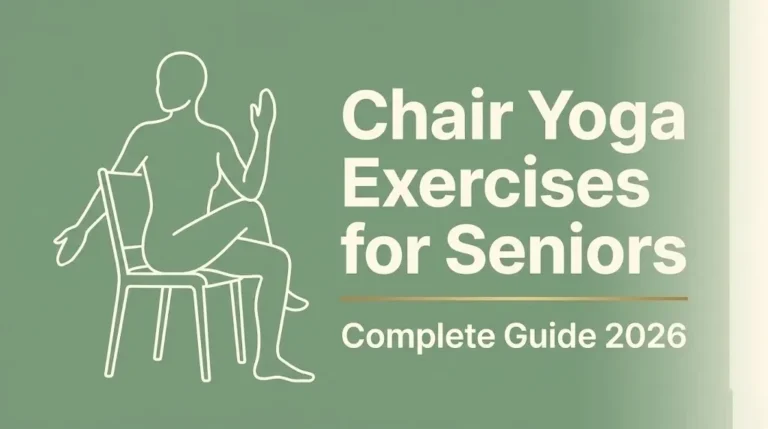
The chair modification deserves special attention for good vibes yoga. A sturdy, non-rolling chair placed beside the mat allows practitioners with any balance limitation to access standing poses like Warrior II and Natarajasana (Dancer’s Pose) with full confidence. The mood-supportive benefit of standing strong in Warrior II is accessible whether the practitioner holds it independently or with one hand on a chair back.
Good Vibes Yoga for Stress and Anxiety
Good vibes yoga is particularly well-suited for stress and anxiety management because it combines the three most evidence-supported non-pharmacological interventions for these conditions: physical movement, controlled breathwork, and present-moment attention.
The NCCIH reports that yoga-based interventions have demonstrated effectiveness for reducing self-reported anxiety in populations including healthcare workers, college students, adults with generalized anxiety disorder, and people managing chronic pain. The effect size in multiple meta-analyses is moderate to large, which places yoga among the most effective non-pharmacological options currently studied.
For practitioners managing acute anxiety or stress, specific good vibes yoga adjustments improve the session’s calming effect:
- Favor passive and restorative shapes over active backbends during high-stress periods. The bolster-supported chest opener and Reclined Bound Angle Pose are particularly effective.
- Extend the exhale to be at least twice the length of the inhale throughout the session. A 4-count inhale paired with an 8-count exhale is a strong starting point.
- Reduce the pace of any Vinyasa transitions. Moving too quickly through poses activates the sympathetic system rather than quieting it.
- End every session with a minimum of 8 minutes in Savasana (Corpse Pose). Shortening this portion significantly reduces the integration benefit of the practice.
For practitioners with panic disorder or post-traumatic stress, breathwork with extended breath retention may trigger rather than reduce anxiety. Using natural breath rhythm throughout the session, while still focusing on the length of the exhale, is the appropriate modification. Working with a yoga therapist trained in trauma-informed practice is worth discussing with a mental health professional managing the specific condition.
Good Vibes Yoga for Seniors
Older adults benefit significantly from a good vibes yoga approach, provided the session is paced appropriately and the poses are adapted for the specific physical considerations that come with age-related changes in flexibility, balance, and joint integrity.
The most beneficial adaptations for senior good vibes yoga practitioners include slowing every transition, adding chair support for standing poses, and emphasizing breath awareness over physical achievement in every section. According to research reviewed by the Journal of Alternative and Complementary Medicine, adapted yoga programs for adults over 65 consistently show improvements in balance, flexibility, pain tolerance, and self-reported mood and quality of life.
A senior-appropriate good vibes yoga session of 30 minutes might include:
- Seated Marjaryasana-Bitilasana (Cat-Cow Pose) in a chair for 8 cycles
- Chair-supported Warrior II for 5 breaths per side
- Seated forward fold for 5 breaths, with hands on thighs rather than reaching to the floor
- Setu Bandha Sarvangasana (Bridge Pose) with a block under the sacrum for 8 breaths
- Ananda Balasana (Happy Baby Pose) with a strap around the feet for 8 breaths
- Savasana for 8 to 10 minutes
Seniors with osteoporosis should avoid any pose that requires deep forward flexion of the spine under load, particularly seated forward folds with additional weight or resistance. A yoga teacher trained in senior or therapeutic yoga can recommend safe alternatives for the forward fold component while preserving the rest of the sequence.
Key Takeaway: Seniors access the full mood and nervous system benefits of good vibes yoga through chair adaptations and slower pacing. The physical simplification does not reduce the physiological benefit.
Good Vibes Yoga for Kids and Families
Good vibes yoga translates naturally into a family practice context because its core principle, yoga should feel good and be accessible, maps perfectly onto what children need from movement.
Children’s yoga does not require children to be still, quiet, or serious. The best kids-oriented good vibes yoga sessions use playful naming for poses, incorporate storytelling or animal sounds, and keep individual pose holds to 3 to 5 breaths rather than the longer holds appropriate for adults. This maintains attention and makes the movement genuinely enjoyable rather than a task.
Effective family-friendly good vibes yoga poses include:
- Adho Mukha Svanasana (Downward-Facing Dog): universally known to kids as “dog pose” and easy to cue playfully
- Balasana (Child’s Pose): introduced as “mouse pose” or “seed pose” for younger children who respond to imaginative framing
- Bhujangasana (Cobra Pose): the “snake pose” with a hissing exhale makes the breath cue fun and memorable
- Virabhadrasana II (Warrior II): kids respond well to the strength feeling of this pose; frame it as a superhero stance
- Ananda Balasana (Happy Baby Pose): almost universally enjoyed; no additional cueing needed for most children
Family sessions work best when they run 20 to 25 minutes and prioritize connection over correctness. The goal is not perfect alignment in any pose. The goal is a shared physical experience that both children and adults find enjoyable and calming.
Research published in Complementary Therapies in Medicine found that children who participated in school-based yoga programs showed measurable improvements in self-regulation and reduced self-reported stress, with effects persisting beyond the duration of the programs.
Good Vibes Yoga At-Home Practice Tips
Building a consistent good vibes yoga home practice requires less equipment than most people assume and more structure than most people apply initially.
The single most important element for a home practice is a dedicated time and cleared space. Research on habit formation consistently shows that environmental cues, a specific mat location, a set time of day, and a brief ritual like lighting a candle or taking three breaths before beginning, are stronger predictors of practice consistency than motivation. Motivation is unreliable. A cleared mat at 7 a.m. is not.
For equipment, a yoga mat is the only non-negotiable. One yoga block and a firm blanket or bolster expand what you can do safely, particularly for hip-opening and chest-opening shapes that are central to the practice. A phone propped on a book works fine as a practice timer.
Practical home practice guidelines:
- Start with 20-minute sessions. Three 20-minute sessions per week build more adaptation than one 60-minute session.
- Use a timer for Savasana. Set it for 8 minutes and commit to staying. The restorative benefit of the practice is largely consolidated in this period.
- Choose one focus per session. Either mood-lifting and energizing sequences in the morning, or calming and stress-relieving sequences in the evening. Mixing intentions within a single short session dilutes both.
- Practice in natural light when possible. Exposure to natural light during morning yoga sessions supports circadian rhythm and enhances the mood-lifting effect through serotonin pathways.
- Record one session per week on your phone. Brief video review identifies alignment errors that internal sensing cannot catch, particularly in Warrior II knee alignment and Downward Dog shoulder positioning.
Good Vibes Yoga vs. Vinyasa and Hatha Yoga
Good vibes yoga is not a competing style with Vinyasa or Hatha yoga. It is a thematic approach that can be applied within either of those styles, or within Restorative yoga as well.
Vinyasa yoga links movement and breath in a continuous flow, with poses transitioning on each inhale and exhale. A good vibes Vinyasa class would select mood-supportive poses as the spine of the sequence, pace the flow to avoid overheating the sympathetic system, and include deliberate rest points rather than maintaining unbroken movement throughout.
Hatha yoga takes a slower, pose-by-pose approach with longer holds and more attention to individual alignment in each shape. A good vibes Hatha class gives practitioners more time to settle into each mood-supportive pose and typically incorporates more guided breathwork between poses. For beginners and anyone managing anxiety, the Hatha format is often more effective because it removes the time pressure of a flowing sequence.
| Feature | Good Vibes Vinyasa | Good Vibes Hatha | Good Vibes Restorative |
|---|---|---|---|
| Pace | Moderate flowing | Slow, pose by pose | Very slow or static |
| Physical intensity | Low to moderate | Low | Minimal |
| Hold time per pose | 1 to 3 breaths | 5 to 10 breaths | 3 to 10 minutes |
| Best for | Intermediate practitioners | All levels, especially beginners | Stress recovery, seniors, health conditions |
| Primary mood tool | Rhythmic movement | Breath-aligned holds | Parasympathetic restoration |
Choosing between these formats depends on your energy level, experience, and what you need from the practice on a given day. Neither is inherently superior. Both deliver the good vibes outcome when taught or self-directed with mood and nervous system regulation as the organizing principle.
Key Takeaway: Good vibes yoga is not a rigid style. It is a thematic lens applied to Vinyasa, Hatha, or Restorative formats, and choosing between them based on your energy level on any given day is itself a good vibes practice decision.
Good Vibes Yoga Intentions and Mindset
Setting an intention before practice is the element that most distinguishes good vibes yoga from a generic yoga session. An intention is not a goal. It is a quality of attention you bring to the practice.
Goals are outcome-focused: I want to touch my toes, I want to lose weight, I want to stop feeling anxious. Intentions are process-focused: I want to move with curiosity, I want to breathe fully, I want to be present without judgment. The distinction matters neurologically. Outcome-focused thinking during exercise activates the prefrontal cortex in a way that maintains analytical mode and reduces the stress-relieving effect of the movement. Process-focused attention supports what psychologist Mihaly Csikszentmihalyi’s research calls “flow state,” a condition associated with reduced self-referential thought and increased positive affect.
Simple intentions that work well in a good vibes yoga context:
- “I practice with curiosity, not judgment”
- “I breathe fully, starting now”
- “I am here, in this body, in this moment”
- “I move for how it feels, not how it looks”
- “I rest when I need to, without apology”
Setting the intention takes 30 seconds at most. Most practitioners take three slow breaths at the start of the session and silently repeat their intention with each exhale. That brief ritual creates a psychological container for the practice that makes every subsequent pose, breath, and rest moment feel purposeful rather than random.
Mindset also means releasing comparison, both with other practitioners and with past versions of yourself. A good vibes yoga practice on a day when everything feels stiff and sluggish is still a complete, valid practice. The nervous system benefits arrive regardless of how graceful the poses look.
Frequently Asked Questions About Good Vibes Yoga
What is good vibes yoga exactly?
Good vibes yoga is a feel-good practice approach that selects poses, sequences, and breathwork to improve mood, reduce stress, and restore energy.
It draws from Vinyasa, Hatha, and Restorative yoga traditions but is organized around the physiological goal of leaving practitioners feeling noticeably better after every session.
It is not a formally certified yoga style but a widely used thematic framework applied by teachers and home practitioners alike.
What are the best poses for a good vibes yoga practice?
The best poses for good vibes yoga include Ananda Balasana (Happy Baby Pose), Virabhadrasana II (Warrior II), Bhujangasana (Cobra Pose), Setu Bandha Sarvangasana (Bridge Pose), and Adho Mukha Svanasana (Downward-Facing Dog).
These poses are selected because they open the hips and chest, support mild spinal extension, and encourage deeper breathing, all of which contribute to the mood-supportive mechanism of the practice.
Cat-Cow and Child’s Pose are equally important as grounding and transitional shapes within the sequence.
How does yoga actually improve your mood?
Yoga improves mood through several measurable neurological pathways, including increased GABA production, reduced cortisol, and improved vagal tone from extended exhale breathing.
A study published in the Journal of Alternative and Complementary Medicine found that a single yoga session produced higher GABA levels than a comparable period of walking, indicating a distinct physiological mechanism.
Rhythmic movement during yoga also reduces activity in the brain’s default mode network, which is associated with rumination and negative self-referential thinking.
Can complete beginners do good vibes yoga?
Complete beginners can practice good vibes yoga effectively from the very first session.
The practice is structured around poses that are accessible at most fitness levels, and the primary goal, feeling better through movement and breath, does not require physical experience or flexibility.
Starting with 20-minute sessions three times per week and building gradually over four to six weeks gives the body time to adapt safely.
How often should I practice good vibes yoga to feel a difference?
Yoga teachers and physical therapists generally recommend practicing three to four times per week for at least four weeks to notice consistent mood and stress-reduction benefits.
The NCCIH notes that yoga’s effects on cortisol and self-reported wellbeing are dose-dependent, meaning regular short sessions outperform occasional long ones.
Even two 20-minute sessions per week will produce measurable improvements in how the body responds to stress over a six-week period.
Pick one pose from this article and practice it today. Child’s Pose and Happy Baby Pose are the lowest-barrier options and both produce genuine nervous system benefits within a single session. You don’t need a full 40 minutes to start.
Build from there. Three sessions per week for four weeks is where most practitioners notice a consistent shift in how they feel, not just during the practice but throughout the day.
The mat is not a performance stage. It is a place you go to feel better. That’s the entire idea.