Wild Thing Yoga: Master Camatkarasana Safely in 2026
Wild thing yoga, known formally as Camatkarasana, is a dynamic backbend that simultaneously opens the chest, stretches the hip flexors, and strengthens the arms, shoulders, and legs. Most practitioners encounter it mid-flow in a Vinyasa class, but it rewards anyone who slows down to understand it properly.
Backbends as a category are among the most studied poses for their effects on mood and posture. According to the National Center for Complementary and Integrative Health (NCCIH), regular yoga practice, including spinal extension work, is associated with measurable improvements in spinal flexibility, mood, and stress-related markers. Wild Thing delivers that spinal extension with a side of full-body coordination that makes it worth learning well.
This article covers everything from the Sanskrit roots of the pose to step-by-step instructions, wrist modifications, senior adaptations, sequencing strategies, and how it compares to its close relative, Flip Dog. Whether you’re new to backbends or refining an existing practice, you’ll find practical, anatomy-specific guidance here.
Wild Thing Yoga: What It Is and Why It Matters
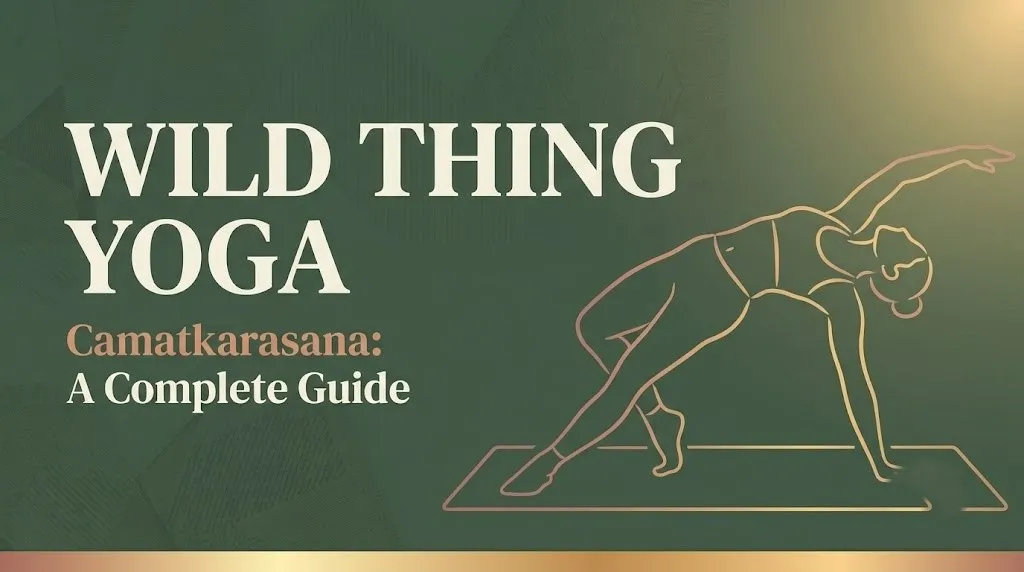
Wild thing yoga is a one-armed supported backbend that flows naturally from poses like Vasisthasana (Side Plank) or Tri Pada Adho Mukha Svanasana (Three-Legged Downward-Facing Dog). The practitioner lifts the hips, arcs the spine into extension, and sweeps the free arm overhead in a gesture of open expansion.
It’s classified as a backbend and a mild arm balance simultaneously. Unlike a deep backbend like Urdhva Dhanurasana (Wheel Pose), Wild Thing keeps one foot grounded while the other sweeps to the floor behind, which distributes load more evenly across the body. That makes it accessible to intermediate practitioners who aren’t yet ready for full wheel.
The pose asks the body to combine shoulder stability, hip flexor mobility, thoracic extension, and wrist strength in one integrated movement. Each of those components needs to be present for the pose to feel supported rather than strained.
Pose Tip:
- Wild Thing is categorized as both a backbend and an arm-supported lateral stretch
- It requires thoracic spine mobility, not just lumbar flexibility
- Practitioners with limited shoulder range or wrist sensitivity need modifications before entering the full expression
Camatkarasana Pose Meaning and Sanskrit Origin
Camatkarasana comes from the Sanskrit root camatkara, which translates roughly to “the ecstatic unfolding of the enraptured heart.” The word captures something the pose physically expresses: an open, upward arc of the chest and sternum toward the sky.
Understanding the name matters practically, not just philosophically. “Enraptured heart” points directly to the anatomical target. The front body, specifically the pectoralis major, anterior deltoid, and intercostals, is where the sensation of opening should be felt. If those areas feel engaged and stretched, the pose is working as intended.
The pose is sometimes also called “Rock Star Pose” in contemporary Vinyasa classes, particularly in studios that prioritize English naming. Both names refer to the same shape. When you see either term in a class or tutorial, know they describe identical alignment.
| Term | Meaning | Context |
|---|---|---|
| Camatkarasana | “Ecstatic unfolding of the heart” | Traditional Sanskrit naming |
| Wild Thing Pose | English translation/adaptation | Common in Vinyasa and Hatha classes |
| Rock Star Pose | Contemporary colloquial name | Used in modern studio environments |
Wild Thing Pose Benefits
The benefits of Wild Thing pose span the musculoskeletal, cardiovascular, and psychological systems in ways that make it more than a flashy transition move. Practiced with correct alignment, it delivers genuine physiological value.
A study published in the International Journal of Yoga found that consistent backbend practice produced measurable improvements in thoracic spine mobility and self-reported energy levels among adult practitioners. Wild Thing, as a supported backbend with an upper body opening component, contributes to both of those adaptations when practiced regularly.
Specific benefits include:
- Chest and shoulder opening: The pectoralis major and anterior deltoid lengthen under load, which counteracts the forward-rounded posture most people develop from prolonged sitting
- Hip flexor lengthening: The iliopsoas and tensor fasciae latae on the sweeping leg get a sustained stretch through the full arc of the movement
- Mood support: Backbends stimulate the sympathetic nervous system briefly before activating the parasympathetic rebound, a pattern associated with improved alertness and mood, according to research reviewed by the Journal of Alternative and Complementary Medicine
- Arm and shoulder strengthening: The supporting arm works isometrically to maintain stability throughout the pose
- Spinal extension: Thoracic and lumbar extension is encouraged in a supported, single-arm context that feels less intense than Wheel Pose
Key Takeaway: Wild Thing yoga is a supported backbend that opens the chest and hip flexors while building shoulder and arm strength, and research supports backbend practice as a tool for both spinal mobility and mood.
What Muscles Does Wild Thing Yoga Work
Wild Thing yoga engages a specific set of muscles across the entire front and lateral body while the posterior chain works to stabilize the pose. Knowing which muscles are active helps you feel the pose more accurately and reduces the risk of overloading any single area.
The supporting arm side carries the most structural load. The wrist extensors stabilize the hand and wrist against the floor. The serratus anterior works to keep the scapula flush against the ribcage rather than winging outward. The rotator cuff muscles, particularly the infraspinatus and supraspinatus, hold the glenohumeral joint in a stable position throughout the arc.
The sweeping leg side stretches the hip flexor chain while the gluteus medius and hip stabilizers on the grounded foot side work to keep the pelvis lifted. The intercostals open with each breath cycle. The rhomboids and mid-trapezius engage to resist shoulder collapse.
| Body Region | Muscles Engaged | Primary Role |
|---|---|---|
| Supporting arm | Wrist extensors, serratus anterior, rotator cuff | Structural stability |
| Chest and front body | Pectoralis major, anterior deltoid | Eccentric lengthening (stretch) |
| Core and lateral torso | Intercostals, obliques | Breath support and lateral stability |
| Hip and pelvis | Iliopsoas, tensor fasciae latae, gluteus medius | Hip lift and flexor lengthening |
| Sweeping leg | Quadriceps, hip flexors | Active extension and sweep |
How to Do Wild Thing Pose Step by Step
Wild Thing pose is typically entered from Adho Mukha Svanasana (Downward-Facing Dog) via a Three-Legged Dog transition, though it can also be entered from Side Plank. The following sequence uses the Downward Dog entry, the most common approach in Vinyasa yoga.
To practice Camatkarasana:
- Begin in Adho Mukha Svanasana (Downward-Facing Dog). Press firmly through all ten fingers. Engage the serratus anterior to keep the shoulder blades stable.
- Inhale and lift your right leg toward the ceiling into Tri Pada Adho Mukha Svanasana (Three-Legged Dog). Keep the hip squared toward the floor initially.
- Bend the right knee and open the hip toward the right wall. This is the pivot point of the transition.
- Begin to shift your weight onto the outer edge of your left foot and rotate onto the left arm, moving into a modified side plank position.
- Let the right foot sweep behind you and plant it on the floor, toes pointed. The right foot should land roughly level with or slightly behind the left foot.
- Press into the left hand and lift the hips toward the ceiling. Stack the left shoulder over the left wrist as closely as possible.
- Let the right arm sweep up and over, reaching toward the floor behind you or simply opening to the ceiling if the shoulder is tight.
- Hold for 3 to 5 breath cycles. Release by lifting the right leg back up and returning through Three-Legged Dog, or simply lowering back to Downward Dog.
Modification for beginners: Keep the right arm lifted straight up toward the ceiling rather than arcing it behind the head. This reduces the demand on the thoracic spine while still allowing the chest to open.
Wild Thing Pose Alignment Tips
Good alignment in Wild Thing pose comes down to three structural priorities: a stable supporting arm, a lifted hip line, and a genuine thoracic extension rather than a lumbar crunch.
The most common error is sinking into the supporting shoulder. Think of the shoulder as a tent pole. If it collapses, everything above it falls. Press the floor away with your supporting hand and actively lift the shoulder away from the ear. That single cue resolves most collapse issues.
The second most common error is letting the hips drop. The hip lift in Wild Thing is what creates the arc of the pose. If the hips sink, the lumbar spine takes excessive compression, and the stretch moves from the intended front-body opening to a lower back pinch.
Pose Tip:
- Supporting wrist should be directly under the supporting shoulder, or very close to it
- Both hips should lift as high as your shoulder mobility allows
- The sweeping arm arc should originate from the thoracic spine rotating open, not just the arm reaching back
- Gaze: either straight up at the ceiling or slightly back, never cranked hard behind you
- Distribute weight evenly across all four points of contact: the supporting hand, the outer edge of the supporting foot, and the planted sweeping foot
Wild Thing Pose Breathing Technique
The breath in Wild Thing follows a specific pattern that supports both the structural demands and the energetic intention of the pose. Entering on an inhale creates the lift and expansion the pose asks for.
Inhale as you sweep the leg through and lift the hips. That inhalation naturally inflates the ribcage, which assists the thoracic expansion. A shallow or held breath during entry makes the chest opening feel forced and often causes the shoulder to collapse under the loss of core tension.
Once you’re in the full expression, maintain Ujjayi breath: a soft, audible breath through the nose with a slight constriction at the back of the throat. According to yoga teachers and physiotherapists who work with breathing mechanics, Ujjayi creates mild intra-abdominal pressure that supports spinal stability during backbends. Hold for 3 to 5 cycles, then exhale on the release.
| Breath Phase | Action | Why It Matters |
|---|---|---|
| Entry | Full inhale as hips lift | Assists thoracic expansion and ribcage lift |
| Hold | Steady Ujjayi breath | Maintains core pressure and spinal support |
| Exit | Exhale as hips lower | Controls the descent and prevents joint compression |
| Recovery | Natural breath in Child’s Pose or Downward Dog | Resets the nervous system after backbend activation |
Key Takeaway: Entering Wild Thing on an inhale and using Ujjayi breath while holding the pose creates the structural support your spine needs and makes the chest opening feel natural rather than forced.
Wild Thing Pose for Beginners
Wild Thing is accessible to beginners who have already developed basic familiarity with Downward-Facing Dog and Side Plank, two poses that build the wrist, shoulder, and hip strength the pose requires. Attempting Wild Thing before those foundations are in place usually results in collapsed shoulders or wrist discomfort.
If you’re new to yoga or have been practicing for less than three months, spend time first building comfort in Vasisthasana (Side Plank). That pose isolates the shoulder stability component without adding the rotational complexity of the sweep. Once Side Plank feels stable for 5 breath cycles, Wild Thing becomes a logical next step.
For beginners entering Wild Thing, use this modified approach:
- Keep the sweeping arm pointed straight up rather than arcing behind the head
- Plant the sweeping foot closer to the supporting foot, reducing the demand on hip flexor length
- Hold for only 2 to 3 breath cycles initially
- Follow every Wild Thing attempt with Balasana (Child’s Pose) for 5 breaths to counter the spinal extension
A 2021 review in Complementary Therapies in Medicine noted that beginner yoga practitioners who progressed through foundational pose sequences before attempting complex transitions reported fewer acute wrist and shoulder incidents than those who jumped directly into advanced poses without preparation.
Wild Thing Pose Modifications and Props
Props make Wild Thing pose safer, more accessible, and more anatomically honest for practitioners at every level. The most useful props are a yoga block, a folded blanket, and the wall.
| Prop | Use | Who It Helps |
|---|---|---|
| Yoga block (under supporting hand) | Raises the floor, reduces wrist extension angle | Practitioners with wrist tightness or mild discomfort |
| Folded blanket (under supporting forearm) | Moves the pose to a forearm-supported version | Practitioners with acute wrist injuries |
| Wall (behind the sweeping foot) | Provides a target for the sweeping foot to press into | Beginners who struggle with hip lift |
| Yoga strap (across chest) | Not applicable to this pose directly | N/A |
| Second block (under sweeping hand) | Supports the sweeping arm if shoulder range is limited | Practitioners with shoulder impingement |
For the forearm modification specifically: instead of pressing through a flat palm, lower the supporting forearm to the floor with the elbow directly under the shoulder. This removes wrist extension entirely and is appropriate for anyone managing carpal tunnel syndrome or recent wrist strain.
Modification for limited hip mobility: if the hips don’t lift high enough to feel comfortable, try practicing the shape supine first. Lie on your back in a bridge-like position to learn the sensation of hip extension and chest opening before adding the arm-support component.
Wild Thing Pose Wrist Modification
Wrist health is the primary structural concern in Wild Thing yoga, and it deserves its own focused guidance rather than a single bullet point at the bottom of a modification list. The standard pose places the wrist in full extension while bearing partial body weight, which is a significant demand for many practitioners.
Think of the wrist in this pose like a bridge bearing traffic. If the bridge’s supports are not well-built, the traffic load causes damage over time. Healthy wrist extension under controlled load is fine. Compromised wrist tissue under load is a different situation entirely.
For practitioners with carpal tunnel syndrome, wrist tendinitis, or hypermobility, the forearm modification is the safest alternative:
- Begin in the same Three-Legged Dog entry
- As you transition, lower the supporting forearm to the floor
- Keep the elbow directly under the shoulder joint
- Complete the hip lift and sweeping leg movement identically to the full version
- Hold for 3 to 5 breaths and release with control
For practitioners with mild wrist tightness rather than an injury, placing a folded mat or yoga block under the heel of the hand shifts the angle of wrist extension and reduces peak load. This is not a long-term workaround. It is a bridge while you build wrist extensor strength through dedicated wrist conditioning work outside your yoga practice.
Anyone who has had wrist surgery within the past year should consult with their physical therapist before attempting any weight-bearing hand position, including this modification.
Key Takeaway: If your wrists are your limiting factor in Wild Thing, the forearm modification preserves the full shape and benefits of the pose while removing wrist extension load entirely.
Wild Thing Pose Contraindications
Wild Thing pose should be avoided or significantly modified in the presence of specific health conditions and injuries. The pose places load on the wrist, shoulder, and lumbar spine simultaneously, which means issues in any of those areas deserve careful attention before attempting it.
Absolute contraindications (skip the pose entirely):
- Rotator cuff tear: The supporting arm shoulder is under significant load throughout. An active tear cannot safely stabilize under this kind of demand.
- Recent spinal surgery: Spinal extension poses require a full surgical clearance from the operating surgeon, not a general medical green light.
- Acute wrist fracture or post-surgical wrist: Even the forearm modification places some load through the elbow and forearm, which may be inappropriate depending on the specific injury.
- Severe carpal tunnel syndrome with acute nerve symptoms: Tingling, numbness, or shooting pain in the hand during any weight-bearing position is a signal to stop and address the condition with a hand specialist first.
Proceed with caution and modification:
- Mild wrist tightness: use the block or forearm modification
- Tight hip flexors or iliotibial band: hold the pose for shorter durations and avoid forcing the hip lift
- Osteoporosis: backbends in general require guidance from a yoga teacher trained in bone health; the American College of Sports Medicine recommends individualized assessment for practitioners with low bone density before engaging in spinal extension loading
Wild Thing Pose for Back Pain
Wild Thing yoga can support a back pain management practice, but only when the source of the pain is understood and the pose is approached with appropriate guidance. Not all back pain responds the same way to spinal extension.
For practitioners with tension-based upper back tightness or thoracic kyphosis (rounded upper back from prolonged sitting), Wild Thing is often genuinely helpful. The thoracic extension component directly counteracts the forward rounding pattern, and the chest opening releases tension in the pectoralis minor, which often pulls the shoulders forward and contributes to upper back strain.
For practitioners with lumbar disc issues, the situation is more nuanced. Spinal extension poses can decompress certain disc presentations (posterior disc bulges may benefit) while aggravating others (anterior bulges or stenosis may worsen with extension). A physical therapist or spine specialist familiar with your imaging can tell you which direction your spine responds to.
According to the NCCIH, yoga has been shown in multiple clinical trials to reduce chronic low back pain scores, with several studies demonstrating benefits comparable to physical therapy for non-specific lower back pain. However, the NCCIH consistently notes that the pose selection within those programs matters, and not every pose is appropriate for every back pain presentation.
Never push through sharp or radiating pain during any backbend. Dull muscular fatigue is normal. Electrical, shooting, or joint-specific pain is a signal to stop.
Wild Thing Pose Senior Modifications
Older adults can practice Wild Thing safely with targeted modifications that reduce joint load while preserving most of the pose’s benefits. The key adaptation areas are the wrist, the shoulder, and the transition into and out of the pose.
The transition from Downward Dog through Three-Legged Dog and into Wild Thing involves a rotational movement that happens quickly in Vinyasa-paced classes. Seniors or practitioners with joint sensitivity should slow that transition down significantly or enter the pose from a stationary Side Plank instead, which removes the rotational momentum.
A chair-supported version is also available for practitioners who cannot safely support full body weight through one arm:
- Sit sideways on a sturdy, non-rolling chair
- Place both hands on the seat beside the hips
- Shift weight to the outer edge of one thigh and one hand while lifting the opposite arm overhead
- This creates a modified lateral backbend shape with significantly reduced joint load
Research reviewed in the Journal of Alternative and Complementary Medicine indicates that adapted yoga programs for adults over 65 show meaningful improvements in balance, hip mobility, and self-reported quality of life. Wild Thing, adapted appropriately, contributes to hip flexor length and shoulder mobility, two areas strongly associated with fall risk reduction in older adults.
Seniors with osteoporosis should avoid the full weight-bearing version and use the chair adaptation or forearm modification, with guidance from a yoga teacher trained in senior or therapeutic yoga.
Key Takeaway: Seniors can access the chest-opening and hip-stretching benefits of Wild Thing through a chair adaptation or a forearm-supported version, both of which are legitimate expressions of the pose rather than lesser substitutes.
Wild Thing Pose Advanced Variations
Advanced practitioners can deepen Wild Thing by increasing the demand on shoulder mobility, hip flexor length, and spinal extension, all without compromising the foundational alignment that makes the pose safe.
The most common advanced variation is extending the sweeping arm all the way behind the head and lowering it toward the floor, creating a full overhead reach that intensifies the anterior deltoid and pectoralis minor stretch. This is only appropriate when the thoracic spine has sufficient mobility to support the rotation without collapsing into the lumbar spine instead.
A second advanced variation involves lifting the sweeping leg off the floor mid-pose, essentially returning to a Three-Legged Downward Dog shape from inside the Wild Thing arc. This significantly increases the demand on the supporting arm, core, and hip stabilizers.
| Variation | Added Challenge | Prerequisites |
|---|---|---|
| Arm swept fully overhead to floor | Deeper pectoralis and anterior deltoid stretch | Good thoracic rotation and shoulder mobility |
| Sweeping leg lifted mid-pose | Increased arm and core load | Strong serratus anterior and wrist stability |
| Held for 8 to 10 breath cycles | Endurance demand on supporting structures | Established pose comfort at 5 breaths |
| Flowing between Wild Thing and Side Plank | Strength-through-range work | Smooth, controlled transitions at full pace |
| Entered directly from Wheel Pose | Complex transition, deep spinal extension | Advanced backbend practice and teacher supervision |
Do not attempt the flowing Wild Thing to Side Plank sequence at full Vinyasa pace until the individual hold is completely stable. Rushing the progression is the most common way experienced practitioners sustain wrist and shoulder strain.
Wild Thing Yoga Sequence and Flow
A well-designed Wild Thing yoga sequence prepares the body progressively, enters the pose from a position of readiness, and transitions out safely without abrupt loading or decompression. Entering cold is the fastest way to make a pose feel forced.
A practical preparatory sequence, suitable for intermediate practitioners:
- Balasana (Child’s Pose): 5 breaths to open the hips and establish breath awareness
- Adho Mukha Svanasana (Downward-Facing Dog): 5 breaths to warm the shoulders, wrists, and hamstrings
- Vasisthasana (Side Plank, both sides): 5 breaths each to build supporting arm stability
- Anjaneyasana (Low Lunge): 5 breaths each side to begin opening the hip flexors
- Tri Pada Adho Mukha Svanasana (Three-Legged Dog): 3 breaths each side to practice the hip opening
- Camatkarasana (Wild Thing): 3 to 5 breaths each side
After Wild Thing, the body benefits from a counter-pose that neutralizes the spinal extension. Balasana (Child’s Pose) or Apanasana (Knees-to-Chest Pose) both work well. Avoid jumping directly into a deep forward fold immediately after a backbend, as the rapid directional shift can create lumbar discomfort.
In a full Vinyasa class, Wild Thing typically appears in the standing sequence or as a peak pose in a shoulder- and chest-opening themed practice.
Wild Thing Pose vs. Flip Dog
Wild Thing (Camatkarasana) and Flip Dog (Viparita Svanasana) are related but distinct poses, and conflating them leads to alignment errors in both. Many yoga teachers use the terms interchangeably, which creates confusion. The difference matters for how you place your foot and how deeply you arc the spine.
In Wild Thing, the sweeping foot plants behind the body with the toes pointed and the foot relatively close to the supporting hand. The hips lift but the emphasis is on the lateral chest and shoulder opening, with the gaze directed to the ceiling or slightly back.
In Flip Dog (Viparita Svanasana), the sweeping foot plants further behind and the practitioner reaches the sweeping hand all the way to the floor, creating a deeper spinal extension and a shape that more closely resembles a full backbend. The hips typically rise higher and the thoracic extension is more pronounced.
| Feature | Wild Thing (Camatkarasana) | Flip Dog (Viparita Svanasana) |
|---|---|---|
| Sweeping foot placement | Close behind body, toes pointed | Further back, creating more extension |
| Sweeping arm | Lifted toward ceiling or slightly behind | Reaches all the way to the floor |
| Spinal arc | Moderate thoracic and lumbar extension | Deeper extension, more like a full backbend |
| Intensity level | Intermediate | Intermediate to advanced |
| Primary focus | Lateral chest and shoulder opening | Full anterior body lengthening |
If a teacher cues “Flip Dog” and your sweeping hand doesn’t reach the floor, stay in Wild Thing. That’s the correct pose for your current range. Forcing the deeper shape before the shoulder and spinal mobility supports it causes exactly the kind of shoulder strain that gives backbends a bad reputation.
Frequently Asked Questions About Wild Thing Yoga
What is wild thing yoga pose good for?
Wild Thing yoga is good for opening the chest and shoulders, stretching the hip flexors, and building supporting arm strength.
It also provides a moderate spinal extension that counteracts the rounded-forward posture associated with prolonged sitting.
According to research reviewed by the NCCIH, regular backbend practice supports both spinal mobility and self-reported mood.
How do you do wild thing pose step by step?
Start in Downward-Facing Dog, lift one leg into Three-Legged Dog, bend the knee and open the hip, then rotate onto the outer edge of your grounded foot.
Plant the sweeping foot behind you, press into the supporting hand, lift the hips, and sweep the free arm toward the ceiling or behind the head.
Hold for 3 to 5 breath cycles, then release back through Three-Legged Dog.
Is wild thing pose safe for beginners?
Wild Thing is accessible to beginners who are already comfortable in Downward-Facing Dog and Side Plank, two poses that build the wrist and shoulder strength the pose requires.
Beginners should keep the sweeping arm lifted toward the ceiling rather than arcing it behind the head, and should hold for only 2 to 3 breath cycles initially.
Spending time in Side Plank before attempting Wild Thing significantly reduces the risk of shoulder strain.
What is the difference between wild thing and flip dog?
Wild Thing (Camatkarasana) and Flip Dog (Viparita Svanasana) are different poses despite being commonly confused.
In Wild Thing, the sweeping hand lifts toward the ceiling and the foot plants relatively close behind the body. In Flip Dog, the sweeping hand reaches all the way to the floor and the spinal extension is deeper.
Flip Dog requires more shoulder mobility and spinal range, making Wild Thing the appropriate starting point for most practitioners.
What muscles does wild thing yoga work?
Wild Thing works the wrist extensors, serratus anterior, and rotator cuff in the supporting arm; the pectoralis major and anterior deltoid in the front body; and the iliopsoas, tensor fasciae latae, and gluteus medius through the hips and sweeping leg.
The intercostals and obliques engage throughout to support lateral stability and breath expansion.
The rhomboids and mid-trapezius work isometrically to prevent the supporting shoulder from collapsing.
Start with a single round of Wild Thing on each side, preceded by at least one round of Side Plank. Notice where you feel the most resistance, whether that is the wrist, the shoulder, or the hip flexor. That tells you exactly where your prep work should focus.
Practice Wild Thing two to three times per week as part of a broader chest- and shoulder-opening sequence. Over weeks, the pose will ask less of your flexibility and more of your strength, which is when it becomes genuinely satisfying to hold.
You do not need to reach Flip Dog to get the full value of this pose. Wild Thing, practiced well, is already doing a lot.