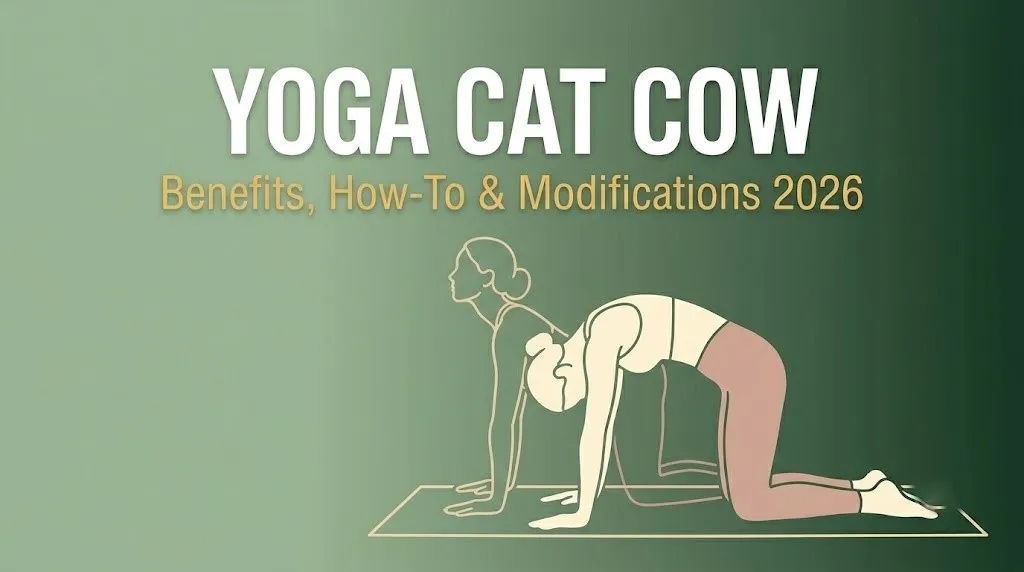
Yoga Cat Cow: Benefits, How-To, and Modifications 2026
The yoga cat cow movement is one of the most effective spinal mobility exercises available to practitioners of any level. It pairs two complementary poses, Marjaryasana (Cat Pose) and Bitilasana (Cow Pose), into a flowing breath-linked sequence that gently moves every segment of the spine.
Research published in the Complementary Therapies in Medicine has found that regular spinal mobilization exercises reduce chronic lower back pain intensity and improve functional movement. Cat cow delivers this mobilization in a safe, low-load format that almost anyone can access.
This guide covers exactly how to perform the movement, which muscles it targets, what the research actually says about its benefits, and how to adapt it for your body. Whether you are brand new to yoga, managing a back condition, or refining a long-standing practice, you will find something practical here.
Yoga Cat Cow: What It Is and Why It Matters
The yoga cat cow sequence is a two-pose spinal warm-up that moves the spine through its natural range of motion using breath as a guide. It is practiced on hands and knees and alternates between spinal flexion in cat and spinal extension in cow.
This is not a passive stretch. The movement actively engages your core musculature, erector spinae, and multifidus while also mobilizing the sacroiliac joint and every vertebral segment from the cervical spine through the lumbar spine.
Physical therapists and yoga teachers recommend it as a foundational warm-up because it prepares the spine for more demanding movement without placing compressive load on the vertebral discs. It is also used as a standalone therapeutic practice for desk workers and people with chronic back stiffness.
Pose Tip:
- Cat cow is a sequence, not a single pose. Both positions are equally important.
- The movement should originate from your tailbone and ripple up through each vertebra.
- Beginners often rush the motion; slowing it down produces better spinal articulation and more benefit.
Cat-Cow Yoga Pose: Understanding the Two-Part Movement
The cat-cow yoga pose is actually two distinct poses linked by breath into one continuous movement. Bitilasana (Cow Pose) is the inhale phase, where the spine extends and the chest opens. Marjaryasana (Cat Pose) is the exhale phase, where the spine flexes and the belly draws toward the ceiling.
Each phase serves a different mechanical purpose. Cow pose stretches the front body, including the hip flexors, rectus abdominis, and anterior chest muscles. Cat pose strengthens and lengthens the back body, including the multifidus, rhomboids, and trapezius.
Together, they create what movement specialists call reciprocal inhibition: as one muscle group contracts, the opposing group releases. Think of it like wringing out a damp cloth. Each pass through the movement squeezes and flushes the tissues in a different direction.
| Phase | Sanskrit Name | Spinal Movement | Primary Muscles Activated |
|---|---|---|---|
| Inhale | Bitilasana (Cow Pose) | Extension | Hip flexors, erector spinae, anterior chest |
| Exhale | Marjaryasana (Cat Pose) | Flexion | Rectus abdominis, multifidus, trapezius, rhomboids |
Cat and Cow Yoga Pose: The Anatomy Behind the Sequence
The cat and cow yoga pose engages far more anatomy than most people realize. This is not just a “gentle stretch.” It is a multi-joint, multi-plane movement that touches nearly every soft tissue structure of the back.
The erector spinae group runs along either side of the vertebral column. It lengthens during cat and contracts during cow. The transverse abdominis, your deepest core stabilizer, engages throughout both phases to protect the lumbar spine from collapsing.
Your intervertebral discs also benefit. Discs are fluid-filled structures that receive nutrition through movement rather than direct blood supply. The alternating compression and decompression created by cat cow helps circulate fluid through disc tissue, supporting disc health over time. According to research cited by the National Center for Complementary and Integrative Health, movement-based yoga practices show measurable positive effects on lumbar disc health in adults with chronic low back conditions.
Key muscles engaged include:
- Erector spinae: Control spinal extension in cow phase
- Multifidus: Stabilize individual vertebrae throughout both phases
- Rectus abdominis: Actively flexes the spine in cat phase
- Transverse abdominis: Provides deep core support throughout
- Quadratus lumborum: Stabilizes the lumbar-pelvic connection
- Trapezius and rhomboids: Support shoulder blade positioning throughout
Key Takeaway: Cat cow is not a passive stretch. It actively recruits your deepest core stabilizers, mobilizes every spinal segment, and supports disc hydration through rhythmic compression and decompression.
How to Do Cat Cow Yoga Pose: Step-by-Step Instructions
To practice Marjaryasana-Bitilasana (Cat-Cow Pose):
- Start on hands and knees. Place your wrists directly under your shoulders and your knees directly under your hips. Your fingers spread wide on the mat.
- Set a neutral spine to begin. Your back is flat, your neck is long, and your gaze is slightly forward of your hands.
- Inhale slowly. Drop your belly toward the mat, lift your chest forward and up, and gently let your tailbone rise. This is Bitilasana (Cow Pose). Do not crank your head back; let the neck follow the natural curve of the upper spine.
- Exhale fully. Press the mat away with your hands, round your entire spine upward, draw your navel toward your spine, and tuck your tailbone under. Drop your head naturally. This is Marjaryasana (Cat Pose).
- Hold each position for one full breath cycle before transitioning. Move slowly between poses, vertebra by vertebra.
- Continue for 5 to 10 complete breath cycles, then return to neutral and rest in Balasana (Child’s Pose) if needed.
Modification for beginners: Place a folded blanket under your knees to reduce pressure on the knee joints. Move through a smaller range of motion until your spine warms up.
Modification for wrist sensitivity: Lower onto your forearms with elbows under your shoulders. The movement is identical; the forearm position removes wrist load entirely.
Cat Cow Pose Muscles Worked: A Complete Breakdown
The cat cow pose muscles worked span three major functional groups: spinal mobilizers, core stabilizers, and shoulder girdle supporters. Understanding which muscles are doing what helps you refine your form and get more from each repetition.
During Cow Pose (Bitilasana), the erector spinae actively contracts to produce spinal extension. The hip flexors stretch as the pelvis tilts anteriorly. The pectorals and anterior deltoids lengthen as the chest opens.
During Cat Pose (Marjaryasana), the rectus abdominis shortens to produce spinal flexion. The multifidus and quadratus lumborum eccentrically lengthen to control the rounding. The rhomboids and middle trapezius stretch as the shoulder blades separate.
| Muscle Group | Phase Active | Function |
|---|---|---|
| Erector spinae | Cow (Bitilasana) | Spinal extension |
| Rectus abdominis | Cat (Marjaryasana) | Spinal flexion |
| Multifidus | Both phases | Vertebral stabilization |
| Transverse abdominis | Both phases | Deep core protection |
| Rhomboids | Cat (Marjaryasana) | Scapular protraction, lengthening |
| Quadratus lumborum | Both phases | Lumbar-pelvic stability |
| Hip flexors | Cow (Bitilasana) | Anterior pelvic tilt |
One thing most guides miss: the wrists, elbow joints, and shoulder girdle are working isometrically throughout the entire sequence. They are holding your body weight in table-top while the spine moves above them. This is why wrist modifications matter for anyone with upper extremity issues.
Cat Cow Yoga Pose Benefits: What Research Actually Shows
The cat cow yoga pose benefits range from improved spinal mobility to nervous system regulation. The research supporting these outcomes is more substantial than most online guides suggest.
A study published in the International Journal of Yoga found that yoga-based spinal mobilization exercises, including cat-cow sequences, produced measurable reductions in lower back pain intensity and improved functional movement scores in adult participants after eight weeks of consistent practice.
The American College of Sports Medicine acknowledges movement-based yoga as a valid complementary intervention for musculoskeletal health, specifically citing spinal mobility work as beneficial for sedentary adults and people in desk-based occupations.
Beyond the spine, cat cow activates the parasympathetic nervous system through breath synchronization. Slow, diaphragmatic breathing during movement has been linked in multiple studies to reduced cortisol levels and improved heart rate variability. This is why the pose often feels calming even though it is physically active.
Benefits include:
- Spinal mobility: Increases range of motion through all spinal segments
- Disc health: Supports fluid circulation in intervertebral discs
- Core activation: Engages deep stabilizers without compressive spinal load
- Posture correction: Counters the effects of prolonged sitting and forward-head posture
- Nervous system regulation: Slow breath-linked movement activates the parasympathetic response
- Pain reduction: Research supports reduction in chronic lower back pain with consistent practice
- Body awareness: Develops proprioceptive sensitivity in the spine and pelvis
Key Takeaway: Cat cow’s benefits are not just mechanical. The breath component activates the parasympathetic nervous system, making this a recovery tool as much as a mobility tool.
Cat Cow Pose for Back Pain: Does It Actually Help?
Cat cow pose for back pain has strong support in both yoga research and physical therapy literature. It is one of the most commonly recommended exercises by physical therapists for people with non-specific chronic lower back pain.
A review published in Complementary Therapies in Medicine found that yoga interventions including spinal flexion and extension movements produced clinically meaningful reductions in pain and disability in adults with chronic lower back pain. Cat cow was among the movement patterns most consistently included in effective protocols.
The mechanism is straightforward. Most lower back pain linked to sedentary behavior involves stiffness in the lumbar facet joints and shortening of the erector spinae and hip flexors. Cat cow directly addresses both by moving those structures through their full range under minimal load.
That said, cat cow is not appropriate for all back pain presentations. People with active disc herniation accompanied by nerve symptoms, spinal stenosis with leg pain, or compression fractures should check with their treating physical therapist or spine specialist before including spinal flexion exercises. Not all back pain responds to the same movement patterns.
Pose Tip:
- Start with a smaller range of motion if your back is acutely painful.
- The goal is gentle mobilization, not maximum stretch.
- Stop immediately if you feel sharp, shooting, or radiating pain during either phase.
Cat Cow Pose Breathing: Why Breath Is the Foundation
Cat cow pose breathing is not optional decoration. The breath is what transforms this from a mechanical exercise into a yoga practice with nervous system benefits.
The rule is straightforward: inhale into Cow Pose (Bitilasana) and exhale into Cat Pose (Marjaryasana). This pairing is anatomically logical. Inhalation naturally expands the chest and tilts the pelvis anteriorly, making the cow shape easier. Exhalation naturally draws the abdominal muscles inward, supporting the spinal flexion of cat.
Using Ujjayi breath (victorious breath, a soft ocean-sound breath created by slightly constricting the back of the throat) lengthens each breath cycle and deepens the neurological calming effect. Yoga teachers and physical therapists generally recommend a 4-count inhale and 4-count exhale during cat cow, though any slow, controlled breathing pattern produces similar results.
Research published in the Journal of Alternative and Complementary Medicine found that slow yogic breathing during movement practice significantly reduced perceived exertion and anxiety scores compared to the same movements performed without breath awareness. The breath is doing real physiological work here, not just slowing you down.
Do not hold your breath between positions. A common error is inhaling into cow and pausing before exhaling into cat. Maintaining continuous breath flow keeps the nervous system regulated and the movement smooth.
How Many Times Should You Do Cat Cow?
Most yoga teachers and physical therapists generally recommend 5 to 10 complete breath cycles of cat cow per session, performed slowly and with full spinal articulation in each direction.
That amounts to roughly 2 to 4 minutes of movement at a controlled pace. For general spinal health and warm-up purposes, one set of 8 to 10 cycles before your yoga practice or morning movement routine is effective.
For people using cat cow therapeutically, such as for chronic back stiffness or posture correction, practicing twice daily, morning and evening, produces better outcomes than one longer single session. The Spine Journal and related physical therapy literature support frequency over duration for spinal mobilization interventions.
| Goal | Recommended Cycles | Frequency |
|---|---|---|
| General warm-up | 5 to 8 cycles | Before yoga or exercise |
| Back pain management | 8 to 10 cycles | Twice daily |
| Morning stiffness relief | 5 to 6 cycles | Upon waking |
| Stress and nervous system regulation | 8 to 10 cycles with Ujjayi breath | Daily or as needed |
| Senior spinal maintenance | 5 to 8 cycles, slow pace | Daily |
There is no upper limit that makes the pose harmful for most people. The limiting factor is usually your attention and breath quality, not repetition count. When the movement becomes mechanical and the breath disconnects, stop and rest.
Key Takeaway: For back pain and posture, frequency matters more than session length. Two shorter sessions per day outperform one long session for spinal mobilization benefits.
Cat Cow Pose for Beginners: Starting the Right Way
Cat cow for beginners is genuinely accessible, but “accessible” does not mean there is nothing to learn. The setup position alone has several details that beginners routinely miss.
The most common beginner error is placing the hands too far forward or the knees too far back. This forces the wrists into excessive extension and flattens the lumbar curve before the movement even begins. Wrists under shoulders and knees under hips is not a suggestion; it is the mechanical foundation the entire movement depends on.
The second common issue is moving the neck independently of the spine. In Cow Pose, beginners often force the chin up toward the ceiling, compressing the cervical vertebrae. The neck should follow the natural arc of the rest of the spine, not lead it. The gaze naturally lifts slightly in cow and naturally drops in cat.
Beginner modifications:
- Knee padding: Fold your mat or place a blanket under your knees if they are sensitive on hard floors.
- Reduced range: Move through 50% of the available range for the first several sessions. Let the spine warm up gradually.
- Hand placement: Spread your fingers wide and press through all four corners of each hand to distribute wrist load.
- Wall support: Beginners with wrist issues can practice a standing version with hands on a wall at shoulder height, mirroring the same spinal movement while standing.
Practice cat cow slowly enough that you can feel each vertebra participating in the movement. If you are rushing, you are moving too fast.
Cat Cow Pose Modifications: Adapting for Every Body
Cat cow pose modifications make this sequence available to people who cannot comfortably access the standard hands-and-knees position. The underlying movement pattern, spinal flexion and extension with breath, can be performed in multiple different positions.
The standard modifications address four common limiting factors: wrist pain, knee pain, shoulder instability, and limited floor mobility. Each has a solution that preserves the benefit of the movement.
| Limitation | Modification | How It Helps |
|---|---|---|
| Wrist pain | Fists or forearms on mat | Reduces wrist extension load |
| Knee pain | Folded blanket under knees | Adds cushioning and reduces compression |
| Shoulder instability | Reduce forward weight shift, tighten the core | Decreases load on shoulder girdle |
| Cannot get to the floor | Chair or standing wall version | Removes floor requirement entirely |
| Disc herniation | Smaller range of motion, neutral pelvis | Reduces spinal load during flexion |
| Pregnancy (second trimester onward) | Wider knee stance, shallower flexion | Accommodates belly, reduces pressure |
For practitioners with wrist pain, making fists and pressing the knuckles into the mat is often more comfortable than open hands. Some yoga equipment suppliers offer wrist wedges that reduce extension angle by 15 to 20 degrees, which can make a significant difference for people with wrist arthritis or carpal tunnel sensitivity.
Always tell your yoga teacher about any physical limitations before class. A good instructor will offer modifications without being asked, but they can only do so if they know what you are working with.
Cat Cow Pose on a Chair: The Seated Version
The cat cow pose on a chair is the most practical modification for people who cannot safely get to the floor. It produces the same spinal flexion-extension movement with full weight bearing through the pelvis rather than the wrists.
Sit toward the front edge of a sturdy, non-wheeled chair. Place your feet flat on the floor, hip-width apart. Rest your hands on your thighs.
To practice seated cat cow:
- Sit tall with a neutral spine. Feet flat on the floor. Hands resting on thighs.
- Inhale and gently arch your lower back, lifting your chest, drawing your shoulders back and down. This is the cow shape. Your tailbone moves slightly backward.
- Exhale and round your spine, drawing your navel gently inward, dropping your chin toward your chest, and curling your tailbone under. This is the cat shape.
- Move slowly between the two positions for 5 to 8 cycles, guided by your breath.
- Return to neutral and pause for two natural breaths.
The chair version is equally effective at mobilizing the thoracic and lumbar spine. According to yoga teachers and physical therapists who specialize in chair yoga, the seated position also reduces fear of falling and makes the practice more sustainable for older adults and people in post-surgical recovery.
No props other than a sturdy chair are required. The floor is optional.
Key Takeaway: The chair version is not a lesser version of cat cow. For many older adults and people with floor mobility limitations, it is simply the right version for their body.
Cat Cow Pose During Pregnancy: Safety and Adaptation
Cat cow pose during pregnancy is widely recommended by prenatal yoga teachers and midwives as one of the safest and most beneficial movements throughout all three trimesters. The hands-and-knees position itself is therapeutic during pregnancy, taking direct weight off the lumbar spine and sacroiliac joint.
In the first trimester, the standard version of the pose is generally appropriate for most people. As the pregnancy progresses, two adaptations improve both comfort and safety.
First, widen your knee stance to create room for the growing belly. A wider base also provides better pelvic stability. Second, moderate the depth of cat pose flexion. Very deep spinal flexion in the late second and third trimesters may be uncomfortable and is not necessary for the movement to be beneficial.
According to the American College of Obstetrics and Gynecology’s guidance on exercise during pregnancy, weight-bearing positions on hands and knees are appropriate throughout uncomplicated pregnancies and can help with fetal positioning in the third trimester. Cat cow’s gentle pelvic rocking has also been used in labor preparation to encourage optimal fetal alignment.
Avoid cat cow during pregnancy if you have been advised to restrict physical activity, if you have diagnosed placenta previa, or if any position produces pelvic pain, pressure, or discomfort. Consulting your midwife or obstetrician before starting or continuing any yoga practice during pregnancy is appropriate care, not excessive caution.
Cat Cow Yoga for Seniors: Benefits and Safe Practice
Cat cow yoga for seniors addresses two of the most common physical challenges that come with age: reduced spinal mobility and weakened deep core stabilizers. Both can be safely and progressively improved through consistent cat cow practice.
As the spine ages, the intervertebral discs lose hydration and the facet joints develop reduced range of motion. This is a normal aging process, but sedentary behavior accelerates it dramatically. Cat cow’s rhythmic mobilization of every spinal segment directly counters this degeneration pattern.
A study published in the Journal of Alternative and Complementary Medicine found that older adults who practiced yoga interventions including spinal mobilization exercises showed improved balance scores, reduced fall risk indicators, and better self-reported quality of life after 12 weeks. While cat cow alone cannot claim all those outcomes, it is a consistent element of the yoga sequences studied.
For seniors, the following adaptations make cat cow safer and more sustainable:
- Use the chair version if getting to the floor and back up is a barrier or a fall risk.
- Slow the pace to one full breath cycle every 6 to 8 seconds. Slower movement produces better spinal articulation for older adults.
- Use a folded blanket under the knees on the floor version. Knee joint padding matters more with age.
- Start with 4 to 5 cycles and build gradually. Connective tissue in older adults responds better to gradual progression.
- Avoid the floor version if you have unmanaged osteoporosis affecting the wrists or spine without first getting clearance from a bone health specialist.
Cat Cow Pose for Sciatica: What Works and What to Watch
Cat cow pose for sciatica requires more nuance than most yoga guides provide. Sciatica is not one condition; it is a symptom that can arise from several different causes, including disc herniation, piriformis syndrome, spinal stenosis, or sacroiliac joint dysfunction. The right movement approach depends on the underlying cause.
For sciatica caused by piriformis syndrome or sacroiliac joint irritation, cat cow is generally well-tolerated and may be directly helpful. The gentle mobilization of the pelvic girdle and lumbar spine reduces compressive tension around the sciatic nerve pathway.
For sciatica caused by lumbar disc herniation with nerve root compression, the cat phase, which involves full spinal flexion, may aggravate symptoms. In this case, the cow phase performed alone, or a modified neutral-spine version, is preferable. Physical therapists often describe this as an extension-biased approach.
Before using cat cow to manage sciatic symptoms, work with a physical therapist or spine specialist to identify the source of your symptoms. The right movement pattern for one person can worsen symptoms in another, depending on what is irritating the nerve.
Signs to stop immediately:
- Increased shooting or radiating pain down the leg during either phase
- Numbness or tingling that worsens during the movement
- Any sensation of electrical shock through the leg or foot
Key Takeaway: Cat cow can be a powerful tool for sciatica relief, but only if you know the cause. The right movement pattern depends entirely on what is irritating the sciatic nerve.
Cat Cow vs Child’s Pose: Which One Should You Choose?
Cat cow and Balasana (Child’s Pose) are both foundational yoga positions that appear in nearly every Hatha and Vinyasa class. They serve different purposes and are not interchangeable.
Cat cow is an active, dynamic movement. It mobilizes the spine through repetitive flexion and extension, engages core musculature, and synchronizes breath with movement. It produces spinal articulation and muscle activation simultaneously.
Child’s Pose is a passive, static hold. It places the spine in a single position of mild flexion and uses gravity and time to release tension in the lower back, hips, and posterior shoulder muscles. It is restorative rather than mobilizing.
| Feature | Cat Cow (Marjaryasana-Bitilasana) | Child’s Pose (Balasana) |
|---|---|---|
| Movement type | Dynamic, repetitive | Static, passive |
| Spinal action | Flexion and extension alternating | Mild sustained flexion |
| Core engagement | Active throughout | Minimal |
| Breath role | Drives movement | Allows deeper relaxation |
| Primary benefit | Spinal mobility, warm-up | Passive release, recovery |
| Best used for | Beginning a practice, back stiffness | Rest between poses, cool-down |
| Duration | 5 to 10 breath cycles | 1 to 3 minutes |
In practice, they work best together. Cat cow warms up and mobilizes the spine. Child’s Pose provides rest and passive release afterward. You lose something by choosing one and skipping the other.
Cow Position in Yoga: Understanding Bitilasana on Its Own
The cow position in yoga, practiced as standalone Bitilasana (Cow Pose), is sometimes held for longer periods in Yin or Restorative yoga contexts rather than being flowed through dynamically. Understanding what makes cow pose distinct from the full cat cow sequence helps practitioners use it more intentionally.
In its isolated form, Bitilasana involves a clear anterior pelvic tilt, the tailbone rises and the ASIS (anterior superior iliac spine) drops forward. The chest opens and the thoracic spine extends. The cervical spine gently extends in the same arc, though it should never be forced into maximum range.
Holding cow pose for 5 to 10 breath cycles, rather than moving through it, targets a longer stretch of the hip flexors, anterior thoracic chain, and abdominal wall. This is the approach used in Yin yoga, where the goal is connective tissue rather than muscular release.
In standard Hatha and Vinyasa contexts, cow pose is always the inhale phase of the cat cow sequence. It is rarely practiced independently in those styles. Iyengar yoga is the style most likely to hold Bitilasana as a separate pose with precise alignment cues and the potential use of props like a yoga block under the chest or a strap around the pelvis.
For most practitioners in 2026, knowing the distinction between the dynamic and held versions of cow allows you to choose based on what your body and practice need that day.
Cat Cow in a Yoga Flow Sequence: How to Use It Effectively
Cat cow in a yoga flow sequence functions best as a warm-up at the start of practice or as a transitional reset between more demanding poses. It is one of the most versatile sequencing tools available.
In a standard Vinyasa or Hatha class, cat cow typically appears in the first 5 to 10 minutes. It signals to the spine and nervous system that movement is beginning, gradually increasing circulation in the spinal muscles and lubricating the facet joints before more load is applied.
A practical warm-up sequence using cat cow as the anchor:
- Balasana (Child’s Pose), 5 breaths, to begin settling into the body.
- Marjaryasana-Bitilasana (Cat-Cow), 8 breath cycles, to mobilize the spine.
- Adho Mukha Svanasana (Downward-Facing Dog), held 5 breaths, to lengthen the posterior chain after the mobilization.
- Return to table-top, then transition into your standing sequence or seated work.
Cat cow can also be used mid-sequence as a reset after strong backbends like Ustrasana (Camel Pose) or Urdhva Dhanurasana (Wheel Pose). A few slow cat cow cycles after an intense backbend helps neutralize the spine and settle the nervous system before moving on.
According to yoga teacher training curricula endorsed by Yoga Alliance, intelligent sequencing includes both mobilization and stabilization phases. Cat cow handles the mobilization phase more efficiently than almost any other pose available to yoga teachers.
Key Takeaway: Cat cow belongs at the beginning of every yoga session and deserves a permanent spot in any therapeutic or maintenance routine. It does more mechanical and neurological work per minute than most people realize.
Frequently Asked Questions About Yoga Cat Cow
What does cat cow yoga do for your body?
Cat cow yoga mobilizes every segment of the spine through alternating flexion and extension while activating the deep core stabilizers and synchronizing movement with breath.
It improves spinal mobility, supports intervertebral disc health, reduces lower back stiffness, and activates the parasympathetic nervous system when performed with slow, controlled breathing.
Research published in the International Journal of Yoga supports its use as an effective intervention for chronic lower back pain and reduced functional mobility.
How many times should you do cat cow per day?
Most yoga teachers and physical therapists recommend 5 to 10 complete breath cycles per session, performed once or twice daily for general spinal health.
For people managing chronic back pain or morning stiffness, two sessions per day, one in the morning and one in the evening, produces better outcomes than one longer session.
Start with 5 cycles and gradually build to 10 as your spine warms up and your breath control improves.
Is cat cow yoga good for lower back pain?
Cat cow is one of the most well-supported yoga movements for non-specific chronic lower back pain, recommended by physical therapists and yoga therapists alike.
A review published in Complementary Therapies in Medicine found that yoga interventions including spinal flexion and extension movements produced clinically meaningful pain reduction and improved function in adults with chronic low back pain.
People with acute disc herniation with nerve symptoms, spinal fractures, or spinal stenosis with leg pain should get clearance from a spine specialist before using spinal flexion exercises.
Can you do cat cow yoga if you are pregnant?
Cat cow is widely considered one of the safest and most beneficial movements during an uncomplicated pregnancy, recommended by prenatal yoga teachers across all three trimesters.
Widen your knee stance as the belly grows, moderate the depth of spinal flexion, and avoid the pose entirely if you have been advised to restrict exercise or if any position causes pelvic pain or discomfort.
If you have any pregnancy complications, confirm with your midwife or obstetrician that general yoga movement is appropriate for your situation before practicing.
What is the difference between cat pose and cow pose in yoga?
Marjaryasana (Cat Pose) is the exhale phase, where the spine rounds upward toward the ceiling and the belly draws in; Bitilasana (Cow Pose) is the inhale phase, where the spine extends downward, the chest opens, and the tailbone rises.
Cat engages the abdominals and stretches the back body; cow stretches the front body and engages the spinal extensors.
They are always practiced together in the cat cow sequence because each pose counterbalances the effects of the other.
Start Here, Start Slow
Cat cow is one of those poses that rewards patience. A fast, sloppy cat cow gives you very little. A slow, breath-led cat cow where you can feel each vertebra articulating gives you genuine spinal health over time.
Start with 5 cycles tomorrow morning before you get dressed. Use the chair version if the floor is not accessible right now. Notice whether your back feels different after three days of consistent practice.
That one small habit, done daily, is worth more than any ambitious yoga sequence practiced occasionally.