Yoga Words and Meanings: The 2026 Complete Guide
Yoga words are the shared language of the practice, and understanding them makes the difference between feeling like an outsider in class and feeling genuinely at home on your mat. Most of these words come from Sanskrit, an ancient Indian language, and each one carries a specific meaning that connects directly to what you do with your body, breath, and attention.
The National Center for Complementary and Integrative Health (NCCIH) notes that yoga practice is most effective when practitioners understand the purpose behind each element, including the language used to describe it. Research suggests that vocabulary comprehension in any skilled practice accelerates learning and deepens the practitioner’s connection to the technique itself.
This guide covers the most important yoga words organized by category: pose words, breath words, energy words, philosophy words, teacher cue phrases, and the names of yoga styles. You will also learn what specific words like namaste, om, and drishti genuinely mean, not just dictionary definitions but practical explanations of how each one functions in a real class.
Yoga Words: What They Are and Why They Matter
Yoga words are a specialized vocabulary that describes the physical, mental, and philosophical dimensions of yoga practice, drawing primarily from the Sanskrit language of ancient India.
Understanding these words is not academic preparation. It is practical preparation. When your teacher says “engage your Mula Bandha” or “hold your drishti,” knowing what those terms mean changes how your body responds. You stop guessing and start doing.
Sanskrit yoga words also carry precision that English translations often lose. The word Asana, for example, does not simply mean “pose.” Its root meaning is “seat” or “to sit,” implying a quality of stability and ease that the English word “pose” entirely misses. That distinction matters when you are trying to understand what the practice is actually asking of you.
According to research in Complementary Therapies in Medicine, practitioners who received vocabulary and context education alongside their yoga instruction reported higher levels of engagement, better technique retention, and stronger motivation to continue practicing compared to those who received movement instruction alone.
The practical takeaway is this: learning yoga words is not separate from learning yoga. It is part of the same process. Every term you understand is a door into a deeper layer of the practice.
| Category of Yoga Word | Examples | What It Guides |
|---|---|---|
| Pose names | Asana, Tadasana, Savasana | Physical shape and position |
| Breath terms | Pranayama, Ujjayi, Prana | Breath technique and rhythm |
| Energy terms | Bandha, Chakra, Nadi | Internal engagement and focus |
| Philosophy terms | Dharma, Ahimsa, Sankalpa | Ethical and intentional practice |
| Mind terms | Drishti, Dharana, Dhyana | Attention and concentration |
| Style names | Vinyasa, Hatha, Yin, Ashtanga | Type of class and format |
Yoga Words and Meanings: The Essential Beginner Glossary
The most essential yoga words for beginners are the ones that appear repeatedly in class before you even step onto the mat, and understanding them removes most of the confusion that new practitioners experience.
Every yoga class uses a core set of terms. Some are Sanskrit. Some are English words borrowed into yoga culture. Some are teacher-specific phrases that carry standard meanings across most studios. The ones below appear in nearly every yoga class regardless of style.
Core yoga words every beginner needs:
- Asana (Sanskrit, “seat” or “posture”): refers to any physical yoga pose; the third of Patanjali’s Eight Limbs of Yoga
- Savasana (Sanskrit, “Corpse Pose”): the final resting pose at the end of every class; lying flat, completely still
- Namaste (Sanskrit, “I bow to you”): a respectful greeting used to open or close class; said with hands at the heart center
- Vinyasa (Sanskrit, “to place in a special way”): a breath-linked movement sequence; also a style of yoga class
- Pranayama (Sanskrit, “breath regulation”): any structured breathing technique practiced in yoga
- Mantra (Sanskrit, “mind tool”): a word, sound, or phrase repeated silently or aloud during meditation or practice
- Drishti (Sanskrit, “gaze”): a focused eye gaze point used to stabilize attention during poses
- Namaskara (Sanskrit, “salutation”): used in Surya Namaskara (Sun Salutation), the foundational warm-up sequence
- Mat (English): the non-slip surface you practice on; central piece of yoga equipment
- Flow: informal English term for a sequence of poses linked by breath, often used in Vinyasa-style classes
A study published in the Journal of Alternative and Complementary Medicine found that beginner yoga students who received clear vocabulary instruction in their first four sessions reported significantly lower anxiety about class participation and higher self-reported practice quality at eight weeks.
Yoga Sanskrit Words: The Language Behind the Practice
Sanskrit yoga words are terms drawn from an ancient South Asian language that has been used to describe yoga philosophy, anatomy, and practice for over two thousand years.
Sanskrit is not a dead language in yoga. It is a living instructional code. Each Sanskrit term encodes a precise concept, and that precision is why teachers worldwide use Sanskrit despite teaching in English, Spanish, French, or any other native language. It creates a shared vocabulary that transcends translation.
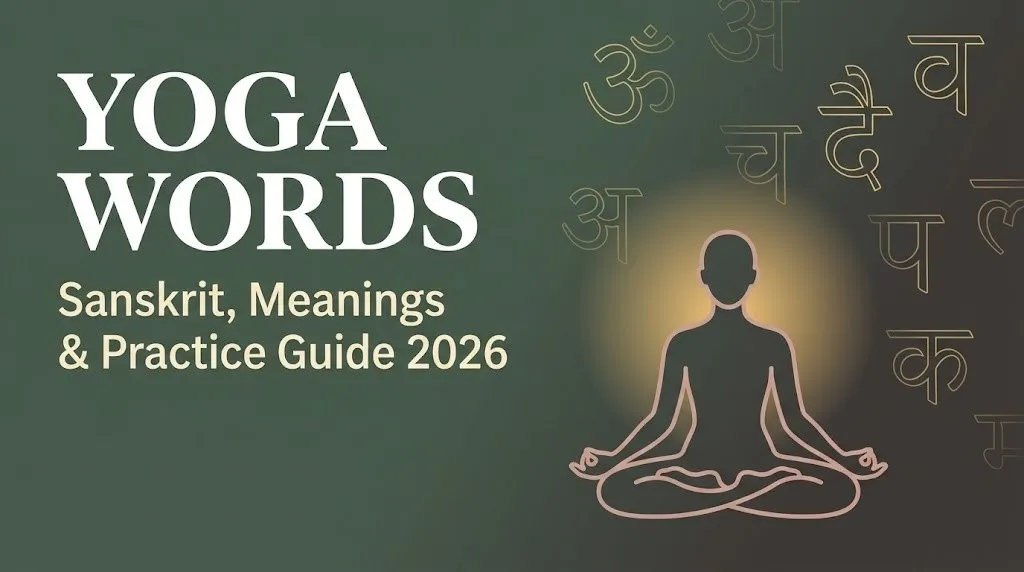
The script used to write Sanskrit is called Devanagari. You do not need to read it. But understanding that Sanskrit words have specific root meanings helps you decode new terms as you encounter them. The root “mukha,” for example, means “face” or “mouth.” So Adho Mukha Svanasana (Downward-Facing Dog) literally translates as “downward face dog,” and Urdhva Mukha Svanasana (Upward-Facing Dog) translates as “upward face dog.” Once you know “mukha” and “adho” (down) and “urdhva” (up), you can begin to decode new pose names on your own.
Key Sanskrit root words and their meanings:
- Adho: downward
- Urdhva: upward
- Utthita: extended
- Parivrtta: revolved or twisted
- Eka: one (as in one leg or one arm)
- Dvi: two
- Pada: foot or leg
- Hasta: hand
- Mukha: face
- Sana/Asana: seat or posture
Modification note for beginners: You do not need to memorize Sanskrit before your first class. Focus on recognizing three to five common terms. Add more as they appear naturally in your practice.
Key Takeaway: Sanskrit is not intimidating when you treat it like a code rather than a foreign language. Learn the root words, and pose names start to explain themselves.
Words Related to Yoga: How the Vocabulary Is Organized
Words related to yoga fall into distinct functional categories, and recognizing which category a word belongs to tells you immediately what part of the practice it describes.
This is the organizational map that no competitor glossary provides. Most lists dump all yoga words into alphabetical order, which is useful for lookup but terrible for understanding. When you know that drishti belongs to the mind category and bandha belongs to the energy category, you can place each word in its correct functional context the moment you encounter it.
The six main vocabulary categories in yoga are:
- Physical practice words: describe poses, movement, alignment, and anatomy (Asana, Tadasana, Vinyasa, Krama)
- Breath words: describe breathing techniques, breath patterns, and the relationship between breath and movement (Pranayama, Ujjayi, Kapalabhati, Nadi Shodhana)
- Energy and body words: describe internal engagement, energy channels, and the subtle body system (Bandha, Chakra, Nadi, Prana)
- Philosophy and ethics words: describe values, intentions, and the Eight Limbs framework (Yama, Niyama, Dharma, Ahimsa, Sankalpa)
- Mind and meditation words: describe states of attention, concentration, and meditative absorption (Drishti, Dharana, Dhyana, Samadhi)
- Style and format words: describe types of yoga classes and practice structures (Hatha, Ashtanga, Yin, Restorative, Mysore, Led)
Think of these categories like different departments in a large building. Knowing which floor you are on tells you what kind of instruction to expect. A breath word tells you to change how you breathe. A philosophy word tells you to examine how you approach the practice.
Yoga Pose Words: Asana Names and What They Describe
Yoga pose words are built from Sanskrit root components that describe the shape, direction, position, or quality of each posture, making them self-descriptive once you know the key roots.
Asana is the parent word for all yoga poses. It appears at the end of most pose names: Tadasana (Mountain Pose), Trikonasana (Triangle Pose), Balasana (Child’s Pose). When a pose name does not end in “asana,” it often ends in a descriptor: Savasana (Corpse Pose) from “sava” (corpse) and “asana” (pose).
Key yoga pose names with full Sanskrit and English translations:
| Sanskrit Name | English Name | Primary Body Region | Key Muscles |
|---|---|---|---|
| Tadasana | Mountain Pose | Full body, standing | Quadriceps, core stabilizers, tibialis anterior |
| Balasana | Child’s Pose | Hips, spine, shoulders | Gluteus maximus (passive), erector spinae (released) |
| Adho Mukha Svanasana | Downward-Facing Dog | Shoulders, hamstrings, calves | Deltoids, serratus anterior, hamstrings |
| Uttanasana | Standing Forward Bend | Hamstrings, lower back | Hamstrings, erector spinae (lengthened) |
| Trikonasana | Triangle Pose | Hips, lateral torso | Hip abductors, obliques, IT band |
| Savasana | Corpse Pose | Full body | All musculature released passively |
| Virabhadrasana I | Warrior I | Legs, hip flexors, shoulders | Quadriceps, hip flexors, deltoids |
| Sukhasana | Easy Seated Pose | Hips, spine | Hip external rotators |
Modification for beginners: In Balasana (Child’s Pose), place a folded blanket between the thighs and calves if the hips do not reach the heels comfortably. In Sukhasana (Easy Seated Pose), note that cross-legged sitting is not accessible for all bodies; sit on a folded blanket or block to raise the hips above the knee level and reduce strain on the knee joints and hip external rotators.
Yoga Breathing Words: Pranayama, Prana, and Breath Terms Explained
Yoga breathing words describe one of the most physiologically documented areas of yoga practice: the deliberate regulation of breath and its measurable effects on the nervous system.
Pranayama is the Sanskrit word for breath regulation, from “prana” (life force or breath energy) and “ayama” (extension or regulation). In practical terms, Pranayama refers to any structured breathing technique used in yoga. It is the fourth of Patanjali’s Eight Limbs of Yoga, immediately following Asana.
The Harvard T.H. Chan School of Public Health notes that slow, deliberate breath regulation activates the parasympathetic nervous system through stimulation of the vagus nerve, producing measurable reductions in heart rate and cortisol levels. This is why breathing words in yoga are not just vocabulary. They describe physiological tools.
Essential yoga breath words and their meanings:
- Prana: life force or vital breath energy; the animating principle behind all movement and consciousness in yoga philosophy
- Pranayama: structured breath regulation; any deliberate control of inhalation, exhalation, or retention
- Ujjayi Pranayama: Victorious Breath; a slightly constricted throat breath creating an ocean-like sound; primary breath of Ashtanga yoga
- Nadi Shodhana: Alternate Nostril Breathing; balances left and right breath channels; calms the nervous system
- Kapalabhati: Skull-Shining Breath; rapid, forceful exhalations with passive inhalations; energizing and cleansing
- Kumbhaka: breath retention; holding the breath either after inhalation (Antara Kumbhaka) or after exhalation (Bahya Kumbhaka)
- Rechaka: exhalation
- Puraka: inhalation
Safety note: Kapalabhati and breath retention techniques should be approached gradually. Anyone with cardiovascular conditions, high blood pressure, or pregnancy should work with an experienced teacher before practicing advanced Pranayama. If lightheadedness occurs during any breathing exercise, return immediately to normal nasal breathing.
Key Takeaway: Breathing words in yoga are not decorative vocabulary. Each one describes a specific physiological technique with documented effects on the nervous system. Learning them is learning how to use your own breath as a tool.
Yoga Energy Words: Bandha, Chakra, and the Body’s Subtle System
Yoga energy words describe an internal system of engagement, channels, and centers that yoga philosophy uses to map the relationship between breath, body, and awareness.
These words come from a different layer of yoga’s vocabulary than the pose names. They describe what is happening inside the body rather than the external shape of a pose. For many Western practitioners, they are the most confusing category of yoga words, primarily because they do not map neatly onto Western anatomical concepts.
Bandha means “lock” or “seal.” In practice, a Bandha refers to a subtle muscular engagement that directs energy upward through the body and supports the spine and internal organs. There are three primary Bandhas:
- Mula Bandha (Root Lock): a gentle engagement of the pelvic floor muscles; in practice, it feels like a subtle upward lift at the base of the pelvis
- Uddiyana Bandha (Abdominal Lock): a drawing inward and upward of the lower abdominal wall; engages the deep transversus abdominis
- Jalandhara Bandha (Chin Lock): a slight tucking of the chin toward the chest; practiced during specific Pranayama techniques
Chakra means “wheel” in Sanskrit and refers to seven energy centers described in yogic anatomy, aligned along the spine from the base to the crown of the head. Western physiological anatomy does not directly validate the chakra system, but research suggests that the locations of the chakras correspond closely to major nerve plexuses along the spinal cord.
Nadi refers to energy channels in the body, of which yoga philosophy describes 72,000. The three primary Nadis are Ida (left channel, cooling), Pingala (right channel, heating), and Sushumna (central channel, running along the spine).
Yoga Philosophy Words: Dharma, Ahimsa, Sankalpa, and More
Yoga philosophy words describe the ethical, intentional, and contemplative framework that gives the physical practice its broader meaning and context.
These terms come from Patanjali’s Yoga Sutras, an ancient text organizing yoga practice into eight interconnected limbs. The first two limbs, Yama (ethical restraints) and Niyama (personal observances), are entirely composed of philosophy words. Understanding them changes how you approach not just your mat but your entire approach to practice and daily life.
Essential yoga philosophy words:
- Dharma: duty, right action, or one’s authentic path; the concept that each person has a specific role to fulfill
- Ahimsa: non-harming; the first and most fundamental of the Yamas; applies to how you treat yourself on the mat and others off it
- Satya: truthfulness; practicing honesty in thought, speech, and action
- Sankalpa: heartfelt intention or resolve; a present-tense statement of personal purpose set before practice
- Tapas: disciplined effort or heat; the willingness to engage consistently with practice even when it is uncomfortable
- Svadhyaya: self-study; the practice of observing yourself honestly during practice and in life
- Ishvara Pranidhana: surrender to something greater than the self; the act of releasing attachment to outcomes
- Yama: the five ethical restraints in Patanjali’s system, including Ahimsa, Satya, Asteya (non-stealing), Brahmacharya (energy conservation), and Aparigraha (non-grasping)
- Niyama: the five personal observances, including Saucha (cleanliness), Santosha (contentment), Tapas, Svadhyaya, and Ishvara Pranidhana
A study published in Frontiers in Psychology found that yoga practitioners who integrated philosophical principles into their practice showed greater psychological well-being scores and reduced anxiety compared to those who practiced yoga purely as a physical exercise.
Key Takeaway: Yoga philosophy words are not abstract extras. Research shows that integrating concepts like Ahimsa and Sankalpa into physical practice produces measurable improvements in well-being beyond what physical movement alone achieves.
Yoga Words and Phrases Used in Class: Teacher Cues Decoded
Yoga class phrases are the specific verbal instructions your teacher uses to guide alignment, attention, breath, and transitions, and many of them use Sanskrit or specialized English that sounds opaque until you know what it means.
Every teacher has their own phrasing style, but a core set of cues appears across almost all yoga classes regardless of style or studio. Knowing these phrases before you walk in removes the cognitive overload of simultaneously trying to learn movements and decode language.
Common yoga teacher phrases and what they mean:
- “Find your drishti“: fix your gaze on a specific point to stabilize balance and concentration
- “Engage your core”: draw the lower abdominal muscles gently inward; activates transversus abdominis and obliques
- “Root down through your feet”: press actively through all four corners of each foot into the mat
- “Lengthen through the crown of your head”: create space between vertebrae by extending the spine upward
- “Soften your jaw“: release tension in the masseter muscles and around the face, a common tension-holding site
- “Let your shoulder blades slide down your back”: depress and retract the scapulae away from the ears
- “Breathe into your back body”: expand the ribcage posteriorly on the inhale, particularly in forward bends
- “Take a vinyasa“: move through the standard Chaturanga-Updog-Downdog transition sequence
- “Honor your body today”: an invitation to modify or rest rather than push through discomfort or pain
- “We’ll close with Savasana“: the final resting pose is coming; allow the body to fully release and be still
Pose Tip:
- When a teacher says “honor your body,” that is your cue to use props, shorten a hold, or skip a pose entirely
- “Breathe into” a body region does not mean you literally direct air there; it means expand awareness and sensation toward that area
- If a cue does not make sense, wait one breath cycle and watch how other students respond before adjusting
What Does Namaste Mean in Yoga?
Namaste is a Sanskrit greeting meaning “I bow to you” or “the light in me honors the light in you,” spoken with hands pressed together at the heart center in a gesture called Anjali Mudra.
The word breaks into “namas” (bow, reverence) and “te” (to you). It is both a spoken word and a physical gesture simultaneously. In Indian cultural tradition, Namaste is a standard respectful greeting used in daily life. In Western yoga classes, it is most commonly used at the end of class as a mutual acknowledgment between teacher and students.
The gesture accompanying Namaste, Anjali Mudra (Prayer Seal), involves pressing the palms together at the sternum with fingers pointing upward. This physical position signals a transition from the active state of practice to a state of receptive stillness.
Some yoga teachers use Namaste to open class rather than close it. Both are valid. What matters is the spirit of mutual respect the word carries. It is not a religious statement in the Western yoga context; it is an acknowledgment that teacher and student are both practitioners in the same tradition.
Modification note: If pressing the palms together is uncomfortable due to wrist pain or finger joint issues, hold the hands loosely together at the chest or simply bow the head. The gesture’s meaning does not require perfect physical form.
What Does Om Mean in Yoga?
Om, also written and pronounced as Aum, is considered the primordial sound of the universe in Hindu, Buddhist, and yogic traditions, representing the vibrational essence of all existence.
In practice terms, Om is chanted at the beginning or end of yoga class as a collective sound, often held for several seconds. The sound has three phonetic components: “Ah” (arising), “Oo” (sustaining), and “Mm” (dissolving), followed by silence. That four-part structure is said to represent the four states of consciousness: waking, dreaming, deep sleep, and the transcendent state beyond all three.
Research published in the International Journal of Yoga found that Om chanting produced measurable deactivation of the limbic system, the brain region associated with emotional processing and stress response, compared to a control group that produced a similar nasal sound without the specific Om resonance. The study suggests that the vibrational quality of Om, not just the act of vocalizing, may have distinct neurological effects.
You are never required to chant Om in a yoga class. Many practitioners simply listen or hum quietly. The value is in the shared moment of stillness it creates, not in perfect vocal participation.
Key Takeaway: Om is not just a cultural symbol. Research in the International Journal of Yoga shows it produces measurable limbic system deactivation, meaning the sound itself, not just the ritual, affects the brain’s stress processing centers.
Yoga Style Words: Vinyasa, Hatha, Yin, and What Each Name Means
Yoga style words describe distinct systems of practice, each with its own philosophy, pace, physical demands, and intended effects on the body and mind.
Confusing yoga style names is one of the most common mistakes beginners make when choosing a class. “Yoga” is an umbrella term. The style name tells you what kind of yoga you are signing up for. These are genuinely different practices, not just different names for the same thing.
| Style Name | Sanskrit/Origin | Meaning | Pace and Character |
|---|---|---|---|
| Hatha | Sanskrit: sun (ha) and moon (tha) | Union of opposing forces | Slow to moderate; foundational poses held statically |
| Vinyasa | Sanskrit: to place in a special way | Breath-linked movement sequences | Moderate to vigorous; flowing transitions |
| Ashtanga | Sanskrit: eight limbs | Eight-limbed yoga system | Vigorous; fixed sequence, daily practice model |
| Yin | English/Chinese concept | Passive, receptive practice | Very slow; long passive holds of 3 to 7 minutes |
| Restorative | English | Rest-based recovery practice | Fully supported; props under entire body; minimal effort |
| Kundalini | Sanskrit: coiled energy | Energy-awakening practice | Includes breathwork, mantra, movement, and meditation |
| Iyengar | Named for B.K.S. Iyengar | Alignment-precise practice | Slow and precise; extensive use of props |
| Bikram/26&2 | Named for Bikram Choudhury | Fixed 26-pose sequence in heat | Vigorous; practiced in 105-degree room |
Knowing these style words before you search for a class saves you from booking a vigorous Ashtanga class when your body needs a Restorative session, or arriving at a Yin class expecting a workout.
Yoga Words for the Mind: Drishti, Dharana, Dhyana
Yoga words for the mind describe the progressive stages of attention, concentration, and meditative absorption that form the inner practice of yoga beyond the physical poses.
These words come from the final three of Patanjali’s Eight Limbs of Yoga: Dharana (concentration), Dhyana (meditation), and Samadhi (absorption or complete integration). Together, they describe a continuum from focused attention to effortless meditative awareness.
Drishti is the most practically immediate of the mind words. It means “gaze” or “sight” and refers to a specific point of visual focus held during poses. In Ashtanga yoga, each pose has a prescribed Drishti point: the tip of the nose, the thumb, the navel, the horizon, or the sky, depending on the posture. Fixing the gaze stabilizes the mind as well as the body.
Dharana means concentration or single-pointed focus. It is the sixth limb and the entry point into the meditative state. In practice, Dharana is what happens when you hold Drishti consistently through several breath cycles. The attention narrows and the fluctuations of the mind begin to slow.
Dhyana means sustained, effortless meditation. It is not something you “do”; it is a state that arises when Dharana deepens. The distinction matters because many beginners try to force meditation and become frustrated. Dhyana cannot be manufactured. Dharana is the preparation; Dhyana is what sometimes follows.
Samadhi, the eighth and final limb, describes complete absorption: a state in which the boundary between the practitioner and the object of awareness dissolves entirely. Most practitioners never experience classical Samadhi, and most teachers are careful not to overstate its accessibility.
Yoga Mantra Words and Their Effects on the Nervous System
Yoga mantra words are syllables, words, or phrases repeated rhythmically during meditation or practice, with documented effects on the nervous system that go beyond cultural or spiritual significance.
A mantra literally means “mind tool” in Sanskrit, from “manas” (mind) and “tra” (tool or instrument). The repetition of a mantra, whether spoken aloud, whispered, or repeated silently, provides the mind with a steady object of attention that reduces the frequency and amplitude of distracting thought.
A study published in the International Journal of Yoga found that repetitive mantra meditation reduced resting heart rate and cortisol levels in participants over an eight-week period, with effects comparable to those seen in mindfulness-based stress reduction (MBSR) programs. The rhythmic, repetitive quality of mantra appears to drive the physiological response, not the specific meaning of the words.
Common yoga mantras and their meanings:
- Om (Aum): the primordial sound; chanted to create collective stillness and open or close practice
- Om Shanti Shanti Shanti: peace mantra; “shanti” means peace; repeated three times for peace in body, speech, and mind
- So Hum: “I am that”; a breath mantra where “so” is silently linked to the inhale and “hum” to the exhale
- Om Namah Shivaya: salutation to the inner self; one of the most widely used mantras in Hatha yoga traditions
- Gayatri Mantra: a Vedic mantra from the Rigveda honoring the light of the sun as a symbol of universal wisdom
Modification: Mantra repetition does not require vocalization. Silent repetition of any mantra phrase produces similar neurological effects to spoken repetition, according to research in Complementary Therapies in Medicine. For beginners or those in shared spaces, silent mantra practice is entirely valid.
Key Takeaway: Mantra is not religious obligation. Research shows that any rhythmic, repetitive mental phrase reduces cortisol and resting heart rate. The tool works whether or not you connect with the specific words.
Yoga Anatomy Words: The Body Terms Teachers Use
Yoga anatomy words are the specific anatomical terms that teachers use to direct your attention to muscles, joints, and body regions during instruction, and knowing them makes alignment cues instantly actionable.
Most yoga teachers blend anatomical English with Sanskrit pose names. When your teacher says “press through your heels and draw the femurs back,” they are using anatomical English. When they say “extend through the crown in Tadasana,” they are mixing Sanskrit with anatomical direction. Both require that you know the body terms being referenced.
Essential anatomy words used in yoga instruction:
- Femur: the thigh bone; teachers often cue “draw the femurs back” to align the hip joints and protect the lumbar spine
- Scapula (plural: scapulae): shoulder blades; “slide your scapulae down your back” means retract and depress them away from the ears
- Sacrum: the triangular bone at the base of the spine; often cued in forward folds and backbends for spinal alignment
- Lumbar spine: the lower five vertebrae; frequently referenced for protection in forward bends and backbends
- Thoracic spine: the mid-back’s twelve vertebrae; often cued to “open” or “expand” in backbends and twists
- Cervical spine: the seven neck vertebrae; cued in headstands, shoulder stands, and any pose loading the neck
- Anterior: front-facing surface of the body
- Posterior: back-facing surface of the body
- Lateral: side-facing
- Medial: toward the midline of the body
- Engage: apply controlled muscular contraction to a specific region
- Release: reduce muscular effort or tension in a specific region
Safety note: When a teacher cues “protect your lower back” in a forward fold, the practical instruction is to bend the knees enough to keep the spine long rather than rounding the lumbar vertebrae under load. Rounding the spine to reach the floor is one of the most common yoga-related causes of lumbar strain.
How to Learn Yoga Words and Use Them in Your Own Practice
Learning yoga words effectively means encountering them in the context of practice rather than studying a list in isolation, because the body remembers language better when it is paired with physical experience.
Research in Complementary Therapies in Medicine consistently shows that embodied learning, where vocabulary is introduced at the moment the corresponding movement or sensation occurs, produces stronger long-term retention than list memorization. This is why you learn yoga words faster in class than from a glossary.
A practical system for building your yoga vocabulary:
- Start with five words per category. Use the tables in this guide to select the five most commonly heard words in each section.
- Write each word and its meaning on a small card. Keep the cards near your mat.
- Before each practice session, pick one word and set it as a point of focus for that session. Notice when it appears in the teacher’s cues.
- After class, write one sentence about how that word appeared in your practice experience.
- Add three new words per week. After eight weeks, you will have a working vocabulary of over 100 terms.
The goal is not perfection. Yoga vocabulary builds naturally with consistent practice. Every class teaches you something new if you listen for the words alongside the movements.
Pose Tip:
- Keep a small notebook in your yoga bag for new words you hear in class
- Ask your teacher after class what a specific word meant; most teachers are glad to explain
- When you encounter a new Sanskrit pose name, try breaking it into its root components using the root word list in this guide
Frequently Asked Questions About Yoga Words
What are the most common yoga words a beginner should know?
The most common yoga words beginners need are: Asana (pose), Savasana (Corpse Pose), Namaste (respectful greeting), Pranayama (breath regulation), Vinyasa (breath-linked movement), and Drishti (focused gaze).
These six words appear in nearly every yoga class regardless of style or studio.
Learning these before your first class removes most of the vocabulary confusion that makes beginners feel out of place.
What does namaste mean in yoga?
Namaste is a Sanskrit greeting meaning “I bow to you” or “the light in me honors the light in you,” spoken with hands pressed together at the heart.
It is used at the end of most yoga classes as a mutual acknowledgment between teacher and students.
The gesture accompanying it is called Anjali Mudra (Prayer Seal) and signals a transition from active practice to receptive stillness.
What is the difference between asana and yoga?
Asana refers specifically to the physical postures practiced in yoga; it is the third of Patanjali’s Eight Limbs of Yoga.
Yoga is the broader system that encompasses physical poses, breath regulation, ethical principles, concentration, meditation, and states of absorption.
In most Western yoga classes, “yoga” and “asana” are used interchangeably, but technically asana is just one component of the complete yoga system.
Why do yoga teachers use Sanskrit words?
Yoga teachers use Sanskrit because it is the original language of the yoga tradition and carries precise meanings that English translations often simplify or lose.
Sanskrit also creates a universal vocabulary that practitioners and teachers worldwide share regardless of their native language.
Knowing Sanskrit terms helps practitioners understand what each pose, technique, or concept is genuinely asking of the body, breath, and attention.
What does om mean and why do we chant it in yoga class?
Om (Aum) is considered the primordial sound of the universe in yogic and Hindu philosophy, representing the vibrational essence of all existence.
Research published in the International Journal of Yoga found that Om chanting produced measurable deactivation of the limbic system, the brain’s emotional processing center, compared to a control nasal sound.
In yoga class, Om is chanted collectively to create shared stillness; you are never required to participate and may simply listen or hum quietly.
The Words Will Come
The best way to learn yoga words is to use one new term per session and let the rest arrive naturally through practice. Pick one word from this guide today: Drishti is a good starting point. Fix your gaze on a single point during your next standing pose and notice how it changes your steadiness.
Language and movement learn each other. The more you practice, the more the vocabulary settles into your body rather than sitting in your head.
You already know more than enough to begin.