Ashtanga Yoga Near Me: Your 2026 Complete Guide
Finding ashtanga yoga near me is not just about locating a studio. It is about understanding what you are walking into, because Ashtanga is unlike any other yoga class you have likely tried.
The National Center for Complementary and Integrative Health (NCCIH) notes that yoga practiced with structured breath coordination and progressive physical sequencing produces measurable improvements in strength, flexibility, and psychological well-being. Ashtanga, with its fixed sequence and Ujjayi breath system, is one of the most structured yoga methods in existence.
This guide covers everything you need before you walk through a studio door: what Ashtanga actually is, how the Primary Series works, what Mysore-style classes involve, what research says about the practice’s benefits, how to stay safe, and how to find quality studios in Denver, Atlanta, Richmond, and beyond. You will also get a practical breakdown of what to bring to your very first class.
What Is Ashtanga Yoga?
Ashtanga yoga is a structured, breath-synchronized movement practice in which practitioners work through a fixed sequence of poses in the same order every session.
The system was developed and popularized by Sri K. Pattabhi Jois, based on teachings passed from his teacher Krishnamacharya in Mysore, India. The name “Ashtanga” comes from the Sanskrit “ashta” (eight) and “anga” (limb), referencing Patanjali’s Eight Limbs of Yoga. The physical practice corresponds to the third and fourth limbs: Asana (posture) and Pranayama (breath regulation).
What separates Ashtanga from a general Vinyasa yoga class is the fixed sequence. Every session, you practice the same poses in the same order. That repetition is intentional. The body learns the sequence deeply, which frees the mind to focus on breath, gaze, and internal sensation rather than watching the teacher for the next cue.
There are six series in Ashtanga, but most practitioners spend their entire practice life in the Primary Series. The Second Series (Intermediate) and beyond are taught only when a teacher determines the student is ready.
| Feature | Ashtanga Yoga | Vinyasa Yoga | Hatha Yoga |
|---|---|---|---|
| Sequence | Fixed, same every session | Varies each class | Varies each class |
| Breath system | Ujjayi throughout, counted vinyasas | Breath-cued but less structured | Breath-aware, variable |
| Pace | Moderate to vigorous | Variable | Slower |
| Format | Mysore or led | Teacher-led | Teacher-led |
| Best for | Dedicated daily practice | Variety seekers | Beginners, general wellness |
What Is the Ashtanga Primary Series (Yoga Chikitsa)?
The Ashtanga Primary Series, known in Sanskrit as Yoga Chikitsa (yoga therapy), is the foundational sequence of approximately 75 poses practiced in a specific order every session.
“Yoga therapy” is an accurate description. The Primary Series is designed to detoxify and realign the body, beginning with forward bends and hip openers that address the most common physical tightness patterns in modern adults. The series is physically demanding, but its sequencing logic is intelligent. Each pose prepares the body for the next.
The series is divided into clear sections:
- Opening sequence: Surya Namaskara A (Sun Salutation A) repeated five times, then Surya Namaskara B (Sun Salutation B) repeated five times
- Standing sequence: A set of standing poses including Utthita Trikonasana (Extended Triangle Pose), Utthita Parsvakonasana (Extended Side Angle Pose), and Prasarita Padottanasana (Wide-Legged Forward Bend)
- Seated sequence: Forward bends, twists, and hip openers including Janu Sirsasana (Head-to-Knee Pose), Marichyasana A through D (Sage Marichi’s Poses A through D), and Navasana (Boat Pose)
- Backbend and closing sequence: Urdhva Dhanurasana (Upward Bow Pose), shoulder stands, headstand, and Savasana (Corpse Pose)
Beginners do not practice the full sequence from day one. A Mysore teacher introduces poses incrementally, adding new postures only when the current ones are stable.
Mysore Style Yoga: What It Is and How It Works
Mysore-style yoga is a self-paced Ashtanga practice format in which each student practices their individual portion of the Primary Series simultaneously in the same room, guided by a teacher who moves between students offering individual instruction.
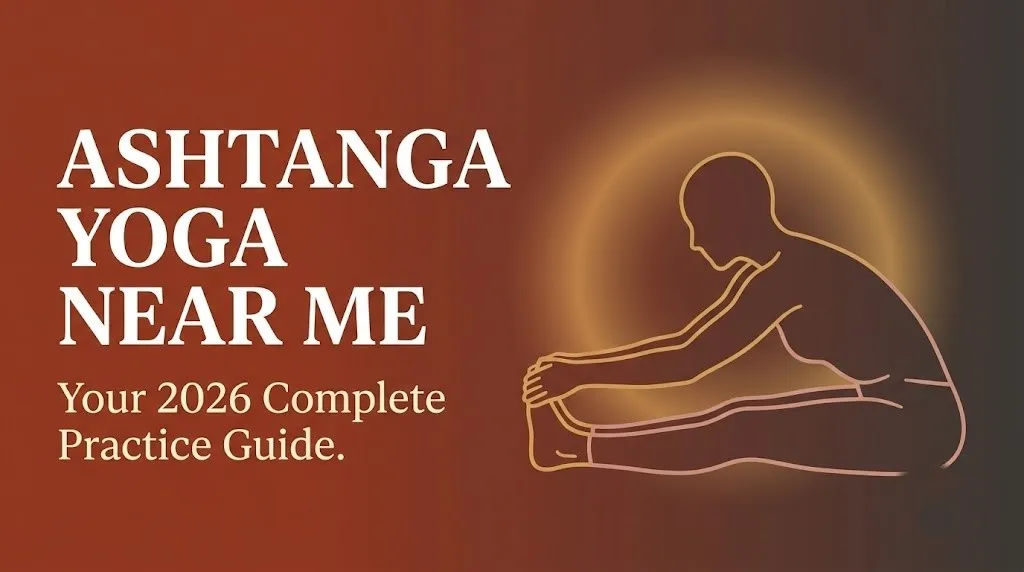
The name comes from the city of Mysore, India, where Pattabhi Jois taught. The Mysore format is radically different from a standard yoga class. There is no teacher calling out poses from the front of the room. No music cues the flow. Students arrive, roll out their mats, and begin their personal sequence, which they have memorized.
The teacher circulates, offering physical adjustments, verbal cues, and decisions about when a student is ready for the next pose. This structure means a complete beginner and an advanced practitioner can practice in the same room at the same time. Both are doing the Primary Series, but the beginner may only be through the Sun Salutations while the advanced student is deep into the seated section.
For new students, the first Mysore session typically involves learning Surya Namaskara A (Sun Salutation A) and nothing more. This can feel underwhelming if you expected a full class. Resist that impulse. The Sun Salutations in Ashtanga are more demanding and precise than in any other yoga style, and mastering them properly takes genuine time and attention.
Pose Tip:
- Arrive 10 to 15 minutes before the stated start time for your first Mysore session
- Tell the teacher it is your first time before class begins; they will guide you through the opening sequence only
- Do not try to copy what other students are doing; everyone is at a different point in the series
Key Takeaway: Ashtanga yoga is a fixed-sequence, breath-driven system where the Mysore format means you learn poses one at a time from a teacher, not by watching the front of the room. That individual attention is its greatest strength for beginners.
Mysore vs. Led Ashtanga: Which Is Right for You?
The main difference between Mysore and led Ashtanga is pacing and guidance: Mysore is self-paced with individual teacher attention, while a led class has the teacher calling out every pose and vinyasa count for the entire group simultaneously.
Led classes use a traditional Sanskrit count system. The teacher calls each movement and breath, and every student moves together. This format is more like a standard yoga class in structure, but it requires you to already know the sequence. Most Ashtanga teachers recommend establishing a Mysore practice first before attending led classes, so the sequence is already in your body.
For true beginners, Mysore is almost always the better starting point. You receive individual instruction, you move at a pace appropriate for your body, and you are not pressured to keep up with a group that has been practicing for months or years.
| Format | Pacing | Best For | Prior Knowledge Needed |
|---|---|---|---|
| Mysore | Self-paced | Beginners, daily practice, individual attention | None; teacher introduces poses |
| Led Primary | Group-paced, counted | Practitioners who know the sequence | Full or most of Primary Series |
| Led Half Primary | Group-paced, shorter | Intermediate beginners | Standing sequence and some seated poses |
| Guided Fundamentals | Slow teacher-led | Complete beginners | None |
Guided Fundamentals classes, offered by many studios, are a separate format where the teacher walks beginners through the Primary Series slowly with alignment explanations. If your target studio offers this, it is an excellent entry point before joining a Mysore room.
Ashtanga Yoga for Beginners: What to Realistically Expect
Ashtanga yoga is accessible to beginners, but it is not beginner-easy, and studios that tell you otherwise are setting you up for discouragement.
The physical demands of the Primary Series are real. Chaturanga Dandasana (Four-Limbed Staff Pose), practiced as part of every Sun Salutation, requires significant shoulder girdle and core strength. Most beginners modify this pose for weeks or months. That is not a failure; it is the practice working as designed.
According to yoga teachers and physical therapists who work with Ashtanga students, the first four to six weeks typically focus on the Sun Salutations and the standing sequence only. Expect to feel sore in the deltoids, triceps, wrist flexors, and hip flexors in the early weeks. These are the primary movers in the opening portion of the series.
What beginners often find surprising is that Ashtanga feels meditative faster than expected. Because you practice the same sequence repeatedly, the cognitive load drops quickly. By week three or four, many practitioners report entering a focused, internally quiet state during practice, sometimes described as moving meditation.
What beginners need for their first month:
- A non-slip yoga mat with at least 4mm thickness for joint cushioning
- Two yoga blocks to support hands in standing forward bends
- A yoga strap for forward bends where hamstring flexibility limits reach
- Comfortable fitted clothing that does not restrict hip or shoulder movement
- A willingness to practice the same short sequence repeatedly without adding poses prematurely
Modification for beginners: In Chaturanga Dandasana, lower the knees to the floor. Keep the elbows tracking close to the ribs. Build shoulder strength for six to eight weeks before attempting the full pose.
Ashtanga Yoga Benefits: What Research Actually Supports
Ashtanga yoga produces documented physical and psychological benefits, particularly when practiced consistently over six weeks or more, according to multiple peer-reviewed studies.
A study published in the International Journal of Yoga found that regular Ashtanga practice improved muscular strength, flexibility, and cardiovascular endurance across multiple demographic groups. The fixed-sequence format appears to support these outcomes by ensuring the same muscle groups and movement patterns are trained consistently rather than randomly.
The NCCIH identifies yoga, particularly breath-synchronized styles like Ashtanga, as having evidence-supported benefits for anxiety reduction, improved sleep, and reduced chronic pain perception. The Tristhana method (breath, gaze, and energy locks practiced simultaneously) appears to produce a stronger parasympathetic nervous system response than yoga practiced without these integrated focal points.
Documented benefits with source attribution:
- Improved upper body strength, particularly in the shoulder girdle, triceps, and serratus anterior (International Journal of Yoga)
- Increased hamstring and hip flexibility after eight or more weeks of consistent practice (Complementary Therapies in Medicine)
- Reduced cortisol levels and improved stress response regulation (NCCIH research summary)
- Improved cardiovascular efficiency in sessions of 60 minutes or more (American College of Sports Medicine)
- Enhanced interoceptive awareness and emotional regulation (Frontiers in Psychology, mindful movement research)
- Reduced perceived lower back pain with proper instruction and modification (Journal of Bodywork and Movement Therapies)
These benefits are not unique to Ashtanga, but the structured, daily-practice model makes consistent training outcomes more predictable than drop-in class formats.
Key Takeaway: Ashtanga’s fixed sequence and daily repetition are not limitations; they are the mechanism behind its measurable strength, flexibility, and stress-reduction outcomes. Research backs the practice, not just the mythology around it.
Ashtanga Yoga Breathing: The Tristhana Method
Ashtanga yoga breathing is built around the Tristhana method, which means practicing three interdependent focal points simultaneously: Ujjayi Pranayama (breath), Drishti (gaze), and Bandha (energy lock).
Think of Tristhana like three radio signals tuned at once. When all three are clear and simultaneous, the practice shifts from a physical workout into a deeply attentional, internally focused state. When any one drops out, the quality of the practice drops with it.
Ujjayi Pranayama (Victorious Breath) is the foundational breath of the entire Ashtanga system. It involves a slight constriction at the back of the throat during both inhalation and exhalation, creating a steady, audible wave-like sound. The breath is nasal, slow, and equal in length on both sides.
Drishti refers to a specific focal gaze point associated with each pose. In Tadasana (Mountain Pose), the gaze is forward. In Uttanasana (Standing Forward Bend), the gaze is toward the nose tip. Each drishti point is prescribed in the traditional sequence and serves to stabilize concentration.
Mula Bandha (root lock) and Uddiyana Bandha (abdominal lock) are subtle internal engagements of the pelvic floor and lower abdominal muscles, respectively. They are not forceful contractions. Think of them as a 20 to 30 percent subtle lift, maintained throughout the practice, that protects the lumbar spine and stabilizes the core.
To begin Ujjayi breath practice:
- Sit comfortably in Sukhasana (Easy Seated Pose) with the spine upright.
- Inhale slowly through the nose for a count of five.
- Slightly constrict the back of the throat, as if whispering “haah” with the mouth closed.
- Exhale for a count of five with the same gentle throat constriction.
- The breath should make a soft, steady ocean sound.
- Practice ten cycles before adding movement.
Modification for beginners: Ignore Drishti and Bandha for the first two to four weeks. Establish Ujjayi breath first. Adding all three focal points at once is cognitively overwhelming for new practitioners and leads to shallow, forced breath rather than genuine breath awareness.
Ashtanga Yoga Poses: Key Postures in the Primary Series
The Primary Series contains approximately 75 poses, but beginners learn a subset of key postures that form the foundation of the entire practice.
Understanding these poses before your first class reduces anxiety and helps you recognize what the teacher is introducing. Every pose below is practiced in a specific order within the sequence and serves a specific preparatory function for the poses that follow.
Key Ashtanga Primary Series poses:
- Surya Namaskara A (Sun Salutation A): Nine movements linked by breath. Warms the entire body. Engages deltoids, quadriceps, hamstrings, and spinal extensors.
- Utthita Trikonasana (Extended Triangle Pose): Opens the lateral hip, IT band, and thoracic spine. Common error: rotating the top shoulder forward instead of stacking it directly above the bottom shoulder.
- Janu Sirsasana A (Head-to-Knee Pose A): Seated forward bend with one knee bent. Primary stretch in the hamstrings and erector spinae of the extended leg side.
- Marichyasana A (Sage Marichi’s Pose A): Seated forward fold with one knee raised. Requires hamstring and spinal flexibility. Use a yoga strap if the hand-to-foot bind is unavailable.
- Navasana (Boat Pose): Strengthens the iliopsoas and rectus abdominis. Practiced five times in succession in the traditional sequence. Beginners bend the knees to protect the lumbar spine.
- Setu Bandhasana (Bridge Pose): Backbend that strengthens the gluteus maximus and opens the thoracic spine. Practiced near the end of the seated sequence.
- Savasana (Corpse Pose): Final rest. Held for a minimum of five minutes. Not optional in Ashtanga; it is the integration period for the entire session.
Modification for wrist pain: In all weight-bearing poses, make fists with the hands instead of pressing flat palms. This reduces wrist extension angle and the associated load on the carpal ligaments.
Ashtanga Yoga for Strength and Flexibility
Ashtanga yoga builds functional strength and flexibility simultaneously, which is rare in most exercise modalities, because each pose requires active muscular engagement while also producing a stretching effect on adjacent muscle groups.
The Sun Salutation sequence alone, performed five times in Surya Namaskara A and five times in Surya Namaskara B, constitutes a significant upper body and core workout before a single seated pose is practiced. The repeated Chaturanga Dandasana (Four-Limbed Staff Pose) transitions train the triceps, anterior deltoids, pectorals, and serratus anterior in a way that few bodyweight exercises match.
Flexibility gains in Ashtanga are primarily driven by the seated sequence’s deep forward folds and hip openers. The hamstrings, hip flexors, and external hip rotators are worked progressively throughout the seated sequence. Research in Complementary Therapies in Medicine found that practitioners who trained the same flexibility sequence repeatedly, rather than varying stretches randomly, showed faster and more lasting range-of-motion improvements.
Think of your hamstrings in the early weeks of Ashtanga practice like cold taffy: stiff, resistant, and likely to strain if pulled hard and fast. The consistent, daily application of gentle, breath-guided lengthening is what eventually produces genuine flexibility rather than forced stretching under tension.
Strength development by body region:
| Body Region | Primary Ashtanga Mechanism | Key Poses |
|---|---|---|
| Shoulder girdle | Repeated Chaturanga transitions | Surya Namaskara A and B |
| Core stabilizers | Bandha engagement throughout | All poses; Navasana specifically |
| Hip flexors | Active extension in backbends | Virabhadrasana (Warrior Poses) |
| Hamstrings | Eccentric load in forward bends | Uttanasana, Janu Sirsasana |
| Spinal extensors | Backbend sequences | Urdhva Mukha Svanasana, Setu Bandhasana |
Key Takeaway: Ashtanga builds strength and flexibility at the same time through the same movement. The Chaturanga-based Sun Salutations are an upper body workout, and the seated sequence is the flexibility training. They are inseparable parts of one system.
Ashtanga Yoga and Mental Health
Ashtanga yoga produces measurable mental health benefits through a combination of breath regulation, focused attention, and the neurological effects of consistent physical training.
A 2020 meta-analysis published in Frontiers in Psychology reviewed yoga interventions across anxiety and depressive symptom outcomes and found that breath-synchronized yoga practices, which includes Ashtanga’s Tristhana method, produced larger reductions in anxiety than yoga without explicit breath focus. The mechanism involves sustained Ujjayi breath activating the vagus nerve, which directly modulates the body’s stress response system.
The repetitive, memorized nature of the Ashtanga sequence also produces a specific cognitive benefit: once the sequence is internalized, the mind is free to rest in a state of attentional absorption rather than problem-solving or anticipation. Many longtime Ashtanga practitioners describe this as the most reliable access point to a genuinely meditative state they have found.
According to the NCCIH, yoga practices that include breath coordination, physical movement, and meditative attention components show the most consistent evidence for improving symptoms of anxiety, mild depression, and post-traumatic stress. Ashtanga’s structure addresses all three components by design.
Safety note: If you are managing a diagnosed mental health condition, work with a yoga teacher who has training in trauma-sensitive instruction. The physical intensity of Ashtanga can occasionally surface strong emotional responses during practice, particularly in deep hip-opening poses. Having an experienced guide matters.
Ashtanga Yoga Injury Prevention and Safety
Ashtanga yoga carries a real injury risk when practiced without proper guidance, and any article that avoids this fact is doing readers a disservice.
The repetitive nature of the practice is its strength and its vulnerability simultaneously. Practicing the same sequence six days per week means any misalignment in a foundational pose like Chaturanga Dandasana (Four-Limbed Staff Pose) is repeated hundreds of times per month. The most commonly reported Ashtanga injuries involve the wrists, shoulders, hamstrings, and sacroiliac joint.
A study in the Journal of Bodywork and Movement Therapies found that yoga-related injuries most frequently occurred in the knee, lower back, and shoulder regions, with repetitive-load practices showing higher rates of overuse injuries than variable-sequence practices. This makes qualified instruction, not just enthusiasm, the most important safety factor in Ashtanga.
Injury prevention principles for Ashtanga practitioners:
- Never add a new pose to your practice without your teacher’s guidance; the sequence is progressive for a reason
- Modify Chaturanga Dandasana with knees down until shoulder and tricep strength is genuinely established
- Do not force binds in poses like Marichyasana (Sage Marichi’s Pose); use a yoga strap and wait for the flexibility to arrive naturally
- Practice on a rest day (traditionally Sunday and moon days in Ashtanga) without guilt; the rest day is part of the system
- If sacroiliac joint pain develops, report it to your teacher immediately; this joint is particularly vulnerable in deep seated twists
Who should approach Ashtanga with medical clearance from a physical therapist or orthopedic specialist before starting: people with existing rotator cuff tears, wrist tendinitis, active lumbar disc herniation, or recent knee surgery. The practice can often be adapted, but the adaptation needs to be specific to your condition.
Ashtanga Yoga for Seniors and Modified Practice
Ashtanga yoga is adaptable for seniors, but the traditional six-day-per-week format and advanced poses require thoughtful modification to be both safe and sustainable for older bodies.
The American College of Sports Medicine recommends that adults over 65 engage in flexibility, balance, and strength training regularly. Ashtanga, when appropriately modified, addresses all three. The seated forward bends develop hamstring and spinal flexibility. The Sun Salutations build upper body and core strength. The single-leg balancing poses in the standing sequence directly address fall-prevention balance training.
The modifications required for older practitioners are not compromises. They are how the practice becomes genuinely appropriate for an aging body. The goal is never to “do Ashtanga fully.” The goal is to receive the physical and attentional benefits at a dose and intensity that your body can sustain long-term.
Senior modifications for Ashtanga practice:
- Reduce practice frequency to three or four days per week rather than six
- Replace Chaturanga Dandasana with a slow lowering to the floor with knees down, building strength gradually
- Use yoga blocks under the hands in all standing forward bends to keep the spine long rather than rounding to reach the floor
- Skip or replace deep Marichyasana twists if there is any history of spinal compression or osteoporosis
- Limit Urdhva Dhanurasana (Upward Bow Pose) and substitute Setu Bandhasana (Bridge Pose) if shoulder or spinal mobility is restricted
- End every practice with a minimum of five minutes in Savasana (Corpse Pose); the nervous system recovery time is especially important for older practitioners
If osteoporosis is present, work with a physical therapist before beginning any spinal flexion sequence in Ashtanga. Repeated rounding under load carries specific risk for vertebral compression fractures in low bone density.
Key Takeaway: Ashtanga is not off-limits for seniors, but the traditional format needs real modification in frequency, intensity, and specific poses. Three days per week with blocks, straps, and knees-down Chaturanga is a complete and effective practice.
How Often Should You Practice Ashtanga Yoga?
Traditional Ashtanga yoga prescribes practice six days per week, resting on Saturdays and on new and full moon days, but most Western teachers and practitioners adapt this to three to five days per week for realistic, sustainable results.
The six-day prescription comes from Pattabhi Jois’s teaching tradition and reflects the system’s design as a daily contemplative and physical discipline. That frequency produces faster skill acquisition and deeper physical adaptation. It also produces overuse injuries if the body is not yet conditioned for it.
Research reviewed by the American College of Sports Medicine suggests that three sessions per week of structured physical yoga practice is sufficient to produce measurable gains in strength, flexibility, and stress regulation. More frequent practice accelerates those outcomes but also increases injury risk in the early months.
Practice frequency guide by experience level:
| Level | Recommended Frequency | Session Length | Key Consideration |
|---|---|---|---|
| Complete beginner (weeks 1 to 4) | 3 days per week | 30 to 45 minutes | Learn Sun Salutations only |
| Building beginner (months 2 to 4) | 4 days per week | 45 to 60 minutes | Add standing sequence gradually |
| Established practice (6 months plus) | 5 to 6 days per week | 60 to 90 minutes | Full Primary Series in progression |
| Senior or modified practice | 3 to 4 days per week | 30 to 45 minutes | Modified poses, shorter sequence |
Rest days are not a sign of insufficient commitment. In Ashtanga, rest is structured into the system because recovery is when the body integrates the work. Skipping rest days consistently is the single most common factor in Ashtanga overuse injuries.
Ashtanga Yoga Denver, Atlanta, and Richmond: What to Look for in a Studio
Finding quality ashtanga yoga in cities like Denver, Atlanta, and Richmond means knowing how to evaluate a studio before you commit, because the quality of Ashtanga instruction varies widely.
The Sri K. Pattabhi Jois Ashtanga Yoga Institute (KPJAYI) in Mysore, India, authorizes teachers who have completed extensive training in the traditional method. An Authorized or Certified KPJAYI teacher is a meaningful credential for Ashtanga specifically, beyond a general Yoga Alliance RYT 200 registration.
When searching for ashtanga yoga in Denver, you will find studios ranging from traditional Mysore rooms to gyms offering “Ashtanga-inspired” Vinyasa classes. These are not the same thing. A true Mysore program has a consistent daily schedule, a teacher who knows the full Primary and Intermediate Series, and a structure where students are introduced to poses individually over time.
In Atlanta, mysore yoga programs tend to cluster around dedicated Ashtanga studios rather than general wellness studios. The same is true in Richmond. The presence of a dedicated, daily Mysore time slot on the schedule is the clearest signal that a studio takes the practice seriously.
What to look for in any Ashtanga studio, in any city:
- A dedicated Mysore time slot, ideally offered six days per week or at minimum three to four mornings per week
- A teacher with KPJAYI authorization or documented long-term direct study in the Mysore tradition
- A beginner introduction program or guided fundamentals class alongside the Mysore room
- Clear communication about how new students are introduced to the sequence
- A studio culture that emphasizes individual progression, not competitive comparison
- Props available in the room: blocks, straps, and blankets provided or easily accessible
What to Bring and Expect at Your First Ashtanga Class
Your first Ashtanga class will be unlike any yoga class you have attended, and arriving with accurate expectations makes a genuine difference in whether you return for a second session.
Most studios offer a beginner introduction or a “new student Mysore” session where the teacher works with you individually through the opening sequence. Arrive five to ten minutes early. Tell the teacher it is your first time before class begins. This is not optional politeness; it changes how they approach your entire session.
What to bring to your first Ashtanga class:
- A non-slip yoga mat (bring your own; studio mats are often heavily used and less grippy)
- A small towel for hands and face; Ashtanga produces more heat than most yoga styles
- Light, fitted clothing; loose clothing can interfere with teacher adjustments and your own body awareness in forward bends
- An empty stomach; traditional Ashtanga is practiced in the morning before eating, or at least three hours after a meal
- Water, but expect to drink it before or after, not during; traditional Ashtanga does not include water breaks
What will actually happen in your first session:
- The teacher greets you and gives a brief overview of the format.
- You begin with three to five rounds of Surya Namaskara A (Sun Salutation A) at a pace the teacher sets for you.
- The teacher may add Surya Namaskara B (Sun Salutation B) if A feels stable.
- You rest in Savasana (Corpse Pose) for at least five minutes.
- The session ends. That is a complete first Ashtanga practice.
Do not leave disappointed that you only learned one or two things. That restraint is the system protecting you. The poses that come next in the sequence require the ones before them to be stable first.
Key Takeaway: Walk into your first Ashtanga class expecting to learn only Sun Salutations, tell the teacher it is your first time, and bring a grippy mat and an empty stomach. That is genuinely all you need to have a successful first session.
Frequently Asked Questions About Ashtanga Yoga
What is ashtanga yoga and is it good for beginners?
Ashtanga yoga is a fixed-sequence, breath-synchronized practice based on the Primary Series (Yoga Chikitsa) taught in the Mysore tradition.
It is accessible to beginners when taught in a Mysore format, where a teacher introduces poses one at a time rather than expecting new students to keep up with a group.
Expect the first weeks to focus exclusively on Sun Salutations, which is by design and is the foundation every long-term Ashtanga practitioner built their practice on.
What is the difference between Mysore and led Ashtanga classes?
In a Mysore class, each student practices their individual portion of the sequence at their own pace while the teacher moves through the room offering personal instruction.
In a led class, the teacher calls every movement and breath count aloud, and all students move together through the full or half Primary Series simultaneously.
Beginners should start with Mysore; it requires no prior knowledge of the sequence because the teacher introduces poses individually.
How many poses are in the Ashtanga Primary Series?
The Ashtanga Primary Series (Yoga Chikitsa) contains approximately 75 poses, including Sun Salutations, standing poses, seated poses, backbends, and closing inversions.
Beginners typically spend their first weeks learning only the opening Sun Salutations, with new poses added by the teacher as earlier poses become stable.
Completing the full Primary Series in one session takes experienced practitioners 60 to 90 minutes.
Is Ashtanga yoga safe for people with injuries or joint pain?
Ashtanga yoga can be practiced with injuries when the practice is properly modified by an experienced, qualified teacher.
The most common areas of concern are the wrists, shoulders, hamstrings, and sacroiliac joint, all of which have specific modifications that reduce load without removing the benefit of the practice.
If you have a diagnosed orthopedic condition, discuss it with your Ashtanga teacher before your first session and consider consulting a physical therapist to identify which movements need to be modified for your specific condition.
How often should you practice Ashtanga yoga to see results?
Three sessions per week produces measurable improvements in strength, flexibility, and stress regulation, according to research reviewed by the American College of Sports Medicine.
Traditional Ashtanga prescribes six days per week, but most Western teachers recommend starting with three to four days for the first three to six months to allow the body to adapt without overuse injury.
Consistency over months matters more than frequency in any single week; a steady three-day-per-week practice sustained for six months outperforms an intense six-day-per-week practice abandoned after four weeks.
Start Where You Are, Not Where You Think You Should Be
Your first step is simple: find a studio in your area that offers a genuine Mysore program, not just a class with “Ashtanga” in the name. Check for a teacher with KPJAYI authorization or documented long-term Mysore training. Email them before you go and ask how they introduce new students.
Then show up. Practice Surya Namaskara A (Sun Salutation A) with Ujjayi breath and let the teacher take it from there. That is the whole job on day one.
The sequence will reveal itself one pose at a time. That is the point.