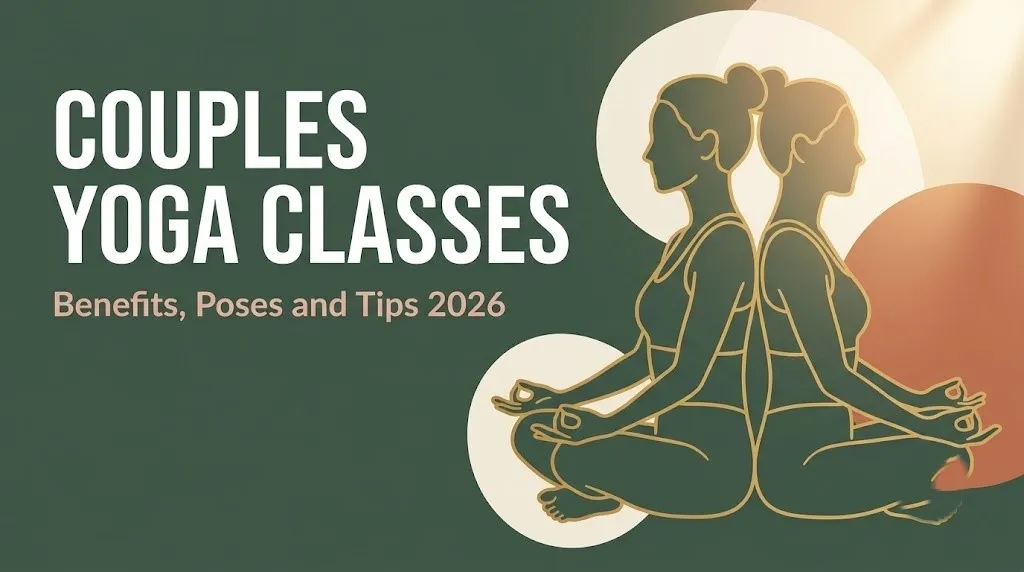
Couples Yoga Classes: Benefits, Poses and Tips 2026
Couples yoga classes are structured yoga sessions designed for two people to practice together, using each other’s weight, reach, and breath as tools for deepening poses, building trust, and creating a shared physical experience. They work for complete beginners, experienced practitioners, and everyone in between.
Research published in the Journal of Alternative and Complementary Medicine indicates that shared physical activity between partners increases feelings of closeness and reduces perceived stress more effectively than the same activity practiced alone. That’s not just pleasant. It’s a measurable physiological and psychological effect worth understanding.
This article covers what couples yoga classes actually involve, which poses work best for beginners, what the science says about practicing yoga with a partner, how to find the right class format, and how to start safely at home. You’ll also find specific modifications for seniors, people with injuries, and partners of very different body sizes.
What Are Couples Yoga Classes and How Do They Work?
Couples yoga classes are guided yoga sessions in which two participants practice poses together, using physical contact, synchronized breath, and assisted stretching to deepen the experience beyond what solo practice allows.
In a typical class, partners face each other, sit back-to-back, or hold hands while moving through a sequence. An instructor guides both timing and contact, explaining how one partner’s support changes the range of motion or stability available to the other. The physical mechanic is straightforward: one body as a counterweight or anchor changes what the other body can do.
Classes generally run 60 to 90 minutes. Most follow a Hatha or Restorative yoga format, prioritizing slow, deliberate movement over flow sequences. Some studios offer Vinyasa-based couples classes, which move more quickly and require more coordination between partners.
The structure typically includes:
- A seated or standing warm-up with synchronized breathing
- A series of assisted standing poses for balance and strength
- Floor-based stretches using each other as support or resistance
- A closing Savasana (Corpse Pose) practiced side by side or with physical contact
No prior yoga experience is required for most beginner couples yoga classes. Instructors adapt every pose to the pair’s combined mobility and comfort level.
Couples Yoga vs Partner Yoga: What Is the Difference?
Couples yoga and partner yoga refer to the same style of practice, though the terms carry slightly different cultural and marketing connotations depending on the studio.
“Partner yoga” is the more technically accurate term used within the yoga teaching community. It describes any yoga practiced between two people, regardless of their relationship. Friends, family members, teammates, and strangers paired in a class all practice partner yoga.
“Couples yoga” is the marketing term most studios and searchers use. It implies a romantic or intimate relationship between participants and often signals that the class has a warmer, more relationship-oriented atmosphere than a general partner yoga session.
| Term | Who It’s For | Typical Atmosphere | Common Styles Used |
|---|---|---|---|
| Partner yoga | Any two participants | Neutral, technique-focused | Hatha, Vinyasa, Acro |
| Couples yoga | Romantic partners | Warm, connection-oriented | Hatha, Restorative, Yin |
| Intimate couples yoga | Established couples | Deeply personal, trust-based | Restorative, Yin |
| Acro yoga | Experienced practitioners | Athletic, playful | Acro-specific sequences |
The practical difference for a first-time participant is minimal. Both formats use the same poses and the same physical principles. The difference lies mostly in class culture, instructor framing, and the assumed relationship between participants.
Acro yoga is a distinct discipline that involves one partner lifting, balancing, or flying the other. It requires significantly more strength, practice, and spotting guidance than standard couples or partner yoga. It is not interchangeable with either term.
Couples Yoga Benefits: What Research Says
Couples yoga offers documented benefits across physical fitness, stress physiology, and interpersonal connection, and the evidence is more specific than most studio marketing acknowledges.
On the physical side, assisted stretching in partner yoga allows greater range of motion than unassisted solo stretching. When one partner gently extends the other’s forward fold, the hamstrings, hip adductors, and thoracic spine receive a deeper, longer-held stretch than the individual could safely create alone. A 2016 study in Complementary Therapies in Medicine found that yoga-based assisted stretching produced greater flexibility improvements than unassisted practice over an 8-week program.
The cardiovascular and strength benefits parallel those of general yoga practice. Holding balance poses together, supporting each other’s weight, and stabilizing through shared movement engages the core musculature, shoulder girdle, and lower-body stabilizers in ways that solo practice does not require.
Key physical benefits supported by research and yoga teacher consensus:
- Improved range of motion in the hips, hamstrings, and spinal extensors through assisted stretching
- Increased proprioceptive awareness from balancing with a partner’s counterweight
- Core strengthening through stabilized shared poses
- Improved balance and joint stability in standing partner poses
- Reduced muscle tension through partner-assisted restorative holds
The psychological benefits are equally well-documented. Synchronized movement between two people activates neurological pathways associated with social bonding and trust, an effect studied extensively in movement psychology research reviewed by the American Psychological Association.
Key Takeaway: Couples yoga delivers real physical gains in flexibility, strength, and balance, and those benefits are amplified by the partner dynamic in ways that solo yoga cannot replicate.
Couples Yoga and Relationships: The Psychology Behind It
Couples yoga improves relationship quality through a combination of nonverbal attunement, physical touch, shared focus, and the trust required to support and be supported by another person.
The mechanism starts with touch. Appropriate, consensual physical contact between partners stimulates the release of oxytocin, a neuropeptide associated with social bonding and trust. Research reviewed by the American Psychological Association consistently links nonsexual touch between partners to increased relationship satisfaction and reduced conflict reactivity.
Interpersonal synchrony, meaning the coordination of movement and breath between two people, has its own distinct effect. A body of research in behavioral neuroscience suggests that synchronized physical activity increases feelings of affiliation and cooperation between participants. Partner yoga creates synchrony deliberately, through shared breath counts, mirrored movements, and coordinated transitions.
The communication demands of partner yoga are also worth noting. To practice safely and comfortably, partners must give and receive verbal and nonverbal feedback continuously. One person signals discomfort; the other adjusts. This pattern of responsive attunement, practiced physically on the mat, mirrors what relationship researchers call co-regulation, a process linked to emotional security in long-term partnerships.
According to research published in the Journal of Alternative and Complementary Medicine, couples who participated in shared mindful movement activities reported improved communication and reduced relationship stress compared to couples who engaged in separate leisure activities during the same period.
This is not magic. It’s applied neuroscience on a yoga mat.
Couples Yoga for Stress Relief and Anxiety
Couples yoga reduces stress and anxiety through the combined mechanisms of physical movement, breathwork, social connection, and the specific calming effect of safe, intentional physical contact with a trusted person.
The parasympathetic nervous system is the body’s rest-and-digest mode. Slow yoga movement, controlled breathing, and the feeling of physical safety all activate this system, reducing circulating cortisol and lowering heart rate. The NCCIH notes that yoga practice consistently shows stress-reduction effects across populations, with breathwork being one of the most reliable activators of parasympathetic function.
Practicing with a partner adds a layer that solo yoga cannot. Ujjayi breath, the slow nasal breathing used in most Hatha and Restorative yoga classes, can be synchronized between partners. Research in clinical psychology suggests that breathing in rhythm with another person amplifies the individual calming effect, because the nervous system responds not only to its own regulated breath but also to the regulated state of the nearby person.
For people managing anxiety specifically, the physical grounding of a partner’s hand, the predictability of a shared sequence, and the social presence of someone moving alongside them create a safe container that some anxious individuals find more accessible than solo meditation or solo yoga.
A practical starting point for stress relief:
- Begin seated back-to-back in Sukhasana (Easy Pose) and breathe together for 5 minutes before starting any poses
- Feel the other person’s rib cage expand on the inhale and soften on the exhale
- This single exercise activates the parasympathetic response before any movement begins
Modification: Partners with severe anxiety may prefer side-by-side seated breathing before any physical contact is introduced.
Couple Yoga Poses for Beginners
The best beginner couple yoga poses require minimal flexibility, carry low injury risk, and use physical contact in ways that feel natural rather than acrobatic.
Upavistha Konasana (Wide-Angle Seated Forward Fold) practiced with a partner is one of the most effective entry-level couple poses. Each partner sits facing the other with legs extended wide. They hold each other’s wrists or forearms. Partner A gently folds forward while Partner B sits upright, providing a stable anchor. The hamstrings, hip adductors, and lower back of the folding partner receive a deep, supported stretch.
To practice seated partner forward fold:
- Sit facing your partner with legs extended wide, feet touching or overlapping.
- Both partners sit tall through the spine before any forward movement.
- Reach forward and hold each other’s forearms just below the wrist.
- Partner A begins to fold forward slowly, hinging from the hips, not the lower back.
- Partner B sits upright and leans slightly back as counterweight, keeping the grip gentle.
- Hold for 5 to 8 breath cycles, roughly 30 to 45 seconds.
- Partner A slowly returns upright. Switch roles. Repeat.
Modification: If either partner has tight hamstrings, both partners can sit on folded blankets to tilt the pelvis forward. A yoga strap around both partners’ feet removes the need for full forearm grip.
Safety note: Partner B should never pull or yank. The movement comes from Partner A’s breath and willingness to fold, not from being forced deeper.
Pose Tip:
- Keep both partners’ spines as long as possible throughout the fold.
- The folding partner leads with the chest, not the head.
- If one partner is significantly taller, adjust leg position so feet contact comfortably.
Key Takeaway: The best beginner couple yoga poses use counterweight and gentle assistance, not flexibility or strength, which means almost any two people can start practicing together today.
How to Do Partner Yoga: Key Techniques and Cues
Partner yoga works through four core physical principles: counterweighting, assisted stretching, contact stabilization, and breath synchronization, each of which requires specific technique to practice safely.
Counterweighting is the most fundamental partner yoga technique. Two partners lean away from each other, arms linked or hands clasped, each providing resistance that allows the other to deepen a stretch or hold a balance that would be impossible alone. Think of it like a seesaw: each person’s weight makes the other’s position possible.
To practice Paschimottanasana (Seated Forward Fold) with partner assistance:
- Partner A sits with legs extended forward, feet flexed.
- Partner B kneels behind Partner A, placing both hands gently on the mid-back, not the lower back.
- Partner A inhales to lengthen the spine, then exhales and folds forward from the hips.
- On Partner A’s exhale, Partner B applies gentle, even pressure along the mid-back.
- Hold for 5 breath cycles. Release pressure fully on each inhale.
- Partner A slowly rolls up on an inhale. Switch roles.
Contact stabilization involves one partner placing a hand, foot, or back against the other to create a fixed reference point. Back-to-back seated poses use this principle: each person’s spine is supported by the other’s, allowing both to sit taller than they could alone.
Breath synchronization is practiced by both partners inhaling and exhaling at the same time, using audible Ujjayi breath so each person can hear and match the other’s rhythm.
Modification: Partners with lower back sensitivity should skip the mid-back pressure cue and use only back-to-back contact for support.
Intimate Couples Yoga Classes: What to Expect
Intimate couples yoga classes are smaller, more personally focused sessions designed specifically for romantic partners, typically featuring Restorative or Yin yoga formats and a slower, more emotionally attuned teaching style.
The word “intimate” in this context does not mean sensual. It means close, attentive, and trust-based. Intimate couples yoga classes prioritize the quality of connection between partners over pose achievement or athletic output. The instructor typically limits class size to four to eight couples to allow individual attention.
What typically happens in an intimate couples yoga class:
| Class Element | What You’ll Experience |
|---|---|
| Opening ritual | Seated facing each other, synchronized breathing, eye contact or hand-holding |
| Warm-up | Gentle individual movement, back-to-back breathing, light physical contact |
| Main sequence | Assisted stretches, counterweight poses, supportive holds |
| Communication practice | Instructor prompts verbal and nonverbal feedback throughout |
| Closing | Savasana side by side, optional partner breathing or hand contact |
| Duration | Typically 60 to 90 minutes |
Most intimate couples yoga instructors hold at minimum a 200-hour Yoga Alliance-registered teacher training certification. The best instructors also have training in trauma-informed yoga or somatic practices, which matters when physical contact and emotional vulnerability are part of the class design.
First-time attendees consistently report that the awkwardness they anticipated was mostly absent by the ten-minute mark. The structured nature of the class removes guesswork. You are told exactly where to place your hands and how to adjust.
Couples Yoga with Props: Blocks, Straps, and Bolsters
Props are not optional extras in couples yoga. They are practical tools that make poses accessible for different body proportions, mobility levels, and experience backgrounds.
A yoga strap is the single most useful prop for couples yoga. When partners have different arm lengths or flexibility levels, a strap between their hands or around their feet bridges the gap without forcing either person to compromise their alignment. In a partner forward fold, looping a strap around both sets of feet allows a shorter-armed partner to maintain the counterweight dynamic without gripping awkwardly.
Yoga blocks serve multiple functions in partner practice:
- A block under the sit bones of the less flexible partner levels the pelvis in seated poses, allowing both partners to work in the same direction at the same time.
- Blocks under the hands in standing poses help the less mobile partner maintain alignment while the more mobile partner supports from the other side.
- A block between partners in back-to-back poses can cue correct spinal spacing if partners are significantly different in height.
Bolsters are most relevant in couples Restorative yoga. One partner reclines over a bolster in a supported backbend while the other partner provides gentle traction or simply maintains physical contact. The supported partner experiences passive chest opening and hip flexor lengthening without any muscular effort.
Prop recommendations by pose type:
- Seated forward folds with significant flexibility difference: strap between feet
- Sitting back-to-back with height difference: blanket under shorter partner’s sit bones
- Restorative partner holds: bolster under partner receiving the stretch
- Balance poses with limited ankle stability: block beside foot of less stable partner
Key Takeaway: Props are what make couples yoga genuinely accessible for two people with different bodies and different flexibility levels. Skipping them means one partner is always compromising.
Couples Yoga at Home: A Beginner Sequence to Try
Couples yoga at home is fully practical for beginners, requiring only two yoga mats, a strap or long belt, and about 30 to 40 minutes of uninterrupted time together.
The following sequence builds from breath synchronization into gentle contact poses. Do not skip the breathing warm-up. That five minutes does more for the rest of the session than any pose.
Home beginner couples yoga sequence:
- Sukhasana (Easy Pose) back-to-back: Sit with spines touching. Breathe together for 3 to 5 minutes. Feel each other’s rib cage move. No talking during this section.
- Seated side stretch: Both partners sit cross-legged facing each other. Each reaches one arm overhead and leans in the same direction. Hold for 5 breaths. Switch sides.
- **Partner *Baddha Konasana (Bound Angle Pose):** Sit facing each other. Bring soles of feet together. Gently place hands on each other’s knees. Neither partner pushes. Both breathe into the inner hips for 8 to 10 breaths.
- Seated forward fold with strap: Use the technique from the earlier section. Each partner takes one full round as the person folding and one round as the anchor.
- Back-to-back chair pose: Stand back-to-back. Both partners step feet hip-width apart. Lean back into each other slightly and both sit into Utkatasana (Chair Pose). Hold 5 breaths. Rise together on the inhale.
- Savasana (Corpse Pose) side by side: Lie down with backs of hands touching. Rest for 5 minutes. No movement.
Modification: If floor sitting is uncomfortable, both partners can practice seated poses on a chair or folded blanket.
Couples Yoga for Seniors and Limited Mobility
Couples yoga is particularly well-suited to older adults and people with limited mobility because the partner dynamic provides built-in support, stability, and motivation that solo senior yoga often lacks.
Research published in the International Journal of Yoga found that yoga practice in adults over 60 produced meaningful improvements in balance, lower-body strength, and fall-risk reduction after 8 to 12 weeks of consistent practice. The presence of a partner adds a social accountability factor that research on exercise adherence consistently identifies as a predictor of long-term consistency.
For seniors and people with mobility limitations, the key modifications involve moving practice from the floor to chairs, using walls for stability, and reducing the range of motion required without losing the partner dynamic.
| Pose | Standard Version | Senior or Limited Mobility Modification |
|---|---|---|
| Back-to-back Sukhasana | Seated on floor | Both partners seated in chairs, backs touching |
| Partner forward fold | Floor seated, legs extended | Chair seated, folding over thighs with strap |
| Partner Warrior I (Virabhadrasana I) | Full standing lunge | Half-lunge depth, both partners near wall |
| Side-by-side balance | One-leg balance | Both hands on wall or backs of chairs |
| Partner Savasana | Floor-based | Reclined in matching chairs or on a sofa |
Safety note for seniors: Partners should always agree on a clear verbal signal, such as “stop” or “ease,” that immediately halts any pressure or movement without question or negotiation. Establishing this signal before the first pose begins is not optional.
People with osteoporosis should avoid deep forward folds and spinal twists in partner yoga. A physician familiar with their bone density history should advise on appropriate movement ranges before they attend any couple yoga class.
Couples Yoga Safety Tips and Who Should Be Cautious
Couples yoga carries lower injury risk than solo acrobatic or advanced yoga, but specific conditions and dynamics require careful attention before and during practice.
The most common injuries in partner yoga involve the lower back, the shoulder joint, and the knees. These typically occur when one partner applies pressure during a pose without the other person’s explicit readiness, when a partner is pulled or pushed past their comfortable range of motion, or when two partners attempt a balance pose they are not yet ready for without proper spotting.
People who should exercise particular caution or seek professional guidance before attending couples yoga classes:
- Those with herniated discs or sciatica: Deep forward folds with partner pressure on the back can compress already irritated nerve roots.
- Those with shoulder impingement or rotator cuff injuries: Overhead partner assists and counterweight poses load the shoulder girdle significantly.
- People with hypermobility or Ehlers-Danlos syndrome: The additional range of motion provided by a partner can push hypermobile joints past safe thresholds before any pain signal occurs.
- Those with significant vestibular or balance disorders: Partner balance poses increase fall risk for both participants if one partner loses stability.
- Partners with a large size or weight discrepancy: Counterweight poses are calibrated by roughly equal resistance. If one partner is significantly heavier or taller, many standard counterweight poses need to be modified or replaced.
Core safety rules for every couples yoga session:
- Establish a clear stop signal before the first pose.
- Neither partner ever applies pressure without verbal confirmation first.
- Slow down all transitions. Rushing in partner yoga is the fastest route to injury.
- If something feels sharp rather than stretchy, stop immediately and reassess.
Key Takeaway: The golden rule of couples yoga safety is that all pressure and physical assistance must follow breath and consent, never lead it.
Romantic Couples Yoga Near Me: How to Find the Right Class
Finding a couples yoga class that actually fits your needs means looking beyond the studio name and evaluating the instructor’s credentials, the class format, and the size and atmosphere of the session before you book.
Start with Yoga Alliance’s online teacher registry, which allows you to verify whether an instructor holds a recognized RYT-200 or RYT-500 credential. An instructor leading couples or partner yoga without formal training poses real physical risk to participants who trust them to manage assisted poses safely.
What to look for when researching couple yoga near me:
- Credential verification: RYT-200 minimum, RYT-500 preferred for couples-specific classes
- Class size: Smaller classes (under 10 couples) allow more individual instructor attention
- Format description: “Restorative couples yoga” and “Hatha partner yoga” are specific enough to tell you the pace and style. “Couples yoga experience” is a red flag for vague marketing.
- New student policy: Does the studio mention modifications, props availability, or a pre-class check-in for injuries?
- Studio atmosphere: Read reviews specifically for language about safety culture, not just how “romantic” the class felt
Date-night couples yoga events at studios are often 90-minute themed sessions. These work well for first-timers because the instructor typically assumes no prior experience. Workshop-style couples yoga intensives last two to four hours and are better suited for people who already have a yoga foundation.
Romantic couples yoga near me searches will surface both studio classes and private instructor booking options. Both are valid. The private option allows the instructor to design the session entirely around your specific bodies and experience levels.
Private Couples Yoga Session vs Group Couples Yoga Class
A private couples yoga session offers a personalized, injury-aware, and body-specific experience that a group class cannot match, but group classes offer community energy and a lower cost that many couples prefer.
In a private session, the instructor assesses both partners before the first pose. They note flexibility differences, injury histories, and comfort with physical contact. Every pose in the session can then be adapted to those specific bodies. For couples where one partner has a specific injury or condition, private sessions are often the safer starting point.
| Feature | Private Session | Group Couples Class |
|---|---|---|
| Cost | Higher ($80 to $200 per session typical) | Lower ($20 to $50 per couple typical) |
| Personalization | Full: every pose adapted to your bodies | Limited: instructor manages the whole group |
| Injury accommodation | Detailed: modifications built around your specific needs | General: standard modifications only |
| Social energy | Quiet, focused, intimate | Group dynamics, shared energy |
| Best for | Couples with injuries, beginners, specific goals | First-timers wanting a low-pressure entry point |
| Instructor attention | Constant | Divided among all couples in class |
Many couples find that starting with one or two private sessions and then transitioning to group classes gives them the best of both formats. The private session builds a foundation of safe technique. The group class adds variety, community, and cost efficiency.
The group setting also normalizes the experience for couples who feel self-conscious about practicing together in front of others. Seeing other couples struggling through the same balance pose with the same amount of laughter tends to dissolve any awkwardness quickly.
How Often Should Couples Practice Yoga Together?
Two to three couples yoga sessions per week produces the best results for flexibility, connection, and stress management, though one session per week still delivers measurable benefits when practiced consistently over 8 to 12 weeks.
The frequency question depends heavily on your goals. If the primary goal is physical: flexibility, strength, and joint mobility, more frequent practice produces faster adaptation. The American College of Sports Medicine’s flexibility training guidelines support two to three sessions per week as the minimum effective dose for meaningful range of motion improvement in adults.
If the goal is relational, meaning using yoga as a shared practice for connection and stress reduction, research on shared activities and relationship quality suggests that regularity matters more than frequency. One consistent weekly session practiced mindfully outperforms sporadic intense sessions with no rhythm.
A practical framework for different couple types:
- New to yoga together: Start with one group class per week for four weeks. Add one home practice session in week five.
- One experienced, one new: Begin with a private session to establish shared technique. Move to one group class plus one short home session weekly.
- Both experienced: Two to three sessions weekly, alternating group classes with home practice.
- Seniors or limited mobility: One studio session plus one gentle home session weekly, with full rest days between.
Rest days matter in partner yoga as they do in all physical training. The connective tissue lengthened through assisted stretching needs recovery time between sessions. Practicing every day without rest slows adaptation rather than accelerating it.
Key Takeaway: One consistent weekly session beats irregular intense practice every time. Build the habit first, then add frequency once showing up together feels natural.
Frequently Asked Questions About Couples Yoga Classes
What should I expect in my first couples yoga class?
Your first couples yoga class will begin with breathing together and a simple warm-up before any partner contact poses are introduced.
Expect the instructor to explain every pose in detail, demonstrate it, and check in with both partners before adding any physical assistance or pressure.
Most first-time couples report feeling awkward for about ten minutes and comfortable for the remaining sixty, once the structured format removes the guesswork.
Do you have to be flexible to do couples yoga?
No flexibility is required to start couples yoga classes.
Partner poses are adapted to whatever range of motion the less flexible person has, and props like straps, blocks, and blankets fill the gap between different flexibility levels.
The partner dynamic itself gradually improves flexibility for both people over consistent practice, starting from wherever your body currently is.
Is couples yoga good for your relationship?
Research published in the Journal of Alternative and Complementary Medicine suggests that couples who engage in shared mindful movement show improved communication and reduced relationship stress.
The physical touch, synchronized breathing, and trust-building required in partner yoga activate neurological pathways associated with bonding and emotional co-regulation.
These effects are not guaranteed by attendance alone. They develop through consistent, attentive practice over time.
Can two complete beginners do couples yoga together?
Two complete beginners can absolutely attend a beginner couples yoga class together without any prior yoga experience.
Most studios offering couples or partner yoga classes design their beginner sessions with zero assumed knowledge, walking participants through every pose from the starting position.
The key is choosing a class specifically labeled for beginners or first-timers rather than a general partner yoga session that may assume baseline yoga familiarity.
What is the difference between couples yoga and acro yoga?
Couples yoga focuses on assisted stretching, counterweight poses, and synchronized breathing between partners at a similar level of physical contact.
Acro yoga is a separate discipline involving one partner lifting, inverting, or balancing the other in the air, requiring significantly more strength, core control, and spotting experience.
If you are new to yoga or partner practice, start with couples yoga. Acro yoga carries a higher injury risk and requires specific preparation that beginner-level partner yoga does not.
Your Next Step Starts with One Session
Start with a single class. Not a month-long commitment. Not a full home sequence. One 60-minute session with your partner, ideally with an RYT-certified instructor who has experience teaching couples or partner yoga.
Bring a strap and a block if you have them. Arrive five minutes early. Tell the instructor your experience level and any injuries before the class begins.
The rest will become clear once you’re in the room together, breathing at the same pace, figuring it out side by side