Easy 3 Person Yoga Poses: Complete Beginner Guide 2026
The best 3 person yoga poses easy enough for complete beginners are ones that use side-by-side formations, seated partner work, and standing poses with mutual support rather than weight-bearing on top of another person. These poses are accessible to friend groups, families, and kids with no prior yoga experience, as long as everyone communicates clearly before and during the session.
Group yoga is not just fun. The National Center for Complementary and Integrative Health (NCCIH) documents that social connection during movement practices supports stress reduction and emotional regulation more effectively than solo practice in some populations. Research suggests that partner-based yoga increases adherence to practice and improves mood compared to individual sessions.
This guide covers what three-person yoga actually is, how to set up safe communication between your group, which poses to start with, how to modify for kids and seniors, and how to build a sequence your group can return to again and again. Every pose includes step-by-step instructions, real muscle engagement details, and safety notes that the standard listicle articles skip entirely.
3 Person Yoga Poses Easy: What You Need to Know First
The most important thing to understand before attempting 3 person yoga poses is that group yoga requires communication, not just physical flexibility. The poses themselves are accessible. The group dynamics require deliberate setup.
Three-person yoga falls under the broader category of partner and group yoga, which has been practiced in various forms across yoga traditions for decades. Unlike solo yoga, group practice introduces variables like mismatched strength levels, different ranges of motion, and the physical and emotional risk of falling or pulling a partner into discomfort without realizing it.
The term “easy” in three-person yoga refers to structural simplicity: poses where no one is supporting another person’s full body weight, where all three practitioners are grounded, and where the formation can be entered and exited independently. These are the right starting point. Acrobatic or weight-bearing group poses are intermediate to advanced work, regardless of how they look in photos.
What makes a 3 person yoga pose genuinely beginner-appropriate:
- All three practitioners remain in contact with the floor throughout the pose
- No person is bearing the body weight of another
- The formation can be entered and exited without assistance
- Each practitioner can release independently without disrupting the others
- The pose uses familiar individual poses as its building blocks
Starting with these criteria filters out the impressive but risky poses that dominate most “easy” group yoga lists and leaves you with a set of genuinely safe and instructive experiences.
What Is 3 Person Yoga and How Does It Work
Three-person yoga is a group movement practice in which three practitioners coordinate their bodies into a shared formation, using each other’s presence for balance support, alignment feedback, or mutual stretching assistance. It is not a separate yoga style; it is a social format applied within established yoga traditions.
Most three-person yoga sessions draw from Hatha yoga principles: individual poses are adapted into side-by-side rows, back-to-back formations, or assisted variations where one practitioner offers gentle support to another. The group structure does not change the fundamental biomechanics of each pose. Trikonasana (Triangle Pose) is still Trikonasana whether one person or three are practicing it. What changes is the sensory and social layer.
Three-person yoga differs from acro yoga, which involves one practitioner supporting or flying above another. In beginner three-person yoga, all practitioners remain independently grounded. Acro yoga techniques involve weight distribution across bodies and require specific training to practice safely.
Three-person yoga formats by structure:
| Formation Type | Description | Best For |
|---|---|---|
| Side-by-side row | All three face the same direction in identical poses | Standing poses, warrior sequences |
| Back-to-back triangle | Three practitioners stand back-to-back in a triangle | Balance poses, seated twists |
| Circle formation | Three sit or stand facing inward in a circle | Seated stretches, breathing exercises |
| Assisted pair plus observer | Two practice while one offers hands-on support | Beginners learning poses, seniors |
Understanding which formation suits which pose type prevents the confusion that collapses most first attempts at group yoga.
Benefits of Doing Yoga with Three People
Practicing yoga with three people produces physical, psychological, and social benefits that extend beyond what solo yoga provides, particularly in the areas of balance, accountability, and interpersonal trust.
Balance improvement is one concrete physical benefit. When three practitioners perform Vrksasana (Tree Pose) in a row with their inside hands connected, each person gains a small external reference point for their balance system. The American College of Sports Medicine notes that external tactile feedback during balance training measurably improves proprioceptive accuracy. The connected hands function as that feedback without replacing the work of the standing leg.
The social benefits are equally well-documented. A 2020 study published in the Journal of Alternative and Complementary Medicine found that partner yoga practice reduced cortisol levels and increased self-reported feelings of social connection more effectively than solo practice in the same participants. Three-person practice amplifies this effect by adding a third relational dimension.
Benefits specific to three-person yoga practice:
- Shared breathing rhythm synchronizes the nervous systems of all three practitioners
- Mutual alignment feedback reduces common solo errors like uneven hip height in standing poses
- Social accountability increases session consistency: group commitments are harder to skip than solo ones
- Trust-building through physical coordination improves interpersonal communication outside the yoga context
- For children, group yoga builds cooperation and body awareness simultaneously
The fun factor is real and worth naming directly. Most practitioners laugh more in group yoga than in solo sessions, and positive emotional states during movement directly support the parasympathetic nervous system’s recovery response.
Key Takeaway: Three-person yoga improves balance through tactile feedback, reduces cortisol through social connection, and builds the kind of group accountability that makes showing up consistently easier than solo practice.
How to Communicate Safely in 3 Person Yoga
Safe communication in three-person yoga means establishing three specific agreements before the session begins: a verbal check-in signal, a stop signal, and a confirmation of each person’s current physical limitations.
Most group yoga injuries happen not from poses that are too difficult, but from one person pushing further than they communicated or holding a position longer than their partner expected. In solo yoga, you read your own body continuously. In group yoga, you need to read your partners’ bodies too, and that requires words, not just observation.
Before any group yoga session, agree on a clear stop word or signal. Many yoga teachers use “release” or “stop” as non-negotiable words that immediately end any shared formation without explanation required. A thumbs-down gesture works if you’re in a position where speaking is awkward. The signal should be something every practitioner agrees to honor immediately, without hesitation or negotiation.
The three-point pre-session communication checklist:
- Physical check-in: each person names any current injuries, tight areas, or areas to avoid contact with today
- Stop signal agreement: choose one verbal and one non-verbal signal that means “release immediately”
- Effort level communication: agree that each person practices at their own range of motion, not at their most flexible partner’s range
Also establish the practice of verbal check-ins during held poses. A simple “how are you doing?” mid-hold, answered honestly, prevents the slow build of discomfort that leads to someone suddenly releasing from a shared position and destabilizing the group.
How to Warm Up Before 3 Person Yoga
The best warm-up before three-person yoga combines individual joint mobilization with a brief shared breathing exercise that synchronizes the group before any physical contact begins. A warm-up for group yoga serves two purposes: preparing the body and calibrating the group’s pace and energy.
Individual warm-up should take 5 to 7 minutes and target the joints most involved in the planned poses: hips, shoulders, ankles, and spine. Cat-Cow spinal mobilization (Marjaryasana-Bitilasana), gentle neck rolls, and ankle circles are appropriate for all ages and fitness levels.
After individual warm-up, the group should spend 2 to 3 minutes breathing together in a circle. Sit in Sukhasana (Easy Pose) facing each other. Inhale for a count of 4 together, exhale for a count of 6 together. Three to five rounds of this synchronized breath calms the nervous system and creates a shared rhythm the body carries into the physical practice.
5-minute group warm-up sequence:
- All three sit in Sukhasana (Easy Pose) in a circle. Take 5 synchronized breaths.
- Move to hands and knees. Practice Marjaryasana-Bitilasana (Cat-Cow Pose) for 8 rounds, synchronized.
- Press back to Balasana (Child’s Pose) for 5 breaths.
- Come to standing in a side-by-side row. Roll shoulders back 5 times, then forward 5 times.
- Stand in Tadasana (Mountain Pose) together for 3 full breaths. This is your group neutral position.
Modification: For groups including a senior or someone with knee discomfort, substitute the floor phases with seated chair versions or standing hip circles. The synchronized breathing remains unchanged.
Key Takeaway: Synchronized breathing before any physical contact in group yoga is not optional. Two to three minutes of shared breath at the start creates a collective nervous system baseline that makes every pose safer and more cohesive.
3 Person Yoga Poses Standing for Beginners
The best standing 3 person yoga poses for beginners use a side-by-side row formation, where all three practitioners perform the same pose simultaneously, optionally connecting at the inside wrists or shoulders for balance feedback.
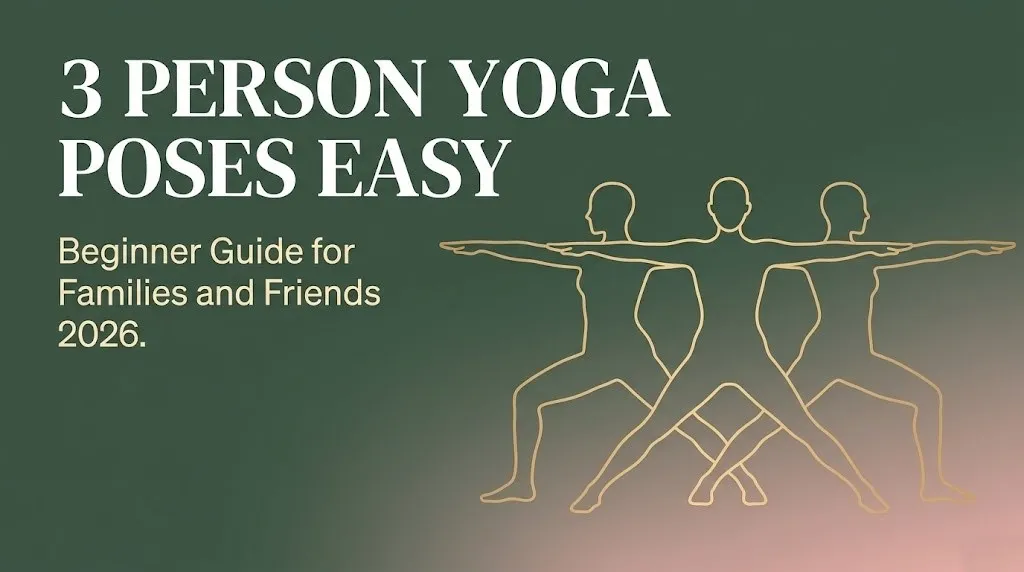
Virabhadrasana II (Warrior II) in a three-person row is the ideal starting standing pose. Each person performs an identical pose. The two practitioners on the ends face outward while the middle practitioner can face either direction. All three open their arms to the sides. The outside arms extend freely. The inside arms can connect at the wrists, with light contact rather than gripping.
To practice the Three-Person Virabhadrasana II (Warrior II) Row:
- Stand in a row with approximately 12 to 18 inches between each practitioner.
- All three step or jump the feet wide, roughly 3 to 4 feet apart depending on individual leg length.
- The end practitioners turn their front feet outward toward their respective ends. The middle practitioner turns their feet to one side.
- All three bend the front knee to 90 degrees, tracking the knee over the second toe.
- Extend arms parallel to the floor, palms down. Inside arms may lightly connect at the wrists.
- Breathe together for 5 breath cycles. Hold steady. Gaze over the front hand.
- Inhale to straighten the front leg. Switch sides.
Vrksasana (Tree Pose) in a connected row is equally accessible. Each practitioner balances on one leg, with the raised foot on the inner calf or inner thigh, never the knee. Inside hands can connect at shoulder height for balance support.
Modification: Practitioners with balance challenges should stand within arm’s reach of a wall, with their outside hand available to touch the wall if needed. The wall contact is a safety backup, not a prop they must use continuously.
3 Person Yoga Poses Sitting and on the Floor
Seated and floor-based three-person yoga poses are among the most accessible options for beginners because all practitioners are grounded, the risk of falling is removed, and deeper stretching becomes possible with gentle partner assistance.
Paschimottanasana (Seated Forward Fold) in a three-person star formation is a foundational group floor pose. All three sit on the floor with legs extended, arranged in a star or triangle, so that each person’s feet are near or touching another person’s feet. Each practitioner folds forward at their own natural depth.
The three-person seated twist is another grounded option. All three sit back-to-back in a tight triangle. Each person twists to the right, placing one hand on their own knee and one hand on the knee of the person beside them. This creates a gentle, three-way rotation that provides both a spinal twist and a shared grounding experience.
To practice the Three-Person Star Paschimottanasana (Seated Forward Fold):
- All three sit on the floor with legs extended, arranged like a three-pointed star with feet near the center.
- Flex all feet, pressing the soles toward the center of the group.
- Each person inhales to lengthen the spine. Exhale and fold forward over the legs.
- Reach the hands toward the feet or shins. Do not pull on a partner’s limbs.
- Hold for 5 to 8 breath cycles. Each person folds to their own comfortable depth.
- Inhale to rise, one person at a time rather than all simultaneously.
Modification: Practitioners with tight hamstrings should sit on a folded blanket or a yoga block to tilt the pelvis forward, reducing lumbar rounding. People with herniated lumbar discs should remain upright rather than folding forward, and can participate by sitting in the formation and practicing synchronized breathing instead.
Easy Three Person Yoga Poses for Kids
Three-person yoga poses that are accessible for children work best when they involve playful shapes, clear roles, and movements that feel more like a game than a structured practice. Children benefit from group yoga’s cooperation demands, but they need shorter hold times and more varied movement than adult sessions typically provide.
According to the National Center for Complementary and Integrative Health (NCCIH), yoga practice in children supports attention, emotional regulation, and body awareness when delivered in age-appropriate formats. Group formats add a cooperation and communication layer that solo children’s yoga does not reach.
The three-person “forest” formation is ideal for kids. All three stand in a row in Vrksasana (Tree Pose), connected at the inside wrists. They become three trees in a forest. This language engages children’s imagination while teaching single-leg balance, hip stability, and cooperative connection.
The three-person “bridge” shape is a floor-based alternative. Two children lie on their backs side by side with knees bent and feet flat. The third sits cross-legged between them, one hand resting lightly on each person’s belly. The two lying down breathe and feel their bellies rise and fall under the seated child’s hands. Hold for 4 to 5 breaths, then switch roles.
What makes a pose kid-appropriate in a group setting:
- Short hold times of 3 to 5 breaths rather than longer holds
- A story or imaginative framework attached to the shape
- All three children remain independently grounded
- The pose can be entered and exited in under 10 seconds
- No child bears the weight of another child
Modification: For groups with a significant age gap between children, the older or larger child should never be placed in a role where the younger child’s safety depends on their strength or balance. Use observation and coaching roles for older children instead.
Key Takeaway: Children thrive in three-person yoga when the poses have imaginative names, short hold times, and independent grounding for all three practitioners. Keep every child’s safety independent of another child’s physical capacity.
3 Person Yoga Poses for Families
Family three-person yoga works best when it explicitly accounts for the size and strength differences between adults and children, rather than assuming everyone can perform the same pose at the same depth or duration.
The most practical family three-person pose format puts two adults in side-by-side positions with a child in between or in front. In a three-person Virabhadrasana II (Warrior II) row, two adults perform the full pose while a child stands between them in a modified version, holding onto one adult’s hand for balance if needed.
The family seated circle is equally effective. Two adults and one child sit in Sukhasana (Easy Pose) facing each other in a tight triangle, knees touching or nearly touching. All three place their right hand on the left knee of the person beside them and breathe together. This physical connection at the knees creates a circuit of contact without any weight-bearing demands.
Family-friendly three-person yoga poses by age combination:
| Combination | Recommended Pose | Family Role |
|---|---|---|
| 2 adults, 1 young child (3 to 6) | Forest Tree row (Vrksasana), child in center | Child holds one adult’s hand |
| 2 adults, 1 older child (7 to 12) | Warrior II row (Virabhadrasana II) | Child performs full pose independently |
| 2 adults, 1 teenager | Seated star forward fold (Paschimottanasana) | All three at own depth |
| 2 adults, 1 senior | Seated circle with synchronized breathing | Focus on breath, not range of motion |
The key principle for family yoga is that every person’s experience of each pose is valid at their own level. An adult in a deep forward fold and a six-year-old sitting upright in the same formation are both doing the pose correctly.
3 Person Yoga Modifications for Different Body Types
Three-person yoga modifications exist to ensure that practitioners of different flexibility levels, body sizes, and physical conditions can participate in the same session without anyone pushing beyond their safe range to keep up with the group.
The most common mismatch in mixed-group yoga is flexibility differences. When three practitioners of significantly different hamstring flexibility attempt Paschimottanasana (Seated Forward Fold) together, the least flexible person may feel pressure to fold deeper than their spine and hamstrings comfortably allow. The solution is explicit permission: each person folds to their own depth, and no one’s depth becomes the group’s standard.
Prop use is the most practical modification tool. Yoga blocks, folded blankets, and yoga straps make poses accessible across body types without altering the shared shape of the formation.
Modifications by body type and condition:
| Situation | Modification | Which Pose |
|---|---|---|
| Tight hamstrings | Sit on a yoga block; keep knees slightly bent | Seated Forward Fold (Paschimottanasana) |
| Knee discomfort | Raised foot stays on inner calf only, not thigh | Tree Pose (Vrksasana) |
| Shoulder restriction | Arms stay at sides rather than extending | Warrior II (Virabhadrasana II) |
| Lower back sensitivity | Stay upright in seated poses; skip forward folds | Star formation |
| Limited balance | One hand maintains wall contact throughout | All standing balance poses |
| Pregnancy (second/third trimester) | Widen stance; skip deep forward folds; avoid belly compression | All poses; substitute Warrior II for forward fold |
Modification note: A practitioner managing an acute injury should take on the role of the “observer and encourager” rather than skipping the session entirely. This role keeps them connected to the group experience without physical risk.
Key Takeaway: Prop use and explicit group permission to practice at individual depth are the two most effective tools for making three-person yoga genuinely accessible to mixed-ability groups without anyone feeling left behind.
How to Breathe Together in Three Person Yoga
Synchronized breathing in three-person yoga means all three practitioners inhale and exhale at the same pace, creating a shared rhythm that stabilizes the nervous system and makes coordinated movement significantly easier.
Think of synchronized breathing like three musicians playing in the same time signature. When everyone is breathing to different rhythms, the group feels fragmented and poses feel harder. When breath aligns, the shared body work feels fluid. The physical reason is physiological: synchronized breath patterns synchronize heart rate variability between practitioners, a phenomenon documented in research on choral singing and partner movement.
Ujjayi pranayama (ocean breath) is the most practical breathing technique for group yoga. Its audible quality means each practitioner can hear whether the group is still synchronized without visual cues. When one person’s Ujjayi becomes ragged or silent, it signals that they need a rest or have pushed to their limit.
To practice synchronized group breathing in three-person yoga:
- All three sit in Sukhasana (Easy Pose) in a circle, eyes closed or soft-gaze downward.
- One person counts aloud: “Inhale, 2, 3, 4. Exhale, 2, 3, 4, 5, 6.”
- Practice 5 rounds with the verbal count, then let the count drop.
- Continue breathing at the established pace without counting for 3 to 5 minutes.
- If someone naturally speeds up or slows down, the group gently returns to the original pace without comment.
Modification: Practitioners with respiratory conditions like asthma should use their own comfortable breath rhythm and participate in the group formation without being required to match the group’s exact count. Breath forcing in any pranayama practice is always contraindicated.
3 Person Yoga Challenge Poses for When You Are Ready to Progress
Three-person yoga challenge poses are intermediate formations that require all three practitioners to have solid individual pose foundations and strong group communication before attempting shared weight or more complex geometry.
These are not beginner poses. The label “challenge” here is literal. A challenge pose in a three-person context involves one or more of these demands: a single practitioner providing balance support for another, asymmetric weight distribution across the group, or a formation that cannot be exited independently without coordination.
The three-person connected Trikonasana (Triangle Pose) chain is the least demanding challenge progression. Three practitioners perform Trikonasana (Triangle Pose) in a row, each facing the same direction, with their inside hand resting lightly on the other’s back hip rather than the floor or a block. This adds spinal rotation and communication demands without weight-bearing.
Challenge pose progression table:
| Pose | Individual Foundation Required | Group Skill Required | Difficulty |
|---|---|---|---|
| Connected Trikonasana (Triangle Pose) chain | Solid individual Triangle | Light hand contact on partner’s hip | Low challenge |
| Three-person Wheel base (floor only, no flyer) | Comfortable Setu Bandha Sarvangasana (Bridge Pose) | Synchronized timing to enter and hold | Moderate challenge |
| Three-way seated spinal twist, interlaced arms | Comfortable individual seated twist | Arm coordination and communication | Low-moderate challenge |
Modification: If any practitioner in the group is not comfortable with their individual version of the foundation pose, the group should return to that foundation pose independently before attempting the connected version. This is not a setback; it is the correct progression.
3 Person Acro Yoga Poses: What Beginners Should Know
Acro yoga for three people involves one practitioner (the base) supporting another (the flyer) with their feet or hands, while a third practitioner (the spotter) stands beside the pair to prevent falls. True acro yoga is not beginner territory, and conflating it with beginner three-person yoga causes injuries.
The American College of Sports Medicine recommends that activities involving weight-bearing on another person’s body be approached with structured progression and ideally in-person instruction from a trained teacher. Reading instructions online is not sufficient preparation for acro yoga’s physical demands.
That said, there are accessible acro-adjacent experiences available to curious beginners that involve no lifting. The “base and wings” floor shape has one practitioner lying on their back with legs extended vertically, feet flat against a standing practitioner’s hips (not bearing weight, just in contact), while a third sits cross-legged beside them as the observer. No one is lifted. The feet contact creates a grounding connection without load-bearing.
What three-person acro yoga actually requires before beginning:
- All three practitioners should have at least 6 months of consistent individual yoga practice
- At minimum one in-person workshop with a certified acro yoga teacher
- Clear stop signals agreed upon before every session
- A soft surface, such as grass or a thick mat, not a hard studio floor
- Spotters must understand their role: hands-on proximity to catch, not observe from a distance
Beginners attracted to acro yoga should start with a local workshop rather than attempting poses from photos or videos. The risk of wrist, shoulder, and neck injury in unsupported acro yoga attempts is real and preventable.
Key Takeaway: Acro yoga is not beginner yoga, regardless of how the photos make it look. True beginners should spend at least 6 months building individual pose foundations before attempting any weight-bearing three-person formations.
3 Person Yoga for Seniors: Safe Adaptations
Three-person yoga is genuinely accessible for seniors when it uses chair-supported formations, short hold times, and explicitly removes any weight-bearing between practitioners. The social and physical benefits are particularly valuable for older adults, who often have fewer natural movement contexts for cooperative physical activity.
A review published in Complementary Therapies in Medicine found that group yoga practice in adults over 60 improved balance, reduced fall risk, and increased social well-being when practiced consistently over 8 weeks. The group format produced greater adherence than solo senior yoga in the same study population.
For senior three-person yoga, seated circle formations in chairs replace floor-based poses. Three chairs arranged in a triangle, occupants facing inward, with hands resting on each other’s knees during synchronized breathing is a complete and physiologically meaningful three-person yoga session for practitioners with mobility limitations.
Senior-adapted three-person yoga sequence:
- Three chairs in a triangle, all facing inward. Sit with feet flat on the floor.
- Practice 5 rounds of synchronized breathing, hands on own thighs.
- Each person places their right hand on the left knee of the person beside them. Take 3 breaths in this connected position.
- All three perform seated side bends to the right: right arm reaches up and over. Hold 3 breaths. Return. Repeat left.
- All three perform a gentle seated spinal twist: right hand to left knee, left hand behind the chair back. Hold 3 breaths per side.
- Return to the connected knee position. Take 5 closing breaths together.
Modification: Seniors with osteoporosis should avoid any rotation that places torsional load on the vertebral bodies. Substitute a simple lateral lean for the seated twist, keeping the spine long rather than rotating.
How to Build a Three Person Yoga Sequence
A three-person yoga sequence is built by ordering poses from the least to most physically demanding, separating active poses with brief shared rest positions, and ending with a synchronized cool-down that returns all three practitioners to calm.
The sequencing logic for group yoga mirrors individual yoga sequencing: warm-up, standing active work, seated or floor work, and final rest. What changes is the group pacing. A sequence for three moves at the speed of the least experienced or least mobile practitioner, not the fastest or most flexible.
A complete beginner three-person yoga sequence (45 to 60 minutes):
| Phase | Poses | Duration |
|---|---|---|
| Warm-up | Synchronized breathing, Cat-Cow, Tadasana (Mountain Pose) | 7 to 10 minutes |
| Standing active | Warrior II row (Virabhadrasana II), Tree row (Vrksasana) | 12 to 15 minutes |
| Transition rest | Group Balasana (Child’s Pose) or seated breathing circle | 3 to 5 minutes |
| Floor active | Star Forward Fold (Paschimottanasana), Seated Twist circle | 10 to 12 minutes |
| Cool-down | Reclined breathing, Savasana (Corpse Pose) side by side | 8 to 10 minutes |
Building consistency into a three-person sequence means using the same warm-up and cool-down every session. The middle poses can rotate. Familiar opening and closing rituals help the nervous system of all three practitioners settle quickly into group practice mode.
One more practical note: appoint a session guide for each practice. This person counts breath cycles aloud, announces transitions, and checks in verbally with the group mid-holds. Rotating this role prevents one person from always carrying the cognitive load of the session.
Frequently Asked Questions About 3 Person Yoga Poses Easy
What are the easiest 3 person yoga poses for complete beginners?
The easiest poses are side-by-side Virabhadrasana II (Warrior II), connected Vrksasana (Tree Pose) rows, and the seated star Paschimottanasana (Seated Forward Fold).
These poses require no weight-bearing between practitioners, can be entered and exited independently, and use familiar individual pose shapes as their foundation.
Start with the standing row formations before moving to floor-based poses, so the group can calibrate their communication before getting close to the ground.
Is 3 person yoga safe for kids?
Three-person yoga is safe for children when all poses are independently grounded, no child bears another child’s weight, and hold times are kept to 3 to 5 breaths.
The best kid-friendly formats use imaginative names and playful themes to keep engagement high and make the cooperative element feel natural rather than forced.
Children under age 5 should be supervised by an adult within arm’s reach throughout the entire session.
How do you signal that you need to stop or adjust in partner yoga?
Agree on a verbal stop word before the session starts, such as “release” or “stop,” that every practitioner honors immediately without question or delay.
A non-verbal signal, such as a thumbs-down or a double tap on a partner’s hand, should also be agreed upon for positions where speaking is awkward.
Practice using the stop signal once at the beginning of the session so everyone knows it is real and will be respected.
Do you need yoga experience to try 3 person yoga poses?
No prior yoga experience is needed for beginner three-person poses that use grounded, independently accessible formations.
Learning the individual versions of poses like Tadasana (Mountain Pose), Virabhadrasana II (Warrior II), and Balasana (Child’s Pose) before attempting group versions makes the transition significantly smoother.
A 10-minute individual practice warm-up before joining the group gives complete beginners enough body awareness to participate safely.
What props do you need for 3 person yoga?
The minimum props for a beginner three-person session are three yoga mats, placed side by side or in a triangle depending on the formation.
Yoga blocks help practitioners with tight hamstrings or limited hip mobility participate fully in seated floor poses without compromising spinal alignment.
A folded blanket under the hips of any senior or less flexible practitioner in floor poses is the single most useful modification tool for mixed-ability groups.
Try One Pose. Add a Second. Build From There.
Start with the Warrior II row. Three people, side by side, arms open. Hold for five breaths together. That is a complete beginning.
Add the seated star forward fold in week two. Add synchronized breathing to open and close every session. Build the sequence one pose at a time, letting the group’s comfort level guide the pace.
The best three-person yoga session is the one where everyone shows up again next week. Keep it grounded, keep it communicated, and keep it at everyone’s actual level.