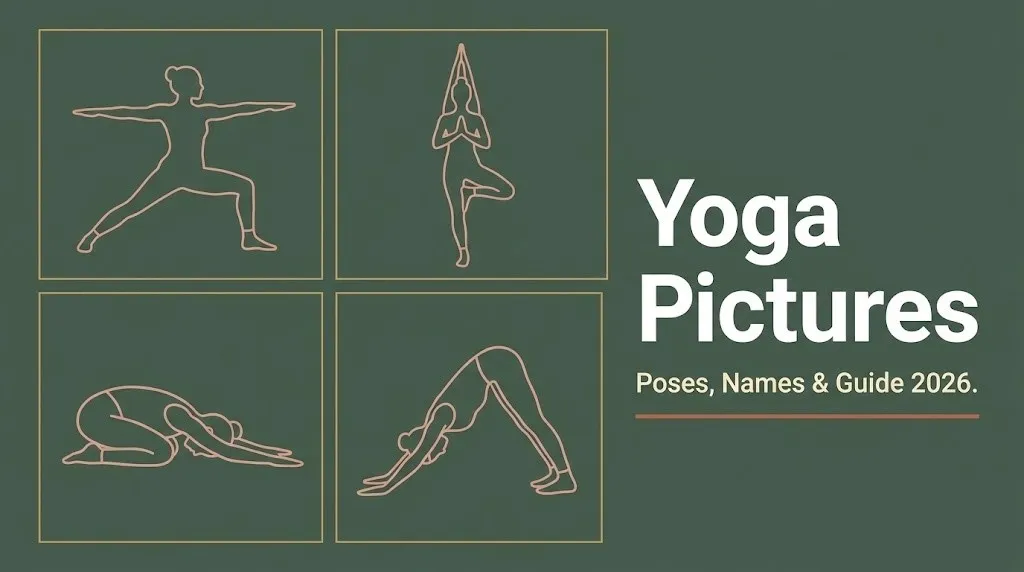
Yoga Pictures: Poses, Names & Complete Guide for 2026
Yoga pictures are one of the most common entry points into yoga practice, but a photo without context teaches you very little about what a pose actually does, how to align your body in it, or whether it is appropriate for where you are right now. This guide goes beyond the image to give you the anatomy, technique, and safety information that turns visual inspiration into a real, safe practice.
According to the National Center for Complementary and Integrative Health (NCCIH), yoga is practiced by over 21 million American adults, and visual learning is consistently cited as one of the primary ways new practitioners first engage with the practice. A yoga photo that shows a pose without naming it in Sanskrit and English, explaining what muscles are working, or noting who should modify it is an incomplete teaching tool.
You will find pose breakdowns by category, alignment cues, Sanskrit and English names, research-backed benefits, modification guidance for beginners and seniors, and a practical guide to using yoga photos as a genuine self-teaching resource in 2026.
What Yoga Pictures Actually Show: Poses, Alignment, and Form Explained
A yoga picture shows the external shape of a pose, but the most important information in any yoga position is what is happening on the inside: which muscles are actively working, which are passively lengthening, how the joints are positioned, and what the breath is doing.
This gap between the visible and the functional is why learning yoga from pictures alone requires context. A photo of Adho Mukha Svanasana (Downward-Facing Dog) shows the inverted V-shape of the body. What it does not show is whether the hamstrings are lengthening, the shoulder girdle is actively supporting, and the thoracic spine is extending rather than rounding. These invisible elements are what make the pose therapeutic.
The most instructionally useful yoga photos show the body from multiple angles, include visible alignment cues (such as the straight line from wrist to hip in Plank or the knee-over-ankle relationship in Warrior poses), and ideally provide some indication of breath timing. A side view of Virabhadrasana II (Warrior II) shows you whether the front knee is tracking over the second toe. A front view shows whether the arms are level with the shoulders.
When looking at any yoga photo, ask three questions before attempting the pose:
- What is the base of support? (hands, feet, sitting bones, or a combination)
- Where does the spine go? (extended, neutral, flexed, or rotated)
- What is the visual relationship between the major joints? (hips over ankles, shoulders over wrists, etc.)
These three questions pull the anatomically relevant information out of any photo and give you enough to attempt a safe, informed version of the shape.
Pose Tip:
- A single photo from one angle is rarely enough to learn a pose safely.
- Look for images that show the full body, not just from the knees up.
- The most useful yoga photos show a neutral or imperfect form, not just a perfect advanced expression.
Yoga Poses Pictures With Names: Sanskrit and English Guide
Yoga poses have two naming systems: Sanskrit (the classical Indian language of yoga texts) and English (usually a translation of the Sanskrit meaning). Both names appear in this guide, and knowing both helps you search for and identify poses accurately.
The Sanskrit naming system is not arbitrary. Each name describes the shape or the story the pose embodies. Vrksasana translates to Tree Pose. Adho Mukha Svanasana means Downward-Facing Dog. Virabhadrasana references Virabhadra, a warrior from Hindu mythology. Knowing the meaning helps you remember the form.
Most yoga classes, teachers, books, and websites use a mix of both systems. Iyengar yoga and Ashtanga yoga tend to use Sanskrit names more consistently. Vinyasa yoga and general studio classes mix both freely. Beginners do not need to memorize Sanskrit, but recognizing the common names makes yoga resources significantly easier to use.
| Sanskrit Name | English Name | Pose Category | Primary Body Area |
|---|---|---|---|
| Tadasana | Mountain Pose | Standing, foundational | Full kinetic chain |
| Adho Mukha Svanasana | Downward-Facing Dog | Standing/inversion | Hamstrings, shoulders, spine |
| Virabhadrasana I | Warrior I | Standing | Hip flexors, quadriceps, shoulders |
| Virabhadrasana II | Warrior II | Standing | Hips, quadriceps, shoulder girdle |
| Vrksasana | Tree Pose | Standing balance | Hip abductors, ankle stabilizers |
| Balasana | Child’s Pose | Floor/resting | Hip rotators, thoracic spine |
| Setu Bandha Sarvangasana | Bridge Pose | Supine | Glutes, hamstrings, erector spinae |
| Uttanasana | Standing Forward Fold | Standing/forward bend | Hamstrings, calves, lumbar spine |
| Ustrasana | Camel Pose | Kneeling/backbend | Hip flexors, thoracic extensors |
| Savasana | Corpse Pose | Supine/resting | Full body release |
Beginner Yoga Poses Pictures: Where to Start and What to Look For
The best beginner yoga poses are the ones that teach core movement patterns the body uses in every other pose it will ever encounter. They are not selected for being simple. They are selected for being foundational.
Tadasana (Mountain Pose) is the first pose every beginner should understand. It looks like standing still, but the active engagement involved teaches neutral spinal alignment, three-arch foot engagement, and conscious proprioception through the full kinetic chain. When you see a yoga picture of Mountain Pose and it looks like someone just standing there, look more closely. The feet are actively pressing through four corners. The thighs are gently engaged. The shoulder blades are drawing gently toward the spine.
Balasana (Child’s Pose) is the most important reset pose in any beginner’s repertoire. It is the shape you return to when a pose becomes too intense or you need to rest. The hip rotators and gluteus maximus open passively while the thoracic spine lengthens. In beginner yoga pictures, look for whether the forehead actually reaches the mat or a prop. If it does not, a block under the forehead is the correct modification.
Setu Bandha Sarvangasana (Bridge Pose) is one of the most therapeutically valuable beginner poses available. It strengthens the gluteus maximus and hamstrings while lengthening the hip flexors. When reading a yoga picture of Bridge Pose, the key alignment indicator is the relationship between the knees and the feet: knees should be directly over the heels and tracking in line with the second toes.
According to the American College of Sports Medicine, progressive movement training that starts with foundational positions and adds complexity over time produces the safest and most durable physical adaptation. This is exactly what a well-structured beginner pose sequence does.
Modification: In Balasana (Child’s Pose), anyone with knee sensitivity should place a folded blanket between the thighs and calves. Wide-knee Child’s Pose (knees wider than hip-width, big toes together) is more accessible for those with tight hips.
Key Takeaway: Yoga pictures work best as learning tools when you use them to understand foundational poses first. Tadasana, Balasana, and Bridge Pose teach the movement principles that every other pose is built on.
Standing Yoga Poses Pictures: Benefits and Alignment Explained
Standing yoga poses build lower body strength, improve balance, and train the body’s ability to support itself against gravity through integrated muscular engagement.
Virabhadrasana II (Warrior II) is one of the most photographed standing poses in yoga for good reason. It is accessible to most beginners, visually clear in its alignment requirements, and teaches the body to manage isometric loading across the quadriceps, gluteus medius, and hip abductors of the front leg simultaneously. When looking at a yoga picture of Warrior II, check four things: the front knee is tracking over the second toe (not collapsing inward), the back foot is angled at roughly 45 degrees, the torso is upright (not leaning toward the front leg), and the arms are level with the shoulders, parallel to the floor.
Uttanasana (Standing Forward Fold) is a standing pose that targets the hamstrings, calves, and lumbar spinal extensors. In yoga pictures, the key visual indicator is whether the bend is coming from the hips (correct) or from the lower back (incorrect). A practitioner with tight hamstrings will round the lumbar spine if they try to straighten the legs. The correction is always to bend the knees and maintain a flat back, prioritizing the hip hinge over leg position.
Think of the standing poses in a yoga sequence like columns in a building. They create the structural integrity that lets everything else around them function. Without them, the practice lacks the foundational strength work that makes passive and floor-based poses therapeutically meaningful.
To practice Virabhadrasana II (Warrior II):
- Stand at the top of your mat in Tadasana (Mountain Pose).
- Step your left foot back 3.5 to 4 feet. Turn the left foot to a 45-degree angle.
- Bend the right knee to a 90-degree angle. Check that the knee tracks over the second toe.
- Extend both arms parallel to the floor. Right arm forward, left arm back.
- Keep the torso upright. Do not lean toward the front leg.
- Hold for 5 to 8 breaths. Switch sides.
Modification: Shorten the stance for anyone with knee pain or limited hip mobility. Keep the knee bend shallow rather than forcing a 90-degree bend. A chair placed beside the front leg offers stability for seniors or balance-challenged practitioners.
Seated Yoga Poses Pictures: Floor Practice With Form Guidance
Seated yoga poses are practiced on the floor and target the hips, hamstrings, and spinal column in ways that standing poses cannot easily access.
Paschimottanasana (Seated Forward Fold) is one of the most commonly photographed seated poses. It targets the hamstrings, calf muscles, and erector spinae. In yoga pictures, the most common error is immediately visible: the practitioner is rounding severely through the lower back rather than hinging from the hip joint. A flat back with slight knee bend is always more therapeutically appropriate than a deeply curved spine in a forced-straight-leg position.
Navasana (Boat Pose) is a seated pose that builds deep core stabilizer strength, specifically the hip flexors, transverse abdominis, and rectus abdominis. Yoga pictures of Boat Pose often show the full expression with straight legs and arms extended. The beginner version, knees bent and hands holding the backs of the thighs, is equally valid and produces the same core engagement with less spinal strain.
Sukhasana (Easy Seated Pose) is the foundational seated position used in meditation and pranayama. In yoga pictures, this looks simple: cross-legged on the floor. For many practitioners, however, the hips are too tight to allow the pelvis to tilt forward naturally in this position, causing the lumbar spine to round. Sitting on a folded blanket or yoga block raises the hips above the knees and restores the natural lumbar curve.
A 2020 review published in the Journal of Alternative and Complementary Medicine found that yoga practices incorporating seated forward folds and hip-opening poses showed measurable improvements in hamstring flexibility and lumbar mobility in adult populations over 8 weeks of consistent practice.
Modification: In Paschimottanasana (Seated Forward Fold), bend the knees generously and place a strap around the feet to allow a flat-back position. Elevating the hips on a blanket also helps practitioners with tight hamstrings maintain spinal neutrality.
Balancing Yoga Poses Pictures: Technique, Benefits, and Safety
Balancing yoga poses train proprioception, the body’s ability to sense its own position in space, which is one of yoga’s most clinically valuable contributions to physical health.
Vrksasana (Tree Pose) is the most universally recognized single-leg balance pose in yoga. In yoga pictures, the visual focus is often the raised leg, but the work happens in the standing leg: the gluteus medius, tibialis anterior, and peroneals are all working to maintain stability in the ankle and hip. The raised foot is placed on the inner thigh or inner calf of the standing leg. It is never placed against the knee joint, because the lateral pressure this creates is harmful to the knee’s medial structures.
Balancing poses are particularly valuable for older adults. According to research compiled by the NCCIH, yoga practice in adults over 60 showed measurable improvements in balance and reduced fall risk across multiple clinical studies. Fall prevention is one of the most clinically important outcomes in geriatric health, and single-leg balance training is among the most effective methods for achieving it.
When looking at yoga pictures of balance poses, the first alignment check is the relationship between the standing hip and the shoulder. If the hip has dropped to one side (called a Trendelenburg pattern), the gluteus medius on the standing side is not doing its job. The pelvis should remain level.
To practice Vrksasana (Tree Pose):
- Stand in Tadasana (Mountain Pose) near a wall if needed.
- Shift weight onto the left foot, pressing all four corners into the mat.
- Lift the right foot and place it on the inner left thigh or inner calf. Never against the knee.
- Press the right foot gently into the inner left leg. Press back with the inner left leg.
- Bring palms together at the chest or extend arms overhead if stable.
- Hold for 5 to 8 breaths. Switch sides.
Modification: Stand with one hand resting lightly on a wall for balance support. Place the raised foot at the ankle rather than the thigh if stability is limited.
Key Takeaway: Balancing poses like Tree Pose are among the most clinically supported yoga shapes for fall prevention in older adults. The work happens in the standing leg, not the raised one.
Yoga Backbend Pictures: What These Poses Do for Your Spine
Backbend yoga poses extend the spine, open the chest and anterior shoulder region, and lengthen the hip flexors. They are among the most visually dramatic yoga pictures and also among the most frequently practiced incorrectly.
Ustrasana (Camel Pose) is one of the most commonly photographed kneeling backbends. In yoga pictures of this pose, the key visual indicator of correct form is whether the extension is occurring primarily in the thoracic spine (the mid and upper back) or whether it is concentrated in the lumbar spine (the lower back). A practitioner who cannot extend the thoracic spine will compensate by compressing the lumbar spine, which places harmful shear forces on the lumbar vertebrae and intervertebral discs.
Setu Bandha Sarvangasana (Bridge Pose) is a gentler backbend that appears in beginner and therapeutic yoga pictures regularly. It extends the lumbar and thoracic spine while the hips are supported by the floor, making it far more accessible than standing backbends. The gluteus maximus is the primary driver: the lift comes from pressing the feet and activating the glutes, not from arching the lower back.
When viewing any yoga backbend picture, look for:
- Is the cervical spine (neck) held in a neutral position or forced into extension?
- Is the bend distributed across the entire spine or concentrated in one segment?
- Are the knees tracking hip-width apart and not collapsing inward?
- Does the practitioner appear to be breathing freely or holding the breath?
Safety caution: Anyone with a diagnosed herniated disc, spinal stenosis, or history of lumbar vertebral fracture should approach deep backbends under the guidance of a physical therapist or spine-informed yoga teacher before attempting poses like Ustrasana (Camel Pose).
Modification: In Ustrasana (Camel Pose), place yoga blocks beside the feet and reach for those instead of the heels. This reduces the depth of the backbend and shifts the emphasis toward thoracic extension rather than lumbar compression.
Yoga Twist Pictures: How Twisting Poses Work and Who They Help
Yoga twist poses rotate the spine along its vertical axis, mobilizing the thoracic vertebrae and the facet joints of the lumbar spine. They appear frequently in yoga photos because the spiraling shape of the body is visually striking.
Parivrtta Trikonasana (Revolved Triangle Pose) is a standing twist that combines spinal rotation with hamstring and hip lengthening. In yoga pictures of this pose, the key alignment marker is the relationship between the arms: one reaches toward the floor (or a block) while the other reaches straight upward. The goal is a long, rotated spinal line from the lower hand to the upper, not a collapsed or rounded back.
Seated twists like Ardha Matsyendrasana (Half Lord of the Fishes Pose) are more commonly seen in beginner yoga pictures. The spine must be long before it rotates. A practitioner who cannot sit tall in this pose due to tight hamstrings or hip flexors will round the lumbar spine and rotate from the wrong segment. The fix is always to lengthen first, then rotate: inhale to grow tall, exhale to turn.
Research published in Complementary Therapies in Medicine suggests that yoga practices incorporating spinal mobility work, including rotational poses, are associated with reduced perceived spinal stiffness and improved functional range of motion in adults with desk-based occupations, a population that suffers from chronic thoracic restriction.
Modification: For seated twists, sit on a folded blanket to raise the hips above the knees. This allows the pelvis to tilt forward and the lumbar spine to maintain its natural curve. Anyone with a diagnosed disc herniation should avoid deep spinal rotation and work with a yoga therapist to identify appropriate movement patterns.
Yoga Inversion Pictures: Which Are Safe and Which Require Experience
Yoga inversions are poses in which the hips are above the heart or the head is below the heart. The range includes very accessible options and highly demanding ones, and yoga pictures of inversions can make the most challenging variations look more achievable than they are.
Viparita Karani (Legs-Up-the-Wall Pose) is the safest and most accessible yoga inversion. The legs rest vertically against a wall while the back lies on the floor. It requires no upper body strength or advanced balance. Yoga pictures of this pose show a relaxed, supported shape that anyone without specific contraindications can practice. This pose improves venous return, reduces perceived fatigue in the lower limbs, and activates the parasympathetic nervous system.
Sirsasana (Headstand) is an advanced inversion that appears frequently in yoga pictures because of its visual impact. This pose requires a strongly engaged shoulder girdle, specifically the serratus anterior and upper trapezius, to protect the cervical spine from bearing excessive load. When headstands go wrong, they almost always do so because the neck is carrying weight the shoulders should be supporting. This pose is not appropriate for beginners and should not be attempted without consistent supervision.
| Inversion | Difficulty | Experience Needed | Contraindications |
|---|---|---|---|
| Viparita Karani (Legs-Up-the-Wall) | Accessible | None | Glaucoma, severe hypertension |
| Adho Mukha Svanasana (Downward-Facing Dog) | Beginner | None | Wrist injury, uncontrolled hypertension |
| Sarvangasana (Shoulderstand) | Intermediate | 6+ months experience | Neck injury, glaucoma, pregnancy |
| Sirsasana (Headstand) | Advanced | 1+ years, supervised | Neck injury, glaucoma, osteoporosis of cervical spine, hypertension |
Safety caution: Inversions where the head is below the heart are contraindicated for people with glaucoma, uncontrolled high blood pressure, history of stroke, detached retina, or cervical spine injury. These conditions are not always visible from outside. Seek guidance from a healthcare provider managing these conditions before attempting any inversion beyond Legs-Up-the-Wall.
Key Takeaway: Inversion yoga pictures include a huge range from fully accessible (Legs-Up-the-Wall) to genuinely advanced (Headstand). Never assume that because something appears in a yoga picture, it is appropriate for your body right now.
Yoga Pictures for Flexibility: The Poses That Actually Deliver Results
Yoga builds flexibility through consistent, sustained mechanical stimulus applied to muscles and connective tissue. The pictures of yoga’s most flexible-looking poses are often the result of years of regular practice, not a starting point.
The poses with the strongest evidence for producing flexibility gains in adults are those that target the hamstrings, hip flexors, thoracic spine, and shoulder girdle: the four regions where most adults accumulate the most restriction from prolonged sitting and repetitive movement patterns.
A 2019 review published in the International Journal of Yoga found that yoga practitioners who held poses for longer durations (60 seconds or more) showed greater tissue adaptation than those using shorter holds at the same frequency. This is the physiological argument for Yin yoga and Restorative yoga approaches over rapid flow-based sequences for flexibility development.
Yoga poses that research and experienced teachers consistently identify as most effective for flexibility:
| Target Area | Pose (English) | Pose (Sanskrit) | Minimum Effective Hold |
|---|---|---|---|
| Hamstrings | Standing Forward Fold | Uttanasana | 60 to 90 seconds |
| Hip flexors | Low Lunge | Anjaneyasana | 60 to 90 seconds per side |
| Inner hips/groin | Reclined Bound Angle | Supta Baddha Konasana | 2 to 5 minutes |
| Thoracic spine | Thread the Needle | Parsva Balasana | 60 seconds per side |
| Shoulder girdle | Eagle Arms | Garudasana Arms | 60 seconds per side |
| IT band/outer hip | Reclined Pigeon | Supta Kapotasana | 1 to 3 minutes |
Modification: In Uttanasana (Standing Forward Fold), anyone with tight hamstrings should bend the knees and place hands on blocks. The priority is always a long, flat back rather than straight legs.
Yoga Poses Pictures for Back Pain: What Helps and What to Avoid
Yoga is one of the most thoroughly researched non-pharmacological interventions for chronic low back pain, and knowing which poses help versus which can aggravate the problem matters more here than in any other category.
A 2017 clinical practice guideline from the American College of Physicians listed yoga as a recommended first-line approach for chronic low back pain, placing it alongside other evidence-based movement therapies. The poses that support this outcome are specific and not interchangeable with any yoga picture you happen to find online.
Poses that research consistently supports for low back pain relief:
- Setu Bandha Sarvangasana (Bridge Pose): Strengthens the gluteus maximus and hamstrings, reducing the compensatory load on the lumbar spine.
- Marjaryasana-Bitilasana (Cat-Cow): Gently mobilizes the lumbar and thoracic vertebrae without axial load.
- Balasana (Child’s Pose): Creates passive lumbar decompression and traction.
- Supta Matsyendrasana (Supine Spinal Twist): Gently mobilizes lumbar facet joints in a safe, non-loaded position.
- Viparita Karani (Legs-Up-the-Wall Pose): Reduces muscle tension in the lumbar region through gravity-assisted release.
Poses to approach cautiously or avoid with low back pain:
- Deep backbends like Ustrasana (Camel Pose): Can compress lumbar vertebrae if the thoracic spine is inflexible.
- Paschimottanasana (Seated Forward Fold) with straight legs: Overstretches the already-strained posterior chain in many back pain presentations.
- Full inversions: Require core and spinal stability that most people with active back pain have not yet built.
Safety caution: Low back pain has many causes, and the wrong pose for your specific condition can worsen it. Anyone with a diagnosed structural spinal condition should get movement guidance from the physical therapist or spine specialist managing their care before starting a yoga-for-back-pain practice.
Yoga Pictures for Seniors: Safe Poses and Accessible Modifications
Yoga pictures for seniors are most useful when they show modified, chair-supported, or fully supported versions of poses alongside the standard expression. Most yoga photography shows the full, advanced form only, which creates a false impression that yoga is not accessible to older bodies.
Every standing, seated, and supine yoga pose has a chair-supported or prop-assisted version that is safe and therapeutically effective for adults with limited mobility, joint replacements, or significant fall risk. The therapeutic value does not disappear with modification. Often it increases, because the practitioner is not spending energy managing instability.
According to a 2021 review published in Complementary Therapies in Medicine, yoga practice in community-dwelling adults over 60 was associated with measurable improvements in balance, lower-limb strength, and self-reported quality of life. Chair yoga was specifically noted as an accessible format producing these outcomes.
Safe yoga poses for seniors with common modifications:
| Pose (English) | Pose (Sanskrit) | Senior Modification | Chair Version |
|---|---|---|---|
| Mountain Pose | Tadasana | Stand near wall | Stand behind chair, hands on back |
| Warrior II | Virabhadrasana II | Shorter stance, shallower knee bend | Seated, one leg extended |
| Tree Pose | Vrksasana | Foot at ankle, wall nearby | Seated, one foot lifted |
| Bridge Pose | Setu Bandha Sarvangasana | Block under sacrum (passive version) | Seated hip extension |
| Standing Forward Fold | Uttanasana | Hands on chair seat | Seated fold toward shins |
| Child’s Pose | Balasana | Blanket between thighs and calves | Seated forward fold in chair |
| Corpse Pose | Savasana | Blanket under knees, warm covering | Reclined in chair |
Safety caution: Adults with osteoporosis affecting the spine should avoid poses that deeply flex the thoracic or lumbar spine under load. A physical therapist familiar with bone density management can advise on specific pose safety for individual cases.
Key Takeaway: Chair yoga pictures for seniors are not lesser versions of real yoga. They are the right version for that body, and the research confirms they deliver the same documented benefits as mat-based practice.
How to Use Yoga Pictures to Teach Yourself Poses at Home
Yoga pictures are a valuable self-teaching tool when used systematically, but looking at a photo and trying to copy the shape without any other context is the least effective approach available.
The most effective way to learn from yoga pictures involves three steps. First, identify the pose by both its Sanskrit and English name. Second, find a written description of the alignment cues and muscle engagement. Third, practice the pose with that information active in your attention, not just the visual shape you saw in the photo.
Think of learning a yoga pose from a picture like learning a guitar chord from a photo of a hand position. The photo tells you where the fingers go but nothing about the pressure, the timing, or how the wrist needs to be angled to make the string ring cleanly. The technique layer is what the image cannot show.
To build a yoga home practice using pictures as a guide:
- Choose 3 to 5 foundational poses from this guide. Start with standing, seated, and one supine option.
- Find the Sanskrit and English name for each. Write them down.
- Read the alignment cues for each pose before attempting it.
- Practice each pose with a timer. Hold for 5 to 8 breaths (roughly 30 to 45 seconds) minimum.
- Note what you feel in the body during the hold, not just what the pose looks like from outside.
- Photograph your own form if possible. Comparing your photo to a reference image is a legitimate self-correction tool.
- Modify immediately if anything feels sharp, pinching, or wrong. Mild muscular effort and stretch are appropriate. Joint discomfort is not.
Pose Tip:
- Use a mirror or take short video clips of yourself in poses. Visual feedback accelerates learning more than any number of reference images alone.
- Begin each home session with 3 rounds of Marjaryasana-Bitilasana (Cat-Cow) to warm the spine before attempting anything more demanding.
- Prioritize consistent practice over ambitious pose selection. Three familiar poses done well beat ten unfamiliar poses done poorly.
Beautiful Yoga Images: What Makes Yoga Photography Instructionally Useful
Beautiful yoga images are not automatically instructionally useful. The most photographed yoga images tend to show advanced poses, flexible practitioners, and aesthetically dramatic shapes. These images are genuinely inspiring. They are not always the most educational.
The yoga photos that teach the most are the ones showing a pose from the angle that reveals the most critical alignment information. Virabhadrasana II (Warrior II) is most informative from the front, showing the knee-to-toe relationship. Ustrasana (Camel Pose) is most informative from the side, showing the spinal curve distribution. Vrksasana (Tree Pose) is informative from both the front (pelvis level) and the side (ankle and hip alignment).
The yoga photography tradition has historically favored slim, highly flexible, primarily female practitioners in aesthetically pleasing outdoor settings. This has created a visual representation of yoga that does not reflect the diversity of bodies, abilities, and ages for whom yoga is genuinely appropriate. The most useful educational yoga photos in 2026 show practitioners of diverse ages and body types, using props, practicing modified versions alongside advanced versions, and demonstrating real-world practice rather than performance.
What distinguishes instructionally useful yoga photography from purely aesthetic yoga photography:
- Multiple angles showing the same pose.
- Visible alignment markers: foot placement, knee tracking, spinal position.
- Props shown in use: blocks, straps, chairs, walls.
- Modified versions alongside the full expression.
- Clear labeling with both the Sanskrit and English pose name.
- A visible neutral or beginner form alongside an advanced one.
When using yoga pictures as learning references, actively seek out photos that meet at least three of these criteria. Images that show only the most advanced, aesthetically refined expression of a pose are beautiful but incomplete as teaching tools.
Yoga Poses Pictures and Benefits: What the Research Says About Each Pose Type
Every major category of yoga pose has a documented physiological effect, and the research on these effects is specific enough to match particular pose types to particular health goals.
According to the NCCIH, yoga’s documented health benefits include improvements in flexibility, balance, chronic pain, anxiety, depression symptoms, and sleep quality across multiple randomized controlled trials. The research is not uniform across all pose types. Different categories of poses produce different physiological effects.
What the research says by pose category:
| Pose Category | Primary Physiological Effect | Research Attribution | Best Style |
|---|---|---|---|
| Standing poses | Lower body strength, balance, proprioception | American College of Sports Medicine | Hatha, Vinyasa |
| Seated poses | Hamstring and hip flexibility, hip mobility | Journal of Alternative and Complementary Medicine | Yin, Hatha |
| Supine poses | Spinal decompression, nervous system calm | NCCIH | Restorative, Yin |
| Backbends | Thoracic mobility, hip flexor lengthening, mood | International Journal of Yoga | Hatha, Vinyasa |
| Twists | Spinal rotational mobility, thoracic release | Complementary Therapies in Medicine | Hatha, Yin |
| Inversions | Venous return, mood, interoceptive awareness | Frontiers in Psychology | Hatha, Iyengar |
| Balancing poses | Proprioception, fall prevention, ankle stability | NCCIH | Hatha, Iyengar |
| Restorative/supine | Parasympathetic activation, cortisol reduction | International Journal of Yoga | Restorative, Yin |
A study published in the International Journal of Yoga found that practitioners who engaged in a mixed-category yoga practice (including standing, seated, supine, and inversions) showed greater improvements across multiple health markers than those practicing a single-category approach. This supports the standard yoga class structure of moving through multiple pose categories within a single session.
For practical purposes: if you are working toward a specific health goal, prioritize the pose category with the strongest research support for that goal. Flexibility: seated and supine forward folds. Balance and fall prevention: standing and single-leg poses. Stress and nervous system: Restorative and supine poses. Back pain: targeted supine and gentle standing work.
Frequently Asked Questions About Yoga Pictures
What are the names of yoga poses with pictures?
The most commonly photographed yoga poses include Adho Mukha Svanasana (Downward-Facing Dog), Virabhadrasana I and II (Warrior I and II), Vrksasana (Tree Pose), Balasana (Child’s Pose), and Savasana (Corpse Pose).
Each pose has both a Sanskrit name (from classical yoga tradition) and an English name (a translation of the Sanskrit meaning).
Using both names when searching for yoga photos gives you significantly better access to educational resources that explain what the pose actually involves.
What yoga poses are best for beginners?
The best beginner yoga poses are Tadasana (Mountain Pose), Balasana (Child’s Pose), Setu Bandha Sarvangasana (Bridge Pose), Adho Mukha Svanasana (Downward-Facing Dog), and Virabhadrasana II (Warrior II).
These poses teach foundational movement patterns: postural awareness, hip hinging, spinal extension, shoulder support, and lower body strength.
Yoga teachers and physical therapists generally recommend mastering these five before adding more complex poses.
Can I learn yoga from pictures alone?
Pictures are a useful starting point but are not sufficient on their own to learn yoga safely.
A photo shows the external shape of a pose but cannot convey alignment cues, breath timing, which muscles should be actively engaged, or when to modify.
Pairing yoga pictures with written alignment guidance and pose-specific safety notes, as provided in this guide, produces much safer and more effective self-directed learning.
What yoga poses help with back pain?
Setu Bandha Sarvangasana (Bridge Pose), Marjaryasana-Bitilasana (Cat-Cow), Balasana (Child’s Pose), and Viparita Karani (Legs-Up-the-Wall Pose) are the most consistently supported poses for chronic low back pain.
The American College of Physicians included yoga in its 2017 clinical practice guidelines as a recommended first-line treatment for chronic low back pain.
Anyone with a structural spinal condition should identify the appropriate poses for their specific diagnosis with the physical therapist or specialist managing their care.
What is the most recognized yoga pose?
Adho Mukha Svanasana (Downward-Facing Dog) is consistently the most widely recognized yoga pose in Western yoga culture, appearing in virtually every style of yoga practice.
It is used as a transitional pose, a resting position, and a strength-building shape simultaneously.
Tadasana (Mountain Pose) and Virabhadrasana II (Warrior II) are also among the most universally photographed and recognized poses across yoga traditions.
Take One Pose Off the Page
The single most useful thing you can do with yoga pictures is choose one pose from this guide, read the alignment cues, and practice it today for five breaths. Not tomorrow. Not when you buy a mat. Today, on whatever surface you are standing on.
Start with Tadasana (Mountain Pose) or Balasana (Child’s Pose). Both teach you more about your body in two minutes than an hour of browsing photos will.
Come back to this guide when you are ready for the next category. The poses will still be here. So will the research