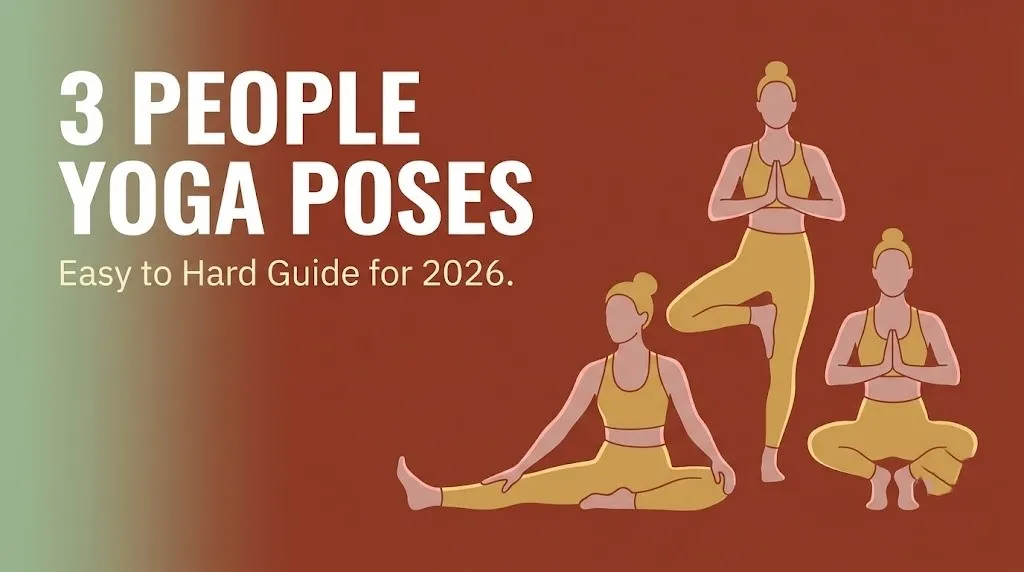
3 People Yoga Poses: Guide to Easy and Hard Poses 2026
Three people yoga poses are structured group positions where all three practitioners share weight, balance, or counterbalance to create shapes no single person could form alone. Done with clear role assignments, proper communication, and appropriate difficulty selection, they are one of the most engaging ways to practice yoga with friends, family, or a class group.
Group yoga is not a niche activity. According to the National Center for Complementary and Integrative Health, social forms of physical practice, including partner and group yoga, show measurable benefits for stress reduction and interpersonal trust, effects that solo practice does not replicate in the same way. Practiced safely, trio yoga builds strength, flexibility, and body awareness simultaneously.
This guide covers every aspect of three-person practice: what it is, how roles work, which poses are accessible for beginners and kids, which ones challenge experienced practitioners, how seniors can participate safely, and how to build a complete trio sequence from the ground up.
What Are 3 People Yoga Poses?
Three people yoga poses are yoga positions practiced simultaneously by exactly three people, where each person’s body contributes to a shared structure through contact, counterbalance, or synchronized movement.
Unlike solo yoga, where each practitioner holds their own alignment independently, trio yoga creates interdependence. Each person’s position affects the others. That interdependence is both the draw and the risk. When all three are aligned and communicating, the shared shape feels stable and achievable. When one person loses focus or shifts unexpectedly, all three feel it.
The practice draws on traditions in AcroYoga, Hatha yoga, and therapeutic partner yoga. AcroYoga specifically developed the language of roles and spotting that makes group yoga safer and more teachable. Many of the clearest frameworks for three-person practice come from AcroYoga traditions.
Three-person yoga works for a wide range of groups:
- Friends or classmates exploring yoga together for the first time
- Families with children wanting a physical activity that includes everyone
- Yoga students adding a social or playful element to their practice
- Experienced practitioners seeking balance and strength challenges beyond solo work
- School physical education programs using yoga as a cooperative activity
Modification note: If any participant has never practiced solo yoga, spend at least one session on individual foundational poses before attempting any three-person structure. Building individual body awareness first makes group coordination significantly safer and more successful.
What Is Three Person Yoga and How Is It Different?
Three person yoga refers specifically to practice where three bodies work together in a single pose or sequence, as distinct from partner yoga (two people) or group class yoga (many people practicing individually in parallel).
The key difference from two-person partner yoga is structural complexity. With two people, one person typically supports and one person stretches or balances. Add a third person and the structure gains an additional variable: someone who is simultaneously supported by one person and supporting another, or someone who connects two separate partner pairs into a single shape.
That middle position, sometimes called the connector or bridge role, requires the clearest body awareness of all three roles. The connector must manage their own alignment while responding to two other people’s movements at once.
Three person yoga is also fundamentally different from a group class. In a class of thirty students, each person holds their own Virabhadrasana II (Warrior II Pose) independently. In three-person practice, your Warrior II might be the foundation for a partner pressing their hands into your thigh for a supported backbend, while a third person mirrors your shape on the opposite side. The poses are the same. The coordination is completely different.
| Feature | Solo Yoga | Partner Yoga (2 people) | Three Person Yoga |
|---|---|---|---|
| Body awareness demand | Individual | Shared between 2 | Shared between 3 |
| Communication needed | Internal | Moderate, verbal cues | High, continuous verbal and physical |
| Weight distribution | Self only | Between 2 bodies | Across 3 bodies |
| Entry/exit complexity | Simple | Moderate | More planning required |
| Suitable for beginners | Yes | With guidance | With clear role assignment |
Roles in Three Person Yoga: Base, Middle, and Flyer
In three person yoga, each practitioner takes one of three distinct roles: base, middle (sometimes called connector), and flyer (or top position). Understanding these roles before attempting any pose is the single most important safety step.
The base is the practitioner who makes direct contact with the ground and bears the most structural weight. In a standing trio, the base often has feet planted and hands or shoulders offering a support point. In a seated or lying arrangement, the base lies on their back with legs raised, or sits anchored to the floor. The base needs the most strength and the clearest understanding of weight load. They call the shots on readiness.
The middle or connector position links the base to the third person. They may stand on the base’s hands or thighs, lean against the base’s back, or form a bridge between two flanking practitioners. This role demands the best body awareness and balance of the three, since they are rarely fully grounded.
The flyer is the practitioner in the highest or most aerial position. In beginner and intermediate three-person work, the flyer is rarely more than a few inches off the ground. In advanced AcroYoga-influenced trio work, the flyer may be supported at hip height. A flyer who feels unsafe must always be able to call for a stop and receive a controlled descent.
Pose Tip:
- The base always signals readiness before weight is transferred
- The middle communicates to both the base and the flyer simultaneously
- The flyer keeps their core engaged at all times to reduce unpredictable weight shifts
- Any participant can call “down” at any moment and all three respect it immediately
Key Takeaway: Before you try a single three-person pose, assign roles out loud. Base, middle, flyer. Every person knows their job before any weight is shared.
Benefits of Yoga Poses for Three People
Three person yoga poses build physical strength, improve balance, and create a documented social-emotional benefit that solo practice cannot replicate. These are not separate effects. They happen at the same time within the same practice.
Physically, trio poses demand more from the core musculature, shoulder girdle, and hip stabilizers than equivalent solo poses. When you are the base supporting two other people, your erector spinae, quadriceps, and glute muscles work against a load they rarely encounter in individual practice. When you are the flyer, your core must maintain tension to prevent wobbling that would destabilize everyone below you.
A study published in the International Journal of Yoga found that partner-based yoga practice significantly improved balance, body awareness, and perceived self-efficacy compared to equivalent solo practice periods. While most published research focuses on two-person partner yoga, the physical mechanisms transfer directly to three-person arrangements.
The social dimension is equally well-documented. Research published in Complementary Therapies in Medicine indicates that synchronized movement with others, which includes partner and group yoga, activates social bonding mechanisms and reduces cortisol levels more effectively than solitary exercise. Three-person practice amplifies this effect because the coordination required is higher and the successful completion of a shared shape produces a stronger shared sense of achievement.
Benefits of regular three person yoga practice include:
- Improved proprioception and body position awareness from responding to others’ weight
- Strengthened core and postural muscles through shared weight-bearing demands
- Enhanced interpersonal trust and communication skills
- Increased range of motion when a partner provides gentle traction or counterbalance
- Reduced social anxiety around physical contact and movement in social settings, based on findings in Complementary Therapies in Medicine
Easy Yoga Poses for Three People
Easy three person yoga poses are arrangements where all three practitioners remain grounded or near-grounded, no one bears another person’s full body weight, and exits are simple and immediate. Ease in yoga is always individual and body-dependent, so these poses are accessible for most people but may still require modification.
The most reliably accessible trio arrangement for beginners is a seated circle or star formation. Three people sit facing outward or inward in a circle, touching at their backs, hips, or hands. This creates a shared structure without any weight transfer.
Three-Person Seated Back-to-Back Circle:
To practice this grounding trio arrangement:
- All three sit cross-legged (Sukhasana, Easy Seated Pose) in a triangle formation, backs touching at the shoulder blades
- Each person sits tall, lengthening their spine upward
- On an inhale together, all three expand the chest and feel the shared back support
- On an exhale, each person slightly leans back into the shared center, letting the group form a stable triangle
- Hold for 5 to 8 shared breaths, staying in sync through audible breathing
- Release by each person leaning forward slightly before standing
Modification: Practitioners with tight hips or limited floor sitting comfort can sit on a folded blanket or a firm cushion. This raises the hips slightly above the knees and reduces lumbar strain during seated holds.
| Pose Name | Position | Weight Shared | Ground Contact | Difficulty |
|---|---|---|---|---|
| Seated back-to-back circle | All seated | None, contact only | All three grounded | Beginner |
| Three-way seated forward bend | All seated facing in | None | All three grounded | Beginner |
| Standing three-way mountain | All standing | None | All three standing | Beginner |
| Linked Tree Pose chain | All standing | Minimal | All three standing | Beginner-moderate |
Three Person Yoga Poses for Beginners
Three person yoga for beginners works best when the poses require no weight transfer, everyone stays at roughly the same height, and every exit can happen independently without assistance.
The standing three-way Tadasana (Mountain Pose) chain is an ideal starting point. Three people stand in a line, each placing their inside hand on the adjacent person’s shoulder. All three draw their feet together, press through all four corners of each foot, and stand tall. The shared contact at the shoulder creates subtle proprioceptive feedback without any load transfer.
From this foundation, beginners can progress to a simple three-person counterbalance seated forward fold. Three practitioners sit facing each other in a triangle, legs extended so feet touch in the center. Each person holds the wrists of their neighbors. On a shared exhale, all three hinge forward slightly at the hips, feeling the gentle traction from their partners’ resistance. This introduces counterbalance without any lifting.
According to Yoga Alliance, qualified yoga teachers consistently recommend that beginners to partner or group yoga start with contact-only poses before progressing to poses involving weight transfer. This sequence, contact before weight, is the professional standard for safe group yoga introduction.
Pose Tip:
- No trio beginner session should include any lifting in the first practice
- All three participants should be able to release hands and return to neutral independently
- Keep feet on non-slip mats or bare feet on non-carpeted surfaces for grip
- Verbally agree on a stop signal before starting any pose
Modification for beginners with balance challenges: Use a wall within arm’s reach for all standing poses. One practitioner can keep their fingertips on the wall while the other two form the shape. This supports the group’s stability without compromising the shared experience.
Three Person Yoga Poses Sitting
Seated three person yoga poses are the most accessible category for all experience levels, age groups, and body types. All three practitioners remain on the floor, exits are easy, and weight transfer is minimal or entirely absent.
The three-person Upavistha Konasana (Wide-Angle Seated Forward Bend) star is one of the most satisfying seated trio poses. Three people sit in a triangle facing each other, legs spread wide so that each person’s feet touch a neighbor’s feet. All three extend their arms and clasp wrists. On a slow, coordinated exhale, each person gently leans back slightly, creating a star-shaped counterbalance. The sensation is a gentle inner thigh and hamstring stretch that solo practice rarely achieves with such evenness.
To practice the three-person seated star counterbalance:
- Sit in a triangle, each person facing the center of the group
- Spread legs wide, aiming feet toward the adjacent partners’ ankles
- Flex feet and press the inner edges of both feet toward the floor
- Each person extends both arms forward and grasps the wrists of the person to their right
- On a shared inhale, sit tall through the lumbar spine
- On a shared exhale, each person leans back gently, allowing the group to form a balanced star
- Hold for 5 to 6 shared breaths
- On an inhale, each person draws forward and releases wrists to exit
Modification: Practitioners with tight hamstrings or a history of lumbar disc sensitivity should sit on a folded blanket to tilt the pelvis slightly forward. Never pull a partner toward you with force. The traction should come from shared weight, not from active pulling.
Key Takeaway: Seated three-person poses are the safest starting point for any group, regardless of experience level. They keep everyone grounded, they exit independently, and they still produce a genuine stretch benefit through counterbalance.
Three Person Yoga Poses Standing
Standing three person yoga poses introduce a higher center of gravity and more demanding balance requirements than seated arrangements. Each person must maintain individual stability before the group can function as a shared structure.
The most accessible standing trio pose is the three-person Tadasana (Mountain Pose) circle, where all three stand facing inward in a tight triangle, arms around each other’s waists or shoulders, and all six feet press firmly into the floor. This builds a sense of shared grounding without any weight transfer.
A step up from that is the three-person Trikonasana (Triangle Pose) mirror, where three practitioners arrange themselves in a line. The center person does Trikonasana to the right while the left practitioner mirrors the pose in the opposite direction, and the right practitioner does Virabhadrasana II (Warrior II Pose) as a counterbalance. Each person is doing an individual pose, but the alignment of the trio creates a visually unified and physically interdependent group shape.
The three-person linked Vrksasana (Tree Pose) chain is the most common standing balance trio pose. Three practitioners stand in a line. Each person assumes Tree Pose on their outside leg. The center person extends both arms to the sides, and the outside practitioners each press one palm lightly into the center person’s raised hand.
To practice three-person linked Tree Pose:
- Stand in a line, center practitioner flanked by one person on each side
- All three shift weight onto their outside foot and lift their inside foot to the calf or inner thigh (not the knee joint)
- Center person extends both arms to the sides at shoulder height
- Outside practitioners each press their inner palm lightly against the center person’s palm
- Hold for 4 to 6 shared breaths, breathing audibly to stay synchronized
- Lower feet together on a shared exhale and switch sides
Modification: Practitioners with ankle instability or vertigo should keep the raised foot low, touching the calf rather than the inner thigh. Standing near a wall ensures safety if balance is lost.
Three Person Yoga Balance Poses
Three person yoga balance poses are arrangements where the shared structure requires at least one person to maintain balance with another participant as the stabilizer. They are more demanding than simple contact poses and require genuine proprioceptive skill.
Think of these poses like a three-legged stool. Remove any one leg and the structure collapses. Each practitioner functions as a structural element, not just a participant. When one person shifts their weight, the other two feel it immediately and must adjust.
The three-person counterbalance squat is a gateway balance pose for intermediate groups. Three people stand in a triangle facing inward, each grasping the wrists of their neighbors. Slowly, all three lean back simultaneously, allowing the shared tension in the arms to support each person into a partial or full squat position. The combined counterbalance keeps everyone upright.
The American College of Sports Medicine notes that balance training within group physical activity contexts improves individual proprioceptive response times, a finding that directly supports incorporating balance-focused trio poses into a regular practice.
To practice the three-person counterbalance squat:
- Stand in a triangle, all three facing inward, feet hip-distance apart
- Each person grasps the wrists of both neighbors firmly
- All three lean back simultaneously, arms straight, engaging the core
- Allow the hips to sink toward a squat position together, pausing at whatever depth feels stable
- Hold for 3 to 5 breaths, maintaining upright spines
- Press through the feet together to stand, releasing wrists only after returning to upright
Modification: Beginners or those with knee sensitivity should only lower into a partial squat, roughly 30 to 45 degrees of knee flexion. Do not attempt full depth until the group has practiced the entry and exit multiple times.
Key Takeaway: The counterbalance squat is the best first balance trio pose because it is entirely self-correcting. If anyone loses balance, the others feel it immediately and can pull back to upright. It teaches the mechanics of interdependence without any height risk.
3 Person Yoga Poses Hard
Hard three person yoga poses involve weight transfer, elevated positions, or complex counterbalance arrangements that require genuine strength, body awareness, and established trust between all three practitioners. None of these should be attempted in a first session.
The most commonly referenced hard three-person pose is the three-person flying plank, drawn from AcroYoga traditions. The base lies supine (on their back) with legs raised perpendicular to the floor. The first flyer places their hips on the base’s feet and extends into a plank position, arms straight, body horizontal. A second person then places their hands on the first flyer’s ankles and mounts into their own plank on top, creating a three-level horizontal stack.
This pose requires:
- A base with strong hip flexors, core, and leg extension endurance
- A first flyer with a solid plank pose and shoulder stability
- A third person with wrist strength and controlled entry
- A trained spotter who is not one of the three participants
Safety caution: Do not attempt any stacked or elevated three-person structure without a qualified AcroYoga teacher or experienced group yoga instructor present. The biomechanical load on the base’s hip joints and the first flyer’s wrist joints is substantial and increases with any misalignment.
| Hard Pose | Roles | Primary Risk | Prerequisite Skill |
|---|---|---|---|
| Three-person flying plank | Base, flyer 1, flyer 2 | Wrist and hip load | Strong solo plank, AcroYoga experience |
| Three-level standing pyramid | Base pair, top flyer | Fall height risk | Solo balance mastery, trained spotter required |
| Stacked Adho Mukha Svanasana | Ground dog, mid dog, top | Wrist hyperextension | Strong Downward Dog for all three |
| Three-person wheel arch | Two bases, one arch | Lumbar compression | Full Urdhva Dhanurasana (Wheel Pose) solo |
Modification note: Practitioners new to elevated or weight-bearing trio poses should always start with a trained spotter present. Anyone with wrist injuries, shoulder impingement, or lumbar instability should avoid weight-bearing elevated roles entirely and instead take a supporting or ground-level role.
Three Person Partner Yoga Poses
Three person partner yoga poses differ slightly from AcroYoga-influenced trio work. They draw more directly from Hatha yoga and Iyengar yoga traditions, using props and mutual support to deepen individual poses rather than creating aerial structures.
In this category, two people provide a support or traction system that allows the third to access a deeper version of a pose they might not reach solo. The roles rotate so all three receive the benefit.
The three-person supported Virabhadrasana I (Warrior I Pose) is a clear example. The central practitioner enters Warrior I. One partner stands behind and places both hands on the central person’s hips, gently drawing them back to square the hips toward the front. The third partner stands in front and offers their hands as a light resistance point, encouraging the central person’s arms to extend fully upward and their chest to open.
To practice three-person supported Warrior I:
- Central practitioner steps into Virabhadrasana I, front knee over ankle, back leg extended
- Partner one stands directly behind, placing palms on the back of the central person’s hip points (posterior superior iliac spine)
- Partner two stands in front and lightly presses both palms against the central person’s extended hands
- Central practitioner breathes into the stretch created by the dual support
- Hold for 5 to 7 breaths
- All three release simultaneously and rotate roles
Modification: Practitioners with limited shoulder range should skip the front-hand resistance and simply receive the hip-squaring support from the rear partner. This still provides measurable benefit without shoulder strain.
3 People Yoga Poses Easy for Kids
Children take naturally to three person yoga because the playful, cooperative format matches how they already prefer to move. The most important adaptation for including children is ensuring poses require no adult-level strength from the child and that exits are always immediate and independent.
A study published in the Journal of Alternative and Complementary Medicine found that yoga-based cooperative movement activities in children improved attentional focus, reduced behavioral stress responses, and increased prosocial behavior in both school and home settings. Three-person formats amplify the cooperative dimension that drives these benefits.
The most child-friendly three-person poses involve mirroring and synchronized movement rather than weight transfer. Three kids (or two adults and one child) can stand in a line and mirror Tadasana (Mountain Pose), then flow into Vrksasana (Tree Pose) together, all raising the same foot at the same time.
Child-appropriate three-person poses include:
- Three-person boat rocking: All three sit facing each other, knees bent, holding hands in a triangle. They rock gently side to side in sync, like a boat on water. Targets core awareness and seated balance.
- Three-person caterpillar: Three children get on hands and knees in a line. Each one places their feet gently on the hips of the person in front. No weight is loaded. They practice moving forward together in crawl coordination.
- Three-person bridge tunnel: Two practitioners form a table-top position (hands and knees). The third crawls under both tunnels in sequence. This encourages spatial awareness and takes turns so all three experience both roles.
Safety note for children: Adult supervision is required for all three-person poses involving children. Children under age six should only participate in ground-level, contact-free variations. No child should ever be in a flyer role above ground level without a trained adult spotter.
Key Takeaway: Kids do three-person yoga best when the poses feel like games. Mirroring, synchronized movement, and crawling tunnels work better than poses that require holding still or bearing weight.
Three Person Yoga for Seniors
Three person yoga for seniors is both accessible and genuinely beneficial when poses are selected for ground-level safety, minimal joint load, and easy independent exits. Seniors do not need to miss out on group yoga because they cannot do advanced poses. The seated and standing contact variations work well for older practitioners.
According to the International Journal of Yoga, yoga practice in adults over 60 shows measurable improvements in balance, hip flexibility, and self-reported quality of life when practiced with appropriate modifications. Adding a social dimension through partner or group practice has been associated with increased adherence. Seniors who practice with a friend or family member are more likely to maintain a regular routine.
The most appropriate three-person poses for seniors involve standing with support or seated floor work. Seated back-to-back poses require no balance challenge and no joint load. Standing mirror poses, where all three do the same pose simultaneously without physical contact, build coordination and the experience of group practice without structural demand.
Senior-friendly adaptations include:
- Chair-supported trio standing poses: All three practitioners stand beside chairs. They perform simple standing poses, like a modified Tadasana or a hip-hinge forward fold, in synchronized movement while keeping one hand on a chair back for stability.
- Three-person seated twist: All three sit in chairs in a triangle, facing the same direction. On an inhale, all three rotate to the right together. On an exhale, all three return to center. The synchronized movement creates a shared rhythm without any physical contact.
- Seated three-way wrist stretch: All three sit in chairs, extend arms to the center, and gently hold each other’s hands. Each person circles their wrists slowly. This is a gentle shared warm-up for the wrist joints frequently used in yoga practice.
Modification: Seniors with osteoporosis should avoid forward folds where the spine rounds under load, including seated forward bends where a partner applies pressure. All positions should allow the spine to remain neutral or gently extended. If any participant has a history of falls, ensure all practices occur near a wall or chair with immediate grip access.
Safety and Modifications for Three Person Yoga
The most important safety principle in three person yoga is this: no weight transfer happens without all three participants explicitly agreeing they are ready. That agreement must be verbal, not assumed.
The American Physical Therapy Association consistently notes that most yoga-related injuries in group and partner settings result from one participant moving before another is prepared. In solo yoga, you control your own timing. In trio yoga, all three timings must align.
Physical safety priorities for three-person practice:
- Non-slip surfaces: All three participants should practice on yoga mats or bare, non-carpeted floors. Carpeted surfaces mask instability and create fall risk.
- Wrist preparation: Any pose where someone bears weight through their hands requires wrist warm-up. Perform wrist circles, gentle extensions, and flexions before any weight-bearing pose.
- Core engagement: The base must engage their transverse abdominis and erector spinae before accepting any load. A base who is not engaged is not a safe base.
- Foot and ankle warm-up: Standing balance trio poses require ankle stability. Perform calf raises and ankle circles before any standing balance work.
Specific contraindications by role:
| Condition | Role to Avoid | Safer Alternative |
|---|---|---|
| Wrist injury or carpal tunnel | Base bearing wrist weight | Seated base with feet support |
| Shoulder impingement | Any overhead arm extension under load | Ground-level contact poses only |
| Lumbar disc sensitivity | Flyer in arched backbend | Seated or standing support role |
| Knee replacement or sensitivity | Deep counterbalance squats | Partial range or chair-supported |
| Vertigo or balance disorder | Flyer in any elevated pose | Ground-level seated roles only |
| Pregnancy (second trimester on) | Prone or supine base positions | Seated support role with guidance from a prenatal yoga teacher |
How to Communicate and Exit Safely in Group Yoga
Clear communication in three person yoga is not optional. It is the structural layer that makes every pose safer and every session more productive. Before the first pose, establish three verbal signals: a readiness word, a hold word, and a stop word.
Yoga teachers and physical therapists working with partner and group yoga generally recommend these standard signal words: “ready” (I am prepared for weight transfer), “hold” (maintain current position, do not proceed), and “down” (everyone descends immediately to the nearest grounded position). All three practitioners agree to these signals before beginning.
Entry and exit protocols matter as much as the poses themselves. Every pose entry should follow this sequence:
- All three practitioners verbally confirm their role and readiness: “I’m the base, I’m ready.” “I’m the middle, I’m ready.” “I’m the flyer, I’m ready.”
- Weight transfer begins only after all three have confirmed
- Transitions into the pose are slow, deliberate, and paused at each stage until all three are stable
- Exits always reverse the entry sequence: the highest position descends first, then the middle, then the base releases
According to Yoga Alliance guidance on partner and group yoga practice, the most common source of group yoga injury is rushed entry or exit from poses, particularly when participants assume readiness rather than confirming it. Slowing down every transition by at least 50 percent from what feels natural significantly reduces this risk.
Safety tip: Designate one person as the primary communicator for each pose. This is usually the base. They count breaths aloud, call transitions, and give the release cue. Having one voice reduces confusion when three people are trying to coordinate simultaneously.
Key Takeaway: Agree on your stop word before the first pose. One clear word, used without hesitation, lets any participant end a pose immediately without explanation. That one agreement changes the entire safety dynamic of group yoga.
How to Build a Three Person Yoga Sequence
A three person yoga sequence is an ordered set of poses that progressively warms up the body, builds shared trust, challenges balance or strength, and ends with a grounded, calming finish. It follows the same arc as a well-designed solo class.
A well-structured trio sequence for beginners to intermediate groups runs approximately 30 to 45 minutes and follows this arc:
Phase 1: Individual warm-up (5 minutes)
All three practice solo poses simultaneously, without contact. Tadasana (Mountain Pose), simple sun breath (arms raising and lowering with breath), standing hip circles, and wrist warm-up. This ensures everyone arrives in their body before any shared structure is attempted.
Phase 2: Contact without weight (10 minutes)
Back-to-back seated poses, three-way counterbalance seated forward bend, synchronized Vrksasana (Tree Pose) mirror without hand contact. The goal is feeling each other’s presence and breath rhythm.
Phase 3: Counterbalance work (10 to 15 minutes)
Three-person counterbalance squat, three-person seated star forward fold, linked Tree Pose chain with light hand contact. Introduce the first experience of shared weight and active counterbalance.
Phase 4: Peak pose (5 to 10 minutes)
Choose one more demanding pose appropriate to the group’s level. This might be three-person supported Warrior I for beginners, or a three-person stacked Downward Dog (Adho Mukha Svanasana) for intermediate groups.
Phase 5: Grounding and close (5 to 10 minutes)
Return to back-to-back seated circle. Shared breathing for five to eight rounds. End with all three practitioners lying in Savasana (Corpse Pose) simultaneously, hands touching lightly in the center.
| Sequence Phase | Duration | Intensity | Contact Type |
|---|---|---|---|
| Individual warm-up | 5 min | Low | None |
| Contact without weight | 10 min | Low-moderate | Touch only |
| Counterbalance work | 10-15 min | Moderate | Shared weight |
| Peak pose | 5-10 min | Moderate-high | Active support |
| Grounding close | 5-10 min | Low | Light contact |
Modification for shorter sessions: A 20-minute version works well for kids or seniors. Skip the counterbalance and peak pose phases. Spend 5 minutes on individual warm-up, 10 minutes on contact poses, and 5 minutes on a grounded close. Every phase still follows the same progressive logic.
Frequently Asked Questions About 3 People Yoga Poses
What are the easiest 3 person yoga poses for beginners?
The easiest three person yoga poses for beginners are seated back-to-back contact poses, synchronized standing Mountain Pose, and three-way counterbalance seated forward folds.
These poses keep all three practitioners grounded, require no weight transfer, and allow independent exits at any moment.
Start here for at least one or two sessions before attempting any pose involving lifted or elevated positions.
How do you decide who is the base in three person yoga?
The base role should go to the heaviest and strongest practitioner in the group, since the base bears the most structural load.
In AcroYoga traditions, the base also takes on the communication lead, calling readiness and release cues for the group.
If all three practitioners are similar in size and strength, rotate the base role across sessions rather than locking one person into it permanently.
Is three person yoga safe for kids?
Three person yoga is safe for children when poses are ground-level, exits are immediate and independent, and an adult supervisor is present throughout.
Children should never be in a flyer role above ground level without a trained adult spotter.
Poses that mimic play, like synchronized Tree Pose, boat rocking, or crawling tunnels, work best for children and build the same coordination and cooperative benefits as more structured adult trio practice.
What muscles do 3 person yoga poses work?
Three person yoga poses work the core musculature, glutes, quadriceps, and shoulder girdle more actively than equivalent solo poses due to the added challenge of shared weight and counterbalance.
The base role specifically demands strong hip extensors, erector spinae, and leg stability.
The flyer role primarily engages core stabilizers and shoulder girdle muscles to maintain body tension and prevent destabilizing shifts.
How long should you hold three person yoga poses?
Most yoga teachers recommend holding three person yoga poses for 4 to 8 shared breath cycles, roughly 20 to 40 seconds, for beginners.
Advanced groups working on strength-based trio poses can extend holds to 60 to 90 seconds, but only when all three participants confirm comfort throughout.
Exit any pose as soon as one person signals discomfort, regardless of hold time. Time targets are guidelines, not rules.
The Best Group Practice Is a Safe One
Three-person yoga works when everyone knows their role, communication is continuous, and no one pushes past what the group is ready for. Pick one seated pose today. Try the three-way counterbalance forward fold or the back-to-back seated circle. Get comfortable with the feeling of shared breath and shared weight before adding any complexity.
Once those ground-level poses feel easy, the standing and balance work becomes genuinely fun rather than stressful. Build the sequence phase by phase, just like any good yoga practice.
Your group does not need to be experienced. You need to be honest with each other about what you’re ready for.