3 Person Yoga Poses: Top Trio Poses and Safety Tips
Three person yoga poses are yoga shapes practiced by three people simultaneously, combining balance, counterweight, and physical communication to create forms no single practitioner could hold alone. Whether you’re practicing with two close friends, your kids, or a pair of fellow students, trio yoga is approachable for all skill levels when you start with the right poses.
Group yoga has grown well beyond classroom novelty. According to the National Center for Complementary and Integrative Health (NCCIH), social forms of physical practice show measurable benefits for mood, stress reduction, and motivation to maintain a consistent routine. Three-person yoga sits squarely in that category.
This guide covers everything you need: what three-person yoga actually is, which poses work best for beginners and which ones require real training, how to stay safe, how to adapt for kids or people with limited mobility, and how to warm up properly before you start. You’ll find numbered step-by-step instructions, comparison tables, and modification options throughout.
Three Person Yoga Poses
Three person yoga poses are structured yoga shapes where each participant plays a distinct physical role, using each other’s weight, support, or alignment as part of the pose itself. Unlike solo yoga, the form only works when all three bodies cooperate.
In most trio poses, participants take on one of three functional roles. The base supports the most weight and stays closest to the floor. The middle partner bridges or connects the base to the top position. The flyer or top partner holds the highest or most extended position, often requiring active core engagement and trust.
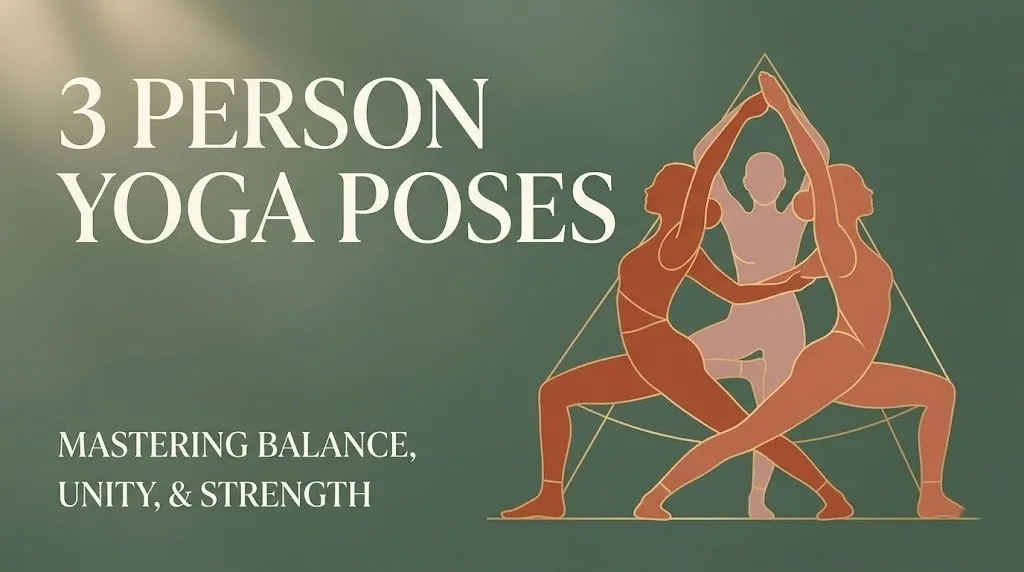
Not every three-person pose uses this vertical structure. Many trio poses are horizontal: three people in identical shapes side by side, or two partners supporting a central person in a passive stretch. The variety is wide, and the difficulty range is genuinely vast.
Pose Tip:
- Define roles before you begin. Decide who is the base, who is the middle, and who is the top.
- The base should always be the most experienced or physically stable participant.
- Communicate openly. If something hurts or feels unstable, everyone stops immediately.
Yoga Poses for 3 People
Yoga poses for 3 people work because the human body responds to shared resistance and weight distribution the same way it responds to gravity or a prop. When a partner provides resistance, your muscles activate more precisely.
A solo forward fold stretches your hamstrings because gravity pulls your upper body down. In a three-person counterbalanced forward fold, a partner’s pull creates the same effect, often more controllably. That controllability is one reason physical therapists sometimes use partner-assisted stretching in clinical settings.
The poses in this guide draw from Hatha yoga and acro yoga traditions. Hatha yoga provides the foundational pose architecture: the shapes, the alignment principles, and the breath awareness. Acro yoga adds the weight-sharing, spotting protocols, and basing mechanics that make multi-person practice safe and efficient.
| Role in Trio Yoga | Physical Position | Key Responsibility |
|---|---|---|
| Base | Closest to floor | Weight support, stability |
| Middle Partner | Between base and flyer | Bridging, counterweight |
| Flyer / Top | Highest position | Core engagement, trust |
| All Three | Shared | Breath coordination, communication |
What Is 3 Person Yoga and How Does It Work
Three person yoga is a cooperative movement practice where three participants use each other’s bodies as structure, resistance, and support to hold yoga-based shapes. It works through the physics of counterbalance and shared load.
When two people lean away from each other with gripped wrists, neither would stay upright alone. Together, they create a system of opposing forces that becomes stable. Add a third person and that system gains a new axis of support or extension.
Proprioception (your body’s sense of its own position in space) is heavily engaged during trio yoga. Each participant must constantly adjust micro-movements in response to what their partners are doing. A 2021 review in the International Journal of Yoga noted that partner-based balance activities significantly improve proprioceptive awareness and joint stability compared to solo balance training.
The breathing dimension matters as well. In most trio poses, all three practitioners aim to synchronize their inhale and exhale. This keeps movement coordinated and prevents one person from suddenly shifting weight during a crucial hold.
Benefits of Doing Yoga Poses for 3 People
Doing yoga poses for 3 people offers a combination of physical, psychological, and social benefits that solo practice cannot replicate. The benefits stack on top of the standard advantages of yoga itself.
According to a 2019 study published in the Journal of Alternative and Complementary Medicine, group-based yoga practice was associated with greater reductions in perceived stress and loneliness compared to solo home practice over an eight-week period. The social accountability element plays a real role in consistency.
Physically, trio poses challenge balance and stability in ways a solo mat session rarely does. Holding a counterbalanced shape requires active engagement of the gluteus medius, core stabilizers, and erector spinae muscles simultaneously. You’re essentially performing an integrated strength exercise while also stretching.
Key benefits of three person yoga poses include:
- Improved balance and proprioceptive coordination
- Strengthened core and stabilizer muscles through counterbalance demands
- Increased flexibility through partner-assisted range of motion
- Reduced stress and improved mood through social contact and synchronized breath
- Better body awareness and non-verbal communication skills
- Fun and novelty that keeps motivation high
Easy 3 Person Yoga Poses for Beginners
Easy 3 person yoga poses for beginners are ground-level shapes that require no lifting, minimal balance challenge, and simple weight-sharing mechanics. Start here before attempting anything vertical or inverted.
These poses work because all three participants stay connected to the floor. No one carries another person’s full body weight. The challenge is coordination, breath timing, and gentle flexibility, not strength or advanced balance.
Pose: Triple Baddha Konasana (Bound Angle Pose) Circle
All three sit on the floor in a triangle formation, facing inward. Each person sits in Baddha Konasana (Bound Angle Pose), soles of the feet together, knees dropping outward. Reach your hands to your neighbors and gently hold wrists. On an inhale, all three sit tall. On the exhale, all three gently fold forward together.
Pose: Three-Person Seated Forward Fold with Hands Linked
Sit in a straight line, all three facing the same direction. The front person folds into Paschimottanasana (Seated Forward Fold). The middle person sits upright and gently presses palms to the front person’s upper back. The back person mirrors the middle. Hold for five breath cycles.
Modification for beginners: Place folded blankets under the hips of anyone with tight hamstrings. This tilts the pelvis forward and makes the fold far more accessible without straining the lower back.
How to Do 3 Person Yoga Safely
Safe three person yoga requires three non-negotiable elements: a defined safety protocol before starting, honest communication during every pose, and a spotting system for any shape that involves lifting or balance challenge.
The American Council on Exercise recommends that any partner-based exercise involving weight support begin with a verbal check-in system. Establish a clear stop word before you start. “Stop,” “down,” or “base” all work. Everyone agrees to freeze and lower slowly the moment that word is spoken, no questions asked.
Floor surface matters. Practice on a non-slip yoga mat or a clean hardwood floor with grip. Avoid carpet for trio yoga because it creates unpredictable drag. If you are outdoors, flat, dry grass works. Never practice on wet surfaces.
Safety rules for three person yoga:
- Never attempt a pose where one person lifts another without a designated spotter who is not performing the pose
- The base should communicate throughout: say “ready,” “holding,” and “release” at each stage
- Warm up all three participants for at least 8 to 10 minutes before attempting balance-dependent poses
- Anyone with a wrist, shoulder, or lower back injury should take the least weight-bearing role or skip lifting poses entirely
- If someone experiences sharp pain (not muscle fatigue, but sharp or localized pain), stop the pose immediately and do not retry without assessing the cause
Key Takeaway: The single most important factor in safe three-person yoga is not strength or flexibility. It is clear, pre-agreed verbal communication before and during every pose.
BFF 3 Person Yoga Poses
BFF 3 person yoga poses are trio shapes designed for fun, social connection, and shared experience rather than athletic performance. They prioritize laughter, bonding, and accessibility over difficulty.
These poses became popular through social media, particularly among friend groups documenting shared experiences. But the underlying yoga is sound. Many BFF trio poses are adapted from genuine Hatha yoga shapes that happen to work well with three bodies.
Triple Vrksasana (Tree Pose) Line:
Three people stand side by side in a line. Each person comes into Vrksasana (Tree Pose), with the raised foot pressed against the inner thigh or calf of the standing leg. Never press the raised foot against the knee joint itself, as this can strain the medial collateral ligament. The middle person places one arm around each neighbor’s shoulder. Outer partners place their free arm at heart center. Hold for five breaths.
Triple Utkatasana (Chair Pose) Circle:
Three people stand in a circle, all facing inward, shoulders close. All three lower simultaneously into Utkatasana (Chair Pose), arms reaching toward the center of the circle. Fingertips lightly touch in the middle. Hold for five breath cycles, then rise on a shared inhale.
Modification: Anyone with knee sensitivity can widen their stance and reduce their depth of bend. This keeps them in the circle without loading the knee joint past a comfortable range.
Group Yoga Poses for 3 With Step-by-Step Instructions
Group yoga poses for 3 people work best when each participant understands their specific role, the entry sequence, and the exit before the pose begins. Never enter a multi-person pose without knowing how to come out of it safely.
Below are three core trio poses with full instructions.
Pose 1: Triple Adho Mukha Svanasana (Downward-Facing Dog) Stack
To practice this pose:
- Person A comes into Adho Mukha Svanasana (Downward-Facing Dog), hips high, heels pressing toward the floor.
- Person B faces Person A and places both hands on Person A’s lower back, directly over the sacrum, not the spine.
- Person C stands behind Person B, places hands on Person B’s hips, and all three lengthen their spines simultaneously.
- Breathe together for three to five breath cycles.
- Person C releases first, then Person B, then Person A softens the knees and steps to standing.
Safety note: Anyone with wrist pain, shoulder impingement, or high blood pressure should not take the base position in this variation. Use a forearm modification instead.
Pose 2: Three-Person Navasana (Boat Pose) Circle
To practice this pose:
- All three sit facing each other in a triangle formation, knees bent, feet flat on the floor.
- Each person reaches forward and grips the wrists of the partners beside them, not the hands.
- On a shared exhale, all three lift their feet off the floor and extend the legs toward straight.
- Hold the wrist-grip firmly. Press the soles of the feet toward the center of the triangle.
- Hold for three breath cycles. Lower feet to floor together on a shared exhale.
Modification: Anyone with lower back sensitivity keeps the knees bent rather than extending the legs fully. This reduces the load on the lumbar spine and hip flexors considerably.
Pose 3: Three-Person Seated Spinal Twist Circle
To practice this pose:
- All three sit cross-legged in a close triangle, knees nearly touching neighbors’ knees.
- Each person places their right hand on the left knee of the neighbor to their right.
- Each person places their left hand behind their own lower back.
- On a shared inhale, all three lengthen the spine. On the exhale, all three twist to the right.
- Hold for four breaths. Return to center on an inhale. Repeat to the left.
Key Takeaway: In every trio pose, entry and exit sequences matter as much as the pose itself. Agree on the sequence before you move, not during.
Three Person Yoga Poses Hard
Hard three person yoga poses involve significant strength, advanced balance, weight-bearing on one participant’s body by another, or inverted positions requiring refined body awareness. These are not beginner territory.
Before attempting hard three person yoga poses, every participant should have a consistent solo yoga practice, familiarity with acro yoga safety principles, and experience with easy and intermediate trio shapes. Skipping that progression is the most common reason people get hurt.
According to the International Journal of Yoga, balance-intensive partner poses activate the vestibular system and deep stabilizer muscles at a significantly higher rate than equivalent solo poses. That activation is a real training benefit but also means the margin for error is smaller.
Hard trio poses by difficulty level:
| Pose Name | Difficulty | Key Requirement | Who Should Skip |
|---|---|---|---|
| Flying Warrior Trio | Advanced | Base strength, flyer core | Wrist or shoulder injuries |
| Three-Person Pyramid | Advanced | All: spinal flexibility | Disc issues, tight hamstrings |
| Standing Shoulder Stack | Expert | Base balance, spotter | Beginners, any vertigo |
| Triple Handstand Wall Support | Expert | Individual handstand ability first | Anyone without solo inversion practice |
Anyone with a history of spinal disc issues, shoulder instability, or inner ear disorders that affect balance should work with a certified acro yoga instructor before attempting advanced trio poses.
3 Person Acro Yoga Poses
Three person acro yoga poses combine the physical discipline of acrobatics with yoga’s alignment principles and breath awareness, creating shapes where one or two participants are lifted off the ground.
Acro yoga as a formalized practice was developed in the early 2000s and draws from Thai massage, circus arts, and Hatha yoga. It uses a specific vocabulary: the base lies on their back with feet in the air; the flyer balances on the base’s feet; the spotter stands beside the pair to catch the flyer if balance is lost.
In a three-person acro configuration, the spotter becomes structurally essential rather than optional. Never skip the spotter role in acro trio work.
Beginner Acro Trio: Foot-to-Hip Flying Pose
To practice this pose:
- The base lies flat on their back, knees bent, feet flat on the floor.
- The spotter stands to the side of the base, arms ready to catch.
- The flyer stands facing the base’s feet at the base’s hips.
- The base places the soles of their feet against the flyer’s hip bones, not the abdomen.
- The flyer shifts weight into the base’s feet as the base lifts their legs to vertical.
- The flyer extends the arms to the sides for balance. Both breathe steadily.
- To come down, the flyer bends at the hips and steps back to the floor as the base lowers the legs.
Modification: Practice this with the base’s feet only at hip level rather than fully extended overhead. This keeps the center of gravity lower and allows the spotter to intervene easily.
3 Person Yoga Poses for Kids and Families
Three person yoga poses work extremely well for families with children because they transform yoga into cooperative play rather than structured exercise. Kids engage with the physical challenge without feeling like they are “doing yoga.”
Research published in Complementary Therapies in Medicine found that yoga-based activities in family settings improved children’s body awareness, frustration tolerance, and parent-child connection when practiced consistently over six weeks. The play element is not a distraction from the benefit; it is part of how the benefit works.
For family trio yoga, keep all poses floor-based. No lifting children off the ground unless they are older teens with body weight control and a very experienced adult base.
Kid-friendly 3 person yoga poses:
- Triple Child’s Pose (Balasana) Side by Side: All three kneel and fold forward into Balasana (Child’s Pose), arms extended forward. Hold hands with the partners on either side. Breathe together for ten slow counts.
- Three-Person Rainbow: All three sit in a row, the middle person facing opposite the outer two. Outer partners reach their inside arm to the middle person’s raised hand, creating a “rainbow” arch. Hold for five breaths each side.
- Group Boat Pose (Navasana) with Bent Knees: As described earlier, but all three keep knees bent. Appropriate for children 8 and older with adult supervision.
Safety note for kids: Children under 8 should not be placed in any pose where their body weight is supported by an adult’s extended limbs. The risk of sudden uncontrolled movement is too high.
Key Takeaway: Family trio yoga works best when you treat it like a game with rules, not a workout with requirements. Let kids suggest shapes and follow their curiosity.
3 Person Yoga Modifications for Limited Mobility
Three person yoga modifications for limited mobility allow participants with arthritis, reduced flexibility, chronic pain, or post-injury restrictions to participate fully in trio practice without taking on unsupported physical risk.
The key principle is role-matching. A person with limited hip mobility should never take the base role in a pose requiring deep hip flexion. A person with wrist arthritis should not bear weight on their hands. Assigning roles based on each person’s individual capacity, not just their willingness, is the difference between an inclusive session and one that causes harm.
According to the NCCIH, adapted yoga programs for people with musculoskeletal conditions show consistent improvements in pain ratings and functional mobility when poses are appropriately modified for the individual’s condition. The same principle applies in group settings.
Modification options for common limitations:
| Limitation | Pose Adjustment | Prop Option |
|---|---|---|
| Wrist pain or arthritis | Use forearms instead of full palm contact | Folded blanket under forearms |
| Tight hamstrings | Bend knees in all forward fold shapes | Rolled blanket under knees |
| Lower back sensitivity | Avoid spinal flexion under load | Use wall for upright support |
| Hip replacement | Skip deep hip rotation poses | Chair yoga version of the shape |
| Balance issues | Stay seated for all trio poses | Two chairs facing each other |
| Knee pain | Widen stance, reduce bend depth | Block under hips in seated poses |
If any participant is managing a diagnosed musculoskeletal condition, working with a physical therapist or registered yoga teacher before joining a trio practice session is a reasonable step, not an overreaction.
Communication and Trust in Three Person Yoga
Communication in three person yoga is a physical skill, not just a social nicety. The ability to clearly signal readiness, discomfort, or the need to stop determines whether a trio practice session is safe or dangerous.
Before any pose, establish three verbal checkpoints:
- “Ready” (all three say it before entering the pose)
- “Holding” (spoken by the base or most weight-bearing participant when they feel stable)
- “Release” (spoken by any participant at any time to initiate a controlled exit)
Non-verbal signals matter equally. A squeeze of the hand, a tap on the forearm, or a single word can communicate what a sentence cannot during a held balance. Many experienced trio yoga groups develop their own shorthand over time.
Trust is built incrementally. The International Journal of Yoga has noted that partner yoga practices are associated with increased oxytocin release, the neurochemical linked to social bonding and trust, during cooperative physical contact. This is not abstract. The physical act of sharing weight builds a neurological basis for feeling safe with a partner.
Practical trust-building steps:
- Start every new trio session with one easy, floor-level pose before attempting anything harder
- Debrief briefly after the session. Ask what felt uncomfortable and adjust for next time.
- Never pressure any participant to attempt a pose they’ve said they’re not ready for
- Rotate roles across sessions so everyone develops skill in each position
Key Takeaway: The verbal stop system is not optional in trio yoga. Set it up before you start. Use it without hesitation.
How to Warm Up Before Three Person Yoga Poses
A proper warm-up before three person yoga poses prepares the joints, raises the muscle temperature, and allows all three participants to arrive in the session with the same level of physical readiness. Skipping it increases injury risk in proportion to the difficulty of the poses you plan to attempt.
The warm-up should last 8 to 10 minutes for easy poses and up to 15 minutes before attempting hard or acro-based trio shapes. Work from large joints to small: hips and spine first, then knees and ankles, then wrists and shoulders last.
A practical trio warm-up sequence:
- Joint rotations (3 minutes): All three stand in a loose circle and rotate wrists, ankles, hips, and shoulders simultaneously. Move at the same pace so you warm up together.
- Three-Person Tadasana (Mountain Pose) with breath sync (2 minutes): All three stand in Tadasana (Mountain Pose), feet hip-width apart, arms at sides. Match breath rhythm for 10 cycles. This aligns your breath before the physical work.
- Side stretch circle (2 minutes): All three reach the right arm overhead and lateral-flex left. Hold for five breaths. Switch sides. This warms the lateral flexors and intercostal muscles.
- Gentle seated forward fold (3 minutes): All three sit and move into a mild Paschimottanasana (Seated Forward Fold) with knees slightly bent. Hold for 10 to 15 slow breath cycles. This prepares the hamstrings and erector spinae for any trio shape involving hip hinging or folding.
Modification: Anyone with limited spinal mobility can perform all warm-up movements in a chair. This does not reduce the value of the warm-up. It matches the warm-up to the body actually practicing.
Frequently Asked Questions About 3 Person Yoga Poses
What are the easiest 3 person yoga poses for beginners?
The easiest three person yoga poses for beginners are seated floor-based shapes where no one carries another person’s weight.
Good starting points include the Triple Baddha Konasana circle, the three-person seated spinal twist, and Triple Vrksasana (Tree Pose) in a side-by-side line.
All three people stay connected to the floor, which keeps the safety level high and the coordination challenge manageable.
Is 3 person yoga safe for kids?
Three person yoga is safe for kids when all poses are kept floor-level and adult-supervised.
Children under 8 should not be placed in any shape where their body weight rests on an adult’s extended arms or legs.
Older children and teens can participate in partner-based balances with a responsible adult spotter present at all times.
Do you need yoga experience to try three person yoga poses?
You do not need formal yoga experience to try beginner three person yoga poses, but basic body awareness helps significantly.
If none of the three participants has practiced yoga before, start with the simplest seated shapes and spend the first session learning how to communicate, not how to balance.
Taking even two or three solo yoga classes before your first trio session will make the experience safer and more enjoyable for everyone.
What muscles do 3 person yoga poses work?
Three person yoga poses work a broad range of muscles depending on the specific shape and your role in it.
Common muscles engaged across most trio poses include the core stabilizers, gluteus medius, hamstrings, hip flexors, erector spinae, and shoulder girdle muscles.
Counterbalanced poses add an isometric strength component because your muscles must hold against resistance throughout the entire hold.
How do three people communicate during a yoga pose?
Three people communicate during a yoga pose using pre-agreed verbal checkpoints: “ready” before entry, “holding” once stable, and “release” to exit.
Non-verbal signals like a hand squeeze or forearm tap supplement verbal cues during held balances where speaking takes significant effort.
Establish all signals before the session starts, not during a held pose under load.
Start With One Pose Today
Trio yoga does not require a studio, a certification, or even much space. It requires three willing people, a clear surface, and the agreement to communicate before, during, and after every shape you try.
Start with the Triple Vrksasana (Tree Pose) line or the three-person seated twist. Practice the warm-up sequence once before you begin. Use the verbal check-in system from the first moment, even if it feels unnecessary for something simple. Building that habit on easy poses means it will be automatic when you need it on harder ones.
The poses get more interesting as your group develops trust and physical familiarity with each other. Let the difficulty follow naturally from your comfort level, not from social pressure or a desire to recreate something you saw online.