Fun Christmas Yoga for Kids: Poses and Sequences (2026)
Christmas yoga blends festive holiday themes with kid-friendly yoga poses, giving children a playful way to move, breathe, and settle their busy minds during the most exciting time of year. Whether you are a parent clearing space in the living room or a teacher looking for a structured classroom activity, this guide gives you everything you need to lead a safe, fun session from start to finish.
Research backs up the instinct that yoga helps kids. A 2019 review published in the International Journal of Yoga found that school-based yoga programs improved children’s attention, emotional regulation, and self-esteem across multiple studies. During the holidays, when routines break down and excitement spikes, those benefits become especially practical.
Below, you will find specific poses with step-by-step instructions, complete sequences organized by age group, breathing exercises kids actually enjoy, creative games, and a ready-to-use lesson plan. Every pose includes modifications and safety notes so you can lead with confidence, even if you have never done yoga yourself.
What Is Christmas Yoga?
Christmas yoga is a style of kids’ yoga that renames and adapts traditional poses to match holiday themes like Christmas trees, stars, reindeer, and snowflakes.
The idea is simple. Take poses children’s bodies can do safely, wrap them in a story or seasonal theme, and turn movement into a game. A standard Vrksasana (Tree Pose) becomes a Christmas tree. Virabhadrasana I (Warrior I) becomes a toy soldier. The biomechanics stay the same; only the name and the narrative change.
This approach comes from the broader field of themed kids’ yoga, which yoga educators have used in classrooms and studios for over two decades. Themed sessions hold children’s attention longer because the poses connect to something they already find exciting.
Christmas yoga works for home living rooms, classrooms, holiday parties, and even outdoor spaces. No prior yoga experience is needed from the adult leading the session.
| Feature | Traditional Kids’ Yoga | Christmas Yoga |
|---|---|---|
| Pose names | Sanskrit or standard English | Holiday-themed (Reindeer, Star, Snowman) |
| Sequencing | Standard flow or hold-based | Story-driven or game-based |
| Props | Mats, blocks | Mats plus optional holiday items |
| Best setting | Studio, classroom, home | Classroom, home, holiday events |
| Session length | 15 to 45 minutes | 10 to 30 minutes |
Adults do not need to be yoga teachers to lead these sessions. The poses are adapted for simplicity and safety, and this guide gives you exact cues for each one.
Christmas Yoga for Kids
Christmas yoga for kids is a movement activity designed to channel holiday excitement into focused, body-aware play through adapted yoga poses and breathing exercises.
Kids during December are running on adrenaline. School parties, sugar, late bedtimes, and gift anticipation create a perfect storm of overstimulation. Yoga gives their nervous systems a structured way to shift gears.
According to Harvard Health Publishing, yoga activates the parasympathetic nervous system, the body’s built-in calm-down response. While most of that research has been done on adults, pediatric studies are growing. A 2020 study in Frontiers in Psychology found that children who participated in school-based yoga showed measurable improvements in self-regulation compared to a control group.
The beauty of Christmas-themed yoga is that kids do not realize they are doing a calming exercise. They think they are pretending to be reindeer.
Key reasons christmas yoga works for kids:
- Gross motor engagement: Balancing, stretching, and holding poses builds coordination and body awareness.
- Breath regulation: Simple breathing games teach kids to slow down without being told to “calm down.”
- Imagination activation: Storytelling keeps engagement high, even for children who resist structured activities.
- Routine anchoring: A 10-minute yoga session can become a daily advent tradition, giving kids a predictable calm moment in an unpredictable season.
Any child who can follow simple verbal instructions can participate. For very young children (ages 2 to 3), a parent or caregiver should model each pose alongside them.
Christmas Kids Yoga Poses
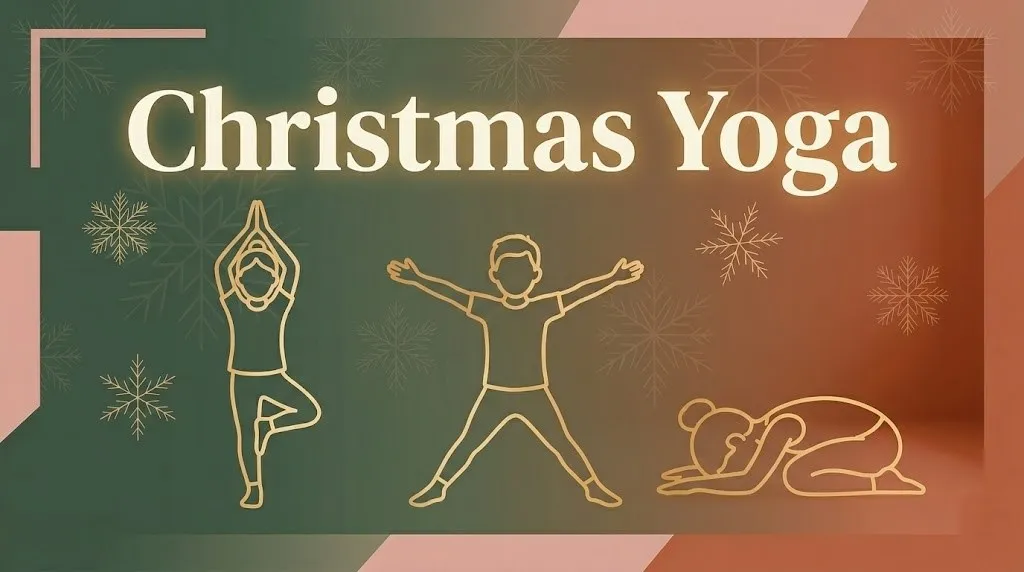
The best christmas kids yoga poses are ones that children can attempt on their first try, hold for a few breaths, and connect to a holiday image they recognize.
Below are ten poses, each renamed with a Christmas theme. Every pose includes the original yoga name, the muscles it works, and a brief alignment cue.
| Christmas Name | Yoga Name | Primary Muscles | Hold Time |
|---|---|---|---|
| Christmas Tree | Vrksasana (Tree Pose) | Quads, glutes, ankle stabilizers | 3 to 5 breaths |
| Star | Utthita Tadasana (Five-Pointed Star) | Deltoids, hip abductors | 3 to 5 breaths |
| Reindeer | Virabhadrasana III (Warrior III, adapted) | Hamstrings, glutes, core | 2 to 4 breaths |
| Candy Cane | Standing side bend (no standard Sanskrit) | Obliques, intercostals | 3 breaths per side |
| Snowman | Tadasana (Mountain Pose) with arms overhead | Spinal extensors, deltoids | 3 to 5 breaths |
| Toy Soldier | Virabhadrasana I (Warrior I) | Quads, hip flexors, deltoids | 3 to 5 breaths |
| Present/Gift | Balasana (Child’s Pose) | Spinal extensors, hips (passive stretch) | 5 to 8 breaths |
| Sleigh Ride | Navasana (Boat Pose, modified) | Rectus abdominis, hip flexors | 3 to 5 breaths |
| Gingerbread Man | Utthita Tadasana with wide legs | Adductors, deltoids | 3 to 5 breaths |
| Falling Snow | Savasana (Corpse Pose) | Full body relaxation | 1 to 3 minutes |
Each of these poses can be simplified further for younger kids or made more challenging for older ones. Specific modifications appear in the modifications and safety section later in this guide.
Pose Tip:
- Always demonstrate the pose yourself before asking kids to try it.
- Use the Christmas name first, then show the shape. Skip the Sanskrit with children under 8.
- Praise effort, not perfection. “Look at that strong tree!” works better than “Straighten your leg.”
Key Takeaway: Christmas yoga works because it hides a real physical and emotional regulation practice inside festive play. The poses are standard yoga poses with holiday names, the benefits are backed by pediatric research, and any adult can lead a session with clear instructions.
Benefits of Yoga for Kids at Christmas
Yoga benefits children year-round, but the holiday season amplifies several specific advantages that address the unique stresses of December.
The National Center for Complementary and Integrative Health (NCCIH), part of the NIH, notes that yoga may help reduce stress and anxiety, improve balance and flexibility, and support general wellness. While most NCCIH data focuses on adults, the agency acknowledges a growing body of evidence for pediatric applications.
Holiday-specific benefits include:
- Emotional regulation during overstimulation: The combination of sugar, screen time, late nights, and anticipation pushes kids’ nervous systems into overdrive. Yoga’s focused breathing and slow movement activate the parasympathetic response, helping children shift from “wired” to “tired” without a meltdown.
- Gross motor release: Kids need to move. When weather keeps them indoors, yoga gives their large muscle groups a workout in a small space.
- Focus and attention practice: Holding a pose for five breaths requires concentration. That skill transfers directly to sitting through a holiday dinner or waiting to open gifts.
- Sleep improvement: A 2022 study published in Complementary Therapies in Medicine found that mind-body practices including yoga were associated with improved sleep quality in children and adolescents.
- Social-emotional bonding: Practicing yoga together as a family or classroom creates a shared experience that does not involve screens or spending money.
One benefit that often gets overlooked: yoga teaches kids the concept of “enough.” Holding a pose until it feels challenging, then releasing, builds tolerance for discomfort without forcing it. That is a life skill that extends far beyond the mat.
Christmas Yoga Sequence
A christmas yoga sequence is a structured order of holiday-themed poses designed to be followed from beginning to end, typically lasting 10 to 25 minutes depending on the age group.
The sequence below is organized into four phases: warm-up, active poses, cool-down, and rest. This structure mirrors how professional kids’ yoga teachers design their classes, moving from gentle activation to peak energy and then back down.
10 to 15 Minute Christmas Yoga Sequence:
- Snowman (Tadasana): Stand tall, arms overhead. Circle arms like rolling a snowball. 5 breaths.
- Candy Cane (Standing Side Bend): Reach arms up, lean right, then left. 3 breaths per side.
- Toy Soldier (Virabhadrasana I): Step right foot forward, bend front knee, arms up. Hold 4 breaths. Switch sides.
- Christmas Tree (Vrksasana): Stand on one leg, other foot on calf (never on knee). Arms overhead like branches. 4 breaths per side.
- Reindeer (Adapted Warrior III): Balance on one leg, lean forward, back leg lifts behind. Hold 3 breaths per side.
- Sleigh Ride (Modified Navasana): Sit on mat, lean back slightly, lift feet. “Hold the reins.” 4 breaths.
- Present (Balasana): Fold forward from kneeling. Rest forehead on mat. 6 slow breaths.
- Falling Snow (Savasana): Lie flat on back, eyes closed. Imagine snowflakes landing on your body. 1 to 3 minutes.
Pose Tip:
- Narrate transitions. “Now our toy soldier is tired, so he turns into a beautiful Christmas tree standing still in the snow.”
- Keep the pace gentle. Rushing through poses defeats the calming purpose.
- For groups, have everyone start and finish each pose together to build a sense of shared rhythm.
Christmas Yoga Flow
A christmas yoga flow connects poses through continuous movement and breath, similar to a simplified Vinyasa style, rather than holding each pose in isolation.
Flows work best for children ages 6 and older who have some body awareness and can follow a sequence of movements. Younger children generally do better with hold-and-release individual poses.
Sample 5-Pose Christmas Flow (Repeat 3 Times):
- Inhale: Snowman (Tadasana), arms sweep overhead.
- Exhale: Fold forward into Present (Uttanasana / Standing Forward Fold).
- Inhale: Halfway lift, hands on shins (“Peeking into the gift box”).
- Exhale: Fold back down.
- Inhale: Rise up into Star (Utthita Tadasana), arms and legs wide.
- Exhale: Return to Snowman (Tadasana).
The key difference between a sequence and a flow is breath-linked movement. In a flow, every transition happens on either an inhale or an exhale. This teaches children to coordinate breath and motion, a skill that improves body awareness and has been shown to reduce anxiety markers in school-age children.
| Element | Yoga Sequence | Yoga Flow |
|---|---|---|
| Pace | Pause between poses | Continuous movement |
| Breath pattern | Breathe within each held pose | Breath drives each transition |
| Best age range | All ages (3 and up) | Ages 6 and up |
| Energy level | Moderate | Higher |
| Coordination demand | Low | Moderate |
For children who find the flow too fast, simply slow down and add a pause between each movement. There is no wrong speed.
How to Teach Christmas Yoga to Kids at Home
Teaching christmas yoga to kids at home requires no certification, no special equipment, and no previous yoga experience on the part of the adult.
Here is what matters: your willingness to do the poses alongside your child. Kids mirror behavior. If you stand on one leg and wobble, they see that wobbling is fine. If you laugh when you fall out of a pose, they learn that yoga is not about perfection.
Step-by-step setup:
- Clear a space roughly 6 feet by 6 feet per person. Remove sharp-edged furniture.
- Use yoga mats if you have them. Towels or carpet work, too.
- Wear comfortable clothing. Socks off for better grip.
- Choose 5 to 8 poses from the pose list in this guide.
- Practice each pose yourself once before introducing it to kids.
- Lead with the Christmas name first. Show the shape. Then invite kids to try.
- Hold each pose for 3 to 5 breaths. Count out loud.
- End with Falling Snow (Savasana) every time.
Home Teaching Tips:
- Keep sessions short. 10 minutes for ages 3 to 5. Up to 20 minutes for ages 6 to 9. Older kids can handle 25 to 30 minutes.
- Use music sparingly. Soft instrumental holiday music works. Lyrics are distracting.
- Avoid corrections. Say “try reaching your arms a little higher” instead of “you’re doing it wrong.”
- Join in. Never stand apart and instruct like a drill sergeant. Get on the mat.
A 2021 report from the American Academy of Pediatrics emphasized that children benefit most from physical activities that feel play-based rather than performance-based. Yoga at home, without grades or competition, fits that description exactly.
Key Takeaway: The best christmas yoga sessions follow a warm-up, active, cool-down, rest structure; the adult doing the poses alongside the child matters more than any specific instruction technique; and flows suit older kids while simple held poses work for younger ones.
Christmas Yoga for Preschoolers
Christmas yoga for preschoolers (ages 3 to 5) works best with very short sessions, simple shapes, and strong imaginative storytelling to hold attention.
Preschoolers are still developing proprioception, their sense of where their body is in space. Balance poses will be wobbly. That is completely normal and actually beneficial, because the wobbling itself builds neural pathways in the vestibular system.
Best poses for this age group:
- Snowman (Tadasana): Simply standing tall with arms up. Start here every time.
- Star (Utthita Tadasana): Wide legs, wide arms. “Shine like the star on top of the tree!”
- Present (Balasana): Kneeling and folding forward. “You are a wrapped gift under the tree.”
- Candy Cane (Standing Side Bend): Lean side to side. Easy to do and fun to exaggerate.
- Falling Snow (Savasana): Lying flat. “Snowflakes are landing on your tummy.”
Preschooler Session Guidelines:
| Guideline | Recommendation |
|---|---|
| Session length | 5 to 10 minutes maximum |
| Number of poses | 3 to 5 |
| Hold time per pose | 2 to 3 breaths |
| Repetition | Repeat favorite poses 2 to 3 times |
| Adult role | Model every pose alongside the child |
| Music | Optional soft instrumentals |
| Props | Not necessary; stuffed animals can be “yoga friends” |
Expecting a 4-year-old to hold Tree Pose for 30 seconds is unrealistic. Two breaths is a win. If the child falls, you say, “The Christmas tree got blown by the wind! Let’s grow it back up.”
Never force a preschooler into a pose. If they want to make up their own “snowflake dance” instead, that counts. The goal is positive association with mindful movement, not technical precision.
Christmas Yoga for School Age Kids
Christmas yoga for school age kids (ages 6 to 12) can include longer sequences, balance challenges, partner poses, and basic breath-counting exercises.
Children in this age range have enough body awareness to follow multi-step instructions and enough attention span for sessions lasting 15 to 25 minutes. They also start to feel social pressure and self-consciousness, so creating a non-competitive, playful atmosphere matters.
Poses that challenge school-age kids appropriately:
- Reindeer (Adapted Warrior III): Balancing on one leg with the torso tipping forward builds the glutes, hamstrings, and core. Allow hands on a wall or chair for support.
- Sleigh Ride (Modified Navasana / Boat Pose): Sit, lean back, lift feet. This fires up the rectus abdominis and hip flexors. Knees can stay bent for an easier version.
- Christmas Tree (Vrksasana): Full Tree Pose with foot placed on the inner calf or inner thigh. Never on the knee joint, as this places lateral stress on the knee ligaments.
- Toy Soldier (Virabhadrasana I): Front knee bends toward 90 degrees, back leg stays straight. Arms reach overhead.
Partner Pose Option: “Double Candy Cane.” Two kids stand side by side, hold inside hands, and both lean away from each other in a side bend. This builds trust and requires communication.
According to a 2019 systematic review in the Journal of Developmental and Behavioral Pediatrics, yoga-based interventions in school settings showed positive effects on children’s emotional and behavioral regulation. The review covered studies with children ages 5 to 18.
For kids who say yoga is “boring,” introduce the timed challenges and games covered in the Yoga Games section below. Competition with yourself (how long can you hold Reindeer Pose?) is motivating without being exclusionary.
Christmas Yoga Story for Kids
A christmas yoga story for kids is a guided narrative where each story event corresponds to a yoga pose, creating a moving story that children physically act out.
Yoga stories are one of the most effective formats for keeping kids engaged because children are hardwired for narrative. Instead of saying “now do Tree Pose,” you say, “and in the forest, there stood a tall, beautiful Christmas tree.”
Sample Christmas Yoga Story (5 to 7 minutes):
“One snowy December night, a little snowman (Tadasana, arms overhead) stood very still in the yard. The wind blew, and he swayed like a candy cane (Standing Side Bend, lean left, lean right). Across the yard, a brave toy soldier (Virabhadrasana I, right foot forward) was guarding a pile of presents (Balasana, fold forward in child’s pose).
Suddenly, a reindeer (Adapted Warrior III, balance on one leg) landed in the garden! The reindeer looked up at the star (Utthita Tadasana, arms and legs wide) shining at the top of the tallest christmas tree (Vrksasana, stand on one leg, arms up like branches).
The reindeer was tired from flying, so it curled up to rest. Snow began to fall. Everything got quiet. The snowflakes drifted down and landed softly on the ground. We lie down like falling snow (Savasana, flat on back, eyes closed). Everything is peaceful. Everything is still.”
Story Tips:
- Speak slowly. Pause between sentences.
- Let children hold each pose for 3 to 4 breaths before moving the story forward.
- Use a calm, low voice during the Savasana ending.
- Invite older kids to make up their own stories using the pose names.
Stories work for all ages, but preschoolers especially respond to this format because it removes the pressure of “doing yoga correctly” and replaces it with imaginative play.
Key Takeaway: Preschoolers need 5 to 10 minute sessions with 3 to 5 simple poses, school-age kids can handle 15 to 25 minutes with balance challenges and partner work, and yoga stories are the single most effective engagement tool across all age groups.
Christmas Themed Yoga Poses
Christmas themed yoga poses take standard yoga positions and assign them holiday-inspired names that help kids visualize and remember the shape their body should make.
The renaming is not random. Effective themed poses connect a visual image to the physical shape. A child who pictures a star spreading its five points will naturally widen their arms and legs in Utthita Tadasana. The mental image becomes an alignment cue.
Here are five additional themed poses beyond those already covered:
- Angel: Stand in Tadasana. Sweep arms out and up to touch palms overhead. Lower arms back down. Repeat 5 times, coordinating with breath. This builds shoulder mobility and rhythmic breathing.
- Snowflake Spin: Stand on one foot (like Tree Pose). Slowly rotate the raised knee outward to the side, then bring it back to center. This challenges the hip external rotators and standing-leg stability.
- Chimney (Chair Pose / Utkatasana): Feet together, bend knees, sit hips back, arms overhead. “Squeeze through the chimney!” This pose loads the quadriceps and glutes significantly.
- Wreath (Seated Twist): Sit cross-legged. Place right hand on left knee, left hand behind. Gently twist to look over the left shoulder. Switch sides. This rotates the thoracic spine and stretches the obliques.
- Icicle (Standing Forward Fold / Uttanasana): Stand tall, then fold forward slowly. “Melt like an icicle in the sun.” Hang heavy. This stretches the hamstrings and erector spinae.
Pose Tip:
- Let kids suggest their own Christmas pose names. “What shape would a candy cane make?” sparks creativity and ownership.
- Avoid poses that put pressure on the neck or require deep backbends for children under 10.
- Every pose should feel playful, not painful. If a child says it hurts, they stop immediately.
Christmas Yoga Breathing Exercises for Kids
Christmas yoga breathing exercises for kids are simple pranayama techniques adapted with holiday imagery to make breath awareness fun and accessible.
Breathing exercises are arguably the most beneficial part of kids’ yoga, and the part most often skipped. Research published in the International Journal of Yoga (2018) found that even brief pranayama practice improved attention and reduced anxiety in school-age children.
The challenge: telling a child to “take a deep breath” rarely works. Themed breathing games do.
Four Christmas Breathing Exercises:
- Hot Cocoa Breath:
- Cup hands around an imaginary mug.
- Inhale through the nose to “smell the cocoa” (4 counts).
- Exhale through the mouth to “cool it down” (6 counts).
- Repeat 4 to 6 times.
- Snowflake Breath:
- Hold one palm flat in front of the face, like a snowflake.
- Inhale through the nose (3 counts).
- Exhale very gently through the mouth, trying not to “blow the snowflake away.”
- This teaches extended, controlled exhalation, which activates the parasympathetic nervous system.
- Jingle Bell Breath:
- If available, hold a small bell. If not, imagine one.
- Inhale quietly through the nose (3 counts).
- Exhale and shake the bell gently. The sound should be soft, not loud.
- This connects breath to a physical, auditory cue.
- Star Breath (Five-Point Breath):
- Hold one hand up, fingers spread like a star.
- Use the index finger of the other hand to trace up each finger on the inhale and down each finger on the exhale.
- Five fingers equals five full breaths.
- This is a well-known technique used by occupational therapists and school counselors for anxiety management.
| Breathing Exercise | Best Age | Primary Benefit | Props Needed |
|---|---|---|---|
| Hot Cocoa Breath | 3 and up | Extended exhale, calming | None |
| Snowflake Breath | 4 and up | Breath control | None |
| Jingle Bell Breath | 4 and up | Auditory-breath connection | Small bell (optional) |
| Star Breath | 5 and up | Counting, focus, anxiety relief | None |
Start every yoga session with one breathing exercise and end with another. This bookending creates a ritual that signals “we are beginning” and “we are finishing” to the child’s nervous system.
Calming Yoga for Kids During Holidays
Calming yoga for kids during holidays uses slower poses, longer holds, and guided relaxation to help children manage the overstimulation that December brings.
Holiday overstimulation is not a behavioral problem. It is a nervous system response. Bright lights, loud music, crowded stores, schedule disruptions, and sugar all push a child’s sympathetic nervous system (fight-or-flight mode) into overdrive. The result looks like hyperactivity, meltdowns, or difficulty sleeping.
Calming yoga specifically targets the parasympathetic response through three mechanisms:
- Slow, controlled breathing extends the exhale, which stimulates the vagus nerve.
- Gentle forward folds and supported resting poses reduce heart rate and cortisol levels.
- Guided visualization redirects attention from external stimulation to internal imagery.
Best calming poses for holiday overstimulation:
- Present (Balasana / Child’s Pose): Forehead resting on the mat sends a grounding signal to the brain.
- Falling Snow (Savasana): Complete stillness. Cover the child with a light blanket for added sensory comfort.
- Wreath (Seated Twist): Gentle spinal rotation has a massaging effect on the organs and feels soothing.
- Icicle Melt (Ragdoll / Uttanasana): Standing forward fold with heavy arms. Gravity does the work.
According to Harvard Health Publishing, yoga’s calming effects are linked to reduced cortisol production and increased GABA activity in the brain, a neurotransmitter associated with relaxation.
Quick Calming Routine (5 minutes):
- Hot Cocoa Breath (6 rounds).
- Candy Cane (Standing Side Bend), 3 breaths per side.
- Icicle Melt (Uttanasana), 5 breaths.
- Present (Balasana), 8 breaths.
- Falling Snow (Savasana), 2 minutes with guided imagery.
Use this routine before bedtime on Christmas Eve, after a holiday party, or whenever a child seems overwhelmed. The consistency of repeating the same short sequence helps kids internalize the calming pattern.
Key Takeaway: Breathing exercises are the most underused and most effective part of kids’ yoga; Star Breath and Hot Cocoa Breath work for anxiety management even outside yoga sessions; and a 5-minute calming routine before bed can become the most useful tool in your holiday parenting toolkit.
Yoga Games for Kids Christmas
Yoga games for kids at Christmas turn poses and breathing exercises into interactive, group-friendly activities that maintain engagement while still delivering the physical and calming benefits of yoga.
Games solve the biggest challenge of kids’ yoga: attention. Even the best sequence loses a 6-year-old after 8 minutes. Games bring the energy back without abandoning the mindful movement framework.
Five Christmas Yoga Games:
- Freeze Dance Yoga:
- Play holiday music. Kids dance freely.
- When the music stops, call out a Christmas yoga pose name.
- Everyone freezes in that pose. Hold for 3 breaths.
- Resume music. Repeat with a different pose each time.
- Yoga Pose Charades:
- Write Christmas yoga pose names on slips of paper.
- One child picks a slip and does the pose silently.
- Others guess the holiday name.
- No talking allowed by the poser.
- Santa Says (Simon Says Variation):
- Leader calls out “Santa says do Reindeer Pose!”
- Kids only do the pose if the leader says “Santa says” first.
- If the leader just says “Do Star Pose!” without “Santa says,” anyone who moves sits down for one round.
- Yoga Advent Calendar:
- Create 24 cards, one for each day of advent.
- Each card has a different pose, breathing exercise, or partner activity.
- Open one card per day from December 1 through 24.
- Snowball Pass:
- Kids sit in a circle. Pass a soft ball (the “snowball”) around.
- When the music stops, whoever holds the snowball picks a pose for everyone to do.
- This gives children leadership practice and choice.
| Game | Group Size | Best Age | Energy Level | Session Placement |
|---|---|---|---|---|
| Freeze Dance Yoga | 2 to 20 | 4 and up | High | Middle of session |
| Yoga Pose Charades | 3 to 10 | 6 and up | Medium | Middle |
| Santa Says | 3 to 30 | 5 and up | Medium-High | Early or middle |
| Yoga Advent Calendar | 1 to 5 | 3 and up | Variable | Daily standalone |
| Snowball Pass | 4 to 15 | 5 and up | Low-Medium | Beginning or middle |
Games should always end with a calming transition. After the last game, guide kids into Present (Balasana) or Falling Snow (Savasana) for at least one minute so their nervous systems come back down.
Christmas Yoga Lesson Plan
A christmas yoga lesson plan is a structured, timed outline that an adult can follow to lead a complete yoga session for children, whether at home, in a classroom, or at a holiday event.
Below is a ready-to-use plan designed for a mixed-age group (ages 4 to 10). For preschool-only or older-kids-only groups, adjust timing and complexity using the age-specific sections earlier in this guide.
20-Minute Christmas Yoga Lesson Plan:
| Time | Activity | Details |
|---|---|---|
| 0:00 to 2:00 | Opening Circle | Sit together. Ask: “What’s your favorite thing about Christmas?” One answer per child. |
| 2:00 to 4:00 | Hot Cocoa Breath | 6 rounds. Cup hands, inhale nose, exhale mouth. |
| 4:00 to 7:00 | Standing Poses | Snowman, Candy Cane, Star. Hold each 4 breaths. |
| 7:00 to 10:00 | Balance Poses | Christmas Tree, Reindeer. 3 breaths per side. Wall nearby for support. |
| 10:00 to 12:00 | Active Pose | Toy Soldier (Warrior I). 4 breaths each side. |
| 12:00 to 14:00 | Game | Freeze Dance Yoga. 3 to 4 rounds. |
| 14:00 to 16:00 | Floor Poses | Sleigh Ride (Boat), Wreath (Twist). 3 to 4 breaths each. |
| 16:00 to 18:00 | Cool Down | Present (Child’s Pose). 6 slow breaths. Star Breath with hand tracing. |
| 18:00 to 20:00 | Falling Snow (Savasana) | Lie flat. Guided imagery: “Imagine snowflakes landing on you one by one.” |
Lesson Plan Notes:
- Print this table and keep it next to your mat. Glance at it between transitions.
- Transitions should be narrated. “The toy soldier is getting sleepy, so let’s play one last game before we rest.”
- If attention drops, skip ahead to the game or straight to Savasana. Forcing poses builds negative associations.
- For classroom use, desks can be pushed aside. Poses can also be done standing beside desks if space is tight.
This plan works as a one-time holiday activity or a repeatable weekly session through December. Children who repeat the same plan multiple weeks show noticeable improvement in their balance and breath control by the third or fourth session.
Christmas Yoga Modifications and Safety for Kids
Christmas yoga modifications and safety for kids address how to adapt poses for different ages, abilities, and physical conditions so every child can participate without risk of injury.
Yoga is one of the lowest-risk physical activities for children, but “low risk” is not “no risk.” The American Academy of Pediatrics supports yoga as a safe activity for children when age-appropriate poses are selected and proper supervision is provided.
Common Modifications:
| Pose | Standard Version | Modification for Younger/Less Mobile Kids | Safety Note |
|---|---|---|---|
| Christmas Tree (Vrksasana) | Foot on inner thigh, arms overhead | Foot on inner calf, one hand on wall | Never place foot on the knee joint. |
| Reindeer (Warrior III) | One leg extended back, torso parallel to floor | Hands on chair back, leg lifts only a few inches | Do not lock the standing knee. |
| Sleigh Ride (Navasana) | Legs lifted, arms extended forward | Feet stay on floor, lean back only slightly | Skip if the child reports lower back pain. |
| Chimney (Utkatasana) | Deep squat, arms overhead | Shallow bend, hands on hips | Knees should not travel past toes. |
| Toy Soldier (Virabhadrasana I) | Deep front knee bend, arms up | Shorter stance, arms on hips | Front knee stays over the ankle, not past it. |
Safety Rules for All Kids’ Yoga:
- No headstands, shoulder stands, or deep backbends for children under 12. Their spinal structures are still developing.
- No forced stretching. Children’s connective tissue is more elastic than adults’, which means hypermobility is a real risk. A stretch should feel like a gentle pull, never sharp or painful.
- Bare feet always. Socks slide on mats and hard floors. Bare feet give better proprioceptive feedback.
- Hydration. Offer water before and after. Not during Savasana.
- Supervision. An adult should always be present and actively watching, not on their phone.
Special Considerations:
- Children with autism or sensory processing differences may find Savasana overstimulating (lying still with eyes closed in a group). Offer the alternative of sitting quietly with eyes open, or hugging a stuffed animal in Child’s Pose.
- Children with hypermobility or joint laxity should avoid locking their knees or elbows in any pose. Cue “keep a tiny bend” in every straight-leg position.
- Children recovering from injuries should have clearance from their pediatrician or physical therapist before participating in any balance or weight-bearing poses. This is especially relevant for wrist, ankle, or knee injuries common in active kids.
No child should ever feel excluded. If a child cannot do a pose, they can be the “yoga helper” who calls out the next pose name, rings the bell to signal transitions, or counts breaths out loud for the group.
Key Takeaway: Every single kids’ yoga pose should have a simpler option available, the most common safety error is placing the foot on the knee in Tree Pose, and children with sensory differences or hypermobility need specific adaptations that are easy to implement once you know what to look for.
Frequently Asked Questions About Christmas Yoga for Kids
What age can kids start doing christmas yoga?
Children as young as 2 or 3 can begin simple christmas yoga poses with a parent modeling alongside them.
At this age, sessions should last no more than 5 minutes and focus on 2 to 3 very simple shapes like Snowman (Tadasana) and Present (Balasana).
Most kids can follow a structured group session by age 4 or 5.
How long should a christmas yoga session be for kids?
Preschoolers (ages 3 to 5) do best with 5 to 10 minute sessions, while school-age kids (ages 6 to 12) can sustain 15 to 25 minutes.
Attention span is the limiting factor, not physical endurance.
When kids start fidgeting or losing focus, transition to Savasana and close the session on a calm note.
Do you need special equipment for kids christmas yoga?
No special equipment is required.
A yoga mat helps with grip and defines each child’s personal space, but a towel or carpeted floor works fine.
Optional extras include a small bell for Jingle Bell Breath, soft holiday music, and a stuffed animal for Savasana.
Can christmas yoga help kids with anxiety during the holidays?
Yes, yoga’s breathing exercises and calming poses can help reduce anxiety symptoms in children.
The NCCIH notes that yoga may help manage stress and anxiety, and specific techniques like Star Breath are used by school counselors as calming tools.
Consistent practice, even 5 minutes a day through December, builds the calming response over time.
How do you keep kids interested in yoga during a christmas session?
Games, stories, and themed pose names are the three strongest engagement tools.
Freeze Dance Yoga and Santa Says keep energy high, while yoga stories channel focus into imagination.
Letting kids suggest their own pose names and lead the group for one pose gives them ownership, which dramatically increases buy-in.
Christmas yoga gives kids something rare during December: a way to feel the excitement of the season without being overwhelmed by it. Pick three poses and one breathing exercise from this guide, and try them tonight.
You do not need a certification or a perfect sequence. You need a clear patch of floor, a willingness to wobble alongside your kids, and the understanding that ten minutes of mindful movement can shift the entire energy of a holiday evening.
Start small. Repeat what works. Let the rest go.