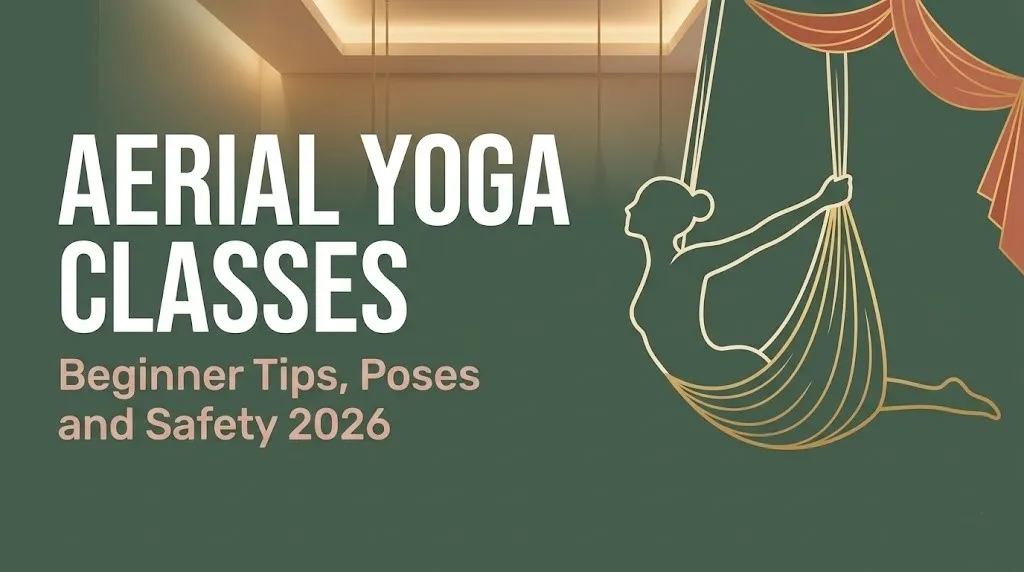
Aerial Yoga Classes: Beginner Tips, Poses and Safety 2026
Aerial yoga classes are structured yoga sessions where a fabric hammock suspended from the ceiling supports the body during poses, inversions, and stretches that would be difficult, impossible, or joint-stressful on a standard mat. The hammock does not make the practice easier; it changes the physical demand in specific ways that benefit some bodies more than others.
That distinction matters more than most class descriptions acknowledge. According to the National Center for Complementary and Integrative Health (NCCIH), yoga in its many forms produces documented improvements in flexibility, balance, and stress reduction across diverse populations, and aerial yoga adds the dimension of spinal decompression through inversion that research in physical therapy literature suggests can temporarily reduce compressive load on lumbar discs.
This guide explains exactly what aerial yoga classes involve, how the hammock changes each pose’s biomechanics, which people benefit most and which should skip it, what a safe studio setup looks like, and how to prepare physically and practically for a first session.
What Are Aerial Yoga Classes?
Aerial yoga classes are yoga sessions conducted with the support of a fabric hammock, typically made from high-strength nylon or polyester tricot material, suspended from a ceiling mount or freestanding rig at heights between two and three feet from the floor.
The hammock, sometimes called an aerial yoga silk or aerial yoga sling, functions as a prop that supports specific body parts during poses rather than bearing the practitioner’s full weight continuously. In most beginner aerial yoga classes, the fabric is used to support the hips in inversions, the hands in low poses, or the entire body in a reclined cocoon position during relaxation.
Aerial yoga is distinct from aerial silks, which is a circus arts discipline requiring upper body strength to climb, wrap, and perform drops on unsupported fabric panels. In aerial yoga, the hammock is rigged at a low height and practitioners rarely leave the ground entirely in beginner sessions.
| Format | Equipment | Height from Floor | Skill Required | Purpose |
|---|---|---|---|---|
| Aerial yoga classes | Low-hung hammock (2-3 ft) | Low to moderate | None to beginner | Yoga poses with hammock support |
| Restorative aerial yoga | Very low hammock (1-2 ft) | Very low | None | Passive supported stretching |
| Aerial silks (circus) | Full-length fabric panels | High (ceiling) | Significant | Acrobatics and performance |
| AntiGravity Yoga | Proprietary hammock system | Low to moderate | None to beginner | Registered trademark method |
The first aerial yoga class most people encounter is genuinely accessible. You do not need flexibility, upper body strength, or any yoga background to participate in a beginner-level session at a well-run studio.
Aerial Yoga vs. Silks Yoga: What Is the Difference?
Aerial yoga uses a wide fabric hammock rigged low for yoga-based movement and support, while silks yoga or aerial silks is a circus arts discipline that uses two vertical fabric panels rigged high for climbing, wrapping, and aerial performance.
This distinction is frequently blurred in marketing, which creates genuine confusion and occasionally real safety problems. A person who books “silks yoga” expecting a gentle hammock experience and arrives at a circus arts class with no prior upper body conditioning is not properly served by that marketing.
The physical demands are categorically different:
- Aerial yoga hammock: Wide, low, used for support and decompression. No climbing. No drops. The practitioner’s hands and feet typically maintain some contact with the floor or the hammock simultaneously.
- Aerial silks (circus): Two narrow fabric panels rigged at ceiling height. Requires grip strength sufficient to support full body weight. Involves wrapping, inverting, and controlled drops. Injury risk is substantially higher for untrained practitioners.
Some studios use the terms interchangeably, which is inaccurate. When booking, it helps to ask specifically whether the class uses a wide hammock rigged below hip height for yoga poses, or narrow panels rigged at ceiling height for climbing. The answer determines whether the class is appropriate for a beginner with no training.
Modification note: If you have any shoulder, wrist, or grip strength limitation, book a hammock-based aerial yoga class specifically, not an aerial silks class. The hammock does not require gripping or bearing full body weight through the hands.
What to Expect in Your First Aerial Yoga Class
In a first aerial yoga class, you can expect a 45 to 75 minute session that begins with basic hammock familiarization, moves through supported standing and seated poses, introduces one or two gentle inversions, and closes with a suspended relaxation in the hammock called the Cocoon.
The first ten minutes of any well-run beginner aerial yoga class are spent learning to trust the hammock. The instructor demonstrates how the fabric supports weight, how to sit and stand in and around it, and how to enter basic positions safely. This familiarization period is not rushed at reputable studios because it is the foundation for everything that follows.
A typical beginner class sequence:
- Hammock introduction: Standing beside the hammock; testing weight and adjustment
- Seated hammock poses: Sitting in the hammock, basic supported stretches
- Standing poses with hammock support: Supported Virabhadrasana I (Warrior I) using the hammock as a hand hold
- Supported inversions: Hips in the hammock at hip crease, gentle forward fold into supported aerial inversion
- Aerial Savasana (Cocoon): Lying fully inside the cocooned hammock for 5 to 10 minutes of suspension
Most students find the Cocoon, the final wrapped position, unexpectedly calming. Being gently suspended with full-body fabric compression activates the same proprioceptive calming response that weighted blankets produce, through consistent pressure on the body’s mechanoreceptors.
Modification note: Anyone with claustrophobia should inform the instructor before class. The Cocoon position can be skipped entirely; the student can instead practice standard Savasana (Corpse Pose) on the mat while others use the hammock.
Key Takeaway: Aerial yoga classes are not circus arts. They use a low-hung hammock as a support tool for yoga poses, making the experience accessible for beginners with no flexibility or strength prerequisites, as long as the contraindications are respected.
Aerial Yoga Hammock: How the Equipment Works
The aerial yoga hammock is a single piece of high-strength fabric, typically 5 to 9 meters in length and approximately 2.8 meters wide, folded in half and suspended from a ceiling mount or freestanding rig to create a sling that adjusts from hip height to floor level.
The fabric used in reputable aerial yoga hammocks is either nylon tricot or polyester tricot: tightly woven, non-stretching synthetic fabrics with load ratings far exceeding the forces generated in a yoga class. Quality aerial yoga hammocks are rated to bear between 300 and 900 kilograms of dynamic load, which is dramatically more than the static body weight of any human practitioner.
The rigging system is where safety actually lives. A hammock made from rated fabric is only as safe as the hardware attaching it to the ceiling:
- Ceiling mount plate: Should be bolted directly into a structural beam or joist, not a drywall ceiling
- Carabiners: Must be rated, locking, and load-tested (usually 25 kN or greater for aerial yoga applications)
- Daisy chains or adjustable rigging: Allow height adjustment between practitioners and class formats
- Point load capacity: The ceiling attachment point should be rated for a minimum of 10 times the expected dynamic load
A freestanding aerial yoga rig (a portable A-frame steel structure) is an alternative for home use or events. Quality freestanding rigs are load-rated and tested, but they must be assembled correctly every time and placed on a non-slip, level surface.
Safety note: Never practice aerial yoga from a ceiling mount that has not been professionally installed and load-tested. Residential ceiling fans and standard drywall anchors are not structural mounting points for aerial yoga.
Key Aerial Yoga Poses for Beginners
The most accessible aerial yoga poses for beginners are the supported standing stretch, the seated hammock fold, the aerial Adho Mukha Svanasana (Downward-Facing Dog), and the Cocoon, all of which use the hammock for support rather than requiring practitioners to bear their full body weight through their arms or grip.
These four poses represent the standard progression in most beginner aerial yoga classes. They build hammock familiarity, trust in the rigging, and body awareness in a supported environment before any inversion is introduced.
Aerial Adho Mukha Svanasana (aerial Downward-Facing Dog):
- Adjust the hammock to hip height while standing
- Turn to face away from the hammock and place the tops of both feet inside the fabric loop
- Walk the hands forward on the floor as you allow the hips to rise
- Form an inverted V-shape with the feet supported in the hammock and hands on the floor
- Spread fingers wide and press through the base of the index fingers to distribute wrist load
- Hold for 3 to 5 breaths, keeping the head between the upper arms
- Walk hands back toward the hammock and stand to exit
This aerial version reduces wrist load compared to the mat pose because the hammock elevation shifts some of the body weight away from the hands. The hamstrings and gastrocnemius still receive the same lengthening stimulus.
Modification note: Anyone with wrist sensitivity can place hands on yoga blocks on the floor during aerial Downward-Facing Dog to reduce wrist extension angle further.
Aerial Yoga Inversions: Benefits and Beginner Safety
Aerial yoga inversions are positions where the hips or head are suspended above the heart level with the hammock supporting the hip crease, allowing a supported inversion without the cervical spine compression of mat-based inversions like Sirsasana (Headstand).
This is one of the most medically relevant distinctions in aerial yoga. A standard mat Sirsasana (Headstand) places approximately 15 to 20 percent of body weight directly through the cervical spine. The aerial equivalent, with the hammock at the hip crease and the head hanging free, eliminates cervical compression entirely while still delivering the circulatory and nervous system effects of inversion.
The inversion does increase intraocular pressure as all inversions do. Research measuring intraocular pressure during yoga inversions, published in the Journal of Alternative and Complementary Medicine, documented pressure increases that are transient and clinically benign for healthy eyes but potentially hazardous for people with glaucoma or ocular hypertension.
Beginner aerial inversion entry:
- Set the hammock to approximately hip crease height while standing
- Sit in the hammock and allow the fabric to support the hips and lower back
- Slowly lean back, keeping the hands holding the hammock beside the hips for control
- Allow the legs to rise as the torso descends, finding an inverted hang with the hammock at the hip crease
- Keep the knees slightly bent initially; arms can reach toward the floor or cross at the chest
- Hold for 3 to 5 breaths, then use the abdominals to curl back upright
- Sit in the hammock for 2 to 3 breaths before standing, allowing blood pressure to normalize
Safety note: Always come out of aerial inversions slowly. Standing immediately from a full inversion creates orthostatic hypotension (a drop in blood pressure upon standing) that can cause dizziness or fainting. Sitting in the hammock for two to three breaths before standing is not optional; it is a physiological safety step.
Key Takeaway: Aerial inversions are safer for the cervical spine than mat headstands because the hammock bears hip weight rather than placing the load through the neck. But the intraocular pressure increase of any inversion makes glaucoma a firm contraindication regardless of how the inversion is supported.
Aerial Yoga Benefits for the Spine and Core
Aerial yoga produces specific benefits for the lumbar spine, thoracic spine, and core stabilizers that differ from mat yoga, primarily because suspension changes gravitational loading on joints and creates opportunities for active traction that standard poses do not.
In the inverted hanging position, gravity works to lengthen the spine rather than compress it. The intervertebral discs, which bear compressive load throughout most waking hours of a person’s life (sitting, standing, walking), experience a temporary reduction in that compression during aerial inversion. This is commonly called spinal decompression, and while the traction forces in aerial yoga are mild compared to clinical mechanical traction devices, the subjective experience of spinal lengthening is consistent across practitioners.
Core strengthening in aerial yoga is a direct result of the instability the hammock introduces. Think of the aerial hammock like a suspension trainer: it reduces the stable base the body has to work from, which forces the transverse abdominis, multifidus, and erector spinae to co-contract continuously to maintain position. This is active core engagement, not passive support.
Documented physical benefits of aerial yoga:
- Spinal decompression during inversions: Temporary reduction in compressive disc loading
- Core activation: Constant stabilization demand from hammock instability
- Shoulder girdle mobility: Hanging and reaching in the hammock opens the pectoralis minor and anterior deltoid
- Hip flexor lengthening: Supported inversions allow gravity to open the iliopsoas complex without lumbar compression
- Improved proprioception: The unstable hammock surface trains balance and body awareness more actively than a stable mat
Aerial Yoga for Back Pain and Spinal Decompression
Aerial yoga is frequently sought by people managing chronic lower back pain, and it can provide relief when practiced carefully, though it is not a treatment and should not be used as a substitute for medical evaluation of specific spinal conditions.
The appeal is straightforward. The inverted hammock position creates gentle axial traction on the lumbar spine. This temporarily increases the space between vertebrae, which reduces the disc bulge pressure that contributes to nerve irritation in certain types of lower back pain. Physical therapists use mechanical traction devices for the same purpose; aerial yoga creates a gentler, body-weight-driven version of this effect.
Research published in Complementary Therapies in Medicine documented that regular yoga practice (across multiple styles) reduced chronic low back pain severity in participants over 12 weeks, with the improvement correlating with consistent spinal mobility work. Aerial yoga’s inversion component adds a decompression dimension that most floor-based styles do not provide.
However, important distinctions apply:
- Appropriate: Chronic postural back tension, muscular lower back pain, stiffness from prolonged sitting
- Requires medical clearance: Lumbar disc herniation, spinal stenosis, spondylolisthesis, recent spinal surgery
- Contraindicated: Acute disc herniation with nerve compression, spinal fracture, severe osteoporosis of the lumbar vertebrae
Modification note: Anyone with a diagnosed lumbar condition should discuss aerial yoga participation with the physician or physical therapist managing their care before booking, specifically because the inversion changes spinal loading in ways that are beneficial for some conditions and harmful for others. The instructor at the studio should also be informed of the condition before class begins.
What Does the Research Say About Aerial Yoga?
The research base for aerial yoga specifically is smaller than for traditional yoga styles, but the available studies and the broader yoga literature provide a credible picture of what aerial practice does for the body.
A study published in the International Journal of Yoga examining practitioners of aerial yoga over an 8-week period found improvements in spinal flexibility, shoulder range of motion, and self-reported wellbeing compared to a non-practicing control group. The inversion component was identified as a contributing factor to the spinal mobility gains, consistent with physical therapy research on traction effects.
The broader literature on inversion-assisted yoga is more developed. According to the National Center for Complementary and Integrative Health (NCCIH), yoga interventions consistently improve flexibility, balance, and psychological wellbeing across diverse populations, and aerial yoga’s unique ability to decompress the spine during inversion adds a physiological mechanism not available in floor-based practice.
What research currently supports about aerial yoga:
- Improved spinal and shoulder flexibility after 6 to 12 weeks of regular practice
- Reduced self-reported anxiety and stress following aerial class sessions
- Core activation levels comparable to or exceeding floor-based yoga sequences, based on electromyographic patterns documented in suspension training research
- Temporary reduction in perceived spinal compression during inversion holds
- Increased practitioner-reported enjoyment compared to floor yoga, which correlates with greater practice adherence over time
What research does not yet support: Specific claims about “detoxification,” permanent disc rehydration, or dramatic therapeutic outcomes for diagnosed spinal pathology. These claims circulate widely in aerial yoga marketing but are not supported by the current evidence base.
Key Takeaway: The research supporting aerial yoga is real but modest in volume. The strongest documented benefits are spinal flexibility gains, core activation, and stress reduction, all of which are consistent with what the biomechanics of the practice would predict.
Who Should Not Do Aerial Yoga: Safety and Contraindications
Aerial yoga is contraindicated for people with glaucoma, uncontrolled high blood pressure, recent eye surgery, severe osteoporosis, active vertigo disorders, and during the second and third trimester of pregnancy, because the inverted positions in aerial yoga increase intraocular pressure and intracranial blood flow in ways that are unsafe for these conditions.
This is not a brief list to skim. Understanding why each contraindication exists helps practitioners make informed decisions about their own bodies rather than relying on a studio’s intake form to do all the thinking.
Contraindications explained:
| Condition | Why Aerial Yoga Is Contraindicated | What Is Safe Instead |
|---|---|---|
| Glaucoma | Inversions increase intraocular pressure, worsening optic nerve damage risk | Non-inverted floor yoga; restorative yoga |
| Uncontrolled hypertension | Inversions increase intracranial pressure; risk of cardiovascular event | Gentle seated yoga with physician guidance |
| Recent eye surgery (any) | Pressure changes during inversion risk surgical site disruption | Wait for medical clearance, typically 3 to 6 months |
| Severe osteoporosis | Fabric pressure on brittle bones; fall risk if hammock slips | Chair yoga; restorative yoga on mat |
| Active vertigo | Inversion dramatically worsens vestibular symptoms | Seated balance-focused yoga |
| 2nd and 3rd trimester pregnancy | Inversions are not recommended; hammock compression on abdomen | Prenatal yoga on mat; first trimester with caution only |
| Acute disc herniation with radiculopathy | Traction can worsen nerve compression in some presentations | Physical therapy first; return to yoga under medical guidance |
| Recent shoulder surgery | Hanging and supporting body weight risks surgical repair | Gentle seated yoga; return to aerial after full surgical clearance |
Safety note: This table represents general guidance, not personalized medical advice. Anyone with a condition on this list should discuss aerial yoga participation specifically with the treating specialist before booking, because some conditions are absolute contraindications and others are conditional depending on severity and treatment status.
What to Wear to Aerial Yoga and How to Prepare
Wear fitted, full-coverage clothing that covers the backs of the knees and the underarms, because the hammock fabric creates friction burns on bare skin in these areas during inversions and transitions.
This is the single most consistently reported first-timer mistake. Every aerial yoga instructor has watched a new student arrive in shorts and a sleeveless top and spend half the class adjusting to avoid fabric on bare skin. Tight yoga leggings and a form-fitting long-sleeve or fitted T-shirt solve the problem completely.
Clothing checklist for aerial yoga:
- Leggings: Full-length, past the knee at minimum. Capri length works if it covers the back of the knee in bending positions.
- Top: Form-fitting, long enough to stay tucked during inversions. A fitted long-sleeve is ideal. Avoid loose or draped fabrics that fall over the face in inverted positions.
- No zippers, buttons, or metal hardware: These damage the hammock fabric and create pressure points on the skin.
- No jewelry on wrists, fingers, or neck: Hardware catches in the hammock and causes both injury and fabric damage.
- Bare feet: Aerial yoga is practiced barefoot. Grip socks are optional but not required.
What to do before your first class:
- Eat a light meal at least 2 hours before the class. Inversions with a full stomach create nausea reliably.
- Arrive 10 to 15 minutes early to speak with the instructor about any health conditions or concerns.
- Inform the instructor of any shoulder, wrist, neck, or back issues before class begins.
- Hydrate normally beforehand. Avoid heavy hydration immediately before class, as lying inverted with a full bladder is uncomfortable.
Aerial Yoga for Seniors: Accessible Modifications
Aerial yoga for seniors is most safely practiced in low-impact, non-inverted formats where the hammock functions as a support tool for standing balance, seated stretches, and gentle restorative holds rather than as an inversion device.
The American College of Sports Medicine recommends that adults over 65 engage in flexibility and balance training at least two days per week. Aerial yoga, in its most accessible format, addresses both simultaneously. The hammock provides a stable handhold for standing balance poses, allows seated forward folds without floor-level transition demands, and supports the body in gentle hip and shoulder openers that would otherwise require mat floor work.
The modifications that make aerial yoga appropriate for most seniors:
- Skip all full inversions: The cardiovascular and vestibular risks of inversion increase with age. A senior practitioner can receive all the core, flexibility, and proprioceptive benefits of aerial yoga without any position where the head drops below the heart.
- Use the hammock at standing height as a barre: Holding the hammock at hip height for standing balance poses gives the same safety benefit as a ballet barre.
- Limit sessions to 45 minutes: Fatigue-related errors are more likely in longer sessions with an unfamiliar prop.
- Inform the instructor of balance conditions or vestibular issues before class: These affect safe hammock entry and exit as much as the poses themselves.
Safety note for seniors with osteoporosis: The hammock fabric, when rigged for seated or standing support rather than inversion, does not create the bone compression risks associated with twisting or forward folding on a mat. However, seniors with diagnosed osteoporosis should seek a studio that specifically offers a seniors or therapeutic aerial yoga format with appropriately trained instructors.
Restorative Aerial Yoga: A Gentler Approach to the Hammock
Restorative aerial yoga is a slow, passive practice format where the hammock is rigged very low or at floor level to support the body in long-held, gravity-assisted stretches with no active movement, no inversions, and complete muscular release as the goal.
This format is the closest aerial yoga comes to Restorative yoga on a mat. The hammock in restorative aerial yoga functions like a bolster or blanket: it holds the body in a position and allows gravity and time to produce the stretch, rather than muscular effort or dynamic movement. Sessions are slow, warm, and quiet.
Restorative aerial yoga is particularly useful for:
- People recovering from physical or emotional exhaustion who want supported stretching without muscular effort
- Practitioners with chronic tension in the thoracic spine who benefit from the gentle traction that a slightly elevated hammock creates when lying across it
- Beginners who want to experience the hammock in a very low-risk format before attempting a standard aerial yoga class
- Anyone managing anxiety or insomnia, because the cocoon effect of the hammock activates parasympathetic nervous system dominance more completely than lying on a flat mat
A restorative aerial yoga session typically includes long holds (three to ten minutes per position) in supported backbends over the hammock, seated forward folds with the hammock cradling the torso, side-lying supported stretches, and an extended Cocoon at the close of the session.
Modification note: Restorative aerial yoga is appropriate for many people who cannot practice standard aerial yoga, including those with mild hypertension (without full inversions), mild vertigo, and general mobility limitations, but the contraindications listed earlier still apply to this format’s hammock positions.
Aerial Yoga Equipment: What a Safe Studio Needs
A safe aerial yoga studio requires professionally installed ceiling mounts or rated freestanding rigs, load-certified hammock fabric and hardware, and instructors with verifiable aerial yoga teaching credentials from a recognized training program.
Most yoga students never think to evaluate the safety of the physical setup before a class. In aerial yoga, this evaluation is genuinely worth doing, because the equipment is structural and the consequences of a failure are immediate and potentially serious.
What to look for or ask before booking:
- Ceiling mount type: Ask whether mounts are bolted into structural beams. Drywall anchors are not appropriate. A reputable studio will answer this question without hesitation.
- Hammock load rating: Quality aerial yoga hammocks from reputable manufacturers (such as Aerial Essentials, Uplift Active, or similar companies) provide load ratings. Ask what hardware and fabric brand the studio uses.
- Instructor certification: Yoga Alliance registered aerial yoga teacher training programs and proprietary certifications like AntiGravity Yoga teacher certification are the main credential systems. Ask what training your instructor has completed.
- Class size: Aerial yoga classes require individual instructor attention during inversions. Classes larger than 8 to 10 students per instructor reduce the safety margin for new students.
- Equipment maintenance schedule: Hammocks should be inspected for wear and hardware should be checked before each class. Ask how frequently equipment is inspected.
For home aerial yoga setup: A freestanding aerial yoga stand is the safest home option. Ceiling-mounted home systems require professional installation by a structural engineer or qualified rigger and are not appropriate as DIY projects.
Key Takeaway: A safe aerial yoga experience depends as much on the studio’s rigging quality and the instructor’s credentials as it does on what you wear or how flexible you are. Asking two questions before you book, “What are the ceiling mounts rated to?” and “What aerial yoga certification does my instructor hold?” takes thirty seconds and tells you most of what you need to know.
Frequently Asked Questions About Aerial Yoga Classes
What exactly are aerial yoga classes and what happens in them?
Aerial yoga classes are yoga sessions where a fabric hammock suspended from the ceiling supports the body during poses, stretches, and inversions.
A typical beginner class lasts 45 to 75 minutes, moving from basic hammock familiarization through supported poses, gentle inversions, and a final suspended relaxation called the Cocoon.
No yoga experience or special flexibility is required for a beginner aerial yoga class at a reputable studio.
Is aerial yoga good for beginners with no yoga experience?
Yes, aerial yoga is accessible to beginners when practiced at a beginner-level class with a qualified instructor and appropriate class size.
The hammock provides support that can make certain positions more accessible than their mat equivalents, particularly for people who struggle with wrist-bearing poses or floor-level transitions.
The one firm requirement is disclosing any health conditions to the instructor before class, because the contraindication list for aerial yoga is specific and important.
What is the weight limit for aerial yoga?
Most aerial yoga hammocks and properly installed rigs are rated to support 300 kilograms or more of dynamic load, which far exceeds the weight of any individual practitioner.
The limiting factor is not the hammock itself but the ceiling mount installation: a correctly installed structural ceiling mount, not a drywall anchor, is required for any aerial yoga setup.
Reputable aerial yoga studios do not impose a weight limit based on practitioner body weight because the equipment is rated well above human weight ranges when properly installed.
Is aerial yoga good for back pain?
Aerial yoga can reduce chronic lower back tension through gentle spinal decompression during inversions, particularly for postural back pain caused by prolonged sitting or standing.
It is not appropriate for all back conditions: acute disc herniation, spinal stenosis, recent spinal surgery, and fractures require medical evaluation before any aerial yoga participation.
The appropriate step for anyone with a diagnosed spinal condition is to discuss the specific format of aerial yoga (particularly whether it includes inversions) with the treating physician or physical therapist before booking.
What should I wear to my first aerial yoga class?
Wear full-length, fitted leggings and a form-fitting top with no metal hardware, zippers, or buttons.
The backs of the knees and underarms are the areas most likely to experience fabric friction on bare skin during inversions, so coverage in these areas is the priority.
Avoid loose or draped clothing that falls over the face in inverted positions, and remove all wrist and finger jewelry before the class begins.
Book Your First Class Prepared, Not Just Excited
Before you book, take five minutes to confirm that the studio uses professionally installed ceiling mounts, rated hardware, and an instructor with verifiable aerial yoga training. These three criteria separate studios worth your time and trust from those that are not.
Wear full-length leggings, skip the metal jewelry, and eat your last meal at least two hours before class. Arrive ten minutes early and tell the instructor honestly about any neck, shoulder, back, or eye conditions.
Then get in the hammock. Let it take your weight. The spinal lengthening you feel in your first supported inversion will explain immediately why people come back.