Zen Rabbit Yoga: Full Rabbit Pose Benefits Guide 2026
Zen rabbit yoga combines the grounding philosophy of Zen-inspired mindfulness with Sasangasana (Rabbit Pose), a deep spinal flexion posture that targets the entire length of the back body. Whether you encountered the name through a local studio or a social media post, this guide gives you the full picture.
Yoga’s mental health applications have drawn growing research attention. The National Center for Complementary and Integrative Health (NCCIH) reports that Americans practicing yoga cite stress reduction and improved mental well-being among the top reasons for maintaining their practice. Poses like Sasangasana, which activate the parasympathetic nervous system through deep forward folding, are among the most studied for this purpose.
Here you’ll find a clear explanation of what zen rabbit yoga means, how Rabbit Pose works biomechanically, who it helps most, and how to practice it safely at home. You’ll also find a complete warm-up sequence, detailed modification guidance, and honest safety information about who should skip this posture entirely.
What Is Zen Rabbit Yoga?
Zen rabbit yoga is a yoga practice philosophy and sometimes a studio brand name that centers on mindful, grounded movement with Sasangasana (Rabbit Pose) as a signature posture.
The term blends two concepts. “Zen” refers to the meditative, present-moment awareness tradition rooted in Buddhist practice. “Rabbit” refers to the yoga posture Sasangasana, which resembles a rabbit curled in on itself. Together, the phrase describes an approach to yoga that emphasizes inward focus, gentle intensity, and nervous system awareness.
Some yoga studios have adopted the name “Zen Rabbit Yoga” as their brand. In that context, you’ll typically find classes spanning Hatha, Yin, and Restorative yoga styles, all sharing a common thread of slow, intentional movement and breath-led practice.
Pose Tip:
- Zen rabbit yoga is accessible to most fitness levels when taught with proper modifications
- The practice emphasizes breath awareness and spinal health over advanced flexibility
- Studios using this name typically offer beginner-friendly class options alongside intermediate levels
What Is Zen Rabbit Yoga as a Practice?
As a practice, zen rabbit yoga integrates breath-centered movement, mindful transitions between postures, and an emphasis on spinal health and nervous system regulation.
What distinguishes this approach from a generic yoga flow is the deliberate pace. Postures are held longer than in a typical Vinyasa class. Transitions happen with full breath awareness. The rabbit pose itself, with its inward curl and spinal traction, becomes a physical metaphor for turning attention inward.
Many practitioners drawn to this practice describe it as meeting the needs of both the body and the mind in a single session. That overlap is not accidental. According to a study published in the Journal of Alternative and Complementary Medicine, yoga practices combining sustained posture holds with breath regulation showed greater reductions in self-reported anxiety compared to faster-paced movement practices.
| Practice Element | Description | Why It Matters |
|---|---|---|
| Posture hold duration | Longer than Vinyasa; 1 to 5 minutes per pose | Targets deep connective tissue and nervous system |
| Breath focus | Ujjayi or natural breath throughout | Activates parasympathetic response |
| Transition style | Slow, deliberate, breath-led | Reduces mental chatter between poses |
| Class tone | Quiet, inward, meditative | Supports focus and present-moment awareness |
| Core posture | Sasangasana (Rabbit Pose) | Spinal traction and deep back body stretch |
Sasangasana Rabbit Pose Explained
Sasangasana (Rabbit Pose) is a kneeling forward fold in which the practitioner sits back on the heels, grips the heels with both hands, and lifts the hips while lowering the crown of the head toward or onto the mat.
The result is a deep curve through the entire spine from the cervical (neck) region through the thoracic (mid-back) and lumbar (lower back) regions. This is one of the deepest spinal flexion postures in yoga. Unlike Balasana (Child’s Pose), which is a passive resting position, Sasangasana creates active traction through the posterior chain by using the arm grip and hip lift simultaneously.
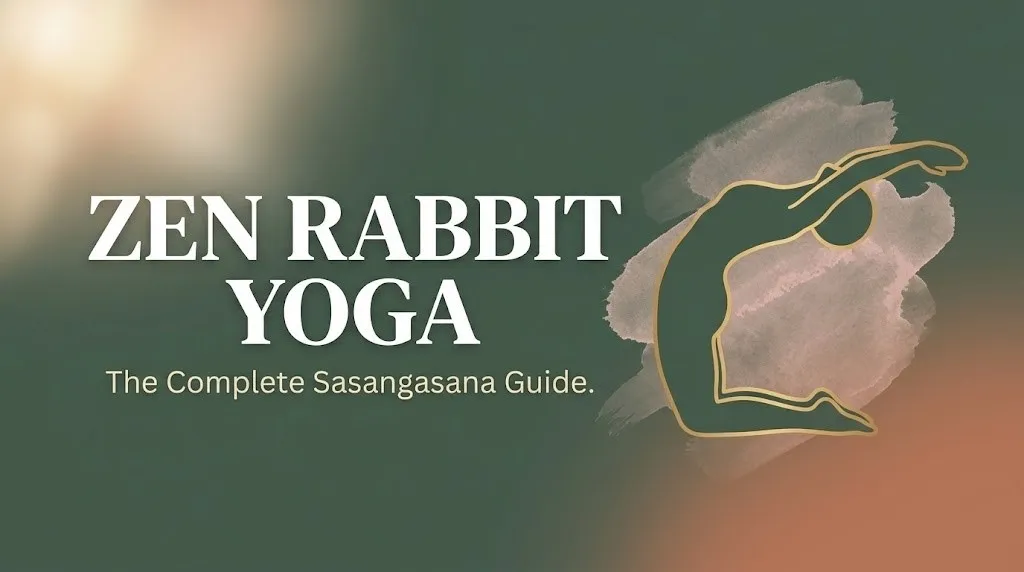
The pose appears across multiple yoga traditions. In Hatha yoga, it is used as a spinal decompression tool. In Yin yoga, it is held passively for extended periods to target the thoracolumbar fascia and the posterior spinal ligaments. In Bikram (26 and 2) yoga, Sasangasana is the 25th posture in the sequence and is practiced in a heated room with specific alignment cues focused on maintaining crown-of-head contact with the floor.
The name in Sanskrit reflects the visual: a rabbit in its natural resting position, ears tucked, back rounded, body compact and still.
Key Takeaway: Zen rabbit yoga is not just a studio name. It describes a slow, breath-led yoga practice built around the deep spinal flexion of Sasangasana, designed to calm the nervous system and decompress the spine.
Zen Yoga Philosophy and Approach
Zen philosophy, applied to yoga, means removing the goal and focusing entirely on the present moment of the practice.
In practical terms, this means slowing down. It means choosing depth of attention over range of motion. A Zen-influenced yoga class is not concerned with how far you fold or how perfect your alignment looks from the outside. The attention goes inward: toward breath sensation, subtle body awareness, and the quality of presence you bring to each posture.
This approach has measurable effects. The NCCIH notes that mindfulness-based practices, including mindful movement, are associated with reduced activation of the body’s stress response, lower reported pain sensitivity, and improved sleep quality in adults practicing consistently over 8 weeks.
For people who feel overwhelmed by fast-paced fitness culture, a Zen-inspired yoga framework offers a genuinely different relationship with physical practice. You’re not performing. You’re attending.
Key principles of a Zen yoga approach include:
- Non-striving: Moving toward a pose without forcing the outcome
- Present-moment focus: Attending to breath and sensation, not the final shape
- Impermanence: Accepting that each practice feels different and that is the point
- Simplicity: Fewer poses held longer rather than many poses rushed through
Rabbit Pose Yoga Benefits for Body and Mind
Sasangasana (Rabbit Pose) offers documented physical and neurological benefits when practiced with correct technique and appropriate frequency.
Physical benefits supported by yoga research and anatomy include:
- Passive lengthening of the erector spinae along the entire spine
- Decompression of intervertebral discs, particularly in the thoracic and lumbar regions
- Stretching of the trapezius and rhomboids across the upper back
- Improved circulation to the paraspinal muscles through sustained compression and release
- Gentle traction of the cervical spine when the pose is performed with correct head placement and heel grip
Mental and neurological benefits include reduced cortisol levels associated with forward-folding postures, which trigger a parasympathetic nervous system response. Think of it like folding your body inward the way you naturally curl up when you feel safe and relaxed. That physical position sends a signal to your nervous system that matches the state you’re trying to create.
A study published in Complementary Therapies in Medicine found that yoga practices incorporating sustained forward folds and breath regulation were associated with statistically lower scores on standardized anxiety measures after 8 weeks of twice-weekly practice.
Rabbit Pose for Spinal Flexibility and Back Pain
Rabbit Pose targets spinal flexion mobility, which is the spine’s capacity to round forward through its full range.
Most people with desk-based jobs spend hours in a position that compresses the front of the spinal discs and shortens the hip flexors. The back body, including the erector spinae and thoracolumbar fascia, becomes chronically tight. Sasangasana directly counters this by placing the spine in the opposite position, creating space along the entire posterior chain.
For people with general, non-specific low back stiffness, regular practice of supported spinal flexion postures is commonly recommended by physical therapists as part of a mobility maintenance routine. That said, spinal flexion postures are not appropriate for all back conditions. People with lumbar disc herniation or spinal stenosis should speak with a physical therapist before including Rabbit Pose in their practice, since flexion can aggravate both conditions in certain presentations.
The American College of Sports Medicine recommends that flexibility training, including yoga-based postures targeting spinal mobility, be performed at least 2 to 3 days per week for adults seeking to maintain or improve range of motion. Sasangasana fits naturally into that frequency when practiced as part of a broader yoga sequence.
How to Do Rabbit Pose Step by Step
Sasangasana (Rabbit Pose) requires careful attention to neck and head placement before the hips lift. Read the full safety guidance in the contraindications section before attempting this pose for the first time.
To practice Sasangasana:
- Begin in Vajrasana (Thunderbolt Pose) or a simple kneeling position, sitting back on your heels. Tops of feet flat on the mat.
- Place your hands on your heels behind you. Thumbs wrap around the outer edge of the foot. Fingers hold the inner arch or heel.
- Tuck your chin toward your chest. Lower the crown of your head toward the mat in front of your knees. The top of the head, not the forehead, makes contact.
- Inhale fully. On the exhale, lift your hips up and back, away from your heels. Your arms extend and straighten as the hips rise.
- Keep your grip firm on the heels throughout. The traction from the grip is what protects the neck. Do not release mid-pose.
- Hold for 3 to 5 breath cycles. Keep the breath slow and steady. Avoid holding the breath.
- To release: lower the hips back to the heels first, then gently lift the head last. Never lift the head while the hips are still raised.
- Rest in Balasana (Child’s Pose) for 3 to 5 breaths before continuing.
Safety caution: If any tingling, numbness, or sharp sensation occurs in the neck or head, release immediately using the correct exit sequence above.
Key Takeaway: The traction created by gripping the heels and lifting the hips is what makes Rabbit Pose both effective and safe. Releasing the heel grip mid-pose removes that protection and places the cervical spine at risk.
Rabbit Pose Muscles Engaged and Anatomy
Sasangasana (Rabbit Pose) works the body primarily through passive lengthening of the posterior chain under a unique form of self-traction.
The primary structures targeted:
- Erector spinae: The long muscles running parallel to the spine are placed in a full elongated position. This creates a sustained stretch along the entire back.
- Trapezius and rhomboids: These upper back muscles are passively stretched as the thoracic spine rounds forward and the shoulder blades separate.
- Scalenes and sternocleidomastoid: These neck flexor muscles are under load as the cervical spine flexes and the weight of the head is managed.
- Thoracolumbar fascia: The broad sheet of connective tissue across the lower back receives a sustained stretch during the full hip-lifted position.
- Hip flexors and gluteus maximus: These are shortened and passively compressed in the kneeling position, receiving a secondary effect from the posture.
The joints most involved are the cervical, thoracic, and lumbar spinal segments in flexion, the knee joints in deep flexion under bodyweight, and the shoulder joints in a slightly internally rotated position as the arms reach back.
| Structure | Action in Pose | Sensation Location |
|---|---|---|
| Erector spinae | Passively lengthened | Full length of back |
| Trapezius and rhomboids | Passively stretched | Upper and mid back |
| Thoracolumbar fascia | Sustained stretch | Lower back |
| Cervical flexors | Under load | Back of neck |
| Knee joint | Deep flexion | Front of knee |
Rabbit Pose Alignment Cues and Common Mistakes
The single most common alignment error in Sasangasana (Rabbit Pose) is placing weight on the top of the head rather than using the heel grip to create traction.
When the hands release or the grip is too loose, the body’s weight presses down through the cervical vertebrae. This places compressive load on the neck, exactly the opposite of the decompressive traction the pose is designed to create. The arms must be actively engaged throughout the entire hold.
Common mistakes and their corrections:
- Mistake: Knees splaying wide during the pose. Correction: Keep knees hip-width apart, no wider than the mat lines if possible.
- Mistake: Forehead, not crown, contacts the floor. Correction: Tuck the chin more before lowering to ensure the top of the head is the contact point.
- Mistake: Hips don’t fully lift. Correction: Actively press the hips up and away from the heels as you exhale into the pose.
- Mistake: Breath is held throughout. Correction: Maintain slow, steady breathing. If you cannot breathe comfortably, the pose depth or duration should be reduced.
- Mistake: Head is lifted before hips lower on exit. Correction: Always lower hips to heels first, then slowly lift the head to neutral.
Pose Tip:
- Place a folded blanket under the knees to reduce pressure on the kneecaps during the kneeling base
- Wrap a strap around the heels before entering if gripping the heels directly is not accessible
- Keep the chin tucked throughout the entire hold, not just at entry
Rabbit Pose Modifications and Props for Beginners
Beginners should approach Sasangasana (Rabbit Pose) with prop support from the first session, not after the first attempt fails.
The most practical modification is using a yoga strap looped around the heels. Hold one end of the strap in each hand before entering the pose. This extends your reach without requiring deep shoulder flexibility or a firm heel grip. As hip mobility and grip strength develop, the strap can be shortened progressively over weeks.
Props and modifications that support beginner practice:
- Folded blanket under the knees: Reduces pressure on the kneecaps. Essential for anyone with sensitive or arthritic knees.
- Yoga strap around the heels: Replaces direct heel grip for those with limited shoulder range or smaller hands.
- Yoga block under the forehead: For practitioners who cannot lower the head to the floor without strain, a block raises the floor to meet them. This reduces the depth of the forward fold while maintaining the spinal shape.
- Reduced hip lift: Instead of fully extending the hips away from the heels, lift only 30 to 50 percent of the full range. This still creates spinal flexion without the full cervical load.
- Chair-adapted version: Sit at the front edge of a chair, hinge forward from the hips, and let the head hang toward the knees with hands resting on the shins. This mimics the spinal rounding without any floor-based kneeling.
Yoga Alliance teacher training guidelines recommend that instructors offer at least two modification options for any pose with significant joint loading. Rabbit Pose qualifies on both neck and knee grounds.
Key Takeaway: A yoga strap looped around the heels is the single most effective beginner modification for Rabbit Pose. It maintains the integrity of the traction mechanism without requiring a grip that many new practitioners cannot sustain.
Rabbit Pose for Seniors
Seniors can practice a version of Sasangasana (Rabbit Pose), but the standard floor-based posture requires careful assessment before inclusion in any senior yoga practice.
According to research published in Complementary Therapies in Medicine, gentle yoga adapted for adults over 65 improved self-reported spinal mobility, reduced lower back discomfort, and supported better postural awareness when practiced at least twice weekly. Seated and supported variations of spinal flexion postures contributed meaningfully to these outcomes.
For seniors, the chair-adapted version described in the modifications section is typically the most appropriate starting point. It delivers the spinal rounding and upper back stretch without requiring deep knee flexion, floor kneeling, or cervical loading.
Seniors should avoid the standard Sasangasana if they have:
- Osteoporosis or low bone density: Spinal flexion under load increases fracture risk at the thoracic vertebrae in people with compromised bone density. A seated forward fold with hands on thighs is a safer alternative.
- Knee replacement or severe knee arthritis: Deep kneeling flexion places stress on the knee joint that may not be appropriate post-surgery.
- Cervical spondylosis or disc degeneration: The neck flexion in Rabbit Pose is contraindicated when cervical discs are already compromised.
- Balance concerns: Getting up from the floor after Rabbit Pose requires core control and balance. Practice near a wall or with a teacher present.
Rabbit Pose Neck Safety and Contraindications
Neck safety is the primary concern in Sasangasana (Rabbit Pose), and it is not adequately addressed in most online yoga content.
The cervical spine is in a full flexion position during this pose, with the crown of the head contacting or approaching the floor. When practiced correctly, the heel grip and hip lift create a gentle traction that decompresses the cervical vertebrae. When practiced incorrectly, compressive force is applied to those same vertebrae. The difference is entirely in the technique.
Rabbit Pose is contraindicated for:
- Cervical disc herniation or bulging disc: Flexion under load can increase intradiscal pressure and aggravate nerve root symptoms. Anyone experiencing neck pain radiating into the arms should not attempt this pose without clearance from a spine specialist.
- Osteoporosis affecting the thoracic or cervical spine: Bone fragility combined with spinal flexion under any load creates fracture risk.
- Recent whiplash or cervical spine injury: The neck must be fully healed and cleared before any flexion-based loading.
- Glaucoma or elevated intraocular pressure: The inverted head position in Rabbit Pose increases intraocular pressure temporarily. This is relevant for anyone with a diagnosed eye pressure condition.
- Uncontrolled high blood pressure: Any posture with significant head-below-hips positioning warrants medical clearance for people with hypertension.
- Vertigo or inner ear conditions: The position change and head inversion can trigger dizziness in susceptible individuals.
If pain or tingling occurs in the neck, head, or arms during the pose, exit immediately using the correct sequence: lower hips to heels first, then slowly raise the head.
Rabbit Pose vs Child’s Pose
Sasangasana (Rabbit Pose) and Balasana (Child’s Pose) are both forward-folding kneeling postures, but they differ significantly in purpose, intensity, and safety profile.
Child’s Pose is passive and restorative. The forehead rests on the mat, the arms extend forward or rest alongside the body, and the spine rounds gently without any active traction. It is appropriate for nearly all yoga practitioners, including most people with injuries, and is commonly used as a resting posture during any style of class.
Rabbit Pose is active and specific. The heel grip, the hip lift, and the chin-tucked head position create deliberate spinal traction. It requires more preparation, more body awareness, and more caution. It is not a resting posture. It is a targeted intervention for spinal mobility and nervous system regulation.
| Feature | Sasangasana (Rabbit Pose) | Balasana (Child’s Pose) |
|---|---|---|
| Spinal position | Deep active flexion with traction | Gentle passive rounding |
| Head placement | Crown of head on mat | Forehead on mat |
| Arm position | Gripping heels behind the body | Extended forward or alongside body |
| Intensity | Moderate to high | Low |
| Appropriate for beginners | With modifications and guidance | Yes, generally |
| Safe for most neck conditions | No | Often yes |
| Used as resting posture | No | Yes |
| Target benefit | Spinal traction and decompression | Gentle release and rest |
Both postures have a place in a well-rounded yoga sequence. Child’s Pose serves as a bookend and a reset. Rabbit Pose serves as an active therapeutic intervention.
Key Takeaway: Child’s Pose and Rabbit Pose look similar from a distance but serve completely different functions. Never substitute one for the other in a therapeutic context without understanding the difference in spinal load and safety requirements.
Rabbit Pose in Yin Yoga and Restorative Practice
In Yin yoga, Sasangasana (Rabbit Pose) is held passively for extended durations, typically 2 to 5 minutes, to target the deep connective tissue of the posterior spine.
Yin yoga operates on the principle that slow, sustained loading of fascia and ligaments creates greater long-term mobility gains than dynamic stretching. The thoracolumbar fascia, one of the densest connective tissue sheets in the body, responds specifically to this kind of sustained, low-load stretching. Rabbit Pose is one of the few postures that can load this structure from a kneeling position, making it a Yin yoga staple.
In Restorative yoga, the pose is modified substantially. The forehead may rest on a block rather than the crown of the head on the floor, and the hips may not fully lift. The goal shifts from active traction to passive release. A bolster under the torso can provide additional support for practitioners who need more ground contact.
The International Journal of Yoga has published findings indicating that Yin-style yoga practice with hold durations of 2 minutes or more per posture produced greater improvements in posterior chain flexibility over 6 weeks compared to shorter dynamic stretching protocols.
Pose Tip:
- In Yin practice, skip the heel grip and instead rest the arms alongside the body or forward. This reduces active effort and allows the body to release passively.
- Use a bolster under the chest for Restorative Rabbit to fully support the torso weight
- A folded blanket under the knees remains essential in all versions of this posture
Zen Rabbit Yoga Warm-Up Sequence and Home Practice Flow
A complete zen rabbit yoga home practice begins well before Sasangasana (Rabbit Pose) appears in the sequence.
The spine needs to be warmed through its full range before entering any deep flexion posture. Cold connective tissue has less elasticity and greater injury risk. A 15 to 20 minute warm-up that moves through extension, lateral flexion, and rotation before arriving at deep forward folds is the standard recommendation among yoga teachers and physical therapists who work with spinal health.
A practical 40-minute zen rabbit yoga home sequence:
- Sukhasana (Easy Pose) with Ujjayi breath: 2 minutes. Establish breath rhythm before movement.
- Bitilasana Marjaryasana (Cat-Cow Pose): 10 slow cycles. Warms the spine through extension and flexion.
- Adho Mukha Svanasana (Downward Facing Dog): Hold for 5 breaths. Lengthens the posterior chain and warms the shoulders.
- Balasana (Child’s Pose): 1 to 2 minutes. Establishes the kneeling shape and tests current hip and knee comfort.
- Uttanasana (Standing Forward Fold): 1 minute. Warms the hamstrings and lower back before kneeling work.
- Vajrasana (Thunderbolt Pose) with neck rolls: 1 minute. Prepares the cervical spine for the flexion ahead.
- Sasangasana (Rabbit Pose): 3 to 5 breath cycles. Full pose or appropriate modification.
- Balasana (Child’s Pose): 1 to 2 minutes as immediate counter-stretch.
- Setu Bandha Sarvangasana (Bridge Pose): 5 breaths. Counter-pose in spinal extension to balance the flexion work.
- Viparita Karani (Legs Up the Wall Pose): 3 to 5 minutes. Calms the nervous system and encourages venous return.
- Savasana (Corpse Pose): 5 to 7 minutes. Non-negotiable. The integration period is part of the practice.
This sequence moves from breath establishment through joint preparation, arrives at the target posture, and closes with counter-poses and rest. That arc is what makes a zen rabbit yoga practice different from simply dropping into Rabbit Pose cold and hoping for the best.
Frequently Asked Questions About Zen Rabbit Yoga
What is zen rabbit yoga?
Zen rabbit yoga is a yoga practice approach that combines Zen-inspired mindfulness with Sasangasana (Rabbit Pose) as a central posture.
It emphasizes slow, breath-led movement, longer hold durations, and inward attention rather than physical performance.
The name is also used by yoga studios whose class offerings reflect this philosophy.
Is rabbit pose safe for people with neck problems?
Rabbit Pose is generally not safe for people with cervical disc herniation, cervical spondylosis, or recent neck injuries.
The pose places the cervical spine in flexion under a degree of load, which can aggravate disc and nerve root conditions.
Anyone with a diagnosed cervical spine condition should work with a spine specialist or physical therapist before attempting Sasangasana.
What is the difference between rabbit pose and child’s pose?
Rabbit Pose creates active spinal traction by gripping the heels and lifting the hips, making it an intentional therapeutic posture.
Child’s Pose is a passive resting position where the spine rounds gently without active load or traction.
They look similar but serve entirely different purposes in a yoga sequence.
How long should you hold rabbit pose?
Most yoga teachers recommend holding Rabbit Pose for 3 to 5 breath cycles as a starting point, roughly 20 to 40 seconds.
In Yin yoga, the pose may be held for 2 to 5 minutes using a modified, passive version without active heel grip.
Build duration gradually and release immediately if any neck, head, or arm sensation develops.
Can beginners do rabbit pose?
Beginners can practice a modified version of Rabbit Pose with appropriate props and teacher guidance.
Using a yoga strap around the heels and reducing the height of the hip lift makes the posture accessible while maintaining its essential shape.
Beginners with any neck concern, knee sensitivity, or high blood pressure should begin with the chair-adapted version or Child’s Pose instead.
The most practical thing you can take from this guide is simple: start with the warm-up. Rabbit Pose is not a pose you walk up to cold. The Cat-Cow, the Child’s Pose hold, the standing forward fold: those ten minutes of preparation are what make Sasangasana feel spacious instead of strained.
Try the home sequence above three times this week. Use a strap for the heel grip if you need it. Notice how the spine feels in Savasana after a well-prepared Rabbit Pose.
That quality of attention, preparation, purpose, and rest, is exactly what zen rabbit yoga means in practice.