Folk Yoga: What It Is, Who It’s For, and How to Start
Folk yoga is an accessible, community-centered approach to yoga practice that strips away studio formality and prioritizes movement for every body type, age, and experience level. If you have been confused by the term, you are not alone: even within yoga communities, “folk yoga” means different things to different teachers, and this article gives you the clearest, most practical explanation available.
The National Center for Complementary and Integrative Health reports that yoga is practiced by more than 36 million Americans, yet barriers including cost, body image concerns, and perceived complexity keep many people from ever trying it. Folk yoga emerged specifically to address those barriers, drawing on yoga’s oldest, most accessible roots rather than its most performance-oriented modern expressions.
This article covers what folk yoga is and where it comes from, how it compares to conventional studio yoga, what poses and breathing techniques define it, who benefits most, and how to build a genuine home practice starting today.
Folk Yoga: The Practice Behind the Term
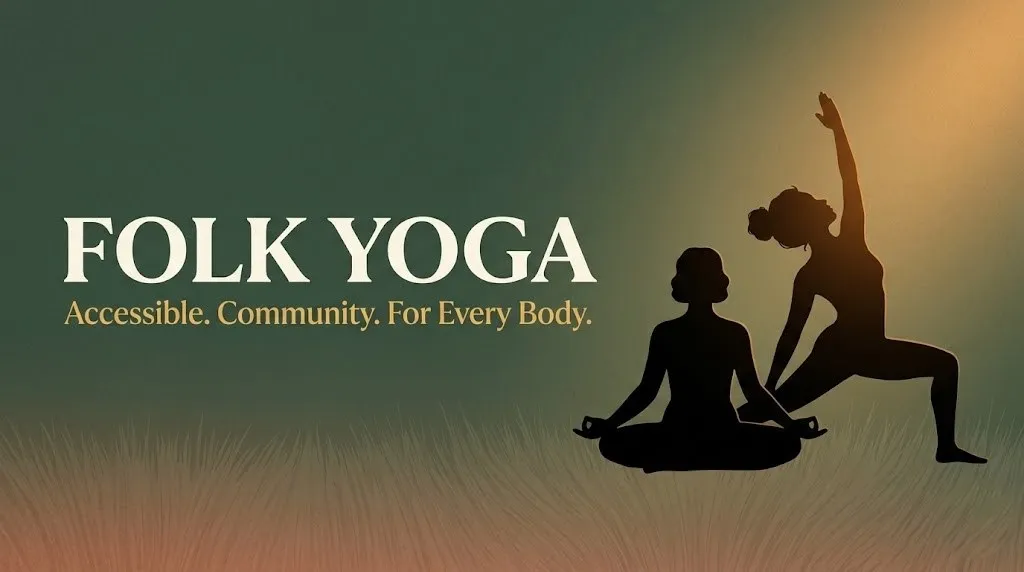
Folk yoga is a community-rooted, accessibility-first approach to yoga that emphasizes participation over performance, tradition over trend, and inclusion over exclusivity. It is not a single proprietary method with a fixed curriculum. Instead, it describes a philosophy of practice: yoga made available to people regardless of their body size, flexibility level, income, or cultural background.
The word “folk” carries weight here. In music, folk traditions belong to the community, not to a single composer or institution. Folk yoga borrows that same logic. The practice is not owned by a brand or a celebrity teacher. It lives in community centers, parks, church halls, and living rooms as much as in formal studios.
What you will actually do in a folk yoga practice varies by teacher and community, but certain qualities are consistent:
- Poses are offered with multiple variations so every participant can find a version that works for their body
- Breathwork is taught as a tool, not a performance measure
- Props are treated as standard equipment, not as aids for people who cannot “do yoga properly”
- The pace is accessible rather than athletic, though physical challenge is available for those who want it
- Community interaction before and after class is considered part of the practice itself
Folk yoga’s defining characteristic is its orientation toward the person, not the pose. The sequence serves the student. Not the other way around.
What Is Folk Yoga? A Clear Definition
Folk yoga is a style and philosophy of yoga practice that prioritizes accessibility, community, and the full participation of diverse bodies over aesthetic performance or athletic achievement. It draws from traditional Hatha yoga foundations while deliberately rejecting the gatekeeping that has characterized some modern Western studio environments.
Defining folk yoga precisely is slightly complicated by the fact that different teachers use the term differently. Some use it to describe community-organized outdoor yoga classes. Others use it to describe culturally rooted yoga practices that honor yoga’s South Asian origins while adapting the physical practice for modern, non-specialist students. A third usage describes accessibility-forward yoga programs specifically designed for populations underserved by conventional studios.
What all three usages share is a commitment to low-barrier entry. You do not need expensive equipment. You do not need to already be flexible. You do not need to fit a particular body shape. And you do not need prior yoga experience.
According to the National Center for Complementary and Integrative Health, one of the most commonly cited barriers to yoga participation is the perception that yoga is only for people who are already fit or flexible, a perception that folk yoga programs are specifically designed to dismantle.
The practical result is a yoga class that feels more like a community gathering than a fitness performance. Teachers in folk yoga traditions tend to explain the purpose of each pose in plain language, offer multiple variations without judgment, and create space for students to ask questions during and after class.
Folk Yoga History and Origins
Folk yoga’s roots reach back to yoga’s oldest layers, predating the modern studio system by centuries, and understanding this history helps clarify why the term has practical meaning rather than being purely a marketing label.
Classical Hatha yoga, as documented in texts like the 15th-century Hatha Yoga Pradipika, was not practiced in commercial studios. It was transmitted between teachers and students in small communities, often outdoors, with minimal equipment, and with a strong emphasis on breath, stillness, and functional movement over acrobatic achievement. In this sense, all early yoga was “folk” in character: communal, accessible, and rooted in the needs of the practitioner rather than the demands of a performance culture.
The contemporary folk yoga movement emerged partly as a response to the commercialization of yoga in Western markets from the 1990s onward. As yoga became associated with expensive studios, form-fitting activewear, and physically idealized practitioners, a counter-movement developed. Teachers and communities began reclaiming yoga’s older, more democratic character.
Key historical and cultural influences on folk yoga include:
- Classical Hatha yoga traditions: Foundational breath-and-movement practices requiring minimal equipment and no formal studio
- Indian physical culture traditions: Community-based movement practices emphasizing participation over performance
- The 1960s and 1970s American yoga revival: Early teachers like Swami Satchidananda emphasized yoga as available to all, regardless of physical capability
- The body positivity and fat acceptance movements: Which pushed back against the narrow body ideal represented in mainstream yoga marketing from the 2000s onward
- Outdoor and park yoga initiatives: Community organizations bringing free or low-cost yoga to public spaces from the 2010s onward
Key Takeaway: Folk yoga is not a new invention but a return to yoga’s original democratic character, and understanding that history makes its accessibility orientation feel less like a trend and more like a correction.
Folk Yoga vs. Traditional Studio Yoga
Folk yoga and traditional studio yoga share the same physical foundation: poses (asana), breath (pranayama), and the integration of mind and body through deliberate movement. The differences are philosophical, structural, and cultural, not technical.
Traditional studio yoga, as practiced in most Western fitness and wellness contexts, typically operates within a commercial framework. Classes are ticketed, spaces are purpose-built with mirrors and specialized flooring, teachers maintain a performance role at the front of the room, and students are often implicitly evaluated against an aesthetic standard of what poses “should” look like.
Folk yoga inverts several of those assumptions:
| Feature | Traditional Studio Yoga | Folk Yoga |
|---|---|---|
| Setting | Purpose-built studio | Community spaces, parks, homes |
| Cost | Typically $15 to $35 per class | Often free, donation-based, or low-cost |
| Equipment | Matching mats and branded props | Whatever is available; chairs, blankets, floor |
| Teacher role | Instructor at front of room | Facilitator within the group |
| Pose standard | Specific aesthetic alignment goal | Functional variation for each body |
| Pace | Structured by style (Vinyasa, Yin, etc.) | Responsive to the group’s needs |
| Who attends | Often homogeneous demographic | Deliberately diverse and inclusive |
Neither approach is superior in every situation. Traditional studio yoga provides structured progression, consistent environments, and specialized teaching. Folk yoga provides lower barriers, stronger community bonds, and greater physical adaptability. Many practitioners benefit from both.
Folk Yoga Philosophy and Community Practice
Folk yoga’s philosophy rests on a single foundational idea: yoga belongs to everyone. This is not a marketing slogan. It is an organizing principle that shapes every aspect of how folk yoga classes are structured, taught, and made available.
The community element of folk yoga practice is not incidental. It is central. In mainstream studio yoga, community often means the group of people who happen to be in the same class. In folk yoga, community is the reason the class exists. Teachers actively work to build relationships between students, often including time for conversation, shared reflection, or collaborative movement at the end of a session.
This community orientation has a measurable physical effect. Research published in the Journal of Alternative and Complementary Medicine found that group-based yoga practices produce greater reductions in self-reported loneliness and social isolation than solo home practice, even when the physical movements are identical. The presence of others practicing alongside you is itself a therapeutic variable.
Folk yoga philosophy also tends to honor yoga’s cultural origins more explicitly than commercial studio yoga. Many folk yoga teachers integrate the ethical foundations of yoga, including the Yamas (ethical observances) and Niyamas (personal practices) from Patanjali’s Yoga Sutras, into their teaching as practical guides for daily life rather than as abstract philosophical concepts.
The practical implication for a new student is this: a folk yoga class will likely feel warmer, less performative, and more conversational than a conventional studio class. You are expected to be a participant, not an audience member.
What to Expect in a Folk Yoga Class
A folk yoga class typically follows a three-phase structure: a grounding or settling phase, a movement and breath phase, and a closing or integration phase, but the specifics vary widely depending on the teacher, setting, and community.
The grounding phase often begins with the group seated, either on mats, chairs, or the floor, taking several minutes to arrive and settle the nervous system through guided breath. This is not just a warm-up formality. It is a deliberate shift from the pace of daily life to the quieter attention yoga requires.
The movement phase in a folk yoga class covers foundational poses with explicit instruction and multiple variations offered simultaneously. Unlike a conventional studio class where the teacher demonstrates and students replicate, a folk yoga teacher may walk through the group, adjusting props, asking individuals about their comfort, and modifying sequences in real time based on what they observe.
What to bring to a folk yoga class:
- A yoga mat if you have one; many folk yoga settings provide mats or use carpeted floors
- Comfortable, loose or stretchy clothing that allows free movement in all directions
- A blanket or cushion for seated practice and final rest
- Water, especially if the class is held outdoors or in a warm space
- No prior experience and no particular level of flexibility: both are genuinely unnecessary
The closing phase typically includes Savasana (Corpse Pose) or a supported rest position, followed by a brief period of community sharing or simple conversation. This closing is treated as part of the practice, not an optional add-on.
Key Takeaway: A folk yoga class is structured around the needs of the people in the room, not around a fixed sequence, which means your first class will feel more responsive and less prescriptive than most studio yoga experiences.
Folk Yoga Poses for Beginners
The poses most commonly practiced in folk yoga are foundational shapes drawn from classical Hatha yoga, chosen specifically because they are adaptable to a wide range of bodies and do not require baseline flexibility or strength to begin.
Tadasana (Mountain Pose) is the starting point for almost every standing practice and one of the most instructive poses in folk yoga. It looks like simply standing, but done with attention, it develops postural awareness, strengthens the feet and legs, and establishes the spinal alignment that carries through all other standing shapes.
To practice Tadasana (Mountain Pose):
- Stand with feet hip-width apart or together, whichever feels stable.
- Press all four corners of each foot into the floor evenly.
- Allow the knees to soften slightly rather than locking them straight.
- Let the arms hang naturally at the sides, palms facing forward.
- Lengthen the back of the neck by drawing the chin gently level.
- Breathe steadily for 5 to 8 full breath cycles, feeling the body’s weight distributed evenly.
Other foundational folk yoga poses include:
- Balasana (Child’s Pose): A deeply restorative shape that releases the lower back and hips. Keep knees wide if the torso cannot comfortably reach the floor.
- Bhujangasana (Cobra Pose): A gentle backbend that opens the chest and strengthens the posterior spinal muscles. Keep elbows bent and close to the ribs for a gentler version.
- Setu Bandha Sarvangasana (Bridge Pose): A supine hip lift that opens the hip flexors and builds posterior chain strength.
- Sukhasana (Easy Seat): The basic seated position for breathing and meditation work. Sit on a folded blanket if the hips are above the knees in cross-legged position.
Modification: Every pose above can be practiced in a chair. Tadasana becomes seated Mountain Pose with feet flat on the floor. Bhujangasana becomes a seated backbend with hands on the lower back. Chair adaptations make these shapes accessible to people who cannot safely floor-sit.
Folk Yoga Breathing Techniques and Pranayama
Breathwork is not a supplement to folk yoga practice; it is the foundation on which every other element of the practice rests. In folk yoga traditions, breath is taught as a practical tool before it is ever taught as a spiritual concept, making it immediately accessible to students who have no interest in yoga philosophy.
Diaphragmatic breathing, sometimes called belly breathing or three-part breath (Dirga Pranayama in Sanskrit), is the most common starting point. In diaphragmatic breathing, the inhale expands the belly outward before the chest rises. The exhale releases the belly first, then the ribs, then the chest. This pattern activates the parasympathetic nervous system and slows the heart rate within a few breath cycles.
To practice Dirga Pranayama (Three-Part Breath):
- Sit comfortably in Sukhasana (Easy Seat) or lie on your back with knees bent.
- Place one hand on the belly and one hand on the chest.
- Inhale slowly through the nose, feeling the belly rise first, followed by the lower ribs expanding, followed by a slight lift in the chest.
- Exhale through the nose in reverse: chest releases, ribs drop, belly draws gently inward.
- Continue for 8 to 10 breath cycles, keeping the breath smooth and unhurried.
According to research published in Complementary Therapies in Medicine, slow diaphragmatic breathing practiced for as little as 5 minutes reduced self-reported anxiety scores and lowered resting heart rate in adult participants across multiple controlled studies.
Modification: If lying down causes discomfort in the lower back, practice this breath seated in a chair with feet flat on the floor. The breath mechanics are identical in either position.
Folk Yoga Sequence for All Levels
A folk yoga sequence for all levels is built around simplicity, adaptability, and the principle that every person in the room should be able to participate in every pose, even if their version looks quite different from the person next to them.
The following sequence is appropriate for complete beginners, seniors, people with limited mobility, and experienced practitioners who want a grounding, accessible practice. Each pose includes a variation for people who need more support.
To practice a foundational folk yoga sequence:
- Begin in Sukhasana (Easy Seat) or chair-seated position. Take 5 diaphragmatic breaths to settle.
- Move to seated neck rolls: inhale to lengthen, exhale to drop the right ear toward the right shoulder. Hold for 3 breaths. Switch sides.
- Come to hands and knees (or stay seated) for Marjaryasana-Bitilasana (Cat-Cow Pose). Inhale to arch the spine gently (Cow). Exhale to round it (Cat). Repeat 6 to 8 times.
- Move to Adho Mukha Svanasana (Downward Facing Dog) or a standing forward fold with knees bent (Uttanasana). Hold for 5 breaths.
- Step or walk to standing for Tadasana (Mountain Pose). Hold for 5 breaths with full attention on the breath.
- Step one foot back into Anjaneyasana (Low Lunge). Hold for 5 breaths each side to open the hip flexors.
- Lower to the floor for Setu Bandha Sarvangasana (Bridge Pose). Hold for 5 breaths. Lower slowly.
- Move into Supta Baddha Konasana (Reclined Bound Angle Pose), lying on the back with the soles of the feet together. Hold for 8 to 10 breaths.
- Extend into Savasana (Corpse Pose) for 5 to 10 minutes.
Modification: The entire sequence can be adapted to a chair. Steps 4, 6, and 7 can be approximated seated or with wall support. A folded blanket under the hips in reclined poses reduces lower back strain.
Key Takeaway: A well-designed folk yoga sequence is not a simplified version of “real yoga”; it is yoga practiced with the full intelligence of the tradition applied to the actual bodies in the room.
Folk Yoga Benefits Backed by Research
Folk yoga produces the same core physical and mental health benefits as other yoga styles, with additional documented advantages that stem from its community-based structure. These are not anecdotal claims. The research base is specific and growing.
Physical benefits documented across yoga research include:
- Flexibility: Studies indicate that consistent yoga practice increases joint range of motion within 8 to 12 weeks across all age groups
- Muscular strength: Weight-bearing poses build functional strength in the lower body, core, and shoulder girdle
- Balance: Research published in Complementary Therapies in Medicine found that yoga practice in older adults improved balance measures and reduced fall risk over a 10-week period
- Cardiovascular health: The American College of Sports Medicine notes that active yoga styles and even gentler formats, when practiced consistently, support healthy blood pressure and cardiovascular function
A study published in the International Journal of Yoga found that community-based yoga programs (classes held in non-studio settings for diverse participant groups) produced outcomes for flexibility, stress reduction, and mood improvement comparable to those in controlled studio research settings. This finding directly supports the folk yoga model.
The community dimension adds a layer of benefit that solo practice or conventional studio yoga does not always deliver. Group practices have been associated with higher adherence rates: people continue practicing longer when they feel accountable to a community. Higher adherence, in turn, produces better long-term physical and mental outcomes than sporadic intensive practice.
Folk Yoga for Stress and Mental Health
Folk yoga is one of the most well-suited yoga approaches for stress and mental health support because its accessibility-first design removes the performance anxiety that can make conventional yoga classes counterproductive for people already managing stress or anxiety.
The National Center for Complementary and Integrative Health reports that yoga practices have shown consistent, replicable results in reducing perceived stress, lowering salivary cortisol levels, and improving self-reported anxiety and depression symptoms across more than 50 randomized controlled trials. These benefits appear across yoga styles, including gentle formats like those typical of folk yoga.
The mechanism is specific. Slow, deliberate breathing activates the parasympathetic nervous system, shifting the body away from the stress-activated sympathetic state. Poses that involve the hip flexors and thoracic spine, regions where physical tension accumulates under chronic stress, create physical release that has measurable physiological effects. The community context adds social connection, which independently reduces stress hormone levels.
Think of chronic stress like a spring compressed under constant weight. Vigorous exercise removes some of that weight through physical exertion. Folk yoga does something different: it teaches the spring itself to decompress. The combination of breath regulation, gentle movement, and social safety creates the conditions for genuine nervous system reset, not just temporary relief.
For people managing anxiety, the predictability of folk yoga sequences matters. Knowing what pose comes next, being offered clear choices at every transition, and practicing in a non-judgmental environment each reduce the physiological threat response that fuels anxiety. Folk yoga classes, by design, minimize these triggers.
Folk Yoga for Beginners with No Experience
Folk yoga for complete beginners is not just accessible; it is specifically designed for people who have never practiced yoga and may carry significant uncertainty about whether they belong on a mat at all. No prior experience, flexibility, or fitness level is required to begin.
The most common beginner concern is flexibility. This worry is worth addressing directly: flexibility is a result of yoga practice, not a prerequisite for it. Every experienced yoga practitioner you have ever seen in a difficult pose was once a beginner who could not touch their toes. Folk yoga teachers are specifically trained to work with bodies at their current range of motion, using props, modifications, and verbal cues to make each pose accessible without waiting for flexibility to arrive first.
According to the Harvard T.H. Chan School of Public Health, beginner yoga participants who received explicit instruction in basic breathing and foundational poses before their first group class reported greater confidence, lower injury rates, and higher six-month continuation rates than those who started without preparation.
Practical steps for a complete folk yoga beginner:
- Learn Tadasana (Mountain Pose), Balasana (Child’s Pose), and Savasana (Corpse Pose) before your first class. These three poses appear in almost every session and knowing them removes most first-class confusion.
- Choose a class explicitly labeled Beginner, Intro, or All Levels. Folk yoga classes in particular should always accommodate complete beginners, but verifying this before you attend saves time.
- Tell the teacher you are new before class starts. A folk yoga teacher will actively look out for you during the session.
- Plan to feel slightly lost during your first two or three classes. This is normal. By the fourth class, the sequence will begin to feel familiar.
Folk Yoga Modifications for Diverse Bodies
Folk yoga modifications exist to ensure that every person in the room can participate in every pose, regardless of body size, joint mobility, injury history, or fitness level. Modifications are not a workaround for people who cannot do yoga “properly.” They are the correct version of yoga for a specific body at a specific moment.
The most frequently needed modifications in a folk yoga context:
For larger bodies or reduced hip mobility: Use a chair for all standing poses. Place a folded blanket under the hips in seated poses to allow the pelvis to tilt forward. In Balasana (Child’s Pose), keep the knees wide and use a bolster between the thighs and the floor.
For wrist pain or injury: Replace all floor-based weight-bearing through flat hands with forearm support or fist position. A folded blanket under the heel of the hand reduces wrist extension in poses like Adho Mukha Svanasana (Downward Facing Dog).
For knee pain: Reduce the depth of any knee bend in lunges and standing poses. Place a folded blanket under the kneecap when kneeling. Avoid poses requiring full knee flexion until assessed by a physical therapist familiar with yoga loading patterns.
| Body Condition | Standard Pose | Folk Yoga Modification |
|---|---|---|
| Limited hip mobility | Full seated forward fold | Bent knees, hands on shins |
| Wrist pain | Plank on flat hands | Forearm plank or fist plank |
| Knee pain | Deep Low Lunge | Rear knee down on blanket |
| Low back sensitivity | Full forward fold | Hands on chair back, slight bend |
| Balance difficulty | Warrior III on one leg | Warrior III with hand on wall |
| Larger body | Floor Child’s Pose | Chair-seated forward lean |
Key Takeaway: The modification is the pose for the body that needs it; folk yoga’s insistence on making every modification visible and routine is what separates it from yoga traditions where asking for help feels like admitting defeat.
Folk Yoga for Seniors and Older Adults
Folk yoga is one of the most appropriate yoga approaches for seniors and older adults, and the research on yoga for older populations is some of the most consistent and practically applicable in the yoga science literature. Age is not a barrier to folk yoga practice. Unaddressed joint conditions, uncontrolled cardiovascular disease, or untreated balance disorders are the actual variables that require attention.
The National Institutes of Health has documented that yoga practice in adults over 65 is associated with reduced fall risk, improved balance, increased bone density in certain formats, and better self-reported quality of life across multiple longitudinal studies. Folk yoga’s emphasis on accessible modifications makes these benefits available to a wider range of older adults than conventional studio yoga typically reaches.
Chair yoga, which can be considered a subset of folk yoga practice, adapts every foundational pose to a seated or standing-with-support format. Chair Tadasana (seated Mountain Pose), chair-supported Virabhadrasana I (Warrior I), and seated Bhujangasana (Cobra Pose) all deliver the muscular engagement, spinal mobility, and breath training of their floor-based equivalents without requiring the practitioner to get up and down from the floor repeatedly.
Practical guidance for seniors attending their first folk yoga class:
- Inform the teacher of any history of osteoporosis, joint replacement, glaucoma, or cardiovascular conditions before class begins
- Avoid full inversions including Sirsasana (Headstand) or Salamba Sarvangasana (Supported Shoulderstand) if you have glaucoma or uncontrolled blood pressure
- Prioritize the cool-down and rest phases of class rather than pushing through fatigue to stay with the group’s pace
- Restorative or Yin formats are excellent complementary practices for seniors who also attend gentle folk yoga classes
Folk Yoga at Home Practice
Folk yoga at home is entirely practical and requires minimal equipment: a clear floor space, a mat or folded blanket, and a chair within reach for balance support. The absence of a studio or teacher does not disqualify anyone from practicing folk yoga at home; the practice was built for exactly this context.
The home practice advantage in folk yoga is its flexibility. You can practice for 10 minutes or 60 minutes. You can start with three foundational poses and nothing else. You can follow a recorded class or practice in silence using the sequence you know. None of these choices is wrong.
A minimal home folk yoga setup includes:
- Yoga mat or non-slip rug: Provides cushioning and grip for floor poses
- Two yoga blocks or firm books: Support the hands in forward folds and seated poses
- A yoga strap or bathrobe belt: Extends the reach in reclined stretches
- A chair with a stable back: Provides balance support and enables chair yoga variations
- A folded blanket: Used under the hips in seated poses and under the knees in reclined poses
The key to a sustainable home folk yoga practice is starting with less, not more. A 15-minute morning practice of three to five poses practiced consistently five days per week builds more strength, flexibility, and body awareness than an ambitious 60-minute session practiced once every two weeks.
Begin with Tadasana (Mountain Pose) and three rounds of diaphragmatic breathing. Add one pose each week until the practice feels natural. Within six to eight weeks, you will have a sequence that genuinely feels like yours.
How Often Should You Practice Folk Yoga?
Most yoga teachers and physical therapists recommend practicing folk yoga two to four times per week for meaningful physical and mental health benefits, with at least one rest day between vigorous sessions and daily practice appropriate for gentler or shorter formats.
The American College of Sports Medicine recommends that adults include flexibility and balance training at least two to three times per week alongside cardiovascular and resistance work. A consistent folk yoga practice satisfies both of those requirements simultaneously, without requiring specialized gym access or equipment.
Frequency guidance by experience level and goal:
| Experience Level | Recommended Frequency | Session Length | Best Format |
|---|---|---|---|
| Complete beginner | 2 times per week | 20 to 30 minutes | Gentle or foundations class |
| Some experience | 3 times per week | 30 to 45 minutes | Mixed level folk yoga |
| Consistent practitioner | 4 to 5 times per week | 45 to 60 minutes | Full sequence plus breathwork |
| Seniors or recovery-focused | Daily if gentle | 15 to 30 minutes | Chair yoga or Restorative |
| Stress management focus | 3 to 4 times per week | 30 to 45 minutes | Yin or gentle folk yoga |
Beginners should start at two sessions per week and hold that frequency for at least six weeks before increasing. Connective tissues, including tendons and ligaments, adapt more slowly than muscles and require consistent recovery time between sessions to strengthen without accumulating strain.
If muscle soreness appears after practice, it typically peaks 24 to 48 hours after a session and resolves within 72 hours. Joint pain that persists beyond 48 hours is a signal to reduce frequency, modify the practice, or seek evaluation from a physical therapist with yoga experience.
Frequently Asked Questions About Folk Yoga
What exactly is folk yoga and is it a real yoga style?
Folk yoga is a real and practiced approach to yoga that prioritizes accessibility, community, and participation for all body types and experience levels.
It draws on classical Hatha yoga foundations but deliberately rejects the commercial studio model in favor of community spaces, donation-based or free classes, and radically inclusive teaching.
Whether it qualifies as a “style” depends on definition: it is less a fixed sequence and more a philosophy applied to yoga practice.
Do you need to be flexible to do folk yoga?
You do not need any baseline flexibility to begin folk yoga; flexibility is what the practice builds over time, not what it requires at the start.
Folk yoga teachers are trained to offer every pose in multiple versions so participants can engage at their current range of motion.
Most teachers explicitly address this concern at the beginning of class because it is the most common reason people hesitate to attend.
What poses are commonly practiced in folk yoga?
Folk yoga most commonly uses foundational Hatha yoga poses including Tadasana (Mountain Pose), Balasana (Child’s Pose), Adho Mukha Svanasana (Downward Facing Dog), Setu Bandha Sarvangasana (Bridge Pose), and Savasana (Corpse Pose).
These poses are chosen because they are adaptable to any body and do not require advanced strength or flexibility to begin.
Breathwork, particularly diaphragmatic breathing and three-part breath (Dirga Pranayama), is also central to most folk yoga sessions.
Is folk yoga good for seniors or older adults?
Folk yoga is one of the best yoga approaches for seniors because its modification-centered design ensures that joint limitations, balance challenges, and reduced range of motion are addressed from the start.
The National Institutes of Health has documented that yoga in adults over 65 reduces fall risk, improves balance, and supports better quality of life across multiple studies.
Chair-based adaptations of folk yoga poses make the full range of practice benefits available even to seniors who cannot safely move between floor and standing positions.
Can you practice folk yoga at home without a teacher?
Yes, folk yoga is well-suited to home practice because its foundational poses are simple to learn and do not require a trained spotter or specialized studio equipment.
A clear floor space, a folded blanket, two blocks or firm books, and a stable chair are sufficient equipment for a complete home practice.
Starting with three to five poses practiced consistently is more effective than attempting long complex sequences without the guidance of a teacher to establish your alignment first.
Start Where You Are, With What You Have
Folk yoga asks nothing of you except your presence and your honest effort. No flexibility. No expensive gear. No prior experience on a mat. You do not need to fit a particular body shape or achieve a particular pose depth to participate fully.
Start this week with three poses: Tadasana (Mountain Pose), Balasana (Child’s Pose), and Savasana (Corpse Pose). Hold each for five to eight breaths. Add one round of diaphragmatic breathing before and after. That is a complete folk yoga practice.
Do that three times this week. Notice what changes in your body and in your state of mind. Let the practice earn your continued attention rather than demanding it up front.